Available online on 15.05.2019 at http://jddtonline.info
Journal of Drug Delivery and Therapeutics
Open Access to Pharmaceutical and Medical Research© 2011-18, publisher and licensee JDDT, This is an Open Access article which permits unrestricted non-commercial use, provided the original work is properly cited
Open Access
Research Article
Development and Validation of UV Spectrophotometric Method for
Estimation Ibandronate sodium in Pharmaceutical Formulation
Prajakta A. Chawale, Dinesh R. Chaple, Alpana J. Asnani, Kumar Pratyush
Priyadarshini J. L. College of Pharmacy, Electronic zone, Electronic building, Hingna Road, Nagpur-440016
ABSTRACT
A simple, accurate, precise, rapid spectrophotometric method for estimation of Ibandronate sodium in pharmaceutical formulation. Ibandronate sodium is one off the nitrogen carrying bisphosphonate. It prevents osteoclast-conciliate bone resorption, Paget’s disease, postmenopausal osteoporosis. The maximum wavelength (λmax) of ibandronate sodium is 218nm. Linearity was observed in the concentration range 2-100µg/ml. The coefficient of variation value was found to be 0.3499. Amount of drug estimated from tablet formulation were in precise with label claim. The method was statistically validated as per ICH guidelines and can be successively applied for analysis for tablet formulation. The proposed method is economical and sensitive for estimation of ibandronate sodium in pharmaceutical formulation.
Keywords-Ibandronate sodium, ICH guidelines, Bisphosphonate, pharmaceutical formulation.
Article Info: Received 30 March 2019; Review Completed 06 May 2019; Accepted 10 May 2019; Available online 15 May 2019
Cite this article as:
Chawale PA, Chaple DR, Asnani AJ, Pratyush K, Development and Validation of UV Spectrophotometric Method for Estimation Ibandronate sodium in Pharmaceutical Formulation, Journal of Drug Delivery and Therapeutics. 2019; 9(3):339-343 http://dx.doi.org/10.22270/jddt.v9i3.2675
*Address for Correspondence:
Prajakta A. Chawale, Priyadarshini J. L. College of Pharmacy, Electronic zone, Electronic building, Hingna Road, Nagpur-440016
INTRODUCTION
Bisphosphonates are a class of drugs that prevent the loss of bone density, used to treat osteoporosis and similar diseases. They are the most commonly prescribed drugs used to treat osteoporosis. They are called bisphosphonates
because they have two phosphonates (PO(OH)2) groups.
They are thus also called diphosphonates. Ibandronate
sodium is one of the nitrogen carrying bisphosphonate.[13]
According to IUPAC nomenclature it is 3-(N-methyl-N-pentyl) amino-1-hydroxypropane-1,1-diphosphonic acid, sodium salt, monohydrate with the molecular formula
C9H22NO7P2Na.H2O and molecular weight of 359.23. It
prevents osteoclast-conciliate bone resorption.[16] It is
precious for the cure of hypercalcemia of malignancy, Paget's disease, postmenopausal osteoporosis, and corticosteroid-induced osteoporosis metastatic bone disease. The activity of ibandronate on bone tissue is depending on its resemblance for hydroxyapatite, which is fraction of the mineral matrix of bone. In postmenopausal women, it decreases the high rate
of bone mass, leading to, a net gain in bone mass.[15] For
quantification of impurity and assay of ibandronate sodium, there are so many analytical methods have been determined. The aim of our study was to develop an easy responsive accurate and precise method for determination of
C
H
3
NH
O
H
P
P
O
H
OH
O
OH
O
O
H
Fig.1 Structure of Ibandronate sodium
MATERIALS AND METHODS
Ibandronate sodium drug (Batch No. IBS/07/11) was obtained from JPN pharma Pvt Ltd, Mumbai. Shimadzu UV Visible Spectro- photometer (UV-1800) with asynchronized pair of 10 mm quartz cells were used for experimental reason.
1. Selection of Solvent
2. Standard Stock Solution
An accurately weighed quantity of Ibandronate
sodium(10.0mg) was dissolved in 0.1N NaOH in volumetric flask(10.0ml). The volume was made up to mark with 0.1N NaOH. Appropriate dilutions were made from resulting solution with NaOH so as to get a concentration of 10 µg/ml.
3. Selection of Maximum wavelength (λ max)
Solution was scanned within the wavelength region of 200-400nm against NaOH as blank using UV spectrophotometer. At 218 nm of Ibandronate sodium maximum absorption in absorption curve.
Fig no.2 UV Spectra of Ibandronate sodium
Determination of A(1%.1cm) value of Ibandronate sodium at 218nm A(1%,1cm) = Absorbance/ Concentration
(g/100ml)
Table no.1 Result of A1%,1cm.
Sr.no Concentration Absorbance A1%
1 10µg/ml 0.155nm 155
2 10µg/ml 0.153nm 153
3 10µg/ml 0.149nm 149
4 10µg/ml 0.152nm 152
5 10µg/ml 0.158nm 158
Table no.2 Statistical Data
Mean 153.4
Standard deviation 0.9992
Relative standard deviation 0.6513
Application of Proposed Method to Marketed Formulation
Twenty tablets were weighed, calculate average weight and powdered. An amount of tablet powdered equivalent to 10
mg of Ibandronate sodium was weighed accurately and transferred to a 10 ml of NaOH in volumetric flask and sonicated for 15 min and then diluted up to the mark with NaOH. The resultant solution was again diluted by 0.1N NaOH to get concentration 10 µg/ml. The absorbance was measured at selected wavelength 218nm and concentration of the sample present in marketed formulation was determined.
Average weight of tablet=0.601g
Table no.3 Result of assay of tablet
Sr.no Amount of tablet powder taken(g) Amount of drug estimated(g) % labelled claim
1 0.0402g 0.149 99.33
2 0.0400g 0.148 98.66
3 0.0401g 0.151 100.66
Table no.4 Statistical Data
Mean 98.79
Standard deviation 1.1436
Relative standard deviation 1.1576
Method Validation
Validation is one of the important steps for analytical determination of any drug. There is a number of most significant validation parameters such as linearity and range, accuracy and precision, LOD, LOQ, recovery, ruggedness, robustness were assessed in developed method.
Linearity and Range
Standard solution was prepared by daily diluting stock solution with NaOH. To get calibration standard solutions 2,5,10,20,30,40,50,60,70,80,90,100 µg /ml of Ibandronate sodium to construct Beers law plot for pure drug. The range of drug to study the Beers law is 2-100µg/ml. A calibration curve was plotted as concentration verses absorbance. Accuracy
Accuracy of the method was determined by replicate analysis of three sets of samples spiked with three different levels of Ibandronate sodium at level 80%, 100% and 120% and comparing the difference between the spiked value (theoretical value) and that actually found value
Precision
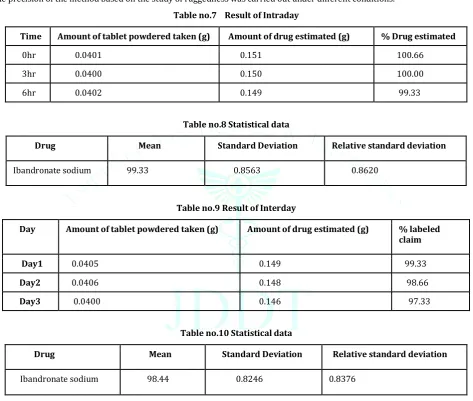
The precision of the method based on the study of ruggedness was carried out under different conditions.
Limit of detection (LOD) and Limit of quantification (LOQ)
The method is used based on standard deviation of the response and slope of calibration curve.
The formula is
LOD=3.3σ LOQ= 10σ S S
Signal to noise ratio (k)=3.3 and 10 for LOD and LOQ respectively
σ = standard deviation of the response , S = Slope of the calibration curve
RESULTS AND DISSCUSSION
Validation is one of the important steps for analytical determination of any drug. There is a number of most significant validation parameters such as linearity and range, accuracy and precision, LOD, LOQ, recovery, ruggedness,
robustness were assessed in developed method.[20]
Linearity and Range
Standard solution was prepared by daily diluting stock solution with NaOH. To get calibration standard solutions 2,5,10,20,30,40,50,60,70,80,90,100 µg /ml of Ibandronate sodium to construct Beers law plot for pure drug. The range of drug to study the Beers law is 2-100µg/ml. A calibration curve was plotted as concentration verses absorbance.
Fig. 3 Calibration curve of Ibandronate sodium Accuracy
Accuracy of the method was determined by replicate analysis of three sets of samples spiked with three different levels of Ibandronate sodium at level 80%, 100% and 120% and comparing the difference between the spiked value (theoretical value) and that actually found value.
Table no.5 Results of recovery studies
Sr.no. Amount of pure drug
added Amount of sample added Amount of drug recovered % Drug recovery
80 % recovery
1 40 50 39.85 99.62
2 40 50 39.91 99.77
3 40 50 39.98 99.95
100 % recovery
1 50 50 49.96 97.92
2 50 50 49.81 99.62
3 50 50 49.89 99.78
120% recovery
1 60 50 58.91 98.18
2 60 50 59.49 99.15
Table.no 6 Statistical data
Mean Standard deviation Relative standard deviation
80 % recovery
99.78 0.11545 0.11570
100 % recovery
99.10 0.84063 0.84826
120 % recovery
99.09 0.72341 0.73005
Precision
The precision of the method based on the study of ruggedness was carried out under different conditions. Table no.7 Result of Intraday
Time Amount of tablet powdered taken (g) Amount of drug estimated (g) % Drug estimated
0hr 0.0401 0.151 100.66
3hr 0.0400 0.150 100.00
6hr 0.0402 0.149 99.33
Table no.8 Statistical data
Drug Mean Standard Deviation Relative standard deviation
Ibandronate sodium 99.33 0.8563 0.8620
Table no.9 Result of Interday
Day Amount of tablet powdered taken (g) Amount of drug estimated (g) % labeled
claim
Day1 0.0405 0.149 99.33
Day2 0.0406 0.148 98.66
Day3 0.0400 0.146 97.33
Table no.10 Statistical data
Drug Mean Standard Deviation Relative standard deviation
Ibandronate sodium 98.44 0.8246 0.8376
Limit of detection (LOD) and Limit of quantification (LOQ) The LOD and LOQ are given in Table no 12.
Table no.11 Result of LOD and LOQ
PARAMETERS IBANDRONATE SODIUM
LOD(µg/ml) 0.56943
CONCLUSION
Simple, accurate, precise, sensitive spectrometric method was done for the estimation of Ibandronate sodium in pharmaceutical formulation.
ACKNOWLEDGEMENT
The authors are grateful to JPN pharma Pvt Ltd, Mumbai., India for providing gift samples of Ibandronate sodium (IBN) and towards Priyadarshini J. L. College of Pharmacy the for providing the necessary chemicals and an instrument for the study.
REFERENCES
1. Chatwal G R, Pharmaceutical Organic Chemistry, 5th ed,
Himalaya Publishing House, 2002, p.125-124.
2. Skoog A.D, Fundamentals of Analytical Chemistry, 8th Ed,
Thomson brook/Cole, 2004, p.1-16.
3. Jeffery G.H, et al, Vogel’s text book of Quantitative Chemical
Analysis,5th Ed, Congmon Scientific and Technical, 1999, p.10-26.
4. Kaur H, Spectroscopy, 5th Ed, Pragati Prakashan, Meerut, 2010,
p.65-82.
5. FDA, Guidance for Industry: Analytical Procedures and
Methods Validation (Draft guidance), Food and Drug Administration, Rockville, MD., 2000, p.501-505.
6. ICH, Stability Testing of New Drug Substances and Products,
Q1A(R2), Geneva, International Conference on Harmonization, 2003, p.462-489.
7. Siddiqui Anees A. Pharmaceutical Analysis. 2nd ed, CBS
Publishers and Distributors pvt. ltd., 2009, p. 52-53.
8. Kasture A. V, Wadodkar, et al, Pharmaceutical Analysis, Nirali
Prakashan, 2010, p.4-6.
9. Dr. Sethi P. D, High Performance Liquid Chromatography
(Quantitative Analysis of Pharmaceutical Formulation), 1st Ed, CBS Publisher and Distributors, 2001, p. 6-7
10. Indian Pharmacopoeia, Government of India Ministry of Health
and Family Welfare, Vol 2, The Indian Pharmacopoeia Commission Ghaziabad, 2007, p. 749-756.
11. The Merck Index, 14th Ed, Merck Research Laboratories, 2006,
p.142a, 942b.
12. Jineetkumar B. Gawad, Development and Validation of
RP-HPLC assay method for determination of Ibandronate sodium in tablet dosage form. International Journal of Innovative Pharmaceutical Research 2012; (3):220-225.
13. Lubna Azmi., A Straightforward and Receptive UV
Spectrophotometric Method for the determination of Ibandronate sodium in Pharmaceutical Formulations and Bulk drugs. Journal of Advances in Medical and Pharmaceutical Sciences 2016; (6):1-7.
14. Hemant Kumar Sharma., Stability indicating ion
chromatography method for the simultaneous determination of Ibandronate sodium drug substance and its impurities. Journal of Pharmaceutical and Biomedical Analysis. 2011; (54):596-601.
15. Frieder Bauss., Analytical methods for the quantification of
Ibandronate in body fluids and bone. 2005; (39):246-256.
16. Jineetkumar B. Gawad, Development and Validation of
RP-HPLC Dissolution method for determination of Ibandronate sodium in Tablet dosage form. World Journal of Pharmacy and Pharmaceutical sciences. 2013; (3):287-301.
17. Oliver WAHL, Impurity profiling of Ibandronate sodium by
HPLC-CAD. Journal of pharmaceutical and Biomedical analysis. 2015; (1):1-5.
18. Acharya S, A Validated HPLC method for determination of
Ibandronate sodium residue in cleaning pharmaceutical equipment by refractive index detector. Analytical Chemistry: An Indian Journal. 2011; (1):1-6.
19. L.E. Diaz., validation of a Capillary electrophoresis method for
the analysis of Ibandronate related impurities. Journal of pharmaceutical and Biomedical analysis. 2007; (44):305-308.
20. Bhusari S., Chaudhari T., Wakte P. Development and validation
of a spectrofluorimetric method for the estimation of
camptothecin in bulk and formulation. Journal of Drug Delivery