Available online on 15.03.2019 at http://jddtonline.info
Journal of Drug Delivery and Therapeutics
Open Access to Pharmaceutical and Medical Research© 2011-18, publisher and licensee JDDT, This is an Open Access article which permits unrestricted non-commercial use, provided the original work is properly cited
Open Access
Research Article
Analytical method development and validation of assay test of pravastatin
sodium tablets
* Ashvini C Shinde1, Nitin V Devhadrao2, Ashwini S Bansode3, Ajit S Bansode3 1 Pravara Rural College of Pharmacy, Pravaranagar, Loni., Ahmednagar, 413736, India
2 Sharadchandra pawar college of pharmacy, Dumbarwadi, Otur. (Pune)-412409, India
3 VJSM’S Vishal Institute of pharmaceutical Education & Research Ale, Junnar, (Pune), 412411, India
ABSTRACT
A simple, accurate, precise and stability indicating Ultra performance liquid chromatographic method for determination of pravastatin sodium in tablet dosage form. The separation was carried on Acquity UPLC ® HSS C18, 2.1 × 100mm, 1.8µm ID column, with mobile phase comprising of mixture of pH 5.5 buffer: methanol in the ratio of 30 : 70 v/v, as the mobile phase at a flow rate 0.2 ml/min and the detection was carried out using UV-visible detector at 238nm. The method was validated by evaluation of different parameters such as accuracy, precision, linearity, ruggedness, robustness, filter equivalency, solution stability. The retention time were found to be 1.5 min. Calibration curves were linear with correlation coefficient (r2) 0.999. The Percent assay of Pravastatin sodium tablet was found to be 98.4%. The developed methods were validated as per the ICH guidelines.
Keywords: Pravastatin sodium (PVS), UPLC, Method Validation.
Article Info: Received 24 Jan 2019; Review Completed 21 Feb 2019; Accepted 25 Feb 2019; Available online 15 March 2019 Cite this article as:
Shinde AC, Devhadrao NV, Bansode AS, Bansode AS, Analytical method development and validation of assay test of pravastatin sodium tablts, Journal of Drug Delivery and Therapeutics. 2019; 9(2):70-75
http://dx.doi.org/10.22270/jddt.v9i2.2379
*Address for Correspondence:
Ashvini Chandrakant Shinde, Pravara Rural College of Pharmacy, Pravaranagar, Loni., Ahmednagar, 413736, India
INTRODUCTION
Chromatography is a non-destructive procedure for resolving a multi-component mixture of trace, minor, or major constituents into its individual fractions. UPLC refers
to Ultra Performance Liquid Chromatography.1-5 It improves
in three areas: chromatographic resolution, speed and sensitivity analysis. It uses fine particles and saves time and reduces solvent consumption. UPLC comes from HPLC. HPLC has been the evolution of the packing materials used to effect the separation. An underlying principle of HPLC dictates that as column packing particle size decreases, efficiency and thus resolution also increases. As particle size decreases to less than 2.5µm, there is a significant gain in efficiency and it’s doesn’t diminish at increased linear velocities or flow rates according to the common Van Demeter equation. By using smaller particles, speed and peak capacity (number of peaks resolved per unit time) can be extended to new limits
which is known as Ultra Performance.6
Drug Profile:
Name: Pravastatin Sodium
Structure of Pravastatin sodium Chemical Name : sodium (3R,5R
)-3,5-dihydroxy-7-((1R,2S,6S,8R,8aR)-6hydroxy 2-methyl-8- {[(2S
Molecular Formula: C23H35O7Na
Molecular Weight : 446.5
Category: Anti-hyperlipidemic
Description: Pravastatin is white to yellowish white power
or crystalline Powder, hygroscopic.
BCS Class: High solubility, low permeability.
Solubility: Freely soluble in water and in methanol, soluble in ethanol.
Melting point: 172-173 °C
pH: 7.2 - 9.0
Mode of Action: Pravastatin sodium is one of a new class of
lipid- lowering compounds. The HMG-CoA reductase inhibitors, which reduce cholesterol biosynthesis. These agents are competitive inhibitors of 3-hydroxy-3-methylglutaryl-co-enzyme A (HMG-CoA) reductase, the enzyme catalyzing the early rate-limiting step in cholesterol
biosynthesis, conversion of HMG-CoA to mevalonate.7-11
MATERIALS AND METHODS
Instruments:
1) Acquity Waters,Acquity PDA ,Empower 3 Software Build
3471
2) Balance RADWAG Wagl Elektroniczne, model-XA
82|220|2X
3) PH-meter used of LABINDIA
4) Sonicator chiller
5) Calibrated glasswares were used for the whole
experimental work
Reagents and Chemicals:
All chemicals and solvents used for the experimental are from MERCK, RANKEM etc. enlisted as follows;
1) HPLC/AR Grade Methanol
2) HPLC Grade Water (Milli-Q)
3) AR Grade Triethylamine
4) Pravastatin Sodium, Glenmark Phramaceuticals
Ltd.Taloja (Mumbai)
Spectral study of Pravastatin Sodium:
A solution of Pravastatin Sodium was prepared in methanol having concentration of 10 ppm. The above solution was taken in a 1 cm cell in order to obtain the Ultra violet (UV) spectrum of drug in the range 200-400 nm using UV spectrophotometer was recorded. The absorbance maxima or lambda max (λmax) of the drug was found to be 238 nm.
Preparation of Diluent: Methanol: water (HPLC grade)
50:50v/v was used as diluent
Preparation of Mobile Phase A:
Added 5.0 ml glacial acetic acid in 1.5 liter of water. Adjusted the pH to 5.5 ± 0.05 with Triethylamine. Filtered through 0.45µ nylon membrane filter.
Preparation of Mobile Phase B: Methanol.
Preparation of Standard Solution:
Accurately weighed and transfered about 25 mg of Pravastatin Sodium working standard into a 50 ml volumetric flask. Added 30 mL of diluents and sonicated to
dissolve. Made up the volume upto the marked and mixed. Diluted 5 ml of the above solution to 50 ml with diluents (50ppm)
Preparation of Sample Solution:
Taken 5 intact tablets to 100 mL volumetric flask and 60 mL of diluent added then sonicated it for complete dispersion with intermittent swirling. Further sonicated for 15 minutes and diluted to volume with diluent. Allowed it to stand for 10 minutes, diluted 5 mL of supernatant solution to 50 mL with diluent. Further Filtered through 0.45 µ nylon membrane filter. As shown in table no.2
Optimized chromatographic method for Assay: Table1: Data for Assay of Pravastatin Sodium tablet
Parameter Condition
UPLC System Wasters UPLC
Stationary Phase Acquity UPLC ® HSS C18 (2.1 ×
100mm, 1.8µ)
Mobile Phase Buffer(pH 5.5) : Methanol(30:70)
Flow Rate 0.2ml/min
Detection 238nm
Pump Mode Gradient
Injection Volume 2 µl
Run Time 3 min
Column Temperature 400C
Retention Time 1 to 2 min
Evaluation of System suitability:
Inject the standard solution five times. The relative standard deviation of five replicate injections should not be more than 2.0%. The Tailing factor for the Pravastatin Sodium peak should not be more than 2.0 and the number of theoretical plates should not be less than 2500.
Method validation
Method validation is the process to confirm that the analytical procedure employed for a specific test is suitable for its intended use. Method validation provides the method development extremely specific, Linear, Precise, accurate & sensitive. 12-22
Linearity
Linearity is the ability of the method to elicit test results that are directly proportional to analyte concentration within a given range. Linearity is generally reported as the variance of the slope of the regression line. It is demonstrated directly on the drug substance by dilution of a standard stock solution of the drug product components, using the proposed procedure. For the establishment of linearity, minimum of five concentrations is recommended by ICH guideline. The value of correlation co-efficient should fall around 0.99. The regression equation and correlation coefficient was calculated and found to be within the required limits as shown in Tables no.4 and figure no.3 respectively.
Accuracy
reported. Accuracy should be assessed using a minimum of nine determinations at a minimum of three concentration levels covering the specified range. The recovery results were shown in table no.5.
Precision:
The precision of analytical procedure expresses the closeness of agreement between series of measurements obtained from multiple sampling of the same homogeneous sample.The precision of an analytical procedure is usually expressed as the variance,standard deviation.The precision results were shown in table no.6 .
Ruggedness
Ruggedness is the degree of reproducibility of the results obtained under a Varity of conditions, expressed as %RSD. These conditions include different laboratories, analyst,
instruments, reagents, days etc.The ruggedness results was shown in table no.7.
Robustness
The robustness of an analytical procedure is a measure of its capacity to remain unaffected by small but deliberate variations in method parameters. The robustness of a method is evaluated by varying method parameters such as percent organic, pH, wavelength, temperature, etc., and determining the effect on the results of the method. The results of robustness study were shown in Tables no 9, 10, 11 respectively.
RESULTS AND DISCUSSION
Assay data: The percent Assay of pravastatin sodium tablet
was found to be 98.4%
Table 2: Data for Assay of Pravastatin Sodium tablet
Wt.of Std (mg) Area of Standard Area of Sample Purity of Standard % Assay
25
1359265 1361568 1356933 1365771 1361791
1368275 1365143
98% 98.4%
Mean 1361066 1366709
SD 3287.854
% RSD 0.24
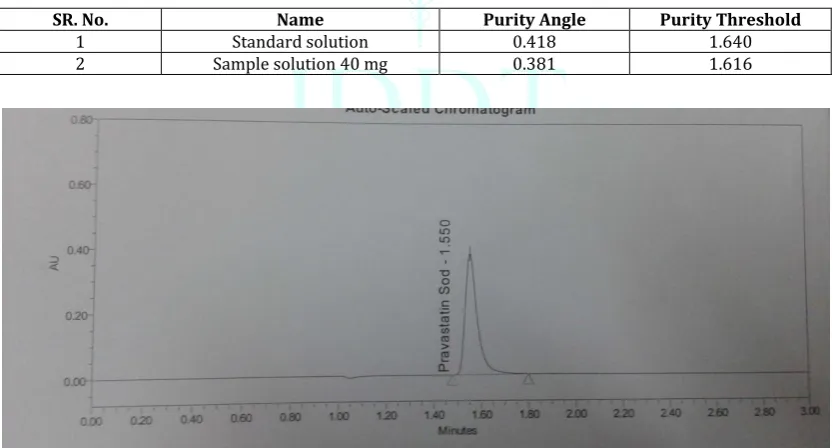
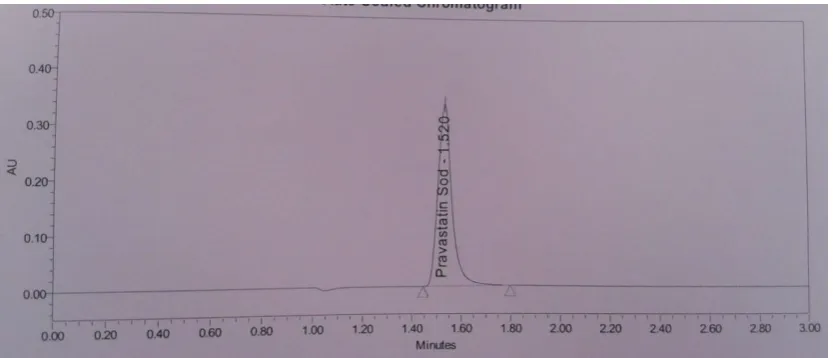
Specificity: The retention time of the Pravastatin Sodium peak in the chromatogram of the Sample preparation corresponds to that of the Pravastatin Sodium peak in the chromatogram of the Standard preparation. The Pravastatin
Sodium peak is pure in Standard solution and Sample solution. Blank and Placebo should not show any peak at the retention time of Pravastatin sodium.
Table 3: Specificity table for Pravastatin Sodium tablet
SR. No. Name Purity Angle Purity Threshold
1 Standard solution 0.418 1.640
2 Sample solution 40 mg 0.381 1.616
Figure 2: Chromatogram of Specificity Sample Solution
Linearity: A series of solutions of Pravastatin Sodium
Standard was prepared over a range of 30% to 70% of the standard concentration of Pravastatin Sodium in Pravastatin Sodium tablets. Since the standard concentration is 50 µg/ml. Linear calibration graph was obtained between
absorbance versus concentration of pravastatin sodium drug. Correlation coefficient was 0.99993. Therefore, the UPLC method for the determination of Pravastatin Sodium in Pravastatin Sodium tablets was linear.
Table 4: Linearity for Pravastatin Sodium tablets
% Concentration Concentration
(µg per ml) Response (Area) Statistical analysis
30% 30.432 831281 Slope 27168.2
40% 40.576 1107490
50% 50.720 1389802 Intercept -6284.1
60% 60.864 1659407
70% 71.008 1933293 Correlation Coefficient 0.99997
Figure 3: Linearity Graph of Pravastatin Sodium.
Accuracy (Recovery)
Placebo of Pravastatin Sodium tablets 40 mg was spiked with Pravastatin Sodium Drug Substance at three different levels: 80%, 100% and 120% of the label claim in triplicate (in total nine determinations) and then proceeded with Sample solution as described under Methodology. Each of the Sample solution was injected in duplicate and the average area count was taken for calculation. Mean recovery is 100.5% & RSD is 1.02 %. Therefore, the UPLC method for the determination of Pravastatin Sodium in Pravastatin Sodium tablets was accurate.
Table 5: Accuracy for Pravastatin Sodium tablets
Sample No. Amount added (mg) Amount recovered (mg) % Recovery
Acc. 80% -1 31.85 31.90 100.2
Acc. 80% -2 31.56 31.86 101.0
Acc. 80% -3 31.48 31.83 101.1
Acc. 100% -1 39.45 40.06 101.5
Acc. 100% -2 39.32 39.87 101.4
Acc. 100% -3 40.62 40.19 98.9
Acc. 120% -1 48.59 48.33 99.5
Acc. 120% -2 48.66 48.28 99.2
Acc. 120% -3 48.27 48.88 101.3
Mean SD % RSD
Precision
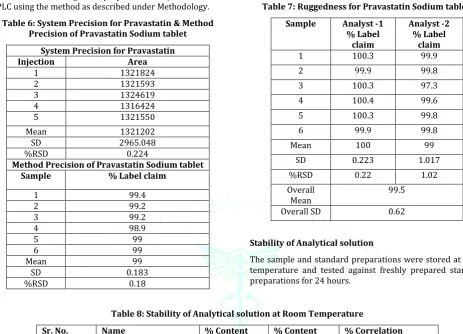
System Precision: Five replicate injections of the Standard preparation were injected into the UPLC using the method as
described under Methodology.
Method Precision: Six sample solutions of Pravastatin
Sodium tablets 40 mg were prepared and injected into the UPLC using the method as described under Methodology.
Table 6: System Precision for Pravastatin & Method Precision of Pravastatin Sodium tablet
System Precision for Pravastatin
Injection Area
1 1321824
2 1321593
3 1324619
4 1316424
5 1321550
Mean 1321202
SD 2965.048
%RSD 0.224
Method Precision of Pravastatin Sodium tablet
Sample % Label claim
1 99.4
2 99.2
3 99.2
4 98.9
5 99
6 99
Mean 99
SD 0.183
%RSD 0.18
Six sample preparations of the Pravastatin Sodium Tablets 40 mg were made by a different analyst, using different column on a different day and injected in duplicate into a different UPLC using the method as described under Methodology, along with Standard preparation.
Table 7: Ruggedness for Pravastatin Sodium tablet
Sample Analyst -1
% Label claim
Analyst -2 % Label
claim
1 100.3 99.9
2 99.9 99.8
3 100.3 97.3
4 100.4 99.6
5 100.3 99.8
6 99.9 99.8
Mean 100 99
SD 0.223 1.017
%RSD 0.22 1.02
Overall
Mean 99.5
Overall SD 0.62
Stability of Analytical solution
The sample and standard preparations were stored at room temperature and tested against freshly prepared standard preparations for 24 hours.
Table 8:Stability of Analytical solution at Room Temperature
Sr. No. Name % Content
0 hours % Content 24 hours % Correlation
1 Standard Solution -- 99.0 99.0
2 Sample solution 98.9 100.6 101.7
Robustness
Three Sample preparations of the Pravastatin Sodium tablets 40 mg were prepared as described under Methodology. The
samples along with standard were injected in duplicate under different chromatographic condition as shown below.
Change in mobile phase composition (+ 2% absolute):
Table 9: Table for mobile phase composition (+ 2% absolute)
Control +2% absolute -2% absolute
99.9 99.6 99.9 100.5
99.8 99.8 98.5 98.8
97.3 99.8 99.1 99.4
Mean 99.3 99.4
SD 0.883 0.918
%RSD 0.89 0.92
Change in Flow rate (+ 0.1%):
Table 10: Table for Change in Flow rate (+ 0.2 mL/min).
Control +0.2ml/min -0.2ml/min
99.9 99.6 98.8 100.0
99.8 99.8 97.5 98.8
97.3 99.8 98.0 99.3
Mean 98.9 99.4
SD 1.075 0.859
Change in wavelength (+ 5nm)
Table 11: Table for Change in wavelength (λmax 238)
Control + 5 (243nm) -5 (233nm)
99.9 99.6 100.2 100.2
99.8 99.8 99.5 99.5
97.3 99.8 100.1 100.1
Mean 99.6 99.6
SD 0.873 0.873
%RSD 0.88 0.88
CONCLUSION
The developed UPLC method offers several advantages such as rapidity, usage of simple mobile phase and sample preparation steps. Further, improved sensitivity makes it specific and reliable for its intended use. Hence, this method can be applied for the analysis of pharmaceutical dosage forms. From the present study it can be concluded that the proposed method was Simple, Linear, Precise, and Accurate for Assay of Pravastatin sodium in its tablet dosage form. Hence this method can be introduced into routine use for the assay & dissolution study of Pravastatin in Pravastatin sodium tablets. Results of validation parameters demonstrated that the analytical procedure is suitable for its intended purpose and meets the criteria defined in ICH Q2A/B.
ACKNOWLEDGEMENT
We are thankful to Glenmark pharmaceuticals, Taloja , Mumbai for providing sample , necessary infrastructure and excellent lab facilities for my research project. We are thankful to our guide Mr. S.B Bhawar for the beneficial and time to time guidance. We take immense pleasure to acknowledge my family for the constant moral support.
REFERENCES
1. Hatanaka T. et al, Clinical pharmacokinetics of pravastatin.Clin. Pharm., 2000; 39(6):397-412.
2. Quion, J A., et al, Clinical pharmacokinetics of pravastatin. Clin. Pharm., 1994; 27(2):94-103.
3. Jungnickel, P W., et.al, Pravastatin: a new drug for the treatment of hypercholesterolemia. Clin. Pharmacy, 1992; 11(8): 677-689.
4. Gomes F P., Garcia P L. et al, Development and validation of stability-indicating HPLC methods for quantitative determination of pravastatin, fluvastatin, atorvastatin and rosuvastatin in pharmaceuticals. Anal. Lett., 2009; 42(12):1784-1804.
5. Chaudhari B G., et al, Determination of simvastatin, pravastatin sodium and rosuvastatin calcium in tablet dosage forms by HPTLC. Indian J of Pharm Sci, 2007; 69(1):130-132.
6. Ashour, S., et al, Quantitave determination of pravastatin in pharmaceutical dosage forms by High-Performance Liquid Chromatography with ultraviolet detection. Int J Biomed Sci, 2008; 4(2):135-139.
7. Lennernäs H, Fager G. Pharmacodynamics and pharmacokinetics of the HMG-CoA reductase inhibitors. Clin. Pharmacokinet. 1997; 32:403–425.
8. Hatanaka, T. et al, Clinical pharmacokinetics of pravastatin: mechanisms of pharmacokinetic events. Clin. Pharmacokinet. 2000; 39:397–412.
9. Haria M, McTavish D. Pravastatin. A reappraisal of its pharmacological properties and clinical effectiveness in the management of coronary heart disease. Drugs. 1997; 53:299– 336.
10. Rang H P, Dale M M, Ritter JN, Flower R J. Rang and Dale’s Pharmacology. 6th ed. Edinburgh: Churchill Livingstone, Elsevier Science Ltd.; 2003.
11. Mahley RW, Bersot T P. Drug therapy for hyper-cholesterolemia and dyslipidemia. In: Hardman JG, Limberd LE, editors. Goodman and Gilman’s The Pharmacological Basis of Therapeutics. New York: The McGraw Hill, Medical Publishing Division; 2007. p. 984-9.
12. Menddham, J., Denney, R., M. J. K., Vogel’s Textbook of Quantitative Chemical Analysis, 6th Edn.; India ; Pearson Education (Singapore) P. Ltd., 2003.
13. International Conference on Harmonization of Technical Requirements for Registration of Pharmaceuticals for Human Use, ICH Harmonized Tripartite Guideline –Validation of Analytical Procedures: Text and Methodology Q2(R1), Current Step 4 version, London, 2005.
14. “ICH guidelines, validation of analytical procedure: Methodology Q2B”; I.C.H. Harmonized Tripartite Guidelines, 1996.
15. ICH, Q2A “Text on validation of analytical procedures”, Int. Conference of Harmonization, Oct. 1994.
16. ICH, Q3B “Text on validation of analytical procedures”: methodology, Int. Conference of Harmonization, Nov.1996. 17. Dinc, E., Yucesoy, C and Onu, F, J. Phar. Biomed. Anal., 2002, 15,
1091.
18. ICH, 3QB Validation of Analytical Procedures: Methodology, International Conference on Harmonization. November 1996. 19. ICH, Q1A Stability testing of new drug substances and products,
in: Proceedings of the international conference on harmonization, Geneva, Switzerland, October, 1993.
20. ICH, Q2B, Harmonised tripartite guideline, Validation of analytical procedure: Methodology, International conference on harmonization, Geneva, Switzerland, 1996.
21. ICH Guidance on analytical method validation, International convention on quality for the pharmaceutical industry, Toronto, Canada, 2002.
22. ICH, Q1B, Stability testing: photostability testing of new drug substances and products. In: International Conference on Harmonization, IFPMA, Geneva, Switzerland, 1996.