452 |
P a g e
A LITERATURE BASED SURVEY ON SWARM
INTELLIGENCE INSPIRED OPTIMIZATION
TECHNIQUE
Anukaran Khanna
1, Akhilesh Mishra
2, Vineet Tiwari
3and P.N.Gupta
41
Assistant Professor, Department of Electronics Engineering,
2,3
Assistant Professor, Department of Electrical Engineering
United College of Engineering & Research, Allahabad, (India)
4
Associate Professor, Department of Electronics & Communication Engineering,
University of Allahabad, Allahabad, (India)
ABSTRACT
Nature is of course a great and enormous source of inspiration for solving hard and composite problems in the
field of computer science, transportation engineering, mechanical engineering, management and so on, since it
exhibits exceptionally diverse, dynamic, robust, and complex phenomenon. It always finds the optimal solution
to resolve its problem establishing perfect balance among its components. This is the driving force behind bio
inspired computing. Nature inspired algorithms are meta heuristics that mimics the nature for solving
optimization problems thus opening a new era in computation .For the past decades ,numerous research efforts
has been concentrated in this particular area. Still being infantile and the results being very astonishing,
broadens the scope and feasibility of Nature Inspired Algorithms (NIAs) exploring new areas of application and
more opportunities in computing. This paper highlights the comparative analysis of nature inspired swarm
Intelligence based optimization techniques based on literature analysis and the areas where these algorithms
have been most successfully applied.
Keywords
:
Nature Inspired Algorithm, Optimization technique, Swarm Intelligence
I. INTRODUCTION
453 |
P a g e
have resulted as an outcome of some of the finest research work. This paper discusses the classification of set of nature-inspired algorithms particularly brief explanation of swarm based algorithm.II. CLASSIFICATION OF NATURE INSPIRED ALGORITHMS
Nature presents many diverse phenomenons. These can be transformed into mathematical algorithms, which, formulates to mathematical algorithms. However, based on the applicability some of these algorithms have reached a stage of development while some are still in the intangible phase or in a situation where the application mapping is not found. Nature inspired algorithms are broadly categorized into four categories based on the fundamental natural process that they possess : swarm intelligence (SI) based, bio-inspired (but not SI-based), physics/chemistry-based, and others. However, we will focus here on swarm intelligence (SI) based algorithms.
It is worth pointing out the classifications here are not distinctive as some algorithms can be categorized into different categories at the same time. The categorization depends on the real perspective and inspirations. Therefore, the categorization here is just one probable attempt, though the stress is placed on the sources of inspiration.
2.1 Swarm intelligence based
Swarm intelligence (SI) concerns the cooperative, promising performance of multiple, interacting agents who follow some plain rules [1]. While each agent may be measured as unintelligent, the whole system of multiple agents may show some self-organization performance and thus can behave like some sort of cooperative intelligence. Many algorithms have been developed by drawing inspiration from swarm-intelligence systems in nature.
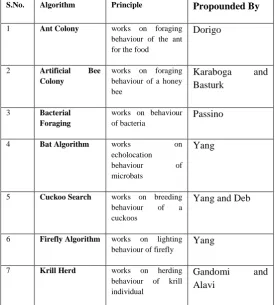
All SI based algorithms use multi-agents, inspired by the cooperative actions of social insects like ants, bees, as well as from other animal societies like flocks of birds or fish. A list of swarm intelligence algorithms and there principle is grouped in Table 1.
SI-based algorithms are amongst the most accepted and extensively used. There are several reasons for such recognition; one of the reasons is that SI-based algorithms usually shared information among multiple agents, so that self-organization, co-evolution and learning all through iterations may help to provide the high efficiency of most SI-based algorithms. Another reason is that multiple agent can be parallelized easily so that large extent optimization becomes more realistic from the implementation point of view.
2.2 Bio-inspired (not SI-based)
In true sense, bio-inspired algorithms form a popular of all nature-inspired algorithms. From the set theory point of view, SI-based algorithms are a subset of bio-inspired algorithms, while bio-inspired algorithms are a subset of nature-inspired algorithms [1]. That is
SI-based ⊂ bio-inspired ⊂ nature-inspired
454 |
P a g e
swarming behaviour. Therefore, it is better to call them bio-inspired, but not SI-based like Invasive weed optimization, Paddy Field Algorithm, Flower pollination algorithm etc.2.3 Physics and Chemistry based
Not all algorithms are bio-inspired, since their sources of inspiration often come from physics and chemistry. For the algorithms that are not bio-inspired, most have been developed by mimicking certain physical and/or chemical laws, including electrical charges, gravity, river systems, etc. As diverse natural systems are relevant to this category, we can even subdivide these into physics and chemistry based algorithms.
2.4 Other algorithms
While researchers develop new algorithms, some may look for idea away from nature. As a result, some algorithms are not bio-inspired or physics/chemistry-based, it is sometimes difficult to put some algorithms in the above three categories, because these algorithms have been developed by using various characteristics from diverse sources, such as social, emotional, etc. In this case, it is better to put them in the other category.
III APPLICATIONS
Nature Inspired Computing techniques are so elastic that they can be applied to broad range of problems, so flexible that they can deal with undetected data and capable of learning, so robust that they can handle imperfect data.. There are three key differences between conventional computing systems and biological information processing systems: components of biological systems react slowly but implement much higher-level operations. The capacity of biological systems to assemble and develop on their own enables much higher interconnection densities. The implementation of biological systems is not a premeditated one.
One who wishes for solutions from nature for complex problems has to first examine the nature‟s behaviour cautiously. The subsequent step is to use models and record all the behaviours observed so far. The above steps should be repeated till an ideal operational model is obtained. As a by-product some unidentified mechanisms may be found. Based on the examination from nature a problem-solving strategy is formulated. Two main computational applications of NIC are Clustering and Optimization.
3.1 Clustering
Clustering is the unverified categorization of patterns into groups (clusters). An explanation of clustering could be the method of organizing objects into groups whose members are similar in some way. A cluster is therefore a group of objects which are “similar” among them and are “dissimilar” to the objects belonging to other clusters.
455 |
P a g e
3.2 OptimizationAn optimization problem is the problem of finding the best solution from all possible solutions. Optimization problems can be divided into two categories depending on whether the variables are continuous or discrete. Classification of optimization algorithm can be carried out in many ways. A straightforward way is to look at the nature of the algorithm, and this divides the algorithm into two categories: deterministic algorithms, and stochastic algorithms.
Deterministic algorithms pursue a rigorous process, and its path and values of both design variables and the function are repeatable. On the other hand, stochastic algorithms always have some randomness and every individual path towards a possible solution is not exactly repeatable.
Several techniques are suitable only for specific types of problems. Thus, it is significant to identify the characteristics of a problem and to identify a suitable technique in the context of given problem to find the optimal solution, such that for each class of problems there are different minimization methods, varying in computational requirements, convergence properties, and so on. Optimization problems are classified according to the mathematical characteristics of the objective function, the constraints and the control variables. The most significant characteristic is the nature of the objective function. The relationship between the control variables is of a particular form, such as linear, e.g.
f(x) = btx+c ………(1)
Where b is a constant-valued vector and c is a constant, or quadratic, e.g. f(x) = xtAx btx+c ………...…(2)
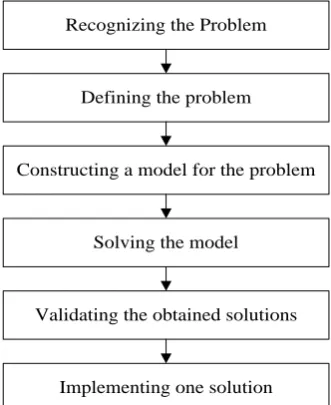
Recognizing the Problem
Constructing a model for the problem Defining the problem
Validating the obtained solutions Solving the model
Implementing one solution
Fig. 1 Flow chart of Optimization Technique formulation
Where A is a constant-valued matrix, special methods exist that are guaranteed to locate the optimal solution very efficiently.
456 |
P a g e
2. Recognize the decision variables3. Establish the objective function 4. Recognize any constraints
5. Choose and apply an optimization method
IV. SWARM INTELLIGENCE BASED OPTIMIZATION TECHNIQUES
The different SI based optimization techniques are given as:- 4.1 Ant Colony
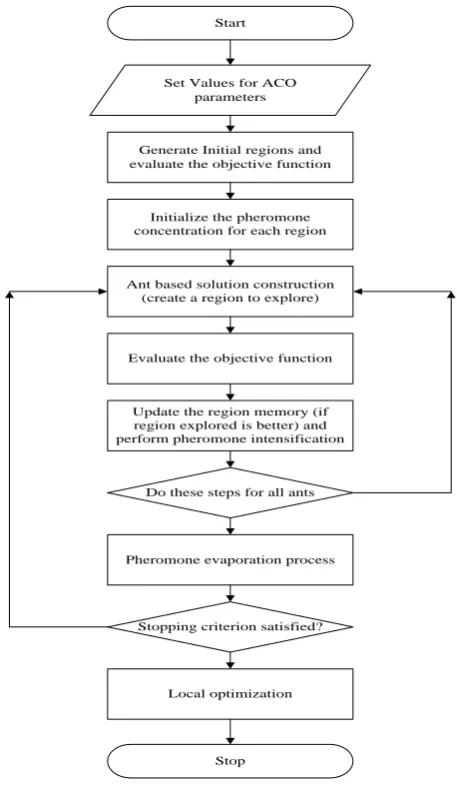
Start
Set Values for ACO parameters
Generate Initial regions and evaluate the objective function
Initialize the pheromone concentration for each region
Ant based solution construction (create a region to explore)
Evaluate the objective function
Update the region memory (if region explored is better) and perform pheromone intensification
Do these steps for all ants
Pheromone evaporationprocess
Stopping criterion satisfied?
Local optimization
Stop
Fig. 2 Flow chart of Ant Colony Optimization Algorithm
457 |
P a g e
the food sources by tracing pheromone trails Then, ants choose the path to follow by a probabilistic decision biased by the amount of pheromone: the stronger the pheromone trail, the higher its desirability. Because ants in turn deposit pheromone on the path they are following, this behavior results in a self-reinforcing process leading to the formation of paths marked by high pheromone concentration. By modeling and simulating ant foraging behavior, brood sorting, nest building and self-assembling, etc. algorithms can be developed that could be used for complex, combinatorial optimization problems.The first ant algorithm, named Ant System (AS), was developed in the nineties by Dorigo et al. (1996) and tested successfully on the well known benchmark Travelling Salesman Problem. The ACO meta heuristic was developed (Dorigo & Di Caro, 1999;) to generalize, the overall method of solving combinatorial problems by approximate solutions based on the generic behavior of natural ants. ACO is structured into three main functions as Ant Solutions Construct, Pheromone Update, and Deamon Actions.
4.2 Artificial bee colony
Artificial bee colony (ABC) Algorithm is an optimization algorithm based on the intelligent behavior of honey bee foraging. This model was introduced by Dervis Karaboga in 2005, and is based on inspecting the behaviors of real bees on finding nectar amounts and sharing the information of food sources to the other bees in the hive. These specialized bees try to maximize the nectar amount stored in the hive by performing efficient division of labour and self-organization [7]. The three agents in Artificial Bee Colony are: The Employed Bee, The Onlooker Bee , The Scout. The employed bees are associated with the specific food sources, onlooker bees watching the dance of employed bees within the hive to choose a food source, and scout bees searching for food sources randomly [4]. The onlooker bees and the scout bees are the unemployed bees. Initially, the scout bees discover the positions of all food sources, thereafter, the job of the employed bee starts. An artificial employed bee probabilistically obtains some modifications on the position in its memory to target a new food source and find the nectar amount or the fitness value of the new source. Later, the onlooker bee evaluates the information taken from all artificial employed bees and then chooses a final food source with the highest probability related to its nectar number. If the fitness value of new one is higher than that of the previous one, the bee forgets the old one and memorizes the new position [5]. This is called as greedy selection. Then the employed bee whose food source has been exhausted becomes a scout bee to search for the further food sources once again.
458 |
P a g e
Initial Food Positions
Calculate Nectar Amounts
Determine neighbors of the chosen food sources by the employed bees
Calculate Nectar Amounts
Selection
All onlookers distributed ?
Memorize the position of best food source
Find the abandoned food source
Produce new positions for the abandoned food sources Calculate Nectar Amounts
Determine a neighbors of the chosen food sources by the onlooker
Are termination criterion satisfied ?
Final food positions
No No
Yes
Fig. 3 Flow chart of Artificial Bee Colony Optimization Algorithm
4.3
Bacterial foraging
459 |
P a g e
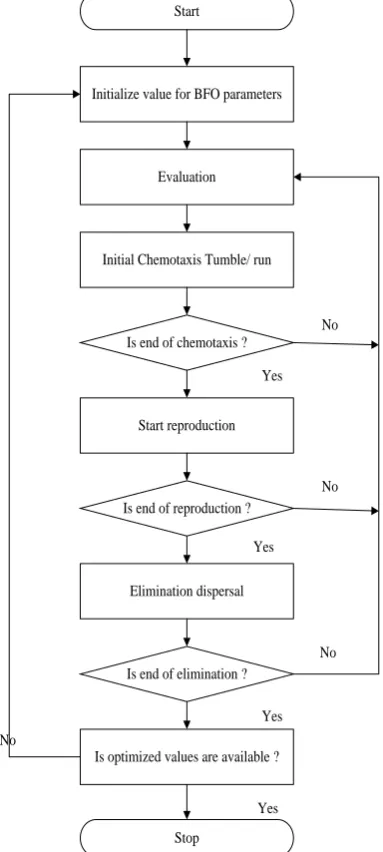
StartInitialize value for BFO parameters
Evaluation
Initial Chemotaxis Tumble/ run
Is end of chemotaxis ?
Start reproduction
Is end of reproduction ?
Elimination dispersal
Is end of elimination ?
Is optimized values are available ?
Stop No
Yes Yes Yes
Yes
No No No
Fig. 4 Flow chart of Bacterial Foraging Algorithm
4.4 Bat algorithm
460 |
P a g e
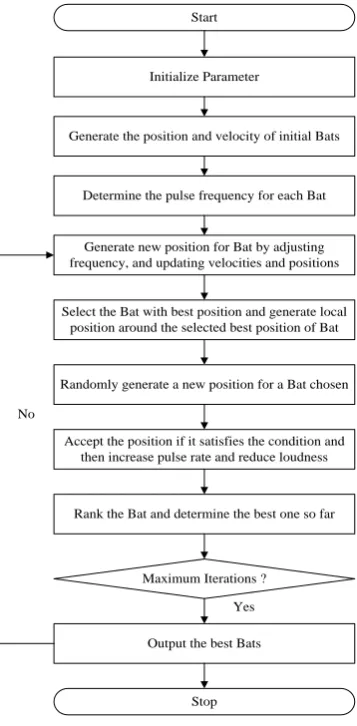
StartInitialize Parameter
Generate the position and velocity of initial Bats
Determine the pulse frequency for each Bat
Generate new position for Bat by adjusting frequency, and updating velocities and positions
Select the Bat with best position and generate local position around the selected best position of Bat
Randomly generate a new position for a Bat chosen
Accept the position if it satisfies the condition and then increase pulse rate and reduce loudness
Rank the Bat and determine the best one so far
Maximum Iterations ?
Output the best Bats
Stop Yes
No
Fig. 5 Flow chart of Bat Algorithm
4.5 Cuckoo search
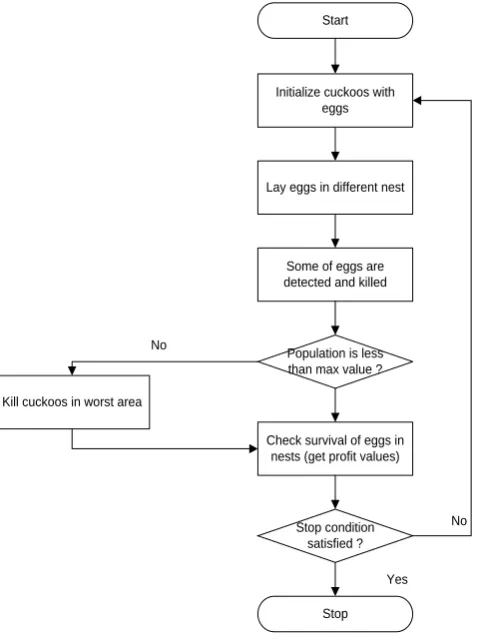
The CSA is introduced by yang and Deb in 2009 [11-12]. The CS was inspired by compel brood parasitism of cuckoo species by laying their eggs in the nests of host birds. Some cuckoos have evolved in such a way that female scrounging cuckoos can reproduce or rather imitate the colors and patterns of the eggs of a few chosen host species. This reduces the probability of the eggs being abandoned. Yang and dev also suggested in their research that levy flights is useful for improve solution quality besides on random walk method. A Levy flight is a random walk in which the step-lengths are distributed according to a heavy-tailed probability distribution. Each egg in a nest represents a solution .the objective it to employ good quality solution in the nest and replace those which are not so good solution. The algorithm based on three idealized rule:
• Each Cuckoo laid one egg only, and dumps the egg in a randomly chosen nest. • The best nest (with quality solutions) will carry over the next generation.
461 |
P a g e
Start
Initialize cuckoos with eggs
Lay eggs in different nest
Some of eggs are detected and killed
Population is less than max value ?
Check survival of eggs in nests (get profit values)
Stop condition satisfied ?
Stop Kill cuckoos in worst area
No No
Yes
Fig. 6 Flow chart of Cuckoo Search Algorithm
4.6 Firefly
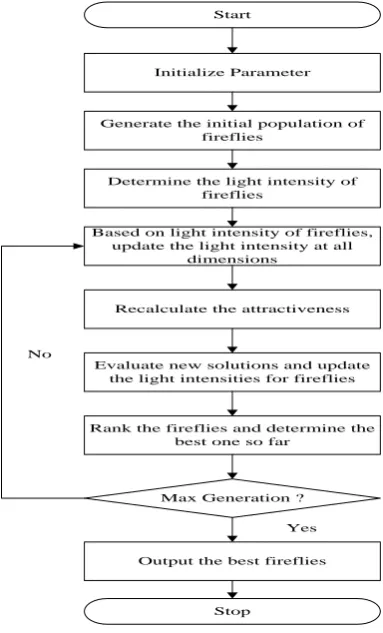
Fire flies, also called glowworms or lightning bugs are found all over the world. There are around two thousand firefly species and most fireflies produce short and rhythmic flashes of light. The pattern of flashes is often unique for a particular species. The fundamental functions of such flashes are to attract mating partners and preys. Females respond to male‟s unique pattern of flashing within the same species. The light emitting from their body strictly obeys the inverse square law i.e. as the distance between two flies increases, the intensity of light decreases. The air absorbs light, which becomes weaker and weaker as the distance increases. The bioluminescence from the body of the fireflies is due to „luciferin‟, which is a heterocyclic compound.
462 |
P a g e
Start
Initialize Parameter
Generate the initial population of fireflies
Determine the light intensity of fireflies
Based on light intensity of fireflies, update the light intensity at all
dimensions
Recalculate the attractiveness
Evaluate new solutions and update the light intensities for fireflies
Rank the fireflies and determine the best one so far
Max Generation ?
Output the best fireflies
Stop No
Yes
Fig. 7 Flow chart of Firefly Algorithm
4.7 Krill herd
Many Research have been done in order to find the mechanism that lead to the development non- random formation of groups by various marine animals [14,15].The significant mechanisms identified are feeding ability, protection from predators, enhanced reproduction and environmental condition.
Krills from Antarctic region are one of the best researched marine animals. One of the most significant ability of krills is that they can form large swarms [16, 17].Yet there are number of uncertainties about the mechanism that lead to distribution of krill herd [18].There are proposed conceptual models to explain observed formation of krill heard [19] and result obtained from those models states that krill swarms form the basic unit of organization for this species.
463 |
P a g e
StartData Structures
Initialization
Fitness Evaluation
Motion Calculation
Updating Krill Positions
Is Stop criterion reached ?
Best Solution
Stop Yes
No
Fig. 8 Flow chart of Firefly Algorithm
Table I. A list of swarm intelligence algorithms
S.No. Algorithm Principle Propounded By
1 Ant Colony works on foraging
behaviour of the ant for the food
Dorigo
2 Artificial Bee
Colony
works on foraging behaviour of a honey bee
Karaboga and Basturk
3 Bacterial
Foraging
works on behaviour of bacteria
Passino
4 Bat Algorithm works on
echolocation
behaviour of
microbats
Yang
5 Cuckoo Search works on breeding
behaviour of a
cuckoos
Yang and Deb
6 Firefly Algorithm works on lighting
behaviour offirefly
Yang
7 Krill Herd works on herding
behaviour of krill individual
Gandomi and
464 |
P a g e
V. CONCLUSION
Nature inspired algorithms are going to be a new revolution in the field of computer science, transportation engineering, mechanical engineering, management and so on. The scope of this area is really vast since as compared to nature, computer science problems are only a subset, opening a new era in next generation computing, modelling and algorithm engineering. This paper provides an overview of a range of nature inspired swarm Intelligence based optimization techniques. Generally speaking, almost all of the SI algorithms perform with heuristic population-based search procedures that incorporate random variation and selection. It has been witnessed that the applications and growth of natural computing in the last years is very drastic and has been applied to numerous optimization problems in computer networks, control systems, bioinformatics, data mining, game theory, music, biometrics, power systems, image processing, industry and engineering, parallel and distributed computing, robotics, economics and finance, forecasting problems, applications involving the security of information systems etc. Nature inspired computing still has much room to grow since this research community is quite young. There still remain significantly challenging tasks for the research community to address for the realization of many existing and most of the emerging areas in technology.
REFERENCES
[1]. Iztok Fister Jr., Xin-She Yang, Iztok Fister, Janez Brest, Dušan FisterBbb(2013), A Brief Review of Nature-Inspired Algorithms for Optimization, Elektrotehni\v{s}ki vestnik, 80(3), 2013
[2] X.S. Yang, Nature-Inspired Metaheuristic Algorithms, 2008.
[3] Xin-She Yang.: A New Metaheuristic Bat-Inspired Algorithm. Nature Inspired Cooperative Strategies for Optimization (NICSO 2010). Studies in Computational Intelligence Vol. 284 (2010) 65-74.
[4] Karaboga, D. Artificial Bee Colony Algorithm. Scholarpedia 2010,5,6915.Availableonline : http://www.scholarpedia.org/article/Artificial_bee_colony_algorithm/ (accessed on 27 May 2011).
[5] Chaotic Bee Swarm Optimization Algorithm for Path Planning of Mobile Robots Jiann-Horng Lin and Li-Ren Huang Department of Information Management I-Shou University, Taiwan 2009
[6] An Effective Refinement Artificial Bee Colony Optimization Algorithm Based On Chaotic Search and Application for PID Control Tuning Gaowei YAN †, Chuangqin LI College of Information Engineering, Taiyuan University of Technology, Taiyuan, 030024, China
[7] Artificial bee colony (abc), harmony search and bees algorithms on Numerical optimization D. Karaboga, b. Akay Erciyes University, the dept. Of computer engineering, 38039, melikgazi, kayseri, turkiye
[8] Elitist artificial bee colony For constrained real-parameter optimization Efr´en mezura-montes member, ieee and ramiro ernesto velez-koeppel
[9] M. Marinaki, Y. Marinakis, and C. Zopounidis, “Honey bees mating optimization algorithm for financial classification problems,” Appl. Soft Comput., vol. 10, pp. 806-812, 2010.
[10] Y. Marinakis, M. Marinaki, and G. Dounias, “Honey bees mating optimization algorithm for large scale vehicle routing problems,” Nat. Comput., vol. 9, pp. 5-27, 2010.
465 |
P a g e
[12] X S Yang, Nature-Inspired Meta heuristic Algorithms, 2ndEdition, Luniver Press, 2010.[13] Xin-She Yang, Chaos-Enhanced Firefly Algorithm with Automatic Parameter Tuning, International Journal of Swarm Intelligence Research, December 2011.
[14] Flierl G, Grunbaum D, Levin S, Olson D. From individuals to aggregations: the interplay between behavior and physics. J Theor Biol 1999;196:397–454.
[15] Okubo A. Dynamical aspects of animal grouping: swarms, schools, flocks, and herds. Adv Biophys 1986;22:1–94.
[16] Hardy AC, Gunther ER. The plankton of the South Georgia whaling grounds and adjacent waters, 1926– 1927. Disc Rep 1935;11:1–456.
[17] Marr JWS. The natural history and geography of the Antarctic krill (Euphausia superba Dana). Disc Rep 1962;32:33–464.
[18] Nicol S. Living krill, zooplankton and experimental investigations. Proceedings of the international workshop on understanding living krill for improved management and stock assessment marine and freshwater behaviour and physiology 2003;36(4):191–205.
[19] Raghavendra V. Kulkarni, and Ganesh Kumar Venayagamoorthy, “Bio-inspired Algorithms for Autonomous Deployment and Localization of Sensor Nodes”, PART C: APPLICATIONS AND REVIEWS(to appear in issue 5, volume 40, 2010)
[20] K. M. Passino, ―Biomimicry of bacterial foraging for distributed optimization and control,‖ IEEE Control Syst. Mag., vol. 22, no. 3, pp.52–67, Jun. 2002
[21] S.He,Q.H.Wu, Senior Member IEEE and J.R Saunders.Anovel group search optimizer inspired by Animal Behavioral Ecology;2006,IEEE Congress on Evolutionary Computation,1272-1278