Copyright © 2013 IJTEEE.
Issues And Challenges In Implementation Of
Wireless Body Area Sensing Networks
Raghav Vadehra, Jyoteesh Malhotra, Nitika Chowdhary
ECE, Guru Nanak Dev University, Regional Campus, Jalandhar, 144001, India, ECE, Guru Nanak Dev University, Regional Campus, Jalandhar, 144001, India, ECE, Guru Nanak Dev University, Regional Campus, Jalandhar, 144001, India
E-mail: [email protected], [email protected], [email protected]
ABSTRACT A Body Area Network is a wireless network of wearable computing devices. This paper provides survey on implementation issues of WBAN (Wireless Body Area Network) to be deployed in a medical environment. It describes the challenges in WBAN networks at Physical an MAC layers. It also addresses different protocols used for the transmission of signal. We figured out that the positioning of sensors and receivers, antenna type, complexity of receiver circuit, physical signaling techniques are considered to play a significant role in transmission of the signals. In order to improve efficiency of transmitted signal researchers are working in areas like controlling the power transmission, detecting the distance and handovers between the sensor nodes.
Keywords: WBAN (Wireless Body Area Networks), UWB (Ultra Wide Band), MICS (Medical Implant Communication Service) Band
1 INTRODUCTION
Body Area Networks could allow inexpensive and continuous health monitoring with real-time updates of medical records for patients, fire fighters, military personnel through the Internet with the help of sensors [1]. Health monitoring signals can be detected from patients and sent to receivers via wireless mode and then communicated to the remote locations so that they can be analyzed and required measures can be taken at right time. It covers three major areas for a complete transfer of signal. These are Tier-1 and Tier-2, Tier-1 i.e. the Sensor level—WBAN. It consists of intelligent nodes/sensors that are used to monitor ECG/EEG/EMG etc, The Tier-2 i.e. the personal level which helps in interfacing the sensors through different protocols like ZIGBEE etc. Last is the Tier-3 which is the medical server that receives data, analyses it and sends instructions to the patient s. In this paper we have discussed major problems like power issues at the receiver end vulnerability of high power damaging tissues, the traffic encountered while the transfer of signal, antenna orientation, collisions encountered, etc. However, Wireless Body Area Network has potential to reduce the healthcare cost as well as work load of medical professions, resulting in high efficiency. This paper has five sections, Section 2 illustrates background of WBAN, Section 3 and section 4 describes about various issues and challenges in the implementation of WBAN and section 5 is future works and section 6 gives concluding remarks on WBAN.
2 BACKGROUND
Many monitoring systems based on WBAN that operate in and around human body have been developed in healthcare systems. Different operating scenarios in WBAN communication are as follows:
1. Implant to Implant 2. Implant to Body Surface 3. Body Surface to Body Surface 4. Body Surface to External
Body Area Sensors transmit vital signs or body physiological data to facilitate remote monitoring for the purposes of healthcare services, assistance for people with disabilities, and entertainment or user identification. WBAN can be
modeled in different frequency bands: MICS (Medical Implant Communication Service) Band in the frequency range of 402MHz to 405MHz for Implant to Implant and Implant to Body Surface communication. Zigbee and Bluetooth in the frequency band of 2.5GHz are used due to low transmitter power for Body Surface to Body Surface or Body Surface to External communication. Low data rate UWB (Ultra Wide Band) in the range of 3 to 10 GHz for Body Surface to Body Surface or Body Surface to External communication. In order to standardize physical and MAC layer protocols IEEE 804.15.6 standard has been formed for short range, low power WBAN based on UWB. Research in WBAN has shown a tremendous growth with time. Recent advancements and issues in this field have been discussed in the subsequent sections.
3 LITERATURE SURVEY
Till now WBAN has undergone a series of different aspects of growth. In 2001, PAN (Personal Area Network) was modified to BAN to widen the scope to widen the scope of body applications. In 2005 E. Jovanov et al. described monitoring results for multi-sensors from a multi hopping wireless link. Mehmet Rasit Yuce et al. in [2] described the use of WBAN in medical environments in 2010. Moving forward from small ranged technologies like Zigbee, Bluetooth and other ordeals like traffic and data corruption, medical bands have been evolved specially for this purpose.
3.1 Ultra Wide Band (UWB)
Copyright © 2013 IJTEEE.
data is transferred to remote stations through the local area network or the Internet that is available in medical centers.
Sensor Nodes:-Low power operation and miniaturization are two essential physical requirements of sensor. One big advantage of UWB wireless technology is that its data rate ranges from 850kbps to 20Mbps which can be used for simultaneous for keeping a track of many continuous physiological signals such as ECC, EEG and EMG moreover it does not present any EMI risk to other narrow bands since it has a low transmitter power and is primarily not crowded. High power consumption mainly comes from the design of the receiver as higher RF and analog gains are required at the front-end to receive the very low level transmit power. Amplifier and low pass filters are important because the signals used are of small amplitude and low frequency. ADC stage is employed to convert the analog body signals into digital for a digital signal processing.
Fig. 1: Model proposed for Sensor and Receiver Nodes for ECG Monitoring [6].
The digitized signal is processed and stored in a microcontroller. The microcontroller will then pack the data and transmit over the air via a wireless transceiver.
Fig. 2: Working of a sensor node.
3.2 Power saving techniques
FCC has stringent requirement of UWB transmission allowing the average power transmission of -41.3dB/MHz but UWB receivers consume very high power. Hence, Maduranga Silva Thotahewa et al. proposed a work around for the
disadvantage which is the use of Transmit only Mechanism [10]. Following are some of the characteristics of Transmit Only mechanism are [10]: Deterministic pulse signal are used instead of pseudo codes, hence minimum receiver involvement is seen .Therefore the need of synchronizing sensor node & gateway nodes is eliminated. Unique pulse rate is assigned to sensors that belong to the same user while different pulse rates are used to differentiate between the sensors that belong to different users. Transmitted power is controlled by sending multiple UWB pulses per data bit. There is no feedback in the network. The sensor nodes access the channel without assessing the channel. This mechanism has been evaluated on the basis of collision probability. The number of collisions decreases as we define different pulse rates for different users in different circumstances.
3.3 OSI model of WBAN
Physical layer [5] –The initiation of the transmitting of the signal starts with this layer, where the data rate, kind of modulation and the band are selected.
ASK (Amplitude Shift Keying) is selected for the communication between sensors and receiver for the communication between receivers and the based station, a frequency shift keying (FSK) mode is selected. Two different modulation schemes are configured from different wireless transceivers in order to avoid any possible interference effects between wireless links.
Fig. 3: The use of CSMA CA protocol for data transmission [6], [7]
Copyright © 2013 IJTEEE.
time as to when it can send a response to that particular RTS being received by it.
If the receiver senses a free channel it waits for a short duration known as SIFS (Short Inter Framing Slot)time and the sends CTS to the already waiting sensor node signaling that the node can now send the data/the id. Like this the pairing of the receiver& the sensor node is done. Till the receiver receives the signal it is in waiting state. Thereafter the checksum is calculated. Till receiver sends back an ACK or NACK the sensor node is in waiting state. Network / Transport /Application layer: IP (Internet Protocol) followed by TCP/IP help in the complete transmission of the frames/data and at the application layer we can see the data on the GUI. Ultra wide Band in Static and Dynamic Conditions Terence SP See et al. [2] proposed that in static conditions power reduces by 26 dB if the receiver and sensor are placed at optimum positions and in dynamic conditions where the sensor or the receiver are in motion, the transmission power needs to be increased by 7dB to keep the same BER. ECG sensors, Temperature measuring sensor, wrist sensor and waist sensor are placed on the body and subsequently their receivers at waist, arm and chest. For every position of the sensor, there is a position of the receiver where an optimum signal is received and results are calculated on the basis of BER (Bit Error Rate). For every position of the sensor there is a position of the receiver where an optimum signal is received. Chest area receivers are best suited for ECG and EEG sensors over receiver at waist or arm with total power saving of 17dB for ECG and 8dB for EEG respectively. Arm receiver is suited for wrist sensors with total power saving of 18dB for receiver positions at chest or waist. Different results have been retrieved from the study describing the effect of body movements on different sensors. Chest area receivers are considered best in case of different body movements with the maximum 5dB and 1dB loss for EEG and ECG sensors respectively. However, position of receiver at arm is best for wrist sensors for body movement scenario. Dual Band Structure to reduce Receiver Complexity Thotahewa et al. [13] suggested synchronization of the IR-UWB pulses at receiver stage using low power front end circuitry is one of the major problems that restrict the use of IR-UWB receivers for implant applications. MAC protocols for UWB systems govern the multiple access of the UWB channel. The MAC protocols for UWB systems have to be designed in a way such that they enhance the advantages provided by the UWB signals and overcome the drawbacks such as high receiver complexity.
Fig. 4: Cross layer design
Dual Band structure where IR-UWB is used at the transmitter end and the narrowband is used at the receiver end has been incorporated. Since, the data sent by the receiver are mainly
control messages or ACKS/NACKS that can be easily handled by narrow band.
(a)
(b)
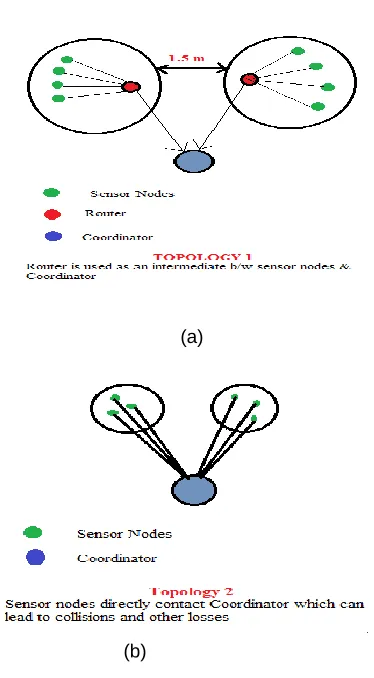
Fig. 5: (a) and (b) are Topologies of WBAN sensors
Working and comparing two topologies. Topology1, where a direct connection is made between the sensor node and the coordinator and the topology 2, where the connection between the coordinator and the sensor is made via a router that senses and sends the signals,[14]discovers that the topology 2 becomes more reliable when it comes to power consumption, traffic sense, receiving ACKs/NACKs. The Dual band system also uses the super frame structure where continuous signals are sent using GTS (Guaranteed Slots) in the CFP (Contention Free Period) and the periodic signals are sent using the CAP (Contention Access Period). Coordinator provides CAP time frame whenever the periodic sensor has to send the data else the time is utilized by the continuous signal. Synchronization of the IR-UWB pulses at receiver stage using low power front end circuitry is one of the major problems that restrict the use of IR-UWB receivers for implant applications. MAC protocols for UWB systems govern the multiple access of the UWB channel. The MAC protocols for UWB systems have to be designed in a way such that they enhance the advantages provided by the UWB signals and overcome the drawbacks such as high receiver complexity. Some technologies and why were they rejected while being
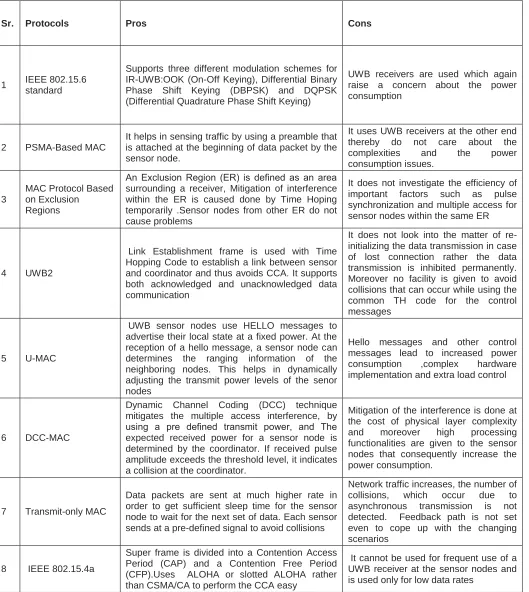
Copyright © 2013 IJTEEE. TABLE 1
Data Link Layer protocols for WBAN
Sr. Protocols Pros Cons
1 IEEE 802.15.6 standard
Supports three different modulation schemes for IR-UWB:OOK (On-Off Keying), Differential Binary Phase Shift Keying (DBPSK) and DQPSK (Differential Quadrature Phase Shift Keying)
UWB receivers are used which again raise a concern about the power consumption
2 PSMA-Based MAC
It helps in sensing traffic by using a preamble that is attached at the beginning of data packet by the sensor node.
It uses UWB receivers at the other end thereby do not care about the complexities and the power consumption issues.
3
MAC Protocol Based on Exclusion
Regions
An Exclusion Region (ER) is defined as an area surrounding a receiver, Mitigation of interference within the ER is caused done by Time Hoping temporarily .Sensor nodes from other ER do not cause problems
It does not investigate the efficiency of important factors such as pulse synchronization and multiple access for sensor nodes within the same ER
4 UWB2
Link Establishment frame is used with Time Hopping Code to establish a link between sensor and coordinator and thus avoids CCA. It supports both acknowledged and unacknowledged data communication
It does not look into the matter of re-initializing the data transmission in case of lost connection rather the data transmission is inhibited permanently. Moreover no facility is given to avoid collisions that can occur while using the common TH code for the control messages
5 U-MAC
UWB sensor nodes use HELLO messages to advertise their local state at a fixed power. At the reception of a hello message, a sensor node can determines the ranging information of the neighboring nodes. This helps in dynamically adjusting the transmit power levels of the senor nodes
Hello messages and other control messages lead to increased power consumption ,complex hardware implementation and extra load control
6 DCC-MAC
Dynamic Channel Coding (DCC) technique mitigates the multiple access interference, by using a pre defined transmit power, and The expected received power for a sensor node is determined by the coordinator. If received pulse amplitude exceeds the threshold level, it indicates a collision at the coordinator.
Mitigation of the interference is done at the cost of physical layer complexity and moreover high processing functionalities are given to the sensor nodes that consequently increase the power consumption.
7 Transmit-only MAC
Data packets are sent at much higher rate in order to get sufficient sleep time for the sensor node to wait for the next set of data. Each sensor sends at a pre-defined signal to avoid collisions
Network traffic increases, the number of collisions, which occur due to asynchronous transmission is not detected. Feedback path is not set even to cope up with the changing scenarios
8 IEEE 802.15.4a
Super frame is divided into a Contention Access Period (CAP) and a Contention Free Period (CFP).Uses ALOHA or slotted ALOHA rather than CSMA/CA to perform the CCA easy
Copyright © 2013 IJTEEE.
4 OPEN ISSUES AND CHALLENGES
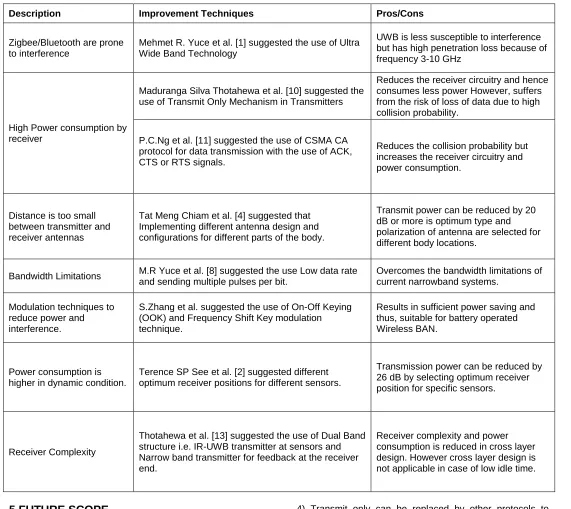
TABLE 2
Different problems and proposed solutions in WBAN
Description Improvement Techniques Pros/Cons
Zigbee/Bluetooth are prone to interference
Mehmet R. Yuce et al. [1] suggested the use of Ultra Wide Band Technology
UWB is less susceptible to interference but has high penetration loss because of frequency 3-10 GHz
High Power consumption by receiver
Maduranga Silva Thotahewaet al. [10]suggested the use of Transmit Only Mechanism in Transmitters
Reduces the receiver circuitry and hence consumes less power However, suffers from the risk of loss of data due to high collision probability.
P.C.Ng et al. [11] suggested the use of CSMA CA protocol for data transmission with the use of ACK, CTS or RTS signals.
Reduces the collision probability but increases the receiver circuitry and power consumption.
Distance is too small between transmitter and receiver antennas
Tat Meng Chiam et al. [4]suggested that Implementing different antenna design and configurations for different parts of the body.
Transmit power can be reduced by 20 dB or more is optimum type and polarization of antenna are selected for different body locations.
Bandwidth Limitations M.R Yuce et al. [8] suggested the use Low data rate and sending multiple pulses per bit.
Overcomes the bandwidth limitations of current narrowband systems.
Modulation techniques to reduce power and interference.
S.Zhang et al. suggested the use of On-Off Keying (OOK) and Frequency Shift Key modulation technique.
Results in sufficient power saving and thus, suitable for battery operated Wireless BAN.
Power consumption is higher in dynamic condition.
Terence SP See et al. [2]suggested different optimum receiver positions for different sensors.
Transmission power can be reduced by 26 dB by selecting optimum receiver position for specific sensors.
Receiver Complexity
Thotahewa et al. [13] suggested the use of Dual Band structure i.e. IR-UWB transmitter at sensors and Narrow band transmitter for feedback at the receiver end.
Receiver complexity and power consumption is reduced in cross layer design. However cross layer design is not applicable in case of low idle time.
5 FUTURE SCOPE
Modern WBAN systems have addressed the challenges discussed above. However, certain issues that are still open and need to be solved are as follows:
1) Increasing the distance from 2 m to 10 m to 15m for the free movement of the patient.
2) Avoiding interferences from other bands or when the patient is obstructed by another patient as it will improve SNR ratio.
3) Handovers have to be smooth enough so that the data does not error out.
4) Transmit only can be replaced by other protocols to reduce collision probability.
5) Antenna configurations need to be precise for different areas of the body to improve signal quality and reduce interference.
6 CONCLUSION
Copyright © 2013 IJTEEE.
Dual Band structure to reduce receiver complexity, different modulation techniques like OOK, various antenna design and position configurations. Thus, if the described parameters are standardized then WBAN can be deployed widely in medical, military and other healthcare monitoring environments.
7 REFERENCES
[1] Mehmet R. Yuce. (2010, July). ―Implementation of wireless body area networks for healthcare systems.‖ Sensors and Actuators A: Physical. [On-line]. 162(1), pp. 116–129. Available: http://www.sciencedirect.com/science/article/pii/S09244 24710002657 [Aug. 24, 2014].
[2] Chee Keong Ho, Terence SP See and Mehmet R Yuce. (2010, July). ―An ultra wideband wireless body area networks: Evaluation in static and dynamic condition‖ Sensors and Actuators A: Physical. [On-line]. 180, pp. 137–147. Available: http://www.sciencedirect.com/science/article/pii/S09244 24712002233 [Aug. 24, 2014].
[3] Jamil Y.Khan, Mehmet R.Yuce and Farbood Karami. ―Performance and Evaluation of Wireless Body Area Sensor Network for Remote Patient Monitoring.‖ Engineering in Medicine and Biology Society, 2008. EMBS 2008. 30th Annual International Conference of the IEEE, 2008, 1266-1269.
[4] Terence S.P. See, Tat Meng Chiam, Michael C.K. Ho and Mehmet Rasit Yuce, ―Experimental Study on the Dependence of Antenna Type and Polarization on the Link Reliability in On-Body UWB Systems.‖ IEEE Transactions On Antennas and Propagations, Volume 60, Issue 11, 2012, pp. 5373-5380.
[5] Katrin Bilstrup. ―A Preliminary Study of Wireless Body
Area Networks,‖
https://www.hh.se/download/18.70cf2e49129168da015 8000140697/IDE0854.pdf, August 2008 [January 4, 2015].
[6] Thomas Falck, Heribert Baldus, Javier Espina and Karin Klabunde. ―Plug ‗n Play Simplicity for Wireless Medical Body Sensors.‖ Pervasive Health Conference and Workshops, 2008, pp. 1-5.
[7] Ho Chee Keong and Mehmet R. Yuce, ―Low Data Rate Ultra Wideband ECG Monitoring System.‖ Engineering in Medicine and Biology Society, 2008. EMBS 2008. 30th Annual International Conference of the IEEE, 2008, pp. 3413-3416.
[8] Mehmet Rasit Yuce, Ho Chee Keong, and Moo Sung Chae. (2009, September). ―Wideband Communication for Implantable and Wearable Systems.‖ Microwave theory and techniques, IEEE Transactions. [On-line]. 57(10), pp-2597-2604. Available: http://www.ecse.monash.edu.au/staff/mehmety/IEEE_T MTT_UWB_BioMedical.pdf [Feb 2, 2015].
[9] L. Huang, Ruben De Francisco, Guido Dolmans. ―Channel Measurement and Modeling in Medical Environments.‖ in Proceedings of 3rd International Symposium on Medical Information and Communication Technology, 2009.
[10]Ho Chee Keong, Kasun Maduranga Silva Thotahewa, and Mehmet Rasit Yuce. (2013, May). ―Transmit-Only Ultra Wideband Body Sensors and Collisions Analysis.‖ Sensors Journal, IEEE. [On-line].13(5), pp. 1949-1958. Available:
http://ecse.monash.edu.au/staff/mehmety/J2013A.pdf [Aug. 24, 2014].
[11]Mehmet R. Yuce, Peng Choong Ng and Jamil Y. Khan. (2008 Apr.). ―Monitoring of physiological parameters from multiple patients using wireless sensor network.‖ Journal of Medical Systems. [On-line]. 32(5) pp. 433–
441. Available:
http://www.researchgate.net/profile/JY_Khan/publicatio n/23280115_Monitoring_of_physiological_parameters_f rom_multiple_patients_using_wireless_sensor_network /links/00b7d52b8ff29acd52000000.pdf. [Dec. 4, 2014]
[12]N. Golmie, D. Cypher and O. Rebala. (2005 June) ―Performance analysis of low rate wireless technologies for medical applications.‖ Computer Communications [On-line]. 28(10), pp. 1266–1275. Available: http://isiarticles.com/bundles/Article/pre/pdf/27868.pdf. [Mar. 3, 2015].
[13]Kasun M. S. Thotahewa, Jamil Y. Khan and Mehmet R. Yuce. (2014 Aug.) ―Power Efficient Ultra Wide Band Based Wireless Body Area Networks with Narrowband Feedback Path.‖ Mobile Computing, IEEE Transactions. [On-line]. 13(8), pp. 1829-1842. Available:
http://www.ecse.monash.edu.au/staff/mehmety/J2014B .pdf. [Dec. 4,2014].
![Fig. 1: Model proposed for Sensor and Receiver Nodes for ECG Monitoring [6].](https://thumb-us.123doks.com/thumbv2/123dok_us/7797609.1659675/2.612.73.259.502.651/fig-model-proposed-sensor-receiver-nodes-ecg-monitoring.webp)