Performance Improvement of Ad-Hoc Networks
Using Multi-Interface Multi-Channel Mac and
Routing Protocols
Sumit Kumar
#1, Dr. Brijesh Kumar
*2, Ruchi Garg
$3#Comp. Sc. & Engg., Technology Education and Research Integrated Institutions, Kurukshetra, Haryana, India. *School of Computer Sciences, Lingaya's University, Faridabad, Haryana, India.
$Electronics & Comm. Engg., Technology Education and Research Integrated Institutions, Kurukshetra, India.
Abstract—IEEE 802.11 MAC standard allocates single channel, single interface to each node in the case of wireless ad-hoc networks, as a default behavior of this protocol. The same feature of single channel, single interface per node is supported by routing agents, as various routing protocols are available. This feature of interfacing and channel allocation hinders the network to exploit the available channels, which may be supported by physical layer, for simultaneous communication between nodes. The same network can perform better in terms of throughput, end to end delay, packet generation, and packet loss ratio, if somehow multi-channel multi-interface method can be exploited at each node. This paper is an effort to move in this direction, to firm the belief in multi-channel multi-interface communication with necessary modifications in IEEE 802.11 and AODV protocols.
Keywords—AODV, end-to-end delay, goodput, IEEE 802.11 MAC, Multi-interface, multi-channel, MANET, throughput.
I. INTRODUCTION
Mobile Ad-hoc Networks (MANET) are self organizing and self configuring networks. Commonly these networks employ IEEE 802.11 MAC at data link layer. IEEE 802.11 was designed for single hop communication but it is in use for multi hop communication also. This standard offers multiple non-overlapping channels. To achieve better throughput, it is necessary to exploit the maximum available channels for the effective communication. For the effective utilization of number of channels, it is desired to have number of nodes communicate in parallel with the help of different channels. This concept of utilization of number of channels in parallel by number of nodes leads to the concept of multi-channel multi-interface implementation.
In order to implement the concept some modifications are required at MAC layer. The moment these changes take place at MAC layer, some handlers are required at the routing layer. If routing layer is unable to handle these changes then routing protocol can't exploit the benefits of MAC layer modifications. There are number of reactive protocols has emerged already for mobile ad-hoc networks.
Some of the pronounced reactive routing protocols are Ad-hoc On-Demand Distance Vector (AODV) [3] and Dynamic Source Routing (DSR) [5]. Reactive routing protocols establish routes by broadcasting a Route Request Packet. Either in-between node or the intended destination node replies with a Route Reply Packet.
This paper makes an attempt to modify the existing IEEE 802.11 MAC and AODV protocols to achieve better through-put, lesser end to end delay and lesser packet loss ratio. To outline the contribution in this paper, these are the following
points- The paper established a way for routing agent (i.e. AODV) to maintain interface queue list, message broadcasting for multiple number of interfaces, un-icasting with the help of index number of an interface and to modify the routing table to maintain the entry for interfaces.
Since the proposed solution is considering arbitrarily any number of non-overlapping channels so it can be implemented on IEEE 802.11 a, IEEE 802.11 b or any other variants.
The paper contributes towards network per-formance improvement with the help of well known metrics-throughput, end to end delay, and average packet loss ratio.
II. RELATED WORK
Various researchers have published their work in this direction. To move with the aim, it is worthwhile to consider earlier published work as preliminary for this paper.
A. Multi-channel MAC protocols
From time to time researchers have proved their ideas to exploit the advantages of multiple channels at the data-link layer. They put their efforts to modify the existing IEEE 802.11 MAC protocol. P. Kyasanur and N. H. Vaidya [9] propose modifications at link-layer and evaluate in terms of interface switching cost. N. Jain, S. R. Das and A. Nasipuri [8] divided the bandwidth in the number of channels. Out of these channels they fix one common channel for control packets and on the basis of signal to interference plus noise ratio, receiver selects a channel for communication with sender. A. Nasipuri, Jun Zuhang et al. [2] investigates multiple-channel to reduce hidden node problem. They show the performance improvement by selecting a channel similar to frequency division multiple access schemes used in cellular communication. Asis Nasipuri and Samir R. Das [1] proposed a method to divide the available bandwidth in the number of channels and transmitting station selects a channel on the basis of interference power measurement.
All the above proposals suggest some modifications in the existing IEEE 802.11. They select a channel for data packet communication from the existing channel on the basis of one or other metric.
Our proposed work is a step to consider number of channels with the help of number of interfaces to take part in the effective communication. We have proposed a model where numerous network metrics may be consider, as presented by various researchers in the above discussion.
B. Overview of Routing Agent- AODV
Several routing protocols are available for MANETs. Researchers proposed multi-channel, multi-interface routing agents to target the optimal channel or optimal path for the communication or to establish a new routing protocol.
Jungmin So. and Nitin H. Vaidya [6] suggest a way to use single interface at each node for multi-channel communication networks. It has no considerations for multi-interface at each mobile node. Similar to [6], Shacham et al. [7] propose to use multi-channel wireless network architecture but with the help of single interface at each node. Where each mobile node is
having a fixed channel to receive packets. It’s a sender node
who has to switch to the receiver node's frequency channel. Again the paper moves towards multi-channel concept but does not employ more than one channel at a time for a pair of nodes in effective communication.
Subsequently with the above research work, LQSR has been proposed by Draves et al. [10]. It’s a source routing protocol for multi-channel, multi-interface mobile networks. Besides going to design a new routing protocol, we have employed a well established protocol- AODV, with some modifications only.
AODV [3] is a reactive distant vector routing protocol. It has various features common as that of other protocols- hop to hop routing vector is similar as that of Destination Sequence Distance Vector (DSDV) routing protocol [4], route establishment and maintenance procedure is similar as that of Dynamic source Routing Protocol (DSR) [5].
When a node has some packets to send to a receiver and have no path in its routing table, it broadcast Route Request packet. The route request packet is composed of source and destination node IP, route request ID, sequence number, hop count and control flags.
Every node who is receiving this route request packet, add a route to the sender and broadcast this packet further if the sequence number of the route is smaller than the sequence number existing in the route request packet or the route does not exist in its routing table. At the same time it increment the value of hop count.
information for this request, in such a case this node will unicast the Route Reply Packet.
AODV [3] selects shortest path among all the paths, which leads to employ single channel out of the all available channels indirectly. This limitation is removed here and presented in the next sections.
III. PROPOSED ARCHITECTURE
[image:4.612.72.298.302.591.2]It is discussed in the previous sections that the result of this paper required multi-channel, multi-interface mobile node and routing agent. But it is worth mentioning here the existing architecture before the proposed modifications. The explanation is based on the documentation of ns2 simulator [11].
Figure 1: Mobile Node Architecture [11].
The mobile node consists of routing agent, link layer, MAC protocol, ARP, interface queue and network interface. The channel is shared among all the above blocks as shown in the figure 1.
Considering the mobile node architecture, as shown in figure 1, the proposed architecture should posses the following
features- The number of nodes participating in the communication should be able to connect to different number of channels.
The number of nodes participating in the communication should be able to connect to different number of channels.
Each node should be capable to have number of interfaces.
For the data communication, number of channels may be variable.
[image:4.612.322.549.408.681.2] Routing protocol (i.e. AODV) should be modified to take the advantages of all above modifications.
Figure 2 presents the proposed architecture of the modified mobile node. It is presented here, that each node has same number of copies of entities as that of total number of interfaces it may have.
Channel Network
MAC
InterfaceLink
Propagation
ARP
Routing Agent Application
IF 0
Propagation
Model
Channel Channel
IF 1
Channel
IF n
Figure 2: Proposed Architecture of Mobile Node with Mul-tiple-channel and Multiple-Interface (IF stands for Interface).
Since it is assumed that the all the combinations of channels and interfaces are sharing a same propagation model, the module of Propagation Model is shown in a shared mode. The Propagation Model module is not repeated with every interface.
The inflow of the packets follow almost the same procedure as that of the original architecture, only difference is that the packets may be received from different interfaces with the help of corresponding channels but in the end they reach at Address Multiplexer through Link Layer module as that of original one.
The outflow of the packets needed to make the routing agent enough intelligent so as to decide which interface should be selected. In other words routing agent needs to adapt the changed architecture. To broadcast the packets routing agent can make use of all the interfaces available. At the time of unicast, an index value is used to select the appropriate interface for each packet. This index value is selected with the help of a loop, which iterates number of times, as that of the total number of interfaces. By this, the generated data packets distributed among the interfaces, each interface gets equal opportunity to transmit the packet and every interface takes part in the communication.
IV. PERFORMANCE EVALUATION
The modified protocols are simulated with the help of ns2 network simulator. Results of simulation are shown and discussed in reference to some of the well known network performance metrics.
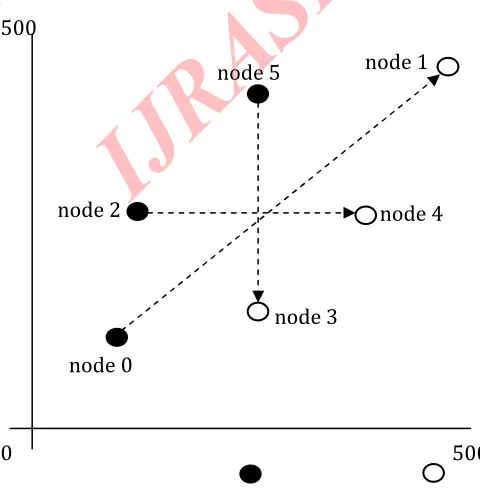
Figure 3: Test-bed (where is source node and is destination node, dotted arrow represents the pair and
direction of communication).
A. Simulation Model
The proposed architecture is simulated on the modified version of ns2. All the modifications are performed as per the discussion in the previous sections. In the experiment, to understand the true performance of the proposed modifications, the wireless medium is considered as error-free and noises less. Each node is equipped with an omni directional antenna with a 2 Mbps bit rate and transmission range of 250 meters.
In order to simulate a true situation, test bed is so studded with the nodes so that the performance of modified routing agent (i.e. AODV) should come under the lens also. As shown in the figure 3, there are three pairs of communicating nodes; all the nodes are also working as router for others except node1. The node1 is kept out of the routing load so as to find out the goodput at this node. To understand the functioning, some parameters are needed to be constant as given
below- Bandwidth at the physical layer is set at 11 Mbps.
All the nodes (as shown in figure 3) are TCP agents.
Maximum Segment Size (MSS) for a TCP agent is 536 bytes.
Each source is generating packets
as- Every packet is of size 512 bytes.
Every node is generating packets at a rate of 10 Mbps.
Interval between two successive packets at a node is 0.005 sec.
Nodes are generating packets in a continuous flow without any noise.
Purpose to keep some of the parameters constant is to understand the behaviour of the network in terms of performance metrics with respect to a variable. We have selected data rate as a variable to compare the performance among the standard situation and the channel, multi-interface situation.
500
node 0
node 1
node 5
node 2
node 4
B. Simulation Results
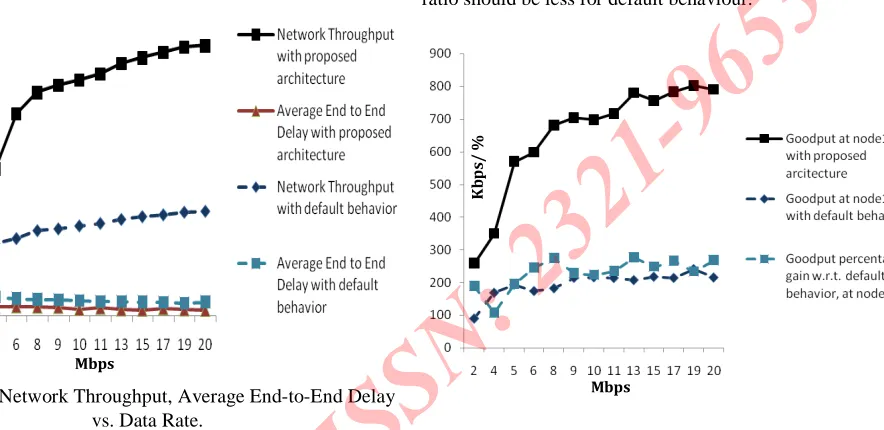
[image:6.612.101.543.206.421.2]Simulation is performed by considering various factors to analyse the proposed architecture carefully. Network throughput shows a remarkable improvement, as shown in figure 4.
Figure 4: Network Throughput, Average End-to-End Delay vs. Data Rate.
Not only the throughput is improved but the average end delay is also improved. Throughput or average end-to-end delay is not improved with the same factor as that of the total number of interfaces added to each node. Since each node is modified with the number of interfaces, proportionately each node is overloaded with more network management jobs. These jobs hinder the proposed modifications to outperform the default protocols with the same number of times as that of the number of interfaces attached to each node. It’s a trade off between the performance and the additional functionalities added to a node.
Figure 5: Packet Delivery Ratio and Packet Droop vs. Data Rate.
For the proposed architecture packet delivery ratio is reflected almost same as that of the default architecture, from the figure 5, but there is slight difference between these values. Since figure 5 shows the packet drop is more in case of default protocols, it may be assumed that packet delivery ratio should be less for default behaviour.
Figure 6: Goodput vs. Data Rate.
But default behavior of the protocols doesn’t reflect this
scenario, because as the packet drop goes high, the packet generated also goes high with respect to increase in data rate as shown by x-axis of the figure.
The above metrics shows the network really perform bet-ter with the proposed architecture. Another parameter tested for it, is goodput. Goodput establishes the faith in- terms of useful work of the network from the receiver and sender point of view. The figure 6 reveals the fact that goodput is also improved with remarkable difference from the default behavior of the protocols. It shows the goodput percentage gain with respect to the goodput at node1, also. The simulation can check this metric (i.e. goodput) at every receiver but it is calculated at node1 only, just to understand the performance improvements.
Mbps
[image:6.612.49.302.431.783.2]V. CONCLUSION
In this paper, some modifications have been suggested for IEEE 802.11 MAC and AODV protocols. The proposed modifications are being presented here with the help of some figures. These figures are results of a simulation performed at ns2. The performance improvement supports the considerations of multi-interface, multi-channel architecture for MANETs.
REFERENCES
[1] A. Nasipuri and S. Das, Multichannel CSMA with Signal Power-Based Channel Selection for Multihop Wireless Networks, in Proceed-ings of IEEE Fall Vehicular Technology Conference (VTC Fall 2000), September 2000, pp. 211–218.
[2] A. Nasipuri, J. Zhuang, and S. R. Das, A Multichannel CSMA MAC Protocol for Multihop Wireless Networks, in Proceedings of the IEEE Wireless Communications and Networking Conference, 1999, pp. 1402–1406.
[3] C. Perkins, E. Belding-Royer, S. Das. (July 2003), Ad hoc On-Demand Distance Vector (AODV) Routing. IETF RFC 3561, 2003.
[4] C. E. Perkins and P. Bhagwat, Highly Dynamic Destination-Sequenced Distance-Vector Routing (DSDV) for Mobile Computers, in Proceedings of the SIGCOMM Conference on Communications, Architectures, Protocols and Applications. ACM Press, 1994, pp. 234–244.
[5] D. B. Johnson, D. A. Maltz, and Y.-C. Hu, The Dynamic Source Routing Protocol for Mobile Ad-hoc Networks (DSR), IETF Draft –MANET working group (2003).
[6] Jungmin So and Nitin H. Vaidya, A Routing Protocol for Utilizing Mul-Tiple Channels in Multi-Hop Wireless Networks with a Single Transceiver, Tech. Rep., University of Illinois at Urbana-Champaign, October 2004.
[7] N. Shacham and P. King., Architectures and Performance of Multi-Channel Multihop Packet Radio Networks, IEEE Journal on Selected Area in Communications, vol. 5, no. 6, July 1987, pp. 1013– 1025.
[8] N. Jain, S. R. Das and A. Nasipuri, A Multichannel CSMA MAC Protocol with Receiver-based Channel Selection for Multihop Wire-less Networks, Proceedings of IEEE ICCCN, 2001, pp. 432- 439.
[9] P. Kyasanur and N. Vaidya, Routing and Link-layer Protocols for Multi-Channel Multi-Interface Ad Hoc Wireless Networks. ACM SIGMOBILE MC2R, 10(1), Jan 2006, pp. 31-43.
[10] Richard Draves, Jitendra Padhye, and Brian Zill, Routing in Multi-Radio, Multi-Hop Wireless Mesh Networks, in ACM Mobicom, 2004.
![Figure 1: Mobile Node Architecture [11].](https://thumb-us.123doks.com/thumbv2/123dok_us/8587903.862968/4.612.72.298.302.591/figure-mobile-node-architecture.webp)