© 2015, IRJET ISO 9001:2008 Certified Journal
Page 387
Face recognition using hybrid radial basis function for low dimensional
feature extraction
CH.LAKSHMI DEVI*, M.PRADEEP +
*
M.TECH Student, ECE Department, Indira Institute of Technology, Markapur .
+Assistant Professor, ECE Department, Indira Institute of Technology, Markapur .
---***---Abstract -
Face recognition method is very interestingtopic and popular method in the area of security. Face recognition is a system to identify the image from the database. In this paper we present face recognition using hybrid radial basis function for low dimensional feature extract ion system that takes an image as the input query and retrieves images based on image content. Face recognition system is recognizing based on dimensionality reduction derived image features. In this paper we proposed hybrid radial basis function which contains PCA, KPCA and neural network method based on radial basis function. This proposed method gives high retrieval efficiency and low recognition time as compared to existing techniques using ORL and YALE database.
Key Words:
PCA, KPCA, RBF and distance measures
1. INTRODUCTION
Face recognition is a computer application for identifying and verifying a person from the face database. The face recognition system is generally used in security purpose and can be compared to other techniques such as fingerprint, iris and signature. More face recognition methods are identify face extract feature, or from an image of the database. These methods may analyze the relative size, shape, position of the database images. These extracted features are used to search for other relevant images. So far face recognition methods developed can be classified as holistic method or local feature method. First method is appearance based technique, which analyze the distribution of individual faces in face space for holistic features. It can be done by using global and local features. Concentration on dynamic link matching or graph matching is considered in local feature method. In global feature method or holistic method concentration on eigenfaces or similar appearance such as Principal Component Analysis (PCA) is considered.PCA approach is mainly concentrated on dimensionality reduction. This scheme is based on linearly projecting the image space to a lower dimensionality space that is also known as Eigen space. Second method is feature
based technique , which is concentrated on dimensionality of input image as well as images in face database. In face recognition system dimensionality
reduction is an essential technique. Block diagram of face recognition system
Basics concepts of principal component analysis (PCA), Kernel Principal Component Analysis (KPCA), and Radial Basis Function (RBF) are discussed in section II. Proposed method is discussed in section III. Experimental results are presented in section IV. Concluding remarks are discussed in section V.
2. PCA, KPCA, and RBF
2.1 Principal component analysis (PCA)
© 2015, IRJET ISO 9001:2008 Certified Journal
Page 388
2.2 Kernel Principal Component Analysis (KPCA)In recent years there has been an explosion of work on kernel methods. For supervised learning these include support vector machines [8], Gaussian process prediction (see, e.g. [10]) and spline methods [9]. The basic idea of these methods is to use the "kernel trick". A point x in the original space is re-represented as a point ¢(x) in a Np-dimensional feature space3 F, where ¢(x) = (¢1(X),¢2(X), ... ,¢NF(X)). We can think of each function ¢j(-) as a non-linear mapping. The key to the kernel trick is to realize that for many algorithms, the only quantities required are of the form4 ¢(Xi).¢(Xj) and thus if these can be easily computed by a non-linear function k(Xi,Xj) = ¢(Xi).¢(Xj) we can save much time and effort. Sch6lkopf, Smola and Miiller [7] used this trick to define kernel peA. One could compute the covariance matrix in the feature space and then calculate its eigenvectors/ eigen values. However, using the relationship between B and the sample covariance matrix S described above, we can instead consider the n x n matrix K with entries Kij = k(Xi,Xj) for i,j = 1, .. . ,no If Np > n using K will be more efficient than working with the covariance matrix in feature space and anyway the latter would be singular. The data should be centered in the feature space so that L~=l ¢(Xi) = o. This is achieved by carrying out the eigen decomposition of K = H K H which gives the coordinates of the approximating points as described in section 2.2. Thus we see that the visualization of data by projecting it onto the first k eigenvectors is exactly classical scaling in feature space.
2.3 Radial Basis Function (RBF)
Radial functions are widely used in feature extraction. There are three layers such as input layer, hidden layer and output layer, firstly input layer uses source nodes that connect to the network to its environment. Secondly Hidden units provide a set of basis function and High dimensionality and finally output layer uses linear combination of hidden functions. Radial basis function are used requires different designs are mainly concentrated on first one is selection of the radial basis function width parameter and second one is number of radial basis neurons. Selections of width of the different parameters are classified below as not required MLP, smaller width altering in unstrained test data and finally larger width based on network on smaller size and faster execution. The locations of the centers may be chosen randomly from the
training data set. Main problem require a large training set
for a satisfactory level of performance. Self-organized
learning of centers by means of clustering. All free
parameters of the network are changed by supervised learning process
3. PROPOSED ALGORITHM
Proposed method is presented below:
1. There are N face images belonging to M persons in the training set; N = N1+N2+N3+…NM. Images size is represented as no. of rows and columns (A1×A2). By using sub-pattern method Each face image is first partitioned into S equally sized, these sub-pattern images are transformed into corresponding column vectors with dimensions of d = (A1×A2)/S using non-overlapping method. 2. In the first step calculate mean value of
sub-pattern images. Each of them can be expressed in the form of a d by-N Column data matrix.
3. Similarly same procedure for independent component analysis and linear discriminate analysis.
4. Each of them can be expressed in the form of d-by-L Eigenvector matrix.
5. Afterwards, S extracted local sub feature weights of an individual vertically are synthesized into a global feature.
6. At final stage necessary to identify a new test image, this image also partitioned into S sub-pattern images. Each of them is represented as C test i and it’s vertically centered.
7. Finally, the identification of the test image is done by using nearest neighbor classifier with cosine measure, in which the cosine of the angle between the test image and each training image in the database.
4. EXPERIMENTAL RESULTS
Recognition performance in terms of average recognition rate and recognition time of the proposed face recognition system is tested by conducting an experiment on hybrid approach face database. A face database [6] test set was constructed by selecting 100 images of 10 individuals, ten images per person. These images of a person used for training and testing. the experimental results are tabulated in Table 1. Since the recognition accuracy of the sub-pattern image, several sizes of sub-pattern images were used in our experiments as shown below: 56×46(S=4), 28×23(S=16), 14×23(S=32), 7×23(S=64), and 4×23(S=112). Result has been presented in hybrid approach with S<64.
© 2015, IRJET ISO 9001:2008 Certified Journal
Page 389
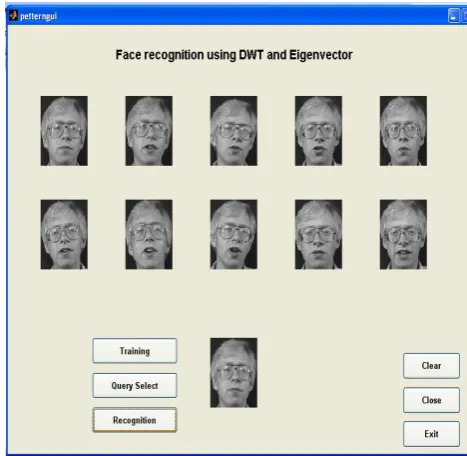
Figure2: Sample imageA sample image from face database and by using sub-pattern technique it can be divided by equal parts. Feature of the query image size is (64×1) by using sub-pattern method. Some of the recognized results when all the 10 images (N=10) in one subject of the image database are recognized are shown in figure 3. From the query image feature is taken based on sub-pattern method .After that in this paper we take only 64 feature of this query image. That may be depends up on the sub-parts of this image(S=16). For each sub-pattern we consider four positive eigenvectors that is largest eigenvector of the subpart. It is represented as only local feature of the query image. After that combination of all sub-parts local feature it can be represented as global feature of the query image. Comparative performance of all training global feature with this query image finally. The image recognition method take feature extraction technique as minimum as possible recognized results images with top left image as query image. Sub pattern method and principal component analysis [8] can significantly improve the recognition accuracy of sub pattern vertically centered method. Since the vertical centering process centers the data by removing the mean of each image, it can be used to eliminate the effect of the values. In other words, the property of vertical centering process [9] can be helpful in eliminating the shifted values of original-pixels. Further, the sub-pattern technique can be utilized to encourage the efficiency of the vertical centering process. Therefore, sub-pattern technique is actually useful to vertical centering process of sub-pattern technique. The vertical centering may benefits for the recognition in varying illumination. Now, we have confirmed this possible forecast and strongly increased the efficiency of the vertical centering process by sub-pattern technique in this paper. From the total experimental results, it can also be seen that for expression variant test, sub-pattern technique and Eigen vector can slightly improve weighted angle based
[image:3.595.306.540.145.373.2]approach classifier, the similarity between a test image and training image is defined as In the weighted angle based approach method cosine measurement.
Figure 3. Recognized images.
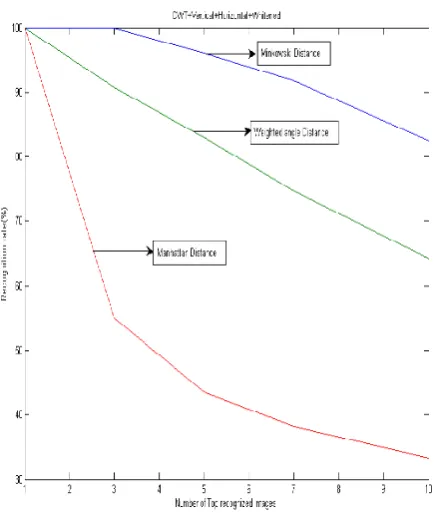
B. Average recognized rate
The average recognized rate for the query is measured by counting the number of images from the same category which are found in the top ‘N’ matches.
Table 1. Recognized rate on face database. (1, 3, 5,7,10 are Top ‘N’ recognized images)
Number of top matches
Methods 1 3 5 7 10
Mean 100 77.5 71 65 58
Variance 100 58.5 50.5 44.2 36.25
PCA 100 60 54.5 48.2 42.25
KPCA
100 91 84 72 65
Combined technique (Proposed method
PCA+KPCA+RBF) 10
© 2015, IRJET ISO 9001:2008 Certified Journal
Page 390
Figure 4. Comparative recognition rates.C. Recognized Time
Face recognition system with weighted angle based approach technique for largest four eigenvector recognized time is 50.42 seconds (training time is 50 seconds and recognitized time is 0.42 seconds), hybrid approach technique for all positive eigenvector recognized time is 51.20 seconds, Existing method in PCA recognized time is 1.65 seconds, KPCA time is 2.90 seconds and LPP method recognized time is 2.72 seconds.
3. CONCLUSIONS
Face recognition using hybrid radial basis function for low dimensional feature extraction. Global feature vector is generated and used for face recognition. Horizontal and vertical variations are considered in feature vector. Facial expression recognition based on dimensionality reduction techniques gives better performance in terms of average recognized rate and retrieval time compared to existing methods.
REFERENCES
[1]. Arnold. W. M. Smeulders, M. Worring, S. Satini, A. Gupta, R. Jain. Content – Based Image Retrieval at the end of the Early Years, IEEE Transactions on Pattern analysis and Machine Intelligence, Vol. 22, No. 12, pp 1349-1380 , 2000. [2]. Gupta. A. Visual Information Retrieval Technology: A Virage respective, Virage Image Engine. API Specification, 1997.
[3] Ping-Cheng Hsieh,Pi-Cheng Tung,A Novel Hybrid Approach Based On Sub pattern Technique and Whitened PCA for Face Recognition, Pattern Recognition 42 (2009) 978-984.
[4] Vytautas Perlibakas Distance measures for PCA based face recognition, Pattern Recognition letters 25 (2004) 711-724
[5] S.I. Choi, C. Kim, C.H. Choi, Shadow compensation in 2D images for face recognition, Pattern Recognition 40 (2007) 2118–2125.
[6] M. Turk, A. Pentland, Eigenfaces for recognition, J. Cognitive Neurosci.3 (1) (1991) 71–86.
[7]Yalefacedatabase
http://cvc.yale.edu/projects/yalefaces/yalefaces.html.
[8] J. Yang, D. Zhang, J.Y. Yang, Is ICA significantly better than PCA for face recognition? in: Proceedings of IEEE International Conference on Computer Vision, vol. 1, 2005, pp. 198–203.
[9] A.J. Bell, T.J. Sejnowski, The independent components of natural scenes are edge filters, Vision Res. 37 (23) (1997) 3327–3338.
[10] M.S. Bartlett, H.M. Lades, T.J. Sejnowski, Independent
component representation for face recognition, in:
Proceedings of SPIE Symposium on Electronic Imaging: Science and Technology, 1998, pp. 528–539.
[11] S. Chen, Y. Zhu, Subpattern-based principle component analysis, Pattern Recognition 37 (2004) 1081–1083.
[12] K.Tan and S.Chen. Adaptively weighted sub-pattern pca
for face recognition. Neurocomputing, 64:505–511, 2005.
[13] R. Gottumukkal and V.K. Asari. An improved face recognition technique based on modular pca approach.
Pattern Recogn Lett., 25(4):429–436, 2004.
[14] Yang J and Zhang D. Two-dimensional pca:a new approach to appearance-based face representation and
recognition. IEEE Transactions on Pattern Analysis and
Machine Intelligence, 26(1):131–137, 2004.
[15] S. H. Ou, Q. L. Wang, and Z. Y. Zhu. The Application
and Technology of Digital Image Processing(In Chinese). Tsinghua Press, Beijing, China, 2004.
[16] Vytautas Perlibakas ―distance measure for PCA-based face recognition. Pattern Recognition Letters 25 (2004) 711– 724
[17] Gupta Navarrete, P., Ruiz-del-Solar, J., 2001. Eigenspace-based recognition of faces: Comparisons and a new approach. In: International Conference on Image Analysis and Processing
ICIAP2001. pp. 42–47.
[18] Graham, D.B., Allinson, G.N.M., 1998. Characterizing virtual eigensignatures for general purpose face recognition. Face recognition: From theory to applications. NATO ASI Series F, Computer and Systems Sciences 163, 446–456. [19] Swets, D.L., Pathak, Y., Weng, J.J., 1998. An image database system with support for traditional alphanumeric queries and content-based queries by example. Multimedia Tools Appl. (7), 181–212.
© 2015, IRJET ISO 9001:2008 Certified Journal
Page 391
[21] D.Q. Zhang, S.C. Chen, J. Liu, Representing image matrices: eigenimages vs. eigenvectors, in: Proceedings ofthe Second International Symposium on Neural Networks (ISNN’05), Lecture Notes in Computer Science, vol. 3497, Chongqing, China, 2005, pp. 659–664.
[22] Paul Computer and Ahmad , Afandi and Amira, Abbes ,optimal discrete wavelet transform (dwt) features for face recognition Nicholl, (2010), Malaysia
[23]Xu,D.Zhang,F.Song,J.Yang,Z.Jing,M.Li,Amethodforspee dingupfeatureextractionbasedonKPCA,Neurocomputing70(20 07)1056–1061.
[24]
Y.Xu,D.Zhang,Z.Jin,M.Li,J.Y.Yang,Afastkernel-basednonlinear discriminant
analysisformulti-classclassification, PatternRecognit.39(6) (2006)1026–1033. [25]M.E.Tipping,Sparsekernelprincipalcomponentanalysis,in: T.K.Leen,T.G.Dietterich,V.Tresp(Eds.),NeuralInformationPro
cessingSystems(NIPS), MIT
Press,Cambridge,MA,2000,pp.633–639.
[26]S.W.Kim,B.J.Oommen,Onusingprototypereductionschem
estooptimize kernel-based
Fisherdiscriminantanalysis,IEEETrans.Syst.,Man,Cybern.— Part B:Cybern.38(2)(2008)564–570.
[27]M.T.Ding,Z.Tian,H.X.Xu,Adaptivekernelprincipalcompo nentanalysis, Signal Process.90(2010)1542–1553.
[28]Z.Y.Zhang,T.Tian,X.Duan,X.Fu,Adaptivekernelsubspace
methodfor speeding
upfeatureextraction,Neurocomputing113(2013)58–66.
[29] D.
Valentin,H.Abdi,A.J.O.Toole,G.W.Cottrell,Connectionistmod elsofface processing: asurvey,PatternRecognit.27(1994)1209– 1230.
[30]M.Oravec,J.Polec,S.Marchevský,Neuralnetworksfordigita lsignalproces- sing, Bratislava,Slovakia,1998,80-967503-9-9(inSlovak).
[31]K.Hlaváčková,R.Neruda,Radialbasisfunctionnetworks,Ne uralNetw.World 3 (1)(1993)93–102.
[32]J.L.Mark,IntroductiontoRadialBasisFunctionNetworks,Ce
ntreforCognitive Science,
UniversityofEdinburgh,Edinburgh,Scotland,1996.
[33]M.J.Er,S.Wu,J.Lu,H.L.Toh,Facerecognitionwithradialbasi
sfunction(RBF) neural
networks,IEEETrans.NeuralNetw.13(3)(2002)697–710.
[34].H. Schwenk,TheDiaboloclassifier,
NeuralComput.10(1998)2175–2200.
[35]A.H.Monahan,Nonlinearprincipalcomponentanalysisbyne
uralnetworks: theory
andapplicationtotheLorenzsystem,J.Clim.13(4)(2000)821– 835.
[36]M.A.Kramer,Nonlinearprincipalcomponentanalysisusinga utoassociative neural networks,AIChEJ.37(2)(1992)233–243. [37]K.Fukunnaga,IntroductiontoStatisticalPatternRecognition, 2ndedition, Academic Press,NewYork,1991.
[38]C.Bishop,NeuralNetworksforPatternRecognition,OxfordU niversityPress, NewYork,1995.
[39]T.J.Moody,C.J.Darken,Fastlearninginnetworksoflocallytu nedprocessing units, NeuralComput.1(1989)151–160.
[40]J.Li,Z.Xiao,Y.Lu,Adaptingradialbasisfunctionneuralnetw
orksforone-class classification,
in:ProceedingsoftheIEEEInternationalJointConferenceon