Linear Programming Problem with Intuitionistic
Fuzzy Numbers
Anil Kumar Nishad
Department of Mathematics, Banaras Hindu University,
Varanasi-221005, India
S.R. Singh
Department of Mathematics Banaras Hindu University,
Varanasi-221005, India
ABSTRACT:
In many real life optimization problems, the parameters are often imprecise and are difficult to be represented in discrete quantity. One of the approaches to model such situation is considering these imprecise parameters as intuitionistic fuzzy numbers and then approximating these by its expected interval value. Further in process of solution, membership function for each objective function are constructed by computing best and worst acceptable solutions and deal the constraints of the problem with ranking of intuitionistic fuzzy number with a concept of feasibility degree. The paper presents a computational algorithm for solution of objective functions at different feasibility degree. The developed algorithm has been illustrated by implementing on a linear programming problem as well as on a multi objective linear programming problem (MOLPP) in intuitionistic fuzzy environment.
Keywords
Intuitionistic Fuzzy Set, Trapezoidal Intuitionistic Fuzzy Number (TIFN), Expected Interval of Fuzzy Number
1.
INTRODUCTION
Modeling a financial or a production planning problem needs some prior information about its feasibility and possible outcome. In many situations, it also needs financial analysis about resource utilization and optimal profit or gain. Such analysis needs the complete information about various parameters such as profit coefficients, resource limitations, constraints as well as its objectives and other goals. As a matter of fact in real life production planning problems, it is often difficult to get discrete and exact information for various parameters affecting the process. Even in many situations the information available are imprecise or vague. Under such situations it is difficult to have the mathematical formulation to solve the mathematical programming problem using a linear programming technique. For such situations, fuzzy set developed by Zadeh[22] played a vital role in modeling the optimization problem having imprecision in parameters and was initiated by Zimmermann[23,24,25] as fuzzy linear programming problem.
One of the major difficulties to study such fuzzy linear programming problems with fuzzy coefficients is how to compare these fuzzy numbers. Thus an important issue of ranking of fuzzy numbers and its approximation method took considerable interest amongst the researchers. Some of the authors who made significant contributions in the area are Dubois and Prade[10], Heliperrn[15], Adrian[1,2]. This growing discipline attracted many authors to extend the theory of fuzzy sets to various application areas of industrial planning, production planning, agricultural production planning, economics etc. Atanossov[4, 5] extended the fuzzy set theory to intuitionistic fuzzy sets. This extended new set, named as intuitionistic fuzzy set, has a feature to accommodate hesitation factor of including an element in a fuzzy set apart
from the feature of degree of belonging and non belonging. This extension of fuzzy set to intuitionistic fuzzy set attracted research workers as well as planners to apply this new set in the field of decision sciences. Thus an extension of deterministic optimization to intuitionistic fuzzy optimization was initiated by Angelov[3].The Angelov study was motivated by Zimmermann visualization of a fuzzy set to explain the degree of satisfaction of respective condition and was expressed by their membership function. Angelov[3] in his study extended the Bellman and Zadeh[6] approach of maximizing the degree of (membership function)acceptance of the objective functions and constraints to maximizing the degree of acceptance and minimizing the degree of rejection of objective functions and constraints.
In view of its suitability of intuitionistic fuzzy set in modeling systems having imprecise parameters, a considerable research work has been carried out in the direction of ranking of intuitionistic fuzzy numbers. Further development of approximation methods are needed for development of intuitionistic optimization techniques (please see Hassan[14], Grzegorzewski[13], Parvathi and Malathi[21]. Nishad et al. [7,20] have also worked on developing the ranking method for intuitionistic fuzzy numbers and have applied it on intuitionistic fuzzy optimization. There are many more authors, who worked on the ranking methods and approximation of intuitionistic fuzzy number (please see Inuiguchi and Tanaka[16]). Recently Dubey et al [11,12] have studied fuzzy linear programming with intuitionistic fuzzy numbers. The present work is a motivation towards the application of intuitionistic fuzzy numbers to optimization problem and develops a computational method for solution of such optimization problems. The study is presented in the following sections: Section 2 is preliminaries to intuitionistic fuzzy set and intuitionistic fuzzy numbers needed for consequent sections. Section 3 comprise of modeling of an intuitionistic fuzzy optimization problem and its solution algorithm. Section 4 illustrates the implementation of the theory developed in section 3 to a linear programming problem as well as to a multi objective linear programming
problem. Last section presents the results of the
undertaken problem and provides a brief discussion on the developed method.
2.
PRELIMINARIES
Definition 1
.Fuzzy Set
Let is a collection of objects denoted by then a fuzzy set in is a set of ordered pairs: , where is called the membership function or grade of membership of in that maps to the membership space .
Definition 2.
Intuitionistic Fuzzy Set
are called the membership and non-membership functions of in respectively.
and and
Definition 3.
Trapezoidal Intuitionistic Fuzzy
Number(TIFN )
An intuitionistic fuzzy set (IFS),
on ℝ is said to be an intuitionistic fuzzy number, if are membership and non-membership function respectively and ≤ where denotes the complement of .
[image:2.595.312.545.74.230.2]A trapezoidal intuitionistic fuzzy number with parameters ≤ a ≤ b ≤ c ≤ d ≤ denoted by is a intuitionistic fuzzy set on real line ℝ whose membership and non-membership functions are defined as follows:
Figure 1. Membership and non-membership function of Trapezoidal Intuitionistic Fuzzy Number
and
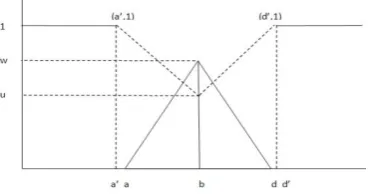
Here, the values w and u represent the maximum degree of membership and the minimum degree of non-membership function, respectively, such that 1.
Definition 4
.Triangular Intuitionistic Fuzzy
Number (TrIFN)
A trapezoidal Intuitionistic fuzzy number, becomes a triangular intuitionistic fuzzy number by setting b = c and hence parameters become a’≤ a ≤ b ≤ d ≤ d’ and is denoted by >
Figure 2. Membership and non-membership function of Triangular Intuitionistic Fuzzy Number
and
Definition 5.
Expected Interval of Fuzzy
Number
One approach to approximate a fuzzy number in deterministic form is expected interval EI( value. The theory of expected interval of a fuzzy number was introduced by Dubois, Prade and Heilpern. Dubois and Prade [11] considered the approximation of a fuzzy number as a mean value of fuzzy number and give a rigorous definition for mean value of a fuzzy interval to show that the addition of mean value is preserved in possibilistic frame work. Later on Heilpern [15] in his study defined the expected value of a fuzzy number via a random set and introduced two notations, the expected interval and the expected value of the fuzzy number. He defined the expected value of a fuzzy number as a centre of the expected interval of such a number. A fuzzy number = <( )> as interval fuzzy number can be written as EI( = [ )] ,
Where = - dx and ) = dx .
Here, the two function and are defined as = , and
Definition
6.
Expected
Interval
for
Intuitionistic fuzzy number
Let there exist numbers: , ℝ
such that with four functions : ℝ [0,1], out of which and are non decreasing and are non increasing functions, then an intuitionistic fuzzy number = is defined by its membership and non-membership function as given as
[image:2.595.64.250.607.704.2]
where
= + dx - dx ) = + dx - dx
and , = , =
Definition 7.
Expected Interval for a
triangular Intuitionistic fuzzy number
If =<( ),( )> is triangular intuitionistic fuzzy number then the above definition of expected interval of triangular intuitionistic fuzzy number produce EI( =[ )]
where = + dx - dx =
) = + dx - dx
=
Definition 8.
Ranking of Intuitionistic fuzzy
number with expected interval
For any pair of intuitionistic fuzzy number and with respective expected intervals EI( =[ )] and EI( =[ )]
(i) iff )
(ii) iff ) and = ) In a situation wher the above definition fails, then degree satisfactory method at which is bigger than or equal to is defined as
(1) Here, ≥ , represented as is bigger than or equal to at least to a degree
3.
PROBLEM FORMULATION
Consider a multi-objective linear programming problem with k objectives and m constraints in n decision variables and is given as
Optimize (X) = (X) subject to
AX ( ≥, = , ≤ ) b
X ≥ 0 (2) (2) where X ℝ , ℝ ℝ and A be a m x n
technological matrix. ( ≥, = , ≤ ) denotes that the constraints may be of any of the tree types or may be of all the three types.
3.1
Multi-Objective Linear Programming
Problem with the Intuitionistic Fuzzy
Parameters
Let us consider a multi-objective optimization problem with n decision variables, m constraints and k objective functions, Maximize Z(X) = { , , , . . . , } X
s.t. Xj (≥, =, ≤) i=1, 2, 3, ... m
Xj ≥ 0 j =1,2,3, . . . n (3)
where X= {x1, x2, x3, . . . xn}, (k=1,2, . . . K) and
(i=1,2,3, . . . m) are n dimensional and m dimensional vectors respectively, is a m x n matrix with intuitionistic fuzzy parameter and and are intuitionistic fuzzy numbers. Since the above problem (3) have intuitionistic fuzzy coefficients which have possibilistic distribution in an uncertain intervals and hence may be approximated in terms of its expected intervals.
Let EI( be expected interval of intuitionistic fuzzy number defined by the definition (7) and is given as
EI( =[ )]
where ) are the lower and upper bound of the expected interval EI( of intuitionistic fuzzy number. Since the coefficients of the objective function are intuitionistic fuzzy numbers, expected interval of can be defined as EI =[ )] where and ) is given as in definition of expected interval. Thus EI can be represented as a closed interval [ )] , such that [ )]
Now the lower and upper bound for the respective expected intervals of the objective function are defined as
= (4) = (5) In the next step, we construct a membership function for the maximization type objective function , and then replace by the upper bound of its expected interval i.e. = (6) Similarly, we construct a membership function for minimization type objective function ,and then replace by the lower bound of its expected interval that is
= (7) and the constraint inequalities
( i = 1, 2, . . . ) (8) (i = 1, 2, ... ) (9)
Which can be written in feasibility degree relation in terms of -parametric constraints as
≥
( )+ (i =1, 2, ... ) (10) ≤
(i = 1, 2, . . . m) (12) can be transformed into two intuitionistic fuzzy inequalities as (i= 1, 2, . . . m) (13) (i= 1, 2, . . . m) (14) The above equations can be also written in α-parametric form as equation (10) and (11) using ranking function defined in equation (1).
Thus the undertaken maximization problem (3) is transformed to an equivalent multi objective linear programming problem (MOLPP) as
Maximize =
(k=1, 2, 3, . . . K) Subject to
≥ ( ) + (i =1, 2, ... ) ≤ + ( ) (i= 1, 2, ... ) ≤ + ( ) (i = 1, 2, ... n) ≥
( ) + (i= 1, 2, ... n) ≥ 0 ( j =1, 2, 3, . . . , n ) (15)
Now, the problem (15) can be reduced to a deterministic linear programming problem for a prescribed value of and can proceed to solve by applying the fuzzy programming techniques.
Thus it need to construct a membership function for maximizing type objective function by using the best and worst acceptable solution defined as:
Where is aspiration level for the kth
objective function and the highest acceptable level for the kth objective function and the lowest acceptable level lk are ideal and anti-ideal solutions
and are computed as
= Max (k=1, 2, 3, . . . K) (16) with respect to constraints of the problem (14) for prescribed value of
l k =Min (k=1, 2, 3, ... K) (17) with respect to constraints of the problem (14) for value of .
Similarly, for maximizing type objective function, an ideal and anti-ideal solution can be also defined.
Now using fuzzy max-min model, the above linear programming problem is converted in to single objective linear programming problem and then can be solved for different value of as follows.
Maximize Subject to
≤
≥ ( ) + (i =1, 2, ... ) ≤ + ( ) (i = 1, 2, ... ) ≤ + ( ) (i = 1, 2, ... n) ≥
( ) + (i= 1, 2, ... n) ≥ 0 ( j =1, 2, 3, . . . , n ) (18)
4.
ILLUSTRATION
Example 1 Consider a linear programming problem in intuitionistic fuzzy environment as
Maximize = + Subject to
+
+ + (19) ,
having intuitionistic fuzzy coefficients given as
<( 19 ),( 18 )>, = <( 44 ),( )>, =<(14 ),( )>, =<(25,30 ),( )> , =<(21,24,26 ),( )>, =<(4,6,8 ),(2,6,11
)>, = <(17,21,22; ) ,(16,21,26 )>, =<(12,14,19
),(8,14,22 )>, =<(44980,45000,45030; ),(4497 0,45000,45070 )>, =<(23980,24000,24060 ),(239 40,24000,24060 )>, =<(27990,28000,28030 ), (27950,28000,28040 )> , respectively,
Now approximating the above intuitionistic fuzzy numbers by its interval value as described in section 2, are written in terms of its expected intervals as
EI = [22.075, 28.825], EI = [45.975, 51.15], EI = [13.525, 16.2], EI = [27.125, 32.9], EI = [22.325, 26.7], EI = [ 4.55, 7.7], EI = [ 18.85, 22.475], EI = [12.05, 17.125], EI = [ 44988, 45024.25], EI = [ 23980.5, 24026.25], EI = [27985.25, 28016.75]
With these expected interval values of intuitionistic fuzzy numbers, the problem (19) is transformed in to a - parametric linear programming problem defined as.
Maximize Z= 28.82 + 51.15 Subject to
[ ] +[ ] ≤ [ ]
[ ] +[ ] ≤ ]
To solve this problem, we compute ideal and anti-ideal solution of objective functions as described in section 4 and thus computed values comes out to be =86975.449 ,
=62866.215 .
Now implementing the above developed computational algorithm, the problem (20) can be written to an equivalent linear programming problem as
Maximize Subject to
0.142 0.064 ≤ -0.529
[ ] +[ ] ≤ [ ]
[ ] +[ ] ≤ ]
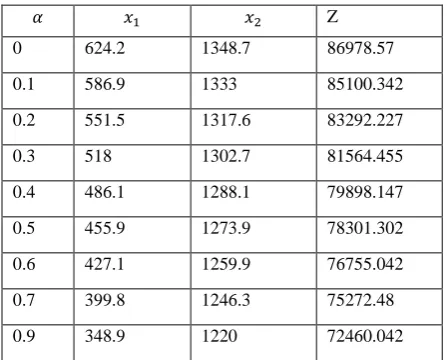
[image:5.595.53.277.366.546.2][ ] +[ ] ≤ [ ] , ≥ 0 (21) This linear programming problem (21) has been solved by MATLAB® for different value of and solution obtained is given in table 1.
Table 1. Optimal solution for different feasibility degree of
Z
0 624.2 1348.7 86978.57
0.1 586.9 1333 85100.342
0.2 551.5 1317.6 83292.227
0.3 518 1302.7 81564.455
0.4 486.1 1288.1 79898.147
0.5 455.9 1273.9 78301.302
0.6 427.1 1259.9 76755.042
0.7 399.8 1246.3 75272.48
0.9 348.9 1220 72460.042
Example.2 Consider a multi-objective intuitionistic fuzzy linear programming problem as
Maximize = + Maximize = + Subject to
+
+ + (22) ,
Here, we assume that each of coefficients are triangular intuitionistic fuzzy numbers and are given as
<( ),( )>, = <( ),( )>, = <( =<(2, ),( )>, =<( ),(
)>, =<(8 ),( )>, =<(20 ),( )>, = <( 23 ),( ) >, respectively,
Approximating the above intuitionistic fuzzy numbers by its interval value as given in section II, their respective expected intervals are given as
EI = [ 0.762, 1.237], EI = [1.525, 2.237], EI = [ 2.525, 4], EI = [ 3.05, 4.95], EI = [ 5.05, 6.95], EI = [ 9.05, 10.47], EI = [ 22.1,
24.95], EI = [25.625, 29.425],
Using these approximated expected interval of intuitionistic fuzzy numbers, the problem (22) is transformed in to an equivalent multi-objective - parametric linear programming problem defined as.
Maximize Z1 = 4.95 + 2.237
Maximize Z2 = 2.237 + 6.95
Subject to
[ ] +[ ] ≤ ]
[ ] +[ ] ≤ [ ]
] +[ ] ≤ ]
, ≥ 0 (23) Now, we calculate ideal and anti-ideal solutions for each of objective functions of the above MOLP as described in section III and thus computed values comes out to be
= 53.019, = 18.359, = 69.781, = 26.892, respectively.
Now implementing our developed computational algorithm, the problem (23) can be written to an equivalent linear programming problem as
Maximize Subject to
0.142 0.064 ≤ -0.529 0.052 0.161 ≤ -0.626
[ ] + [ ] ≤ ] ] +[ ] ≤ ]
[ ] +[ ] ≤ ]
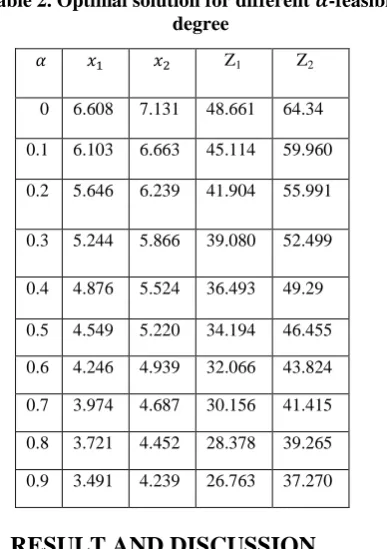
Table 2. Optimal solution for different -feasibility degree
5.
RESULT AND DISCUSSION
The developed algorithm uses the -degree feasibility of linear intuitionistic fuzzy programming problem. We compare the results obtained in table 1 and table 2 with that of results of Dubey and Kuwano method. Clearly the level of satisfaction of each objective function by the proposed method is higher than the previous results. Thus for modeling the optimization problems having vagueness and imprecision in information with intuitionistic fuzzy optimization approach may be considered as an alternative method to see optimal values. The proposed algorithm is more suitable to find the optimal solutions of the problems having intuitionistic fuzzy coefficients arising in production planning problems, financial planning problems, agricultural production planning problems and many other real world multi-objective programming problems. One of the interesting feature of the feasible solutions in both case of linear programming problem as well as in multi objective linear programming problem , the values of the objective functions decrease with increase of values. Clearly the optimal solution is obtained for the lowest values of Thus solutions give an insight on the degree of vagueness and the possible feasible solutions. Hence,, the present study provides visualization in the optimization process in a context that it provides solution to the problem with various degree of feasibility in the situation of imprecision in parameters. Thus the decision maker has enough information about the feasible solutions ranging from best to worst to take appropriate decision according to the situation.
6.
ACKNOWLEDGEMENTS:
Authors are thankful to University Grants Commission, New Delhi, India for providing financial assistance to carry out this research work.
7.
REFERENCES
[1] Adrian B, 2008, Trapezoidal approximations of intuitionistic fuzzy numbers expressed by value ambiguity, width and weighted expected value , NIFS , vol.14, 30-47.
[2] Adrian B. K., Coroiann L C, 2009, A method to obtain trapezoidal approximations of intuitionistic fuzzy numbers from Trapezoidal approximations of fuzzy numbers, NIFS, vol.15, 13-25.
[3] Angelov P.P.,1997, Optimization in an intuitionistic fuzzy environment, Fuzzy Sets and Systems, vol 86, 299-306.
[4] Atanassov K.T., 1986, Intuitionistic fuzzy sets, Fuzzy Sets and Systems vol. 20, 87-96.
[5] Atanassov K. T, Kreinovich V., 1999, Intuitionistic fuzzy interpretation of interval data, Notes on Intuitionistic Fuzzy Set, 5(1) 1-8.
[6] Bellman R.E., and.Zadeh L.A, 1970, Decision making in a fuzzy environment, Management Sciences, Vol. 17, 141-164.
[7] Bharati S. K., Nishad A. K., S. R. Singh, 2014, Solution of Multi-Objective Linear Programming Under Intuitionistic Fuzzy Environment, Proceedings of the Second International Conference on Soft Computing for Problem Solving (SocProS 2012), December 28–30, 2012, Advances in Intelligent Systems and Computing
236, DOI: 10.1007/978-81-322-1602-5_18, © Springer
India.
[8] Charnes A., and Cooper W.W., 1961, Management models of industrial applications of linear program Vol-1 and Vol-2, Wiley, New York,.
[9] Cohon J. L., 1978, Multi objective programming and planning, Academic Press, New York
[10]Dubois D. and Prade H. 1987 The mean value of a fuzzy number, Fuzzy Sets and Systems, vol. 24 , 279-300. [11]Dipti Dubey, Aparna Mehra, 2011, Fuzzy linear
programming with Triangular Intuitionistic Fuzzy Number, EUSFLAT-LFA 2011, Advances in intelligent System Research, Atlantis Press , vol 1(1), 563-569. [12]Dipti Dubey, Suresh Chandra, Aparna Mehra, 2012,
Fuzzy linear programming under interval uncertainty based on IFS representation, Fuzzy Sets and Systems, vol.188, 68-87.
[13]Grzegorzewski P., 2003, Distances and orderings in a family of intuitionistic fuzzy numbers. In Proceedings of the Third Conference on Fuzzy Logic and Technology (Eusflat03),pp 223–227.
[14]Hassan M.N., 2010, A new Ranking Method for Intuitionistic Fuzzy Numbers, International Journal of Fuzzy Systems , Vol. 12(1) ,80-86.
[15]Heilpern S., 1992, The expected value of a fuzzy number, Fuzzy Sets and Systems, vol. 47: 81-86.
[16]Inuiguchi H. and Hideo Tanaka, 1990, Multi-objective Programming in optimization of the interval objective function, European Journal of Operational Research. vol.48 ,219–225.
[17]Kuwano H., 1996, On the fuzzy multi-objective linear programming problems: Goal programming approach, Fuzzy Sets and Systems, vol. 82, 57-64.
[18]Li Deng Feng, 2010, Linear programming method for MADM with interval-valued intuitionistic fuzzy sets, Expert Systems with Applications, vol. 37, 5939-5945. Z1 Z2
0 6.608 7.131 48.661 64.34 0.1 6.103 6.663 45.114 59.960 0.2 5.646 6.239 41.904 55.991
[19]Lai Y. J., Hwang C L. 1994, Fuzzy multiple objective Decision making, Springer: New york .
[20]Nishad A. K., Bharati S. K., Singh S. R., 2014, A New Centroid Method of Ranking for Intuitionistic Fuzzy Numbers, Proceedings of the Second International Conference on Soft Computing for Problem Solving (SocProS 2012), December 28–30, 2012, Advances in
Intelligent Systems and Computing 236, DOI:
10.1007/978-81-322-1602-5_17, © Springer India.
[21]Parvathi R., Malathi C., 2012, Intuitionistic fuzzy linear
optimization, Notes on Intuitionistic Fuzzy Sets, 18(1) 48-56.
[22]Zadeh L. A. 1965, Fuzzy Sets, Information and Control, vol.8, 338 – 353.
[23]Zimmermann H. J. , 1978, Fuzzy programming and linear programming with several objective functions, Fuzzy Sets and Systems, vol. 1, 45-55.
[24]Zimmermann H.J., 1983, Using Fuzzy sets in operational research, European Journal of Operational Research, 13, 201-206.