915
VALUE ASSESSMENT MODEL OF HR BASED ON ASSETS
APPRAISAL
LEI HE
Chongqing University of Technology, Economic& Business College, 400020, China
ABSTRACT
As the world economy entered into a high-speed development period, company’s demand of talented person become bigger and bigger, and the human resource value assessment gain more and more attention. Based on the existing human resources value evaluation method, the paper has proposed a human resource value evaluation model based on the assets assessment. The model is established on the basis of economic value method, future salary reward discount method, and random compensation value method, then using distribution value method to separate the contribution of human resources. Experiments show that the proposed assets assessment based human resource value evaluation model is practical and effective on human resources value evaluation, and it can reflect well the value of human resources.
Keywords: Assets Evaluation, Human Resources, Value Evaluation, Distribution Value Method
1. INTRODUCTION
In the 21st century, the world economy is stepping into a new economy era [1] with the mark of knowledge economy, information economy and network economy. In such an era, human resource has gradually becomes core carrier of the world's economic development [2]. According to the statistics of world bank in 1995: 64% of the world total wealth is human capital, 20%for natural resources, 16% for the artificial assets, this shows that human capital is the main body of the world total wealth, how many artificial assets can be got from natural resources depends on the human capital [3].
Human resources is a kind of labor resources controlled by a particular organization and can bring economic benefits to the organization during the expected service, the value of it is embodied in the creative use of human resources [4]. With the coming of knowledge economy, human resource becomes the final decision factors of enterprise competition [5]. Human resources value evaluation is an important basis for decision-making of enterprise leaders, is the necessary means to prevent enterprise assets loss, is the need of laborer to distribute profits reasonably, is the requirement for enterprises to realize the long-term development [6]. Therefore, it is very necessary to evaluate the value of human resources [7].
In order to adapt to the demands of the new era, this article takes a professional point of view of assets assessment to open up a theoretical analysis and method study to the problems of enterprise
human resource value evaluation, tries to
objectively reflect the human resource value, thus to realize the fairly asset exchanging and restructuring, reasonably distribution according to the elements, and avoid human resources’ idle and waste.
2. ASSET APPRAISAL OVERVIEW
After 10 years of development, China's assets appraisal industry have a considerable progress in the evaluation scope, the object of assessment and evaluation theory, but, with the occurrence of
economic behaviors including enterprise
investment of human resources and participating in the residual allocation, human resources value evaluation problem has been put on the agenda, and which puts forward the new request for Chinese young assets appraisal industry, and also gives a difficult problem for asset appraisal personals[8].
916
3. CONCEPTION AND EVALUATION OF
THE HUMAN RESOURCES VALUE
3.1 Conception of Human Resource Value
Human resource value refers to "the labor value owned or controlled by enterprise which can economic benefits to the enterprise” [10]. That is to say, human resource value is the potential or creative labor ability of human as a carrier of human resources, the external performance of this ability is the value created by human in work, the inherent ability of personnel is unable to accurately measure, but can only speculate and judge. However, this potential creativity can create a quantifiable extrinsic value.
3.2 The Existing Human Resources Value Evaluation Methods
In last 1960s, western countries have already started to research the value of human resources. Up to now, the human resources value evaluation had tremendous developed. There are many existing human resources evaluation methods, here are some methods that are commonly used:
3.2.1 Economic value method
This method emphasis the proportion of manpower resources quantity in the whole enterprise investment, it can compare the contribution to enterprise of human resources and the non-human resources; it eliminates other assets’ contribution in the calculation of human resource value so that make sure the calculation results are more close to the real value of the human resources. But the future net rate of return is estimated, which has the subjectivity and uncertainty, and when the human resources value is less than or equal to zero in the future income, then we can't use this method to evaluate the value of human resources.
3.2.2 Discounting method of future salary and reward
The model introduced for the first time the economic value idea of human resource, which has an important influence on the field of human resources value evaluation. But it has neglected the variable factor of staff’s position change, overestimated the expected length of service of staff. At the same time, the created value of employees may be higher or lower than their reward, taking reward as the basis of human resource value calculation will affect its accuracy.
3.2.3 Random reward value method
This method takes the possibility of employees’ turnover and the human resources’ subjectivity into
consideration, which is a dynamic process model, thus can reflect the value of human resources in a
more scientific way. But it requires the
consideration of each worker’s working condition in each position of every stage, but it’s appraisal cost is huge; At the same time, it is harder to accurately judge the possibility of a certain office holding of a certain worker, so this method is poor to operate. In addition, this method ignored the impact of other assets to the enterprise’ profit, and owe all the enterprise’ profit to the creation of the human resources, thus it may overestimate the value of human resources.
4. EVALUATION MODEL OF HUMAN
RESOURCE VALUE
4.1 Model Constructing
Based on the summarization of all kinds of
evaluation methods, the article takes full
consideration of human resources’ characteristic and the present situation, combing the replacement cost method and income present value method to construct a evaluation model with stronger operation. This model is shown as follows:
1(1 )
n t t t P H V C r
α
β
= × = + +∑
(1)
In the formula above:Vis the evaluation value
of human resources on base date of assets
evaluation;
C is the replacement cost of human resources on
base date of assets evaluation;
t
P are the profits of future periods of enterprise ;
H is the contribution rate of human resource to
enterprise;
α
andβ
are weighted weights of Humanresources’ replacement cost and the present value
of expected future income, and satisfy
α β
+ =1;ris the discount rare;
t (from 1to n)is the calculation time of future
profits created by human resources.
4.2 Index Analysis
4.2.1 The replacement cost
917
4.2.2 Enterprise’s income of future periods
Enterprise’ s income of future periods should be pre-tax profits, because the income tax paid by enterprises are also the value created by enterprises’ human resources and other assets, the human resource value calculated only on the basis of pre-tax profit can thus completely reflect the real value of the human resources.
4.2.3 The discount rate
The discount rate is the ratio of turning the enterprise’s future income into the present value, whether it can reflect accurately the human
resources’ value or not by taking the
present-return value
method depend on the choice of thediscount rate, a slightly difference of discount rate will lead to a very big difference of evaluation results. Theoretically, the essence of discount rate is the return on investment. The calculation of discount rate are mainly the capital asset pricing model (CAPM), the weighted fund cost model (WACC), arbitrage pricing model (APM), and market comparison method, etc.
4.2.4 Confirmation of
α
andβ
α
andβ
are weighted weights of Humanresources’ replacement cost and the present value of expected future income, which can be decided according to the actual situation of enterprises and individuals. Generally speaking, although human resource value is composed of its costs and its expected income, enterprise pay more attention to its income creation ability, so, the future income creation ability of human resources is more important than the input cost, that is to say
α
isless than
β
.4.2.5 The contribution rate H of human resources
Enterprise profit is created together by human resources, material resources and intangible assets (except human resources), in the calculation process of the human resource value, this paper separates human resource’s contribution from the whole income by using the value distribution method, and the concrete computation steps are shown as follows:
(1) Dividing enterprise pre-tax profit into two parts of the industry average profit and excess profit
The industry average profit = each single asset evaluation value of enterprise× industry average profit margin,
The industry average profit margin can be gained through the relevant statistical data.
Excess profit = profit of enterprise - the industry average profit.
(2) The industry average profit is allocated between the material resources and human resources, the industry average profit is the achievement of combination of laborers and material production means, it should allocate between laborers and material capital investors, the proportion of allocation depends on the factors such as macroeconomic regulation and control, the shortage of capital and the effect levels of human resources and means of production in production. This paper determines their contribution according to their investment proportion, that is:
Contribution rate of human resources=input cost
of human resources/ (physical capital + input cost
of human resources)
Portion of human resources =industry average
profit×H
5. EXAMPLE TEST OF MODEL
Proceeding example test of model on 6 employees of a certain company, and the measured human resource value data shows below.
Table1: Assessment Statistics
No. 1 2 3 4 5 6
value 5759 6589 5142 3658 4168 8524
Then evaluating the human resource value of these 6 employees by specialist human resource.
Table2 : Expert Assessment Statistics
No. 1 2 3 4 5 6
assessment fit fit fit fit fit fit
[image:3.612.316.524.559.709.2]Comparing the test result with the expert evaluation result, the comparing result shows below.
918 Figure.1 shows the comparing result of model assessment result and the expert evaluation result, in which 9 fit with the actual situation, and 1 unfit, 1% for the error rate.
[image:4.612.313.522.76.219.2]In order to test and verify the expansibility of the proposed model, expanding the resting result of 100 employees shows below.
Figure 2: Assessing Comparative Statistical
Figure.2 shows the comparing result of model assessment result and the expert evaluation result, in which 98 fit the actual situation and 2 unfit, 2% for the error rate.
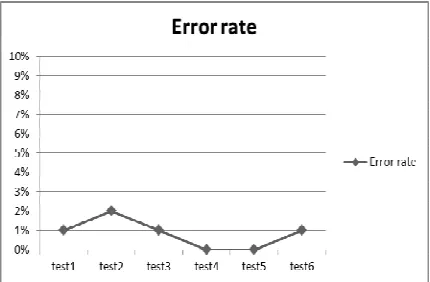
[image:4.612.90.297.185.317.2]In order to test and verify the stability of the proposed model, proceeding repeated test, and census the error rate, the result shows below.
Figure 3: Error Rate Statistics
In conclusion, the error rate of this proposed value assessment model of HR based on assets appraisal is very tiny, and the model is effective.
Comparing with employees’ actual situation after value evaluation to the company's 300 employees, the contrast results are shown below.
Figure 4: The Results Of The Assessment Statistics
Figure.4 shows the comparison results of evaluation and actual results, in which 285 people are completely accord with the actual situation, 7 are according with, 5 are general accord with, 2 are basically not conform to, none is completely not in conformity with, actual situation is evaluated by human resources experts. From that, the proposed model is practical and effective.
6. CONCLUSIONS
Based on the existing human resources value evaluation method, the paper proposed a human resource value evaluation model based on the assets assessment. The model is established based on economic value method, the future salary reward discount method, random compensation value method, and separated contribution of human resources by using distribution value method, the model shows that it’s practical and effective through examples, which is worth for spreading use.
REFERENCES:
[1] H. Liu. “National audit human resource value
evaluation research.” Audit and Economic Research. Vol. 3, No.3, 2012, pp.16-24.
[2] Q. Liu, J.J. Zhou “Hunan resources value
evaluation under era of knowledge economy.” Journal of Shandong University:Philosophy Social Science Edition. Vol. 13, No.3, 2012, pp. 52-58.
[3] L. Ma, “Research and review of enterprise
[image:4.612.90.305.439.580.2]919
[4] Z.Q. Shao, “Comparison of Intangible assets
appraisal pricing with Accounting
measurement.” Accounting Communication:
Comprehensive Version. Vol.6, No.2, 2012, pp.66-67.
[5] B. Yu, X.K. Jin, “Research of internal
governance mechanism of enterprise asset appraisal institution.” Science and Technology Management Research. Vol.7, No.9, 2012, pp.210-213.
[6] Y. Peng, L. Bi, “Methods and steps of
Constructing unified human resources
management information system.” Computer Science. Vol. 39, No.6, 2012, pp. 464-465.
[7] H.J. Fang, “Analysis of literature of
international human resource management research Based on the SSCI.” Scientific and Technological Progress and Countermeasures. Vol.29, No.4, 2012, pp.145-149.
[8] J .X. Wang, “Perfect state-owned assets
supervision of cultural enterprise and assets evaluation.” Finance Supervision. Vol.4, No.4, 2012, pp. 9-10.
[9] L.X. Wang, L.L. Zheng, Zhang X, “Sharing
performance evaluation index system design of R& d organizational technological human resources in.” Scientific and Technological Process and Countermeasures. Vol.29, No.5, 2012, pp. 125-129.
[10] F. Li, Z.J. Yang,J.Z. Xu, “Research on
selection of human resources management mode of Small and medium-sized enterprise.” Study and Exploration. Vol.7. No.8, 2012, pp. 119-122.