ISSN: 1992-8645 www.jatit.org E-ISSN: 1817-3195
706
R&D EFFICIENCY EVALUATION OF COMPUTER
INDUSTRY IN CHINA BASED ON AN IMPROVED DEA
MODEL
CHENGDONG WANG, LIANGQUN QI, YUANYUAN CAI
School of Management, Harbin University of Science and Technology, Harbin150080, China
ABSTRACT
The computer industry plays an important role in promoting the development of national economy and national comprehensive power of China. As an important evaluation indicator, the R&D efficiency of computer industry becomes one of the most important research fields currently. According to the shortages of traditional C2R model of DEA, this paper constructs an improved DEA model for measuring the R&D efficiency of computer industry and does an empirical research on R&D efficiency of computer industry in different regions. This research shows that: the improved DEA model overcomes the shortages of traditional C2R model and it is able to reflect the difference of R&D efficiency between different regions more effectively; Compared with efficiency frontier, the R&D efficiency of Chinese computer industry has potentials to improve; The R&D efficiency of Chinese computer industry is influenced by various factors, such as government support capacity, market structure and enterprise scale; Improve the environment of R&D activities is more effectively than increase the input of R&D resources in improving the R&D efficiency of Chinese computer industry.
Keywords: Computer Industry, Evaluation of R&D Efficiency, Improved DEA Model, Influence Factor
1.
INTRODUCTIONAs a typical high-tech industry, the computer industry not only has an important influence on the other industries and national economy, but also promotes the development of them. Therefore, developing the computer industry has become a high-effectively way to promote China's economic development. As one of the most important measure indicator of development situation, the R&D efficiency of computer industry becomes one of the most important research fields currently.
The outline of the paper is as follows. In section 2 we review previous research on previous improvement of traditional DEA model. In section 3, the improved DEA model is proposed. Evaluation of R&D efficiency by the improved DEA model of computer industry is discussed in section 4. Section 5 gives the conclusions and political suggestions.
2.
PREVIOUS RESEARCH REVIEWPrevious researches on R&D efficiency of computer industry are seldom both in China and abroad. However, the research achievements on high-tech industry are more plenty and they provide
707 information, preference structure information and value efficiency analysis information. Specifically, the improved DEA model with prior information includes the following: direct weight restrictions model, which is built up by Dyson, Thanassoulis(1988) [3] and Roll(1990)[4]; cone ratio model, which is built up by Charnes(1989, 1990)[5] [6]; assurance region model established by Thompson(1986)[7] and Beasley’s virtual inputs and outputs restrictions model (1990)[8]. there second kind of improved DEA model is without prior information, such as super efficiency model(Andersen, Petersen(1993)[9], cross-evaluation model(Sexton(1986 )) [10] and multiple objective approach(Li, X. B, (1999)) [11]. In addition, scholars improved the traditional DEA model by changing the input and output variable type both abroad and in China. For example, Cooper(1999)analyzed the DEA model with categorical variables[12], Cook, Kress and Seiford(1993)given an improved DEA model with ordinal numbers as its input and output variables[13], Herbert and Thomas (2004) studied the efficiency network DEA model for evaluating efficiency of complex structured system[14]. The improved DEA models mentioned above still have some shortages: On one hand, the models with priority information cannot avoid the error or bias in judgment of value and priority information. And these shortages may cause the evaluation results are inconsistent with the facts. On the other hand, the improved DEA model without prior information always calculates the weight vector of input and output indicators from the most advantageous angle for their own DMU, which leads to low comparability of efficiency between different DMU. In order to solve the shortages of the DEA model mentioned above, this paper builds up an improved DEA model by drawing lessons from the previous academic achievements of Liu Yingping(2006) [15] and Sun Kai(2008) [16], and does an quantitative research on evaluation of R&D efficiency of computer industry in China based on the improved DEA model. According to the evaluation results, this paper analyzes the current situation and developing rules of computer industry, and provides policy reference for promoting the development of computer industry.
3.
THE CONSTRUCTION OF IMPROVEDDEA MODEL
3.1 Introduction of Traditional DEA Model- C2R
Model
C2R is built up by Charnes, Cooper and Rhodes at 1978, its basic assumption is unchangeable scale to return. The essence of C2R is evaluating the relative efficiency of organization by mathematical programming techniques [17]. At present, most of the researchers are familiar with the traditional C2R model:
Set n comparable DMU, and denoted by DMU1-n,
each DMU has
m
types input ands
types output. So the input vector can be written asT mj j j
j x x x
X =( 1 , 2 ,L, ) , and the output vector can
be written as:
T sj j j
j
y
y
y
Y
=
(
1,
2,
L
,
)
,(j=1,L,n), and theyare constant.
v
=
(
v
1,
v
2,
L
,
v
m)
T arem
types ofinput weight vectors, and T s u u u
u=( 1, 2,L, ) are
s
types of output weight vectors, they are unknown variable.So, the efficiency of Kth DMU can be rewritten as equation (1):
k T
k T
k X v
Y u
V = (1)
Set
V
k, the efficiency value of DMUk , asobjective function, and constraint to the efficiency value of all DMU, we get fractional programmed C2R model as equation (2):
≥ ≥
= ≤
0 , 0
, , 1 , 1 max
v u
n j
X v
Y u
X v
Y u
j T
j T
k T
k T
L
(2)
Transform equation (2) into equation (3) :
tu tv
X v t
k
T = =
= 1 , α , β (3)
Where
α
ism
-dimension column vector,β
iss
-dimension column vector, so,T m tv tv
tv, , , )
( 1 2 L
=
α
, Ts tu tu
tu , , , )
( 1 2 L
=
β
.ISSN: 1992-8645 www.jatit.org E-ISSN: 1817-3195 708 ≥ ≥ = = ≥ − 0 , 0 1 , , 1 , 0 max β α α β α β k T j T j T k T X n j Y X Y
L (4)
3.2 The Improved DEA Model: By Introducing Virtual DMU
The first step: construct virtual DMU. To
construct two virtual DMU named DMUn+1 and
DMUn+2. DMUn+1 is the optimal decision making
unit, its input vector can be written as
T n m n i n n
n x x x x
X +1=( 1, +1, 2, +1,L, , +1,L, ,+1)
and its output vector can be written as
T n s n r n n
n y y y y
Y+1=( 1, +1, 2,+1,L, ,+1,L, , +1) .
DMUn+2 is the worst decision making unit, its
input vector can be written as
T n m n i n n
n x x x x
X +2 =( 1,+2, 2, +2,L, ,+2,L, ,+2)
And its output vector can be written as
T n s n r n n
n y y y y
Y+2 =( 1, +2, 2, +2,L, ,+2,L, ,+2) . Set the input index of optimal decision making unit equal to the minimum value of X , as well as the output index of optimal decision making unit equal to the maximum value of X . So,
)
,
,
,
min(
1 21 i i in
n
i,
x
x
x
x
+=
L
,)
,
max(
1, 2, 1,n r r rn
r
y
y
y
y
+=
L
.Correspondingly, the input and output indexes of the worst decision making unit are maximum value and minimum value of X , that is
)
,
,
,
(
max
1 22 i i in
n
i,
x
x
x
x
+=
L
,Obviously, DMUn+1 and DMUn+2 may not exist
inside the production possibility set, and their introduction is prepared for the following steps as a reference.
The second step: establish the efficiency
evaluation model of optimal DMUn+1. Take the
efficiency evaluation of
n
+2 DMU as constraint; we build up the new DEA model by setting efficiency evaluation V*n+1 of the optimal DMUas objective function. The new DEA model as equation (5) shows:
≥ ≥ = + = ≥ − + + 0 , 0 1 2 , , 1 , 0 max 1 1 β α α β α β n T j T j T n T X n j Y X Y L (5)
So, DMUn+1 is obviously DEA efficiency, and
1
1
* ≡
+
n
V . But the optimum solutions α* and β*
are infinite. So, choosing of the infinite weight vector is needed in order to identify "reasonable" public weight vector for all the
n
+2 DMU.The third step: choose the public weight
vector. From the equation
1 1 * 1 * 1 * 1 * 1 * = = ≡ + + + + + n T n T n T n T n X Y X v Y u V
α
β
we can infer that,optimal decision making unit, DMUn+1
meet 1
0
* 1 *
−
=
+ + n T n TX
Y
α
β
. In order to make sure there are “reasonable” public weight vector, we build model as:2 2 1 1 min 0, 1 1 0 0 , 0
T n T T j j T n T T n n Y
X Y j n
X Y X β α β α β α α β + + + + − ≥ ≠ + = − = ≥ ≥ (6)
The model (6) aims at the minimum efficiency value of the worst decision making unit DMUn+2,
and adds constraint +1− n+1 =0 T
n T
X Y α
β into the model in order to get maximum value of the optimal decision making unit DMUn+1. Change a
kind of statement, form infinite group weight vector of optimal decision making unit, model (6) can choose a group of weight vector which makes the efficiency value of worst decision making unit to be minimum one.
The fourth step: to calculate efficiency value for DMU. By using the following equation (7) and
optimal solutions α** and β** of equation (6),
calculate efficiency value of every decision making unit. ) , , 1 ( * * * * * * n j X Y V j T j T
j = = L
α
β
(7)
709
fourth step. * *
j
V in fourth step is calculated by
public weight vector, so it is objective and rational, and it can solve the problem of traditional C2R model. The problem of traditional C2R model is that, there are more than one DMUs’ efficiency value is 1, and this caused difficulty in distinguishing and sequencing of all the DMU.
However, the efficiency value is far less than 1 sometimes because DMUn+1 and DMUn+2 are virtual
ideal decision making unit. And more or less, this situation reduces the discrimination degree of different DMU on efficiency evaluation. Therefore, replace DMUn+1 by decision making unit DMUα
with maximum efficiency value, and replace DMUn+2 by decision making unit DMUβ
(
1
≤
α β
,
≤
n
) with minimum efficiency value,and introduced into models above. In this way, not only the results of the fourth step are used, but also makes optimal and worst decision making unit have actual significance (the optimal and worst decision making unit are come from production possibility set).
The sixth step: calculate efficiency value by repeating second step to fourth step. From the
fifth step we can see that, DMUα has the maximum
efficiency value in all the DMU, and it is obviously effective compared with other DMU, so it is set as 1. To use DMUα and DMUβ instead of DMUn+1 and
DMUn+2 in equation (4) and equation (5), then
repeat second step to fourth step until we get satisfying efficiency value of all DMU.
4.
R&D EFFICIENCY EVALUATION OFCOMPUTER INDUSTRY IN CHINA
4.1 Selection of Influencing Factors and Evaluation Indexes
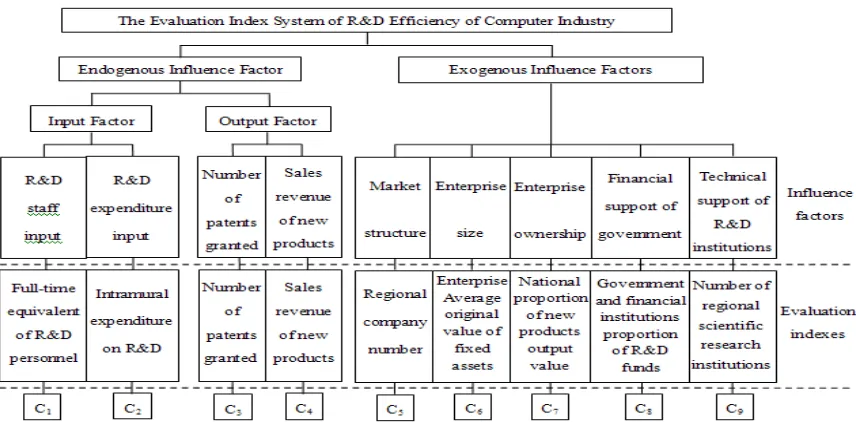
[image:4.612.92.520.436.647.2]R&D efficiency evaluation of computer industry in China by DEA model depends on two aspect endogenous factors: input resources of computer industry in R&D process, and final output results. In addition, exogenous influence factors, such as market structure, enterprise size, enterprise ownership, financial support of government departments and financial institutions and technical support of scientific research institutions have a certain degree influence on R&D efficiency of computer industry in China [18]. To establish R&D efficiency evaluation index system of computer industry in China as shown in figure 1:
Fig. 1. The R&D Efficiency Evaluation Index System of Computer Industry
4.2 Determination of Evaluation Data
Considering the timeliness and availability of data in this paper, we choose “China statistical yearbook 2011”, “China Industrial Economy Statistical
ISSN: 1992-8645 www.jatit.org E-ISSN: 1817-3195
[image:5.612.313.522.102.375.2]710 calculating, we got 23 group data of efficiency evaluation index of regional computer industry, and shown in table 1:
Table I Data Of Regional R&D Evaluation Indexes
[image:5.612.90.298.154.343.2]Descriptive statistics results of the computer industry R & D investment, R & D outputs and influence variables in this paper as shown in table 2:
TABLE 2 Results Of Descriptive Statistics
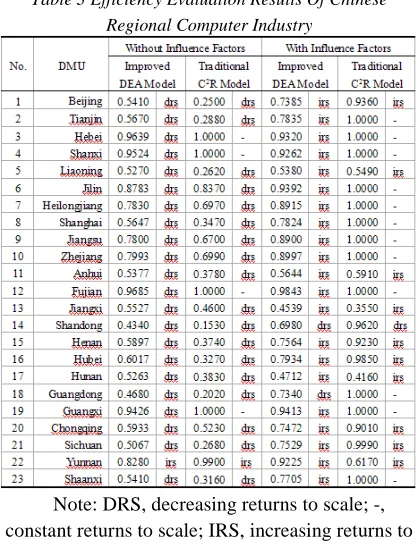
[image:5.612.90.299.402.504.2]Using the improved DEA model above, this paper evaluates the R&D efficiency value of Chinese regional computer industry with and without influence factors of R&D process. The efficiency evaluation results are shown in table 3:
Table 3 Efficiency Evaluation Results Of Chinese Regional Computer Industry
Note: DRS, decreasing returns to scale; -, constant returns to scale; IRS, increasing returns to
scale
4.3 Analysis on R&D Efficiency Evaluation Result of Computer Industry in China
The analysis on evaluation result of computer industry R&D efficiency in China is based on the data in table 1 and table 3, and it shows that:
Firstly, from the perspective of industry, the average efficiency evaluation results of Chinese computer industry without and with influence factors are 0.6603 and 0.7787 respectively. According previous research result of reference [18], the R&D efficiency of Chinese computer industry is in the middle to upper level of high-tech industry. The reason is that, most R&D activities on Chinese computer industry are set focus on implicational research field, and the research results have a high market value and a high conversion rate.
711 frontier production function showed. In the other word, redundancy of inputs or produce insufficient or both of them are existed, and these problems will grow bigger with the increasing investment of R&D activities.
Thirdly, from the perspective of returns to scale: 22 in 23 regions are decreasing returns to scale. But when the exogenous influence factors are considered, this figure dropped to 2 and 21 in 23 regions are increasing returns to scale. These data show that, to improve the R&D efficiency only by increasing R&D investment is not effectively. The exogenous influence factors, such as market structure, enterprise size, enterprise ownership, financial support of government departments and financial institutions and technical support of scientific research institutions should be considered in order to improve the R&D efficiency of computer industry in China.
Finally, from the perspective of influence factors: when the influence factors are considered, the average R&D efficiency value is 0.7787, and it is higher than 0.6603, which is the average R&D efficiency value without considering the influence factors. We can see that, the improvement of R&D efficiency of computer industry is depending on the R&D environment. Therefore, to improve the R&D environment is more effective than increasing R&D input in improving the R&D efficiency of Chinese computer industry.
5.
CONCLUSIONS AND SUGGESTIONSThrough the research above, this paper got the following conclusions:
(1) The improved DEA model designed in this paper is superior to the traditional C2R model on discrimination and disperse degree in R&D efficiency evaluation of Chinese computer industry. (2) At present, R&D efficiency of computer industry is in the middle level of all high-tech industry in China, and the output of Chinese computer industry does not achieve the maximum output which the frontier production function showed. Input redundancy or output deficiency or both of them are existed, and these problems will grow bigger with the increasing investment of R&D activities.
(3) To improve the R&D environment is more effective than increasing R&D input in improving the R&D efficiency. So, exogenous influence factors, such as market structure, enterprise size, enterprise ownership, financial support of government departments and financial institutions and technical support of scientific research institutions should be considered in order to improve the R&D efficiency of computer industry. In addition, ways of financial support need to be changed form “process support” to "result support".
ACKNOWLEDGEMENTS
This work is supported by the following projects: The National Natural Science Foundation of China, No.70773032; Philosophy and Social Science Planning Projects of Heilongjiang Province, No. 11B060; Youth Academic Support Projects of Heilongjiang Province.
REFERENCES:
[1] Akira Suzuki and Kazuyuki, R & D capital, rate of return on R & D investment and spillover of R & D in Japanese manufacturing industry, The
Review of Economics and Statistics, Vol. 71,
No. 4, pp. 555-564, 1989
[2] David Encaoua, Bronwyn H. Hall and Franois Laisney, The Economics and Econometrics of Innovation (Kluwer Academic Publishers, 2000) [3] R. G. Dyson and E, Thanassoulis, Reducing
weight flexibility in data envelopment analysis,
Journal of the Operational Research Society,
Vol. 39, No. 6, pp. 563-576, 1988
[4] Y. Roll, W. Cook, and B. Golany, Controlling factor weights in data Envelopment analysis,
IIE Transactions Journal, Vol. 23, No. 1, pp.
2-9, 1990.
[5] A. Charnes, W. W. Cooper, Q. L. Wei and Z. M. Huang, Cone ratio data envelopment analysis and multiple objective linear programming,
International Journal of System Science,
Vol.20, No. 7, pp. 1099-1118, 1989.
ISSN: 1992-8645 www.jatit.org E-ISSN: 1817-3195
712 [7] R. G. Thompson, Jr. Singleton, R. M. Thrall and
B. A. Smith, Comparative site evaluations for locating a high-energy physics lab in Texas,
interfaces, Vol. 16, No. 6, pp. 35-49, 1986.
[8] J. E. Beasley, Comparing university departments,
International Journal of Management Science,
vol. 18, No. 2, pp. 171-183, 1990.
[9] P.Andersen and N. C.Petersen, A procedure for ranking efficient units in data envelopment analysis, Management Science, Vol. 37, No. 8, pp. 1261-1264, 1993.
[10] T. R. Sexton, Measuring Efficiency: An Assessment of Data Envelopment Analysis, (Jossey-Bass, 1986)
[11] X. B. Li and G. R. Reeves, A multiple criteria approach to data envelopment analysis,
European Journal of Operational Research,
Vol. 115, No. 3, pp. 507-517, 1999.
[12] W. W. Cooper, IDEA and AR-IDEA: Models for Dealing with Imprecise Data in DEA,
Management Science, pp. 597-607, 1999.
[13] W. D. Cook, M. Kress and L. Seiford. On the Use of Ordinal in Data Envelopment Analysis.
Journal of the Research Society, Vol. 45, No. 4,
1993, pp. 133-140.
[14] Herbert F. Lewis and Thomas R. Sexton, Network DEA: Efficiency Analysis of Organizations with Complex Internal Structure,
Computers & Operations Research, Vol.31, No.
9, pp. 1365-1410, 2004.
[15] Liu Yingping, Lin Zhigui and Shen Zuyi, Effective Data Envelopment Analysis Method for Ranking Decision Making Units, Systems
Engineering theory & Practice, Vol. 17, No. 3,
pp.112-116, 2006.
[16] Sun Kai and Ju Xiaofeng, Modified Data Envelopment Analysis Model for Distinguishing Efficient Decision Making Units,
Journal of Systems & Management, Vol. 17,
No. 2, pp. 134-137, 2008.
[17] A. Charnes, W. W. Cooper and E. Rhodes, Measuring the Efficiency of Decision-Making Units, European Journal of operations Research, Vol. 2, No. 6, pp. 429-444, 1978.
[18] Chen Xiude and LIANG Tongying. An empirical research on R&D efficiency and influence factors of China’s high-tech industry-based on panel-data SFPF model, Studies in
Science of Science, Vol. 28, N. 8, pp.