ISSN: 1992-8645 www.jatit.org E-ISSN: 1817-3195
MIGRATION OF A RELATIONAL DATABASE RDB TO AN
OBJECT ORIENTED DATABASE OODB
1
ALAE EL ALAMI, 2MOHAMED BAHAJ,3ILIAS CHERTI
1, 2,3
Hassan 1 University, FST Settat LAB LITEN
1
[email protected], [email protected], 3
[email protected]
ABSTRACT
The objective of this paper is to propose a solution to the migration of RDB to OODB which is based on metadata and the principle of semantic enrichment to extract different object principles including inheritance, aggregation, and composition. Then, to achieve the transformation of the physical schema and to establish the migration of data to the target database. This is done in an automatic way, a prototype has been implemented that takes a RDB and converts it to an OODB which is part of reverse engineering. Then, to realize the relational-object data mapping that respects the passage by reference and the different object principles.
Keywords: RDB, ORDB, OODB, Semantic Enrichment, Schema Translation, Data Mapping, Metadata,
DB4O
1. INTRODUCTION
The relational model is a concept based on the principle of relation, all of these data is organized in a table, based on set theory which is known as a
fundamental theory built around functions,
relationships, integers, real numbers... The
relational model is known for the simplicity of its design, ease of use, based on SQL which is a standardized language that follows the ISO/CEI 9075 :2011.
The relational model is limited as it uses a rigid structure, encounter much difficulty during its evolution, its simplicity also deprives him of several concepts, since it is based on set theory, and a set by definition refers to a collection objects, hence the birth of this data migration approach of a RDB to an OODB.
Several approaches have discussed the database migration problem, some are devoting to the migration of relational databases to the ORDB, an approach based on a data model called SOT Semi Object Type, which is based on the transformation of relational schema with the principle of reverse engineering, then the re-design of the SOT to an object-oriented schema through Frameworks, in the end achieving the migration of data[1].
An approach is based on the principle of modeling object using UML modeling language, which takes as starting element a class diagram, then the diagram extends stereotype for an
advanced object-relational, the use of annotations helps developers to choose well which UDT must be compiled[2] [8].
Maatuk and Akhtar [3] discusses the problem of migration of a RDB to an ORDB, based on the RDB transformation to a Canonical Data Model, then complete its transformation into a physical schema based on a set of treatment.
Another approach makes the migration of RDB to ORDB in a Meta-model derived from the RDB,
then achieve the transformation to its target following a physical schema processing assembly and function, according to an intelligent design that supports different type of DBMS and in an automated manner [4].
A particular approach realize the migration of a RDB to an ORDB at the data mapping, based on a Meta-model and an object relational physical schema of the original RDB created before, data migration is done in an automatic manner which is based on intelligent detection methods of object concept [5].
ISSN: 1992-8645 www.jatit.org E-ISSN: 1817-3195 Other concept of migration approach is used to
show the transformation of a conceptual model based on a class diagram to an XML file based on
mathematical formulas to create graphs and XSD schemas, then define structure and end up by the validation and storage [7].
Xiuzhen Zhang [9] explain an approach of transformation of the RDB towards well-structured OODB schemas, which bases itself on the principle of keys, the inclusion dependence, and some constraint to establish the object oriented aspects as inheritance and association between the classes. The role of the approach is to eliminate data redundancy through a theorem on the multi-valued dependency MVD.
The approach of Andreas Behm [10] show the migration of the RDB towards the OODB bases itself on the definition of the user defined transformation rules, and generates the object-oriented physical schema and data migration that goes with it.
An approach uses the migration of RDB to OODB through a canonical model[13], which enriched the source relational database with object characteristics required, and cardinalities for key migration to establish the object schema physical target according to the ODMG standard[11] [12].
Certain approach shows the migration of RDB to OODB and promotes the ODBMS to the RDBMS by the fastness, direct manipulation of data persistence, increased security level in the data due to the three levels of access to data and their worn for instance variables and methods[14].
Our approach discusses the migration of relational databases to object-oriented databases, a
prototype was created which proves the
effectiveness of this approach, based on the principle of semantic enrichment which acts as the core of the application. the prototype extract and translate the physical schema of the relational database to an object-oriented physical schema and performs the data mapping of the RDB to an OODB, all in an automatic manner without the interference of the human factor.
2. SEMANTIC ENRICHMENT
The semantic enrichment is the first step of migration, which is an extended relational model, defined as a Meta-model that defines the different classes extracted from the RDB through metadata[15].
The Meta-model is defined as a collection of classes : = {C | C: = (Cn, Degree, Cls, A, Contributor)}
Cn =the name of the class.
Degree = first degree (the tables that contain PK) | 2nd degree (the tables that contain FK without PK).
Cls=aggregation, association, inheritance, simple class (the class that does not belong to the other classifications).
Contributor=class list that show the relation between classes.
ISSN: 1992-8645 www.jatit.org E-ISSN: 1817-3195
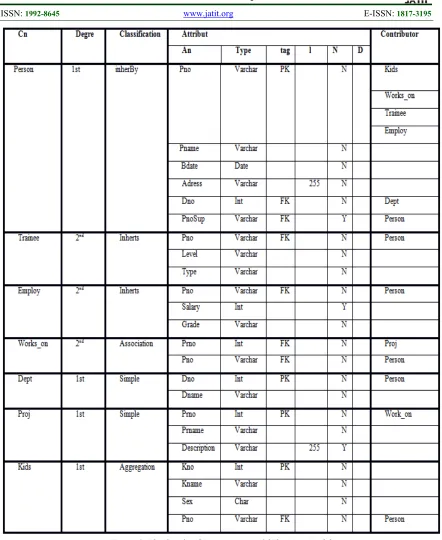
Figure 1: Structure of the Meta-model by metadata
The Meta-model creation process is carried out in two stages, the first stage is based on the extraction of information available outside these
ISSN: 1992-8645 www.jatit.org E-ISSN: 1817-3195
Figure 2: The Graphical Representation Of The Meta-Model
Using metadata to capture the structure and the information accessible through JDBC regarding the source RDB, the table below provides an overview of the main instructions to develop the Meta-model.
The second step is the detection of object principles from the relational database, our approach of database migration is done in an automatic way for every migration steps including
ISSN: 1992-8645 www.jatit.org E-ISSN: 1817-3195 parameter attribute of the Meta-model which
specifies if the attribute can have a worthless value. The degree of a class varies according to the identifier of the table if there is a primary key either not or if it is about a key composite. There are two values in the category degree, first degree for the classes which have a primary key and the second degree for the classes which not have a primary key or when it is a composite key.
The classification of classes is made dynamically according to a set of processing to perform and by the apprenticeship from the degree.
+For associations, the classification is made according to the degree, the absence of primary key and the interaction with two or more classes. For reflexive associations that interact in the same table, it is detected by the appearance of a foreign key that has no other table as a primary key resulting from a self-contribution.
+inheritance is detected according to a data dictionary that includes a set of names, each name indexes a set of synonym or list of matching words, which are dependent on the mother-daughter relationship according to standard naming rules, if we find a match we proceed with the verification of primary keys, if there's a match between the keys, which proves that there's an inheritance relationship daughter-mother, otherwise the treatment is
continued (this check is used to address the problem of non-standard databases).
+Composition is detected when the class itself interacts with a single class, provided Cn.Classification≠association and there is no dependency between the two tables←(absence of RESTRICT or CASCADE).
+aggregation is detected when the class itself interacts with a single class, provided Cn.Classification≠Association and taking into account the dependency between the two tables←(existence of one of these keyword RESTRICT or CASCADE) in order to keep a history when deleting the object that comes into contact with it.
+Simple classes are the classes that remain without any of these classifications mentioned earlier and which are in the first degree.
3. SCHEMA TRANSLATION
[image:5.612.92.524.407.689.2]The physical schema object-oriented database consists of a set of classes, class declares an attribute set that is the state of objects and their behavior, the object-oriented physical schema will be achieved in an automatic manner according to a set of processing based on the Meta-model.
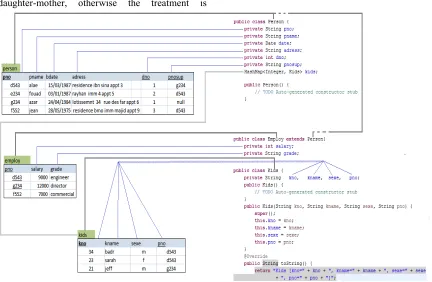
ISSN: 1992-8645 www.jatit.org E-ISSN: 1817-3195 The figure above shows how the relational
tables are mapped to an object-oriented physical schema according to the Meta model with respect for the naming rules and characteristic of the principle(aggregation, composition, inheritance, polymorphism, encapsulation...).
The physical schema of the object-oriented database is realized from the meta-model, which begins by making the equivalence between types of extracts data from the RDB and types observed by
the OO programming languages(eg
VARCHAR→String).
Creating simple classes as
Cn.classification=simple, begins by the declaration of variables with their scope then the two constructor(no parameters, with parameter) and methods that retrieves and sends the attribute values.
The creation of the classes association as Cn .classification=association, will be established of its attribute (if it exists) and both identifiers of the classes who enters in association with her with the principle of Hashtables, considered as a class that makes the referencing between two classes or more to eliminate joints problems. For reflexive associations is within the scope of the same class, the principle of the collections are used, the choice of collections changes depending on the parameter null of the parameter attribute.
The creation of the aggregation classes as cn.classification=aggregation, is achieved by the same way as the simple class, the creation of the
aggregation classes whose
cn.classification=aggregation, is achieved by the same way as the simple class, and it is referenced in the class entering in collaboration with it by adding a collection of the same object according to its nullability. The class entering in collaboration with the aggregation exchange skeleton with the appearance of a new object that will be in the constructor with parameter and the getters and setters of the class.
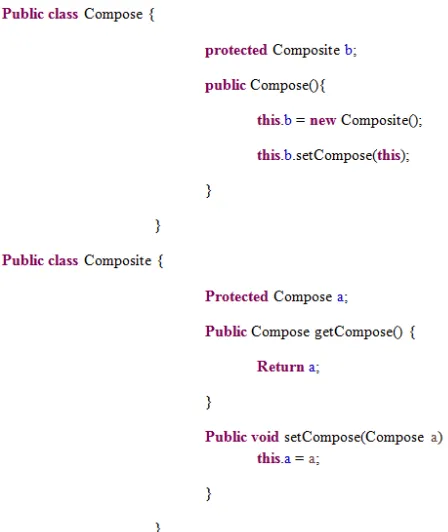
The creation of classes composition as Cn.classification=composition, requires an instance of the class that enters in collaboration with the composition, contain an instance of the class classified as composition, which render their instance physically related.
[image:6.612.314.538.189.455.2]Figure 4: Graphic representation of the composition
Figure 5: Implementation Of The Composition Concept
The creation of classes inheritance as Cn.classification=inherBY will be treated like other single classifications and the inheritance as Cn.classification=inherts Will inherit from classes which enters in collaboration with her.
Algorithm producing OODB schema :
Foreach class C
∈
meta-model doif C.Classification ≠ ’composition’ then
autoDeclarationClass();
autoGenerationAttribut();
autoGenerationConstructor();
autoGenerationConstructorAttribut();
autoGenerationGetters();
autoGenerationSetters();
ISSN: 1992-8645 www.jatit.org E-ISSN: 1817-3195 end if
end for
#capitalFirstLetter(){
String className :=
C.Cn.replaceFirst(".",(table.charAt(0)+"").toUpper Case());
Return className;
}
#autoDeclarationClass(){
If C.Classification≠ ( ‘inherts’ && ‘composition’ ) then
Print (“ private class
”+capitalFirstLetter(C.Cn)+” { ”);
Else if C.Classification= ‘inherts’ then
Print (“ private class
”+capitalFirstLetter(C.Cn)+” extends
“+C.capitalFirstLetter (contributor)+” { ”);
End if
}
#autoGenerationAttribut()
For C.Contributor.firstElement to
C.Contributor.lastElement
Foreach C1∈ meta-model do
If C1.Contributor.element = ‘agregation’ then
If C.Attribut.N = ‘n’ then
print("privateHashMap<Integer, "+capitalFirstLetter (C1.Cn)+"> "+C1.Cn +” ;”);
else
print("privateHashTable<”+capitalFirstLetter (C1.Cn)+ ”,Integer) >“+C1.Cn +” ;”);
End if
End if
End for
//same treatment for the reflexive association
End for
For C.Attribut.firstElement to
C.Attribut.lastElement
If C.Attribut.type = ’Varchar ’ then
Print(“private String
”+C.Attribut.An+” ;”);
Else //same treatment for the other types
End if
End for
#autoGenerationConstructorAttribut()
Print (“public ”+capitalFirstLetter(C.Cn) +"(");
For C.Contributor.firstElement to
C.Contributor.lastElement
Foreach C1∈ meta-model do
If C1.Contributor.element = ‘agregation’ then
If C.Attribut.N = ‘n’ then
print("
HashMap<Integer, "+capitalFirstLetter (C1.Cn)+"> "+C1.Cn +” ,”);
else
print("privateHashTable<”+capitalFirstLetter (C1.Cn)+ ”,Integer) >“+C1.Cn +” ,”);
End if
End if
End for
End for
For C.Attribut.firstElement to
C.Attribut.lastElement
If C.Attribut.type = ’Varchar ’ then
If C.Attribut.lastElelement = false
Print(“String ”+C.Attribut.An+” ,”);
Else Print(“String
”+C.Attribut.An+” ){”);
End if
Else //same treatment for the other types
End if
End for
If C.Classification ≠ (‘inherits’ && ‘composition’) then
For C.Contributor.firstElement to
C.Contributor.lastElement
ISSN: 1992-8645 www.jatit.org E-ISSN: 1817-3195 If C1.Contributor.element =
‘agregation’ then
print(" this."+C1.Cn+" = "+C1.Cn +” ;”);
End if
End for
End for
For C.Attribut.firstElement to
C.Attribut.lastElement
If C.Attribut.type = ’Varchar ’ then
Print(“this. ”+C.Attribut.An+” = ”+ C.Attribut.An);
Else //same treatment for the other types
End if
End for
Else If C.Classification = ( ‘inherits’ ) then
Print(“super();”);
For C.Contributor.firstElement to
C.Contributor.lastElement
Foreach C1∈ meta-model do
If C1.Contributor.element = ‘agregation’ then
print(" this."+C1.Cn+" = "+C1.Cn +” ;”);
End if
End for
End for
For C.Attribut.firstElement to
C.Attribut.lastElement
If C.Attribut.type = ’Varchar ’ then
Print(“this. ”+C.Attribut.An+” = ”+ C.Attribut.An);
Else //same treatment for the other types
End if
End for
End if
Print(“}”);
………
4. DATA MAPPING
The part of data mapping from a RDB into an OODB, we opt for db4o which is a database open source embeddable object, which works on the operating system that supports Java or.NET language[16], which provides the ability to write the query in the programming language himself, queries in db4o is based on the Simple Object database Access SODA query API[17], which provides classes to perform complex queries on OODB.
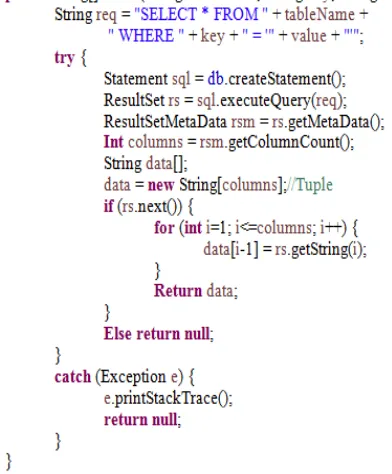
To establish the migration of data we need two types of methods that retrieve data, a method for the complete recovery of a table, and another to make a personalized selection which aims to make the correspondence between the base class reference and DAO data Access Object that provides the ability to separate the object persistence and data access[18].
[image:8.612.323.519.339.576.2]The custom select query is as follows:
Figure 6: Select query implementation
Data migration begins with the creation of the method that will be responsible for persistence, with which there will be no instances of the type of the class extracted from the Meta-model, then establish the storage of instances by using certain methods responsible for the storage DB4O according to the Object Container.
For simple classes and associations a simple method is required, for inheritance classes,
ISSN: 1992-8645 www.jatit.org E-ISSN: 1817-3195 through db4o which operates the physical schema
of the object database generated by the constructor of the super-class. For the class aggregations, compositions, and reflexive associations, we call the responsible method for the specific selection to do the correspondence between objects via references and the class which enters into the contribution in the Meta-model will be instantiate first and then integrate into the instance of the class that collaborates with it.
Part of algorithm producing data migration from a RDB to an OODB :
Foreach class C
∈
meta-model doString t[][] = db.selectAll(C.Cn);
If C.Classification ≠ (‘inherits’ && ‘composition’ && ‘inherBy’) then
print("public static void
store"+capitalFirstLetter(C.Cn)+"(ObjectContainer db4o){");
for line=1 to t.length
For C.Contributor.firstElement to
C.Contributor.lastElement
Foreach C1
∈
meta-model doIf C1.Contributor.element = ‘agregation’ then
print(capitalFirstLetter(C1.Cn)+" "+C1.Cn
+line+”=new HashMap<Integer,
“+capitalFirstLetter(C1.Cn)+”>(); “);
String tableAgregation[][] =
db.selectAllByChamp(C1.Cn,C1.Attribut.tag(pk) , t[line][0]);
for(lineAgregation=1 to tableAgregation.length
print(C1.Cn+lineAgregation+".put("+line
Agregation+", new
"+capitalFirstLetter(C1.Cn))+"(");
for(column=0 to tableAgregation[line].length
if(c<tableAgregation[l].length-1) then
print("\""+tableAgregation [line][column]+"\" ,");
else
print("\""+tableAgregation [l][c]+"\");");
End if
End for
End for
End if
End for
End for
End for
for(l=1 to l=t.length)
print (capitalFirstLetter(C.Cn)+" "+C.Cn+l+"=new "+ capitalFirstLetter(C.Cn)+"( ");
if(tableAgregation[l-1]=1)then
print("null, ");
else
print(C1.Cn+l+", ");
End if
for(column=0 to column = t[l].length
if(column<t[l].length-1)then
print(t[l][column]+" ,");
Else print (t[l][ column]+");");
End if
print("db4o.store("+C.cn+l+");");
End for
End for
End if
End for
ISSN: 1992-8645 www.jatit.org E-ISSN: 1817-3195
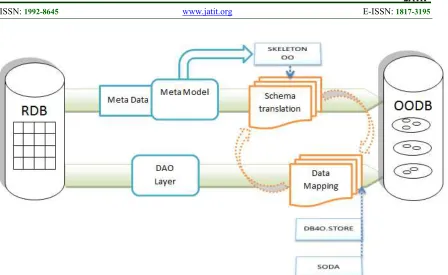
Figure 7: The Cycle Of Processing Of A RDB Towards An OODB
5. CONCLUSION
All in all, the article discusses the migration of a RDB to an OODB using metadata and meta-model that encapsulate all of the RDB and add the principles of object model through semantic enrichment, then establish the transformation of the relational physical schema to the object physical schema based on the Meta model and to realize the data mapping to the new physical schema, explaining the procedure to follow and proposing an algorithm to determine the selection.
Finally we realized a prototype which makes the migration in an automatic way without the interference of the human factor; the tests and the results prove the efficiency of our approach.
REFRENCES:
[1] A. Behm, A. Geppert, R. Dittrich, Algebraic
Database Migration to Object Technology,
Proceeding ER'00 Proceedings of the 19th
international conference on Conceptual
modeling ,Pages 440-453.
[2] E. Marcos, B. Vela, J.M. Cavero, A
Methodological Approach for
Object-Relational Database Design using UML,
Software and Systems Modeling
Volume 2, issue 1,pp 59-72.
[3] A. Maatuk, A. Ali, N. Rossiter, Converting
Relational Databases into Object-relational
Databases, in JOT, vol. 9, no. 2, pages
145-161, 2010.
[4] A. El Alami, M. Bahaj, The Road to a Full
Migration of Relational Database (RDB) to
Object Relational Database (ORDB):
Semantic Enrichment, Target Schema, Data
Mapping, International Journal of Advanced
Information Science and Technology (IJAIST)
Vol.30, No.30, October 2014 ISSN:
2319:2682
[5] M. bahaj, A. El Alami, The Migration Of Data
From A Relationaldatabase (RDB) To An
Object Relational (ORDB) Database, Journal
of Theoretical and Applied Information
Technology, 20th December 2013. Vol. 58
No.2 ISSN: 1992-8645.
[6] A. El Alami, M. Bahaj, The Migration of a
Conceptual Object Model COM (Conceptual
Data Model CDM, Unified Modeling
Language UML class diagram ...) to the
Object Relational Database ORDB, MAGNT
Research Report (ISSN. 1444-8939) Vol.2
(4). PP: 318-327.
[7] M. Bahaj, N. Gherabi, Robust Representation
for Conversion UML Class into XML
Document using DOM, International Journal
of Computer Applications (0975 – 8887)
ISSN: 1992-8645 www.jatit.org E-ISSN: 1817-3195
[8] T. Quatrani, Visual Modeling with Rational
Rose 2000 and UML. Publisher: Addison
Wesley Second Edition, October 19, 1999
ISBN: 0-201-69961-3, 288 pages.
[9] X. Zhang, Y. Zhang, J. Fong, X. Jia,
Transforming RDB schema into
well-structured OODB schema, Information &
Software Technology, 41 275-281 (1999).
[10] A. Behm, A. Geppert, R. Klaus, On The
Migration Of Relational Schemas And Data To Object-Oriented Database Systems, In:
Proceedings of the 5th International
Conference on Re-Technologies for
Information Systems, pp. 13–33 (1997).
[11] A. Maatuk, M.A. Ali, N. Rossiter, Relational
database migration: A perspective, in DEXA,
vol. 5181, pp. 676–6832008.
[12] A. Maatuk, M.A. Ali, N. Rossiter, An
integrated approach to relational database
migration, in IC-ICT2008, 6 pp.
[13] A. Maatuk, M.A. Ali, N. Rossiter, Semantic
Enrichment: The First Phase of Relational
Database Migration, In CIS2E '08, 6pp,
Bridgeport, USA, 2008.
[14] M. Alam, S.K. Wasan , Migration from
relational database into object oriented
database, Journal of Computer Science, vol. 2,
issue. 10,pp 781-784.
[15] A. El Alami, M. Bahaj, Migration of the
Relational Data Base (RDB) to the Object
Relational Data Base (ORDB), World
Academy of Science, Engineering and
Technology International Journal of
Computer, Information Science and
Engineering, Vol:8 No:1, 2014.
[16] J. Paterson, S. Edlich, H. Hörning, and R.
Hörning. The Definitive Guide to db4o.
Apress, 2006.
[17] https://docs.oracle.com/cd/E12095_01/doc.10
303/e12548/csoda.htm
[18] http://www.oracle.com/technetwork/java/data