ISSN(Online): 2320-9801
ISSN (Print): 2320-9798
I
nternational
J
ournal of
I
nnovative
R
esearch in
C
omputer
and
C
ommunication
E
ngineering
(An ISO 3297: 2007 Certified Organization) Website: www.ijircce.com
Vol. 5, Issue 4, April 2017
Improve Resource Utilization by Visualization
Technology in Fog Computing Environment
Radha1, Dr. Vivek Kumar2
Ph.D. Scholar,Singhania University, Pacheri Bari, Distt. Jhunjhunu, Rajasthan,India1
Director & Principal, Delhi College of Technology & Management, Palwal, Haryana,India2
ABSTRACT: Cloud computing means sharing of computing resources throughout any communication network by employing virtualization. Virtualization permits a server to be sliced in virtual machines. Every virtual machine has its own applications/operating system that quickly adjust resource distribution. Cloud computing provides several advantages, one of them is flexible resource distribution. To satisfy the needs of clients, cloud environment should be elastic in nature and can be obtain by effective resource allocation. Resource allocation is the phenomenon of allocating existed resources to clients throughout the internet and plays critical role in Infrastructure-as-a-Service (IaaS) model of cloud computing. Flexible resource allocation is needed to optimize the assignment of resources, reducing the response time and increasing the throughput to enhance the cloud computing performance. Enough solutions have been introduced for cloud computing to enhance the performance but for fog computing still effective solution have to be discovered. Fog computing is the virtualized intermediary layer between cloud and clients. It is a highly virtualized technique which is same as cloud and offer computation, data, storage, and networking facilities between cloud servers and end users. This paper presents an effective algorithm and architecture for resources provisioning in fog computing environment by employing virtualization technology.
KEYWORDS: fog data server (FS) , Cloud data server (CS), Fog computing, Efficient Resource Allocation (ERA) algorithm
I. INTRODUCTION
ISSN(Online): 2320-9801
ISSN (Print): 2320-9798
I
nternational
J
ournal of
I
nnovative
R
esearch in
C
omputer
and
C
ommunication
E
ngineering
(An ISO 3297: 2007 Certified Organization) Website: www.ijircce.com
Vol. 5, Issue 4, April 2017
II. LITERATURE REVIEW
Nisha Peter et. al. [1]; Here, In this paper author represent an Small computing works that locally processed and responses to the end users without the use of cloud. For the performance evaluation author had taken IOX platforms as a simulation tool. After the simulation result author conclude that fog computing is entering an exciting time, where it can positively affect operational costs and it resolves problems related to congestion and latency. Fog computing also provides an intelligent platform to manage the distributed and real-time nature of emerging IoT infrastructures.
Pranati V. Patil et.al.[7]; In this paper author comprehensive the motivation and advantages of Fog computing, and analyses its applications in a series of real scenarios and discuss the state-of-the-art of Fog computing and similar work under the same umbrella. In this paper author apply different application of fog computing and compare cloud and fog computing. . After the simulation result author conclude that the fog will dramatically shift many of our current practices at almost every layer of the IT stack, like apps development, network traffic management
III. PROPOSED ARCHITECTURE
In cloud computing, the efficient resource allocation is the generalized on to execute the economic benefits. Resource Allocation plays an important role to mature they perform of the entire system and increase up the level of customer satisfaction. Server virtualization is an integral of resource allocation. Server virtualization improves the resource devotion of the system, overall confession time and total estimated cost. The work is based on cloud computing technology integral with fog computing technology.
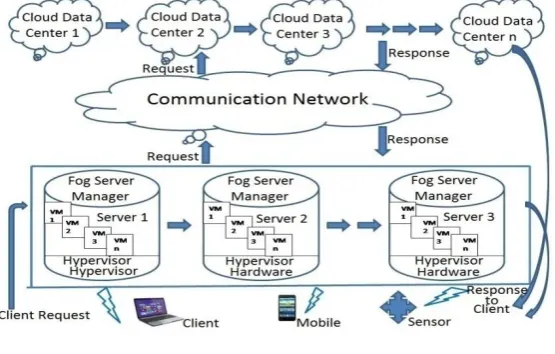
Fig 1. Fog Architecture
The important feature of fog computing is location awareness, mobility, low latency, and distributed geographically. Fog computing is not the replacement into the cloud computing, but it reduces the drawbacks of cloud computing and make it expert. Our paper is focuses on the efficient resource allocation algorithm and its applicability in fog environment. We designing analyses the unconventional present algorithms of strength rebate on lapse we bid designed the framework to develop this algorithm.
Design Model
This model is designed in a cloud-fog environment. So, the model has three layers named as client layer, fog layer and cloud layer. First, we implement the algorithm in client and fog layer to fulfil the requirement of resources for clients. If no resource is available in fog layer than move the request to cloud layer.
Step 1. All the data centres will be arranged in fog layer and in cloud layer. Each fog layer has number of fog data server (FS) and cloud layer has number of cloud data center (CS).
ISSN(Online): 2320-9801
ISSN (Print): 2320-9798
I
nternational
J
ournal of
I
nnovative
R
esearch in
C
omputer
and
C
ommunication
E
ngineering
(An ISO 3297: 2007 Certified Organization) Website: www.ijircce.com
Vol. 5, Issue 4, April 2017 Step 3. Initially, any client will submit their request to any fog data server (FS), and then fog data server loads the request to its fog server manager (FSM).
Step 4. Fog server manager (FSM) will process the service request in following conditions.
I. If all the requesting processors are available to first fog data server, then it loads the result to the client and client sends an acknowledgement to its fog server manager to update the status of the list.
II. If only some requesting processors are available to fog data server, then total task is divided into number of subtasks as per availability.
III. If fog data server is in allocated but early release state, then client will wait for minimum time constraint; then loads the request to fog data server.
IV. If all processors receive at one fog data server but some are failing during processing, then it will again process the request as in II condition.
V. If no processor is available in fog data servers within its fog cluster, then the request is propagated to cloud data server.
Step 5. If the sender has not received the result of their request within maximum allotted time, then client will wait for processing.
Step 6. For further processing client request is propagated to cloud data server (CS).
Step 7. The cloud data server will provide the processor to client directly to increase the response time and sends an acknowledgement to respective fog server manager.
Functional Components
Role of FSM: To enlist all the processors available to the client.
Role of VMs: To handle the request for fog data server and processed the request then provide the result to fog server manager.
Role of FS: It contains one fog server manager and number of virtual machines to handle the request by using the server virtualization technique
IV. PROPOSED ALGORITHM
This is a proposed algorithm for efficient resources allocation in fog computing environment. This algorithm An Efficient Architecture and Algorithm for provisioning resource in fog Computing shows the pseudo code of Efficient Resource Allocation (ERA) algorithm. Objective of this algorithm is to competent commitment of the resource and to abstract the congestion by manipulating the intermediate fog layer.
Hash Map- in which it stores the entry for the last VM allocated to a request from a given user base.
VM State List- this stores the allocation status (i.e. busy available) of each VM. Request Rufds: The request from users to fog data server.
Request Rfdscd: The request from fog data server to cloud data server. CSf: Cloud server process the request.
FSf: Fog server process the request.
FSM: Each fog server contains fog server manager. VMi: Virtual machines at fog server.
Mst: Minimum constraint time to release the processors. Max_time: Maximum allotted time to release the processor. Ti: Threshold value for each request if.
T: Total task
t1, t2, t3…..: Sub task of total task. t1: Number of processors available in FS1. t2: Number of processors available in FS2. 1. For each request Rf.
2. Each request Rufds is sending to nearest fog data server user’s location. 3. Each FSf will process the service request.
4 Fog Server Round_Robin_Load_Balancing ( ) {
ISSN(Online): 2320-9801
ISSN (Print): 2320-9798
I
nternational
J
ournal of
I
nnovative
R
esearch in
C
omputer
and
C
ommunication
E
ngineering
(An ISO 3297: 2007 Certified Organization) Website: www.ijircce.com
Vol. 5, Issue 4, April 2017
6 VM Initialize hash map with no entries;
7 While (new request are received by the Fog Server Manager) 8 Do
{
9 Fog Server Manager queue the requests;
10 Fog Server Manager removes a request from the beginning of the queue for the processing purpose;
11 If (hash map contain any entry of a VM corresponding to the current requesting user base && VM allocation status == AVAILABLE)
{
12 The VM is reallocated to the user base request; }
Else {
13 Allocate a VM to the user base request using Round Robin Algorithm;
14 Update the entry of the user base and the VM in the hash map and the VM state list; }
}
15. IF no processor is available in FS within its fog cluster.
16. THEN request if is propagated to CS through proper communication network. ENDIF
17. Calculate the threshold (Wi). 18. IF Wi <= Max_time
19. THEN client will get a message “Wait for processing” ENDIF
20 For each request Rfdscd.
21 Each request Rfdscd is sending to nearest location CS as FS location. 22 Each CS will process the service request.
23 CS loads the result for client directly.
24 CS sends an acknowledgment to respective FSM.
This algorithm is based on centre of layer (fog) which exists between the clients and clouds. As the request will be complete by the consumer this request will be accepted by all of a add up to covering and not interrupt the clouds. If the request is not prepared favourable its era stretch than this interest is forwarded to clouds by the middle layer. Thus this algorithm is efficient to allot the resources, decrease the response time and maximize the throughput.
V. DESCRIPTION FOR SIMULATION
ISSN(Online): 2320-9801
ISSN (Print): 2320-9798
I
nternational
J
ournal of
I
nnovative
R
esearch in
C
omputer
and
C
ommunication
E
ngineering
(An ISO 3297: 2007 Certified Organization) Website: www.ijircce.com
Vol. 5, Issue 4, April 2017
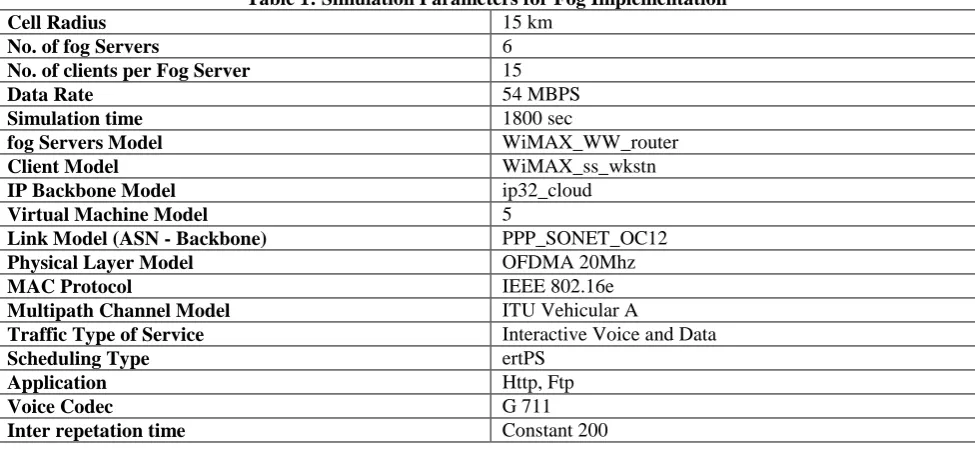
Table 1: Simulation Parameters for Fog Implementation
Cell Radius 15 km
No. of fog Servers 6
No. of clients per Fog Server 15
Data Rate 54 MBPS
Simulation time 1800 sec
fog Servers Model WiMAX_WW_router
Client Model WiMAX_ss_wkstn
IP Backbone Model ip32_cloud
Virtual Machine Model 5
Link Model (ASN - Backbone) PPP_SONET_OC12
Physical Layer Model OFDMA 20Mhz
MAC Protocol IEEE 802.16e
Multipath Channel Model ITU Vehicular A
Traffic Type of Service Interactive Voice and Data
Scheduling Type ertPS
Application Http, Ftp
Voice Codec G 711
Inter repetation time Constant 200
But now the fog layer becomes the consumer bases and cloud layer become data centers. In fog layer there is one user base UB1 and one data center (DC1) instead only one fog server is selected by client if no processor is available to fog layer. This is simply one data center in second phase instead one fog server sends its request to its nearest cloud server. Location of users has been defined in only region 1 of the world and one data centre is located in region 0. In the third stage, we set parameters for client-cloud layer and not considering the two each layer, in reconfigure dynamically with load balancing policy and in optimize response time. In client layer wide are three user bases (UB1, UB2 and UB3) and three data centres (DC1, DC2, DC3).
VI. RESULT AND ANALYSIS
There are various kinds of performance metrics for the performance evaluation of the routing protocols such as delay, throughput and response time. These performance metrics are very essential for representation of the fog computing with virtualization and fog computing without virtualization. In this dissertation work for performance representation and reformation of fog computing with three performance metrics such as delay, throughput and response time. These process need to be checked against certain parameters for their performance. If a client/server gives low end to end delay so this means fog computing is efficient as compare to the cloud computing which gives higher end to end delay. The same is the case with the throughput as it represents the successful deliveries of packets in time. If a client/server shows the high throughput so this means it is the best and efficient fog computing rather than the cloud computing which have low throughput. These parameters have great influence in the selection of an efficient fog computing in any communication network. In the next subsections all considered performance metrics with simulation results has been described.
Throughput: Throughput can be defined as the ratio of the total amount of data reaches a destination from the source. The time it takes by the destination to receive the last message is called as throughput. It can express as bytes or bits per seconds (byte/sec or bit/sec). There are some factors that affect the throughput such as; changes in topology, availability of limited bandwidth, unreliable communication between nodes and limited energy. A high throughput is absolute choice in every network.
ISSN(Online): 2320-9801
ISSN (Print): 2320-9798
I
nternational
J
ournal of
I
nnovative
R
esearch in
C
omputer
and
C
ommunication
E
ngineering
(An ISO 3297: 2007 Certified Organization) Website: www.ijircce.com
Vol. 5, Issue 4, April 2017
Fig. 2- Throughput of fog computing with & without VM
In figure 2, the graph represents the throughput in bits per seconds. The x-axis denotes the simulation time in minutes and the y-axis denotes throughput in bits per seconds. In this graph compare throughput data in fog computing with virtualization and fog computing without virtualization. In this the blue bar indicates fog with virtualization and red bar indicate the fog computing without virtualization in both bar the throughput value flow in bit per second.
End To End Delay
In figure 3, the graph represents the end to end delay in seconds the x-axis denotes the simulation time in minutes and the y-axis denotes delay in bits per seconds. In this graph compare delay data in fog computing with virtualization and fog computing without virtualization. In this the blue bar indicates fog with virtualization and red bar indicate the fog computing without virtualization in both bar the delay value flow in bit per second.
Fig. 3 – Delay of fog computing with & without VM
Response Time: Response time can be defined as the ratio of the total amount of data reaches a destination from the source. The time taken of data from source to destination is called as response time. It can express as bytes or bits per seconds (byte/sec or bit/sec). There are some factors that affect the response time such as; changes in topology, availability of limited bandwidth, unreliable communication between nodes and limited energy.
0 100000 200000 300000 400000
10 min 20 min 30 min 40 min 50 min 60 min
Th
ro
u
gh
p
u
t
(b
it/
sec
.)
Simulation Time (Minutes)
0 0.00005 0.0001 0.00015 0.0002
10 min20 min30 min40 min50 min60 min
D
e
lay
(
b
it/
sec
.)
Simulation Time (Minutes)
ISSN(Online): 2320-9801
ISSN (Print): 2320-9798
I
nternational
J
ournal of
I
nnovative
R
esearch in
C
omputer
and
C
ommunication
E
ngineering
(An ISO 3297: 2007 Certified Organization) Website: www.ijircce.com
Vol. 5, Issue 4, April 2017
Fig. 4- Response Time of fog computing with & without VM
In figure 4, the graph represents the end to end response time in seconds the x-axis denotes the simulation time in minutes and the y-axis denotes response time in bits per seconds. In this graph compare response time in fog computing with virtualization and fog computing without virtualization. In this the blue bar indicates fog with virtualization and red bar indicate the fog computing without virtualization.
VII. CONCLUSION
Fog computing is used in our work because it improve efficiency of cloud computing and reduce the amount of data that needs to be transported to the cloud for data processing and storage. It is inefficient to transmit all the data of Internet of Thing (IoT) and sensors to the cloud, fog computing deal with this problem. So fog is meant to deliver the idea that the benefits of cloud computing can be brought closer to the client. This paper gives the idea about the significance of efficient resource allocation and its related concepts. Cloud computing is difficult to understand without resource allocation because it provides reduced infrastructure cost and elastic scalability. We survey various existing algorithms related to optimal resource allocation and different scheduling techniques. In this paper, an efficient resource allocation architecture and algorithm (ERA) has been proposed and implemented on cloud analyst tool to test the performance of the proposed technique in the fog environment. By implementing the proposed strategy, we find that the proposed strategy can be allocated resources in optimized way and better than existing algorithms in terms of overall response time, data transfer cost and bandwidth utilization in fog computing environment. This document shows the comparison of existing resource allocation strategy with the proposed algorithm in terms of overall estimated response time and cost. Our future work can be extended towards the run time on demand resource allocation, because our algorithm is not satisfying the requirement of resources during the execution of request. We have only allocated those resources to client which are requesting before processing. This work may also be extended towards other issues and matrices in resource allocation such as job scheduling and load balancing by which the efficiency and performance of the system can be increased in fog computing environment.
REFERENCES
[1] Nisha Peter, ”Cloud Computing and Real time Application”, International Journal of Emerging Technology and Advanced Engineering, Vol. 5, Issue 6, pp 266-269, June 2015.
[2] Kc gounda, Anurag Patro, Dines Dwivedi and Nagaraj Bhat ”Virtualization approaches in cloud computing” International Journal of Computer Trends and Technology (IJCTT), Vol. 12, Issue 4, pp161-166, June 2014.
[3] Ivan Stojmenovic and Sheng Wen,” The Cloud Computing Paradigm: Scenarios and Security Issues”, In the Proceedings of Federated Conference on Computer Science and Information Systems, Vol. 2, pp. 1–8, 2014.
[4] Swati Agarwal, Shashank Yadav and Arun Kumar Yadav,” An Efficient Architecture and Algorithm for Resource Provisioning in Cloud Computing”, I.J. Information Engineering and Electronic Business, pp 48-61, January 2016
[5] Clinton Dsouza, Gail-Joon Ahn and Marthony Taguinod,” Policy-Driven Security Management for Cloud Computing: Preliminary Framework and A Case Study”, IEEE IRI 2014, No. 13, pp 16-23, August 2014.
[6] K.P.Saharan and Anuj Kumar,” Cloud in Comparison to Cloud: A Survey”, International Journal of Computer Applications (0975 – 8887), Volume 122 – No.3, pp 10-12, July 2015.
0 5 10 15 20 25
10 min 20 min 30 min 40 min 50 min 60 min
R
e
sp
o
n
se
Ti
m
e
(b
it/
sec
.)
ISSN(Online): 2320-9801
ISSN (Print): 2320-9798
I
nternational
J
ournal of
I
nnovative
R
esearch in
C
omputer
and
C
ommunication
E
ngineering
(An ISO 3297: 2007 Certified Organization) Website: www.ijircce.com
Vol. 5, Issue 4, April 2017
[7] Pranati V. Patil, M. Nagaraju and Ch.Vijay Bhaskar,” Secure Cloud Computing: Providing Data Security”, International Journal of Research in Computer and Communication Technology, Vol 4, Issue 1, pp 53-55, January– 2015.
[8] D.C.Saste, P.V.Madhwai, N.B.Lokhande and V.N.Chothe,” CLOUD COMPUTING: Comprehensive Approach for Avoiding Data Theft Attack Using Decoy Technology”, International Journal Computer Technology and Application, Vol 5(5), pp 1768-1771, Sept.-Oct. 2014.
[9] Tom H. Luan, Longxiang Gao, Zhi Liz, Yang Xiang, Guiyi Wey, and Limin Sunz,” Cloud Computing: Focusing on Mobile Users at the Edge”, arXiv:1502.01815v3 [cs.NI] , pp 1-11, 30 Mar 2016.
[10] Rajesh Bose, Murari Krishna Saha and Debabrata Sarddar,” Cloud Computing Made Easy with the Help of Citrix and Billboard Manager”, International Journal of Computer Applications (0975 – 8887), Volume 121 – No.7, pp 19-23, July 2015.
[11] Viraj G. Mandlekar, VireshKumar Mahale, Sanket S.Sancheti and Maaz S. Rais,” Survey on Cloud Computing Mitigating Data Theft Attacks in Cloud”, International Journal of Innovative Research in Computer Science & Technology, ISSN: 2347-5552, Volume-2, Issue-6, pp 13-16, November 2014.
[12] Durairaj. M and Kannan.P,” A Study On Virtualization Techniques And Challenges In Cloud Computing”, International Journal of Scientific & Technology Research, ISSN 2277-8616 , Volume 3, Issue 11, pp 147-151, November 2014
[13] Kamyab Khajehei,” Role of virtualization in cloud computing”, International Journal of Advance Research in Computer Science and Management Studies, ISSN: 2321-7782, Volume 2, Issue 4, pp 15-23, April 2014.
[14] Thogaricheti Ashwini and Mrs. Anuradha.S.G,” Cloud Computing to protect real and sensitivity information in Cloud”, International Journal of Electronics and Computer Science Engineering, ISSN- 2277-1956, Volume 4, Number 1, pp 19-29
[15] Divya Shrungar J, Priya M P and Asha S M,” Cloud Computing: Security in Cloud Environment”, International Journal of Advanced Research in Computer Science and Software Engineering, ISSN: 2277 128X, Volume 5, Issue 8, pp 803-807, August 2015.
[16] http://blogs.cisco.com/perspectives/iot-from-cloud-to-cloud-computing [17]http://www.webopedia.com/quick_ref/cloud_computing.asp