Proceedings of the 27th International Conference on Computational Linguistics, pages 687–699 687
Exploiting Structure in Representation of Named Entities using Active
Learning
Nikita Bhutani
University of Michigan, Ann Arbor
Kun Qian
IBM Research - Almaden
Yunyao Li
IBM Research - Almaden
H. V. Jagadish
University of Michigan, Ann Arbor
Mauricio A. Hernandez IBM Research - Almaden
Mitesh Vasa IBM Research - Almaden
Abstract
Fundamental to several knowledge-centric applications is the need to identify named entities from their textual mentions. However, entities lack a unique representation and their mentions can differ greatly. These variations arise in complex ways that cannot be captured using textual similarity metrics. However, entities have underlying structures, typically shared by entities of the same entity type, that can help reason over their name variations. Discovering, learning and manipulating these structures typically requires high manual effort in the form of large amounts of labeled training data and handwritten transformation programs. In this work, we propose an active-learning based framework that drastically reduces the labeled data required to learn the structures of entities. We show that programs for mapping entity mentions to their structures can be automatically generated using human-comprehensible labels. Our experiments show that our framework consistently outperforms both handwritten programs and supervised learning models. We also demonstrate the utility of our framework in relation extraction and entity resolution tasks.
1 Introduction
Named entities are atomic objects of reference and reasoning in many cognitive applications and knowledge-centric services like deep question answering, text summarization and analytics. A real-world entity may have a great variety of representations (Gal´arraga et al., 2014; Nakashole et al., 2011). For example,University of California, Santa Cruzcould have different string representations orname variations: UCSC,UC Santa Cruz,UC–Santa Cruz. Determining if two representations refer to the same entity is an important primitive in entity resolution and entity linking algorithms that drive these knowledge-centric applications (Shen et al., 2015; Arasu and Kaushik, 2009).
Unifying entity representations has been widely studied in record linkage (Christen, 2012), deduplica-tion (Elmagarmid et al., 2007) and reference matching (McCallum et al., 2000). Typically, duplicates are identified using the attributes and/or the contextual information of entities (Zhang et al., 2010; Han et al., 2011; Shen et al., 2015). The string representation ormentionof an entity forms key evidence: similar mentions likely refer to the same entity. Although deemed as crucial (Dredze et al., 2010), variations in mentions are typically handled using textual similarity like edit distance and cosine similarity (Zheng et al., 2010; Lehmann et al., 2010; Liu et al., 2013), which can be misleading.
Example. Consider the mentions: (a) General Electric Corporation, (b)General Electric China Corporation, (c)GE Corp. Mentions (a) and (b) are textually similar, differing in just one token. However, they refer to different entities, owing to the location detail‘China’. Conversely, textually dissimilar mentions (a) and (c) refer to the same entity.
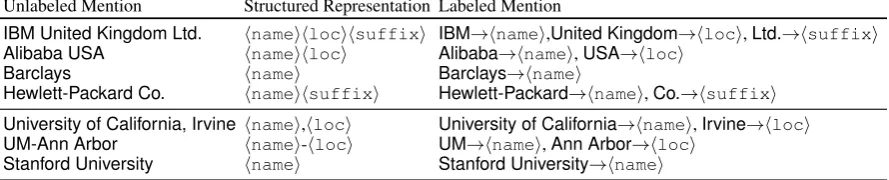
An entity mention is not merely a sequence of characters (Arasu and Kaushik, 2009). It instead has an internal structure, specific to the type of entity. For example in Table 1, the company mentions have a
hnamei, optionally followed byhlociandhsuffixi. Such structural interpretation can help design similarity
Unlabeled Mention Structured Representation Labeled Mention
IBM United Kingdom Ltd. hnameihlocihsuffixi IBM→hnamei,United Kingdom→hloci,Ltd.→hsuffixi
Alibaba USA hnameihloci Alibaba→hnamei,USA→hloci
Barclays hnamei Barclays→hnamei
Hewlett-Packard Co. hnameihsuffixi Hewlett-Packard→hnamei,Co.→hsuffixi
University of California, Irvine hnamei,hloci University of California→hnamei,Irvine→hloci
UM-Ann Arbor hnamei-hloci UM→hnamei,Ann Arbor→hloci
Stanford University hnamei Stanford University→hnamei
Table 1: Example Structured Representations of Company and University Mentions
functions to capture the nuances in name variations of an entity that string similarity functions cannot. For instance,GEcan be explained as a mention ofGeneral Electric Corporationusing transformations like abbreviatehnameiand drophsuffixi. These transformations coupled with string similarity functions can augment existing entity linking algorithms (Qian et al., 2017).
The name variations and, consequently, the transformations are highly domain-dependent (Arasu et al., 2008). Designing similarity functions for an entity type that can reason over the structure of entities requires: (a) a comprehensive list of the structured representations (e.g. column 2 in Table 1), and (b) programs that can map mentions to these structures (e.g. column 3 in Table 1). Traditionally, a domain expert would scan a list of mentions of a target entity type to identify the different structured representa-tions and handwrite programs. This requires specialized skills, and is error-prone and expensive, taking up to several person months to tune the programs for a single application (Campos et al., 2015).
To alleviate the high manual effort, some of the prior works (Arasu and Kaushik, 2009) use declarative, programmable frameworks that allow an expert to directly manipulate the mentions. The expert can provide a program as a set of grammar rules to generate the structured representations. While this equips the expert to manipulate the structure of a mention, it is only a partial solution. The rules are not generic, requiring the expert to specify how each mention is parsed to its structure. This is wasteful because a structure, shared by several mentions, can be captured with a generic rule. Another limitation of previous approaches is that they do not handle structural ambiguities. For instance, there can be multiple structures ofApple Inc.such ashnameihlociandhnameihsuffixi, only one of which is correct.
Since several mentions of an entity type tend to have similar structures, it is possible to learn the vari-ous structures from a subset of mentions. Given a good query strategy, active learning offers a promising approach to efficiently select a small set of such mentions. Moreover, the expert need not provide pro-grams that parse the selected mentions and generalize to unseen mentions. These propro-grams can be in-duced from the labels for the structures of the mentions. Embodying these ideas, we propose LUSTRE, an active-learning based framework that learns structured representations for an entity type from human-comprehensible labels for a small set of mentions. It automatically synthesizesgeneralizableprograms from the labels to map new mentions of the entity type to the learned structured representations. In addi-tion, it allows the expert to incorporate domain knowledge and additional feedback to handle structural ambiguities. Our framework significantly reduces the manual effort in labeling mentions and writing programs for the structured representations. We also demonstrate how these structured representations help define similarity functions that benefit entity resolution, and string transformation functions that benefit relation extraction. The intellectual contributions of this work are as follows:
• Structured Representations.We present a framework to reason about name variations of entities based on their structured representations.
• Active-learning. We present an active-learning approach and a unified query strategy to learn struc-tured representations for a target entity type with minimal human input.
• Program Synthesis. We propose to automatically synthesize generalizableprograms from human-understandable labels to map mentions to their structured representations.
Parsing
Given a set of unlabeled mentions (i.e., raw strings) of a target entity type, our goal is to actively learn a high-quality modelM(with a small number of user labels) that can map a new mention of typeto its structured representation. Key technical challenges in learning such a model include: (1) designing an effective query strategy to find representative mentions that are structurally similar to several other men-tions and to find menmen-tions with diverse structures; (2) automatically inferring mapping programs from the user labels to reduce the human effort, as in (Campos et al., 2015) and (Arasu and Kaushik, 2009); (3) handling ambiguities when an unlabeled mention has multiple candidate structured representations.
Mentions of a target entity type have internalstructured representationsconsisting of atomicsemantic units. Given the labels for the semantic units for a small set of mentions, we want to learn a modelM of mapping rules. Each mapping rule converts a raw string mention into a structured representation.
Definition 1 (Structured Representation). A structured representation S of an entity mention is a se-quence of atomic semantic units that compose its structure.
Textually dissimilar mentions can have the same structure (e.g.Apple Inc.andHewlett-Packard Co.).
Definition 2(Semantic Unit). A semantic unit is a tupleu=hl:piwherelis a label for the unit andp
is a pattern matching function (e.g., a regular expression), referred to as amatcher.
A matcher describes how a substring in a mention matches a semantic unit. For instance, a matcher ([A-Z][A-Za-z]*[-’]?)+captureshnameiin mentionsApple Inc.andGE Corp.Name variations of an entity can be explained as transformations on its semantic units (e.g. dropping suffix inApple Inc.generatesApple).
Definition 3(Mapping Rule). The mapping rulerSfor a structured representationSconsists of matchers which decide how an unlabeled mention is mapped toS, resulting in alabeled entity mention.
Specifically, a mapping rulerS is a sequence of matchers in the semantic units inS, denoted byrS =
{pi | hli, pii ∈ S}. This mapping rule constitutes a program that maps unseen mentions toS. Together the various mapping rules constitute a modelMfor the entity type.
3 The LUSTRE System
We propose LUSTRE that addresses the aforementioned challenges in learning a model of mapping rules for an entity type by:
• adopting a unified query strategy that combines uncertainty sampling (i.e., selecting a mention whose current structured representation is unknown or uncertain) and density-weighted sampling (i.e., select-ing a mention whose structured representation is representative of many unlabeled mentions).
• seeking human-comprehensible labels for the semantic units in the structure of an unlabeled mention, and deducing a mapping rule by combining the matchers for the semantic units.
• handling structural ambiguities of an unlabeled mention by ranking the candidate mapping rules based on theirreliabilityand additional user feedback.
Algorithm 1LUSTRE learning algorithm
input:U =a pool of unlabeled mentions{m}
output:M=a model of mapping rules{rS}
7: selectm∗∈ U, mention with highest utility
8: selectF with least confident predictions
9: query labell∗for mentionm∗
10: query binary feedback onF
11: L=L ∪ hm∗, l∗i,U =U \{m∗}
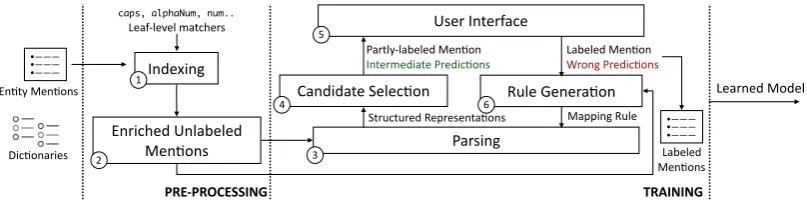
During training, in each iteration, LUSTRE selects a candidate mention for the user to label (Sec 3.2). Given the user-provided labels for se-mantic units of the selected mention, it derives a generic mapping rule for the structure of the mention (Sec 3.3). It then updates the model
M with the new rule, and predicts the structures of unlabeled mentions (Sec 3.4). It presents a sample of these predictions to the user and in-tegrates the user feedback inM (Sec 3.5). This iterative process continues until all the unlabeled mentions can be mapped to some structure or the user is satisfied withM.
3.1 Indexing
User-provided dictionaries and pre-defined reg-ular expressions constitute the vocabreg-ulary of matchers for the mapping rules. The dictionar-ies help capture key domain-specific terminol-ogy but need not correspond to semantic units.
Example.A suffix dictionary may contain ‘Inc.’, ‘Corp’, ‘LLC’, ‘Pvt. Ltd.’
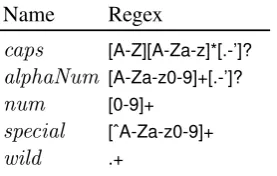
Additionally, we use type-independent regex matchers shown in Table 2. In a pre-processing step (Line 1 of Algorithm 1), we evaluate the
unlabeled mentions against the matchers to save computational overhead. We refer to theseenriched
unlabeled mentionsduring training. Name Regex
caps [A-Z][A-Za-z]*[.-’]?
Example. Given dictionaries for country and suffix and a mention
IBM UK Ltd., the matchers yield matches UK→hcountryi, Ltd.→hsuffixi IBM→[hcapsi,halphaNumi], UK→[hcapsi].
Multiple matchers can match the same token (e.g. hcountryi and
hcapsi match ‘UK’). We assume that more specific matchers offer higher precision than generic matchers. We further formalize this in-tuition in Section 3.3. We rank matchers in the following order based on their selectivity:D>caps>alphaNum>num>special>wild1.
3.2 Candidate Selection
The query strategy to determine what constitutes an informative mention is the central challenge in our active-learning setting (Line 7 of Algorithm 1). We consider a mentioninformativeif its represents the structure of several other unlabeled mentions and its current structure is unknown or uncertain. We adopt a unified approach, combining density-weighted sampling (Settles and Craven, 2008) and uncertainty sampling (Culotta and McCallum, 2005) as it is robust to outliers and input distribution.
For each unlabeled mentionmi, we compute a correlation scoreci (based on its structural similarity to other mentions) and an uncertainty score fi (based on its predicted structure). We then compute a utility scoreui formi, combining its correlation and uncertainty scores, and select a mentionm∗ with the highest utility score for labeling.
To compute correlation scoreci, we need a reliable metric to measure the similarity of the structures of two mentions. Since surface-string similarity metrics won’t suffice, we estimate structural similarity of two mentions as a function of the matchers that constitute their structures. Specifically, we compute structural similarityc(i, j)of a pair of mentions(i,j)as the edit distance of their structures,SiandSj.
1The order of preference can be inferred in a pre-processing step in which the system counts the selectivity of each matcher
Example. ‘IBM Ltd.’ and‘Apple Inc.’ have the same structurehcapsihsuffixi, and therefore, have an edit distance of 0. Each has edit distance 1 to‘Microsoft Asia Inc.’ with structurehcapsihlocihsuffixi.
Given the pair-wise structural similarity metric, the correlation scoreciof a mentionmiis its average structural similarity to other unlabeled mentions.
ci=
To estimate the uncertainty scorefiof a mention, we usePrS, the reliability of the mapping rules that
can parse the mention. If no mapping rule can parse a mentionmi, its structure is unknown i.e. fi is simply 1. Otherwise, it is the uncertainty of the most reliable rulerˆS known to parse the mention. We discuss how the reliabilityPrS of mapping rules are estimated in Sec. 3.4.
3.3 Rule Generation
Once the user labels a selected mention, LUSTRE next has to synthesize a generic program i.e. a mapping rule for the structure of the mention (Line 15 of Algorithm 1). Deriving a mapping rule is non-trivial as semantic units in the structure can potentially span multiple tokens and matchers. As a result, there are many ways to combine matchers and derive the rule.
Example. A user can label‘General Motors’as semantic unithnameiin‘General Motors Co.’ Tokens ‘Gen-eral’and‘Motors’map to matcherscaps andalphaNum. The most reliable interpretation forhnameiis
hname ::caps{1,2}i, a combination of two adjacent matchershcapsi.
LUSTRE derives a reliable rule as the sequence of most selective matchers, whereselectivity is the expected number of matches of a matcher over the set of unlabeled mentionsU (Li et al., 2008).
sel(pi) = E[match(pi, m∈ U)]
withmatch(pi, m)being number of matches ofpiover mentionm.
3.4 Parsing
When a new mapping rule is learned, we want to estimate its reliability in predicting structures of men-tions, and update the modelM (Line 17-18 of Algorithm 1). These reliability scores are used for esti-mating utility scores at candidate selection and for resolving ambiguities when multiple rules can parse a mention (with preference given to the most reliable rule). Following the intuition that generic rules are less reliable, we estimate reliability of a rule based on its expected numbers of matches in the unlabeled mentions. Specifically, reliabilityPrS is a function of the selectivity of the matchers inrS.
p∗= argmin
LUSTRE uses an easy-to-use interface (Qian et al., 2018) to seek labels for a selected mention and additional feedback on intermediate predictions (Line 9 of Algorithm 1). To reduce the labeling effort, tokens in the mention that match an entry in the dictionary are pre-labeled with the name of the dictionary (e.g. ‘IBM Corp’is presented with‘Corp’labeled as suffix). The user can keep these and/or provide new labels (e.g. user can label‘IBM’as name).
In addition, the interface presents the predictions of structures for a sample of unlabeled mentions. It selects 10 least confident predictions based on uncertainty scores (Section 3.2). The user can simply mark a prediction incorrect, without providing labels for its correct structure. LUSTRE effectively integrates this feedback to avoid over-estimating the reliability of learned rules, thereby improving the quality of modelM. Specifically, it updates the reliability of a mapping rulePi
rS as a function of number
withαbeing the decay constant. We found such estimation, though simple, was effective in estimating the reliability of mapping rules. Training more powerful measures such as a discriminative model would require larger user feedback than is available in this setting.
4 Experiments
We assess the effectiveness of our learning algorithm, and the quality and usefulness of learned struc-tures.2
4.1 Experimental Setup
Datasets.We conduct experiments on four entity types of varied complexity and ambiguity.
• Person: Focusing on subtype Individual, we randomly select 200 unique mentions for training and another 200 mentions for testing from the ACE 2005 dataset (Walker et al., 2006). For out-of-domain tests, we randomly select 200 person mentions from Freebase (Bollacker et al., 2008).
• Company: Focusing on subtypeCommercial, we randomly select 200 mentions for training and use the remaining 100 mentions for testing from the ACE dataset. For out-of-domain test, we randomly select 200 company mentions from Freebase.
• Tournament: We use a 50/50 split for the 100 unique mentions of tournaments in Freebase.
• Academic Title: We use a 50/50 split for the 350 unique mentions of academic titles in Freebase. For each mention, we ask two experts to manually annotate every token with a semantic label to produce the ground truth. The average inter-annotator agreement was 0.89 for Cohen’sκ.
Baselines.We compare LUSTRE with the following methods.
• STG: A commercial system (Campos et al., 2015) which requires an expert (with domain knowledge and programming skills) to analyze the structures of an entity type and handwrite mapping programs.
• Linear-chain CRF3: A linear-chain CRF model that predicts a sequence of labels for the tokens in a mention. We use matches from theIndexingstage as features. We use two different training settings: CRF trained on the entire training set (to compare with best model), and CRFLtrained on the subset of training set selected via the query strategy in LUSTRE (to compare with same user effort).
• LUSTRET: LUSTRE with a native tf-idf based query strategy.
Evaluation Metric. We consider a prediction correct if the model and expert agree on the semantic labels for each token in the mention. We measureprecisionas the fraction of predictions that are correct andrecallas the fraction of correct structures that are predicted. We define a new metric, which we call theαvalue, to estimate the role of manual effort on performance of various methods (definition is given below). Intuitively, higher theαvalue, higher the effectiveness of a method in learning from a user label.
α(X, t) = F-score of methodXon entity typet
number of user labels requested byX,where X∈ {LUSTRE, CRF, CRF
L}
.
4.2 Quality Analysis
The performance results of the different methods are summarized in Table 3. ForPersonmentions, all methods achieve reasonably good results (F-scores are all above 0.85). This is not surprising as person mentions typically have simple structures with few semantic units. STG achieves lowest performance, indicating that manually-crafted programs are not as robust as learned models. CRF models, especially CRFL trained on mentions selected using LUSTRE, show evident improvement over STG. LUSTRE achieves comparable performance. However, it outperforms all other methods on out-of-domain test data, suggesting it can capture the structures in mentions regardless of their data source.
Companymentions are more complex than Personmentions. They can have several semantic units such as core name, location, suffix and subsidiary, which can appear in different orders, be separated by special symbols etc. Consequently, capturing structures in company mentions is more difficult, as is reflected in the performance across methods. Learning a reliable model/program would require higher
2
We will release the code and data from this work. Code is proprietary but can be licensed.
manual effort in STG and more training data in CRF. In contrast, LUSTRE, with small human input, achieves high precision and recall for both in-domain and out-of-domain data.
IN-DOMAIN OUT-OF-DOMAIN
Type Algorithm P R F1 P R F1
Person
STG 0.92 0.92 0.92 0.85 0.85 0.85
CRF 0.97 0.97 0.97 0.90 0.90 0.90
CRFL 0.99 0.99 0.99 0.91 0.91 0.91
LUSTRET 0.98 0.95 0.96 0.92 0.90 0.91
LUSTRE 0.99 0.97 0.98 0.92 0.95 0.93
Company
STG 0.83 0.83 0.83 0.79 0.79 0.79
CRF 0.87 0.87 0.87 0.85 0.85 0.85
CRFL 0.81 0.81 0.81 0.73 0.73 0.73
LUSTRET 0.84 0.77 0.80 0.78 0.60 0.68
LUSTRE 0.95 0.86 0.90 0.91 0.85 0.88
Tournament
Table 3: Performances ofLUSTRE,STGandCRF
TournamentandAcademic Titlementions have even more complex structures that exhibit more varia-tions. Even for these complex types, LUSTRE outperforms CRF. We do not report results of STG for these two entity types because these were not considered when STG was developed. We do not provide an out-of-domain evaluation of the two entity types because only the Freebase data included mentions of these entity types.
In summary, LUSTRE outperforms STG and CRF-based methods in terms of overall F-score with the exception of Personwhere CRFLhas a small improve-ment over LUSTRE. Furthermore, its unified query strategy is more effective than a tf-idf based strategy, as is reflected in the performance of LUSTRET.
We found two main sources of er-rors made by LUSTRE. First, akin to all learning methods (such as CRF), it has low recall when the training data is not representative. Second, rank-ing mapprank-ing rules sometimes cannot ef-fectively resolve structural ambiguities. For example, ‘The Stanford University Pro-fessorship in Nephrology’ can be inter-preted ashhonorary prefixihtitleihspecialtyi orhinstituteihtitleihspecialtyi. The former is incorrect, but being more commonly observed in the training data, is ranked higher.
Figure 2: Performance of LUSTRE over itera-tions
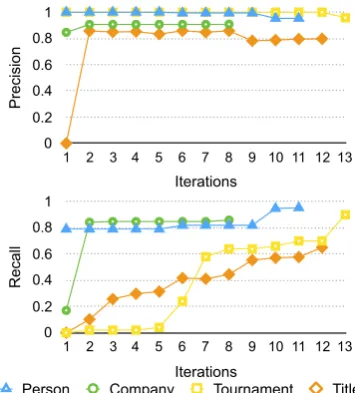
To assess how the quality of structured representa-tions evolves in the learning process, we examine the precision and recall of LUSTRE after each iteration (as shown in Figure 2). We found that the precision remains nearly constant. There are a limited number of structures for the same types of entities. Every time LUSTRE learns a precise rule that improves cover-age. There are slight drops in the precision due to the long tail of non-representative cases. The recall generally increases depending on whether the system prefers to gather additional evidence or to discover new structured representations.
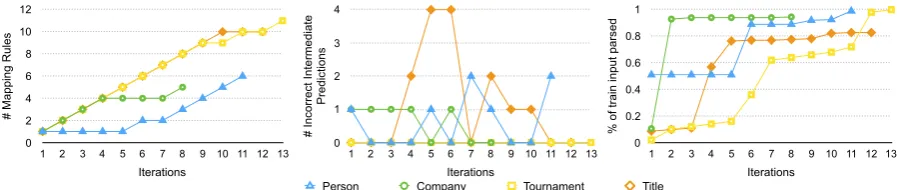
We also examine the number of rules learned, num-ber of incorrect intermediate predictions, and percent-age of input training data covered after each learning iteration in LUSTRE (as shown in Figure 3). We found that it took 8-13 iterations to learn almost all different structures of an entity type. The fraction of
#
Figure 3: Number of mapping rules, number of incorrect predictions, fraction of training data parsed after each iteration
marked incorrect in each iteration. This suggests that LUSTRE, with a small set of labeled mentions and a little user feedback, learned reliable rules and ranked them correctly.
Next, we compare the nature and amount of human effort across different methods. STG requires high effort and high skill. Even for a simple entity typePerson, it takes one skilled developer a few months to manually inspect the different structural patterns and write programs. Learned models such as LUSTRE and CRF reduce the skill level and require only human-readable labels for a mention. However, in contrast to CRF, LUSTRE does not require the user to collect and label a set of representative mentions. It guides the user to interactively and iteratively label a few mentions, with each iteration taking less 7 seconds. The optional feedback also is small (<5 predictions) and low-effort (boolean labels).
LUSTRE CRF CRFL
Table 4: Theαvalues of different methods Quantitatively, we report the αvalues of the three
learning methods. CRF has the lowestα value be-cause it uses all labeled examples. Interestingly, benefiting from the informative mentions selected by LUSTRE, CRFLhave much higherαvalues. LUS-TRE, however, has the highestαvalues.
4.4 Usefulness
We present an extrinsic evaluation on entity resolution and relation extraction tasks, both of which require
reasoning over name variations of entities. We implement a configurable variant generation program that uses structure of an entity to generate its name variations. It allows the user to configure a set of string transformation functions for the semantic units in a structure, which are then used to compose name variations. It supports four transformations: DROP (ignore a token), INITIAL (retain first character of a token),INITIALdot(retain first character followed by a dot) andMAP(replace with user-provided string).
Entity Resolution
Type Algorithm # links Precision # true links
EMP-SOCIAL ERLearn-CIKM 1088 0.93 ∼1015 ERLearn-LUSTRE 1178 0.9 ∼1060
CRYSTAL ERLearn-CIKM 145,516 0.9 ∼130,964 ERLearn-LUSTRE 147,232 0.9 ∼132,508
Table 5: ERLearn-CIKM vs. ERLearn-LUSTRE We use ERLearn (Qian et al., 2017), a
state-of-the-art system for large-scale entity resolution (ER). ERLearn aims to learn a set ofmatching rules, each consisting of matching functions for different entity attributes (e.g., to de-termine duplicate names ‘John Smith’ and ‘J. Smith’). The matching func-tions are mostly based on textual
sim-ilarity of attributes. We replace these with matching functions created using LUSTRE4. We focus on two scenarios: (1)Emp-Social(matching∼470k employee records with 50 million social network user
pro-files) (2)Crystal(de-duplicating∼1.3 million company records). We include new matching functions
forpersonnames andcompanynames for the two scenarios respectively.
As shown in Table 5, the new matching functions help ERLearn identify 4.40% and 1.17% more true links for Emp-Social and Crystal scenarios, respectively. This improvement is significant for
Emp-Socialgiven the extreme low matching ratio for this dataset. ERLearn-CIKM already identifies
a significant subset of the true links in such a sparse space that it is non-trivial for ERLearn-LUSTRE to have found additional 45 true links. In contrast, the ER task is more challenging for the Crystal
scenario, with more matching functions (158 vs. 68) (Qian et al., 2017). ERLearn-LUSTRE could still identify additional 1544 true links, which is a significant improvement over 130k true links already identified by ERLearn-CIKM.5
Relation Extraction
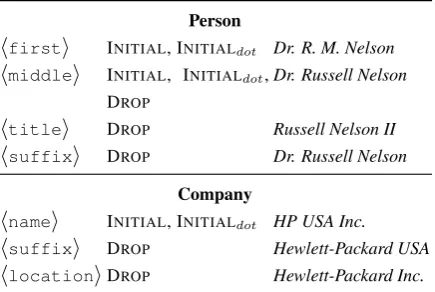
We use MULTIR (Hoffmann et al., 2011), a state-of-the-art relation extractor trained on NY Times text (Riedel et al., 2010) with weak supervision from Freebase (Bollacker et al., 2008). The weak super-vision data is generated by exactly matching the textual mentions to canonicalized entities in Freebase. We instead match to the variations of entities of typesPerson andCompany, generated using the con-figurations in Table 6. We follow the approach of (Hoffmann et al., 2011) to generate supervision data, compute features and evaluate aggregate extraction.
Person
hfirsti INITIAL, INITIALdot Dr. R. M. Nelson
hmiddlei INITIAL, INITIALdot,
DROP
Dr. Russell Nelson
htitlei DROP Russell Nelson II
hsuffixi DROP Dr. Russell Nelson
Company
hnamei INITIAL, INITIALdot HP USA Inc.
hsuffixi DROP Hewlett-Packard USA
hlocationiDROP Hewlett-Packard Inc.
Table 6: Configurations for generating variants For the 2 million entities, we generate 5.3
mil-lion variations. There were 24,882 sentences where textual mentions exactly matched a canon-ical Freebase entity and one of the specified rela-tions existed between the entities. This increased to 34,197 sentences when named variations of en-tities were included, suggesting name variations are useful for entity recognition. By including the variations for only two entity types, we could gen-erate a training data that improved the overall ex-tractor performance (F-1 score increased by 3%
from 0.485 to 0.499). The extractor could further benefit from variations for entities of other types.
5 Related Work
Exploiting the compositional structure of entities and attributes especially from query streams and text has received much attention in databases and NLP literature. It has mostly been used for understanding NL questions (Berant et al., 2013), noun-phrase queries (Li, 2010) or normalizing time expressions (Lee et al., 2014; Bethard, 2013). Consequently, structuring and linking information on the web (Bollacker et al., 2008; Auer et al., 2007) about entities and their attributes, has seen a rise in interest. With this information being automatically extracted from textual data (Fader et al., 2011; Carlson et al., 2010), reconciling variations in entities and attribute names has become an integral part of the effort. Some re-cent work (Halevy et al., 2016) has attempted to organize attribute names by learning their compositional structure. On the other hand, some have proposed complex normalization frameworks (D’Souza and Ng, 2015) for specific domains. However, we need methods that can learn structured representations for the large scale of entity types found on the web.
Named entities are not atomic units and often contain other entities (Finkel and Manning, 2009). How-ever, entity resolution has relied largely on surface-level match of entity mentions (Riedel et al., 2010; Hoffmann et al., 2011; Xu et al., 2013). Variations are typically handled using similarity functions such as edit distance, jaccard similarity, which have limited customizability. While learning string transfor-mation rules (Arasu et al., 2009; Singh and Gulwani, 2012) to reconcile variations has been studied in different contexts, it typically relies on a set of input-output examples. It is difficult to obtain such data for entities and their variations. We instead propose a different approach to first learn the internal structure of an entity and then enable configurable transformations on its structure to generate its variations.
We focus on the problem of reducing manual effort in selecting a set of representative examples for learning the regular expression patterns, which is different from the problem of synthesizing regular
expressions from examples (Bartoli et al., 2012; Li et al., 2008).
6 Conclusion
This paper identifies a novel problem of understanding structured representations of entities for handling their name variations. We propose an active-learning based approach, LUSTRE, to iteratively learn the structured representations of an entity type from a few labeled mentions and a large set of unlabeled men-tions. With small manual effort, it can learn these structured representations and automatically generate programs to map mentions to their structured representations. Reasoning over such structured represen-tations is useful for entity resolution and relation extraction that require reasoning over name variations of entities. In the future, we plan to extend our approach to learn structures of nested entities, and use sophisticated variant generation algorithms that could rank the variations based on their reliability.
Acknowledgements
This work was supported in part by IBM under contract 4915012629 and a graduate fellowship, and by a grant from the UM Office of Research.
References
Arvind Arasu and Raghav Kaushik. 2009. A grammar-based entity representation framework for data cleaning. InProceedings of the 2009 ACM SIGMOD International Conference on Management of data, pages 233–244. ACM.
Arvind Arasu, Surajit Chaudhuri, and Raghav Kaushik. 2008. Transformation-based framework for record match-ing. InData Engineering, 2008. ICDE 2008. IEEE 24th International Conference on, pages 40–49. IEEE.
Arvind Arasu, Surajit Chaudhuri, and Raghav Kaushik. 2009. Learning string transformations from examples.
Proceedings of the VLDB Endowment, 2:514–525.
S¨oren Auer, Christian Bizer, Georgi Kobilarov, Jens Lehmann, Richard Cyganiak, and Zachary Ives. 2007. Dbpe-dia: A nucleus for a web of open data. InThe semantic web, pages 722–735. Springer.
Alberto Bartoli, Giorgio Davanzo, Andrea De Lorenzo, Marco Mauri, Eric Medvet, and Enrico Sorio. 2012. Automatic generation of regular expressions from examples with genetic programming. InProceedings of the 14th annual conference companion on Genetic and evolutionary computation, pages 1477–1478. ACM.
Jonathan Berant, Andrew Chou, Roy Frostig, and Percy Liang. 2013. Semantic parsing on freebase from question-answer pairs. InEMNLP, volume 2, page 6.
Steven Bethard. 2013. A synchronous context free grammar for time normalization. InEMNLP, pages 821–826.
Kurt Bollacker, Colin Evans, Praveen Paritosh, Tim Sturge, and Jamie Taylor. 2008. Freebase: a collaboratively created graph database for structuring human knowledge. InProceedings of the 2008 ACM SIGMOD interna-tional conference on Management of data, pages 1247–1250. AcM.
Adriano Crestani Campos, Yunyao Li, Sriram Raghavan, and Huaiyu Zhu. 2015. Entity variant generation and normalization, June 23. US Patent 9,063,926.
Andrew Carlson, Justin Betteridge, Bryan Kisiel, Burr Settles, Estevam R Hruschka Jr, and Tom M Mitchell. 2010. Toward an architecture for never-ending language learning. InAAAI, volume 5, page 3.
Peter Christen. 2012. A survey of indexing techniques for scalable record linkage and deduplication. IEEE transactions on knowledge and data engineering, 24(9):1537–1555.
Aron Culotta and Andrew McCallum. 2005. Reducing labeling effort for structured prediction tasks. InAAAI, volume 5, pages 746–751.
Mark Dredze, Paul McNamee, Delip Rao, Adam Gerber, and Tim Finin. 2010. Entity disambiguation for knowl-edge base population. InCOLING.
Ahmed K Elmagarmid, Panagiotis G Ipeirotis, and Vassilios S Verykios. 2007. Duplicate record detection: A survey. IEEE Transactions on knowledge and data engineering, 19(1):1–16.
Anthony Fader, Stephen Soderland, and Oren Etzioni. 2011. Identifying relations for open information extraction. In Proceedings of the Conference on Empirical Methods in Natural Language Processing, pages 1535–1545. Association for Computational Linguistics.
Jenny Rose Finkel and Christopher D Manning. 2009. Nested named entity recognition. InProceedings of the 2009 Conference on Empirical Methods in Natural Language Processing: Volume 1-Volume 1, pages 141–150. Association for Computational Linguistics.
Luis Gal´arraga, Geremy Heitz, Kevin Murphy, and Fabian M Suchanek. 2014. Canonicalizing open knowledge bases. InProceedings of the 23rd ACM International Conference on Conference on Information and Knowledge Management, pages 1679–1688. ACM.
Alon Halevy, Natalya Noy, Sunita Sarawagi, Steven Euijong Whang, and Xiao Yu. 2016. Discovering structure in the universe of attribute names. InProceedings of the 25th International Conference on World Wide Web, pages 939–949. International World Wide Web Conferences Steering Committee.
Xianpei Han, Le Sun, and Jun Zhao. 2011. Collective entity linking in web text: a graph-based method. In
Proceedings of the 34th international ACM SIGIR conference on Research and development in Information Retrieval, pages 765–774. ACM.
Raphael Hoffmann, Congle Zhang, Xiao Ling, Luke Zettlemoyer, and Daniel S Weld. 2011. Knowledge-based weak supervision for information extraction of overlapping relations. InProceedings of the 49th Annual Meet-ing of the Association for Computational LMeet-inguistics: Human Language Technologies-Volume 1, pages 541–550. Association for Computational Linguistics.
Kenton Lee, Yoav Artzi, Jesse Dodge, and Luke Zettlemoyer. 2014. Context-dependent semantic parsing for time expressions. InACL (1), pages 1437–1447.
John Lehmann, Sean Monahan, Luke Nezda, Arnold Jung, and Ying Shi. 2010. Lcc approaches to knowledge base population at tac 2010. InTAC.
Yunyao Li, Rajasekar Krishnamurthy, Sriram Raghavan, Shivakumar Vaithyanathan, and HV Jagadish. 2008. Regular expression learning for information extraction. InProceedings of the Conference on Empirical Methods in Natural Language Processing, pages 21–30. Association for Computational Linguistics.
Xiao Li. 2010. Understanding the semantic structure of noun phrase queries. InProceedings of the 48th Annual Meeting of the Association for Computational Linguistics, pages 1337–1345. Association for Computational Linguistics.
Xiaohua Liu, Yitong Li, Haocheng Wu, Ming Zhou, Furu Wei, and Yi Lu. 2013. Entity linking for tweets. InACL (1), pages 1304–1311.
Andrew McCallum, Kamal Nigam, and Lyle H Ungar. 2000. Efficient clustering of high-dimensional data sets with application to reference matching. InProceedings of the sixth ACM SIGKDD international conference on Knowledge discovery and data mining, pages 169–178. ACM.
Ndapandula Nakashole, Martin Theobald, and Gerhard Weikum. 2011. Scalable knowledge harvesting with high precision and high recall. InProceedings of the fourth ACM international conference on Web search and data mining, pages 227–236. ACM.
Kun Qian, Lucian Popa, and Prithviraj Sen. 2017. Active learning for large-scale entity resolution. InProceedings of the 2017 ACM on Conference on Information and Knowledge Management, CIKM ’17, pages 1379–1388, New York, NY, USA. ACM.
Kun Qian, Nikita Bhutani, Yunyao Li, H. Jagadish, and Hernandez Mauricio. 2018. Lustre: An interactive system for entity structured representation and variant generation. In Data Engineering (ICDE), 2018 IEEE 34th International Conference on. IEEE.
Sebastian Riedel, Limin Yao, and Andrew McCallum. 2010. Modeling relations and their mentions without labeled text. In Joint European Conference on Machine Learning and Knowledge Discovery in Databases, pages 148–163. Springer.
Wei Shen, Jianyong Wang, and Jiawei Han. 2015. Entity linking with a knowledge base: Issues, techniques, and solutions.IEEE Transactions on Knowledge and Data Engineering, 27(2):443–460.
Rishabh Singh and Sumit Gulwani. 2012. Learning semantic string transformations from examples. Proceedings of the VLDB Endowment, 5:740–751.
Christopher Walker, Stephanie Strassel, Julie Medero, and Kazuaki Maeda. 2006. Ace 2005 multilingual training corpus.Linguistic Data Consortium, Philadelphia, 57.
Wei Xu, Raphael Hoffmann, Le Zhao, and Ralph Grishman. 2013. Filling knowledge base gaps for distant supervision of relation extraction. InACL (2), pages 665–670.
Wei Zhang, Chew Lim Tan, Yan Chuan Sim, and Jian Su. 2010. Nus-i2r: Learning a combined system for entity linking. InTAC.
7 Appendix A. Experimental Setup of Entity Resolution
htitlei DROP Russell Nelson II
hsuffixi DROP Dr. Russell Nelson
ORDER htitleihfirstihmiddleihlastihsuffixi
Company
hnamei INITIAL, INITIALdot
GM U.S. Trading Corp.
hindustryi DROP General Motors U.S. Corp.
hsuffixi DROP General Motors U.S.
hlocationi DROP General Motors Trading Corp.
ORDER hnameihindustryihsuffixihlocationi
Table 7: Configurations with examples Our entity resolution experiments use
ER-Learn (Qian et al., 2017) on two
scenar-ios Emp-Social and Crystal. We aim to
provide it supplementary matching func-tions that reason over structured represen-tations of entity names. To learn struc-tured representations for the Emp-Social
scenario, we randomly sample 1000 per-son names from theEmprecords and 1000 person names from the online social net-work data. Using LUSTRE over the 2000 names, we learn the structures for Person with five different semantic units: hfirsti,
hlasti,hmiddlei,hsuffixi, andhtitlei. For the
Crystal scenario, we learn structures for
Company names using a sample of 2000 names. These structures have semantic units
hnamei,hindustryi,hsuffixi, andhlocationi. To design matching functions that reason over structured representations to identify duplicates, we refer to the name variations
of mentions generated using their representations. Intuitively, duplicate mentions are likely to share many name variations. Given a mention, we first generate its variations using the configurations in Ta-ble 7. We keep both the original string and the transformed string for a semantic unit modified using an operator from the configuration. For instance, dropping the title in a person name would generate Dr. Russell Nelson Sr. andRussell Nelson Sr. as variations ofDr. Russell Nelson Sr.. We define matching functions to identify two mentions as duplicates if they have at leastrcommon variations.
matchPerson(Emp.name, social.name, r), matchCompany(cp1.name, cp2.name, r),
matchCompany(cp1.parent.name, cp2.parent.name, r),
where r = 1,2, . . . ,20. These matching functions complement the matching functions used in the original study (Qian et al., 2017). We compare the ER rules learned by ERLearn in two different con-figurations, ERLearn-LUSTRE and ERLearn-CIKM, with and without the new matching functions respectively. The rules learned by ERLearn-LUSTRE had similar constituent matching functions as rules from ERLearn-CIKM. However, we found they additionally included the new matching functions and had relaxed some of the matching functions. For illustration, consider the following rules:
match Emp i, Social s By R: