Coling 2010: Poster Volume, pages 232–240,
Topic-Based Bengali Opinion Summarization
Amitava Das
Department of Computer Science and Engineering
Jadavpur University
Sivaji Bandyopadhyay Department of Computer Science
and Engineering Jadavpur University
Abstract
In this paper the development of an opi-nion summarization system that works on Bengali News corpus has been described. The system identifies the sentiment in-formation in each document, aggregates them and represents the summary infor-mation in text. The present sys-tem fol-lows a topic-sentiment model for senti-ment identification and aggregation. Top-ic-sentiment model is designed as dis-course level theme identification and the topic-sentiment aggregation is achieved by theme clustering (k-means) and Doc-ument level Theme Relational Graph re-presentation. The Document Level Theme Relational Graph is finally used for candidate summary sentence selection by standard page rank algorithms used in Information Retrieval (IR). As Bengali is a resource constrained language, the building of annotated gold standard cor-pus and acquisition of linguistics tools for lexico-syntactic, syntactic and dis-course level features extraction are de-scribed in this paper. The reported accu-racy of the Theme detection technique is 83.60% (precision), 76.44% (recall) and 79.85% (F-measure). The summarization system has been evaluated with Precision of 72.15%, Recall of 67.32% and F-measure of 69.65%.
1 Introduction
The Web has become a rich source of various opinions in the form of product reviews, travel advice, social issue discussions, consumer com-plaints, movie review, stock market predictions,
real estate market predictions, etc. Present com-putational systems need to extend the power of understanding the sentiment/opinion expressed in an electronic text to act properly in the society rather than dealing with the topic of a document. The topic-document model of information re-trieval has been studied for a long time and sys-tems are available publicly since last decade. On the contrary Opinion Mining/Sentiment Analysis is still an unsolved research problem. Although a few systems like Twitter Sentiment Analysis Tool1, TweetFeel2 are available in World Wide Web since last few years still more research ef-forts are necessary to match the user satisfaction level and social need.
Researchers have taken multiple approaches towards the problem of Opinion Summarization like Topic-sentiment model, Textual summaries at single document or multiple document pers-pective and graphical summaries or visualization. The works on opinion tracking systems have ex-plicitly incorporated temporal dimension. The topic-sentiment model is well established for opinion retrieval.
The concept of reputation system was first in-troduced in (Resnick et al., 2000). Reputation systems for both buyers and sellers are needed to earn each other’s trust in online interactions.
Ku et al., (2005) selects representative words from a document set to identify the main con-cepts in the document set. A term is considered to represent a topic if it appears frequently across documents or in each document. Different me-thodologies have been used to assign weights to each word both at document level and paragraph level. The precision and recall values of the sys-tem have been reported as 0.56 and 0.85.
1
http://twittersentiment.appspot.com/
2
http://www.tweetfeel.com/
Zhou et al. (2006) have proposed the architec-ture for generative summary from blogosphere. Typical multi-document summarization (MDS) systems focus on content selection followed by synthesis by removing redundancy across mul-tiple input documents. The online discussion summarization system (Zhou et al., 2006) work on an online discussion corpus involving mul-tiple participants and discussion topics are passed back and forth by various participants. MDS sys-tems are insufficient in representing this aspect of the interactions. Due to the complex structure of the dialogue, similar subtopic structure identi-fication in the participant-written dialogues is essential. Maximum Entropy Model (MEMM) and Support Vector Machine (SVM) have been used with a number of relevant features.
Carenini et al. (2006) present and compare two approaches to the task of multi document opinion summarization on evaluative texts. The first is a sentence extraction based approach while the second one is a natural language gener-ation-based approach. Relevant extracted fea-tures are categorized in two types: User Defined Features (UDF) and Crude Features (CF) as de-scribed in (Hu and Liu, 2004).
The summary generation technique uses the aggregation of the extracted features, CF and UDF. Opinion aggregation has been done by the two relevant features: opinion strength and polar-ity. A new opinion distribution function feature has been introduced to capture the overall opi-nion distributed in corpus.
Kawai et al. (2007) developed a news portal site called Fair News Reader (FNR) that recom-mends news articles with different sentiments for a user in each of the topics in which the user is interested. FNR can detect various sentiments of news articles and determine the sentimental pre-ferences of a user based on the sentiments of previously read articles by the user. News ar-ticles crawled from various news sites are stored in a database. The contents are integrated as needed and the summary is presented on one page. A sentiment vector on the basis of word lattice model has been generated for every doc-ument. A user sentiment model has been pro-posed based on user sentiment state. The user sentiment state model works on the browsing history of the user. The intersection of the docu-ments under User Vector and Sentiment Vector are the results.
2 Resource Organization
Resource acquisition is one of the most challeng-ing obstacles to work with resource constrained languages like Bengali. Bengali is the fifth popu-lar language in the World, second in India and the national language in Bangladesh. Extensive NLP research activities in Bengali have started recently but resources like annotated corpus, var-ious linguistic tools are still unavailable for Ben-gali in the required measure. The manual annota-tion of gold standard corpus and acquisiannota-tion of various tools used in the feature extraction for Bengali are described in this section.
2.1 Gold Standard Data Acquisition
2.1.1 Corpus
For the present task a Bengali news corpus has been developed from the archive of a leading Bengali news paper available on the Web (http://www.anandabazar.com/). A portion of the corpus from the editorial pages, i.e., Reader’s opinion section or Letters to the Editor Section containing 28K word forms has been manually annotated with sentence level subjectivity and discourse level theme words. Detailed reports about this news corpus development in Bengali can be found in (Das and Bandyopadhyay, 2009b).
2.1.2 Annotation
From the collected document set (Letters to the Editor Section), some documents have been cho-sen for the annotation task. Some statistics about the Bengali news corpus is represented in the Table 1. Documents that have appeared within an interval of four months are chosen on the hypo-thesis that these letters to the editors will be on related events. A simple annotation tool has been designed for annotating the sentences considered to be important for opinion summarization. Three annotators (Mr. X, Mr. Y and Mr. Z) par-ticipated in the present task.
<Story>
……….. ……….. <SS><TW>Sargeant O’Leary</TW> said “the <TW>incident</TW> took place at 2:00pm.”</SS> ……….. </Story>
XML format. Figure 1 shows the XML annota-tion format. “<SS>” marker denotes subjective sentences and “<TW>” denotes the theme words.
Bengali NEWS Corpus Statistics Total number of documents in the corpus 100 Total number of sentences in the corpus 2234 Average number of sentences in a document 22 Total number of wordforms in the corpus 28807 Average number of wordforms in a document 288 Total number of distinct wordforms in the corpus
17176
Table 1: Bengali News Corpus Statistics The annotation tool highlights the sentiment words (Das and Bandyopadhyay, 2010a)3 by four different colors within a document according to their POS categories (Noun, Adjective, Adverb and Verb). This technique helps to increase the speed of annotation process. Finally 100 anno-tated documents have been developed.
2.1.3 Inter-annotator Agreement
The agreement of annotations among three anno-tators has been evaluated. The agreements of tag values at theme words level and sentence levels are listed in Tables 2 and 3 respectively.
Annotators X vs. Y X Vs. Z Y Vs. Z Avg Percentage 82.64% 71.78% 80.47% 78.30% All Agree 69.06%
Table 2: Agreement of annotators at theme words level
Annotators X vs. Y X Vs. Z Y Vs. Z Avg Percentage 73.87% 69.06% 60.44% 67.8% All Agree 58.66%
Table 3: Agreement of annotators at sentence level
From the analysis of inter-annotator agree-ment, it is observed that the agreement drops fast as the number of annotator’s increases. It is less possible to have consistent annotations when more annotators are involved. In the present task the inter-annotator agreement is better for theme words annotation rather than candidate sentence identification for summary though a small num-ber of documents have been considered.
Further discussion with annotators reveals that the psychology of annotators is to grasp as many as possible theme words identification during annotation but the same groups of annotators are more cautious during sentence identification for summary as they are very conscious to find out the most concise set of sentences that best de-scribe the opinionated snapshot of any document.
3
http://www.amitavadas.com/sentiwordnet.php
The annotators were working independent of each other and they were not trained linguists.
2.2 Subjectivity Classifier
Work in opinion mining and classification often assumes the incoming documents to be opinio-nated. Opinion mining system makes false hits while attempting to summarize non-subjective or factual sentences or documents. It becomes im-perative to decide whether a given document contains subjective information or not as well as to identify which portions of the document are subjective or factual. This task is termed as sub-jectivity detection in sentiment literature. The subjectivity classifier that uses SVM machine learning technique and described in (Das and Bandyopadhyay, 2009a) has been used here. The recall measure of the present classifier is greater than its precision value. The evaluation results of the classifier are 72.16% (Precision) and 76.00 (recall) on the News Corpus.
2.3 Feature Organization
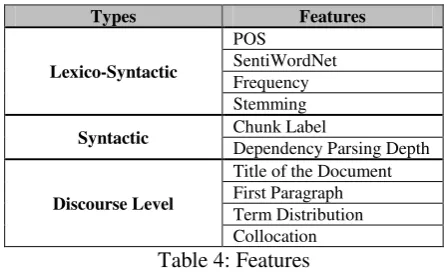
The set of features used in the present task have been categorized as Lexico-Syntactic, Syntactic and Discourse level features. These are listed in the Table 4 below and have been described in the subsequent subsections.
Types Features
Lexico-Syntactic
POS
SentiWordNet Frequency Stemming
Syntactic Chunk Label
Dependency Parsing Depth
Discourse Level
Title of the Document First Paragraph Term Distribution Collocation
Table 4: Features
2.3.1 Lexico-Syntactic Features
2.3.1.1 Part of Speech (POS)
2.3.1.2 SentiWordNet (Bengali)
Words that are present in the SentiWordNet car-ry opinion information. The developed Senti-WordNet (Bengali) (Das and Bandyopadhyay, 2010a) is used as an important feature during the learning process. These features are individual sentiment words or word n-grams (multiword entities) with strength measure as strong tive or weak subjective. Strong and weak subjec-tive measures are treated as a binary feature in the supervised classifier. Words which are col-lected directly from SentiWordNet (Bengali) are tagged with positivity or negativity score. The subjectivity score of these words are calculated as:
| | | |
s p n
E = S + S
where Es is the resultant subjective measure
and Sp , Sn are the positivity and negativity scores respectively.
2.3.1.3 Frequency
Frequency always plays a crucial role in identify-ing the importance of a word in the document. The system generates four separate high frequent word lists for four POS categories: Adjective, Adverb, Verb and Noun after function words are removed. Word frequency values are then effec-tively used as a crucial feature in the Theme De-tection technique.
2.3.1.4 Stemming
Several words in a sentence that carry opinion information may be present in inflected forms and stemming is necessary for them before they can be searched in appropriate lists. Due to non availability of good stemmers in Indian languag-es languag-especially in Bengali, a stemmer (Das and Bandyopadhyay, 2010b) based on stemming cluster technique has been used. This stemmer analyzes prefixes and suffixes of all the word forms present in a particular document. Words that are identified to have the same root form are grouped in a finite number of clusters with the identified root word as cluster center.
2.3.2 Syntactic Features
2.3.2.1 Chunk Label
Chunk level information is effectively used as a feature in supervised classifier. Chunk labels are defined as B-X (Beginning), I-X (Intermediate) and E-X (End), where X is the chunk label. In the task of identification of Theme expressions,
chunk label markers play a crucial role. Further details of development of chunking system could be found in (Das and Bandyopadhyay 2009b).
2.3.2.2 Dependency Parser
Dependency depth feature is very useful to iden-tify Theme expressions. A particular Theme word generally occurs within a particular range of depths in a dependency tree. Theme expres-sions may be a Named Entity (NE: person, or-ganization or location names), a common noun (Ex: accident, bomb blast, strike etc) or words of other POS categories. It has been observed that depending upon the nature of Theme expressions it can occur within a certain depth in the dency tree for the sentence. A statistical depen-dency parser has been used for Bengali as de-scribed in (Ghosh et al., 2009).
2.3.3 Discourse Level Features
2.3.3.1 Positional Aspect
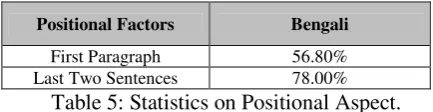
Depending upon the position of the thematic clue, every document is divided into a number of zones. The features considered for each docu-ment are Title words of the docudocu-ment, the first paragraph words and the words from the last two sentences. A detailed study was done on the Bengali news corpus to identify the roles of the positional aspect features of a document (first paragraph, last two sentences) in the detection of theme words and subjective sentences for gene-rating the summary of the document. The impor-tance of these positional features is shown in Tables 5 on the Bengali gold standard set.
2.3.3.2 Title Words
Title words of a document always carry some meaningful thematic information. The title word feature has been used as a binary feature during CRF based machine learning.
2.3.3.3 First Paragraph Words
People usually give a brief idea of their beliefs and speculations in the first paragraph of the document and subsequently elaborate or support them with relevant reasoning or factual informa-tion. Hence first paragraph words are informative in the detection of Thematic Expressions.
2.3.3.4 Words From Last Two Sentences
Positional Factors Bengali
First Paragraph 56.80% Last Two Sentences 78.00%
Table 5: Statistics on Positional Aspect.
2.3.3.5 Term Distribution Model
An alternative to the classical TF-IDF weighting mechanism of standard IR has been proposed as a model for the distribution of a word. The model characterizes and captures the informativeness of a word by measuring how regularly the word is distributed in a document. As discussed in Sec-tion 1, Carenini et al. (2006) have introduced the opinion distribution function feature to capture the overall opinion distributed in the corpus. Thus the objective is to estimate f wd( i) that
measures the distribution pattern of the k occur-rences of the word wi in a document d. Zipf's law describes distribution patterns of words in an entire corpus. In contrast, term distribution mod-els capture regularities of word occurrence in subunits of a corpus (e.g., documents, paragraphs or chapters of a book). A good understanding of the distribution patterns is useful to assess the likelihood of occurrences of a word in some spe-cific positions (e.g., first paragraph or last two sentences) of a unit of text. Most term distribu-tion models try to characterize the informative-ness of a word identified by inverse document frequency (IDF). In the present work, the distri-bution pattern of a word within a document for-malizes the notion of topic-sentiment informa-tiveness. This is based on the Poisson distribu-tion. Significant Theme words are identified us-ing TF, Positional and Distribution factor. The distribution function for each theme word in a document is evaluated as follows:
(
1)
11 1
( ) / ( ) /
n n
d i i i i i
i i
f w S S− n TW TW− n
= =
=
∑
− +∑
−where n=number of sentences in a document with a particular theme word, Si=sentence id of the current sentence containing the theme word and Si-1=sentence id of the previous sentence containing the query term, TWiis the positional id of current Theme word and TWi−1is the positional id of the previous Theme word.
2.3.3.6 Collocation
Collocation with other thematic word/expression is undoubtedly an important clue for identifica-tion of theme sequence patterns in a document. A window size of 5 including the present word is
considered during training to capture the colloca-tion with other thematic words/expressions.
3 Theme Detection
Term Frequency (TF) plays a crucial role to identify document relevance in Topic-Based In-formation Retrieval. The motivation behind de-veloping Theme detection technique is that in many documents relevant words may not occur frequently or irrelevant words may occur fre-quently. Moreover for sentiment analysis topic words should have sentiment conceptuality. The Theme detection technique has been proposed to resolve these issues to identify discourse level relevant topic-semantic nodes in terms of word or expressions using a standard machine learning technique. The machine learning technique used here is Conditional Random Field (CRF)4. The theme word detection is defined as a sequence labeling problem. Depending upon the series of input feature, each word is tagged as either Theme Word (TW) or Other (O).
4 Theme Clustering
Theme clustering algorithms partition a set of documents into finite number of topic based groups or clusters in terms of theme words/expressions. The task of document cluster-ing is to create a reasonable set of clusters for a given set of documents. A reasonable cluster is defined as the one that maximizes the within-cluster document similarity and minimizes be-tween-cluster similarities. There are two princip-al motivations for the use of this technique in theme clustering setting: efficiency, and the clus-ter hypothesis.
The cluster hypothesis (Jardine and van
Rijs-bergen, 1971) takes this argument a step further by asserting that retrieval from a clustered col-lection will not only be more efficient, but will in fact improve retrieval performance in terms of recall and precision. The basic notion behind this hypothesis is that by separating documents ac-cording to topic, relevant documents will be found together in the same cluster, and non-relevant documents will be avoided since they will reside in clusters that are not used for re-trieval. Despite the plausibility of this hypothe-sis, there is only mixed experimental support for it. Results vary considerably based on the
4
tering algorithm and document collection in use (Willett, 1988; Shaw et al., 1996).
Application of the clustering technique to the
The similarity between vectors is calculated by assigning numerical weights to these words and then using the cosine similarity measure as specified in the following equation.
, , various dimensions. However, the dot product between vectors that have been length norma-lized has a useful and intuitive interpretation: it computes the cosine of the angle between the two vectors. When two documents are identical they will receive a cosine of one; when they are orthogonal (share no common terms) they will receive a cosine of zero. Note that if for some reason the vectors are not stored in a normalized form, then the normalization can be incorporated directly into the similarity measure as follows.
, , them, rather than include the normalization in the similarity metric.
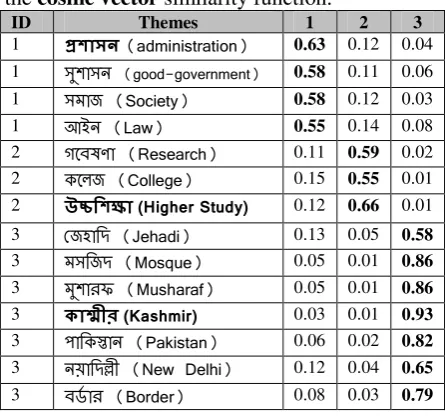
Calculating the similarity measure and using a predefined threshold value, documents are classi-fied using standard bottom-up soft clustering k-means technique. The predefined threshold value is experimentally set to 0.5 as shown in Table 6.
A set of initial cluster centers is necessary in the beginning. Each document is assigned to the cluster whose center is closest to the document. After all documents have been assigned, the cen-ter of each cluscen-ter is recomputed as the centroid
or mean
µ
the cosine vector similarity function.
ID Themes 1 2 3
Table 6: Five cluster centroids (mean
µ
j →) Table 6 gives an example of theme centroids from the K-means clustering. Bold words in Theme column are cluster centers. Cluster cen-ters are assigned by maximum clustering coeffi-cient. For each theme word, the cluster from ta-ble 6 is still the dominating cluster. For example, “p” has a higher membership probability in cluster 1. But each theme word also has some non-zero membership in all other clusters. This is useful for assessing the strength of association between a theme word and a topic. Comparing two members of the cluster2, “&C;2” and “9,-l;”, it is seen that “9,-l;” is strongly asso-ciated with cluster2 (p=0.65) but has some affini-ty with other clusters as well (e.g., p =0.12 with the cluster1). This is a good example of the utili-ty of soft clustering. These non-zero values are still useful for calculating vertex weights during Theme Relational Graph generation.
5 Construction of Document Level Theme Relational Graph
Representation of input text document(s) in the form of graph is the key to our design principle. The idea is to build a document graph G=<V,E> from a given source document d∈D. First, the input document d is parsed and split into a num-ber of text fragments (sentence) using sentence delimiters (Bengali sentence marker “।“, “?” or
stemmed (Das and Bandyopadhyay, 2010b). Thus, the text in each document is split into fragments and each fragment is represented with a vector of constituent theme words. These text fragments become the nodes V in the document graph.
The similarity between two nodes is expressed as the weight of each edge E of the document graph. A weighted edge is added to the document graph between two nodes if they either corres-pond to adjacent text fragments in the text or are semantically related by theme words. The weight of an edge denotes the degree of the relationship. The weighted edges not only denote document level similarity between nodes but also inter document level similarity between nodes. Thus to build a document graph G, only the edges with edge weight greater than some predefined thre-shold value are added to G, which basically con-stitute the edges E of the graph G.
The Cosine similarity measure has been used Theme words. The cosine similarity between two documents (nodes) d1 and d2 is computed using
their vector representations V d( 1) weight is calculated by the clustering co-efficient of those theme nodes. No inter cluster vertex are there. Cluster centers are interconnected with weighted vertex. The weight is calculated by cluster distance as measured by cosine similarity measure as discussed earlier.
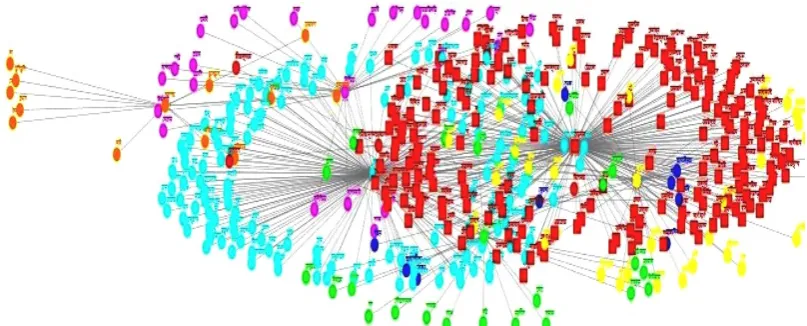
To better aid our understanding of the auto-matically determined category relationships we visualized this network using the Fruchterman-Reingold force directed graph layout algorithm (Fruchterman and Reingold, 1991) and the No-deXL network analysis tool (Smith et al., 2009)5. A theme relational model graph drawn by
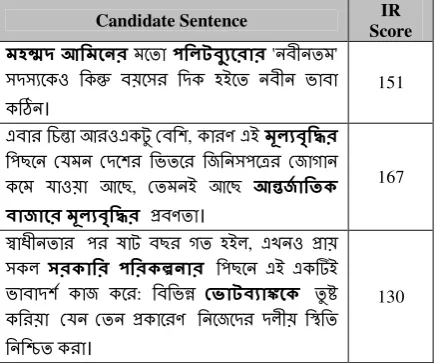
Nod-Present system is an extractive opinion summari-zation system for Bengali. In the previous sec-tions, we described how to identify theme clus-ters that relates to different shared topics and subtopics, from a given input document set. But identifying those clusters is not only a step to-ward generating document level opinionated news summary rather another major step is to extract thematic sentences from each theme clus-ter that reflects the contextual concise content of the current theme cluster. Extraction of sentences based on their importance in representing the as IR based cluster center for that particular clus-ter. With the adaptation of ideas from page rank algorithms (Page et al., 1998), it can be easily observed that a text fragment (sentence) in a document is relevant if it is highly related to many relevant text fragments of other documents in the same cluster. Since, in our document graph structure, the edge score reflects the correlation measure between two nodes, it can be used to identify the most salient/informed sentence from a sentence cluster. We computed the relevance of a node/sentence by summing up the edge scores of those edges connecting the node with other nodes in the same cluster. Then the nodes are given rank according to their calculated relev-ance scores and the top ranking sentences is se-lected as the candidate sentence representing the opinion summary. For example four such candi-date sentences are shown in Table 7. The words in bold are the theme words based on those theme words the sentences are extracted.
Another issue that is very important in sum-marization is sentence ordering so that the Out-put summary looks coherent. Once all the rele-vant sentences are extracted across the input documents, the summarizer has to decide in
which order to present them so that the whole text makes sense for the user. We prefer the orig-inal order of sentences as they occurred in origi-nal document.
Figure 2: Document Level Theme Relational Graph by NodeXL
7 Experimental Result
The evaluation result of the CRF-based Theme Detection task for Bengali is presented in Table 8. The result is presented individually for every annotators and the overall result of the system.
Th
em
e
D
et
ec
ti
o
n Metrics X Y Z Avg
Precision 87.65% 85.06% 78.06% 83.60%
Recall 80.78% 76.06% 72.46% 76.44%
F-Score 84.07% 80.30% 75.16% 79.85%
Table 8: Results of CRF-based Theme Iden-tifier
The evaluation result of subjective sentence identification of the system for opinion summary is in the Table 9.
S
u
m
m
a
ri
za
ti
o
n Metrics X Y Z Avg
Precision 77.65% 67.22% 71.57% 72.15%
Recall 68.76% 64.53% 68.68% 67.32%
F-Score 72.94% 65.85% 70.10% 69.65%
Table 9: Final Results subjective sentence identification for summary
8 Error Analysis
The evaluation result of the present summariza-tion system is reasonably good but still not out-standing. During the error analysis we found that the main false hits occurring for subjectivity identifier. It has been reported (Section 2.2) that the recall value of the classifier is higher than its
precision. Hence some objective sentences are identified during subjectivity analysis. Some of the sentences get high score during Theme de-tection or Theme clustering and being included in final summary. Our observation is at least 2-3% sentences are included due to the wrong identification by Subjectivity identifier.
Another vital source of errors occurring in the accuracy level of linguistics resources and tools are the POS tagger, Chunker and Dependency Parser. These linguistics tools are not well per-forming hence the resultant Theme identification system is missing some of the important theme words. Successive Theme clustering, Document level weighted theme relational model fails to accumulate those important theme expressions. Our observation is at most 3-5% improvement could be possible on final system by granular improvement of every linguistic tool.
9 Conclusion
In this work we have reported our work on sin-gle-document opinion summarization for Benga-li. The novelty of the proposed technique is the topic based document-level theme relational graphical representation. According to best of our knowledge this is the first attempt on opi-nion summarization for Bengali. The approach presented here is unique in every aspect as in literature and for a new language like Bengali.
References
Carenini Giuseppe, Ng Raymond, and Pauls Adam. Multi-document summarization of evaluative text. In Proceedings of the European Chapter of the As-sociation for Computational Linguistics (EACL), pages 305–312, 2006.
Chesley Paula, Vincent Bruce, Xu Li, and Srihari Ro-hini. Using verbs and adjectives to automatically classify blog sentiment. In AAAI Symposium on Computational Approaches to Analysing Weblogs (AAAI-CAAW), pages 27–29, 2006.
Das, A. and Bandyopadhyay S. (2009b) Theme De-tection an Exploration of Opinion Subjectivity. In Proceeding of Affective Computing & Intelligent Interaction (ACII).
Das, A. and Bandyopadhyay, S. (2009a). Subjectivity Detection in English and Bengali: A CRF‐based Approach., In Proceeding of ICON 2009, Decem-ber 14th-17th, 2009, Hyderabad.
Das, A. and Bandyopadhyay, S. (2010a). SentiWord-Net for Bangla. In Knowledge Sharing Event-4: Task 2: Building Electronic Dictionary , February 23th to 24th, 2010, Mysore.
Das, A. and Bandyopadhyay, S. (2010b). Morpholo-gi-cal Stemming Cluster Identification for Bangla., In Knowledge Sharing Event-1: Task 3: Morpho-logi-cal Analyzers and Generators, January, 2010, Mysore.
Fruchterman Thomas M. J. and Edward M. Reingold. 1991. Graph drawing by force-directed placement. Software: Practice and Experience, 21(11):1129– 1164.
Ghosh A., Das A., Bhaskar P., Bandyopadhyay S. (2009). Dependency Parser for Bengali : the JU System at ICON 2009., In NLP Tool Contest ICON 2009, December 14th-17th, 2009a, Hydera-bad.
Hatzivassiloglou Vasileios and Wiebe Janyce. Effects of adjective orientation and gradability on sentence subjectivity. In Proceedings of the International Conference on Computational Linguistics (COL-ING), pages 299-305, 2000.
Hu M. and Liu B.. 2004a. Mining and summarizing-customer reviews. In Proc. of the 10th ACM-SIGKDD Conf., pages 168–177, New York, NY, USA. ACM Press.
Jardine, N. and van Rijsbergen, C. J. (1971). The use of hierarchic clustering in information retrieval. In-formation Storage and Retrieval, 7, 217-240.
Kawai Yukiko, Kumamoto Tadahiko, and Katsumi Tanaka. Fair News Reader: Recommending news articles with different sentiments based on user pre-ference. In Proceedings of Knowledge-Based Intel-ligent Information and Engineering Systems (KES), number 4692 in Lecture Notes in Comput-er Science, pages 612–622, 2007.
Ku Lun-Wei, Li Li-Ying, Wu Tung-Ho, and Chen Hsin-Hsi. Major topic detection and its application to opinion summarization. In Proceedings of the ACM Special Interest Group on Information Re-trieval (SIGIR), pages 627–628, 2005. Poster pa-per.
Nasukawa Tetsuya and Yi Jeonghee. Sentiment anal-ysis: Capturing favorability using natural language processing. In Proceedings of the Conference on Knowledge Capture (K-CAP), pages 70-77, 2003.
Page Lawrence, Brin Sergey, Rajeev Motwani, and Terry Winograd. 1998. The PageRank Citation Ranking: Bringing Order to the Web. Technical re-port, Stanford Digital Library Technologies Project.
Resnick Paul, Kuwabara Ko, Zeckhauser Richard, and Friedman Eric. Reputation systems. Commu-nications of the Association for Computing Ma-chinery (CACM), 43(12):45–48, 2000. ISSN 0001-0782.
Smith Marc, Shneiderman Ben, Natasa Milic-Frayling, Eduarda Mendes Rodrigues, Vladimir Barash, Cody Dunne, Tony Capone, Adam Perer, and Eric Gleave. 2009. Analyzing (social media) networks with NodeXL. In C&T ’09: Proc. Fourth International Conference on Communities and Technologies, Lecture Notes in Computer Science. Springer.
Willerr, P. (1988). Recent trends in hierarchic docu-ment clustering: A critical review. Information Processing and Management, 24(5), 577-597.