Extractive vs. NLG-based Abstractive Summarization of Evaluative
Text: The Effect of Corpus Controversiality
Giuseppe Carenini and Jackie Chi Kit Cheung
1Department of Computer Science
University of British Columbia
Vancouver, B.C. V6T 1Z4, Canada
{carenini,cckitpw}@cs.ubc.ca
Abstract
Extractive summarization is the strategy of concatenating extracts taken from a corpus into a summary, while abstractive summariza-tion involves paraphrasing the corpus using novel sentences. We define a novel measure of corpus controversiality of opinions con-tained in evaluative text, and report the results of a user study comparing extractive and NLG-based abstractive summarization at dif-ferent levels of controversiality. While the ab-stractive summarizer performs better overall, the results suggest that the margin by which abstraction outperforms extraction is greater when controversiality is high, providing a context in which the need for generation-based methods is especially great.
1
Introduction
There are two main approaches to the task of sum-marization—extraction and abstraction (Hahn and Mani, 2000). Extraction involves concatenating ex-tracts taken from the corpus into a summary, whereas abstraction involves generating novel sen-tences from information extracted from the corpus. It has been observed that in the context of multi-document summarization of news articles, extrac-tion may be inappropriate because it may produce summaries which are overly verbose or biased to-wards some sources (Barzilay et al., 1999). How-ever, there has been little work identifying specific factors which might affect the performance of each strategy in summarizing evaluative documents
containing opinions and preferences, such as cus-tomer reviews or blogs. This work aims to address this gap by exploring one dimension along which the effectiveness of the two paradigms could vary; namely, the controversiality of the opinions con-tained in the corpus.
In this paper, we make the following contribu-tions. Firstly, we define a measure of controver-siality of opinions in the corpus based on informa-tion entropy. Secondly, we run a user study to test the hypothesis that a controversial corpus has greater need of abstractive methods and conse-quently of NLG techniques. Intuitively, extracting sentences from multiple users whose opinions are diverse and wide-ranging may not reflect the over-all opinion, whereas it may be adequate content-wise if opinions are roughly the same across users. As a secondary contribution, we propose a method for structuring text when summarizing controver-sial corpora. This method is used in our study for generating abstractive summaries.
The results of the user study support our hy-pothesis that a NLG summarizer outperforms an extractive summarizer by more when the contro-versiality is high.
2
Related Work
There has been little work comparing extractive and abstractive multi-document summarization. A previous study on summarizing evaluative text (Carenini et. al, 2006) showed that extraction and abstraction performed about equally well, though for different reasons. The study, however, did not
look at the effect of the controversiality of the cor-pus on the relative performance of the two strate-gies.
To the best of our knowledge, the task of mea-suring the controversiality of opinions in a corpus has not been studied before. Some well known measures are related to this task, including vari-ance, information entropy, and measures of inter-rater reliability. (e.g. Fleiss' Kappa (Fleiss, 1971), Krippendorff's Alpha (Krippendorff, 1980)). How-ever, these existing measures do not satisfy certain properties that a sound measure of controversiality should possess, prompting us to develop our own based on information entropy.
Summary evaluation is a challenging open re-search area. Existing methods include soliciting human judgements, task-based approaches, and au-tomatic approaches.
Task-based evaluation measures the effective-ness of a summarizer for its intended purpose. (e.g. (McKeown et al., 2005)) This approach, however, is less applicable in this work because we are inter-ested in evaluating specific properties of the sum-mary such as the grammaticality and the content, which may be difficult to evaluate with an overall task-based approach. Furthermore, the design of the task may intrinsically favour abstractive or ex-tractive summarization. As an extreme example, asking for a list of specific comments from users would clearly favour extractive summarization.
Another method for summary evaluation is the Pyramid method (Nenkova and Passonneau, 2004), which takes into account the fact that human sum-maries with different content can be equally infor-mative. Multiple human summaries are taken to be models, and chunks of meaning known as Summa-ry Content Units (SCU) are manually identified. Peer summaries are evaluated based on how many SCUs they share with the model summaries, and the number of model summaries in which these SCUs are found. Although this method has been tested in DUC 2006 and DUC 2005 (Passonneau et al., 2006), (Passonneau et al., 2005) in the domain of news articles, it has not been tested for evalua-tive text. A pilot study that we conducted on a set of customer reviews on a product using the Pyra-mid method revealed several problems specific to the evaluative domain. For example, summaries which misrepresented the polarity of the evalua-tions for a certain feature were not penalized, and human summaries sometimes produced
contradic-tory statements about the distribution of the opin-ions. In one case, one model summary claimed that a feature is positively rated, while another claimed the opposite, whereas the machine summary indi-cated that this feature drew mixed reviews. Clear-ly, only one of these positions should be regarded as correct. Further work is needed to resolve these problems.
There are also automatic methods for summary evaluation, such as ROUGE (Lin, 2004), which gives a score based on the similarity in the se-quences of words between a human-written model summary and the machine summary. While ROUGE scores have been shown to often correlate quite well with human judgements (Nenkova et al., 2007), they do not provide insights into the specif-ic strengths and weaknesses of the summary.
The method of summarization evaluation used in this work is to ask users to complete a question-naire about summaries that they are presented with. The questionnaire consists of questions asking for Likert ratings and is adapted from the question-naire in (Carenini et al., 2006).
3
Representative Systems
In our user study, we compare an abstractive and an extractive multi-document summarizer that are both developed specifically for the evaluative do-main. These summarizers have been found to pro-duce quantitatively similar results, and both signif-icantly outperform a baseline summarizer, which is the MEAD summarization framework with all op-tions set to the default (Radev et al., 2000).
by grouping together semantically similar CFs, such as jpeg picture and jpeg slide show under the UDF JPEG. For the purposes of our study, feature extraction, polarity/strength identification and the mapping from CFs to UDFs are not done automati-cally as in (Hu and Liu, 2004) and (Carenini et al, 2005). Instead, “gold standard” annotations by hu-mans are used in order to focus on the effect of the summarization strategy.
3.1
Abstractive Summarizer: SEAThe abstractive summarizer is the Summarizer of Evaluative Arguments (SEA), adapted from GEA, a system for generating evaluative text tailored to the user's preferences (Carenini and Moore, 2006).
In SEA, units of content are organized by UDFs. The importance of each UDF is based on the number and strength of evaluations of CFs mapped to this UDF, as well as the importance of its children UDFs. Content selection consists of re-peating the following two steps until the desired number of UDFs have been selected: (i) greedily selecting the most important UDF (ii) recalculating the measure of importance scores for the remaining UDFs.
The content structuring, microplanning, and re-alization stages of SEA are adapted from GEA. Each selected UDF is realized in the final summary by one clause, generated from a template pattern based on the number and distribution of polarity/strength evaluations of the UDF. For ex-ample, the UDF video output with an average po-larity/strength of near -3 might be realized as “sev-eral customers found the video output to be terri-ble.”
While experimenting with the SEA summariz-er, we noticed that the document structuring of
SEA summaries, which is adapted from GEA and is based on guidelines from argumentation theory (Carenini and Moore, 2000), sometimes sounded unnatural. We found that controversially rated UDF features (roughly balanced positive and nega-tive evaluations) were treated as contrasts to those which were uncontroversially rated (either mostly positive, or mostly negative evaluations). In SEA, contrast relations between features are realized by cue phrases signalling contrast such as “however” and “although”. These cue phrases appear to signal a contrast that is too strong for the relation between controversial and uncontroversial features. An ex-ample of a SEA summary suffering from this prob-lem can be found in Figure 1.
To solve this problem, we devised an alterna-tive content structure for controversial corpora, in which all controversial features appear first, fol-lowed by all positively and negatively evaluated features.
3.2
Extractive Summarizer: MEAD*The extractive approach is represented by MEAD*, which is adapted from the open source summarization framework MEAD (Radev et al., 2000).
After information extraction, MEAD* orders CFs by the number of sentences evaluating that CF, and selects a sentence from each CF until the word limit has been reached. The sentence that is selected for each CF is the one with the highest sum of polarity/strength evaluations for any fea-ture, so sentences that mention more CFs tend to be selected. The selected sentences are then or-dered according to the UDF hierarchy by a depth-first traversal through the UDF tree so that more abstract features tend to precede more specific ones.
MEAD* does not have a special mechanism to deal with controversial features. It is not clear how overall controversiality of a feature can be effec-tively expressed with extraction, as each sentence conveys a specific and unique opinion. One could include two sentences of opposite polarity for each controversial feature. However, in several cases that we considered, this produced extremely inco-herent text that did not seem to convey the gist of the overall controversiality of the feature.
Customers had mixed opinions about the Apex AD2600. Although several customers found the video output to be poor and some customers disliked the user interface, cus-tomers had mixed opinions about the range of compatible disc formats. However, users did agree on some things. Some users found the extra features to be very good even though customers had mixed opinions about the supplied universal remote control.
3.3
Links to the CorpusIn common with the previous study on which this is based, both the SEA and MEAD* summaries contain “clickable footnotes” which are links back into an original user review, with a relevant sen-tence highlighted. These footnotes serve to provide details for the abstractive SEA summarizer, and context for the sentences chosen by the extractive MEAD* summarizer. They also aid the partici-pants of the user study in checking the contents of the summary. The sample sentences for SEA are selected by a method similar to the MEAD* sen-tence selection algorithm. One of the questions in the questionnaire provided to users targets the ef-fectiveness of the footnotes as an aid to the sum-mary.
4
Measuring Controversiality
The opinion sentences in the corpus are annotated with the CF that they evaluate as well as the strength, from 1 to 3, and polarity, positive or neg-ative, of the evaluation. It is natural then, to base a measure of controversiality on these annotations. To measure the controversiality of a corpus, we first measure the controversiality of each of the features in the corpus. We list two properties that a measure of feature controversiality should satisfy.
Strength-sensitivity: The measure should be sensitive to the strength of the evaluations. e.g. Po-larity/strength (P/S) evaluations of -2 and +2 should be less controversial than -3 and +3
Polarity-sensitivity: The measure should be sen-sitive the polarity of the evaluations. e.g. P/S eval-uations of -1 and +1 should be more controversial than +1 and +3.
The rationale for this property is that positive and negative evaluations are fundamentally differ-ent, and this distinction is more important than the difference in intensity. Thus, though a numerical scale would suggest that -1 and +1 are as distant as +1 and +3, a suitable controversiality measure should not treat them so.
In addition, the overall measure of corpus con-troversiality should also satisfy the following two features.
CF-weighting: CFs should be weighted by the number of evaluations they contain when calculat-ing the overall value of controversiality for the cor-pus.
CF-independence: The controversiality of indi-vidual CFs should not affect each other.
An alternative is to calculate controversiality by UDFs instead of CFs. However, not all CFs mapped to the same UDF represent the same con-cept. For example, the CFs picture clarity and col-or signal are both mapped to the UDF video out-put.
4.1
Existing Measures of VariabilitySince the problem of measuring the variability of a distribution has been well studied, we first exam-ined existing metrics including variance, entropy, kappa, weighted kappa, Krippendorff’s alpha, and information entropy. Each of these, however, is problematic in their canonical form, leading us to devise a new metric based on information entropy which satisfies the above properties. Existing met-rics will now be examined in turn.
Variance: Variance does not satisfy polarity-sensitivity, as the statistic only takes into account the difference of each data point to the mean, and the sign of the data point plays no role.
Information Entropy: The canonical form of in-formation entropy does not satisfy strength or po-larity sensitivity, because the measure considers the discrete values of the distribution to be an un-ordered set.
4.2
Entropy-based ControversialityWe define here our novel measure of controver-siality, which is based on information entropy be-cause it can be more easily adapted to measure controversiality. As has been stated, entropy in its original form over the evaluations of a CF is not sensitive to strength or polarity. To correct this, we first aggregate the positive and negative evalua-tions for each CF separately, and then calculate the entropy based on the resultant Bernoulli distribu-tion.
Let ps(cfj) be the set of polarity/strength
evalua-tions for cfj. Let the importance of a feature,
imp(cfj), be the sum of the absolute values of the
polarity/strength evaluations for cfj.
impcf j=
∑
psk∈pscfj
∣
psk∣
Define:
imp_ poscf j=
∑
psk∈pscfj∧psk0∣
psk∣
imp_negcf j=
∑
psk∈pscfj∧psk0
∣
psk∣
Now, calculate the entropy of the Bernoulli dis-tribution corresponding to the importance of the two polarities to satisfy polarity-sensitivity. That is, Bernoulli with parameter
j=imp_ poscf j/impcf j
Hj=−jlog2j−1−jlog21−j
Next, we scale this score by the importance of the evaluations divided by the maximum possible importance for this number of evaluations to satis-fy strength-sensitivity. Since our scale is from -3 to
+3, the maximum possible importance for a feature is three times the number of evaluations.
max_impcfj=3×
∣
pscf j∣
Then the controversiality of a feature is:
controcf j=
impcf j×Hj
max_impcf j
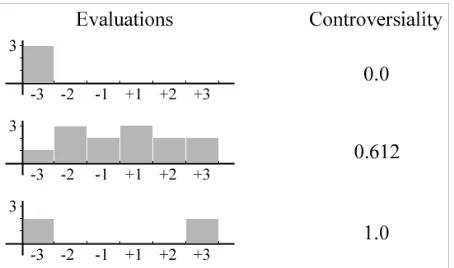
The case corresponding to the highest possible feature controversiality, then, would be the bi-modal case with equal numbers of evaluations on the extreme positive and negative bins (Figure 2). Note, however, that controversiality is not simply bimodality. A unimodal normal-like distribution of evaluations centred on zero, for example, should intuitively be somewhat controversial, because there are equal numbers of positive and negative evaluations. Our entropy-based feature controver-siality measure is able to take this into account.
To calculate the controversiality of the corpus, a weighted average is taken over the CF controver-siality scores, with the weight being equal to one less than the number of evaluations for that CF. We subtract one to eliminate any CF where only one evaluation is made, as that CF has an entropy score of one by default before scaling by impor-tance. This procedure satisfies properties CF-weighting and CF-independence.
wcf j=
∣
pscf j∣
−1controcorpus=
∑
wcf j×controcf j∑
wcf jAlthough the annotations in this corpus range from -3 to +3, it would be easy to rescale opinion annotations of different corpora to apply this met-ric. Note that empirically, this measure correlates highly with Kappa and Krippendorff's Alpha.
5
User Study
Our main hypothesis that extractive summarization is outperformed even more in the case of contro-versial corpora was tested by a user study, which compared the results of MEAD* and the modified SEA. First, ten subsets of 30 user reviews were se-lected from the corpus of 101 reviews of the Apex AD2600 DVD player from amazon.com by stochastic local search. Five of these subsets are controversial, with controversiality scores between 0.83 and 0.88, and five of these are uncontrover-sial, with controversiality scores of 0. A set of
[image:5.612.73.300.540.674.2]ty user reviews per subcorpus was needed to create a summary of sufficient length, which in our case was about 80 words in length.
Twenty university students were recruited and presented with two summaries of the same subcor-pus, one generated from SEA and one from MEAD*. We generated ten subcorpora in total, so each subcorpus was assigned to two participants. One of these participants was shown the SEA sum-mary first, and the other was shown the MEAD* summary first, to eliminate the order of presenta-tion as a source of variapresenta-tion.
The participants were asked to take on the role of an employee of Apex, and told that they would have to write a summary for the quality assurance department of the company about the product in question. The purpose of this was to prime them to look for information that should be included in a summary of this corpus. They were given thirty minutes to read the reviews, and take notes.
They were then presented with a questionnaire on the summaries, consisting of ten Likert rating questions. Five of these questions targeted the lin-guistic quality of the summary, based on linlin-guistic well-formedness questions used at DUC 2005, one targeted the “clickable footnotes” linking to sample sentences in the summary (see section 3.3), and three evaluated the contents of the summary. The three questions targeted Recall, Precision, and the general Accuracy of the summary contents respec-tively. The tenth question asked for a general over-all quality judgement of the summary.
After familiarizing themselves with the ques-tionnaire, the participants were presented with the two summaries in sequence, and asked to fill out the questionnaire while reading the summary. They were allowed to return to the original set of re-views during this time. Lastly, they were given an additional questionnaire which asked them to
com-pare the two summaries that they were shown. Questions in the questionnaire not found in (Carenini et al., 2006) are attached in Appendix A.
6
Results
6.1
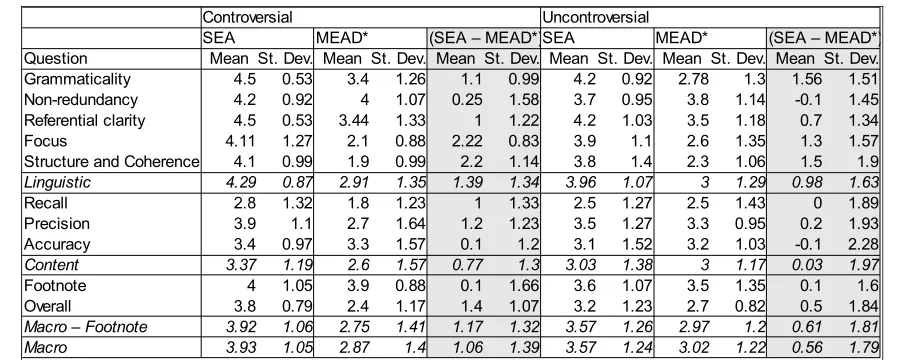
Quantitative ResultsWe convert the Likert responses from a scale from Strongly Disagree to Strong Agree to a scale from 1 to 5, with 1 corresponding to Strongly Disagree, and 5 to Strongly Agree. We group the ten ques-tions into four categories: linguistic (quesques-tions 1 to 5), content (questions 6 to 8), footnote (question 9), and overall (question 10). See Table 1 for a breakdown of the responses for each question at each controversiality level.
For our analysis, we adopt a two-step approach that has been applied in Computational Linguistics (Di Eugenio et al., 2002) as well as in HCI (Hinck-ley et al., 1997).
First, we perform a two-way Analysis of Vari-ance (ANOVA) test using the average response of the questions in each category. The two factors are controversiality of the corpus (high or low) as in-dependent samples, and the summarizer (SEA or MEAD*) as repeated measures. We repeat this procedure for the average of the ten questions, termed Macro below. The p-values of these tests are summarized in Table 2.
The results of the ANOVA tests indicate that SEA significantly outperforms MEAD* in terms of linguistic and overall quality, as well as for all the questions combined. It does not significantly out-perform MEAD* by content, or in the amount that the included sample sentences linked to by the footnotes aid the summary. No significant differ-ences are found in the performance of the
summa-SEA
Customers had mixed opinions about the Apex AD2600 1,2 possibly because users were divided on the range of compatible disc formats 3,4 and there was disagreement among the users about the video output 5,6. However, users did agree on some things. Some purchasers found the extra features 7 to be very good and some customers really liked the surround sound sup-port 8 and thought the user interface 9 was poor.
MEAD*
When we tried to hook up the first one , it was broken - the motor would not eject discs or close the door . 1 The build quality feels solid , it does n't shake or whine while playing discs , and the picture and sound is top notch ( both dts and dd5.1 sound good ) . 2 The progressive scan option can be turned off easily by a button on the remote control which is one of the simplest and easiest remote controls i have ever seen or used . 3 It plays original dvds and cds and plays mp3s and jpegs . 4
rizers over the two levels of controversiality for any of the question sets .
While the average differences in scores be-tween the SEA and MEAD* summarizers are greater in the controversial case for the linguistic, content, and macro averages as well as the ques-tion on the overall quality, the p-values for interac-tion between the two factors in the two-way ANO-VA test are not significant.
For the second step of the analysis, we use a one-tailed sign test (Siegel and Castellan, 1988) over the difference in performance of the summa-rizers at the two levels of controversiality for the questions in the questionnaire. We encode + in the case where the difference between SEA and MEAD* is greater for a question in the controver-sial setting, – if the difference is smaller, and we discard a question if the difference is the same (e.g. the Footnote question). Since the Overall question is likely correlated with the responses of the other questions, we did not include it in the test. After discarding the Footnote question, the p-value over the remaining eight questions is 0.0352, which
lends support to our hypothesis that the abstraction is better by more when the corpus is controversial.
We also analyze the users' summary prefer-ences at the two levels of controversiality. A strong preference for SEA is encoded as a 5, while a strong preference for MEAD* is encoded as a 1, with 3 being neutral. Using a two-tailed unpaired two-sample t-test, we do not find a significant dif-ference in the participants' summary predif-ferences (p=0.6237). However, participants sometimes pre-ferred summaries for reasons other than linguistic or content quality, or may base their judgement only on one aspect of the summary. For instance, one participant rated SEA at least as well as MEAD* in all questions except Footnote, yet pre-ferred MEAD* to SEA overall precisely because MEAD* was felt to have made better use of the footnotes than SEA.
6.2
Qualitative ResultsThe qualitative comments that participants were asked to provide along with the Likert scores con-firmed the observations that led us to formulate the initial hypothesis.
In the controversial subcorpora, participants generally agreed that the abstractive nature of SEA's generated text was an advantage. For exam-ple, one participant lauded SEA for attempting to “synthesize the reviews” and said that it “did re-flect the mixed nature of the reviews, and covered some common complaints.” The participant, how-ever, said that SEA “was somewhat misleading in that it understated the extent to which reviews were negative. In particular, agreement was reported on Question
Set Controver-siality Summarizer Controversiality x Summarizer
Linguistic 0.7226 <0.0001 0.2639 Content 0.9215 0.1906 0.2277 Footnote 0.2457 0.7805 1 Overall 0.6301 0.0115 0.2000
[image:7.612.82.534.72.252.2]Macro 0.7127 0.0003 0.1655
Table 2: Two-way ANOVA p-values.
Table 1: Breakdown of average Likert question responses for each summary at the two levels of controversiali-ty as well as the difference between SEA and MEAD*.
Controversial Uncontroversial
SEA MEAD* (SEA – MEAD*)SEA MEAD* (SEA – MEAD*)
Question Mean St. Dev. Mean St. Dev. Mean St. Dev. Mean St. Dev. Mean St. Dev. Mean St. Dev.
Grammaticality 4.5 0.53 3.4 1.26 1.1 0.99 4.2 0.92 2.78 1.3 1.56 1.51
Non-redundancy 4.2 0.92 4 1.07 0.25 1.58 3.7 0.95 3.8 1.14 -0.1 1.45
Referential clarity 4.5 0.53 3.44 1.33 1 1.22 4.2 1.03 3.5 1.18 0.7 1.34
Focus 4.11 1.27 2.1 0.88 2.22 0.83 3.9 1.1 2.6 1.35 1.3 1.57
Structure and Coherence 4.1 0.99 1.9 0.99 2.2 1.14 3.8 1.4 2.3 1.06 1.5 1.9
Linguistic 4.29 0.87 2.91 1.35 1.39 1.34 3.96 1.07 3 1.29 0.98 1.63
Recall 2.8 1.32 1.8 1.23 1 1.33 2.5 1.27 2.5 1.43 0 1.89
Precision 3.9 1.1 2.7 1.64 1.2 1.23 3.5 1.27 3.3 0.95 0.2 1.93
Accuracy 3.4 0.97 3.3 1.57 0.1 1.2 3.1 1.52 3.2 1.03 -0.1 2.28
Content 3.37 1.19 2.6 1.57 0.77 1.3 3.03 1.38 3 1.17 0.03 1.97
Footnote 4 1.05 3.9 0.88 0.1 1.66 3.6 1.07 3.5 1.35 0.1 1.6
Overall 3.8 0.79 2.4 1.17 1.4 1.07 3.2 1.23 2.7 0.82 0.5 1.84
Macro – Footnote 3.92 1.06 2.75 1.41 1.17 1.32 3.57 1.26 2.97 1.2 0.61 1.81
some features where none existed, and problems with reliability were not mentioned.”
Participants disagreed on the information cover-age of the MEAD* summary. One participant said that MEAD* includes “almost all the information about the Apex 2600 DVD player”, while another said that it “does not reflect all information from the customer reviews.”
In the uncontroversial subcorpora, more users criticized SEA for its inaccuracy in content selec-tion. One participant felt that SEA “made general-izations that were not precise or accurate.” Partici-pants had specific comments about the features that SEA mentioned that they did not consider im-portant. For example, one comment was that “Compatibility with CDs was not a general prob-lem, nor were issues with the remote control, or video output (when it worked).” MEAD* was criti-cized for being “overly specific”, but users praised MEAD* for being “not at all redundant”, and said that it “included information I felt was important.”
7
Conclusion and Future Work
We have explored the controversiality of opinions in a corpus of evaluative text as an aspect which may determine how well abstractive and extractive summarization strategies perform. We have psented a novel measure of controversiality, and re-ported on the results of a user study which suggest that abstraction by NLG outperforms extraction by a larger amount in more controversial corpora. We have also presented a document structuring strate-gy for summarization of controversial corpora.
Our work has implications in practical deci-sions on summarization strategy choice; an extrac-tive approach, which may be easier to implement because of its lack of requirement for natural lan-guage generation, may suffice if the controversiali-ty of opinions in a corpus is sufficiently low.
A future approach to summarization of evalua-tive text might combine extraction and abstraction in order to combine the different strengths that each bring to the summary. The controversiality of the corpus might be one factor determining the mix of abstraction and extraction in the summary. The footnotes linking to sample sentences in the corpus in SEA are already one form of this combined ap-proach. Further work is needed to integrate this text into the summary itself, possibly in a modified form.
As a final note to our user study, further studies should be done with different corpora and summa-rization systems to increase the external validity of our results.
Acknowledgements
We would like to thank Raymond T. Ng, Gabriel Murray and Lucas Rizoli for their helpful com-ments. This work was partially funded by the Nat-ural Sciences and Engineering Research Council of Canada.
References
Regina Barzilay, Kathleen R. McKeown, and Michael Elhadad. 1999. Information fusion in the context of multi-document summarization. In Proc. 37th ACL, pages 550–557.
Giuseppe Carenini and Johanna D. Moore. 2006. Gener-ating and evaluGener-ating evaluative arguments. Artificial Intelligence, 170(11):925-952.
Giuseppe Carenini, Raymond Ng and Adam Pauls. 2006. Multi-document summarization of evaluative text. In Proc. 11th EACL 2006, pages 305-312. Giuseppe Carenini, Raymond T. Ng and Ed Zwart.
2005. Extracting Knowledge from Evaluative Text. In Proc. 3rd International Conference on Knowledge Capture, pages 11-18.
Giuseppe Carenini and Johanna D. Moore. 2000. A strategy for generating evaluative arguments. In First INLG, pages 47-54, Mitzpe Ramon, Israel.
Barbara Di Eugenio, Michael Glass, and Michael J. Tro-lio. 2002. The DIAG experiments: Natural language generation for intelligent tutoring systems. In INL-G02, The 2nd INLG, pages 120-127.
Joseph L. Fleiss. 1971. Measuring nominal scale agree-ment among many raters. Psychological Bulletin. 76:378-382.
U. Hahn and I. Mani. 2000. The challenges of automatic summarization. IEEE Computer, 33(11):29-36. Ken Hinckley, Randy Pausch, Dennis Proffitt, James
Patten, and Neal Kassell. 1997. Cooperative bimanu-al action. In Proc. CHI Conference.
Minqing Hu and Bing Liu. 2004. Mining and summariz-ing customer reviews. In Proc. 10th ACM SIGKDD conference, pages 168-177.
Klaus Krippendorff. 1980. Content Analysis: An Intro-duction to Its Methodology. Sage Publications, Bev-erly Hills, CA.
2005. Linguistic quality questions from the 2005 docu-ment understanding conference. http://duc.nist.gov/duc2005/quality-questions.txt Kathleen McKeown, Rebecca Passonneau, David Elson,
Ani Nenkova, and Julia Hirschberg. 2005. Do sum-maries help? A task-based evaluation of multi-docu-ment summarization. In Proc. SIGIR 2005.
Ani Nenkova, Rebecca J. Passonneau, and K. McKe-own. 2007. The pyramid method: incorporating hu-man content selection variation in summarization evaluation. ACM Transactions on Speech and Lan-guage Processing, 4(2).
Ani Nenkova and Rebecca J. Passonneau. 2004. Evalu-ating content selection in summarization: The pyra-mid method. In Proc. NAACL/HLT.
Rebecca J. Passonneau, Kathleen McKeown, Sergey Sigleman, and Adam Goodkind. 2006. Applying the pyramid method in the 2006 Document Understand-ing Conference. In Proc. DUC'06.
Rebecca J. Passonneau, Ani Nenkova, Kathleen McKe-own, and Sergey Sigleman. 2005. Applying the pyra-mid method in DUC 2005. In Proc. DUC'05.
Rebecca J. Passonneau. 1997. Applying Reliability Met-rics to Co-Reference Annotation. Department of Computer Science, Columbia University, TR CUCS-017-97.
Dragomir Radev, Hongyan Jing, and Malgorzata Budzikowska. 2000. Centroid-based summarization of multiple documents: sentence extraction, utility-based evaluation, and user studies. In Proc. ANLP/NAACL Workshop on Automatic Summariza-tion.
S. Siegel and N. J. Castellan, Jr. 1988. Nonparametric statistics for the behaviorial sciences. McGraw Hill.
Appendix A. Additional Questions
Footnotes: a) Did you use the footnotes when re-viewing the summary?
b) Answer this question only if you answered “Yes” to the previous question. The clickable foot-notes were a helpful addition to the summary.
Summary Comparison Questions:
1) List any Pros and Cons you can think of for each of the summaries. Point form is okay.
2) Overall, which summary did you prefer? 3) Why did you prefer this summary? (If the reason overlaps with some points from question 1, put a star next to those points in the chart.)