www.euacademic.org
The Expression Pattern of CD45 among Sudanese
ALL Patients Using Flowcytometry
FATIMA A. TAHA1 Medical Laboratory Second Specialist Hraa Medical center, Khartoum, Sudan
ENAAM A. ABDELGADER
Associate Professor of Hematology, Al Neelain University, Sudan Consultant Clinical Hematologist Radiation and Isotope Center - Khartoum (RICK)
OSAMA A. ALTAYEB
Flowcytometry Consultant, Flowcytometry Laboratory Khartoum, Sudan
EMAN ABBASS F.
Flowcytometry Specialist,Flowcytometry Laboratory
Khartoum, Sudan
AMIN A. AL-AMIN
Consultant Haematopathologist, Flowcytometry Laboratory Khartoum, Sudan
GADA M. A. MERGHANI
Medical Laboratory Specialist, Flowcytometry Laboratory Khartoum, Sudan
TARIG M. KARFIS
Medical Laboratory Specialist, Flowcytometry Laboratory Khartoum, Sudan
ELDIRDIRI M. ABDELRHMAN
Associate Professor of Medicine and Oncology (KCMS) Khartoum College of Medical Sciences
OSMAN H. MOSA
Consultant Clinical Haematologist, Fedail Hospital
MOHAMMED A. ABDALLA
Consultant Pediatric Oncologist, University of Khartoum
Abstract:
not identified. CD45 gating strategy plays very important role in diagnosis of acute leukemia and lymphoproliferative disorders as well as many other non haematological diseases. Flowcytometer plays very important role in the diagnosis of acute leukemia. There is need to study the role of CD45 expression pattern and its properties using the flowcytometer in acute lymphoblastic leukemia.
Method: This is descriptive cross sectional study involving 50 patients newly diagnosed as acute lymphoblastic leukemia (ALL). The tubes were labeled for analysis. 20 μL of monoclonal antibody (CD45) was added into each tube. 100 μL of sample was added containing no
more than 1 x 10⁴ leukocytes / ml. Each tube was vortexed for 5
seconds. The tubes were incubated at room temperature in dark place for 10 minutes. 1 ml of RBCs lysis was added into each tube then incubated at room temperature in dark place for 10 minutes. All tubes were run by flowcytometer. The flowcytometric parameters (Percentage and mean fluorescence intensity) were recorded by SYSTEM II software.
Result: Out of the 50 cases diagnosed as ALL, the most frequent age group was (0.5-12) y. The male was (56.5%) while the female was (43.5%) of all cases. (60.9%) of the samples were from the bone marrow and (39.1%) from peripheral blood. (80.4%) of the samples were B cells and (19.6%) were T cell. CD45 percentage degree among B-ALL sub types were as follow: pro B-ALL, (18%) showed low percentage, (18%) moderate, and (62%) high, common B-ALL: (5%) showed negative CD45, (22%) low percentage, (22%) moderate and (560%) high. Pre B-ALL: (50%) showed moderate percentage and (50%)
high. Mature B-ALL: All cases (100%) showed moderate percentage.
Conclusion: In our study, we found that CD45 showed a significant role in the diagnosis and differentiation of sub types of acute lymphoblastic leukemia cases in Sudanese patients. These importances were multiply with using of other flowcytometric parameters like percentage level and mean fluorescence intensity. Multi-parametric analysis of CD45 highlighted a lot of advantages assist in the early and accurate differentiation. These benefits may help in the minimization of monoclonal antibodies panel especially with countries of limited recourses like Sudan.
Key words: CD45protein; flowcytometry; leukemia.
Introduction:
Acute lymphoblastic leukemia is malignancy of immature lymphoid cells, comprises approximately 80% of pediatric acute leukemia and 20% of adult cases [1]. The current World Health Organization (WHO) classification for malignancies of hematopoietic and lymphoid tissues [2] recognizes two diagnostic entities: precursor B-cell ALL and precursor T-cell ALL, both of which encompass a spectrum of clinical, morphologic, immunophenotypic, cytogenetic, and molecular features. Although Burkitt’s lymphoma/leukemia is considered a mature B-cell neoplasm in the WHO classification [2], in the earlier French-American-British (FAB) system [3], this tumor was included among the ALLs (designated L3 ALL) .In current clinical practice, flowcytometric immunophenotyping (FCI) plays an important role in the diagnosis of patients who have ALL. The morphologic characteristics of lymphoblasts may be indistinguishable from those of the myeloblasts in many cases of acute myeloid leukemia (AML), and treatment protocols for ALL and AML differ significantly. Because FCI enables rapid (within hours), typically unambiguous characterization of leukemic blasts with respect to lineage this modality has become a routine component of the diagnostic work-up of patients who have suspected acute leukemia. Moreover, complete immunophenotypic characterization of the lympho blasts at diagnosis may predict prognosis [4].
Thymocytes express the lowest molecular weight isoforms resulting from the removal of 3 and 4 exons. T cells have a varied isoform expression pattern that is dependent upon the differentiation state, function, and prior antigenic exposure [5]. All leukocytes, including hematopoietic stem and progenitor cell populations, are characterized by unique cell surface expression of CD45. It can serve as both a positive and negative regulator in a cell type and context-dependent manner. CD45 was shown to regulate different stages of lymphocyte maturation, especially their activation and proliferation. However, its potential role in the function of earlier, undifferentiated hematopoietic progenitor cells was not identified. CD45 gating strategy plays very important role in diagnosis of acute leukemia and Lymphoproliferative disorders as well as many other non hematological diseases [6]. Flowcytometry is a technology that simultaneously measures and then analyzes multiple physical characteristics of single particles, usually cells; as they flow in a fluid stream through a beam of light. The properties measured include a particle’s relative size, relative granularity or internal complexity, and relative fluorescence intensity. These characteristics are determined using an optical-to-electronic coupling system that records how the cell or particle scatters incident laser light and emits fluorescence [7]. There is need to study the role of CD45 gating strategy and
its properties using flowcytomtery in acute lymphoblastic leukemia because this study not done in Sudan before.
Materials and methods:
This is a descriptive cross-sectional study conducted in Khartoum state, patients attended in the Flowcytometry laboratory in the period from April 2015 till Jun-2015.
analysis. 20 μL of monoclonal antibody (CD45) was added into each tube. 100 μL of sample was added containing no more than 1 x 10⁴ leukocytes / ml. Each tube was vortexed for 5 seconds. The tubes were incubated at room temperature in dark place for 10 minutes. 1 ml of RBCs lysis was added into each tube then incubated at room temperature in dark place for 10 minutes. All tubes were run by flowcytometer. The flowcytometric parameters (Percentage and mean fluorescence intensity) were recorded by (SYSTEM II) software.
Results:
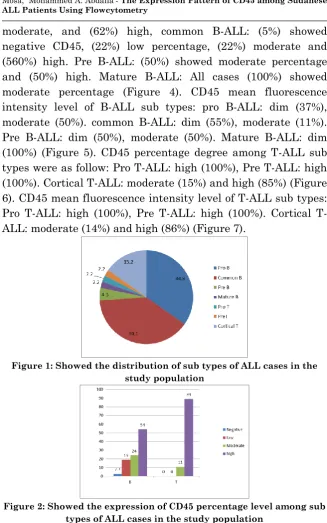
CD45 out of the 50 cases diagnosed as Acute Lymphoblastic Leukemia (ALL) analyzed by flowcytometer at flowcytometry laboratory in Khartoum, Sudan during period from April to June 2015. The distribution of age groups was: (56.5%) for (0.5 – 12) y, (23.9%) for (13 – 45) y and (19.6%) for (46 – 70) y. The distribution of gender was: (56.5%) for males and (43.5%) for females. The distribution of sample type was: (60.9%) for bone marrow samples and (39.1%) for peripheral samples. The distribution of sample diagnosis was: (80.4%) were B-ALL and (19.6%) were T-ALL. The distribution of sub type diagnosis was: (34.8%) was pro ALL, (39.1%) common ALL, (4.3%) pre B-ALL, (2.2%) mature B-B-ALL, (2.2%) pro B-ALL, (2.2%) pre T-ALL, and (15.2%) cortical T-ALL (Figure 1).
CD45 percentage degree of B-ALL cases: negative (2.7%), low (19%), moderate (24%), high (54 %). CD45 percentage degree of T-ALL cases: negative and low (0%) moderate (11%), high (89%) (Figure 2).
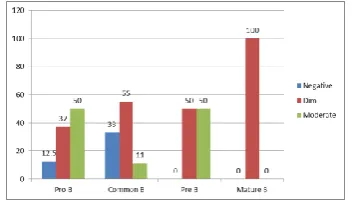
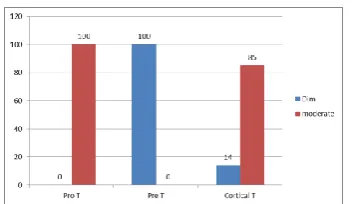
moderate, and (62%) high, common B-ALL: (5%) showed negative CD45, (22%) low percentage, (22%) moderate and (560%) high. Pre B-ALL: (50%) showed moderate percentage and (50%) high. Mature B-ALL: All cases (100%) showed moderate percentage (Figure 4). CD45 mean fluorescence intensity level of B-ALL sub types: pro B-ALL: dim (37%), moderate (50%). common B-ALL: dim (55%), moderate (11%). Pre B-ALL: dim (50%), moderate (50%). Mature B-ALL: dim (100%) (Figure 5). CD45 percentage degree among T-ALL sub types were as follow: Pro T-ALL: high (100%), Pre T-ALL: high (100%). Cortical T-ALL: moderate (15%) and high (85%) (Figure 6). CD45 mean fluorescence intensity level of T-ALL sub types: Pro ALL: high (100%), Pre ALL: high (100%). Cortical T-ALL: moderate (14%) and high (86%) (Figure 7).
Figure 1: Showed the distribution of sub types of ALL cases in the study population
Figure 2: Showed the expression of CD45 percentage level among sub types of ALL cases in the study population
Figure 3: Showed the expression of CD45 mean fluorescence intensity among sub types of ALL cases in the study population
Figure 4: Showed the expression of CD45 percentage level among sub types of B-ALL cases in the study population
Figure 6: Showed the expression of CD45 percentage level among sub types of T-ALL cases in the study population
Figure 7: Showed the expression of CD45 percentage level among sub types of T-ALL cases in the study population
Discussion
T-ALL cases and their relation was significant different (P.value = 0.05). We observed that most cases of B-ALL showed dim mean intensity of CD45 while most cases of T-ALL showed moderate mean intensity of CD45 (P.value = 0.008). CD45 percentage degree of sub B-ALL types showed that negative CD45 results only appear with common B-ALL cases. All mature B-ALL cases have moderate percentage of CD45. We observed that there were no negative or moderate mean intensity with mature B-ALL .Also there were no negative CD45 mean intensity with pre B-ALL, therefore the negative CD45 mean intensity should exclude pre and mature B-ALL and cases (significant p.value = 0.017) . Sub diagnosis of T-ALL (pro, pre and cortical T-ALL) showed high level of CD45 expression (insignificant P.value = 0.897). Finally, we found that in CD45 mean intensity group with sub T-ALL types, when the result showed dim mean intensity, we can use this finding to exclude pro T-ALL cases (insignificant P.value = 0.167 ). we found that in CD45 pw group sub diagnosis of T-ALL the most are heterogeneous, that mean when the result are homogeneous we can exclude pro T and pre T ( insignificant P value = 0.630).
Conclusion:
Acknowledgement:
We are indebted to the staff of Hematology Department (Alneelain University). We are grateful to the staff of Flowcytometry Laboratory for their collaboration. Finally special thanks to the patients for being cooperative.
REFERENCES:
1- Borowitz MJ, DiGiuseppe JA. Acute lymphoblastic leukemia. In: Knowles DM, editor.
Neoplastic hematopathology. 2nd edition. Philadelphia: Lippincott, Williams & Wilkins; 2001. p. 1643–65.
2- Jaffe ES, Harris NL, Stein H, et al, editors. Pathology and genetics of tumours of haematopoietic and lymphoid tissues. Lyon (France): IARC Press; 2001.
3- Bennett JM, Catovsky D, Daniel MT, Flandrin G, Glaton DA, Gralnick HR ,Sultan C . Proposals for the classification of the acute leukaemia. Br J Haematol . 1976 Aug; 33(4):451-8
4- Joseph A. DiGiuseppe, MD, PhD. Acute Lymphoblastic Leukemia: Diagnosis and Detection of Minimal Residual Disease Following Therapy. Clinics in laboratory medicine September 2007, vol 27
5- Elizabeth L.Virts, Oscar Diago, and William C.Raschke. ACD45 minigene restores regulated isoform expression and immune function in CD45-deficient mice: therapeutic implications for human CD45-null severe combined immunodeficiency (Blood. 2003; 101:849-855) © 2003 by The American Society of Hematology
remodeling of metaphyseal trabecules, September 8,2008 // JEM vol . 205 no 10.
7- Introduction to Flow Cytometry: A Learning Guide Manual Part Number: 11-11032-01 April, 2000
8 M. Y Shafini; M. N Noor Haslina; W . M Wan Haslindawani; B, Rosnah; R - Marini Immunophenotype and clinical characteristics of CD45 negative in Acute Lymphoblastic Leukemia this study done in January 2007 Malaysian Journal of medical sciences ;Jan 2007 Supplement.