R E S E A R C H
Open Access
Performance comparison of cooperative relay
links with different relay processing strategies:
Nakagami/Gamma approximation approaches
Jia Shi
*, Chen Dong and Lie-Liang Yang
Abstract
In this article, we investigate and compare the error performance of two-hop communication links (THCLs) with multiple relays, when distributed and cooperative relay processing schemes are respectively employed. Our main objectives include finding some general and relatively simple ways for estimating error performance and
demonstrating the trade-off of using cooperative relay processing. One distributed relay processing and two cooperative relay processing schemes are compared. In the two cooperative relay processing schemes, one assumes the ideal relay cooperation, in which relays exchange information without consuming energy, while the other one assumes energy consumption for relay cooperation. In this paper, the error performance of the THCLs employing the considered relay processing schemes is investigated, when the channels from source to relays, the channels for information exchange and that from relays to destination experience various types of fading modeled by the Nakagami-mdistributions. In order to derive the formulas for the bit error rate (BER) of the THCLs employing binary phase-shift keying (BPSK) modulation and various relay processing schemes, we introduce the Nakagami and Gamma approximation for finding the distribution functions of various variables encountered. Our studies show that the proposed approximation approaches are highly effective, which are capable of accurately predicting the BER of the THCLs supported by the different relay processing schemes.
Keywords: Cooperative communications; Relay communications; Distributed processing; Transmitter preprocessing; Maximal-ratio combining; Equal gain combining; Nakagami fading
1 Introduction
It has been widely recognized that cooperative commu-nications will play important roles in the future gen-erations of wireless communication systems [1-4]. One type of cooperative communication systems is the relay-assisted, where distributed mobile nodes, often referred to as relays, are employed for attaining cooperative diversity, in order to enhance the reliability of wireless communi-cations [5,6]. The relay-assisted wireless communication systems have been investigated in the context of vari-ous relay protocols, which include amplify-and-forward (AF), decode-and-forward (DF), compress-and-forward (CF) protocols, etc. [5-7].
*Correspondence: [email protected]
1School of Electronics and Computer Science, University of Southampton, Southampton, SO17 1BJ, UK
Along with the relay-assisted wireless communications, a lot of researches have addressed the bit error rate (BER) or symbol error rate (SER) analysis, when assum-ing communications over, such as, Rayleigh fadassum-ing, Rician fading and Nakagami-m fading channels [8-15]. In the analyses, various cooperative relay scenarios have been considered, which include the classic three-node relay net-work [13,14], serial or parallel multihop cooperative relay networks [9,12,15], etc. A lot of exact or approximate closed-form formulas have been derived for evaluating the BER/SER of considered scenarios. In [10], the exact aver-age SER formulas have been obtained for the cooperative network, where a source sends messages to a destination with the aid of multiple AF relays, when assuming com-munications over flat Rayleigh fading channels. In [11], the SER analysis has been done in the context of the mul-tihop cooperative relay networks over various types of
fading channels, when both the number of relays and the number of hops may take arbitrary values.
In addition to BER/SER, the outage probability of coop-erative wireless systems has been investigated, for exam-ple, in [16-19]. In more detail, the lower and asymptotic bounds of outage probability have been derived in [16] for dual-hop relay networks experiencing Rayleigh fading. By contrast, in [17,19], the outage probability has been derived, when assuming communication over indepen-dent and non-iindepen-dentically distributed Nakagami-mfading channels. Furthermore, considering capacity/throughput, in [20-22], the authors have studied the capacity bound and rate region of two-hop relay networks. In [21], a tra-ditional three-node relay system has been considered, and the upper and lower bounds of ergodic capacity have been derived, when various relay schemes are employed. In [22], the capacity bounds have been analyzed in the context of multinode ad hoc networks.
In the published references, such as [13,18,23,24], on the relay communications employing cooperative relays, a typical assumption used is ideal cooperation among relays. Under this assumption, there is no energy con-sumption for the information exchange required by coop-eration and, furthermore, other overheads required are also often ignored.
Against this background, in [25], we studied and com-pared various relay processing schemes in association with the two-hop communication links (THCLs), where multiple relays assisted one source to communicate with a destination. We demonstrated that the studies under ideal assumptions often result in misleading observations, when practical scenarios were considered. Continuing the work in [25], in this paper, we investigate further three types of relay processing schemes. The first one is the dis-tributed relay processing (DRP), in which relays do not cooperate with each other, whereas process their signals independently in a distributed way to achieve the trans-mitter equal-gain combining (TEGC). The second scheme is the ideal centralized maximal ratio combining (MRC) and TEGC relay processing, which is termed as ICRP. In this scheme, signals received by the relays from the source are ideally forwarded to a so-called information exchange central unit (IECU) without consuming any energy. After the MRC-assisted detection at the IECU, the IECU broad-casts the detected data back to the relays also without consuming any energy and without error. Finally, the third scheme is the centralized MRC and TEGC relay process-ing, which is referred to as CRP and has the same struc-ture as the ICRP, except the assumptions for information exchange. Specifically, after the relays receive the signals from the source, they convey the information to the IECU based on the principles of direct-sequence code-division multiple-access (DS-CDMA). After the IECU detects the signals, it broadcasts the information back to the relays
also over non-ideal channels. The system needs to allocate energy for implementation of both the above processes.
In this paper, assuming binary phase-shift keying (BPSK) baseband modulation, we analyze the BER of the THCLs employing the above-stated various relay pro-cessing schemes, when assuming that the source-to-relay (S-R) channels, the multiple-access (MA) channels from relays to IECU, the broadcast (BC) channels from IECU to relays, and the relay-to-destination (R-D) channels expe-rience independent flat Nakagami-mfading. As the exact BER analyses for the considered scenarios are extremely hard - if they are not impossible, we propose some gen-eral and accurate approximation approaches for reaching our objectives. Specifically, the proposed approximation approaches include the Nakagami theoretical approxima-tion(Nakagami-TAp), the Nakagami statistical approxi-mation(Nakagami-SAp), and the Gamma approximation (Gamma-Ap). The principles of these approaches as well as their applications will become explicit in our forth-coming discourses. Finally, the error performance of the various relay processing schemes are demonstrated and compared based on the results obtained by both simula-tions and evaluation of the formulas analytically obtained. The results show that the error performance predicted from the formulas derived based on the approximation approaches agree well with that obtained by simulations for the various scenarios addressed.
The rest of the paper is organized as follows: Section 2 states the system model. Section 3 details the relay pro-cessing schemes. In Section 4, we analyze the average BER of the THCLs employing various relay processing schemes. Section 5 demonstrates the BER performance of the THCL systems. Finally, in section 6, we summarize our main findings.
2 System model
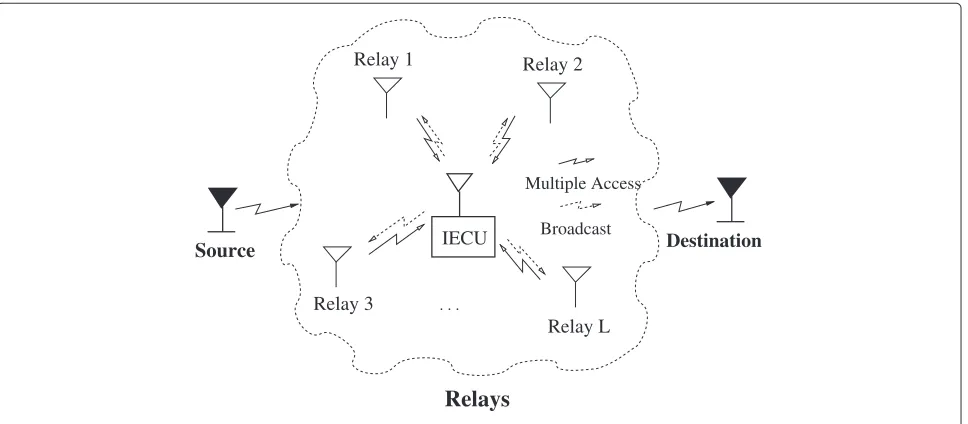
Figure 1 is the schematic diagram for the THCL system considered in this paper. As shown in Figure 1, a THCL consists of one source, one destination andLrelays. Infor-mation is transmitted from the source to the destination with the aid of theLrelays, which either cooperate with each other or independently process their signals. Fur-thermore, when the cooperative relay processing schemes (ICRP and CRP) are employed, information exchange among relays are accomplished via an IECU, as shown in Figure 1.
IECU
. . .
Relays
Relay 3Broadcast Multiple Access
Relay 1 Relay 2
Relay L
Source Destination
Figure 1Schematic diagram for the two-hop communication links.
When the relays are operated in cooperation mode, we assume that the IECU seats in the middle of theLrelays and has small and similar distances from all theLrelays. We also assume that the relays do not communicate with each other, instead, they receive signals from the source, share their information with the aid of the IECU and independently process and transmit their signals to the destination. By contrast, the IECU is assumed to com-municate only with the relays, it does not receive signals from the source or transmit signals to the destination. Note that the IECU may be viewed as a signal process-ing unit, which implements multi-way relay [26,27] to aid information exchange among relays. As shown in Figure 1, the relays forward their signals to the IECU based on the principles of DS-CDMA and, then, the IECU broad-casts the processed signal back to the relays. In this paper, we assume that all communication terminals are oper-ated in half-duplex mode. We assume that a relay employs the channel state information (CSI) of both the S-R and R-D channels related to this relay. The IECU has the CSI required for carrying out MRC. Furthermore, when the CRP is employed, a relay is also assumed to have the CSI of the IECU’s BC channel to this relay.
Let the source transmit a symbol x, which satisfies E[x]=0 andE[|x|2]=1. Then, the received observations by theLrelays can be expressed in vector form as
yr = √
α1hsrx+nr (1)
whereyr =[yr1,yr2,. . .,yrL]Tandyrirepresents the
obser-vation of theith relay,hsr=[hsr1,hsr2,. . .,hsrL]Tcontains
the channel gains of theLS-R channels,α1 depends on the relative power allocated to the first hop, and nr = [nr1,nr2,. . .,nrL]T is a length-Ladditive white Gaussian
noise (AWGN) vector, each element of which obeys the complex Gaussian distribution with zero mean and a vari-ance of 2σ2, whereσ2 = 1/(2γ¯s) withγ¯s denoting the average sound-to-noise ratio (SNR) per symbol. From (1) we are implied that the average SNR of the first hop is γsr=α1γ¯sper relay.
Based on (1), the L relays carry out one of the three relay processing schemes, including the DRP, ICRP and the CRP. Note that, when the ICRP and CRP are consid-ered, the relays use AF to send signals to the IECU. For communications between relays and destination, the DRP scheme achieving TEGC is always used to forward infor-mation to the destination, no matter which of the three relay processing schemes is employed.
Regardless of which relay processing scheme is employed, let us express the signals to be transmitted by the relays to the destination as y˜r =[˜yr1,y˜r2,. . .,˜yrL]T.
Then, the received signals at the destination is in the form of
yd= L
i=1 √α
2hridy˜ri+nd (2)
wherehridrepresents the gain of theith R-D channel,nd
is the Gaussian noise added at the destination, which is distributed with zero mean and a variance of 2σ2, while α2 is determined by the relative power allocated to the second hop. Based on (2), we can know that the aver-age SNR of theith, wherei = 1, 2,. . .,L, R-D channel is γrid = α2E[|˜yri|2]γ¯s, whereγ¯s again denotes the average
SNR per symbol.
using distributed or cooperative relay processing, and of the number of relays. If distributed relay processing is employed, the power allocated to the first and second hops isα1andα2, respectively, which satisfyα1+α2=1. By contrast, if the THCL system employs cooperative relay processing, a portion of power, which is expressed asαr, has to be allocated for information exchange among the relays. Furthermore, according to our previous discussion associated with Figure 1, information exchange requires both the MA transmission and BC transmission. Their corresponding power is expressed asαmaandαbc, respec-tively. Consequently, the relationships ofαr =αma+αbc andα1+α2+αr=1 are satisfied.
In our forthcoming performance analysis, we assume that the S-R channels, MA/BC channels and the R-D channels experience the generalized Nakagami-mfading associated with the different parameters, which determine the fading severity. The probability density function (PDF) of the Nakagami-mdistribution is [28]
f|hij|(r|m,)=
2mmr2m−1 (m)m e
−(m/)r2, r≥0 (3) where the subscriptsi,jassociated withhijare dependent on the specific channel considered. In (3), = E[|hij|2] denotes the average power of the channel and m(m ≥ 0.5) is the Nakagami-mfading parameter characterizing the severity of fading, the fading becomes less severe when the value ofmincreases.
We also consider the special scenarios, where the MA/BC channels only suffer from AWGN, in order to demonstrate that, even in this over-optimistic com-munication environments, the energy spent for relay cooperation may significantly degrade the achievable performance.
3 Relay processing
In this article, three types of relay processing schemes are investigated, which include (1) DRP: TEGC-assisted distributed relay processing; (2) ICRP: ideal centralized MRC- and TEGC-aided relay processing, which imple-ments ideal relay cooperation; and (3) CRP: centralized MRC- and TEGC-aided relay processing, which requires energy for carrying out relay cooperation. Regardless of which of the above three schemes is employed, we assume that the DRP achieving TEGC is employed by the relays for forwarding information to the destination. For this sake, below, we first discuss the principles of the DRP.
3.1 DRP
During the R-D transmission, we assume that every relay has the CSI of the channel between it and the destina-tion. Since there is no cooperation among relays, the relays can only carry out distributed transmitter preprocessing; every relay can only try to maximize the SNR of the link
between it and the destination, which is optimum when considering the individual links. At the receiver, equal-gain combining (EGC) is achieved and, therefore, we have the TEGC-assisted DRP, which is simply referred to as DRP. Explicitly, the TEGC-assisted DRP is optimum in the sense of maximizing the SNR at the destination.
Under the DRP, the signal forwarded by theith relay to the destination is given by
˜
wherexriis the symbol detected by theith relay based on
the observation (1), while 1/√Lis for satisfying the power constraint of the R-D channels. Consequently, after sub-stituting (4) into (2), the decision variable formed by the destination is
Explicitly, the diversity order achieved by the DRP isL. When BPSK is employed and when assuming that there arelrelays (with the indicesi∈l{1,. . .,L}) making correct detection, while the remaining q = L− l relays (hav-ing the indices jˆ∈q{1,. . .,L}) make erroneous detection, where∈ l{1,. . .,L}represents selectingl numbers from {1,. . .,L}, whileˆ∈q{1,. . .,L}means the remainingq num-bers of{1,. . .,L}after the selections. Then, the decision variable of (5) can be written as
y(dl,q)=
where, for convenience of BER analysis, we definedhl=
Since information exchange is ideal, the signals received by the IECU are given byycu = yr, whereyr is given by (1). In this case, assuming that the CSI of all S-R channels are known to the IECU, it can hence form the decision variable based on MRC as
zcu=hHsrycu=
From (7), we can know that the instantaneous SNR can be expressed as
implying that the IECU is capable of obtainingL-order of diversity for detection of the symbol transmitted by the source.
Let us express the symbol detected by the IECU asxˆ. Then,xˆ is sent back to theLrelays without error, as the transmission from the IECU to relays is assumed ideal. Finally, every relay transmits xˆ to the destination with the aid of the TEGC-assisted transmitter preprocessing, which can be described in (4) by settingxri = ˆx.
Cor-respondingly, the final decision variable formed at the destination can be expressed as (5) withxri= ˆx, i.e.,
In the ICRP, it is assumed that information exchange among the relays does not consume energy, which is obviously impractical. In this subsection, we consider the CRP scheme, which takes into account of the energy spent for information exchange among the relays and, hence, is a practical relay processing scheme. By compar-ing the achievable performance of the CRP with that of the ICRP considered in Section 3.2, we will realize that using ideal assumptions for cooperation may greatly overesti-mate the achievable performance of cooperative wireless systems.
When the CRP scheme is employed, theL relays first transmit the signals received from the source to the IECU in the principles of AF relay. At the IECU, sig-nals received from theLrelays are detected in the MRC principles. Then, the IECU broadcasts the detected sym-bol back to the L relays. Finally, the relays use the DRP scheme to transmit their detected symbols to the destination.
In more detail, the CRP is operated as follows: Once the Lrelays obtain the observations ofyr, as shown in (1), each of the relays, say relayi, firstly normalizes its observation, formingsri = yri/
|hsri|2+2σ2(i = 1, 2,. . .,L). Then,
theLrelays forward their normalized observations to the
IECU with the aid of DS-CDMA. Correspondingly, the observations obtained by the IECU can be represented as
ycu=
where, by definition, ycu is a length-N vector, when a spreading factor of N is used by the DS-CDMA, sr = sr1,sr2,. . .,srL
T
, Hma = CAma, where C = [c1,c2,. . .,cL] with ||ci||2 = 1 is a (N × L) matrix containing theL spreading sequences assigned to the L relays andAma = diag{a1,a2,. . .,aL}withai represent-ing the fadrepresent-ing gain of the ith channel. We assume that |ai| obeys the Nakagami-m distribution with the PDF expressed asf|ai|(r)in the form of (3) and the parameters
the complex Gaussian distribution with zero mean and a variance of 2σcu2 withσcu2 = 1/(2γ¯sβ1), whereβ1is relate to the noise variance of the MA channels. Note that, it can be shown that the average SNR of each of the DS-CDMA channels isγma=αmaγ¯sβ1/L.
When substituting (1) into (10), we can obtain an explicit expression relating to the symbol transmitted by the source, which is
ycu= which is a length-Nvector and can be viewed as the equiv-alent source to IECU channel matrix. Similarly, in (11), the length-Nnoise vectornT =
αma
L HmaGrnr+ncucontains the noise conflicted at both the relays and the IECU.
When the IECU employshT, which can be directly esti-mated at the IECU without requiring to knowHma,Grand hsrseparately, it derives the decision variable in the MRC principle as
Based onzcu, the IECU detects the symbol transmitted by the source, which is expressed asxˆ.
Then, the IECU broadcasts the detected symbolxˆto the Lrelays, and theith relay obtains the observation
ˆ yri=
√α
where nˆri is the Gaussian noise added on the ith BC
channel, which has zero mean and a variance of σrˆ2 = 1/(2γ¯sβ2) per dimension, hereβ2 is related to the noise variance of the BC channels. In (13), the channel is assumed to experience Nakagami-m fading with |hbci|
obeying the Nakagami-m distribution of (3) associated with the parameters mbci and bci. From (13), we can
know that the average SNR of a BC channel is γbc =
αbcγ¯sβ2.
Based on{ˆyri}, the relays can make their decisions about
the symbol transmitted by the IECU. Let the symbols detected by the L relays be expressed as{xri}. They are
forwarded respectively by the L relays to the destina-tion, after the TEGC-assisted preprocessing, as detailed in section 3.1. Note again that, since the TEGC-assisted pre-processing invokesLrelays for transmitting signals to the destination, a diversity order ofLcan be achieved by the CRP scheme.
Note that, if we letmmai → ∞andmbci → ∞in the
PDFs for the MA and BC channels, then, the MA and BC channels are reduced to the AWGN channels [28].
4 Analysis of bit error rate
In this section, we analyze the BER of the THCL sys-tem employing the relay processing schemes considered in section 3, when BPSK baseband modulation is assumed. Our analysis is based on the assumptions that the S-R channels, the MA channels and BC channels for informa-tion exchange, and the R-D channels experience indepen-dent fading. Specifically, the S-R channels experience the independent and identically distributed (iid) Nakagami-mfading, the same occurs with the MA/BC channels and the R-D channels. However, the fading parameters charac-terizing the S-R channels, MA/BC channels and the R-D channels may be different. Additionally, we consider the special cases, where the S-R and R-D channels experi-ence Nakagami-mfading, while the MA/BC channels are AWGN channels, in order to demonstrate that the energy spent for relay cooperation cannot be ignored even in this over-optimistic communication environments.
Before considering the specific scheme, we first note that the average BER of the BPSK communicating over flat Nakagami-mfading channels can be formulated as [29,30]
Pb(m,γc)= is the hypergeometric function defined as [31]
2F1(a,b;c;z) = ∞k=0(a)k(b)kz k
(c)kk! with(a)k = a(a+1) . . .
(a+k−1)and(a)0=1.
Note that, there are a range of special forms for (14), which can be found in [28-30].
4.1 Bit error rate of DRP
From the principles of the THCL, as described in section 2, we can know that, when the DRP is employed, the errors of the L S-R channels occur independently. Hence, the average BER can be expressed as
¯ P(bTEGC)(l)is the average BER of the destination’s detection on the condition that lout ofLrelays send the destina-tion correct bits, while the otherq=L−lrelays send the destination erroneous bits.
For the S-R transmission, the observations obtained by the relays are given in (1). Hence, when the S-R channels are assumed Nakagami-mfading channels associated with the parameters(msr,sr), the average BER ofP(bS-R)in (15) is then given by
P(bS-R) =Pb(m=msr,γc=α1srγ¯s) (16)
wherePb(m,γc)is given by (14).
Considering the transmission from the Lrelays to the destination, if there arel relays sending the destination correct bits and q = L−l relays sending the destina-tion erroneous bits, the decision variable formed by the destination is given by (6), i.e. y(dl,q) =
BER expression, we need to derive the PDF ofhl,q. Below, we derive this PDF by first introducing the Nakagami approximationfor the PDFs ofhl andhq. Two types of Nakagami approximation approaches are proposed, which are the modified Nakagami theoretical approx-imation (Nakagami-TAp) and the Nakagami statistical approximation(Nakagami-SAp).
In the context of the Nakagami-TAp, first, according to [32], when the l components in hl are indepen-dent and obey the same Nakagami-m distribution with the parameters m0 and 0, hl can be approximated as a Nakagami-m distributed random variable with the PDFfhl(y|ml,l)in the form of (3) associated with the
parameters
ml=l×m0, l=l2×0 (17)
However, as the results in [32] show, the above approxi-mation may be very inaccurate.
slightly modified to make it very accurate, yielding the modified Nakagami-TAp, which is expressed as
fhMod
l (y|ml,l)=fhl(y|ml,κl) (18)
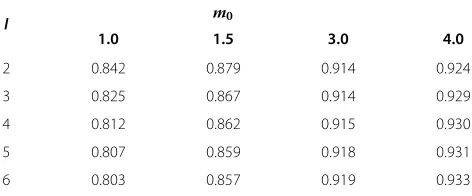
whereκis a coefficient which is dependent on the distri-bution of the components inhl and the value ofl. For instance, when0 =1, a range of values forκhave been found, which are summarized in Table 1. From the table, we see thatκ <1 is always the case. This implies that the approximation using the parameters in (17) overestimates l.
When the Nakagami-SAp is employed, we approximate hl as a Nakagami-mdistributed random variable with its PDFfhl(y|ml,l)expressed in the form of (3), whose
parametersml andl are obtained by simulations. Note that, the Nakagami-m PDF is not very sensitive to the values ofmand, especially, when these values are rel-atively large. For example, the PDFs of f|hij|(y|m,) do
not have any noticeable differences, when±0.01and m±0.01mare applied. Hence, it is usually sufficient for us to derivemandbased on about 103to 104realizations ofhij. Hence, the time spent for using the Nakagami-SAp to obtain BER results can be significantly less than that required by using direct simulations. When using direct simulations, we know that at least 107(independent) real-izations are required for a BER of about 10−5, in order to generate sufficient accuracy.
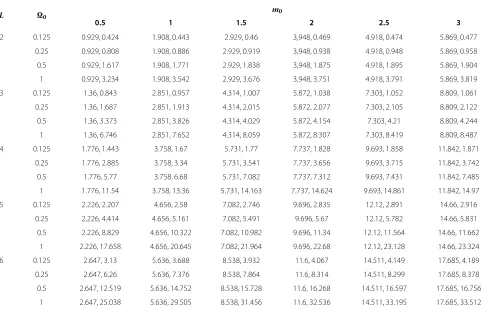
Note furthermore that, the Nakagami-SAp is very gen-eral and robust, as it does not require the details of the component distributions. However, if the parameters of the component distributions are known, the parameters for the Nakagami-SAp are only required to be generated once by simulation, which can then be repeatedly used for performance evaluation. For instance, we can make a ta-ble, like Table 2, showing the parameters, (mL,L), for the resultant Nakagami-m distributions of Ll=1|hl|, whenLtakes different values and the components,{|hl|}, obey the iid Nakagami-mdistributions with different val-ues for the parameters(m0,0). The values of(mL,L) shown in the table were generated based on 104 realiza-tions. Some of these values were used for generating the
Table 1 Parametersκfor PDF ofhlobtained by Nakagami-TAp, where component distributions have parameter0=1
l m0
1.0 1.5 3.0 4.0
2 0.842 0.879 0.914 0.924
3 0.825 0.867 0.914 0.929
4 0.812 0.862 0.915 0.930
5 0.807 0.859 0.918 0.931
6 0.803 0.857 0.919 0.933
performance results shown in Section 5. Explicitly, they generate very accurate approximation. Furthermore, this table can be repeatedly used and possibly for different applications. can be derived, as shown in the Appendix, and can be expressed as
integers, the above formula can be expressed as
fhl,q(x)=
where(a,x)represents the incomplete gamma function given by (40).
When given hl,q, the BER of the R-D transmission employing the DRP can be derived based on (6), which can be expressed as
where Q(x) represents the Gaussian Q function [33], which is defined as Q(x) = √1
dθ [34]. Correspondingly, the aver-age BER of the R-D transmission can be expressed as
Table 2 Parameters(mL, L)for PDF ofhL=Ll=1|hl|obtained by Nakagami-SAp
L 0 m0
0.5 1 1.5 2 2.5 3
2 0.125 0.929, 0.424 1.908, 0.443 2.929, 0.46 3,948, 0.469 4.918, 0.474 5.869, 0.477
0.25 0.929, 0.808 1.908, 0.886 2.929, 0.919 3,948, 0.938 4.918, 0.948 5.869, 0.958
0.5 0.929, 1.617 1.908, 1.771 2.929, 1.838 3,948, 1.875 4.918, 1.895 5.869, 1.904
1 0.929, 3.234 1.908, 3.542 2.929, 3.676 3,948, 3.751 4.918, 3.791 5.869, 3.819
3 0.125 1.36, 0.843 2.851, 0.957 4.314, 1.007 5.872, 1.038 7.303, 1.052 8.809, 1.061
0.25 1.36, 1.687 2.851, 1.913 4.314, 2.015 5.872, 2.077 7.303, 2.105 8.809, 2.122
0.5 1.36, 3.373 2.851, 3.826 4.314, 4.029 5.872, 4.154 7.303, 4.21 8.809, 4.244
1 1.36, 6.746 2.851, 7.652 4.314, 8.059 5.872, 8.307 7.303, 8.419 8.809, 8.487
4 0.125 1.776, 1.443 3.758, 1.67 5.731, 1.77 7.737, 1.828 9.693, 1.858 11.842, 1.871
0.25 1.776, 2.885 3.758, 3.34 5.731, 3.541 7.737, 3.656 9.693, 3.715 11.842, 3.742
0.5 1.776, 5.77 3.758, 6.68 5.731, 7.082 7.737, 7.312 9.693, 7.431 11.842, 7.485
1 1.776, 11.54 3.758, 13.36 5.731, 14.163 7.737, 14.624 9.693, 14.861 11.842, 14.97
5 0.125 2.226, 2.207 4.656, 2.58 7.082, 2.746 9.696, 2.835 12.12, 2.891 14.66, 2.916
0.25 2.226, 4.414 4.656, 5.161 7.082, 5.491 9.696, 5.67 12.12, 5.782 14.66, 5.831
0.5 2.226, 8.829 4.656, 10.322 7.082, 10.982 9.696, 11.34 12.12, 11.564 14.66, 11.662
1 2.226, 17.658 4.656, 20.645 7.082, 21.964 9.696, 22.68 12.12, 23.128 14.66, 23.324
6 0.125 2.647, 3.13 5.636, 3.688 8.538, 3.932 11.6, 4.067 14.511, 4.149 17.685, 4.189
0.25 2.647, 6.26 5.636, 7.376 8.538, 7.864 11.6, 8.314 14.511, 8.299 17.685, 8.378
0.5 2.647, 12.519 5.636, 14.752 8.538, 15.728 11.6, 16.268 14.511, 16.597 17.685, 16.756
1 2.647, 25.038 5.636, 29.505 8.538, 31.456 11.6, 32.536 14.511, 33.195 17.685, 33.512
Lcomponents are iid Nakagami-mrandom variables with parameters (m0,0).
Consequently, the average BER of P(bTEGC)(l) can be evaluated from (22) by invoking (19) or (20). Specifically, when(2ml−1)and(2mq−1)are integers, it can be shown that
P(bTEGC)(l)= m
ml l m
mq q ml
l
mq
q (ml)(mq)
2ml−1
l1=0
2mq−1 q1=0
2ml−1
l1
2mq−1
q1
×
mq qη2
2ml−1−l1 m
q qη2−
1
2mq−1−q11 η
l1+q1+1
×
∞
−∞Q
x2α2γ¯s/L
exp
−mlmqx2
mlq+mql
×
l1+q1+1
2 ,
uη−mqx qη
2
x2ml+2mq−l1−q1−2dx
(23)
when 0<l<L, and whenl=L,
P(bTEGC)(L)=Pb(m=mL,γc=α2Lγ¯s/L) (24)
wherePb(m,γc)is given by (14).
Finally, the average BER of the THCL system employing the DRP can be evaluated from (15) with the aid of (23) and (24).
4.2 Bit error rate of ICRP
When the ICRP scheme is considered, as shown in Section 3.2, the bits transmitted by theLrelays to the des-tination are just the bit detected by the IECU. Hence, the average BER of the THCL system using the ICRP scheme can be written as
¯
Pb(ICRP)=P(bIECU)1−Pb(TEGC)+1−Pb(IECU)P(bTEGC)
(25)
In (25), the first (second) term at the right-hand side denotes the probability that the detection at the IECU is incorrect (correct) while the detection at the destination is correct (incorrect).
First, in (25),P(bTEGC)is the average BER of detection at the destination, which has been analyzed in section 4.1. In the ICRP scenario, all the L bits to be transmitted by the relays are the same. Hence, we have Pb(TEGC) = P(bTEGC)(L), which is given by (24).
LS-R channels experience independent Nakagami-m fad-ing with the same PDF determined by the parametersmsr andsr, the average BER of the IECU’s detection can be expressed as [28-30]
in the general cases. Furthermore, whenmsrLis a positive integer, (26) can be reduced to
Pb(IECU)=
4.3 Bit error rate of CRP
Finally, when the CRP scheme is considered, errors may occur over the S-R channels, MA/BC channels for infor-mation exchange and the R-D channels. Let the BER after the IECU’s detection beP(bIECU) and the BER of the BC channels beP(bBC). Then,P(bS-R) in (15), which represents the BER of the bits to be sent to the destination, can be expressed as
Substituting (28) into (15), we can express the average BER of the THCL system employing the CRP as
¯ readily obtained. The decision variables formed by theL relays for the BC channels are given in (13). Based on this equation, the average BER of the BC channels is
P(bBC)=Pb(m=mbc,γc=αbcβ2bcγ¯s) (30)
when the BC channels are assumed to experience inde-pendent Nakagami-mfading with the parametersmbcand
bc. When the BC channels are AWGN channels, we simply havePb(BC)=Q√2αbcβ2γ¯s/L
.
In (29),P(bIECU)is the BER of the detection at the IECU using MRC. In this case, the decision variable formed
by the IECU is expressed as (12), based on which the instantaneous SNR can be expressed as
γcu= However, it is extremely hard to derive the exact PDF of γcufrom (31), due to the forwarded noise by the relays, as seen in (11). Consequently, we are incapable of deriving the exact average BER ofPb(IECU). In this paper, we propose the Gamma approximation (Gamma-Ap) for obtaining the PDF ofγcu.
Note that, in performance analysis, the Gaussian approximation (Gaussian-Ap) is typically employed. However, for some scenarios, such as for the PDF of (31), where the concerned variables are always positive, the Gamma-Ap has the advantages over the Gaussian-Ap. First, the Gamma distribution [29], which can be obtained by the squares of Nakagami-mdistributed vari-ables, is defined in [ 0,∞), while the Gaussian distribution is defined in(−∞,∞). Second, for applying the Gaussian-Ap, usually a high number of component variables is required, so that their sum yields a symmetric distribu-tion. By contrast, the Gamma-Ap does not impose this constraint, and can be applied for the sum of any num-ber of component variables. Furthermore, as the numnum-ber of components increases, the resultant Gamma distribu-tion appears the Gaussian-like shape, but, in the range [ 0,∞). Hence, the Gamma-Ap (also including the Nak-agami approximation, as they belong to the same family) represents a versatile approximation approach, which may find applications for a lot of problems in practice, includ-ing a lot of performance analysis problems in wireless communications.
Specifically, for the current case, let us rewrite (31) as
γcu= α1αmaγ¯s
Then, with the Gamma-Ap, we can approximateζcuas a Gamma distributed random variable with the PDF [29]
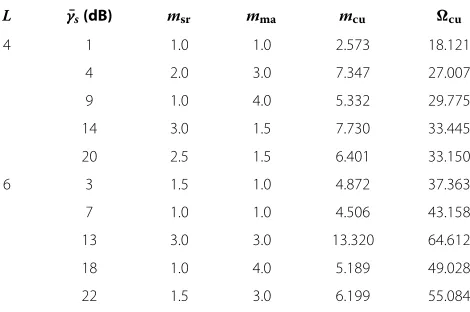
Hence, it may be extremely hard (if it is not impossible) to derive the parameters mcu andcu by mathematical analysis. However, they can be readily found by simula-tions based on about 104 realizations. For instance, in Table 3, a range of cases are considered, where the spread-ing factorNis 16, theLS-R channels experience the same Nakagami-mfading with the parametersmsrandsr=1, and the MA channels also experience the same Nakagami-mfading with the parametersmmaandma = 1. As our results in Section 5, the Gamma-Ap in general yields very accurate approximation.
With the aid of the Gamma-Ap for finding the PDF of ζcu, which is (34), we can now easily obtain the average BER of the detection at the IECU, which can be expressed as
P(bIECU)=Pb(m=mcu,γc=α1αmacuγ¯s/L) (35)
Furthermore, the average of the THCL system employing the CRP scheme can be evaluated from (29) associated with (22) (or (23) and (24)), (30) and (35).
5 Performance results
In this section, we demonstrate a range of performance results for characterizing the achievable performance of THCL systems with the various relay processing schemes considered. Both numerical results evaluated from the formulas derived in the previous sections and simulation results are provided. Note that, for obtaining the results, we assume that all channels of the first and second hops experience independent fading. The MA/BC channels are either Gaussian channels for illustrating the best cases or iid fading channels. When the CRP is employed, we assume that the parametersβ1andβ2take a value of 10, which results in that the average SNR of the MA/BC chan-nels is typically 10 dB higher than that of the S-R and R-D channels. Furthermore, for the DS-CDMA used for
Table 3 Parameters for the Gamma PDFfζcu(ζ )obtained based on the Gamma-Ap
L γ¯s(dB) msr mma mcu cu
4 1 1.0 1.0 2.573 18.121
4 2.0 3.0 7.347 27.007
9 1.0 4.0 5.332 29.775
14 3.0 1.5 7.730 33.445
20 2.5 1.5 6.401 33.150
6 3 1.5 1.0 4.872 37.363
7 1.0 1.0 4.506 43.158
13 3.0 3.0 13.320 64.612
18 1.0 4.0 5.189 49.028
22 1.5 3.0 6.199 55.084
the MA transmission, the spreading codes are assumed random sequences with a spreading factorN=16.
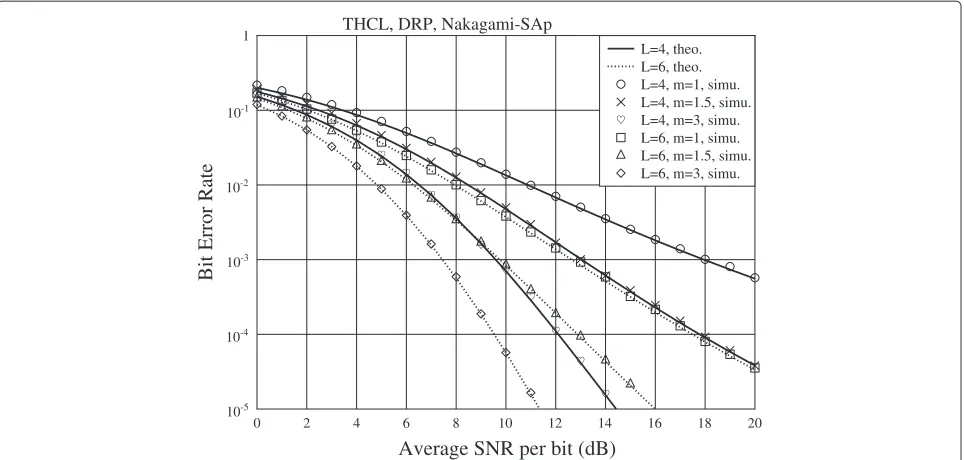
In Figures 2 and 3, we compare the approximate BER of the DRP-assisted THCL with the corresponding BER obtained by simulations, when the S-R and R-D channels are assumed iid Nakagami-m fading channels. Further-more, Figures 2 and 3 illustrate the impacts of the number of relays and the fading parameter m on the achiev-able BER performance. Note that, the approximate BER was evaluated based on (15), when either the Nakagami-TAp or the Nakagami-SAp was employed. From Figure 2, we can observe that there is a slight deviation between the approximate BER and the simulated BER, when the Nakagami-TAp is applied. However, the difference becomes smaller as the Nakagami-mfading becomes less severe, i.e., asm increases. The difference also becomes smaller, as the number of relays increases. Nevertheless, for all the scenarios considered, the approximate BER and simulated BER are close to each other. When the Nakagami-SAp is employed, as shown in Figure 3, the approximate BER and the simulated BER always agree with each other. Therefore, we are confident that both the Nakagami-TAp and Nakagami-SAp are highly effec-tive, while the Nakagami-SAp is more accurate than the Nakagami-TAp.
Additionally, as shown in Figures 2 and 3, the BER per-formance improves as the fading becomes less severe. It also improves as the number of relays increases, owing to the increased spatial diversity.
The BER performance of the THCL employing ICRP is shown in Figure 4, when assuming that both the S-R and R-D channels experience iid Nakagami-m fad-ing. The theoretical BER was evaluated based on the Nakagami-TAp. Again, from the results of Figure 4, we can observe that the approximate BER of all the con-sidered cases closely matches the corresponding BER obtained by simulations. In comparison with the results shown in Figure 2 or Figure 3, we can see that remark-able SNR gain may be attained, when the ICRP is employed by an IECU instead of using the DRP. Note that, this performance gain achieved by the ICRP-assisted THCL is mainly due to the cooperative detection of the first hop without considering the energy consump-tion. This impractical cooperation detection generates the symbols having much higher reliability than that detected by the relays operated under the practicalDRP scheme.
THCL, DRP, Nakagami-TAp
10-5 10-4 10-3 10-2 10-1 1
Bit Error Rate
0 2 4 6 8 10 12 14 16 18 20
Average SNR per bit (dB)
L=4, theo. L=6, theo. L=4, m=1, simu. L=4, m=1.5, simu. L=4, m=3, simu. L=6, m=1, simu. L=6, m=1.5, simu. L=6, m=3, simu.
Figure 2BER of DRP-assisted THCL employing BPSK baseband modulation, power allocation factorsα1=α2=0.5, and Nakagami-TAp approach.
channels are iid Nakagami-mfading channels with a fad-ing parametermma. In this figure, the approximate BER was obtained based on the Gamma-Ap for the detection at the IECU and the Nakagami-TAp for the detection at the destination. From the results shown in the figure, we can have the following observations. First, the approxi-mate BER agrees with the corresponding BER obtained by simulations in the relatively low SNR region, but there
appears some deviation in the high SNR region. Second, the approximate BER becomes more accurate, as channel fading becomes less severe. Third, the approximate BER also becomes more accurate as the first and/or second hops becomes more reliable. Additionally, when compar-ing the results shown in Figure 5 with those shown in Figure 4, we are implied that the practically achievable BER performance of the THCL should be much worse
THCL, DRP, Nakagami-SAp
10-5 10-4 10-3 10-2 10-1 1
Bit Error Rate
0 2 4 6 8 10 12 14 16 18 20
Average SNR per bit (dB)
L=4, theo. L=6, theo. L=4, m=1, simu. L=4, m=1.5, simu. L=4, m=3, simu. L=6, m=1, simu. L=6, m=1.5, simu. L=6, m=3, simu.
THCL, ICRC, Nakagami-TAp
10-5 10-4 10-3 10-2 10-1 1
Bit Error Rate
0 2 4 6 8 10 12 14 16 18 20
Average SNR per bit (dB)
L=6, theo. L=4, theo. m=1, L=6, simu. m=1.5, L=6, simu. m=3, L=6, simu. m=1, L=4, simu. m=1.5, L=4, simu. m=3, L=4, simu.
Figure 4BER of ICRP-assisted THCL employing BPSK baseband modulation and power allocation factorsα1=α2=0.5.
than that predicted from the ICRP, as the relays require energy for cooperation. Note that, as shown at the begin-ning of this section, the MA/BC channels are in fact assumed more reliable than the S-R and R-D channels. This issues will be further discussed later associated with the other figures.
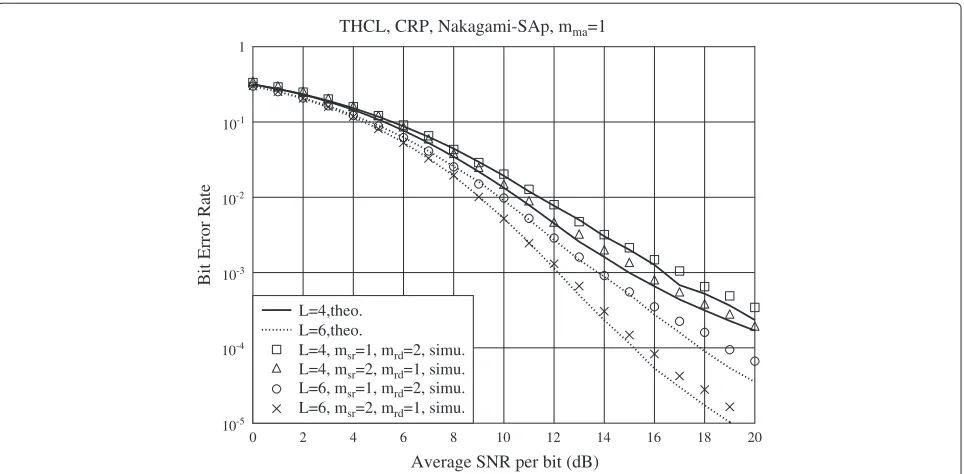
In Figure 6, we demonstrate the impact of the reli-ability of the S-R and R-D channels on the achievable
BER performance of the THCLs. In our simulations, we assumed that the S-R and R-D channels are Nakagami-mfading channels with a fading parametermsrandmrd, respectively, while the MA/BC channels are iid Nakagami-m fading channels with a fading parameter mma. The values for these parameters weremma = mbc = 1, while msr = 1 andmrd = 2 ormsr = 2 andmrd = 1. Since a larger value for the fading parameter means that the
THCL, CRP, Nakagami-TAp
10-5 10-4 10-3 10-2 10-1 1
Bit Error Rate
0 2 4 6 8 10 12 14 16 18 20
Average SNR per bit (dB) L=4,theo.
L=6,theo.
L=4, msr=1, mma=1, simu. L=4, msr=1, mma=2.5, simu. L=4, msr=1, mma=4, simu. L=6, msr=1, mma=1, simu. L=6, msr=2, mma=1, simu. L=6, msr=2, mma=2, simu.
THCL, CRP, Nakagami-SAp, mma=1
10-5 10-4 10-3 10-2 10-1 1
Bit Error Rate
0 2 4 6 8 10 12 14 16 18 20
Average SNR per bit (dB)
L=4,theo. L=6,theo.
L=4, msr=1, mrd=2, simu. L=4, msr=2, mrd=1, simu. L=6, msr=1, mrd=2, simu. L=6, msr=2, mrd=1, simu.
Figure 6BER of CRP-assisted THCL employing BPSK baseband modulation and power allocation factorsα1=α2=αr=1/3.The S-R and R-D channels are assumed Nakagami-mfading channels with a fading parameter ofmsrandmrd, respectively while the MA/BC channels, with a fading parameter ofmma.
corresponding channel is more reliable, from Figure 6, we observe that having reliable S-R channels is more important than having reliable R-D channels, in order to improve the BER performance of the THCL. This obser-vation becomes more explicit, when the number of relays is increased fromL=4 toL=6.
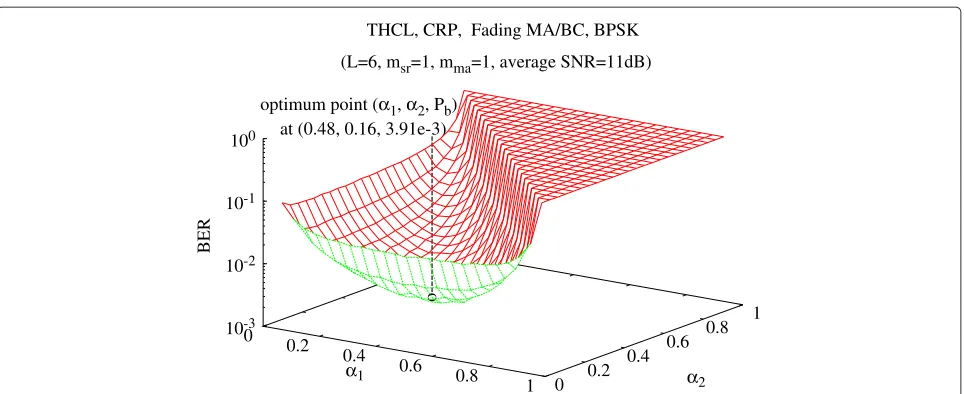
In Figures 7 and 8, we demonstrate the impact of power allocation on the achievable BER performance of the THCL employing the CRP, when both the S-R and the
R-D experience iid flat Rayleigh fading. For the MA/BC channels, AWGN channels are assumed for Figure 7, in order to illustrate that even in this case, the perfor-mance achievable by the practical CRP may be much worse than that achieved by the ICRP, implying that the ideal assumptions applied are highly impractical. By contrast, flat Rayleigh fading channels are assumed for Figure 8. In these figures, the ‘optimum point’ indicates the optimum power allocation and the corresponding
THCL, CRP, AWGN MA/BC, BPSK (L=6, msr=1, average SNR=11dB)
BER
o---optimum point (α1,α2, Pb) at (0.44, 0.28, 1.47e-4)
0 0.2
0.4 0.6
0.8 1
α1
0 0.2
0.4 0.6
0.8 1
α2
10-4 10-3 10-2
10-1 100
THCL, CRP, Fading MA/BC, BPSK
(L=6, msr=1, mma=1, average SNR=11dB)
BER
o---optimum point (α1,α2, Pb) at (0.48, 0.16, 3.91e-3)
0 0.2
0.4 0.6
0.8 1
α1
0 0.2
0.4 0.6
0.8 1
α2
10-3 10-2 10-1
100
Figure 8Effect of power allocation factors on BER performance of CRP-assisted THCL employing BPSK baseband modulation.All the S-R, MA/BC and R-D channels experience flat iid Rayleigh fading.
lowest BER achievable. As seen in Figure 7 for the AWGN MA/BC scenario, the optimum power allocation isα1 = 0.44, α2 = 0.28, αr = 0.28. Hence, the main portion of power is allocated to the first hop to improve the reli-ability of the first hop to a sufficient level. By contrast, when the MA/BC channels are also Rayleigh fading chan-nels, as seen in Figure 8, the power allocation for the THCL system to achieve the best BER performance is α1 = 0.48, α2 = 0.16, αr = 0.36. More portion of the total power is required for information exchange among the relays, compared with the AWGN MA/BC case. From both the figures, we are informed that a big portion of energy is required for implementing cooperation among relays. Hence, in wireless networks, using cooperative relays is in fact highly challenging. Not only is a substantial amount of energy is required for cooperation, the accom-panied increase of complexity may be substantial as well. This is because, first, extra channel estimation is required. Second, power allocation will become more difficult, as four hops need to be considered in a network employing cooperative relays, instead of two hops in a network using distributed relays.
Additionally, we may compare the best BER achieved in Figure 7, which assumed AWGN MA/BC channels, with Figure 4. In Figure 4, the curve corresponding to the parameters ofm= 1,L=6 shows that the BER at 11 dB is well below 10−5. This BER is much lower than the best BER of 1.47×10⁻⁴shown in Figure 7. From this compar-ison, we are implied that the BER predicted by applying ideal assumptions is far overoptimistic.
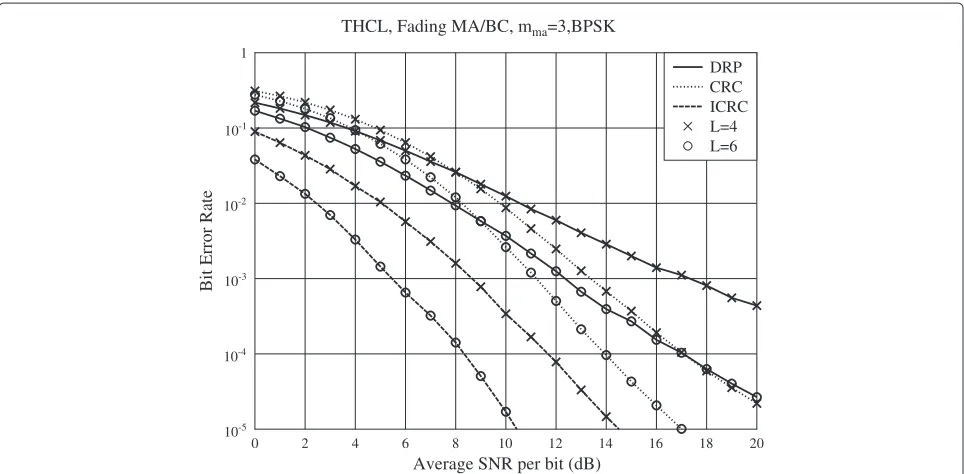
Finally, in Figures 9 and 10, we compare the BER per-formance achieved by the DRP, ICRP, and CRP, when applying the suboptimal power allocation scheme. Under
THCL, Fading MA/BC, mma=1,BPSK
10-5 10-4 10-3 10-2 10-1 1
Bit Error Rate
0 2 4 6 8 10 12 14 16 18 20
Average SNR per bit (dB)
DRP CRC ICRC L=4 L=6
Figure 9Comparison of BER performance of THCL systems employing DRP, ICRP, and CRP.The S-R, MA/BC, and R-D channels are flat Rayleigh fading channels.
6 Conclusions
In this paper, we have studied the BER performance of THCL systems with various relay processing schemes, including the DRP, ICRP, and CRP. As the BER of the TEGC-assisted detection at the destination is hard to analyze, two approximation approaches have been pro-posed, which are the Nakagami-TAp and Nakagami-SAp.
Our performance studies show that both the approxima-tion approaches can be confidently used for predicting the BER of the schemes generating EGC-type decision variables, although the Nakagami-SAp may yield more accurate results than the Nakagami-TAp. For evaluation of the BER at the IECU, the Gamma-Ap is proposed for finding the distribution of the related SINR. From
THCL, Fading MA/BC, mma=3,BPSK
10-5 10-4 10-3 10-2 10-1 1
Bit Error Rate
0 2 4 6 8 10 12 14 16 18 20
Average SNR per bit (dB)
DRP CRC ICRC L=4 L=6
our studies, we can realize that these approximation approaches, especially, the Gamma-Ap, are highly general, which may find applications in performance analysis of a wide range of communication systems. Finally, the BER performance of the various relay processing schemes has been demonstrated and compared. From the performance results, we can conclude that, without considering the cost for relay cooperation, the ICRP always outperforms the DRP. However, in the practical scenarios where relay cooperation consumes energy, bandwidth, and implemen-tation complexity, we find that the DRP often outper-forms the CRP even in terms of the BER performance. Therefore, in relay communications, the performance pre-dicted under the assumption of ideal relay cooperation may be too optimistic and, hence, unachievable in prac-tice. Owing to its low complexity for implementation, in practice, the DRP constitutes a highly desirable relay pro-cessing scheme, especially, in the communication envi-ronments where a few, such as L ≥ 4, of relays are available. Upon substituting these PDFs into (36) and after some arrangement, we obtain
q. Then, we can express the above formula
as trary values, to the best of our knowledge, (38) cannot be further simplified. By contrast, when 2ml−1 and 2mq−1
are integers, it can be shown that, with the aid of the serial expansion, (38) can be expressed as
fhl,q(x)=
where(a,x)represents the incomplete gamma function defined as [31]
(a,x)=
∞
x
ta−1e−tdt (40)
Note that, whenml andmq are relatively big, we may approximate 2ml−1 and 2mq−1 (sometimes evenmland mq) to their nearest integers and still generate sufficient accuracy, as evidenced by the results shown in [12]. This is because the Nakagami-mPDFs are not very sensitive to the value ofm, when it is relatively big.
Competing interests
The authors declare that they have no competing interests.
Acknowledgements
This work was presented in part at the IEEE VTC2012 Spring, 6-9 May 2012, Yokohama, Japan.
Received: 14 November 2013 Accepted: 13 March 2014 Published: 4 April 2014
References
1. S Berger, M Kuhn, A Wittneben, T Unger, A Klein, Recent advances in amplify-and-forward two-hop relaying. IEEE Commun. Mag.47(7), 50–56 (2009)
2. JN Laneman, DNC Tse, GW Wornell, Cooperative diversity in wireless networks: efficient protocols and outage behavior. IEEE Trans. Inform. Theory.50(12), 3062–3080 (2004)
3. A Sendonaris, E Erkip, B Aazhang, User cooperation diversity. part I. system description. IEEE Trans. Commun.51(11), 1927–1938 (2003)
4. A Sendonaris, E Erkip, B Aazhang, User cooperation diversity. part II. Implementation aspects and performance analysis. IEEE Trans. Commun.
51(11), 1939–1948 (2003)
5. AH Bastami, A Olfat, Optimal SNR-based selection relaying scheme in multi-relay cooperative networks with distributed space-time coding. IET Commun.4(6), 619–630 (2010)
6. P Anghel, M Kaveh, Exact symbol error probability of a cooperative network in a Rayleigh-fading environment. IEEE Trans. Wireless Commun.
3(5), 1416–1421 (2004)
7. KJR Liu, AK Sadek, WF Su, A Kwasinski,Cooperative Communications and Networking. (Cambridge University Press, New York, 2009)
8. O Amin, S Ikki, M Uysal, On the performance analysis of multirelay cooperative diversity systems with channel estimation errors. IEEE Trans. Vehicular Technol.60(5), 2050–2059 (2011)
10. P Anghel, M Kaveh, Exact symbol error probability of a cooperative network in a Rayleigh-fading environment. IEEE Trans Wireless Commun.
3(5), 1416–1421 (2004)
11. A Ribeiro, X Cai, G Giannakis, Symbol error probabilities for general cooperative links. IEEE Trans. Wireless Commun.4(3), 1264–1273 (2005) 12. L-L Yang, H-H Chen, Error probability of digital communications using
relay diversity over Nakagami-m fading channels. IEEE Trans. Wireless Commun.7(5), 1806–1811 (2008)
13. B Barua, H Ngo, H Shin, On the SEP of cooperative diversity with opportunistic relaying. IEEE Commun. Lett.12(10), 727–729 (2008) 14. T Himsoon, W Siriwongpairat, W Su, K Liu, Differential modulations for
multinode cooperative communications. IEEE Trans. Signal Process.
56(7), 2941–2956 (2008)
15. J Boyer, D Falconer, H Yanikomeroglu, Multihop diversity in wireless relaying channels. IEEE Trans. Commun.52(10), 1820–1830 (2004) 16. Y Zhao, R Adve, TJ Lim, Outage probability at arbitrary SNR with
cooperative diversity. IEEE Commun. Lett.9(8), 700–702 (2005) 17. HA Suraweera, PJ Smith, J Armstrong, Outage probability of cooperative
relay networks in Nakagami-m fading channels. IEEE Commun. Lett.
10(12), 834–836 (2006)
18. A Bletsas, H Shin, M Win, Outage optimality of opportunistic
amplify-and-forward relaying. IEEE Commun. Lett.11(3), 261–263 (2007) 19. N Sagias, F Lazarakis, G Tombras, C Datsikas, Outage analysis of
decode-and-forward relaying over Nakagami- m fading channels. IEEE Signal Process. Lett.15, 41–44 (2008)
20. G Kramer, M Gastpar, P Gupta, Cooperative strategies and capacity theorems for relay networks. IEEE Trans. Inform Theory.51(9), 3037–3063 (2005)
21. A Host-Madsen, J Zhang, Capacity bounds and power allocation for wireless relay channels. IEEE Trans. Inform. Theory.51(6), 2020–2040 (2005) 22. A Host-Madsen, Capacity bounds for cooperative diversity. IEEE Trans.
Inform. Theory.52(4), 1522–1544 (2006)
23. Y Chen, S Kishore, J Li, Wireless diversity through network coding. IEEE Wireless Commun. Network. Conf. (WCNC 2006).3, 1681–1686 (2006) 24. J Laneman, GW Wornell, Distributed space-time-coded protocols for
exploiting cooperative diversity in wireless networks. IEEE Trans. Inform. Theory.49(10), 2415–2425 (2003)
25. J Shi, L-L Yang, Performance of two-hop communication links employing various relay processing schemes, inIEEE VTC 2012-Spring6–9 May (IEEE, Piscataway, 2012)
26. D Gunduz, A Yener, A Goldsmith, H Poor, The multi-way relay channel, in IEEE International Symposium on Information Theory (ISIT 2009)
(IEEE, Piscataway, 2009), pp. 339–343
27. J Shi, L-L Yang, Performance of multiway relay DS-CDMA systems over Nakagami-m fading channels, inIEEE 73rd Vehicular Technology Conference (VTC 2011-Spring)(IEEE, Piscataway, 2011), pp. 1–5
28. L-L Yang, L Hanzo, Performance of generalized multicarrier DS-CDMA, over Nakagami-m fading channels. IEEE Trans. Commun.50(6), 956–966 (2002)
29. MK Simon, M-S Alouini,Digital Communication Over Fading Channels: A Unified Approach to Performance Analysis. (Wiley, New York, 2000) 30. L-L Yang,Multicarrier Communications. (Wiley, Chichester, 2009) 31. IS Gradshteyn, IM Ryzhik,Table of Integrals, Series, and Products. (Academic
Press, New York, 1980)
32. M Nakagami, The m-distribution, a general formula of intensity of rapid fading, inStatistical Methods in Radio Wave Propagation: Proceeding of a Symposium,June (Pergamon Press, Oxford, 1958)
33. JG Proakis,Digital Communications,3rd ed. (McGraw-Hill, New York, 1995) 34. MK Simon, MS Alouini, A unified approach to the probability of error for
noncoherent and differentially coherent modulations over generalized fading channels. IEEE Trans. Commun.46(12), 1625–1638 (1998) 35. V Rotar,Probability and Stochastic Modeling. (Chapman and Hall/CRC, Boca
Raton, 2012)
doi:10.1186/1687-1499-2014-53
Cite this article as:Shiet al.:Performance comparison of cooperative relay links with different relay processing strategies: Nakagami/Gamma approximation approaches.EURASIP Journal on Wireless Communications and Networking20142014:53.
Submit your manuscript to a
journal and benefi t from:
7Convenient online submission 7Rigorous peer review
7Immediate publication on acceptance 7Open access: articles freely available online 7High visibility within the fi eld
7Retaining the copyright to your article