_____________________________________________________________________________________________________
*Corresponding author: E-mail: [email protected];
www.sciencedomain.org
Intersection of Maternal Age and Parity with
Pregnancy Outcomes in a Rural Health Centre in
Nigeria: Implications for Training and Practice of
Family Physicians
Bock-Oruma A. Andrew
1*,
Dienye O. Paul
2,
Ndukwu U. Geraldine
2and Ajadi A. Michael
31
Department of Family Medicine, Delta State University Teaching Hospital, P.M.B. 07, Oghara, Nigeria.
2
Department of Family Medicine, University of Port Harcourt Teaching Hospital, Port Harcourt, Nigeria.
3
Department of Obstetrics and Gynaecology, Shawsand Medical Centre, P.O.Box 6082, Port Harcourt, Nigeria.
Authors’ contributions
This work was carried out in collaboration between all authors. Author BOAA designed the study, wrote the protocol, and wrote the first draft of the manuscript. Author DOP managed the literature searches, analyses of the study and author NUG contributed to the design and literature search and author AAM contributed to the literature search. All authors read and approved the final manuscript.
Article Information
DOI: 10.9734/BJMMR/2016/21649 Editor(s): (1) Edward J Pavlik, Univ. Kentucky Medical Center, Division of Gynecological Oncology, USA. Reviewers: (1) Fethi Ben Slama, National Institute of Public Health, Tunisia. (2)Tania Machado, University of Minho, Portugal. Complete Peer review History:http://sciencedomain.org/review-history/12171
Received 27th August 2015 Accepted 20th October 2015 Published 9th November 2015
ABSTRACT
Background: The impact of biological factors on pregnancy outcomes is equivocal.
Objective: This study was aimed to examine the effect of maternal age and parity on obstetric and
perinatal outcomes in Nigeria.
Materials and Methods: This was a prospective, observational study of pregnant women at the
Comprehensive Health Centre, Aluu in southern Nigeria. The WHO classifying form of the new
antenatal care model was used in enrolling pregnant women registering for ante natal care at the study centre. Data were entered and analyzed using the statistical package for the social sciences version 16.0. Association between the variables was determined using chi-square test with statistical significance set at P ≤ 0.05.
Results: Out of 410 pregnant women involved in the study, 379 (92.4%) completed it. Considering
maternal age and obstetric outcomes, statistically significant association was observed between maternal age and delivery gestational age (p= 0.019), mode of delivery (p=0.02) and birth weight (p=0.047). There were 146 (38.5%) primips and 21(5.5%) grandmultips. Statistical significance was observed in the association of parity and birth weight (p=0.02) and foetal outcome (p=0.03) with a high incidence of low birth weight among primips (n=17; 11.6%) and higher perinatal mortality among grand multips (n=3; 14.3%). There was no maternal mortality. Teenage pregnancy encountered zero operative deliveries.
Conclusion: Maternal age is associated with preterm deliveries, low birth weight babies and
operative delivery. Parity is associated with birth weight and foetal outcome. There was no maternal mortality and teenage pregnancy encountered zero operative deliveries.
Keywords: Teenage pregnancy; advanced maternal age; parity; pregnancy outcomes; primary care.
1. INTRODUCTION
Maternal reproductive age has been put at between 15-49 years, but 20-35 years is regarded as the safest in the age group of childbearing [1]. This means that pregnancy or childbirth below or above this age bracket may have an adverse effect on either the mother, the pregnancy, delivery or the child. Teenage pregnancy has been influenced in modern times by declining age at menarche, increased schooling, delay of marriage, inadequate contraception and poverty [2,3]. With a prevalence range of 1.6 to 10% across Nigeria [4], 9% in Saudi Arabia [5] and 4 to 22% in the developed countries [6], studies have shown that the main maternal problems are preterm labor and delivery, hypertensive disease, anemia, more severe forms of malaria, obstructed labor, poor maternal nutrition and poor breastfeeding, with the infants of adolescent mothers being more prone to low birth weight and increased neonatal mortality and morbidity worsened by inadequate antenatal care [2,3,7]. On the other hand, women 35 years of age or older (also known as advanced maternal age, AMA), are at increased risk for pregnancy-induced hypertension, diabetes, obesity and other medical conditions. Caesarean section, preeclampsia, and placenta previa are also noted in women with advanced maternal age, with chromosomal abnormalities being more common in infants born to them [7-12].The prevalence of AMA is 1.4% in southern Nigeria [11], and 19.1% to 33.4% in the developed world [12]. These women at the extreme of age carry the greatest risks for maternal death and poor perinatal
outcome [1]. Maternal and neonatal complications are more in women aged 40 years and above, but neonatal outcomes are similar to those in the younger age group [13,14].In the developing world, pregnancy outcome amongst women with advanced maternal age is very poor especially in the presence of high parity, high child mortality and poverty and deprivation [1].
Studies have reported equivocal findings between parity, obstetric and perinatal outcomes [12,15,16]. While multiparity is associated with precipitate labor, increased risk of hemorrhage and amniotic fluid embolism, [9] grandmultiparity is significantly associated with antenatal anemia, multiple pregnancy, fetal macrosomia, perinatal mortality, retained placenta and primary postpartum hemorrhage [17,18].
In south-eastern Nigeria, grandmultiparity has a prevalence of 16.41% and its predisposing factors include illiteracy, desire for large families, high perinatal mortality and non-use of contraception [19]. In Asia and North America, however, the significance of parity on pregnancy outcomes was questioned because of the modifying effect of age [15,20].
In Nigeria, most studies on the impact of biological factors such as maternal age and parity on pregnancy outcomes are retrospective and from secondary and tertiary care facilities by obstetricians in urban centers. No such studies have been conducted in the primary health centers in the rural communities where about 70% of the population inhabits. These primary health centres are usually manned by primary care physicians and their residents in training. This study will therefore determine the association of maternal age and parity on obstetric and perinatal outcomes in a comprehensive health centre in a rural community in Nigeria. The result of this study will serve as an appraisal of the performance of the primary care team led by family physicians in the rural health centers and the implications for their training.
2. MATERIALS AND METHODS
2.1 Setting and Design
This study was conducted in the Comprehensive Health Centre, Aluu in southern Nigeria. The facility is run by a good primary care team consisting of family physicians, community health physicians, nurses and midwifes. It was a prospective cross sectional study of pregnant women who presented for antenatal booking, between January 2009 and June 2010. Obstetrics outcomes measured were delivery gestational age, and mode of delivery, while the perinatal outcomes of interest were birth weight and fetal outcomes. Gestational age was based on the last menstrual period.
2.2 Subject Selection
A computer generated Table of random numbers was used in selecting informed and consenting subjects for the study. Subjects who were selected using the Table of random numbers were administered the questionnaire by the authors or trained research assistants. The inclusion criteria was every woman who presented for antenatal booking at the health centre, while those excluded were pregnant women who registered at the health centre for antenatal care before the commencement of the study and pregnant women with multiple gestation.
2.3 Sample Size Determination
The sample size was calculated using the formula n = z2pq/d2 [21]. An expected prevalence
(p) of 50%, [22] a precision (d) of 5% were considered and z statistic was 1.96 for a 95% confidence interval. The calculated sample size (N) of 384 was obtained. This number was increased to 410 to give room for attrition.
2.4 Ethical Consideration
This study was approved by the Ethical Committee of the institution where it was carried out. Also informed written consent of the respondents was obtained before involving them in the study.
2.5 Data Collection
Questionnaires were used in obtaining data during the booking antenatal clinic from the gravid subjects by the researchers. The questionnaire was made up of three parts: the first part comprising the biodata, parity and last menstrual period; the second part was the WHO classifying form of the new antenatal care model, [23-25] and the third part was used to collect the delivery outcome of both mother and neonate.
Teenage was defined as 19 years and younger and advanced maternal age (AMA) 35 years and older. Nulliparity included women who had not previously delivered a viable foetus (>24 weeks of gestation), while multiparity included women who had at least one prior pregnancy that progressed beyond 24 weeks of gestation, regardless of the actual parity number and grand multiparity were women who had at least five prior pregnancies that progressed beyond 24 weeks of gestation. Pre-term delivery (defined as delivery at <37 weeks of gestation), delivery methods were divided into spontaneous vaginal delivery and operative deliveries (vacuum/forceps delivery, caesarean delivery), and low birth weight <2.5 kg [12].
2.6 Statistical Analysis
Statistical analysis was performed using SPSS statistical program version 16 (SPSS, Chicago, IL, USA). The Chi-square test was used to analyze for association between discrete variables. The statistical significance threshold was set to p < 0.05 (two-tailed).
3. RESULTS
Four hundred and ten pregnant women were involved in the study. Three hundred and seventy-nine of them representing 92.4% completed the study, twenty-seven of them representing 6.6% were lost to follow-up and four of them representing one percent was excluded because of multiple gestation.
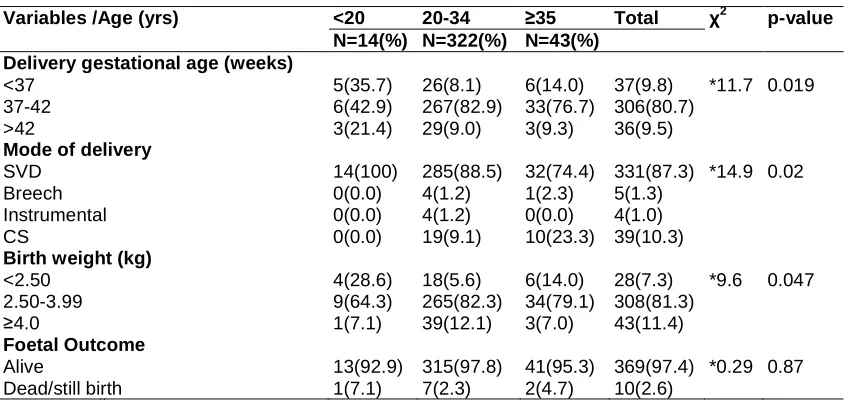
The association of maternal age and pregnancy outcome is shown in Table 1. Most of the mothers were in the 20-34 years age bracket (n=322; 85%). There were only 14(3.7%) teenagers. Delivery gestational age (χ2=11.72, p= 0.019), mode of delivery (χ2=14.9, p=0.02) and birth weight (χ2=9.6, p=0.047) showed statistically significant association with maternal age. Preterm deliveries was most common among the teenagers (n=5; 35.7%) and postdatism was more among the mothers in the 20-34 years age bracket (n=29; 9.0%). All teenagers (n=14; 100%) had spontaneous vaginal delivery. Caesarean sections was most common among those ≥ 35 years (n=10; 23.3%). Low birth weight was most common among the teenagers (n=4; 28%) but macrosomia was more among the mothers in the 20-34 years age bracket (n=39; 12.1%).
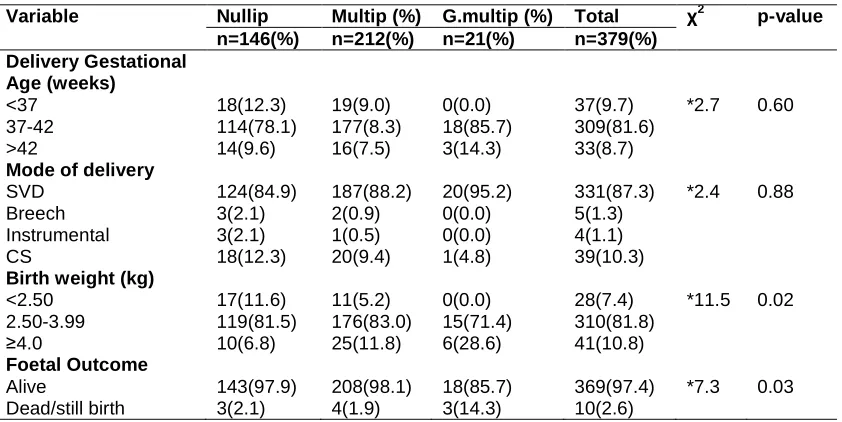
The association of parity and pregnancy outcome is shown in Table 2. There were 146 (38.5%) nulliparas and 21(5.5%) grandmultips. Although preterm delivery (n=18; 12.3%) and caesarean sections (n=18; 12.3%) were commoner among the nulliparas, the association of parity and delivery gestational age and mode of delivery were not statistically significant. Birth weight (χ2=11.5, p=0.02) and fetal outcome (χ2=7.3, p=0.03) showed statistically significant association with parity. The incidence of low birth weight was high among nulliparas (n=17; 11.6%). There was also high incidence of fetal mortality among grand multips (n=3; 14.3%) as compared with other groups.
Table 1. Association of maternal age with pregnancy outcomes
Variables /Age (yrs) <20 20-34 ≥35 Total χ2 p-value
N=14(%) N=322(%) N=43(%)
Delivery gestational age (weeks)
<37 5(35.7) 26(8.1) 6(14.0) 37(9.8) *11.7 0.019 37-42 6(42.9) 267(82.9) 33(76.7) 306(80.7)
>42 3(21.4) 29(9.0) 3(9.3) 36(9.5)
Mode of delivery
SVD 14(100) 285(88.5) 32(74.4) 331(87.3) *14.9 0.02 Breech 0(0.0) 4(1.2) 1(2.3) 5(1.3)
Instrumental 0(0.0) 4(1.2) 0(0.0) 4(1.0) CS 0(0.0) 19(9.1) 10(23.3) 39(10.3)
Birth weight (kg)
<2.50 4(28.6) 18(5.6) 6(14.0) 28(7.3) *9.6 0.047 2.50-3.99 9(64.3) 265(82.3) 34(79.1) 308(81.3)
≥4.0 1(7.1) 39(12.1) 3(7.0) 43(11.4)
Foetal Outcome
Alive 13(92.9) 315(97.8) 41(95.3) 369(97.4) *0.29 0.87 Dead/still birth 1(7.1) 7(2.3) 2(4.7) 10(2.6)
Table 2. Association of parity and pregnancy outcomes
Variable Nullip Multip (%) G.multip (%) Total χ2 p-value
n=146(%) n=212(%) n=21(%) n=379(%)
Delivery Gestational Age (weeks)
<37 18(12.3) 19(9.0) 0(0.0) 37(9.7) *2.7 0.60 37-42 114(78.1) 177(8.3) 18(85.7) 309(81.6)
>42 14(9.6) 16(7.5) 3(14.3) 33(8.7)
Mode of delivery
SVD 124(84.9) 187(88.2) 20(95.2) 331(87.3) *2.4 0.88 Breech 3(2.1) 2(0.9) 0(0.0) 5(1.3)
Instrumental 3(2.1) 1(0.5) 0(0.0) 4(1.1) CS 18(12.3) 20(9.4) 1(4.8) 39(10.3)
Birth weight (kg)
<2.50 17(11.6) 11(5.2) 0(0.0) 28(7.4) *11.5 0.02 2.50-3.99 119(81.5) 176(83.0) 15(71.4) 310(81.8)
≥4.0 10(6.8) 25(11.8) 6(28.6) 41(10.8)
Foetal Outcome
Alive 143(97.9) 208(98.1) 18(85.7) 369(97.4) *7.3 0.03 Dead/still birth 3(2.1) 4(1.9) 3(14.3) 10(2.6)
Nullip=Nulliparous; Multip=Multiparous; G.multip=Grandmultiparous **
The chi square comparison was for the individual variables as presented in the Table 2
4. DISCUSSION
This study was conducted to examine the association of maternal age and parity on pregnancy outcomes in Comprehensive Health Centre, Aluu in the south-south geopolitical zone of Nigeria. The main findings of this study show that the incidence of teenage pregnancy was 3.7%. Maternal age was significantly associated with delivery gestational age, mode of delivery and birth weight. Parity was significantly associated with birth weight and foetal outcome. There was neither operative delivery for teenage pregnancy nor maternal mortality in this study.
The incidence of teenage pregnancy in this study is similar to what is obtainable in other parts of Nigeria and other developing countries [4,6].This has been attributed to decline in the age of menarche, initiation of sexual activity at a younger age and low use rate of contraception [26].
Our observations in this study lay credence to the fact that some adverse pregnancy outcomes are associated with the extremes of maternal age. The high incidence of preterm delivery, low birth weight and spontaneous vaginal delivery among the teenagers in this study corroborates with previous studies [2,3,7]. Previous researchers have reported that the association of preterm delivery in teenage pregnancy could be due to inadequate prenatal care [27]. This
inadequacy in prenatal care could be attributed to lack of access to confidential health care services where they may feel safe to speak with caring adults who will help them get tested and make healthy and appropriate decisions surrounding the pregnancy.
The incidence of advanced maternal age (AMA) in this study is higher than the reported value from a study done in a secondary care facility in the same study environment, [11] but lower than the reported range from the developed world [12]. The present study showed that this age group has a significantly high incidence of caesarean section. This observation is similar to the report by other authors in Tanzania [32]. The trends of caesarean section for older women appear to be related largely to concerns for fetal welfare [33]. They are prone to weak labour pains due to age induced deterioration of uterine muscle causing less effective contractions which are unable to propel the fetus out of the uterine cavity [34].
The incidence of nulliparity among women in this study is comparable to the report from a study done in a secondary care facility in the same study location, [11] while the incidence of grand multiparity in this study is lower than what was reported in south eastern Nigeria [19]. Although studies have reported equivocal relationship between parity, obstetric and perinatal outcomes, [12,15,16] contrary observation was made in this study. The high incidence of Low Birth Weight (LBW) among nulliparous women in this study is similar to the findings by Bisai et al. [29] in which the rate of LBW was observed to decrease significantly with increasing parity. This could be attributed to poor maternal nutritional status [low Body Mass Index (BMI)] at conception, inadequate gestational weight gain due to poor dietary intake and short maternal stature due to mother’s own childhood undernutrition [35]. These are common factors in developing countries like Nigeria.
Pregnancy complications were more common among the grand multipara in this study. The older maternal age which predisposes to medical disorders of pregnancy could be a possible explanation [36,37]. Prominent among the medical disorders of pregnancy is gestational diabetes which is considered as a risk factor for macrosomia [38-40] which was observed in this study. The medical disorders may also be responsible for the perinatal mortality which was significantly associated with grand multiparity in this study.
4.1 Implications for Practice and Training of Family Physicians
The absence of operative delivery for teenage pregnancy and maternal mortality during the
study period in this health centre is an interesting finding in this study. This can be a proof that family physicians in collaboration with other health professionals in the primary care team can deliver high-quality of obstetric care in the health centre. It also corroborates the report that the obstetric outcomes of obstetricians and family physicians are comparable [41,42].
Unfortunately, the experience for most family physicians practicing obstetrics has not been that palatable. The majority of obstetrician/gynecologists do not believe that family physicians should practice obstetrics in some countries. They are denied hospital privileges [43] especially in the teaching and specialist hospitals in performing cesarean sections. Training of family medicine residents is therefore encouraged in district and faith-based hospitals where they are more exposed to these skills. The reasons for withholding such privileges include the belief that they lack of training in cesarean hysterectomy. It is possible that most graduating obstetrics and gynecology residents have never performed a cesarean hysterectomy and may have never even seen one. Overlaps are known to exist between different clinical specialties in hospital practice. Examples include the fact that both neurosurgeons and orthopedic surgeons operate on the spine. General surgeons and orthopedic surgeons both perform trauma surgery. Otorhinolaryngologists and general surgeons perform thyroidectomies. Plastic surgeons and general surgeons augment breasts. Although family physicians and obstetrician/gynecologists deliver babies, obstetrics has been the center of controversy for physicians and hospitals.
Considering the wide distribution of family physicians, particularly in rural and underserved areas [44,45] in many parts of the world, expanding and improving their obstetric skills could improve access to modern maternal and perinatal care for many patient populations.
5. CONCLUSION AND RECOMMENDA-TIONS
This study has shown that teenage and AMA pregnancies are significantly associated with preterm deliveries and delivery of low birth weight babies. Advanced maternal age is significantly associated with operative delivery.
babies, while grand multiparity is significantly associated with perinatal mortality.
There was no maternal mortality and teenage pregnancy encountered zero operative deliveries.
We therefore make the following recommendations:
1. Studies from multiple primary care centres are advocated so as to give a better representation of these findings in the society.
2. All residents must have adequate educational exposure to ensure competency in basic maternity care skills. 3. To maintain competency, opportunities for
enhanced maternity care skills should be available after residency.
4. Advanced Life Support in Obstetrics or another emergency obstetrical course should be a mandatory part of training for all family medicine residents.
5. All family medicine residency programmes should have coordinators of training who should be versatile in maternity care and have link appropriately with local hospital and obstetrical colleagues.
6. Training of residents on obstetric skills should be based in district and faith based hospitals.
COMPETING INTERESTS
Authors have declared that no competing interests exist.
REFERENCES
1. Harrison KA, Bergstrom S. Poverty, deprivation and unsafe abortion. In: Lawson JB, Harrison KA, Bergstrom S eds. Maternity Care in Developing Countries. 1st edition RCOG Press, London. 2001;1-20. 2. Treffers PE, Olukoya AA, Ferguson BJ,
Liljestrand J. Care for adolescent pregnancy and childbirth. Int J Gynaecol Obstet. 2001;75(2):111-21.
3. Magadi M. Poor pregnancy outcomes among adolescents in South Nyanza region of Kenya. Afr J Reprod Health. 2006;10(1):26-38.
4. Mutihir JT, Maduka WE. Comparison of pregnancy outcome between teenage and older primigravidae in Jos university teaching hospital, Jos, north-central
Nigeria. Annals of African Medicine. 2006; 5(2):101-106.
5. El-Gilany AH. Obstetric outcomes of teenagers and older mothers: Experience from Saudi Arabia. Intl J Collab Res Int Med Pub Health. 2012;1:1-3.
6. Darroch JE, Singh S, Frost JJ. Differences in teenage pregnancy rates among five developed countries: The roles of sexual activity and contraceptive use. Fam Plann Perspect. 2001;33(6):244-50,281.
7. Mehta SH, Sokol RJ. Methods of assessment for pregnancy at risk. In: Decherney AH, Nathan L. eds, Current obstetrics and gynaecology diagnosis and treatment. 9th Edition. New York: McGraw-Hill. 2003;249-258.
8. Orji EO, Ndububa VI. Obstetric performance of women aged over forty years. East Afr Med J. 2004;81(3):139-141.
9. Beers MH, Berkow R. High Risk Pregnancy. In: the Merck Manual of Diagnosis and Therapy. 17th edn Merck Research Laboratories. 2006;2186-91. 10. Igberase GO, Ebeigbe PN, Bock-Oruma A.
Twinning rate in a rural mission tertiary hospital in the Niger delta, Nigeria. J Obstet Gynaecol. 2008;28(6):586-9. 11. Ojule JD, Ibe VC, Fiebai PO. Pregnancy
outcome in elderly primigravidae. Ann Afr Med. 2011;10:204-8.
12. Wang Y, Tanbo T, Åbyholm T, Henriksen T. The impact of advanced maternal age and parity on obstetric and perinatal outcomes in singleton gestations. Arch Gynecol Obstet. 2011;284(1):31–37. 13. Yuan W, Steffensen FH, Nielsen GL,
Møller M, Olsen J, Sørensen HT. A population-based cohort study of birth and neonatal outcome in older primipara. Int J Gynaecol Obstet. 2000;68(2):113-8. 14. Delbaere I, Verstraelen H, Goetgeluk S,
Martens G, De Backer G, Temmerman M. Pregnancy outcome in primiparae of advanced maternal age. Eur J Obstet Gynecol Reprod Biol. 2007;135(1):41-6. 15. Simonsen SM, Ellis RN, Lyon JL, Alder
SC, Varner MW. Effect of grand multiparity on intrapartum and newborn complications in young women. Obstet & Gynecol. 2005;106(3):454-460.
17. Owolabi AT, Dare FO, Fasubaa OB, Ogunlola IO, Kuti O, Bisiriyu LA. Risk factors for retained placenta in south western Nigeria. Singapore Med J. 2008; 49(7):526.
18. Akwuruoha E, Kamanu C, Onwere S, ChigbuB, AlukaC, Umezuruike C. Grand multiparity and pregnancy outcome in Aba, Nigeria: A case–control study. Arch Gynecol Obstet. 2011;283:167-172. 19. Eze JN, Okaro JM, Okafor MH. Outcome
of pregnancy in the Grand multipara in Enugu, Nigeria. Trop Journal of Obstetrics and Gynaecology. 2006;23(1):8-11. 20. Noraihan M, Khim F, Suhaimi I, Symonds
EM. Is Grand multiparity a significant risk factor in this new millennium? Malaysian Journal of Medical Sciences. 2006; 13(2):52-60.
21. Israel GD. Agricultural Education and Communication | Program Evaluation | Sampling.
Available:https://edis.ifas.ufl.edu/pd006 (accessed on 7/7/15)
22. Pourhoseingholi MA, Vahedi M, RahimzadehM. Sample size calculation in medical studies. Gastroenterol Hepatol Bed Bench. 2013;6(1):14–17.
23. Aniebue UU, Aniebue PN. A risk assessment for pregnancy using the World Health Organization classifying form in primary health-care facilities in Enugu, Nigeria. Trop Doct. 2008;38(3):135-137. 24. Umeora OUJ, Sunday-Adeoye I, Ugwu
GO. Advocating the new WHO antenatal care model in a free maternity care setting in a developing country. Trop Doct. 2008; 38(1):24-7.
25. World Health Organization. WHO antenatal care randomized trial: manual for the implementation of the new model. WHO/ RHR/01.30. Geneva: World Health Organization; 2002.
26. Chen X, Wen SW, Fleming N, Demissie K, Rhoads GG, Walker M. Teenage pregnancy and adverse birth outcomes: a large population based retrospective cohort study. Int. J. Epidemiol. 2007;36(2): 368-373.
27. Debiec KE, Paul KJ, Mitchell CM, Hiti JE. Inadequate prenatal care and risk of preterm delivery among adolescents: A retrospective study over 10 years. Am J Obstet Gynecol. 2010;203:122.e1-6. 28. Watcharaseranee N, Pinchantra P,
Piyaman S. The incidence and complications of teenage pregnancy at
Chonburi Hospital. J Med Assoc Thai. 2006;89(Suppl 4):S118–23.
29. Bisai S, Sen A, Mahalanabis D, Datta N, Bose K. The effect of maternal age and parity on birth weight among Bengalees of Kolkata, India. Human Ecology. 2006;14: 139-143.
30. Khashan AS, Baker PN, Kenny LC. Preterm birth and reduced birth weight in first and second teenage pregnancies: A register-based cohort study. BMC Pregnancy and Childbirth. 2010;10:36. DOI: 10.1186/1471-2393-10-36
31. Mukhopadhyay P, Chaudhuri RN, Paul B. Hospital-based perinatal outcomes and complications in teenage pregnancy in India. Journal of Health, Population, and Nutrition. 2010;28(5):494-500.
32. Muganyizi PS, Kidanto HL, Kazaura MR, Massawe SN. Caesarean section: Trend and associated factors in Tanzania. AJM. 2008;2(2):65-68.
33. Kenny LC, Lavender T, McNamee R, O’Neill SM, Mills T, Khashan AS. Advanced maternal age and adverse pregnancy outcome: Evidence from a large contemporary cohort. PLoS One. 2013; 8(2):e56583.
34. Hirano H, Obara M, Hatakeyama Y. Risk management and care points 8: Older primipara and difficult labor. Clin Obstet Gynecol. 2007;61:54–7. NEW 34
35. Imdad A, Bhutta ZA. Maternal nutrition and birth outcomes: Effect of balanced protein-energy supplementation. Paediatric and Perinatal Epidemiology. 2012;26(Suppl. 1): 178–190.
36. Rayamajhi R, Thapa M, Pande S. The challenge of grand multiparity in obstetric practice. Kathmandu Univ Med J (KUMJ). 2006;4:70-4.
37. Mutihir JT. Obstetric outcome of the grand multipara in Jos, Nigeria. J Med Trop. 2005;7:14-20.
38. Levy A, Wiznitzer A, Holcberg G, Mazor M, Sheiner E. Family history of diabetes mellitus as an independent risk factor for macrosomia and cesarean delivery. J Matern Fetal Neonatal Med. 2010;23(2): 148-52.
39. Mathew M, Machado L, Ghabshi R, Al-Haddabi R. Fetal macrosomia. Risk factor and outcome. Saudi Med J. 2005;26(1):96-100.
grand multiparity in Flanders, Belgium. J Perinat Med. 2006;34(1):28-31.
41. Homan FF, Olson AL, Johnson DJ. A comparison of cesarean delivery outcomes for rural family physicians and obstetricians. J Am Board Fam Med. 2013;26(4):366-72.
DOI: 10.3122/jabfm.2013.04.120203 42. Aubrey-Bassler K, Cullen RM, Simms A,
Asghari S, Crane J, Wang PP, Godwin M. Outcomes of deliveries by family physicians or obstetricians: A population-based cohort study using an instrumental variable. CMAJ; 2015.
DOI: 10.1503/cmaj.141633
43. Avery DM. The consequences of hospitals denying obstetric privileges to board certified obstetric fellowship trained family physicians: Obstetric privileges based on training, experience, ability & competence. Available:https://jfmo.cchs.ua.edu/files/201 4/04/Avery-Editorial.pdf (Accessed on 26/9/2015)
44. Nesbitt TS, Baldwin LM. Access to obstetric care. Prim Care. 1993;20(3):509-522.
45. Loafman M, Nanda SA. Who will deliver our babies? Crisis in the physician workforce. Am J Clin Med. 2009;6(2):11-16.
_________________________________________________________________________________
© 2016 Andrew et al.; This is an Open Access article distributed under the terms of the Creative Commons Attribution License (http://creativecommons.org/licenses/by/4.0), which permits unrestricted use, distribution, and reproduction in any medium, provided the original work is properly cited.
Peer-review history: