Introduction
The term ‘reactive oxygen species’ (ROS) applies to any mixture of molecules, ions and free radicals containing derivatives of molecular oxygen that are more reactive than oxygen itself. The ROS formed in living cells commonly include hydrogen peroxide, hydroxyl radical and superoxide anion. The normal process of respiration in mitochondria is a major source of ROS, and production of ROS is enhanced when mitochondrial function is disturbed during apoptosis. During apoptosis, and also in some types of necrotic cell death, unusually large amounts of ROS can be released and can contribute, by extensive oxidation of macromolecules, to the killing of cells. In some types of apoptosis, ROS also serve essential signaling functions (reviewed in Fleury et al., 2002). Apoptosis is not confined to multicellular eukaryotes. Unicellular organisms, including budding yeast and fission yeast, can undergo programmed cell death with many of the features of apoptosis in multicellular organisms (for reviews, see Burhans et al., 2003; Madeo et al., 2004; Rodriquez-Menocal and D’Urso, 2004). Where tested, ROS production has proved to accompany apoptosis in yeasts and fungi (Balzan et al., 2004; Cheng et al., 2003; Madeo et al., 1999; Zhang et al., 2003), although in some cases it is not required (Balzan et al., 2004; Cheng et al., 2003).
A wide variety of factors can stimulate apoptosis in yeasts (for reviews, see Burhans et al., 2003; Madeo et al., 2004). In budding yeast these apoptotic triggers include extensive DNA damage (Blanchard et al., 2002; Qi et al., 2003; Weinberger et al., 2005) and defects in the replication-initiation proteins Cdc6p (Blanchard et al., 2002) and Orc2p (Weinberger et al., 2005). The same triggers, DNA damage (Norbury and Zhivotovsky, 2004) and defects in replication-initiation proteins (Blanchard et al., 2002; Dodson et al., 2004; Feng et al., 2003; Kim et al., 2003; Pelizon et al., 2002; Schories et al., 2004; Shreeram et al., 2002; Yim et al., 2003), can also induce apoptosis in mammalian cells.
In mammalian cells, defects in DNA replication or DNA structure activate replication- and damage-checkpoints, and, among other consequences, these checkpoints inhibit CDK activity – thus preventing cells from entering mitosis with incompletely replicated or damaged DNA (Sancar et al., 2004). Entry into mitosis with damaged or incompletely replicated DNA usually leads to cell death by an apoptotic mechanism (Castedo et al., 2004). For these reasons it seemed likely to us that mutations in genes important for the DNA-damage- or replication-checkpoints would enhance susceptibility to inappropriate mitosis when combined with mutations in genes that affect initiation of replication.
Previous studies have indicated that replication stress can trigger apoptosis-like cell death, accompanied (where tested) by production of reactive oxygen species (ROS), in
mammalian cells and budding yeast (Saccharomyces
cerevisiae). In mammalian cells, inappropriate entry into mitosis also leads to cell death. Here, we report similar responses in fission yeast (Schizosaccharomyces pombe). We used ROS- and death-specific fluorescent stains to measure the effects of mutations in replication initiation and checkpoint genes in fission yeast on the frequencies of ROS production and cell death. We found that certain mutant alleles of each of the four tested replication initiation genes caused elevated ROS and cell death. Where tested, these effects were not enhanced by checkpoint-gene mutations. Instead, when cells competent for replication but defective
in both the replication and damage checkpoints were treated with hydroxyurea, which slows replication fork movement, the frequencies of ROS production and cell death were greatly increased. This was a consequence of elevated CDK activity, which permitted inappropriate entry into mitosis. Thus, studies in fission yeast are likely to prove helpful in understanding the pathways that lead from replication stress and inappropriate mitosis to cell death in mammalian cells.
Supplementary material available online at
http://jcs.biologists.org/cgi/content/full/119/1/124/DC1 Key words: Reactive oxygen species, Cell death, Checkpoint, Replication, Mitosis, Apoptosis
Summary
Production of reactive oxygen species in response to
replication stress and inappropriate mitosis in fission
yeast
Maria A. Marchetti1,*, Martin Weinberger2, Yota Murakami3, William C. Burhans2,‡and Joel A. Huberman1,‡
1Department of Cancer Genetics, Roswell Park Cancer Institute, Elm and Carlton Streets, Buffalo, NY 14263, USA 2Department of Cell Stress Biology, Roswell Park Cancer Institute, Elm and Carlton Streets, Buffalo, NY 14263, USA
3Department of Viral Oncology, Institute for Virus Research, Kyoto University, Shogoinkawahara-machi, Sakyo-ku, Kyoto 606-8507, Japan
*Present address: Florida Atlantic University, Charles E. Schmidt College of Science, 777 Glades Road, P.O. Box 3091, Boca Raton, FL 33431, USA
‡Authors for correspondence (e-mail: [email protected]; [email protected])
Accepted 20 September 2005
Journal of Cell Science 119, 124-131 Published by The Company of Biologists 2006 doi:10.1242/jcs.02703
Jour
Study of the interaction between checkpoint genes and replication-initiation genes in pathways leading to apoptosis would be facilitated by the availability of a model organism capable of undergoing apoptosis and with checkpoint pathways similar to those of mammalian cells, but more amenable to genetic analysis than mammalian cells. Fission yeast is such an organism. In contrast to budding yeast, in which checkpoints prevent mitosis primarily by inhibiting spindle elongation or anaphase-chromosome separation, checkpoints in fission yeast – as in mammalian cells – prevent entry into mitosis by inhibiting CDK activity (Caspari and Carr, 1999). Furthermore, there is substantial evidence for apoptosis in fission yeast (Brezniceanu et al., 2003; James et al., 1997; Jürgensmeier et al., 1997; Zhang et al., 2003).
Here, we report the use of ROS production and cell-death assays in fission yeast to test our prediction that mutations of checkpoint genes would enhance the effects of gene mutations affecting replication initiation on the frequency of apoptosis-like cell death. We found that mutations in genes encoding replication-initiation proteins were likely to stimulate ROS production. Where tested, this ROS production was not further stimulated by loss of checkpoint functions – in contrast to our prediction. However, we found that when replication forks were slowed by treatment with hydroxyurea (HU), checkpoint mutations dramatically stimulated ROS production and cell death. It is known that checkpoint failure leads to uncontrolled CDK activity and entry into mitosis with unreplicated DNA (Boddy et al., 1998). Cells with constitutively activated CDK also enter mitosis prematurely (Gould and Nurse, 1989), and we found that they produce ROS. These results suggest that several different pathways, with varying degrees of dependence on checkpoints, can lead from replication defects to ROS production and cell death in fission yeast.
Results
Measuring the production of ROS in fission yeast
We used the dye DCDHFDA, which produces green fluorescence in the presence of ROS (LeBel et al., 1992; Tsuchiya et al., 1994), to measure ROS production in fission yeast cells. This dye is able to penetrate the membranes of living cells (LeBel et al., 1992). Consequently, it can detect ROS in both living cells and in dead and dying cells that lack intact membranes. To distinguish living cells from dead ones, we used a second indicator dye, PI (Tsuchiya et al., 1994). PI cannot pass through the intact membranes of living cells. When PI enters a dead cell, it binds to the remaining DNA within the dead cell and fluoresces red. The fluorescence micrographs in
Fig. 1 demonstrate that most wild-type fission yeast cells displayed insufficient spontaneous green or red fluorescence to be detected by a cooled, charge-coupled-device (CCD) camera. By contrast, cells bearing the dfp1⌬13-240 mutation (affecting the gene that encodes the fission yeast homolog of Dbf4p, the regulatory subunit of the Cdc7p kinase, which is essential for initiation of DNA replication; Table 1) displayed variable, but easily detectable, levels of both green and red fluorescence. We interpreted the pure green cells as living cells (because they did not stain with PI) that had generated high ROS levels, and we interpreted the pure red cells as dead or dying cells that were still sufficiently intact to retain DNA but had either not been producing ROS or had been unable to retain ROS due to membrane permeability. Some cells displayed both green and red fluorescence and appeared in various shades of yellow. These yellow-tinged cells constituted a significant fraction of the fluorescent cells. The presence of both green and red fluorescence in single cells is consistent with the possibility that ROS production precedes cell death and that the sequence of fluorescence is green to yellow to red. For the experiments reported here, we did not further investigate the possibility of ROS being a cause of cell death. We simply noted a correlation between these two phenomena, as quantified in the experiments described below.
Fig. 1.Detection of ROS and death in
fission yeast cells. Wild-type and dfp1⌬ 13-240mutant cells were incubated for 80 minutes at 25°C in the presence of DCDHFDA to detect ROS. The cells were then harvested, washed and resuspended in buffer containing PI to detect dead cells.
Table 1. Names of relevant, functionally similar genes in fission yeast, budding yeast and humans
Fission Budding
yeast yeast Humans Protein function
dfp1 DBF4 DBF4/ASK1 Initiation of replication
hsk1 CDC7 CDC7 Initiation of replication
cdc18 CDC6 CDC6 Formation of pre-replication
complex
orp2 ORC2 ORC2 Formation of pre-replication
complex
orp5 ORC5 ORC5 Formation of pre-replication
complex
pku70 YKU70 KU70 Non-homologous end joining
rad32 MRE11 MRE11 Homologous recombination
rqh1 SGS1 BLM Replication fork stability
rhp9/crb2 RAD9 BRCA1or 53BP1 DNA-damage checkpoint
rad3 MEC1 ATR damage and
DNA-replication checkpoints
cds1 RAD53 CHK2/CDS1 DNA-replication checkpoint
(fission yeast)
cdc2 CDC28 CDK1/CDC2 Cyclin-dependent kinase
This table contains the genes discussed in the text for which the fission yeast name differs from the human name.
Jour
We used flow cytometry to quantitate the extents of red and green fluorescence (supplementary material Fig. S1). In the following figures we report the number of cells per 10,000 examined whose green or red fluorescence exceeded a threshold that was set so as to exclude auto-fluorescence from unstained cells.
Mutants in the genes encoding the initiation proteins Orp2p, Orp5p and Cdc18p displayed increased ROS production and increased cell death
The first step in the initiation of eukaryotic DNA replication is the association of the six proteins of the origin recognition complex (ORC) with replication origins. This is followed by the additional association of Cdc6p (Cdc18p in fission yeast) and Cdt1p (Bell and Dutta, 2002). We tested the effects of mutations in the fission yeast homologs of some of these proteins on ROS production and PI staining. Fig. 2 displays a time-course and temperature-dependence study of ROS production in fission yeast strains bearing mutations in orp2 (encoding the second largest subunit of ORC) (Kiely et al., 2000; Leatherwood et al., 1996) or cdc18 (encoding the fission yeast
homolog of Cdc6p) (Kelly et al., 1993; Muzi-Falconi et al., 1996). Several interesting conclusions emerge from these results. First, as in Fig. 1, there was a rough correlation between ROS production and PI staining, consistent with the possibility that ROS production is an important contributor to the cell death detected by PI staining. Second, the two mutant alleles of the orp2gene had strikingly different effects on ROS production and PI staining. Whereas enhancement of ROS production in the orp2-2mutant strain was barely detectable even at high temperatures, enhancement in the orp2-7strain was striking at all temperatures and for all incubation times. Interestingly, at a restrictive temperature (36.5°C), the orp2-2 mutation inhibits initiation of DNA replication more strongly than the orp2-7mutation (Kiely et al., 2000). Note that all of these mutations are temperature-sensitive for replication. Cells bearing these mutations can replicate their DNA at 25°C but not at 37°C. Therefore, at lower temperatures at least, the strong effect of the orp2-7mutation on ROS production and PI staining could not be a direct consequence of its inhibition of initiation of DNA replication.
In contrast to the temperature-independent effect of orp2-7 on ROS production and PI staining, the cdc18-K46mutation had a temperature-dependent effect. It is possible, therefore, that ROS production and PI staining in the cdc18-K46strain are direct consequences of loss of the ability of Cdc18p to contribute to the formation of pre-RCs.
Similar allele-specific effects were detected when we compared mutant alleles of the orp5gene (which encodes the fifth largest subunit of ORC). ROS production in the orp5-H19 strain was strong only at high temperatures, whereas ROS production in the orp5-H30 strain was relatively weak at all tested temperatures (Fig. 3). Another allele, orp5-H37, behaved like orp5-H30(data not shown). As above, there was considerable correlation between ROS production and PI staining. However, the tested alleles of orp5 behaved
differently from those of orp2 with regard to correlation between ROS production and replication competence. The orp5-H19 allele showed the strongest replication-initiation defect: at 36°C, orp5-H19cells arrested at the G1-S interface with 1C DNA content. By contrast, orp5-H30cells arrested in S phase, and orp5-H37 cells arrested in G2-M, showing no obvious replication defect but possibly a mitotic defect (unpublished observation, F. Matsunaga, H. Kato, D. Gong, G. D’Urso, K. Tanaka and Y.M.). Thus, the orp5allele with the strongest replication defect generated the most ROS, whereas the orp2allele with the strongest replication defect generated the least ROS. This variability is consistent with other results presented here and suggests that there are multiple independent pathways by which defects in replication initiation proteins can stimulate ROS production.
200 400 600 800 1000 ROS PI 25° 30° 35° 37° 2 4 6 2 4 6 2 4 6 2 4 6 25° 30° 35° 37° 2 4 6 2 4 6 2 4 6 2 4 6 25° 30° 35° 37° 2 4 6 2 4 6 2 4 6 2 4 6 25° 30° 35° 37° 2 4 6 2 4 6 2 4 6 2 4 6 Hours: Degrees:
Wild Type orp2-2 orp2-7 cdc18-K46
Number of cells per 10,000
Fig. 2.Time- and temperature-dependence study of ROS production and PI
staining in cells bearing temperature-sensitive mutations in orp2or cdc18. The indicated strains, in log-phase, were shifted to the indicated temperatures for the indicated numbers of hours. Then DCDHFDA was added, and incubation was continued at the same temperatures for an additional 80 minutes. Other conditions were as described in Fig. 1 and supplementary material Fig. S1.
Fig. 3.Temperature-dependence study of ROS production and PI
staining in cells bearing temperature-sensitive mutations in orp5. This experiment was carried out as described in Fig. 2, except that the time of incubation was 4 hours in all cases.
ROS PI
600
Wild Type orp5-H19 orp 5-H30
500 400 300 200 100 0 Deg rees 25° 30° 35° 37° 25° 30° 35° 37° 25° 30° 35° 37°
Number of cells per 10,000
Jour
N- and C-terminal deletions in the dfp1 gene led to increased ROS production and PI staining
Dfp1p is the fission yeast homolog of budding yeast Dbf4p. Just as Dbf4p activates the Cdc7p kinase, Dfp1p activates the Hsk1p kinase, which is the fission yeast homolog of Cdc7p. In all tested eukaryotic organisms, the homologues of Cdc7p and Dbf4p are essential for initiation of DNA replication at individual replication origins (Bell and Dutta, 2002). In addition, where tested, these proteins have proved to be important for viability and checkpoint activation in response to DNA damage (for reviews, see Duncker and Brown, 2003; Kim et al., 2003). Proteins of the Dbf4p family are not well conserved between species, except for three small motifs (N, M and C) in the N-terminal, middle and C-terminal parts of the protein, respectively (Takeda et al., 1999). Of these, motif M is essential for initiation of replication, motif N is important for protection against a wide range of DNA-damaging agents and motif C is important specifically for protection against alkylation damage (Fung et al., 2002; Ogino et al., 2001; Takeda et al., 1999).
We wondered whether mutations in the non-essential N- and C-terminal parts of Dfp1p lead to ROS production and cell death even in the absence of exogenous DNA-damaging agents. To test this possibility, we measured the extent of ROS production and PI staining in a series of N- and C-terminal deletion mutants that had been prepared in the laboratory of Grant Brown (Fung et al., 2002). These included three N-terminal deletions, all of which removed motif N (dfp1⌬183-191,
dfp1⌬13-193, and dfp1⌬13-240) and two C-terminal deletions, both
of which removed motif C (dfp11-376 and dfp11-459). None of the deletions affected the essential motif M. Interestingly, we found that both N- and C-terminal deletion mutants produced ROS and stained with PI at frequencies significantly elevated compared with wild-type cells under the same conditions (Figs 1, 4).
Apparent replication-mutant specificity of ROS production
All of the mutations discussed above are in genes essential for initiation of DNA replication. We wanted to know whether DNA-metabolism mutations that do not directly affect replication would similarly enhance ROS production (ROS production in more than 100 cells per 10,000). We tested the effects of the deletion of genes that encode proteins required for non-homologous end-joining (pku70and lig4) (Manolis et al., 2001), for the DNA-damage checkpoint (rhp9) (Willson et al., 1997) and for maintenance of replication-fork stability under stress conditions (srs2and rqh1) (Maftahi et al., 2002; Marchetti et al., 2002). We also tested genes encoding subunits of the MRN complex (rad32and rad50), which is involved in homologous recombination and checkpoint activation
(Chahwan et al., 2003; Hartsuiker et al., 2001; Tavassoli et al., 1995). As shown in Fig. 5, none of the tested non-replication deletion mutants generated ROS to the same extent as certain mutant alleles of the tested genes encoding replication-initiation proteins (Figs 1-4). These results show that, in the absence of exogenous stressors, replication defects are more likely than recombination- or checkpoint-defects to lead to ROS production. The differences between complete deletions of recombination and checkpoint genes (Fig. 5), and point mutations or partial deletions in replication initiation genes (Figs 1-4) may be a simple consequence of the fact that replication-initiation proteins carry out essential functions in every cell cycle, but the functions of the tested recombination-and checkpoint-genes may be important only under conditions of DNA damage or replication-fork block.
Checkpoint dependence (or lack thereof) of elevated ROS production and PI staining by replication mutants
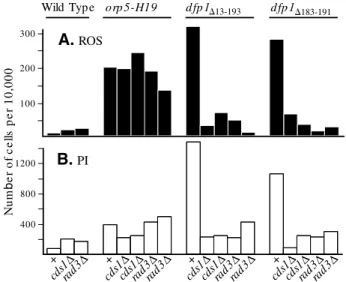
We wondered whether the increased ROS production and PI staining, evident in certain replication mutant strains, is affected by the inactivation of checkpoint pathways. To test this, we deleted the rad3 gene (which encodes Rad3p, the fission yeast ATR homolog, and is essential for the damage-and replication-checkpoints) (Bentley et al., 1996; Furuya damage-and Carr, 2003) or the cds1gene (which encodes Cds1p, the fission yeast Chk2p homolog, and is essential for the replication checkpoint) (Furuya and Carr, 2003; Lindsay et al., 1998; Murakami and Okayama, 1995) from cells bearing the orp5-H19, dfp1⌬13-193or dfp1⌬183-191mutations. The results in Fig. 6 show that, by itself, neither the rad3nor cds1deletion had a significant effect on ROS production or PI staining. These deletions also had no significant effect on the already elevated ROS production and PI staining of the orp5-H19 strain. By contrast, deleting either rad3 or cds1 inhibited the elevated ROS production and PI staining of the dfp1mutants. Thus, a functional replication checkpoint is required for elevated ROS production by dfp1 N-terminal deletion mutants, but ROS production in the orp5-H19 strain is independent of both the replication- and damage-checkpoints. We conclude that, although many replication-initiation mutants display elevated ROS production and PI staining, the pathways leading from replication defects to ROS production are not all identical. At least two pathways are involved, depending on the replication mutant. One pathway requires replication-checkpoint function, the other is checkpoint-independent.
HU-dependent ROS production and PI staining in checkpoint-mutant strains
Although ROS production and PI staining were not significantly elevated in the cds1 and rad3 deletion strains (Fig. 6), we suspected that they would be elevated when these
300 200 100 dfp11-376 dfp1⌬183-191 Wild Type 1200 800 400 Number of cells per 10,000 (R OS ) Number of cells per 10,000 (PI ) 0 dfp1⌬13-193 dfp1⌬13-240 dfp11-459
Fig. 4.N- and C-terminal deletions in dfp1lead to ROS
production and PI staining. The indicated fission yeast strains were incubated for 80 minutes at 25°C in the presence of DCDHFDA and stained with PI.
Jour
mutant strains were treated with HU, because they are highly sensitive to HU (Jimenez et al., 1992; Murakami and Okayama, 1995). HU inhibits ribonucleotide reductase, leading to depletion of deoxyribonucleoside triphosphates and stalling of replication forks. An intact replication checkpoint involving Rad3p and Cds1p is required to maintain the stability of such stalled forks and to prevent eventual cell death (Lindsay et al., 1998; Murakami and Okayama, 1995). In the absence of the replication checkpoint, the DNA-damage checkpoint (which depends on Rad3p and Chk1p) is required to inhibit rapid
passage through mitosis with unreplicated DNA when HU is present (Boddy et al., 1998). In addition to Rad3p, both of these checkpoints require the five additional ‘checkpoint-Rad’ proteins, Rad1p, Rad9p, Rad17p, Rad26p and Hus1p (Al-Khodairy et al., 1994). These proteins are the fission yeast homologs of the mammalian proteins with the same names, except for Rad26p, whose mammalian homolog is ATRIP (reviewed in Nyberg et al., 2002).
When we tested deletions of the genes encoding the checkpoint-Rad proteins we found that, in each case, treating the mutant strain with HU led to elevated ROS production and PI staining (Fig. 7). In contrast to the HU dependence of ROS production in checkpoint-Rad-mutant strains, ROS production in dfp1N-terminal and C-terminal deletion strains (which is high in the absence of HU) could not be significantly further stimulated by the addition of HU (supplementary material Fig. S2). We conclude that one or more checkpoint pathways, which depend on the checkpoint-Rad proteins, are required to prevent elevated ROS production and cell death when fission yeast cells are exposed to HU.
HU-dependent, checkpoint-mutant-dependent ROS production requires inappropriate entry into mitosis
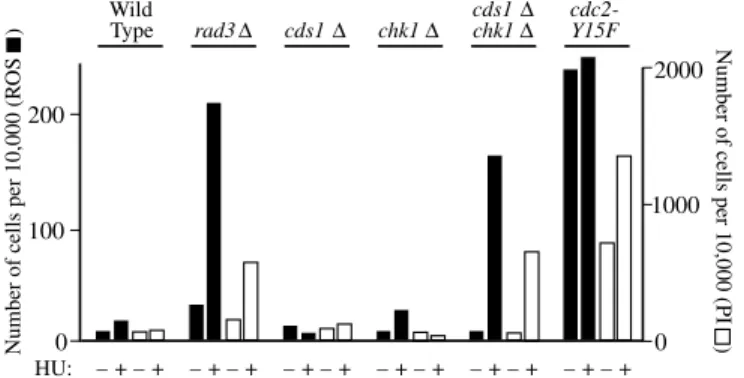
The two well-characterized checkpoint pathways operating downstream of the checkpoint-Rad proteins are the replication checkpoint, which depends on Cds1p (Murakami and Okayama, 1995), and the damage checkpoint, which depends on Chk1p (Walworth et al., 1993). To determine which of these checkpoint pathways might be required to prevent HU-induced elevated ROS production, we measured the effects on HU-induced ROS production of deleting either cds1 or chk1, or both genes. We found that neither of the single deletions facilitated ROS production or cell death during a 4-hour incubation with HU, but cells of the HU-treated double-deletion strain (cds1⌬chk1⌬) showed almost as much ROS and PI as cells of the HU-treated rad3⌬strain (Fig. 8).
Since HU-treated rad3⌬or cds1⌬chk1⌬cells enter mitosis with unreplicated DNA, whereas HU-treated wild-type or single-mutant (cds1⌬or chk1⌬) cells do not do so after 4 hours of HU treatment (Boddy et al., 1998; Murakami and Okayama,
Fig. 5.Mutant cells defective in pathways affecting non-homologous
end-joining, the DNA-damage checkpoint, replication-fork stability and the MRN complex appear to produce less ROS than mutant cells defective in replication proteins. The indicated strains were incubated at 25°C for 80 minutes in the presence of DCDHFDA. Other conditions were as described in Figs 1 and 4.
Controls NHEJ DNA damage check-point Fork stability MRN
Number of cells per 10,000 0 40 80 120 Wild T ype dfp1 ⌬13-193 pku70 ⌬ lig4 ⌬ rhp 9⌬ srs2 ⌬ rqh1 ⌬ rad32 ⌬ rad5 0⌬
Fig. 6.ROS production by dfp1N-terminal deletion mutants requires
a functional Rad3p- and Cds1p-dependent checkpoint pathway, but ROS production by the orp5-H19strain does not. Double-mutant strains bearing orp5-H19, dfp1⌬13-193or dfp1⌬183-191together with rad3⌬or cds1⌬were generated by crossing. Results are shown for two independently derived isolates of each type. Strains lacking a rad3⌬or cds1⌬mutation are indicated by +. Cells in early log-phase were incubated at 30°C for 6 hours. (A) Levels of ROS production. (B) Levels of PI staining. 300 200 100 A.ROS orp 5-H19 d fp 1 d fp 1⌬183-191 Wild Typ e 1200 800 400 B.PI Nu m b e r o f c e lls p e r 1 0 ,0 0 0 rad3 Δ + cds1 Δ rad3 Δ + + + cds1 Δ cds1 Δ cds1 Δ cds1 Δ cds1 Δ cds1 Δ rad3 Δ rad3 Δ rad3 Δ rad3 Δ rad 3Δ ⌬13-193
Number of cells per 10,000 (PI )
0
400 800
0
Number of cells per 10,000 ( )
RO S 100 200 300
Wild Type rad3Δ rad1Δ rad17Δ rad26Δ hus1Δ rad9Δ
HU: – +–+ – +–+ – +–+ – +–+ – +–+ – +–+ – +–+
Fig. 7.Deletion of any of the checkpoint-Rad genes leads, in the
presence of HU, to elevated levels of ROS and PI staining. The indicated strains were incubated at 25°C for 4 hours with (+) or without (–) 12 mM HU. Then DCDHFDA was added, and incubation was continued for 80 minutes. The cells were stained with PI and analyzed by flow cytometry.
Jour
1995), the critical event triggering ROS production might be inappropriate entry into mitosis. To test this, we took advantage of the fact that inappropriate entry into mitosis can also be induced by the cdc2-Y15F mutation, in which the tyrosine residue at position 15 of the cyclin-dependent kinase (CDK), Cdc2p, is replaced by phenylalanine, rendering the site non-phosphorylatable. Since phosphorylation of Y15 is a major means of negatively regulating Cdc2p kinase activity, the mutant Cdc2-Y15Fp is constitutively active. It promotes premature entry into mitosis, giving rise to shortened cells (Gould and Nurse, 1989). If inappropriate entry into mitosis is a trigger for ROS production and cell death, then cdc2-Y15F cells should display constitutively elevated ROS levels and high frequencies of cell death even in the absence of HU. This is indeed what we found (Fig. 8). In other cases, however, we found that – although the cdc2-Y15Fmutation led to elevated ROS levels – ROS production could be further enhanced by treatment with HU (see supplementary material Fig. S3 for an example).
Discussion
Defects in replication-initiation proteins can induce ROS production and cell death
It is striking that at least one mutant allele of each of the tested genes encoding replication-initiation proteins (cdc18, dfp1, orp2 and orp5) proved capable of inducing significant ROS production and cell death (Figs 1-4, 6). By contrast, deletions of genes encoding proteins involved in non-homologous end-joining (pku70 and lig4), homologous recombination (rad32 and rad50), replication-fork stability (rqh1and srs2) and the DNA-damage checkpoint (rhp9) had little or no effect on ROS production (Fig. 5).
The reason for this difference between replication initiation proteins and proteins involved in other aspects of DNA metabolism is not clear. Defects in both sets of proteins would be expected to lead to increased levels of DNA damage. It is possible that the types of damage generated by replication-initiation defects are distinguishable from the types of damage generated by defects in the other pathways that we studied. It
is also possible that the high-ROS-generating mutant alleles of replication-initiation genes produce more spontaneous DNA damage than deletions of the tested recombination-, fork-stability- and checkpoint-genes.
ROS production stimulated by defects in replication-initiation proteins is not further enhanced by checkpoint mutations
Rad3p and Cds1p are both essential for DNA-integrity checkpoints during S phase in fission yeast (Furuya and Carr, 2003; Rhind and Russell, 2000). We suspected that these replication checkpoint proteins help to protect cells from problems generated by defects in replication-initiation proteins. However, when deletions of the rad3 or cds1 genes were combined with mutations affecting replication-initiation proteins (Orp5p or Dfp1p), no enhancement of ROS production or cell death was detected (Fig. 6). In fact, in one case (Dfp1p), deletion of rad3or cds1 reduced both ROS and cell death to near background levels, implying that ROS production and cell death in these dfp1-mutant cells required a functional replication checkpoint. Since the rad3and cds1 deletions had no effect on ROS production and cell death when combined with the orp5-H19mutation (Fig. 6), we conclude that defects in replication-initiation proteins lead to production of ROS and cell death by at least two different pathways. One pathway requires a functional replication checkpoint whereas the other does not. The pathway that requires a functional replication checkpoint is reminiscent of the checkpoint-dependent pathways that, in response to replication stress, induce apoptosis in mammalian cells and thus prevent cancer (reviewed in Venkitaraman, 2005).
HU-induced replication stress, combined with checkpoint mutations, leads to ROS production and cell death
We did, however, find one mechanism by which checkpoint mutations stimulated production of ROS and cell death. When replication forks were slowed down by treating cells with HU, the deletion of any checkpoint-Rad genes, or of chk1and cds1 together, led to a striking increase in the production of ROS and cell death (Figs 7, 8). The fact that significant ROS production required simultaneous deletion of cds1 and chk1 suggested that both the Cds1p-dependent replication checkpoint and the Chk1p-dependent damage checkpoint were individually capable of preventing ROS production. Since each checkpoint by itself is capable of down-regulating Cdc2p sufficiently to prevent premature entry into mitosis during a 4-hour incubation with HU (Boddy et al., 1998; Caspari and Carr, 1999), it seemed likely that inappropriate entry into mitosis in cells with unreplicated DNA might be the ultimate cause of the elevated ROS production and cell death induced by HU treatment of checkpoint-defective cells (Figs 7, 8).
CDK dysregulation induces ROS production
To test this possibility, we measured ROS production in a fission yeast strain carrying an altered version of the gene encoding Cdc2p (the fission yeast CDK), in which Y15 had been mutated to F (cdc2-Y15F). This form of Cdc2p is constitutively active (Gould and Nurse, 1989) and cannot be downregulated by the Cds1p- or Chk1p-dependent checkpoint pathways. We found that cells bearing this mutation frequently produced elevated levels of ROS and died even in the absence 200 2000 100 1000 0 0 HU: – + – + – + – + – + – + – + – + – + – + – + – + Wild Type rad3Δ cds1Δ chk1Δ cds1Δ chk1Δ cdc2-Y15F
Number of cells per 10,000 (R
OS )
Number of cells per 10,000 (PI )
Fig. 8.Stimulation of ROS production and PI staining by HU
requires abrogation of both the Cds1p- and Chk1p-dependent checkpoint pathways or dysregulation of Cdc2p. The indicated strains were incubated at 25°C for 4 hours with (+) or without (–) 12 mM HU. Then DCDHFDA was added, and incubation was continued for 80 minutes. The cells were stained with PI and analyzed by flow cytometry.
Jour
of HU (Fig. 8 and supplementary material Fig. S3). These results imply that dysregulation of CDK activity and inappropriate entry into mitosis can be significant causes of ROS production and cell death in fission yeast cells, just as they are in mammalian cells (Castedo et al., 2004; Castedo et al., 2002).
Utility of fission yeast for study of ROS production and cell death
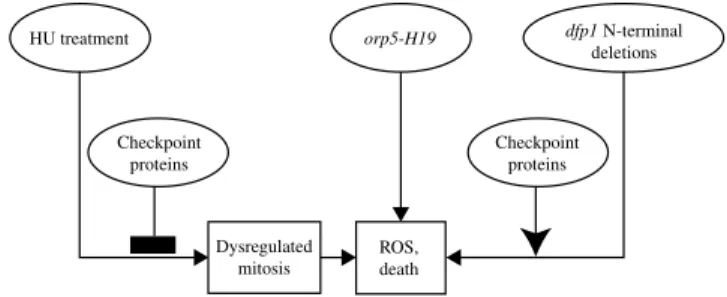
Whether the production of ROS and cell death taking place in certain replication-initiation fission yeast mutants and in HU-treated checkpoint-deficient fission yeast cells are due to apoptosis or necrosis, they appear similar to the production of ROS and apoptosis in mammalian cells and budding yeast cells in response to initiation defects and replication stress. It is therefore worth considering the possible utility of fission yeast as a model organism for further studies of these cell-death responses. Fission yeast offers several advantages for such studies. Like budding yeast, it is a genetically tractable organism with a completely sequenced genome. In fission yeast, the pathways leading to cell death include one pathway that is initiated by inappropriate mitosis and two that are initiated by defects in replication-initiation proteins (Fig. 9). The first pathway is strikingly enhanced by simultaneous defects in the replication- and damage-checkpoints, whereas the second and third pathways are checkpoint-independent and dependent on a functional replication checkpoint, respectively. This multiplicity of cell death pathways in fission yeast reminds one of the multiplicity of cell death pathways in mammalian cells. Further examination of the mechanisms of these pathways in fission yeast is likely to shed light on the mechanisms by which inappropriate mitosis and defects in replication initiation proteins lead to cell death in mammalian cells.
Materials and Methods
Cell culture
The strains used in this study are listed in the supplementary material, Table S1. Cells were propagated at the indicated temperatures in YES medium (Moreno et al., 1991), with the exception of the dfp1mutants, which were maintained in Edinburgh Minimal Medium (EMM) (Moreno et al., 1991), containing supplements but no leucine.
ROS and propidium iodide (PI)-staining assays
Logarithmically growing non-temperature-sensitive strains were incubated at 25°C. Temperature-sensitive strains in log-phase were shifted from the permissive
temperature (25°C) to 25°, 30°, 35° or 37° for 2, 4 or 6 hours. In indicated cases, hydroxyurea (HU, USB Corporation; 12 mM) or MG132 (Calbiochem; 250 M) were added at the beginning of the incubation. At the end of the incubation the ROS indicator dye 2⬘,7⬘-dichlorodihydrofluorescein diacetate (DCDHFDA; Molecular Probes) was added (10 g/ml final) and incubation was continued for 80 minutes. Cells were then harvested in a table-top centrifuge and washed twice with citrate buffer (50 mM sodium citrate, pH 7.0). The pellets were resuspended in an appropriate volume of citrate buffer containing PI (Sigma; 10 g/ml final) and then analyzed by fluorescence microscopy or flow cytometry. The flow data were further analyzed using FlowJo software (TreeStar, Inc.) as described in supplementary material, Fig. S1.
Generation of double-mutant strains
Double-mutant strains were generated by appropriate crosses followed by selection for indicator phenotypes.
Cloning of the orp5+genomic fragment and cDNA, and disruption of orp5+
The orp5+gene was localized to cosmid 855 (Mizukami et al., 1993), which maps
just proximal to the moc1+/sds23+gene on chromosome II. The orp5+genomic clone
was obtained by PCR and confirmed by sequencing. The full-length orp5+cDNA
was isolated from a ZapII (Stratagene) S. pombe cDNA library by plaque hybridization with the orp5+genomic fragment. Sequencing was carried out on both
strands.
Isolation of orp5 temperature-sensitive mutants
A 4.1-kb fragment containing the sds23+and orp5+genes was amplified by PCR
and cloned into pBluescript, and a 2.2-kb fragment containing ura4+was inserted
between the sds23+and orp5+open reading frames. The resulting plasmid was used
as a template for mutagenic PCR with excess dNTPs to amplify the sds23+, ura4+,
orp5+region. The resulting PCR products were transformed into the fission yeast
strain, YM71 (h-, ura4-D18, leu1-32, ade6-704). The ura4+transformants obtained
at 25°C, in which the chromosomal orp5+-sds23+ region was replaced with a
mutated PCR fragment by homologous recombination, were screened for temperature-sensitivity (Ts) at 36.5°C. The resulting Ts mutants were transformed with plasmids expressing either orp5+or sds23+to identify orp5Ts mutation(s).
Nine Ts strains were complemented by the orp5+plasmid but not by the sds23+
plasmid. The orp5-H19, orp5-H30, and orp5-H37mutants were chosen for further analysis.
Hiroaki Kato and Katsunori Tanaka contributed to the identification, characterization and mutagenesis of orp5. Joseph Goldbeck assisted with the initial ROS experiments. Andrew Phillips and members of J.A.H.’s and W.C.B.’s laboratories provided useful comments on the manuscript. Grant Brown, Tony Carr, Kathy Gould, Tom Kelly, Janet Leatherwood and Hiroto Okayama provided strains. Research in Y.M.’s laboratory was supported by a Grant-in-Aid for Scientific Research (B) and a Grant-in-Aid for Scientific Research on Priority Areas (A). Research in W.C.B.’s and J.A.H.’s laboratories was supported by NIH grants CA084086 (W.C.B.), and CA095908 and GM070566 (J.A.H.) as well as by the Cancer Center Support Grant (P30 CA016056) to Roswell Park Cancer Institute, which partially supports the Flow Cytometry Facility employed in this study.
References
Al-Khodairy, F., Fotou, E., Sheldrick, K. S., Griffiths, D. J., Lehmann, A. R. and Carr, A. M.(1994). Identification and characterization of new elements involved in
checkpoint and feedback controls in fission yeast. Mol. Biol. Cell5, 147-160.
Balzan, R., Sapienza, K., Galea, D. R., Vassallo, N., Frey, H. and Bannister, W. H.
(2004). Aspirin commits yeast cells to apoptosis depending on carbon source. Microbiology150, 109-115.
Bell, S. P. and Dutta, A.(2002). DNA replication in eukaryotic cells. Annu. Rev. Biochem.
71, 333-374.
Bentley, N. J., Holtzman, D. A., Flaggs, G., Keegan, K. S., DeMaggio, A., Ford, J. C., Hoekstra, M. and Carr, A. M.(1996). The Schizosaccharomyces pombe rad3
checkpoint gene.EMBO J.15, 6641-6651.
Blanchard, F., Rusiniak, M. E., Sharma, K., Sun, X., Todorov, I., Castellano, M. M., Gutierrez, C., Baumann, H. and Burhans, W. C.(2002). Targeted destruction of DNA replication protein Cdc6 by cell death pathways in mammals and yeast. Mol. Biol. Cell13, 1536-1549.
Boddy, M. N., Furnari, B., Mondesert, O. and Russell, P. (1998). Replication
checkpoint enforced by kinases Cds1 and Chk1. Science280, 909-912.
Brezniceanu, M.-L., Völp, K., Bösser, S., Solbach, C., Lichter, P., Joos, S. and Zörnig,
M.(2003). HMGB1 inhibitis cell death in yeast and mammalian cells and is abundantly
expressed in human breast carcinoma. FASEB J.17, 1295-1297.
Burhans, W. C., Weinberger, M., Marchetti, M. A., Ramachandran, L., D’Urso, G.
dfp1N-terminal deletions orp5-H19 HU treatment ROS, death Checkpoint proteins Checkpoint proteins Dysregulated mitosis
Fig. 9.Checkpoint-inhibited, stimulated and
checkpoint-independent pathways leading to production of ROS and cell death in fission yeast. This figure provides a simplified summary of the pathways leading from mutations in genes that encode replication-initiation proteins, or from HU treatment, to elevated production of ROS and cell death.
Jour
and Huberman, J. A.(2003). Apoptosis-like yeast cell death in response to DNA
damage and replication defects. Mut. Res.532, 227-243.
Caspari, T. and Carr, A. M. (1999). DNA structure checkpoint pathways in Schizosaccharomyces pombe. Biochimie81, 173-181.
Castedo, M., Perfettini, J. L., Roumier, T. and Kroemer, G.(2002). Cyclin-dependent
kinase-1: linking apoptosis to cell cycle and mitotic catastrophe. Cell Death Differ.9,
1287-1293.
Castedo, M., Perfettini, J.-L., Roumier, T., Andreau, K., Medema, R. and Kroemer,
G.(2004). Cell death by mitotic catastrophe: a molecular definition. Oncogene23,
2825-2837.
Chahwan, C., Nakamura, T. M., Sivakumar, S., Russell, P. and Rhind, N.(2003). The fission yeast Rad32 (Mre11)-Rad50-Nbs1 complex is required for the S-phase DNA
damage checkpoint. Mol. Cell. Biol.23, 6564-6573.
Cheng, J., Park, T.-S., Chio, L.-C., Fischl, A. S. and Yi, X. S.(2003). Induction of
apoptosis by sphingoid long-chain bases in Aspergillus nidulans. Mol. Cell. Biol.23,
163-177.
Dodson, G. E., Shi, Y. and Tibbetts, R. S.(2004). DNA replication defects, spontaneous DNA damage, and ATM-dependent checkpoint activation in replication protein
A-deficient cells. J. Biol. Chem.279, 34010-34014.
Duncker, B. P. and Brown, G. W.(2003). Cdc7 kinases (DDKs) and checkpoint
responses: lessons from two yeasts. Mut. Res.532, 21-27.
Feng, D., Tu, Z., Wu, W. and Liang, C.(2003). Inhibiting the expression of DNA
replication-initiation proteins induces apoptosis in human cancer cells. Cancer Res.63,
7356-7364.
Fleury, C., Mignotte, B. and Vayssière, J.-L.(2002). Mitochondrial reactive oxygen
species in cell death signaling. Biochimie84, 131-141.
Fung, A. D., Ou, J., Bueler, S. and Brown, G. W.(2002). A conserved domain of Schizosaccharomyces pombe dfp1+is uniquely required for chromosome stability
following alkylation damage during S phase. Mol. Cell. Biol.22, 4477-4490.
Furuya, K. and Carr, A. M.(2003). DNA checkpoints in fission yeast. J. Cell Sci.116, 3847-3848.
Gould, K. L. and Nurse, P.(1989). Tyrosine phosphorylation of the fission yeast cdc2+
protein kinase regulates entry into mitosis. Nature342, 39.
Hartsuiker, E., Vaessen, E., Carr, A. M. and Kohli, J.(2001). Fission yeast Rad50
stimulates sister chromatid recombination and links cohesion with repair.EMBO J.20,
6660-6671.
James, C., Gschmeissner, S., Fraser, A. and Evan, G. I. (1997). CED-4 induces
chromatin condensation in Schizosaccharomyces pombeand is inhibited by direct
physical association with CED-9. Curr. Biol.7, 246-252.
Jimenez, G., Yucel, J., Rowley, R. and Subramani, S.(1992). The rad3+gene of Schizosaccharomyces pombe is involved in multiple checkpoint functions and in DNA
repair. Proc. Natl. Acad. Sci. USA 89, 4952-4956.
Jürgensmeier, J. M., Krajewski, S., Armstrong, R. C., Wilson, G. M., Oltersdorf, T., Fritz, L. C., Reed, J. C. and Ottilie, S.(1997). Bax- and Bak-induced cell death in
the fission yeast Schizosaccharomyces pombe. Mol. Biol. Cell8, 325-339.
Kelly, T. J., Martin, G. S., Forsburg, S. L., Stephen, R. J., Russo, A. and Nurse, P.
(1993). The fission yeast cdc18+gene product couples S phase to START and mitosis.
Cell74, 371-382.
Kiely, J., Haase, S. B., Russell, P. and Leatherwood, J.(2000). Functions of fission
yeast Orp2 in DNA replication and checkpoint control. Genetics154, 599-607.
Kim, J. M., Yamada, M. and Masai, H.(2003). Functions of mammalian Cdc7 kinase
in initiation/monitoring of DNA replication and development. Mut. Res.532, 29-40.
Leatherwood, J., Lopez-Girona, A. and Russell, P.(1996). Interaction of Cdc2 and
Cdc18 with a fission yeast ORC2-like protein. Nature379, 360-363.
LeBel, C. P., Ischiropoulos, H. and Bondy, S. C.(1992). Evaluation of the probe 2’,7’-dichlorofluorescin as an indicator of reactive oxygen species formation and oxidative
stress. Chem. Res. Toxicol.5, 227-231.
Lindsay, H. D., Griffiths, D. J. F., Edwards, R. J., Christensen, P. U., Murray, J. M., Osman, F., Walworth, N. and Carr, A. M.(1998). S-phase-specific activation of Cds1 kinase defines a subpathway of the checkpoint response in Schizosaccharomyces pombe. Genes Dev.12, 382-395.
Madeo, F., Fröhlich, E., Ligr, M., Grey, M., Sigrist, S. J., Wolf, D. H. and Fröhlich, K.-U.(1999). Oxygen stress: a regulator of apoptosis in yeast. J. Cell Biol.145, 757-767.
Madeo, F., Herker, E., Wissing, S., Jungwirth, H., Eisenberg, T. and Fröhlich, K.-U.
(2004). Apoptosis in yeast. Curr. Opin. Microbiol.7, 655-660.
Maftahi, M., Hope, J. C., Delgado-Cruzata, L., Han, C. S. and Freyer, G. A.(2002).
The severe slow growth of ⌬srs2⌬rqh1in Schizosaccharomyces pombeis suppressed
by loss of recombination and checkpoint genes. Nucleic Acids Res.30, 4781-4792.
Manolis, K. G., Nimmo, E. R., Hartsuiker, E., Carr, A. M., Jeggo, P. A. and Allshire, R. C.(2001). Novel functional requirements for non-homologous DNA and joining in Schizosaccharomyces pombe.EMBO J.20, 210-221.
Marchetti, M. A., Kumar, S., Hartsuiker, E., Maftahi, M., Carr, A. M., Freyer, G. A., Burhans, W. C. and Huberman, J. A.(2002). A single unbranched S-phase DNA damage and replication forkk blockage checkpoint pathway. Proc. Natl. Acad. Sci. USA
99, 7472-7477.
Mizukami, T., Chang, W. I., Garkavtsev, I., Kaplan, N., Lombardi, D., Matsumoto, T., Niwa, O., Kounosu, A., Yanagida, M., Marr, T. G. et al.(1993). A 13 kb resolution cosmid map of the 14 Mb fission yeast genome by nonrandom
sequence-tagged site mapping. Cell73, 121-132.
Moreno, S., Klar, A. and Nurse, P.(1991). Molecular genetic analysis of fission yeast, Schizosaccharomyces pombe. Methods Enzymol.194, 795-823.
Murakami, H. and Okayama, H.(1995). A kinase from fission yeast responsible for
blocking mitosis in S phase. Nature374, 817-819.
Muzi-Falconi, M., Brown, G. W. and Kelly, T. J.(1996). cdc18+regulates initiation of
DNA replication in Schizosaccharomyces pombe. Proc. Natl. Acad. Sci. USA93,
1566-1570.
Norbury, C. J. and Zhivotovsky, B.(2004). DNA damage-induced apoptosis. Oncogene
23, 2797-2808.
Nyberg, K. A., Michelson, R. J., Putnam, C. W. and Weinert, T. A.(2002). Toward maintaining the genome: DNA damage and replication checkpoints. Annu. Rev. Genet.
36, 617-656.
Ogino, K., Takeda, T., Matsui, E., Iiyama, H., Taniyama, C., Arai, K.-i. and Masai,
H.(2001). Bipartite binding of a kinase activator activates Cdc7-related kinase essential
for S phase. J. Biol. Chem.276, 31376-31387.
Pelizon, C., d’Adda di Fagagna, F., Farrace, L. and Laskey, R. A.(2002). Human replication protein Cdc6 is selectively cleaved by caspase during apoptosis. EMBO Rep.
3, 780-784.
Qi, H., Li, T.-K., Kuo, D., Nur-E-Kamal, A. and Liu, L. F.(2003). Inactivation of
Cdc13p triggers MEC1-dependent apoptotic signals in yeast. J. Biol. Chem.278,
15136-15141.
Rhind, N. and Russell, P.(2000). Checkpoints: It takes more than time to heal some
wounds. Curr. Biol.10, R908-R911.
Rodriquez-Menocal, L. and D’Urso, G.(2004). Programmed cell death in fission yeast. FEMS Yeast Res.5, 111-117.
Sancar, A., Lindsey-Boltz, L. A., Unsal-Kacmaz, K. and Linn, S.(2004). Molecular mechanisms of mammalian DNA repair and the DNA damage checkpoints. Annu. Rev. Biochem.73, 39-85.
Schories, B., Engel, K., Dorken, B., Gossen, M. and Bommert, K. (2004). Characterization of apoptosis-induced Mcm3 and Cdc6 cleavage reveals a proapoptotic
effect for one Mcm3 fragment. Cell Death Differ.11, 940-942.
Shreeram, S., Sparks, A., Lane, D. P. and Blow, J. J. (2002). Cell type-specific
responses of human cells to inhibition of replication licensing. Oncogene21,
6624-6632.
Takeda, T., Ogino, K., Matsui, E., Cho, M. K., Kumagai, H., Miyake, T., Arai, K.-i. and Masai, H.(1999). A fission yeast gene, him1+/dfp1+, encoding a regulatory subunit for Hsk1 kinase, plays essential roles in S-phase initiation as well as in S-phase
checkpoint control and recovery from DNA damage. Mol. Cell. Biol.19, 5535-5547.
Tavassoli, M., Shayeghi, M., Nasim, A. and Watts, F. Z. (1995). Cloning and characterisation of the Schizosaccharomyces pombe rad32 gene: a gene required for
repair of double strand breaks and recombination. Nucleic Acids Res.23, 383-388.
Tsuchiya, M., Suematsu, M. and Suzuki, H.(1994). In vivo visualization of oxygen
radical-dependent photoemission. Methods Enzymol.233, 128-140.
Venkitaraman, A. R.(2005). Aborting the birth of cancer. Nature434, 829-830.
Walworth, N., Davey, S. and Beach, D.(1993). Fission yeast chk1protein kinase links
the rad checkpoint pathway to cdc2. Nature363, 368-371.
Weinberger, M., Ramachandran, L., Feng, L., Sharma, K., Sun, X., Marchetti, M. A., Huberman, J. A. and Burhans, W. C.(2005). Apoptosis in budding yeast caused
by defects in initiation of DNA replication. J. Cell Sci.15, 3543-3553.
Willson, J., Wilson, S., Warr, N. and Watts, F. Z.(1997). Isolation and characterization
of the Schizosaccharomyces pombe rhp9gene: a gene required for the DNA damage
checkpoint but not the replication checkpoint. Nucleic Acids Res.25, 2138-2145.
Yim, H., Jin, Y. H., Park, B. D., Choi, H. J. and Lee, S. K.(2003). Caspase-3-mediated cleavage of Cdc6 induces nuclear localization of p49-truncated Cdc6 and apoptosis. Mol. Biol. Cell14, 4250-4259.
Zhang, Q., Chieu, H. K., Low, C. P., Zhang, S., Heng, C. K. and Yang, H.(2003). Schizosaccharomyces pombe cells deficient in triacylglycerols synthesis undergo
apoptosis upon entry into the stationary phase. J. Biol. Chem.278, 47145-47155.