EVALUATION ON THE EFFECTIVENESS OF THE WEB
TECHNOLOGY USAGE IN PROMOTING AND MARKETING
INDONESIA TOURISM
SUROTO ADIAssoc. Prof., Bina Nusantara University, School of Information Systems Jl. KH . No. Syahdan . 9 , Palmerah , West Jakarta 11480
E-mail: [email protected] ; [email protected]
ABSTRACT
One indicator of success in tourism is reflected in the number of foreign tourists visiting Indonesia. Although the number and type of tourism objects in Indonesia is higher than the neighboring countries, the number of visits to Indonesia is far below the neighboring countries such as Malaysia, Singapore, and Thailand. The usage of websites in Indonesia tourism has been widely used, but the results are not satisfactorily yet, especially in supporting tourism promotion and marketing. The study aimed to evaluate the use of websites to support promotion and marketing Indonesia tourism which are carried out by tourism provincial and district offices, travel agencies, hotels and tourist destinations. The methodology used to determine the performance of website is mBSC (modified Balanced Scorecard), whereas to analyze the aspects needed to be strengthened in accordance with the functions of office and business tourism is descriptive statistical method. The data were taken from websites from offices of tourism, travel agencies, hotels, and tourist destinations. The results of the research are proposed to assess and formulate model of integrated website application development for promoting and marketing Indonesia tourism business.
Keywords: Tourism, Integrated Website, Promotion And Marketing
1. INTRODUCTION
Stretching from the province of Aceh to Papua, Indonesia's tourism potency is enormous. Indonesia is rich with cultural attractions varieties and the beauty of its nature, as well as a variety of dishes that contain high taste in culinary tourism. The beauty of it potentially makes Indonesia well known as one of the popular tourist spots, and is expected to attract domestic and foreign tourists more. In practice, attracting tourists need to be supported by a credible of promotion and marketing. The government of Indonesia together with tourism actors establishes tourism promotion, through tourism delegations of art and culture [19]. These activities made Indonesian tourism products well known, but it required a big budget. If the budget is limited, the number of promotion activities is not increased. Referring to these reasons, efforts to promote Indonesian tourism have been made. One of them is to build a website as a center of tourism data and information at central, provincial and district/city levels. The use of information technology, especially web technology, will create a large information network that is likely to strengthen the tourism business.
the implementation of tourism marketing is more accessible. The development of the Internet and the web technology started in the mid-1990s, encouraged a variety of industries to accelerate business processes and improved the performance of the company in an effort to gain a strategic advantage. By now, there are many agencies and managers of local tourism businesses that are currently using this technology to support management and marketing services. Information technology and the internet can be used to support tourism transactions and distributing travel information maintained in various forms of information. Bill Dollin [13] emphasized that the concept adoption internet commerce was to combine three aspects, namely the promotion of web-based business, the completeness of the information and services available in the web, and transaction processing. In Indonesia, the use of information technology in tourism is not declared the legislation explicitly. However, it strongly encourages the government offices and private sectors to use web technology to enhance the tourism business, particularly in supporting promotion and marketing activities [18].
Currently, there are thousands of websites have been built and launched, since last decade, but the results have not shown a significant improvement in term of number of tourist visit to Indonesia, as seen in the data on the number of tourist visits. The number and types of tourism in Indonesia is superior comparing to neighboring countries, but the number of foreign tourists coming to Indonesia did not increase significantly. By comparing to Malaysia, Singapore, and Thailand, the number remains below, as seen in Table 1
Table-1: Number of Foreign Tourists visit to Indonesia, Singapore, Malaysia, and Thailand
No Country 2011 2012 Average
1 Indonesia 7,649,731 8,044,462 7,847,097
2 Singapore 13,200,000 14,400,000 13,800,000
3 Malaysia 23,646,191 25,032,708 24,339.450
4 Thailand 19,230,470 22,303,065 20.776.768
It is understood that there are many factors influence the success of businesses in the tourism sector and the use of information technology or web technologies is one of them. Dimitros Buhalis [11] stated that the use of web technology will support the promotion of tourism as well as the ease of the transaction or business process tourism.
However, Bill Dolin [13] in his study warned that websites were built should not just e-mails, but it should accommodate the user interaction with websites easily, providing online booking for travel and other services, and secure on-line transactions. Therefore there is a need to know whether the Indonesian tourism website has accommodated the user needs, and meet the requirements and criteria of a good website, so that the use of web technology in Indonesia has benefits to support the success of the business, especially in the field of tourism activities.
2. RESEARCH QUESTION
The two research questions in this study are: 1. How far is the performance of the use of web
technology in promoting, marketing and giving tourism products and services?
2. What the important aspects in the use of web technology in tourism need to be strengthened? The answer of the questions is important for the business community such as travel agencies and tourism tours, hotels and tourist destinations as well. They could use to encourage awareness that the use of information technology will improve their competitiveness in the global competition, increasing awareness to always rejuvenate information about products and services provided and encouraging enterprises to develop information technology. It supports their business activities with the right displayed information. As a policy maker, the government would also get benefit to support the formulation of national policies in the field of tourism in various regions, mainly in the provision of tourism infrastructure. It also supports policy formulation in the use of integrated tourism web technologies and integrating national web infrastructure.
3. RESEARCH METHODOLOGY
A. Modified Balanced Scorecard ( mBSC )
customers (customer friendliness and usability), marketing effectiveness (effectiveness of marketing the destination), and the required information (information needs). Similarly taking account the Government Regulation Number 50 on National Tourism Development Master Plan 2010-2025, the website of tourism is evaluated in four perspectives: user perspective (user friendliness and usability), marketing effectiveness (effectiveness of tourism marketing), organizational functions (tourism office functions), and technical perspective (overall technical functionality).
B. Research Design
This study is a combination of qualitative and quantitative research, to evaluate the performance of the use of web technology in the tourism business. The design of this study was designed based on the research objectives as formulated in the research questions, which relates to the use of web technology in the tourism business. The design of the study will show the relationship between the independent variables and the dependent variable that affect the success of tourism businesses as well as direct or indirect variables used in web technologies. Website performance is the dependent variable that is affected by the variability component that builds upon the objectives, strategies, tasks and functions, as well as business goals or objectives of the organization or company in the field of tourism. Furthermore the evaluation of the performance of the website is done by using an indicator variability of each perspective, as shown in the following Figure 01.
Figure 01: Perspectives and Its Indicators
1. User perspective (user friendliness and usability)
Evaluation is done by looking at whether the information presented is useful and easily available, attractive, complete in accordance with the wishes of users , as well as the ease of on-line transaction processing. In this perspective, the evaluation of the website is done by using a 19-22 indicators to assess the benefits and usefulness of the website for users inside and outside the country, the level of website accessibility and ease of reach of the site , ease of website navigation features, view website attractiveness, overall appearance and ease of finding relevant information on the website [8] [9] [10].
2 . Marketing effectiveness perspective (effectiveness of marketing capability)
Evaluation is done by looking at whether the information generated to support the promotion, marketing, and web services transactions especially for travel agents and tours, hotels, and tourist destinations. In this perspective, the evaluation is done by using a 12-20 indicators to assess the ability to pull either individuals or groups, selling point, the ability to sell products , the creation of relationship marketing of tourism products, the ability to support partnerships, information currency, the added value offered [1] [12] [17]. 3. Functionality perspective (organizational
functions of tourism offices and actors) Evaluation is done by looking at whether the information in the website reflects the organization functions as a facilitator or business in the field of tourism. In this perspective, the evaluation is done by using a 11-18 indicators to evaluate whether available information such as covers laws and regulations, infrastructure, facilities and collaboration, support of tourism activities or festivals , public transport information, meetings and conferences , special tourist information , get advice needed [2] [19]. 4. Technical (overall technical functionality)
sufficient technical support in the presentation of information, align with the principles of good web design such as the ability to link, HTML, internet browsing and compatibility website loading time. In this perspective, the evaluation is done by using a 23-25 indicators to evaluate the variability of information technology infrastructure and technical capabilities websites [16][17].
To measure the performance of a website, the Internet browsing to the website was conducted by using an evaluative questionnaire consisting of evaluation indicators or "survey items" derived from the four perspectives. Each item of survey was designed to generate a response of "yes" or "no". In this study, in order to obtain 95 % confidence level, an evaluation was conducted to 103 official tourism websites of provincial, district/city which were selected randomly from 142 websites available, 91 travel agent websites selected from the 121 available websites (DKI Jakarta), 103 hotel websites were selected from 141 hotel websites available (DKI Jakarta), and 108 tourist destination websites were selected from 151 websites available [5][6][7].
Other related to tourism websites, such as airline websites, travel blogs, online travel guides and online travel magazine were not addressed in this study for reasons of priority. Twelve evaluators was trained by the authors to evaluate each website and each website is evaluated by three evaluators to minimize the subjectivity of a particular evaluator. For each survey item, if the response was "yes" value "1" was given while if the response was "no" value "0" was given [4][5][8]. The total value of "1" was obtained from each perspective category was calculated in percentage with a maximum of 100 %. Overall website performance was calculated by summing all the results and then divided by four. The resulting final score is considered as performance of the website. Furthermore, the authors categorize the performance obtained in four groups. There are low performance (0 < 45), middle performance (45 < 65), good performance (65 < 85), and very good performance (85 < 100).
4. RESULT AND DISCUSSION
A. Results
a. Provincial and District Tourism Office
Table-2: Descriptive Statistics Performance of Tourism Office Website
Perspective Mean Skewness Kurtosis Users 52.65 -13.47 -19.33
Marketing Effectiveness
33.36 60.65 -22.75
Functional 38.49 31.31 -64.76 Technical 59.17 -45.25 22.00
Performance 45.92 18.14 -21.98
Table 2 shows that the mean of the performance is 45.92. It can be concluded that the overall performance of the provincial or district tourism
office website into the category of "middle performance". It means that the official tourism websites of provincial and district have not sufficiently supported promotion and marketing activities by facilitating the availability of information. to attracts tourists to visit and enjoy the tourism products provided by tourism businesses in provincial and district/city levels. Effectiveness of marketing performance shows the lowest value which means that information to support the promotion and marketing is poor or provincial and district tourism office put those perspectives in low priority. Positive of skewness (18.14) and negative of kurtosis (-21.98) indicate that the modus of provincial or district tourism website performances are significantly below average and they spread out and are flat.
b. Travel Agencies and Tourism
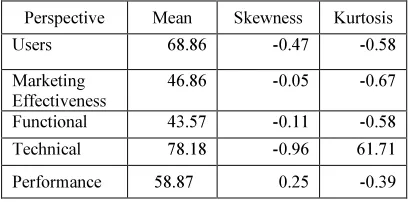
Table-3: Descriptive Statistics Performance Travel of Agents and Tourism Websites
Perspective Mean Skewness Kurtosis
Users 68.86 -0.47 -0.58
Marketing Effectiveness
46.86 -0.05 -0.67
Functional 43.57 -0.11 -0.58
Technical 78.18 -0.96 61.71
Performance 58.87 0.25 -0.39
Table 3 shows that the mean of the performance is 58.87. it can be concluded that the performance of travel agency and tourism websites is within the category of "middle performance", or travel agency and tourism websites did not have adequate information to support an attract tourist to visit and enjoy tourism object and events at tourism destination offered by travel agencies. Effectiveness of marketing performance has the lowest value. It means that information to support the promotion and marketing is poor. Of the four categories, functions and organization perspective show the lowest. It means travel agencies and tourism websites put those perspectives in low priority. It did not inform the function of travel agencies and tourism to sell tourism products. Positive skewness which is close to zero (0.25) and negative kurtosis which tends to zero (-0.39) show that the modus performance of travel agencies and tourism websites is near the average and tends to normal distribution.
c. Hotels
[image:4.595.304.509.357.458.2] [image:4.595.86.291.612.708.2]Perspective Mean Skewness Kurtosis
Users 67.00 -61.90 123.76
Marketing Effectiveness
59.55 -55.43 -71.23
Functional 51.28 -12.26 -24.63
Technical 56.50 0.62 4.50
Performance 58.77 -50.77 -14.51
Table 4 shows the performance of the hotel website (DKI Jakarta) is 58.77 or in the category of "middle performance". It means that hotel websites did not provide enough information to support promotion and marketing of their products as well as to attract tourists to enjoy their products, such as nice and beautiful rooms, facilities and events. Of the four categories, functions and organization perspective show the lowest. It means that hotel websites indicates poor information regarding to support their function in their business, such as collaboration with business partners. Hotel should collaborate with travel agents and tourism, tourist destination websites. High negative skewness (-50.77) and negative kurtosis (-14.51) show that the modus hotel website performances is significantly above the average and they are dispersed or flat. d. Tourist Destination
Table 5. Descriptive Statistics Website Performance Tourist Destinations
Perspective Mean Skewness Kurtosis
Users 56.30 5.98 47.98
Marketing Effectiveness
26.50 109.75 54.30
Functional 31.89 58.40 -20.79 Technical 49.72 17.51 -31.34
Performance 41.10 92.62 72.62
Table 5 shows the performance of tourist destinations websites is 41.10 in the category of "low performance". In other words, tourist destinations websites provide less information to attract tourists to visit and enjoy the products and events organized by tourist destinations. Effectiveness of marketing performance reaches the lowest value. It means that information to support the promotion and marketing is poor or not in the priority. It means they did not provide enough information to promote their products. Functional perspective performance 31.89 indicates that tourist destinations websites did not open collaboration to their partners such as hotels and travel agencies and tourism website. High positive skewness (92.62) and high positive kurtosis (72.62) indicate that the mode of tourist destination website performance is
far below the average and concentrated near the modus.
B. Discussion
Website performance greatly affects the performance of the business supported and finally affects the success of business goals. Thus, it is very important to optimize the performance of the website. Business success can be measured from many aspects, including: the ability to generate profits, market position improved quality of human resources and business development. In this aspect, based on the evaluation of survey conducted, there are some weaknesses of four websites actors that need to be improved.
a. Provincial and District Tourism Office
In term of information informed and displayed in the website, some dominant factors observed that cause the middle performance provincial and district tourism office website are: lack of features frequently Ask Questions (FAQs); unavailability of the site map; the long or complicated domain name; lack of tourism product information such as tourist destinations, hotels, tourism promotion, tourism events (festivals or attractions/public performances) that may increase the number of tourist arrivals. In addition, as a facilitator of development of tourism, they are less information on tourist destination maps and event tourism; history and culture of informed less area; travel information, tourist visas or immigration, and information to support coordination and cooperation with the tourism businesses such as hotels and destinations. In terms of technical support for the poor performance of the website of the Provincial Office, Tourism District/City is caused by no supporting techniques of SEO (Search Engine Optimization) techniques (it is hard to find the website under the Google search engine), the difficulty of finding specific information on the website, no link facility support collaboration between tourism business actors, unavailability of live chat, and no banners/sliders techniques to help and facilitate promotion activities for tourism business purposes.
b. Travel Agencies and Tourism
In terms of information produced and displayed in the website, the middle performance travel agencies and tourism miss some information due to: the lack of foreign language feature (difficult for foreign users to understand the information displayed), the absence of links to other relevant sites (the users must start from beginning to find the desired information), unavailability frequently Ask Questions (FAQs), unavailability of an internal search engine, unavailability of information regarding the latest foreign exchange rates (difficult for customers to make the budget estimate), the slow ordering process (caused customers to cancel the transaction), no price information of available equivalent products (customers can’t compare the advantages and disadvantages of one product with another product), complexity and less flexibility of on-line transaction processing (payment can’t use a credit card), lack of information products or services (may reduce or decreased sales of tour packages), lack of maps and guidance to reach destination area (can lead to the lack of interest to visit), no information on the activities carried out by the hotel or travel destination (it may decrease the possibility of selling the package tour), and unavailability of information about tourism activities in local areas. In terms of technical support, the poor performance websites is hard to access which seems no information due to: low speed access to the website, less attractive website (the website did not use the features of HTML 5), no facilities for using PayPal so that possibly it reduces the transaction chances, and the lack technical variation support for promotions products such as banner/slider.
Refer to weakness, current travel agencies and tourism websites need improvement to make available information related to tourism products and services. Collaboration with hotels and tourism destinations is important to have complete and updated information regarding to tourism product, services, and events include schedule and latest prices. Technical support need improvement to support customer transactions, increase speed of processing and to facilitate collaboration with hotels and tourism destinations regarding to provide better services and information exchange.
c. Hotels
In term of information produced and displayed, the lower performance of hotel website is incomplete due to: unavailability (FAQ) or live chat, no site map; unavailability internal search
engine, unavailability of foreign language, out-to-date of the product and price information, no activity or event information to attract tourists, no interactive features to obtain the desired information, no information about events and promo, and unavailability of information about partners such as travel agents and tourist destinations to generate collaboration. In terms of technical support, the low performance of the hotel website happens due to: no internal search engine, no SEO facility, no features use of HTML 5, no CSS3 technologies use (low speed access), no banner/slider techniques usage which does not support the promotion of hotel products, no facility link/RSS to support collaboration, and no site map to reach the hotels.
Refer to weakness, current hotel websites need improvement related to availability of services, such as room, facilities and events. Collaboration with nearest tourist destinations is important so that hotel websites are recommended to having information about tourism objects and events. Websites need technical support improvement to serve customer transactions easily and fast, facilitate collaboration with tourism destinations for better information exchanges.
d. Tourism Destinations
In term of information produced and displayed, the low performance of tourism destination website happened due to: the unavailability FAQs and live chat, unavailability of site maps, no foreign language feature, no link to other websites which are relevant (the user must always re-start to find the desired information on other sites), less attractive design, lack of promotion of information products and/or new attractions (may reduce tourist arrivals), no facility to easily make payment (no on-line ticketing), no price information, no information to supports collaboration with partners, no information or “tips” on how to enjoy events and tourist attractions, no information about directory of location of event and attractions, and no information about the closest hotel to the tourist destination. In terms of technical support the low performance of tourist destinations website performance happened due to: no SEO utilization (Search Engine Optimization), no feature of HTML 5 used, no availability of Paypal techniques for payment, no banner/slider technique usage, and no facility for using social media.
hotels for having information about accommodations and services available. Technical support need improvement to support customer transactions, and facilitate collaboration with hotels for better information exchange.
5. CONCLUSION
Based on the results and discussion, it can be concluded that: 1. The four tourism website performances in this study : provincial and district website, travel agencies and tourism website, and hotel websites are still included in the category of "middle performance", whereas tourism destinations website is low performance. It means that they did not maximally take role in supporting the success of the tourism industry yet. Therefore, it is necessary to attempt improvement and put information related to tourism products and services in high priority; 2. Many aspects need improvements to support the tourism industry maximally, including technical support, collaboration, and the rejuvenation of the relevant data onto tourism, as well as the integration and presentation of information to domestic and international travelers; 3. This study shows that the average performance of the websites is low. It includes the four business actors in tourism which is seen from the four perspectives: user, effectiveness of marketing, functional and organizational, and technical website; 4. The majority of websites required development and improvement in terms of the information and technical support; 5. Provincial and District Tourism Offices as facilitator of tourism development are recommended to lead the development and implementation the integrated website; 6. It is suggested that further research need to being carried out to show the economic impact of the usage web technology in tourism promotion and marketing.
REFRENCES:
[1] R. Kelly Rainer, Casey G. Cegielski, “Introduction to Information Systems”, 4th John Wiley & Sons Singapore Pte. Ltd., 2013. . [2] Francois Vellas, Lionel Becherel, 2008, “The
International Marketing of Travel and Tourism: A strategic Approach (Pemasaran Pariwisata Internasional: Sebuah Pendekatan Starategis),” Yayasan Obor Indonesia, Jakarta , 2008. [3] Mulyadi, “Integrated Performance
Management System of Personel Based on Balanced Scorecard (Sistem Terpadu
Pengelolaan Kinerja Personel Berbasis Balanced Scorecard),” Unit Penerbit dan Percetakan, STIM YKPN, Yogyakarta, Indonesia, 2007.
[4] Amin, “Performance Measurement and Balanced Scorecard,” Harvarindo, 2009. [5] Rangkuti, “SWOT Balanced Scorecard,” PT.
Gamedia Pustaka Utama, Jakarta, Indonesia, 2011.
[6] Tukiran Taniredja, Hidayati Mustafidah, “Penelitian Kuantitatif (Sebuah Pengantar),”
Alfabeta, Bandung, Indonesia, 2011.
[7] Sugiyono, “Statistics for Research (Statistika untuk Penelitian),” Alfabeta, Bandung, Indonesia, 2002.
Article in a journal:
[8] Svetlana Stepchenkova, Liang Tang, SooCheong (Shawn) Jang, Andrei P. Kirilenko, Alastair M. Morrison, “Benchmarking CVB website performance: Spatial and structural patterns,” Tourism Management Volume 31, Issue 5, October 2010, Pages 611-620.
[9] Ho, C.L., & Lee, Y.L., “The development of an e-travel service quality scale. Tourism Management, “ 28(6), 1434-1449, 2007. [10]Lawa, R., Qi, S., & Buhalis, D., “Progress in
tourism management: A review of website evaluation tourism research”. Tourism Management 31 (3), 297-313, 2010.
[11]Dimitros Buhalis, “Progress in information technology and tourism management: 20 years on and 10 years after the Internet, The state of eTourism research,”, Tourism Management Volume 29, Issue 4, August 2008, Pages 609– 623.
[12]Ndou, V. and Passiante, G., “Value creation in tourism network systems.” In A. Frew (Ed.), Information and Communication Technologies in Tourism (pp. 440-451). Springer Verlag, Vienna, New York, 2005.
Articles in a conference proceedings:
[14]Putera, Prakoso Bhairawa dan Chichi Shintia Laksani. “Penerapan Destination Management System (DMS) dalam Pemasaran Pariwisata Banga Belitung Berbasis TIK (Mengagas E-Tourism Visit Babel Archipelago 2010)”. Prosiding SNATI 2008. Yogyakarta.
[15]Egger, Roman, “Restructuring The Destination Management System Paradigm,” Euro Chire Dubai Conference 2008.
http://pc.parnu.ee/htooman/EuroChrie.
[16]Collis, T.,“9 Essential Principles for Good Web Design”, (2007).
Http://psd.tutplus/tutorials/designing- tutorials/9-essential-principles-for-good-web-design/.
[17]Manolis, “5 Basic Principles (& 25 Best Practices) for DMO Websites. N.p.,1 Feb 2013. Web 15 Sep 2013.
Http://aboutourism.wordpress.com/2010/02/01/ 5-basic-principles-25-best-practices-for-dmo-websites/
Regulations
[18] _____,” Law Number 11 Year 2008 on Information and Electronic Transaction (Undang-Undang Nomor 11 Tahun 2008 Tentang Informasi dan Transaksi Elektronik)”. [19]. _____,”The Government Regulation Number