ISSN: 1992-8645 www.jatit.org E-ISSN: 1817-3195
961
SUCCESSIVE INTERFERENCE CANCELLATION
DECODING FOR THE
K
-USER CYCLIC INTERFERENCE
CHANNEL
1,2YONG LI, 1,4BO ZHANG, 3XIAOXIA SONG, BAOMING BAI 1
1
State Key Lab of ISN, Xidian University, Xi’an 710071, Shaanxi, China
2School of Education Science & Technology, Shanxi Datong University, Datong 037009, Shanxi, China
3School of Physical & Electronics, Shanxi Datong University, Datong 037009, Shanxi, China
4No. No. 96401 troop, Baoji 721007, Shaanxi, China
ABSTRACT
The K-user cyclic interference channel can model one scenario in vehicular networks, where all the base stations are arranged along a highway. The k th user is interfered only by the (( k +1) mod K ) th user in the K -user cyclic interference channel. The Han-Kobayashi scheme based rate region, the best inner bound
known to date for the two-user interference channel, is extended to the K -user cyclic interference channel,
which is obtained by simultaneously decoding the intended messages and a part of the interfered messages at the receiver. In this paper, we show that the simple successive interference cancellation decoding can also achieve this rate region.
Keywords: Interference Channel, Cyclic Interference Channel, Achievable Rate Region, Successive
Interference Cancellation Decoding, Multi-level Encoding
1.
INTRODUCTIONThe interference channel, first introduced by Shannon in 1961 [1], models a communication scenario where all user pairs share the same physical medium and the communication of each user pair will be interfered with that of another user pairs. A user pair is usually named a user for short. The interference channel is useful for determining the performance limits of many practical systems such as the wireless networks. However, the capacity region of the two-user interference channel is still unknown except for the following several cases. For the two-user discrete memoryless interference channel, its capacity region is known if the intensity of the interference is strong [2,3,4], if the channel outputs are some deterministic functions of the channel inputs [5], and if the channel satisfies a class of degraded form [6,7]. For the two-user Gaussian interference channel, the capacity regions of very strong and strong interference channels [4,8,9] and the same capacities of noisy interference [10,11,12] , mixed interference [11,13] and one-sided [14] interference channels are known. So far, the best achievable rate region for the two-user interference channel is
provided by Han and Kobayashi (HK) [8] using superposition coding in conjunction with simultaneous decoding. A simplified description of the HK rate region, named the CMG rate region, is given in [15] via multi-level encoding and simultaneous decoding. In this paper, we refer to these inner bounds as the HK scheme based inner bounds.
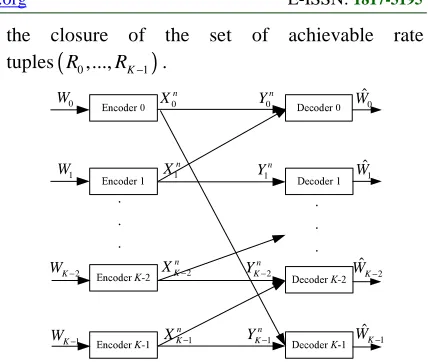
Recently, a special interference channel named the cyclic interference channel was introduced to study the coding problem of a special scenario may appear in vehicular networks, where all the base stations are arranged along a highway or high-speed rail. The cyclic interference channel is motivated by the modified Wyner model that is used to depict the soft handoff scenario of a cellular network [16]. In the K -user cyclic interference channel depicted in
Figure 1, the communication of the k th user pair
is interfered only by that of the ((k +1) mod K )th
user pair . In [17], the HK scheme based inner bounds for the two-user interference channel are extended to the K -user cyclic interference channel,
and its all operating points are pointed out to be achieved by successive interference cancellation decoding via taking a geometric viewpoint and using rate-splitting arguments.
962 discrete memoryless cyclic interference channel in this paper and show that the HK scheme based inner bound of the K -user cyclic interference
channel can be achieved by successive interference cancellation decoding via a rigorous and complete achievability proof using random coding arguments. The key idea of the proof is motivated by the equivalence of simultaneous decoding and successive interference cancellation decoding in achieving the capacity region of the multiple access channel (MAC).
Throughout the paper, we useX , x and X to denote a random variable, its realization and range, respectively. Moreover, a sequence is described
as n =
(
1, 2,...,)
,n
X X X X 1 =
(
11, 12,..., 1)
,n
n
X X X X
and (0)n =
(
0, 1, 2,...,)
n
X X X X X .
2.
CHANNEL MODELThe K -user discrete memoryless cyclic interference channel is shown in Figure 1, which consists of K input and output alphabetsX ,kk Y , k
0,..., 1
= −
k K and a collection of conditional
probability mass functions p y
(
0,...,yK−1x0,...,xK−1)
on Y0× ×L YK−1 . Specially, the marginal
distributions of the channel outputs
satisfyp y x
(
k 0,...,xK−1)
=p y x x(
k k, (k+1) mod K)
. It is assumed that transmitter k (k=0,...,K−1) wants to send an independent message W uniformly kdistributed over W to its intended receiver. A k
(
)
(
2nR0,..., 2nRK−1 ,n code for the K -user discrete)
memoryless cyclic interference channel consists ofK message sets =
{
1, 2,..., 2nRk}
k
W , K encoding
functions fk:Wk→Xkn performed by the corresponding encoder k , and K decoding
functions : n →
k k k
g Y W performed by the
corresponding decoder k . The average probability
of error over the codebook is defined
as ( )
{
(
)
(
)
}
0 1 0 1
ˆ ˆ
Pr ,..., − ,..., −
= ≠
n
e K K
P W W W W . A rate
tuple
(
R0,...,RK−1)
is said to be achievable for theK -user discrete memoryless cyclic interference channel if there exists a sequence of
(
)
(
2nR0,..., 2nRK−1 ,n)
codes with ( )n →0e P
as n→ ∞ . The capacity region of the K -user discrete memoryless cyclic interference channel is
the closure of the set of achievable rate tuples
(
R0,...,RK−1)
.1
n X
.
.
. .
.
.
0
n X
1
−
n K X
1
n Y
0
n Y
1
−
n K Y
Encoder 0
Encoder 1
Encoder K-1
0 W
1 W
1
K W−
Decoder 0
Decoder 1
Decoder K-1
0
ˆ W
1
ˆ W
1
ˆ − K W 2
−
n K
X −2
n K Y
Encoder K-2
2
K W−
Decoder K-2 2
ˆ
−
[image:2.612.310.524.82.263.2]K W
Figure 1: The K-User Cyclic Interference Channel
3.
MAIN RESULTIn this section, we will show that the HK scheme based inner bound of the K -user discrete memoryless cyclic interference channel can be achieved by multi-level encoding in conjunction with successive interference cancellation decoding. We rewrite the achievable rate region of the K -user discrete memoryless cyclic interference channel in [17] as follows.
Given a K -user discrete memoryless cyclic interference channel, the random variables take values in Q U, 0, ,... UK−1 , respectively. And letX0, ,... XK−1,Y0, ,...YK−1 take values in channel input alphabetsX0, ,...XK−1 , and channel output alphabets Y0, ,... YK−1respectively. Let P be the set
of all probability distributions on
0
, , , 1, 0, , 1
(Q U ...UK− X ... XK− ) that factor
as
(
)
( )
( ) (
)
1
1 1
(0) (0)
0
, , ,
q u x q u q x u q
−
− −
=
=
∏
KK K
k k k
k
p p p p .
Given a fixed value p∈P , consider
(
1 1 1) (
1 1)
(
1 1)
(0) (0) (0) (0) (0) (0) (0)
, , , , ,
q uK− xK− yK− = q uK− xK− yK− xK−
p p p
on , 0 1, 0 1, 0 1
( ) ( ) ( )
(Q UK− XK− Y K− )and let
k p
R ( )be the set of
rate tuples
(
Rkp,Rkc,R((k+1) mod )Kc)
that satisfyRkp ≤I X Y U U( k; k k, (k+1) mod K,Q), (1)
; ( 1) mod , ,
( )
kc kp k k k
R +R ≤I X Y U + K Q (2)
(
, ; ,)
(( 1) mod ) ( 1) mod
kp + k+ Kc ≤I X Uk k+ K Y U Qk k
R R
(3)
, ; .
(( 1) mod ) ( ( 1) mod )
kc kp k c k k k
R +R +R + K ≤I X U + K Y Q
ISSN: 1992-8645 www.jatit.org E-ISSN: 1817-3195
963 Let RK( )p denote the rate tuples
(
R0, ,... RK−1)
such that Rk = Rkp +Rkc ,where
(
Rkp,Rkc,R((k+1) mod )Kc)
∈Rk( )p , foreachk =0 ..., ,K −1.
Lemma 1: The set
( )
p
p
∈
=
U
K K
P
R R
is an achievable rate region for the K-user discrete memoryless cyclic interference channel.
Proof: We use the coded time sharing technique,
multi-level encoding and successive interference cancellation decoding. The formal proof using random coding arguments is given below:
a) Random codebook construction.
Fix p
( )
q p(
u x qk, k)
p(
u(k+1) mod K,x(k+1) mod Kq)
.Randomly generate a sequence qn , drawn
according to
1 ( )
n i i=
∏
p qQ . For n qand j=k k, ( +1) mod K , randomly and
conditionally independently generate
2nRjc sequences n( )
j jc
u w , ∈1 : 2nRjc
jc
w , each
according to
1 j ( )
n
ji i U i=
∏
p Q u q . For each ( )n
j jc
u w ,
randomly and conditionally independently generate
2nRjp sequences n( , )
j jc jp
x w w , ∈1 : 2nRjp
jp
w , each
according to
(
)
1 j j ( ),
n
j ji jc i
X U i=
∏
p ,Q x u w q .b) Encoding. To sendwj=(wjc,wjp), transmitter
, ( 1) mod
= +
j k k K sends the corresponding
codewordx wnj( jc,wjp).
c) Decoding. At each receiver a virtual three-user MAC is formed because there are three messages including its own common messagesw , private kc
messages wkp and the rival’s common
messages w((k+1) mod )K c to be decoded. It is performed in three steps via successive interference cancellation decoding. So we have six decoding orders to decode these three messages. Four decoding orders are left because we can get rid of two meaningless decoding orders where the rival’s common messages are decoded at last at the receiver. Also, due to the use of the multi-level encoding technique, we have to decode the common message of each user before decoding its private message. So, we only have two decoding
orders, i.e., the rival’s common messages, the user’s common messages and its own private messages (〈w((k+1) mod )K c,wkc,wkp〉 ), and the user’s common messages, the rival’s common messages and the user’s private messages (〈wkc,w((k+1) mod )K c,wkp〉 ). Each decoding order determines a rate region named sub-region. Theconvex hull of the union of these two sub-regions constitutes the rate region of the virtual three-user MAC at each receiver. And the rate region of the K -user discrete memoryless
cyclic interference channel is the intersection of the rate regions of these K virtual three-user MACs.
Without loss of generality, we only give the proof of one decoding order〈w((k+1) mod )K c,wkc,wkp〉. The
proof of the other decoding order
(( 1) mod )
, ,
kc k+ K c kp
〈w w w 〉 is similar.
The decoder k declares that wˆ((k+1) mod )K cis sent
if it is the unique message such
that
(
n,u(n+1) mod (wˆ(( +1) mod ) ),yn)
∈ ( )nk K k K c k
q Tò ,
otherwise it declares an error. If such
(( 1) mod ) ˆ
w k+ K c is found, the decoder k finds the
unique message wˆkc such that
(
)
( )( 1) mod (( 1) mod )
ˆ ˆ
,u w( ),u + (w + ),yn ∈ n
n n n
k kc k K k K c k
q Tò ,
otherwise it declares an error. If such
(( 1) mod ) ˆ
w k+ K cand ˆw are found, the decoder k finds kc
the unique message wˆkp such that
(
)
( )( 1) mod ˆ(( 1) mod ) ˆ
,u + (w + ),x w( ,w ),yn ∈ n
n n n
k K k K c k kc kp k
q Tò ,
otherwise it declares an error.
d) Analysis of the probability of error. We bound the probability of error averaged over codebooks and messages. By symmetry of the random code generation, the probability of error does not depend on which codeword was sent. So, without loss of generality, we assume that the message pairsWk =
( )
1,1 and W(k+1) mod K =( )
1,1 were sent. Then the conditional probability of an event given that Wk =( )
1,1 and W(k+1) mod K =( )
1,1 were sent is defined as( )
(
( )
1,1 , ( 1) mod( )
1,1)
P ε =P εWk = Wk+ K = .
A decoding error occurs only if
(
)
( ){
}
1 , (1,1), ( 1) mod (1),
n
Q U Y
ε ≡ + ∉
n
n n n
k k K k
964
or
(
)
( )
( 1) mod (( 1) mod )
2
(( 1) mod ) ˆ
, ( ),
ˆ
for some 1
n
n n n
k K k K c k
k K c
ε + +
+ ∈ ≡ ≠ ò
Q U w Y
w
T
,
or
(
)
( )
( 1) mod 3
ˆ
, ( ), (1),
ˆ
for some 1
n
n n n
k kc k K k
kc
ε ≡ + ∈
≠ ò n
Q U w U Y
w
T
,
or
(
)
( )
( 1) mod 4
ˆ
, (1, ), (1),
ˆ
for some 1
n
n n n
k kp k K k
kp
X U
ε ≡ + ∈
≠ ò n
Q w Y
w
T
.
Then, by the union bound of events, we haveP
( )
ε ≤P( )
ε1 +P( )
ε2 +P( ) ( )
ε3 +P ε4 . By thelaw of large numbers (LLN), P
( )
ε1 →0 as n→ ∞.By the packing lemma [18], P
( )
ε2 →0as n→ ∞and R((k+1) mod )K c<I U( (k+1) mod K;YkQ)−δ
( )
ò hold,( )
ε3 →0P if Rkc≤I U Y U( k; k (k+1) mod K, )Q −δ
( )
ò and n→ ∞ , and P( )
ε4 →0 as n→ ∞ if( )
( 1) mod
( ; , + , )Q δ
≤ −
kp k k k k K
R I X Y U U ò . Hence, if
the following inequalities are satisfied the total average probability of decoding error P
( )
ε →0as n→ ∞. Actually, that describes a rate sub-region when Q is fixed:
; , ( 1) mod , ,
( )
kp k k k k
R ≤I X Y U U + K Q (5)
; ( 1) mod , ,
( )
kc k k k
R ≤I U Y U + K Q (6)
; ,
((k 1) mod )c ( (k 1) mod k )
R + K ≤I U + K Y Q (7)
; ( 1) mod , ,
( )
kc kp k k k
R +R ≤I X Y U + K Q (8)
, ; ,
(( 1) mod ) ( ( 1) mod )
kc k c k k k
R +R + K ≤I U U + K Y Q (9)
; , ,
; ,
(( 1) mod ) ( 1) mod
( 1) mod
( )
( )
kp k c k k k k
k k
R R I X Y U U Q
I U Y Q
+ +
+
+ K ≤ K +
K
(10)
, ; .
(( 1) mod ) ( ( 1) mod )
kc kp k c k k k
R +R +R + K ≤I X U + K Y Q
(11) Similarly, according to the other decoding order
(( 1) mod )
, ,
kc k+ K c kp
〈w w w 〉, we have the other rate sub-region for a givenQ :
; , ( 1) mod , ,
( )
kp k k k k
R ≤I X Y U U + K Q (12)
; ,
( )
kc k k
R ≤I U Y Q (13)
; , ,
((k 1) mod )c ( (k 1) mod k k )
R + K ≤I U + K Y U Q (14) ;
; , ( 1) mod , ,
( )
( )
kc kp k k
k k k k
R R I U Y Q
I X Y U U + Q
+ ≤ +
K
(15)
, ; ,
(( 1) mod ) ( ( 1) mod )
kc k c k k k
R +R + K ≤I U U + K Y Q (16)
, ; , ,
(( 1) mod ) ( ( 1) mod )
kp k c k k k k
R +R + K ≤I U + K X Y U Q
(17)
, ; .
(( 1) mod ) ( ( 1) mod )
kc kp k c k k k
R +R +R + K ≤I X U + K Y Q
(18) e) Rate region. According to the convex hull of the union of these two sub-regions, we obtain a rate region of a virtual three-user MAC at receiverk .
The rate region of the K -user discrete memoryless
cyclic interference channel is the intersection of these K rate regions, which can be described as
follows.
; , ( 1) mod , ,
( )
kp k k k k
R ≤I X Y U U + K Q (19)
; ( 1) mod , ,
( )
kc k k k
R ≤I U Y U + K Q (20)
; , ,
((k 1) mod )c ( (k 1) mod k k )
R + K ≤I U + K Y U Q (21)
; ( 1) mod , ,
( )
kc kp k k k
R +R ≤I X Y U + K Q (22)
; ,
(( 1) mod ) ( ( 1) mod )
kc k c k k k
R +R + K ≤I U U + K Y Q (23)
, ; , ,
K K
+ +
+ (( 1) mod ) ≤ ( ( 1) mod )
kp k c k k k k
R R I U X Y U Q
(24)
, ; ,
(( 1) mod ) ( ( 1) mod )
kc kp k c k k k
R +R +R + K ≤I X U + K Y Q
(25) wherek=0,...,K−1
.
According to [15], we get rid of those redundant inequalities and then have the simplified inequalities as below.
; , ( 1) mod , ,
( )
kp k k k k
R ≤I X Y U U + K Q (26)
; ( 1) mod , ,
( )
kc kp k k k
R +R ≤I X Y U + K Q (27)
(
, ; ,)
,(( 1) mod ) ( 1) mod
kp + k+ Kc ≤I X Uk k+ K Y U Qk k
R R
(28)
, ; ,
(( 1) mod ) ( ( 1) mod )
kc kp k c k k k
R +R +R + K ≤I X U + K Y Q
(29) With this, we complete the proof of the achievability of the rate region for the K -user
discrete memoryless cyclic interference channel via multi-level encoding in conjunction with successive interference cancellation decoding.
4.
CONCLUSIONThe cyclic interference channel models a special scenario that may appear in vehicular networks, where all the base stations are arranged along a highway or high-speed rail. To determine the performance limit of this communication system, the K -user cyclic interference channel is often
ISSN: 1992-8645 www.jatit.org E-ISSN: 1817-3195
965 is no wonder that the Han-Kobayashi scheme based inner bound is extended to the K -user cyclic
interference channel and this Han-Kobayashi scheme based inner bound is obtained by superposition coding or multi-level encoding in conjunction with simultaneous decoding. In this paper, we give a rigorous achievability proof using random coding arguments to show that successive interference cancellation decoding can also achieve the Han-Kobayashi scheme based inner bound of the K -user cyclic interference channel, which is
helpful for us to understand and determine the Han-Kobayashi scheme based inner bound.
ACKNOWLEDGEMENTS
This work was supported in part by the NSFC of China under grant 60972046, the 973 Program of China under grant 2012CB316103, and the PCSIRT of China under grant IRT0852.
REFERENCES:
[1] C.E. Shannon, “Two-way communication channels”, Proceedings of the 4th Berkeley
Symp. Mathematical and Statistical Probability, Berkeley, CA, 1961, pp. 611-644.
[2] H. Sato, “On the capacity region of a discrete two-user channel for strong interference”,
IEEE Trans. Inf. Theory, Vol. 24, No. 3, May
1978, pp. 377-379.
[3] M. H. M. Costa and A. A. E. Gamal, “The capacity region of the discrete memoryless interference channel with strong interference”,
IEEE Trans. Inf. Theory, Vol. 33, No. 5, Sept.
1987, pp. 710-711.
[4] A. B. Carleial, “A case where interference does not reduce capacity”, IEEE Trans. Inf. Theory, Vol. 21, No. 5, Sept. 1975, pp. 569-570. [5] A. A. E. Gamal and M. H. M. Costa, “The
capacity region of a class of deterministic interference channels”, IEEE Trans. Inf.
Theory, Vol. 28, No. 2, Mar. 1982, pp.
343-346.
[6] N. Liu and S. Ulukus, “The capacity region of a class of discrete degraded interference channels”, IEEE Trans. Inf. Theory, Vol. 54, No. 9, Sept. 2008, pp. 4372-4378.
[7] R. Benzel, “The capacity region of a class of discrete additive degraded interference channels”, IEEE Trans. Inf. Theory, Vol. 25, No. 2, Mar. 1979, pp. 228-231.
[8] T. Han and K. Kobayashi, “A new achievable rate region for the interference channel”, IEEE
Trans. Inf. Theory, Vol. 27, No. 1, Jan. 1981,
pp. 49-60.
[9] H. Sato, “The capacity of the gaussian
interference channel under strong
interference”, IEEE Trans. Inf. Theory, Vol. 27, No. 6, Nov. 1981, pp.786-788.
[10]X. Shang, G. Kramer and B. Chen, “A new outer bound and the noisy-interference sum-rate capacity for Gaussian interference channels”, IEEE Trans. Inf. Theory, Vol. 55, No. 2, Feb. 2009, pp. 689-699.
[11]A. S. Motahari and A. K. Khandani, “Capacity bounds for the Gaussian interference channel”,
IEEE Trans. Inf. Theory, Vol. 55, No. 2, Feb.
2009, pp. 620-643.
[12]V. S. Annapureddy and V. V. Veeravalli, “Gaussian interference networks: sum capacity in the low-interference regime and new outer bounds on the capacity region”, IEEE Trans.
Inf. Theory, Vol. 55, No. 7, July 2009, pp.
620-643.
[13]D. Tuninetti and Y. Weng, “On gaussian mixed interference channels”, Proceedings of the
IEEE International Symposium Information Theory, Toronto, Canada, July 2008.
[14]I. Sason, “On achievable rate regions for the gaussian interference channel”, IEEE Trans.
Inf. Theory, Vol. 50, No. 6, June 2004,
pp.1345-1356.
[15]H.F.Chong , M.Motani, H.K.Garg, and H. El Gamal, “On the Han–Kobayashi region for the interference channel”, IEEE Trans. Inf. Theory, Vol.54, No.7, 2008, pp. 3188-3195.
[16]O.Somekh, B.M.Zaidel, and S.Shamai, “Sum rate characterization of joint multiple cell-site processing”, IEEE Trans. Inf. Theory, Vol. 53, No. 12, Dec. 2007, pp. 4473-4497.
[17]E.Sasoglu, “Successive cancellation for cyclic interference channels”, Proceedings of Information Theory Workshop, Porto, May
2008, pp. 36-40.
[18]A. A. El Gamal and Y.H. Kim,Lecture Notes
on Network Information Theory, 2010,