http://dx.doi.org/10.4236/jamp.2013.15005
Mathematical Nanotechnology: Quantum
Field Intentionality
Francisco Bulnes
Research Department in Mathematics and Engineering, Technological Institute of High Studies of Chalco, Federal Highway Mexico-Cuautla s/n Tlapala “La Candelaria” Chalco, Mexico City, Mexico
Email: [email protected]
Received July 29, 2013; revised August 29, 2013; accepted September 15, 2013
Copyright © 2013 Francisco Bulnes. This is an open access article distributed under the Creative Commons Attribution License, which permits unrestricted use, distribution, and reproduction in any medium, provided the original work is properly cited.
ABSTRACT
Considering the finite actions of a field on the matter and the space which used to infiltrate their quantum reality at level particle, methods are developed to serve to base the concept of “intentional action” of a field and their ordered and supported effects (synergy) that must be realized for the “organized transformation” of the space and matter. Using path integrals, these transformations are decoded and their quantum principles are shown.
Keywords: Intentional Action; Field Infiltration; Hyper-Reality; Synergic Action; Events Synchronization; Synergic Operators; Cyber-Quantum Algebra; Perception Integral Transforms; Feynman-Bulnes Integrals; Newman Dimension
1. Introduction
The nanotechnology will bring new paradigms of the scientific thought and will change our limited vision of the world since the real causes of any phenomenon initi- ate from an atomic scale, the fifth part of the one hun- dred millionth part of a meter (≈ (1/5)10−9 meters) (and
even subatomic if we want to understand the communi- cation and transference of the states of energy between atoms). Only in these small dimensions, the real reality exists, since everything what our senses can receive there are ordered holograms that obey a cosmic perception that has been developed according to a field conscience that spills their creative intentions from a quantum zone.
We consider a set of particles in the space , under certain law of movement defined by their Lagrangian , we have that the action defined by a field that acts with this movement law and that causes it, as is defined by the map [1]:
E
L
: T ,
E
R
(1) with rule of correspondence
x s
FluxL x s x s
, (2) We can establish that the global action in a particle system with instantaneous action can be re-interpreted locally as a permanent action of the field considering the
synergy of the instantaneous temporary actions under this permanent action of the field. This passes to the follow- ing principle:
Principle 1. The temporary or instantaneous action on a global scale can be measured like a local permanent action
The previous principle together with certain laws of synchronicity of events in the space time will shape one of the governing principles of the nanotechnology, why?
Let be the Lie group of actions defined by their automorphisms
G
G
X
, such that these actions from , are defined in their algebra g, through the diffeomor- phism , [2]. If we consider the alge- bra e , that is to say, find their local application in
their algebra , then we can access to the quantum zone of the nullity where the temporal effects are annulled. Then in ,
G
p tX g
g ex g
g
g
e X x
0, x M [3].Then supposing that the field X can control under fi- nite actions like the described for , and under the es- tablished principle, we can execute an action on a micro- structure always and when the sum of the actions of all the particles is major than their algebraic sum (to give an order to only one particle so that the others continue it).
How to obtain this combined effect of all the particles that move and that is wanted to realize a coordinated action (of tidy effect) and simultaneously (synchronicity), with the only effect?
Inside the universe of minimal trajectories that satis- fies the variation functional [1], we can choose a
t
, such that
2 1
Exe d t,
t
p
t p
L x s x s
(3) which is not arbitrary, since we can define any action on γt, like
2 1
, , d
t
p
p
L x s x s s s
, (4)that is to say, there is an intention defined by the field action that infiltrates into the whole space of the particles influencing or “infecting” the temporary or instantaneous actions making that the particles arrange themselves all and with added actions not in the algebraic sense, but in the holistic sense. This action is the “conscience” that has the field to exercise their action in “intelligent” form that is to say, in organized form through their path integrals like the described by the classical Feynman integrals. Then extending the above mentioned integral to the whole space
, we have the synergic principle of the total field X,
TOTAL d
t
j j
, x s x s
(5)the length and breadth of E.
The order conscience is described by the operator of execution of a finite action of a field X, on a target (re- gion of space that must be infiltrated by the action of the field which is that for which we realize our re-walked
).
Likewise if we choose a geodesic t, of the field X,
on which an action will be applied , measurable in the Lagrange ambience, we have that their execution is as given in (3). The action must be realized in form sup- ported along the object to which is required apply the
transformation due to X.
How to measure this transference of conscience of transformation due to the field X, on an object defined by a portion of the space
? Which is the limit of this supported action or transference of conscience so that it feeds the effect in the portion of the space
, and the temporary or instantaneous actions for every particle xi, are founded on only one global synergic action on?
We measure this transference of conscience (or inten- tion) of X, on a particle x s
, through the value of the integral of the spilled intelligence (path integral) given as [4]:
1 1
,
,
X x s x
x x x x x x
(6) We left at level conjecture and based on our researches of nanotechnology and advanced quantum mechanics that a sensor for the quantum sensitization of any particle that receives an instruction given by a field X, must sat- isfy the inequality of Hilbert type [5], for this transfer- ence of conscience is defined in (6) on the region
, to know [4]:
,
log a log b, 2
X x s t
x x con a
b
(7)
The conscience transference demands a synchroniza- tion of events that obeys to an effect of simultaneity and coordination of temporary actions on a set of particles that must behave under the same intensity that could be programmed through “revisited” path integrals [6], pro- ducing a joint effect called synergy [7].
In the above mentioned process, the time and the space are interchangeable in the quantum zone as we can ob- serve it in the integrals (3), and where a particlewill be and when it will be there, are aspects that go together. Therefore not only the energy must be quantized but also the magnitude “distance”, whose discrete length quantity must perform a low order to 12−13 cm (spin relation be-
tween two connected virtual particles [8]). The energy is to form a particle for an observer who lies in a space - time M.
The above mentioned particle will disappear to the view of the same observer if this one lives in one of the coordinated axes of the space , if the observer is not in any of these axes. On the other hand, for an observer in the region
M
, this one will see the particles as tra- jectories that fill the space as instantons with time [9]. Out of these ambiences the alone observer perceives a cloud of energy that is permanent.
takes as constant the same energy that comes from the permanent field of the matter and which is determined by the quantum field of the constituents particles x s
, of the space and matter. If we want to define a conscience in the above mentioned field, that is to say, an action that involves an intention is necessary to establish this inten- tion inside the argument of the action.Likewise, if x s
, and
x s
, is their action due to a field of particles X, and is a spilled intention defined by (3) showing the length and breadth of the space , such that to satisfy (5), for all the possible trajectories that fill M , we have
TOTAL d d ,
t
E
j j E
x s x s
(8) where the total action is an intentional action (for all the infinity of paths t, that define to )
TOTAL
( )
d
d , c
O x t x s
E E x s dx s t
t
(9)
where the energy factor , represents the energy needed by the always present force to realize the action and c, is the conscience operator who defines the value
or record of the field X, (direction), on every particle of the space
EE
O
, which along their set of trajectories , realizes the action of permanent field Oc , which is
d
c
O c
X
,
x s O x s x s
M
(10)
where the operator Oc , invests an energy quasi infinite,
encapsulated in a microscopic region of the space (quan- tum space ), and with applications and influence in an unlimited space of the sub-particles (boson space). Likewise a photon of certain class
M
x s , will be gener- ated by the quantum field (if it manages to change its field spin) and will be moved for the intention on a tra- jectory , by the path integral
d ,
c
O c
X C
x s O x s x s
I
(11)
Interesting applications of the formula (9) to nano- sciences will happen at the end of the present chapter. Also it will be demonstrated that (9) is a quantum inte- gral transform of bundles or distortions of energy in the space-time if it involves a special kernel. The bundle stops existing if certain intention is applied (path inte-gral transform). The operator c, involves a connec-
tion of the tangent bundle of the space of trajectories O
.
The integral (11) will determine on certain hypotheses the interdependence between the material, quantum and virtual realities in M, (see formula (44)).
Then under this perspective we can define the quan- tum zone of the space-time as susceptible to the appli- cation of intentions which establish statistical weights in the elected trajectories of
to do it. These statisti- cal weights are born of considering the existence of dif- feomorphisms between elements of the topological group , that is subjacent in the space (structure of the operators of the actions of the field X, in the space ) that wants to transform and corresponding algebra g (Lie algebra) of this group that records the operators of the actions of the field locally (space time of every par- ticle).G M
M
Definition 1.1. [12]. The space-time in the quantum zone , is the spatial region of the flux of permanent field (region of application of the field) where are the diffeomorphic correspondences which are subjacent to the relations between the macroscopic effects, and the quantum phenomena of . The diffeomorphisms come given for a uni-parametric group
M
M
eit X
, of the quantum field of the space , [10,11] (generator of quantum isometries) which defines the Lagrangian spe- cial c, of a conscience operator defined for an integralof action [12], as given by (10).
M
O
The macroscopic effects, that is to say, the effects generated in the space , come from causes that take place from the set of automorphisms of the group G (topological group) in which the cause—effect laws are established between elements of G, evaluated in every particle.
M
Considering a particle system , in a space
time p p1, 2,
4
M R . Let x t
R3It,x being a tra-
jectory which predetermines a position for all time
3,
R
. t
t I A field X that infiltrates their action to the whole space of points predetermined by all the tra- jectories 1
, 2 t x t, 3 ,
, is the field that pre-determines the pointsx t x
,i x ti
which are fields whose determination is given by the action of the field
X , and evaluated in the position of every particle. Every point has a defined force by the action , of X, along the geodesic t, and determined direction by their tan-
gent bundle given for TX1
, X1
, that is to say, the field provides direction to every point, i
because their tangent bundle has a spinor bundle [13], where the field X comes given S
i, i , ii x i
X
, , , 1,
X on every particle pix ti
, i1, 2,
. Then to direct an inten- tion we have the map or connection:
1
:T T T*
X M , (12)
, i
i, i
i t
x x , (13) which produces the i -th spinor field i [14], where the
action , of the field X, infiltrates and transmits from particle to particle in the whole space
, using a configuration given by their Lagrangian L (conscience operator), along all the trajectories of
. Then from a sum of trajectories
DF
x t
, one has the sum
d x
,
,
on all the possible field configurations Cn, m.
Extending these intentions to the whole space on all the elections of possible paths whose statistical weight corresponds to the determined by the intention of the field, and realizing the integration in paths for an infinity of particles—fields in
M
, T it is had that
1
0
,
1
1 d d
lim
e d
n i i
i
T
N s
i i
i
x x
B B B
,
x s
I
(14)
where
1 2
, 2 i s
m
B is the amplitude of their propagator and in the second integral of (14), we have expressed the Feynman integral using the form of vol- ume
x
,
T of the space of all the paths that are
added in to obtain the real path of the particle (where we have chosen quantized trajectories,that is to say,
,
d x
,
x. Remember that the sum of all these paths is the interference amplitude between paths that are established under an action whose Lagrangian is
d ,
x x
M
where, if is a complex with , the space-time, and is a complex or configuration space on , (interfered paths in the ex- periment given by multiple split [11,15]), endowed with a pairing
M
M C
M
:C *
M M R,
(15) where is some dual complex (“forms on con- figuration spaces”), i.e. such that “Stokes theorem” holds:
*
M
,d ,
C
(16) then the integrals given by (14) can be written as (toborder points and inner points as:
m - n
-
1 1
1
1 2
T
1
1 ( )
d
d d
d d
n m
t t
n m
t t t
m m
q n
m m
n
x x
This is an infiltration in the space-time by the direct action [4,6] that happens in the space C, to each component of the space through the ex- pressed Lagrangian in this case by
,
, de (10) in (17), the integration of the space is realized with the infiltra- tion of the time, integrating only spinor elements of the field.
Definition 1.2. (intentional action of X) [12]. Let X be a field acting on the particles
1 , 2 , 3 , ,
x t x t x t M M
,
, and let be their action on the mentioned particles above, under an operator who recognizes the “target” in , (conscience operator). We say that
,
is an conscientious intentional action (or simply intention) of the field X, if and only if
1) , is the determination of the field X, to realise or execute (their force);
2) , recognizes well their target, knowing what to
do of the field X (their direction follows a con- figuration patron)
,
The definition 1. 2., is summed establishing the prin- ciple:
Principle 2. [12,13]
Intention = Determination of the field to realize a ac- tion + Knowledge of their objective
The knowledge of their target is the knowledge of their effect. This brings with it the cause—effect knowledge, which anticipates the action and determines their appli-cation.
But how to construct a conscience that integrates the time and space through the proper energy of the matter that constitutes it, and that could transform the matter constituted by these particles x(s), what the intentional action wants?
The action must expand their intention, that is to say, must be transmitted from particle to particle “infecting” all space that it wants transform taking the same intention given by the action, using the relation of distance that is subjacent between connected virtual particles that take this intention (since these that are photons (bosons, fer- mions, gravitons, baryons, etc) shape the exchange of energy information between atoms and weave shaping the network of specific messages between the atoms).
,
(17)
Likewise, if is a space-time constituted by matter defined by the particles and is desir- able to realize a transformation of this matter transmit- ting an intention of an action , given by a field
M
1 , 2 ,
x t x t
X,
through the states , , , such that it satisfies (17) with the angular relation between two connected states given by their angular momentum (and this way succes- sively to all the remaining states) then the intention is transmitted like the quantum wave of the state i,
replaced with the state in the infinite homomorphism [12,16] (which is of the type (14), later in the Section 4, we will talk more about it)
, 1, 2,3,
i i
1 t1 2 t2 3 t3 4 t4 ,
(18) In the quantum zone, the quantum particles field is permanent and interminable, since matter and energy are equivalent and the atoms are interminable (they do not suffer wear), and what gets worn there are the linkages between atoms which can weaken or get lost for absence of a transmission of the states of suitable energy (routes given by path integrals). Nevertheless, infiltrating the intention on every path , and under the condition of permanent field given by the operators the trans- mission of the states will be able to turn revitalized by every node, transmitting the same information about every box. We will call this characteristic a intentionality [12]. But every particle with regard to oth- ers takes their corresponding position, since they all have the same infiltrated intention, by which the synergic ac- tion is realized.
,
c
O
000 0 -
where the transmission of the quantum wave is realized on the spinor space of t, where t, is the nanotech- nology that is wanted to create in the class . An inter- esting re-interpretation of (18) is when this quantum wave is a quantum code of intelligence spilled in the memory of a microprocessor for the achievement of an action of correction, re-composition, alignment, or resto- ration of a field of particles [7]. Here the distinguishable particles states are already bosons or fermions, they have a job or arrangement that eliminates an infinity of the states that by their sum of spins are annulled, leaving alone those who realize an effective action. They annul the shaken states or realize scattering [7].
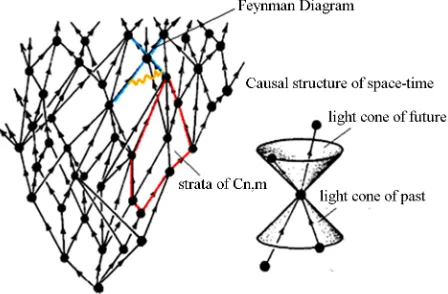
Considering a space of configuration equiva- lent to the complex given for composed for hypercubes defined by 00 boxes, we can define a network of paths that will be able to establish routes of organized transformations on diagrams of Feynman type (with path integrals with actions given by
and path integrals as given in (11)) which will es- tablish the ideal route of the intention, considering the action in every node of the network. Then these ar- rangements can happen in the networks designed on a field of particles that can be arranged in boxes [16], where the action can be calculated in a point (node of the crystalline network of a field [17]) corresponding to the n-states of energy
,
n, m
C
000 0
,C M
0 0 -
n
-,
c
O
U,
-i
i1, 2,3, , ,
Principle 3. The nanotechnology is a science of the organization of nano-components of the matter, space or energy with quantum intention.
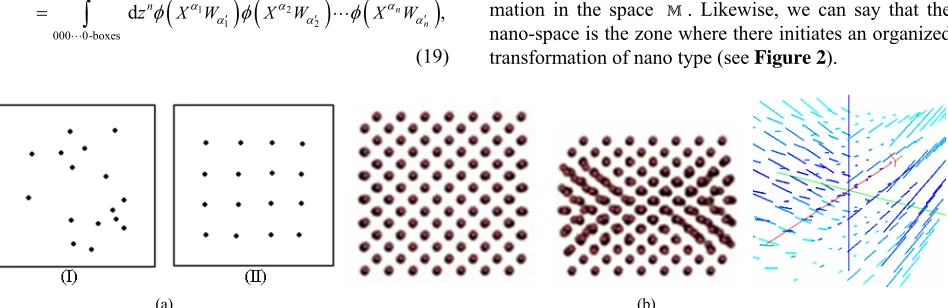
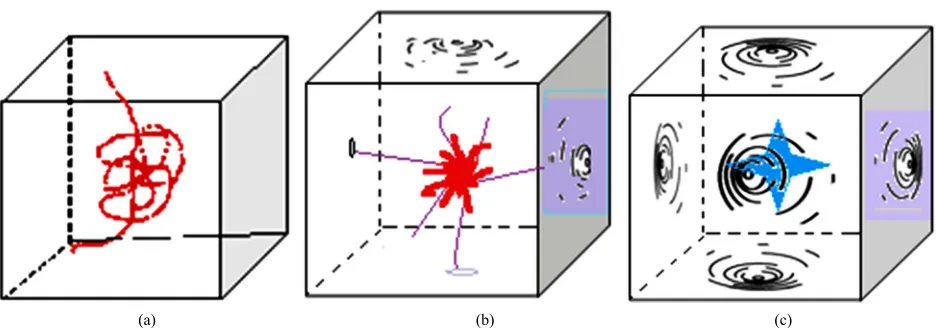
Example 1.1. The nano-components of different ob- jects are the same, the only thing that changes is the ar- rangement of their atoms to form particles or molecules to create the different objects and realities in the space-time M (see Figure 1).
n super- posed near the node for
1
2
1 2
U
000 0-boxes
d n
n
n X W X W X W
x
z
,
(19)
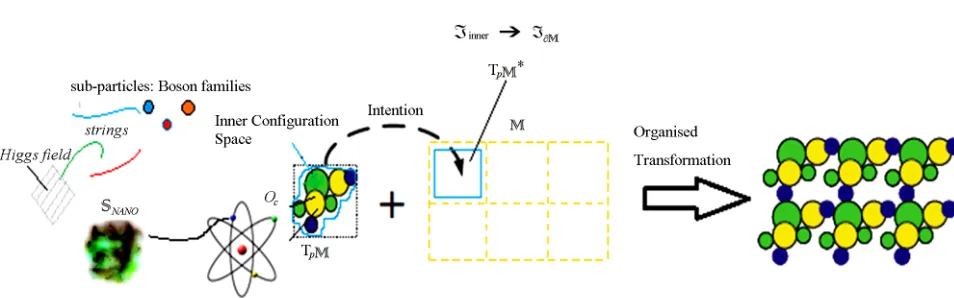
Example 1.2. The intention of an action takes implicit the atomic visualization of every nano-component. Likewise, if p p1, 2, , pnM, are particles with
an finite arrangement of the atoms 1 1 NANO
n
, ,
a a ,am ,
i
S
m SNA
n
given by a struct Cn m, , (configuration
spa in M), which considers configurations fro NO,
up to the particles of the material reality M, the in- tention fro NO, generates the organised transfor-
mation in the space . Likewise, we can say that the nano-space is the zone where there initiates an organized transformation of nano type (see Figure 2).
ure C
MNA S
M
ce m
(a) (b)
Figure 1. (a) Nano-components; (b) Field. (a) The preservation of the measure of the energy process in the nano-components is given for their invariance. The ensemble of the nano-components is realized without energy invariance. This demonstrates that the supported action in all nanotechnological process is the showed by the figure (I) remember that the object obtains their finished transformation in an established limit (Figure 3). (II) The action of the field is expanded to the whole space achieving that the showed configuration in (I), is transmitted to the whole space, object of the transformation in continuous form. This continuous transformation involves a homomorphism between the space of configuration and the space-time that characterizes the continuous map to the nanotechnological transformation. In the given simulating in (I), has been considered a field XVectorPlot3D
2 , 4x x, x2 ,
whose expansion in is the incise (II). The expansion preserve volume of matter, that is to say the volume of particles set that is transformed remains invariant.3
,
[image:5.595.63.537.469.623.2]Figure 2. The intention infiltrated by the conscience given for O ,c establishes that the differential of the action d
h (using the energy (amplitude) that their propagator contributes O ) can be visualised inside the configuration space through F their boarder points (“targets” of the intention of the field X, and that happen in M), being also the interior points of the space M, intM, are the proper sources of the field (particles of the space M, that generate the field X). Then the intention of the field X , is the total action T M
intM
.We consider the following postulate:
Postulate 1. Infinitely big is contained in infinitely small. It allows comprising the cause of any observable effect.
Due to the postulate 1, the measurement of a process of nanotechnology is realized according to their capacity of ensemble of the nano-components (particles) under an energy condition, that is to say, for every time s, of the particles x s
, a map exists0
:
t
T H H , (20) with rule of correspondence
x Ts
x
, (21) that for a sustainable period of time and considering their operator it had that the supported action satis-fies
,
T ,
c
O
0
1
lim d ,
c t
T
O T T T O Tc s s
(22)We will see eventually that a , is always associated with a measure ,
1,
on energy region space with so that
,
E
J H
JE
d
Ec c
J
O O s ,
(23)Thus the limit given in (22) exists for each fixed ,
and is independent of JE,then there is a measure ,
on JE, so that
0
1
lim d d ,
E
T
c s c
T
J
O T s O
T
(24)The measure , has a very important property. Let ,
be fixed and suppose JE, the characteristic func- tion of a measurable set FJE, then
1 1
0
0
0
1 d
1
d 1
d ,
u v u
T
T F
T
T F v
T
F u v
s T
T s
T
T T s T
so if the limT,exists, then (Tu1F) F ,
,
T
that is,the measure is invariant. Then we say that is measure preserving (see Figure 1).
The volume conservation of particles is the conserva- tion of the flow of particles FluxOc,in then we have the following invariability principle of the meas- urement in any nanotechnology process:
,
H
Principle 4. In any nanotechnological process there is preserved the measurement of volume of the set of parti- cles led by c of the region of space-time that is trans-
formed. There must not be losses of volume.
,
O
Example 1.3. In the Hamiltonian formulation of clas- sical mechanics, the position and momentum of a system are described by the points of the cotangent bundle
. Likewise, this is a symplectic manifold in a natu-ral way. The physics aspects of the system are described by a so-called Hamiltonian function and the evolution of the system is given by the flow of the Hamiltonian vector field
T *M
: T * ,
H MR
, H
X associated to H, satis- fying the Lioville integration theorem [1,18].
In the results of this paper, this property will be dis- cussed as fundamental in the nanotechnological chore.
2. Intentionality
We consider 3It,
M R the space-time of certain
the movement of the set of particles in , of such way that the energy conservation law is applied for the total action of each one of their particles. The movement of all the particles of the space , is given geometrically for their tangent vector bundle . Then the action due to
on , is defined like [1]:
M
,M
T
: TM M
,
L M
, L
R (25) with rule of correspondence
x s
x s
Flux
E
L
x s (26) and whose energy due to the movement is
, L
(27) But this energy is given from their Lagrangian
defined like [19]
T , ,L C M R
, ,
T
,
, ,
L x s x s s x s ,x s s V x s x s s ,(28) If we want to calculate the action defined in (13) and (14), along a given path x s
,
we have that the action is
, ,
L x s s
s d ,s
M
x
T *
(29) If this action involves an intention (that is to say, is an intentional action) then the action is translated in all the possible field configurations, considering all the varia- tions of the action along the fiber derivative defined by the Lagrangian L. Of this way, the conscience operator is the map
: T ,
c
O M (30) with corresponding rule
0,d ds
c s
O v w L vtw (31) That is, , is the derivative of , along the fiber in direction c
. In the case ofO v w
w
L
,x s
and
s ,qx q M,L
q, E V 1 2, V q
,
we see that O vc
,T *
M
w ,
M
w , so we recover the usual map (with b, Euclidean in ) as- sociated with the bilinear form
s : Tb 3
R , . Is here where the spin structure subjacent appears in the momentum of the particle x(s).
As we can see, , carries a canonical symplectic form, which we call
T *M
. Using we obtain a closed two-form L, on TM, by setting [12] Oc,
*L Oc ,
(32) Considering the local coordinates
i,i
, to L,modeling the space-time , through spaces, we have that (32) is M
H
2 2
d i d j d i d j,
i j i j
L L
L
(33)
Likewise, the variation of the action from the operator
d ,
c
O L d , is translated in the differ- ential
d
d ,
d
L L
h s s
t
h s sd , (34) where h s
: TM, and is such that Mh , and h x
1 h x
2 0, to extreme points of ,
1 ,x s q and x s
2 q. The total differential (34) is the symplectic form L, that constructs the application of the field intention expanding coordinates in (20). The space2n
1 ,
X is the space of differentiable vector fields on
, and is the manifold of trajectories (space-time of curves) that satisfies the varia- tion principle given by the Lagrange equation that ex-
,
presses the force F
x s
j
,
j1, 2, , n
generated by a field that creates one “conscience” of order given by their Lagrangian (to see the Figure 1(a)).The operator is an operator that involves the La- grangian but directing this Lagrangian in one specific fiber (direction) that is to say, prefixing that Lagrangian action in one direction. We remember that said map:
have rule of correspondence ,
c
O
,
M
: T T *
c
O M
c
wO v w, where w L v
, with the classic Lagrangian. This defines the quantum conscience. If we locally restrict to that is to say, on the tangent space, L ,
c
O T ,
TxM xM x M
, we have that [12]
locally
: T T T T ,
c x x
O M M M M* (35)
with rule of correspondence
v w, ,
O v wc
,c
O v w generalises the means of
, Tc L v v xM,
O v v x
. Likewise, if : T , MR with rule of correspondence
L v
O v
, c
, then the total action along the trajectory
L v v
will be
,
c
O v v L v
36)that is the integral given in (16).
In the forms language, the conscience operator comes given by the map L: TMT * ,M with rule of corre-
spondence given by (32). The quantum conscience shape a continuous flux of energy with an intention, involving a smooth map , (defined in the example 1). Then the conscience operator is related with the action , and the trajectories ,s through of the following diagram
[12]:
C
t
O
M M
R M
T T
*
Proposition 2.1. The diagram (37) is commutative. Proof.Byconstruction and nature of the operator Oc. Consider the following basic properties of the opera- tors Oc. Let O
x x'
,
H [20] defined in the footnote 1,
and where the space H , is the set of points
x
x m m T *
M
H 1
[3], (38)
Points of phase space are called states of the particle system acting in the cotangent space of . Thus, to give the state of a system, one must specify their con- figuration and momentum.
M
Example 2.1 [12]. Let : T *MM, be (like given
by commutative diagram) and :RTCn m, , then
,
R M describes the curve in the configuration space, which also describes the sequence of configure- tions through which the particles system passes to dif- ferent strata of co-dimension one (see Figure 1). Every strata correspond to a phase space of , particles that are moved by curve
m ,
and directed from their energy states d
x by , to , particles n
x This defines our intentional conscience. Then are true the following properties:
1)
x x'
x
x x'
x x x' , 2 MO
2) O x'c
x s
O
x x'
x x' M, and ,s t
3)
HOc
s
dOc;
dOc s dO x sc
,
H
in the unlimited space
4) Oc
s s
, if and only if
x s x s' s s' s t
, then F
x s
x s
,5) (x x' O x s) c
O = F
x x'
x x'
and ,
x x'M ,
s t
6)
Oc
s
d
x x x s
d
x s
H O .
,
All properties are demonstrated in [12], the reader cans to find all details in this reference.
Now we consider the space-time M, like space where
, 3
d t
I d
R
M
is the macroscopic component of the space-time and we called , the microscopic component of the space-time of ratio (length of a string [21]). For previously described the quantum zone of the space-time , is connected with , which we will called virtual zone of the space-time (zone of the space-time where the process and transformation of the virtual particles happens) are connected by possibilities causal space generated by certain class of photons and by the material particles interacting in the material space time, with permanent energy and the material particles re-combining their states they become in waves on hav- ing moved in
F
1033cm
N
, d
t
I
R on any Feynman path. Likewise
we can define the space of this double fibration of quan- tum processing as [12]:
2 2
2
2
, ,
0 , d
c t
c
O x t t C I
t
O x t t
R
L
(39)
with the states , of quantum field are in the quantum zone . Let , the ambi-space (set of connection and fieldM) defined as: N
X, X 0 ,
xy
x y
N ` L (40)
where , is the connection of virtual field X, with the quantum field and is the field whose action is always present to create perceptions in the quantum zone connected with
,
Y ,
(2-form) [22]. Then we can create the correspondence given by the double fibration [16]:
(virtual zone of
the space-time)N M
(quantum zone of the space-time) (space of processing of quantum particles) L
π θ
(41)
This double fibration conforms the interrelation be- tween M, and N . x t
M, give beginning to aubmanifold (that represents the spaces where are the quantum hologram) that includes all these quan- tum images given by quantum holograms, why? Because these complex submanifolds, considering the causal structure given in the space-time by the light cones [23], of all trajectories that follows a particle in the space-time [16], they can write using (41) as:
complex s
1The corresponding cotangent space to vector fields is:
1 1
X M H X M X1 M
Here * , T n m.
m C
2In the general sense the functional derivative
,
a n
ba b
y
y x x
implies
ba x
n d ,
b a
a
y y x x
but does not imply
n .
b y ba y x a x
1 ,
x x
(42)
of N , such that 1 1,which by space-time
P P
properties to quantum level represents the space of all light rays that transit through
x
,
conforming a hyper- surface (projective surface) that is a light surface. This surface is called the skyx
[24]. A sky in this context represents the set of light rays throughx
(bosons) that comes of the virtual field.If 4, then
C
M MMQx,is the complete uni-
verse (include the super-symmetries [25]). But, what is there of our quantum universe with regard to our real universe (included the material part given by the atoms)?
The answer is the same, we have an universe of ten dimensions and where the quantum rep- resentation of the object
,
M N M
,x s is the quantum space-time R3It
,
M
2
(which is the space-time as the Einstein perception) then the images of the virtual parti- cles are C Qx [11], then the execution operator that proceeds to connect virtual particles through the paths which have path integrals on a double fibration, establishing the material-quantum-virtual connection required to a total reality:
,
I
N M
L
π θ
M C
`
σ ρ
(43)
where is the material part connected with the quan- tum zone of the space-time (space taken by atoms) . The corresponding path integral that connects virtual particles in the whole fibration is the integral of line type (5) defining feedback connection:
,
C
M
1
1
,x x s Oc x s
I Q
(44)
always with the space
x s
M x N
, to the permanent field actions. Then the reality state is the ob- tained through the integral of perception (44), consider- ing the fibre of the corresponding reality in the argument of the operator Oc, of the integrating from (44).Proposition 2.2. All transformation of a reality in- cludes bosons of the N field.
Proof. To demonstrate this, is necessary to prove that the cohomological group on , is the same coho- mological group modulus a seated class in , of the material reality and the corresponding for the quantum reality. For it result useful the stacks concept in physics, where is possible to tack bosons to construct superior physical spaces using bosons branes (see corollary of [26]). On the other hand, any open numerable covering of bosons in , contains a finite subcovering in , which is guaranteed by the sky .
N
N
N M
x
Q But a sky in this context represents the set of light rays through x (bosons) that comes of the virtual field.
In a plane of reality of the space N
a commutative diagram similar to the given in (37), con- sidering fibers of the topological space sky
, we can establish
x
Q hat at all times do that the integral submanifolds in
L
(through of the double fibrations of (59)) connect both realities determined in , and , along these sub- manifolds:, t
N M
T *
g
L PTM*
M M
(45)
where
1
0 ,
L with
T O 1
L P M* ,1 , where O
1,1 , is a ho-mogeneous bundle of lines due to that the sky since the normal bundle
1 1,
x
Q P P NQx, in
every sky Qx; is isomorphic to
1 1,1 .
J O In particular there is an exact sucession
1
0 O 1,1 NO 1, 1 0, (46)
which allows to have a composition of the reality in , through fields that come of Then the quantum - virtual composition of both realities is given by the moduli stack:
M
.
N
3. Intention Transmission and Introspection
Considering the quantizations of our Lagrangian system describe in (17), (31) and (32) on n,n2 coordi-R ,
nated by
xj , we describe terms of a graded commu-tative C
M algebra ,H with generating elements
, , 1 2, , 1 2 k,
a a a
x x x x
a , (47)
and the bi-graded differential algebra of differen- tial forms (the Chevalley-Eilenberg differential calculus [4]) over
*,
H
0,
of generating elements (44) of H, as being sui generis coordinates of even and odd fields and their partial de- rivatives. The graded commutative R-algebra H0, is provided with the even graded derivations (called total derivatives) 1 0 , k a a
d d d d
(48)where
1k
, k, and
, 1k
,are symmetric multi-indices. One can think of even ele- ments
0
, d ,x
d d
( 1) d d
a n
a n
a
a n
q
L x x
L x x
d ,
x L x
L E (49)where we observe that L, is the 2-form given by L,
in the formula (33) with n2, and 1 2.
Now we consider the dual part of the space
H,
, that is to say, the space
H L*,
.
n RWe con- sider quantize this Lagrangian system in the framework of perturbative Euclidean QFT. We suppose that is a Lagrangian of Euclidean fields on The key point is the algebra of Euclidean quantum fields
, L B . , given as H0, the graded commutative. It is generated
by elements a
x , x
. For any x
,there is a homomorphism belonging to the space
T ,
,HHom H D
T ,
,(with homomorphisms
HHom H D given for -algebra of cy-
cles): DG
a a
1 1
1 1
1 1 1
1 1 1
:
, C
r r
r r
a a
x a a
a a x
x x x I
rr
r r r r a a x I I (50) of the algebra H0, of classical fields to the algebra
which sends the basic elements
,
B xaH0, to the
elements a and replaces coefficient functions
of elements of
,
B
,
I H0, with their values I
x (exe-cutions) at a point x. Then a state , of is given by symbolic functional integrals B,
1 1 1 1 1 exp d k k k k a a x x a n O x d , a a x x ac x x
x N
H (51)where this is an integral of type
,
cO x s d
H
as was given by the properties. Then when the intention expands to the whole space, infiltrating their information on the tangent spaces images (map (35)) of the cotangent bundle T * ,M (given by the imagen of
x under) then their intentionality will be the property of the
dOc
field to spill or infiltrate their intention from a nano level of strings inside the quantum particles. Then from the energy states of the particles, and considering the inten- tion spilled in them given by Oc
, we have the homomorphism (50) that establishes the action from
,
M to M, for their transformation through
the action T, defined in (28) to any derivation given
through their conscience operator (fiber (31)), like the graded derivation , (considering the derivatives
c c
O x O * , DF d):
: , , , c c cx x O x
O x O
x a x L a a (52)
of the algebra of quantum fields . With an odd pa- rameter α, let us consider the automorphism
,
B
ˆ exp ,
U Id
of the algebra B, This automorphism yields a new
state , , of B, given by the equality
1 1
1 1
1 ˆ ˆ
ˆ ˆ
exp d d ,
k k
k k
a a
a a
x x x x
a n a
c x x
x
U U
N
O U x U
( H (53)where the energy state has survived, since
ˆ
d a d a
x x
U . That because the intention is the same. The intention has not changed.
What happens towards the interior of every particle? What is the field intention mechanism inside every parti- cle?
To answer these questions we have to internalise the actions of field X, on the particles of the space , and consider their spin. But for it, it is necessary to do the immersion of the Lagrangian
M
, defined as the map
2n,
L M 3
with rule of correspondence
i i
Z Ζ
where the image of the 1-form , that the Lagrangian defines,
i , is a symplectic form [1], and the vari- able Ζi is constructed through the algebraic equations
a
W Ζi [28]. They describe the dimensional hypersurfaces denoted by such that where
-k S
S H
3Having chosen
is to consider the two components of any point
2n,
M
in the space (that we are considering isomorphic to the ambient space of any quantum particle
,
N
C
x s , in the space-time) to have the two components that characterise any quantum particle x s , that is their spin (direction) and their energy state (density of energy or “liv-ing force of the particle”). , is the correspond“liv-ing Lagrangian sub-manifold of the symplectic structure given by
L