© 2017, IRJET | Impact Factor value: 5.181 | ISO 9001:2008 Certified Journal
| Page 235
Analysis of Thermal Efficiency of Bio Ethyl Ester of Karanja, Jatropha
and Kusum in Compression Ignition Engine
Subhash Gautam
1, Mahesh Sanadaya
21
Student, M-Tech, Mechanical Engineering, SIT, Mathura, Uttar Pradesh, India
2
Assistant Professor, Department of Mechanical Engineering, SIT, Mathura, Uttar Pradesh, India
---***---Abstract -
Biodiesel is derived from triglycerides bytransesterification has attracted considerable attention during the past decade as a renewable, biodegradable and nontoxic fuel. Several processes for biodiesel fuel production have been developed. In India, non-edible oils like Jatropha oil, Karanja oil and Kusum oil are available in abundance, which can be converted to biodiesel. In the present studies, biodiesel has been prepared from Jatropha, Karanja and Kusum oil., It can be converted to biodiesel by transesterification process. The density of ethyl esters is found to be comparable with that of diesel fuel
Key Words
:
Diesel Engine, Bio-Diesel, Jatropha Oil,
Kusum Oil, Karanja Oil.
1.INTRODUCTION
India’s demand for diesel fuels is roughly six times that of gasoline hence seeking alternative to mineral diesel is a natural choice. Alternative fuels should be easily available at low cost, be environment friendly and fulfill the energy security needs without sacrificing engine operational performance. For the developing countries, fuels of bio origin provide a feasible solution to the twin crises of fossil fuel depletion and environmental degradation. Now befouls are getting a renewed attention because of global stress on reduction of greenhouse gases and clean environment. The fuels of bio-origin may be alcohol, vegetable oils, biomass and biogas. Some of the fuels can be used directly while others need to be formulated to bring the relevant properties close to conventional fuels. Vegetable oils have comparable energy density, cetane number, heat of vaporization, and stoichiometric air/fuel ratio with mineral diesel fuel [1]. Biodiesel has been touted far and wide for its renewable properties. Instead of making a fuel from a finite resource such as crude oil, Biodiesel can be produced from renewable resources such as organic oils, fats. This means that it can be made from things that can be regrown, reproduced, and reused. So, if you need more, you can just grow another crop of seeds for the oil.
When Biodiesel is made from organic oils such as jatropha, Karanja, kusum, or other domestically grown seed crops, it helps the farming community out. Because the oil used to make Biodiesel is "domestically grown", it keeps the money flowing to those that "grow" the feedstock. This continues to
help out the renewable aspect of Biodiesel because this means more seed crops can be grown by local farmers. When Biodiesel is used in place of petro diesel, it reduces the amount of crude oil used up. This means that it helps to reduce our dependence on a limited resource and increases our use of renewable resources. We think that's a great step toward reducing our dependence on a fuel that may not be around forever.
1.1 Karanja Oil
[image:1.595.325.547.434.584.2]Pongamia pinnata is commonly known as karanja in the north and eastern states of India. A single tree yields 9–90 kg seed per tree, indicating a yield potential of 900–9 000 kg seed/ha (assuming 100 trees/ha), 25% of which might be rendered as oil. In general, Indian mills extract 24%–27.5% oil, and the village crushers extract 18%–22% oil [1].
Fig -1: Leaves and Fruits of Karanja
1.2 Jatropha Oil
Jatropha curcas also known as ratanjyot. The leaves are green, 10-15 cm in width and length. The shape of fruits having an ellipsoidal. Each fruit is about 40 mm long and contains three seeds. It takes three to four months after the flowering for the seeds to mature. The seeds are black, measuring on average 18 mm in length, 12 mm in width, and
10 mm in thickness.The seeds weigh between 0.5 and 0.8
grams and the average number of seeds per kilo is 1375
© 2017, IRJET | Impact Factor value: 5.181 | ISO 9001:2008 Certified Journal
| Page 236
Fig – 2: Fruits and seeds of Jatropha1.3 Kusum Oil
The botanical name of kusum is Schleichera olcosaand
the potential of kusum oil is 66000 tons per year in India, out of which 4 000 to 5 000 tones are collected. It is a medium to large sized, dense tree growing to 35 to 45 feet in height. It mainly occurs in sub-Himalayan tracts in the north, central parts of eastern India. The flowers come from February to April and yields fruit in June and July. The fruits are smooth, hard skin berries contains one or two irregularly ellipsoidal slightly compressed seeds. The brown seed coat is brittle and breaks at a slight pressure to expose a ‘U-shaped kernel. The oil content is 51%–62% but the yields are 25%–27% in village gains (oil mills) and about 36% oil in expellers [1]. The weight of 1000 seeds is 500-700 g. Schlichera oleosa evergreen trees with the height up to 30 m and the girth up to 3 m. The leaves are paripinnate, 20-40 cm long [7].
Fig – 3:Tree and Fruits of Kusum
2. MATERIALS AND METHODS
Bio-diesel is fatty acid ethyl ester made from virgin or used vegetable oils (both edible & non-edible) and animal fats. The main commodity sources for bio-diesel in India can be
non-edible oils obtained from plant species such as Schleichera olcosa (kusum), Pongamia Pinnata (Karanja), Jatropha curcas (RatanJyot) etc.
2.1 Preparation of biodiesel from Karanja Oil
Biodiesel is a methyl ester formed by a process called Transesterification. Oil can be extracted from seeds of Karanja with a simple mill (as used for mustard seeds). The Karanja oil reacted with Methanol in the presence of a catalyst to yield methyl esters and glycerol. Sodium Hydroxide (NaOH) and Potassium Hydroxide (KOH) are
commonly used catalyst. Heat the oil at 600C. Dissolve
Sodium Hydroxide tablets in methanol to make solution. The quantity of NaOH and methanol should be 2.5% and 10%, respectively of the total quantity of Karajna oil. After mixing this solution into hot Karanja oil, the solution should be stir for 5 to 7 minutes. Then keep the solution undisturbed at least 4 hours. Glycerol being heavy will slowly settle down at the bottom and biodiesel can be easily separated from the top. To strain the impurities like sodium, give this oil 2-3 washing with water. Add water to the oil and after 5 minutes collect the oil floating on surface. Repeat this process and then finally heat the oil to evaporate the water. The biodiesel is no now ready to use [2].
2.2 Preparation of biodiesel from Jatropha Oil
Biodiesel was prepared with methanol and ethanol each with different reaction conditions. With methanol, the experiment was conducted with optimum molar ratio (6:1) keeping the catalyst concentration (1% NaOH), reaction temperature (65°C) and reaction time (1 hour). With ethanol, the experiment was conducted with optimum molar ratio (8:1) keeping the catalyst concentration (1% KOH), reaction temperature (70°C) and reaction time (3½ hour) [4,6]. The required amount of jatropha oil was filtered, measured with measuring cylinder and then it was poured into the three necked round-bottomed flask. The jatropha oil was heated to the required temperature by using the electric mental. Alkoxide solution was prepared while the jatropha oil was heated. The prepared alkoxide solution was introduced into the reaction vessel and it was mixed vigorously during the reaction. When the required reaction period reached, the reaction was stopped, and the mixture was settled in the separating funnel for 12 hours or overnight. After the mixture was settled for 12 hours, the mixture was separated into two layers. The bottom layer is crude glycerine and it can be drawn off simply from the bottom of the separating funnel. The biodiesel layer was purified by washing with warm water to remove methanol, residual catalyst and soaps. Before washing process, the pH of the biodiesel layer was measured and phosphoric acid was added to the biodiesel layer to neutralize the catalyst residue. After neutralization process, the washing process of
biodiesel was started. During the washing process,gentle
[image:2.595.52.270.498.667.2]© 2017, IRJET | Impact Factor value: 5.181 | ISO 9001:2008 Certified Journal
| Page 237
of the layer for 30 minutes, the wash water layer wasdrained off from the bottom of the separating funnel. The washing process was repeated until the ester layer became clear. After the washing process, it was required to measure
the pH of the biodiesel layer.When the pH of the biodiesel
layer reached 7, the washing process was completed.After
washing process, the biodiesel was introduced to the sand filter and salt filter. The end product, biodiesel was obtained as a clear amber-yellow liquid with a viscosity similar to that of petrodiesel [5,6].
2.3 Preparation of biodiesel from Kusum Oil
Bio-diesel is produced by transesterification which is a process of using either ethanol or methanol, in the presence of a catalyst, such as potassium hydroxide or NaOH, to chemically break the molecule of an oil or fat into an ester and glycerol. This process is a reaction of the oil with an alcohol to remove the glycerine, which is a byproduct of bio-diesel production. The reactor for producing biobio-diesel from Schlichera oleosa oil is a small batch type reactor. The first
we are taken pretreatment oil temperature is 50-550C. The
products of the first stage pretreatment oil are used as the input of the alkaline Transesterification process. A molar ratio of 6:1 and 10grms by weight of potassium hydroxide (KOH) is found to give the maximum ester yield. The
reaction time is maintaining 2hr at 600C. After the reaction is
completed, the products are allowed to separate into two layers. The lower layer contains impurities and glycerol. This top layer (ester) is separated and purified using distilled water. Hot distilled water (20% by volume) is sprayed over the ester and stirred gently and allowed to settle in the separating funnel. The lower layer is discarded and upper layer (purified biodiesel) is separated. Transesterification of the oil produces methyl esters (biodiesel) and glycerol. The methyl ester layer is a light yellow liquid that is on top or bottom of the glycerol layer, which is dark brown in color. The mixtures may be kept overnight and allowed to separate by gravity. Otherwise, the methyl ester is separated from the glycerol and washed with water and acetic acid until the washing water is neutral. The methyl ester is then dried by heating. Materials and energy flows for the transesterification of Schlichera oliosa seed oil into biodiesel [7].
3. EXPERIMENT
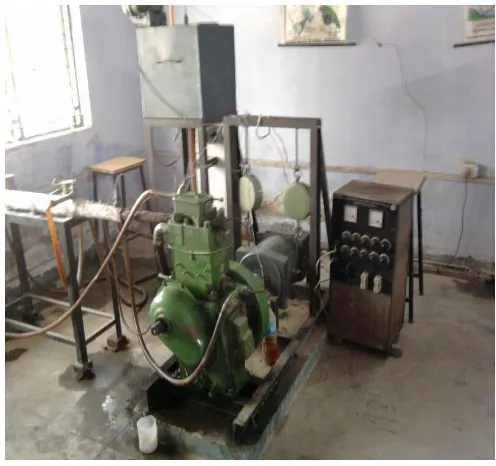
Engine Specification
Engine Kirloskar (AV1-5.0)
Make & Type Single cylinder,
Four Stroke, Water Cooled, Vertical Engine
Bore 80 mm
Stroke 110 mm
Displacement volume 553 cc
Compression ratio 16.5:1
Rated output at 1500 RPM 3.7 KW (5.0 H.P.)
3.1 Formula Used
Break Power KW
Where
T = g(S1-S2)L N-m N = Engine speed in RPM T = Torque in N-m S1&S2 = Spring balance
Specific Fuel Consumption gm/KW-h Where
m = Fuel in gm B.P = Break power
Fuel Consumption = gm/sec Where
t = time in sec m = Fuel in gm
Indicated Power = KW Where
cv = Calorific value of fuel used in KJ/Kg m = Fuel in gm
t = time in sec
Thermal Efficiency = X100 % Where
B.P = Break power t = time in sec m = Fuel in gm
[image:3.595.312.560.503.736.2]cv = Calorific value of fuel used in KJ/Kg
© 2017, IRJET | Impact Factor value: 5.181 | ISO 9001:2008 Certified Journal
| Page 238
Table -1: Fuel Specification4. RESULT AND CONCLUSIONS
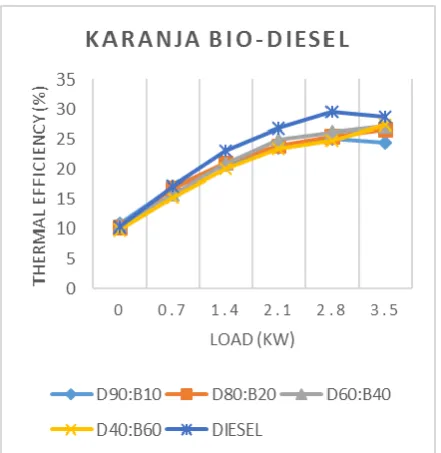
The Performance of Biodiesel blends at different loads is different but some blends give better performance than Diesel at same load.
Karanja biodiesel is efficient than diesel at no load condition at D90:B10 ratio.
Jatropha biodiesel is efficient than diesel on 0.7 KW, 2.1 KW at D80:B20, D90:B10, ratio respectively. And at 2.8 KW it is better than karanja and kusum biodiesel but lesser than diesel.
Kusum biodiesel is efficient than diesel on 1.4 KW, 3.5 KW at D60:B40, D90:B10 ratio respectively
Chart – 1: Performance of thermal efficiency with load (KW) of Karanja biodiesel blends.
Chart – 2: Performance of thermal efficiency with load (KW) of Jatropha biodiesel blends.
Chart – 3: Performance of thermal efficiency with load (KW) of Kusum biodiesel blends.
Thermal efficiencies of jatropha, karanja and kusum biodiesel shows their performance according to blends ratio
with diesel at different loads (in KW) in charts
.
Fuel Density
(gm/cm3)
Calorific value (KJ/Kg)
Diesel [8] 0.8227 41840
Jatropha [9] 0.8667 39230
Karanja [10,11] 0.8700 36577
© 2017, IRJET | Impact Factor value: 5.181 | ISO 9001:2008 Certified Journal
| Page 239
Table -2: Density and calorific value of Karanja biodieselFuel Karanja
Fuel Bled (gm/cmDensity 3)
Calorific value (KJ/Kg)
D90:B10 0.82743 41313.7
D80:B20 0.83216 40787.4
D60:B40 0.84162 39734.8
D40:B60 0.85108 38682.2
Above table shows the density and calorific value of Karanja biodiesel at different blend ratio.
Table -3: Density and calorific value of Jatropha biodiesel
Above table shows the density and calorific value of jatropha biodiesel at different blend ratio.
Table -4: Density and calorific value of Kusum biodiesel
Fuel Kusum
Fuel Bled (gm/cmDensity 3)
Calorific value (KJ/Kg)
D90:B10 0.82663 41156
D80:B20 0.83056 40472
D60:B40 0.83842 39104
D40:B60 0.84628 37736
Above table shows the density and calorific value of kusum biodiesel at different blend ratio.
Table -5: Comparison of thermal efficiency between biodiesel blends and diesel
Load
(KW) Biodiesel Ratio Best Best Thermal Efficiency
Diesel Biodiesel
0 Karanja D90:B10 10.3549 10.7916
0.7 Jatropha D80:B20 17.1321 18.1578
1.4 Kusum D60:B40 23.0588 23.2927
2.1 Jatropha D90:B10 26.9260 26.9784
2.8 Jatropha D90:B10 29.6103 28.5884
3.5 Kusum D90:B10 28.7739 28.8247
Above table shows the comparison of thermal efficiency between biodiesel blends and diesel with load and ratio.
CONCLUSION
The main aim of the present experiment was to use the non-edible oil like jatropha, karanja and kusum oil in diesel engines. We reduced the oil density close to that of diesel without using any external power source and evaluating the performance of engine with the modified oils. The density of jatropha, karanja and kusum oil was reduced by transesterification process. It was found that in the above cases the density was close to that of diesel –which would be suitable for the engines. The performance tests were conducted with diesel, From the experimental investigation it was concluded that the performance of jatropha, karanja and kusum oil is similar to that of diesel, without any operational difficulties. In comparison to each oil defined below.
Jatropha biodiesel shows best performance between 0 KW – 1.4 KW, 3.5 KW with D80:B20 ratio and on 2.1 KW-2.8 KW with D90:B10 ratio.
Kusum biodiesel shows best performance between 0 KW-2.8 KW with D60:B40 ratio and on 3.5KW with D90:B10 ratio.
Karanja biodiesel is one which is give its performance increasing in order with increasing loads and blends ratio. It gives best at 0 KW-0.7 KW with D90:B10 ratio, at 1.4 KW with D80:B20 ratio, at 2.1 KW-2.8 KW with D60:B40 ratio and at 3.5 KW with D40:B60 ratio.
REFERENCES
[1] S K Acharya, A K Mishra, M Rath, C Nayak, “Performance
Analysis of Karanja and Kusum Oils as Alternative Bio-Diesel Fuel in Bio-Diesel Engine,” Int J Agric & Biol Eng June, 2011 Vol. 4 No.2 issn.1934-6344.
[2] R.S. Kureel, C.B.Singh, A.K.Gupta,Ashutosh Pandey,
“Karanja a potentioal source of biodiesel, national oilseeds & vegitable oils,” Development board ministry of agriculture, govt. Of india, may 2008.
[3] Lisa Axelsson Maria Franzén, “Performance of Jatropha
Biodiesel Production and Its Environmental and Socio-Economic Impacts,” Department of Energy and Environment Chalmers University of Technology Göteborg, Sweden, 2010 Report No. FRT 2010:06.
[4] P.Suresh Kumar, Ramesh Kumar Donga, P.K. Sahoo,
“Experimental comparative study between performance and emissions of jatropha biodiesel and diesel under varying injection pressures,” International Journal of Engineering Sciences & Emerging Technologies, August 2012. Volume 3, ISSN: 2231 – 6604.
[5] V. B. Shambhu1, T. K. Bhattacharya, L. K. Nayak and S.
Das Senior Scientist, “Studies on Characterization of Raw Jatropha Oil and its Biodiesels with Relevance of Diesel,”
Fuel Jatropha
Fuel Bled (gm/cmDensity 3)
Calorific value (KJ/Kg)
D90:B10 0.8291 41579
D80:B20 0.8315 41318
D60:B40 0.8403 40796
© 2017, IRJET | Impact Factor value: 5.181 | ISO 9001:2008 Certified Journal
| Page 240
International Journal of Emerging Technology andAdvanced Engineering April Volume 3,2013 ISSN
2250-2459.
[6] Tint Tint Kywe, Mya Mya Oo, “Production of Biodiesel
from Jatropha Oil (Jatropha curcas) in Pilot Plant.” World Academy of Science, Engineering and Technology 26 2009.
[7] Mallela Gandhi,N. Ramu and S. Bakkiya Raj, “Methyl
ester production from schlichera oleosa,” IJPSR, 2011; Vol. 2(5): 1244-1250 ISSN: 0975-8232.
[8] High Speed Diesel / Gas Oil Indian Oil Diesel meets the
requirements of IS 1460:2005 (5th revision).
[9] Wilson Parawira, “Biodiesel production from Jatropha
curcas: A Review,” Scientific Research and Essays Vol. 5(14), pp. 1796-1808, 18 July, 2010 ISSN 1992-2248.
[10] Karikalan and M. Chandrasekaran, “Karanja oil
biodiesel: a potential substitution for diesel fuel in diesel engine without alteration.” ARPN Journal of Engineering and Applied Sciences VOL. 10, NO. 1, January 2015 ISSN 1819-6608.
[11] Bobade S.N. and Khyade V.B. Indian “Biodiesel
Corporation, Baramati Detail study on the Properties of Pongamia Pinnata (Karanja) for the Production of Biofuel,” INDIA Research Journal of Chemical Sciences
Vol. 2(7), 16-20, July (2012)ISSN 2231-606X.
[12] S.K.Acharya, M.K.Mohanty R.K.Swain, “Kusum Oil as a