Abstract— Some trends in computer science argue that home appliances should react to other embedded technology present in peoples’ devices. But these approaches rely on the information predefined by the users on their wearable devices, and this information in occasions, not updates as user preference change. For thus, this paper is devoted to evaluating and developing a set of technologies with the objective of designing a methodology for the implementation of home lighting control by considering user’s preference. Using such information, the methodology will be capable of predicting how adequately modify the intensity of the lights in a determined room of a house depending on each habitant. To do that, a case-based reasoning approach is proposed. The Manhattan distance measure is selected to recovery the most similar case from the case base. Moreover, an inductive decision tree (ID3) technique was running in the decision making of the model to reach the most fitted option for the studied problem. Two cases of study were performed to validate the suitability of the proposed approach. For each study, four diverse type of users were modelling. The results show that ID3 was able to predict all type of user preference with an average performance of 98% in a set of 10,000 proves. In fact, the model achieved stability after 3,500 experiments. The proposed approach can achieve suitable and trustworthy solutions to the preferences of users belonging to completely different lifestyles. Finally, some conclusions are presented, emphasizing the advantages of using ID3 in the intelligent home decision making.
Index Terms— Human-centered computing; Intelligent Home; Intelligent Environments; Ubiquitous Computing; Machine Learning
I. INTRODUCTION
urrently, intelligent environments are becoming more integrated into everyday life, making intelligent homes, reality. There are some issues related to design non-intrusive intelligent environments human-centered with a high efficiency and energy optimization. Despite of such efforts, in the state of the art, there are several studies that address some of these problems. For instance, [1] proposes a methodology based on a hidden-Markov model for the smart home environment to predict energy consumption, environment parameters and moving (presence) cases. The proposed prediction technique was tested and provided a A. H. Garcia is a PhD Student at the Autonomous University of Tamaulipas, Mexico.
S. Ibarra, J. A. Castán, J. Terán, J. Laria, M. G. Treviño and J. Perez are members of the Computer Technology Group at the Engineering School at the Autonomous University of Tamaulipas, Mexico. ([email protected]).
E. Castán is professor at the Electric and Electronic Department at the TecNM/Madero Institute of Technology.
high amount of reliability. On the other hand, [2] presents an architecture that centralizes the control of public lighting and intelligent management to economize lighting and maintain maximum visual comfort in illuminated areas. It achieves optimization in terms of energy consumption and cost by using a modular architecture and is fully adaptable to current lighting systems.
However, just some studies consider users´ preferences to design human-centered environments to avoid the mentioned problems (e.g., lighting control) as well as integrate intelligent homes into everyday life. Such as [3], who use Neural Networks to predict the optimum on/off of domestic devices without affecting the lifestyle of the inhabitants of the home, showing that the use of such method for this task is adequate and significantly reduces the energy cost. Similarly, [4] provides the implementation of a software solution that aims to reduce the domestic water consumption according the basic daily activities and needs. This method shows the reduction of the water consumption and it will help the users with decision making according to their needs and will enable them to satisfy many daily tasks without excessive water use.
In the present work, with the intention of tackling the shortage of works related to intelligent homes focused on the users’ preferences, we present the development of a learning model for the lighting control using the case-based reasoning (CBR) methodology proposed by [5], [6] into overcome some of the problems presented in [7] which are:
• It is difficult to extract from experts (humans) the set of laws and regulations that allow us to create an intelligent system.
• The implementation of expert systems is complex. • Once implemented, they tend to be slow and have
problems accessing and managing large volumes of information.
• They are difficult to maintain.
CBR is based on human experiences to solve present problems [8], due prior characteristic, this methodology was selected to develop the introduced learning model. Such methodology has been widely used in the literature. For instance, [9] proposes an approach to support the intelligent management of energy resources in a residential context. Their results show that the proposed approach can suggest appropriate amounts of energy reduction, which result in significant reductions of the energy bill. In the same way, [10] proposes a hybrid recommender system to improve the success rate of a recommender system. The performance of the proposed method was evaluated, and the results indicate that their proposed method is successful.
Improving Smart Homes Performance by
Learning the User´s Preferences
Alejandro H. García R., Salvador Ibarra M., José A. Castán R., Jesús D. Terán V., Julio Laria M., Mayra G. Treviño B., Julissa Pérez C. and Emilio Castán R.
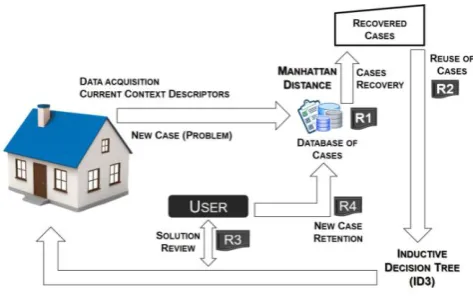
A typical CBR system is composed of four sequential phases (commonly called the 4Rs) that are involved whenever a problem needs to be solved [7], [11], [12]:
R1-Recovery of similar cases. R2-Reuse or adaptation of cases. R3-Review of the proposed solution.
R4-Retention of the proposed solution as part of a new case.
For all these reasons, CBR aims to endow intelligent homes with a mechanism that allows devices response adequately and reliably, making users happier by increasing their comfort and the home services quality. A fact is there are doubts that need to be explained about how to take advantages of the users´ experiences to use that information within the decision-making structure of a specific household appliance. To solve that, the paper proposes the implementation of an inductive decision tree to solve the lamps on/off paradigm. Results depict new metaphors about how the operability of the intelligent homes as a part of the infrastructure in a smart city could be reached. The novelty of this work is its capability of considering the user’s preferences in the lighting control performance without the human noticing it. Since the first efforts developed for the smart home technologies to control home devices by using a sensor network to the recent works in human-centered computer, all they need users concern about their interaction with the household appliances.
This paper presents the development of a novel learning model, as well as the formulation and application of different cases of study used to validate and obtain the average performance of the model. Thus, the remainder of this paper is organized as follows: Section 2 describes the phases of the model development and addresses the application of the cases of study; Section 3 shows the obtained results, and finally, Section 4 presents the conclusions and future work.
II. MATERIALS AND METHODS
The objective of this approach is to develop a methodology capable of learning from human-device interaction (see Fig. 1). Such experience allows people to entrust more and end up accepting this type of technology. To present a first effort, the model was designed to work with the lighting service. In a common house, such service depends on the user preferences. For example, people define the quantity of light based on diverse aspects (i.e., age, situation, emotions, etc.). The lighting service was selected based on the large amount of interactions that users perform with this service throughout day. To represent the operation of the lighting control in a closer human-control way, the model defines two main characteristics:
Description of the application context using measurable attributes that can be represented by a binary vector.
[image:2.595.308.545.69.218.2] Discrete values that reflect user preferences must be the solution to a context.
Fig 1. General Scheme of the Model
To distinguish among the contexts, the cases are grouped so that each one represents a unique context associated with a user and a place in an intelligent home. For thus, a case is constructed by using a binary vector and a scalar:
Vector “Problem” ( ). Binary vector is made up by the attributes that describe a context.
Solution ( ). Scalar that represents the action that the model must perform for a context.
[image:2.595.314.538.435.514.2]For this work, 5 possible values for S (Table I) and 5 attributes for were considered. The possible values of S endow the model the ability to indicate the solution to the different possible contexts by the representation of the users’ preferences, where 0 indicates that the actuator must be off, and the 100, that it is operating at maximum capacity.
Table I. Possible values for the scalar S Possible Values
0 25 50 75 100
Each attribute is associated to a set of labels, a binary equivalent and in some cases to a range of values. Such information allows to differentiate possible states for each attribute. The attributes considered are: The Period (Table II), the Moment of the Day (Table III), the Weather State (Table IV), the Weekday (Table V) and the Luminous Intensity of the Place (Table VI).
The attribute period is relevant to the model because defines the behavior of the inhabitant of a house. Although, it is not the only factor involved in the modification of the human behavior, it is one of the most relevant. For example, a young person modifies the use of its room light based on his class schedule. If he is on vacation, its behavior is seriously altered. The labels definition and their binary equivalent is presented in Table II.
Table II. Attribute "Period"
Name Label Binary
Period Evening 0000010
To know the moment of the day is an essential information for the model because allows to interpret the needs of the users based of the natural conditions of the day and the common human light requirements for such moment. The labels for this attribute and their corresponding ranges where defined according to the normal preferences in Mexico (see Table III).
Table III. Attribute "Moment of the Day"
Name Label Binary Range
Moment of the
Day
Early-Morning 1000000 12am - 5am
Dawn 0100000 5am - 7am
Morning 0010000 7am - 12pm Midday 0001000 12pm - 2pm Afternoon 0000100 2pm - 6pm Evening 0000010 6pm - 8pm Night 0000001 8pm - 12am The condition of weather is considered as a significant attribute for this approach. Indeed, people select lighting intensity considering the environmental luminosity. In some cases, this attribute aims to endow model with information enough to anticipate changes in the lighting control. The Table IV introduces the labels and the binary equivalent of the weather state.
Table IV. Attribute "Weather State”
Name Label Binary
Weather State
Clear 100
Cloudy 010
Rainy 001
[image:3.595.45.292.148.254.2]The fact of identifying the weekday within the model permits generate a structure about the relevance of lighting control in a more detailed way. Normally, the humans group their activities by the type of day. For example, in a common day (i.e., Monday to Friday) a family leaves their home before the 6:30. But in the weekend (Saturday or Sunday) there are many activities in the home during the morning. Table V presents the labels and binary equivalences of the attribute.
Table V. Attribute " Weekday”
Name Label Binary
Weekday
Sunday 1000000
Monday 0100000
Tuesday 0010000
Wednesday 0001000
Thursday 0000100
Friday 0000010
Saturday 0000001
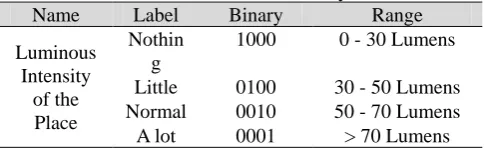
It is necessary to know the lighting intensity in a room to reach a model capable of offering a suitable and comfortable level of light in the surrounding area of a user. To reach that, the model needs to identify the luminous intensity of the specific place where the user is. For experimental reasons, the Table VI shows the labels, the binary equivalences and the ranges values of this attribute. The range of value for each label was proposed in the official Mexican standards described in [13].
Table VI. Attribute "Luminous Intensity of the Place”
Name Label Binary Range
Luminous Intensity
of the Place
Nothin g
1000 0 - 30 Lumens Little 0100 30 - 50 Lumens Normal 0010 50 - 70 Lumens A lot 0001 > 70 Lumens For the database, the attributes associated to each case will be represented following the structure appreciated in (1).
(1) Where:
= Weather State
= Moment of the Day
= Period
= Day of the Week
= Luminous Intensity of the Place The structure of a case will be modified in the reuse phase to facilitate its manipulation; however, it will return to its original form in the retention phase. The following subsections will describe each phase of the methodology. 2.1 Recovery (R1)
This phase is dedicated to recover similar cases that have occurred previously and are stored in the database of cases. Considering statistical comparison of different metrics and measures, the Manhattan Distance is used in this phase. The Manhattan Distance [14] is the sum of all the differences in absolute value of the components of the vectors. This distance is given by the following expression [15]:
(2)
For this measure of similarity, the distance is 0 when both vectors are equal.
There are two types of vectors to carry out the implementation of the Manhattan Distance: contrast ( ) (3), used for the current and comparison ( ) (4), which represents the of one case presented in the database of cases. For each execution of this phase, we have a single and as many as cases in the database ( ) (5). is used to retrieve similar cases from the database using the Manhattan Distance (6), where the recovered vectors ( ) as well as their associated scalar (S) are stored in a separate vector ( ) (7).
[image:3.595.54.282.552.655.2]As a criterion for recovery, we have a 60% of similarity degree; i.e., we will only take cases in which at least 3 of the 5 attributes coincide.
2.2 Reuse (R2)
It allows to obtain a solution to the current context based on the use of an algorithm to support decision making. However, if there is not enough information to provide a solution by this algorithm, the model will provide a random solution to the new case. The algorithm selected for the support decision making was the ID3. ID3 works efficiently with discrete data and has many advantages such as [16]:
It classifies unknown records very fast.
In the presence of redundant attributes decision tree work very good.
Decision trees are somewhat strong in the presence of noise if the methods like over fitting are provided.
ID3 was taken from Framework Accord [17]. An ID3, according to [18], allows the construction of decision trees from a set of cases constituted by a set of attributes and an associated class. Where the domains of the attributes and classes must be discreet. In this work, the set of cases to be used for the construction of the decision tree is formed by , which it is generated in the recovery stage, as well as the name of the attributes mentioned previously. However, must be treated to conform to the input values recognized by the ID3. To do this, on each of , any segment of the binary vector will be replaced by its equivalent label. An example of this treatment is shown below.
(8) (9) The solution obtained in this stage, in either of the two possibilities, will be reflected in its original form in the scalar S of the case associated with the current context and its efficiency will be checked in the next phase.
2.3 Review (R3)
When talking about intelligent homes, to guarantee the efficiency of the automatic solution provided, it is necessary the feedback of the user. If a possible solution has been provided by the model, the user will have a revision time enough to indicate if it is suitable or not, if it is not, the user will be able to modify it according to the desired solution.
The revision time can be modified whenever required but it must not be disabled, taking into consideration, users may change their own behavior at some point. During the review phase, the user can modify the solution provided by the model as many times as he wants. However, only the last modification made before the review time is finished will be stored in the database.
2.4 Retention (R4)
At this phase, if the model was not able to provide the solution expected by the user, the solution proposed by the user will be stored in the database for it subsequent use in other execution of the learning model. To do this, the context along with the solution provided by the user will be transformed into its codification as shown in (1) and stored.
In the opposite situation, when the model provides the desired solution, the storage will be considered unnecessary.
However, if the case is in the database with a different solution, it will be modified to fit the new solution.
2.5 Cases of Study
The objective of the formulation and application of cases of study was the validation of the model, as well as obtaining the average performance of the model with diverse types of users. To select the users to whom the cases of study would be applied, the sociodemographic panorama of Mexico [19] was taken into consideration. It was observed that there was an approximate population of 119 530 753 individuals, with an average age of 27 years. Of this population, 50.3% were economically active, and 49.4% were inactive. Students were 32% of the economically inactive population; People dedicated to domestic work were 46.7%; Retired and pensioners were 6.2%; 3.5% had some physical or mental disability; and the rest did other non-economic activity.
Based on data observation, the candidates for the application of our cases of study should be a student, a professional, a housewife and an elderly pensioner.
For the application of the cases of study, each user was asked to fill a format with the desired solution for all contexts. This with the intention of reducing the time of revision of the model for the evaluation of a greater number of experiments in a shorter time. The experiments were randomly generated. Each experiment was a different case for which a solution was obtained by our model for its later comparison with the solution desired by the user. Two types of cases of study were applied for each type of user.
Case A. With empty database. The model did not contain cases in which it could be supported to provide a solution.
Case B. With base cases. The database began with solutions provided by the development team. The intention to apply these two types of case of study was to analyze their influence on the learning factor of the model. As result of the experimentation, we obtained the degree of efficiency of each case, the average performance of the model and the rate of improvement of case A versus case B, where, a higher rate of improvement means fewer changes in the review stage and reduced number of modifications by the user. The following section shows the results obtained with each type of user for each case of study.
III. RESULTS
Experiments are runner to simulate and assess the performance of the model when different users interact with the proposed methodology. Four experimental phases are considered, each one corresponds to a different type of user. At each experiment, the results are separated in two cases of study: Case A and Case B. The Case A refers to a set of proves started with a data base empty. Other hand, the Case
B starts with a database full of data recollected from users like those of the study.
randomly taken from a test database. The efficiency of each experiment was obtained using the equation (10):
(10) The performance for each case of study in the first block of experiments corresponds to the average of the efficiency calculated for each experiment of the block; i.e., the . For the rest of the blocks, the performance was calculated using the following equation (11):
(11) The efficiency per case was obtained with the average of the efficiency calculated for all occurrences (n) of the case.
The following sections describe the results obtained with each type of user for each of the applied cases of study. 3.1 Student
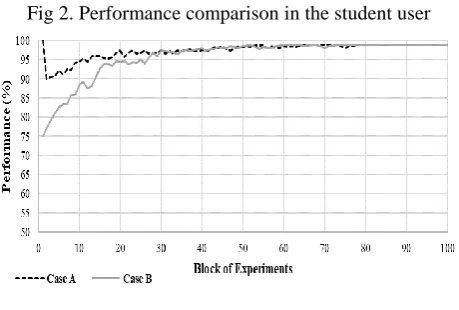
Based on the experiments, the model obtained the average performance shown in Fig 2. In the first experiments, before the stability, it was observed a higher performance for case
A than for case B. The stability was reached near experiment 3500 in both cases with an average performance of 98%. Additionally, in case B, 673 corrections were required due to the review process to provide the solution desired by the user. This number of corrections was higher than the corrections needed for case A, which was 379; i.e., an improvement rate of 44% of case A with respect to Case
[image:5.595.312.543.130.276.2]B. For both cases an average efficiency of 98% was observed. As it can be seen, both cases reached related results despite their differences on the learning process. In this sense, the model proved to be sufficiently robust to satisfy the service demand required by this user.
Fig 2. Performance comparison in the student user
3.2 Housewife
The results presented in Fig 3 show a close similarity between both cases. However, alike to the student user, the performance of case A, exceeds in the beginning the performance of the case B. For the housewife, the stability for both cases was reached near experiment 2500, with an average performance of 99%. Also, a greater number of corrections were required in case B (487) than those required by case A (233) to reach the stability of the model. Thus, observed an improvement rate of 52% of case A with respect to the case B. The efficiency average corresponding to case A was of 99%, slightly higher than the average efficiency associated to case B with a value of 98%. As it can be observed in these results, the model achieved
[image:5.595.54.284.467.622.2]stability around 1000 experiments before the student user. We can attach this fact to the requirements of the activities of the housewife. To cite one, the housewife normally begins her activities before the student, and depends significantly on an adequate level of lighting based on her needs to facilitate the realization of her activities.
Fig 3. Performance comparison in the housewife user
3.3 Elderly Pensioner
In the results shown in Fig 4, in contrast to the previous cases, a higher performance was observed from the beginning of the case B, reaching stability in the performance of both cases of study near experiment 900
with an average of 98%. It is important to highlight that for the first time in the experimentation, fewer corrections were observed for case B (231) than for case A (237), with an improvement rate of 2% of case B over the case A. This behavior may have occurred because of a better fitting of the preferences of this type of user to the initial information on the database for case B. The efficiency calculated for the case A was of 98% and for the case B was of 99%. It is notable that for this user, stability was achieved for both cases with a smaller number of experiments compared to the rest of the users, thus positioning itself as the most stable cases with a fast learning rate. We can attach this fact to several factors such as age, a lifestyle with a smaller number of fluctuations, a more defined routine, among others. Fig 4. Performance comparison in the elderly pensioner user
3.4 Professional
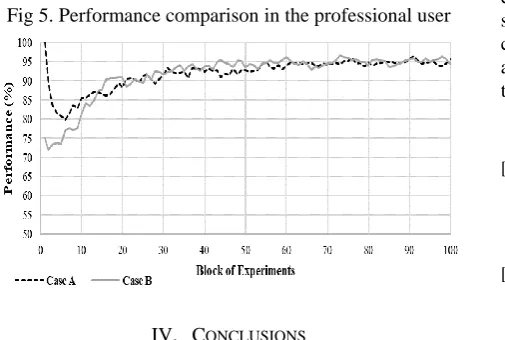
[image:5.595.311.541.531.670.2]variation was due to the lifestyle of the professional, which forces the professional to vary his daily routine to adjust to the needs of the company for which he works, at the time of the day on which he carries out his activities; i.e., he must sometimes work all or part of the night. However, even with this variation the model was able to maintain a remarkably satisfactory performance, achieving slightly stability near experiment 3200, with an average oscillating between 90%
and 95%. The efficiency calculated for both cases was of
[image:6.595.54.307.293.463.2]95%. This user had the lowest average performance and efficiency of the all users. However, it is important to remark that this user is the most complex to analyze and that is why the model needed a longer time to reach stability as well as a lower performance than the other users. We can verify this fact in the number of modifications that the professional performs in comparison with the three previous users, emphasizing in both cases, that it requires double of modifications in comparison with the student, who required a larger interaction with the model revision stage prior to the professional.
Fig 5. Performance comparison in the professional user
IV. CONCLUSIONS
The excessive use of electric energy represents a significant and systematic expense in most of the homes. The new rhythm in human’s life style does not give us the opportunity to pay attention in all the situations that normally occurs in our daily lives. In this light, it is common to forget to put a household appliance off or to leave some lamp on for long and unnecessary periods of time. Unfortunately, these mistakes become tragedy. If a user leaves a lamp working and some peak energy occurs, it could exploit. Such accident can be reflected in economic problem or worst, it can attend against the human life.
Ubiquitous computing, Internet of Things and Home Automation are areas of modern computing, which in the last years have been oriented their efforts to develop new methodologies that facilitates and transparent the interaction between human being and household appliances. Some approaches indicate that devices can be manipulated in a centralized or decentralized manner by an omnipresent and omniscient system. These systems are in-charge of controlling the performance of the household appliances. In this way, the users can dedicate time to other activities. Under this modern perspective, smart devices can work in diverse ways, being reactive, to the user´s requirement or proactive, to learn from the user´s preferences.
The prediction of the preferences of a domestic user involves many and diverse challenges, such as lifestyle, quality of life, age, sedentary lifestyle level, performed
activity. However, some authors have begun to contribute ideas that promote this interesting and cutting-edge line of research. For thus, the paper proposes a learning model based on CBR methodology to lighting control by using a learning mechanism for the subsequent prediction of the users’ preferences. To assess the results of our work, we faced our proposal to four diverse users and asked human experts (one for each user) to validate the responses of the model. Based on the applied cases, we calculated a 98% of average performance of the learning model using an ID3 for the support of decision making. Moreover, in 3 of the 4
users, a higher improvement rate was observed when the execution was carried out with the empty database. Thus, according to this study, it is recommended to start the model with an empty database of cases.
The stabilization capacity of the model was tested, concluding that the model can provide solutions to the preferences of users belonging to completely different lifestyles.
Finally, we have detected some ideas for future work: evaluation of other techniques to support decision making such as Fuzzy Logic and Neural Networks; extension of the cases of study to add new users, restrictions and services; and the evaluation of multiple users while the model make the necessary corrections.
REFERENCES
[1] K. Zaouali, M. L. Ammari, R. Bouallegue, I. Sahloul, and A. Chouaieb, “Incoming data prediction in smart home environment with HMM-based machine learning,” in
2016 International Symposium on Signal, Image, Video and Communications (ISIVC), 2016, pp. 384–389. [2] J. F. De Paz, J. Bajo, S. Rodríguez, G. Villarrubia, and J.
M. Corchado, “Intelligent system for lighting control in smart cities,” Inf. Sci. (Ny)., vol. 372, pp. 241–255, Dec. 2016.
[3] M. S. Ahmed, A. Mohamed, H. Shareef, R. Z. Homod, and J. A. Ali, “Artificial neural network based controller for home energy management considering demand response events,” in 2016 International Conference on Advances in Electrical, Electronic and Systems Engineering (ICAEES), 2016, pp. 506–509.
[4] R. Zaher, K. Chaccour, and G. Badr, “Intelligent Software Simulation of Water Consumption in Domestic Homes,” in 2016 UKSim-AMSS 18th International Conference on Computer Modelling and Simulation (UKSim), 2016, pp. 99–104.
[5] J. Kolodner, “Maintaining organization in a dynamic long-term memory,” Cogn. Sci., vol. 7, no. 4, pp. 243– 280, Oct. 1983.
[6] J. Kolodner, “Reconstructive memory: A computer model,” Cogn. Sci., vol. 7, no. 4, pp. 281–328, Oct. 1983. [7] I. Watson and F. Marir, “Case-based reasoning: A
review,” Knowl. Eng. Rev., vol. 9, no. 04, p. 327, Dec. 1994.
[8] D. Y. Joh, “CBR in a changing environment,” Springer, Berlin, Heidelberg, 1997, pp. 53–62.
[9] F. Fernandes et al., “Intelligent energy management using
CBR: Brazilian residential consumption scenario,” in
2016 IEEE Symposium Series on Computational Intelligence (SSCI), 2016, pp. 1–8.
Foundational issues, methodological variations, and system approaches,” AI Commun., vol. 7, no. 1, pp. 39– 59, 1994.
[12] J. Kolodner, Case-Based Reasoning, vol. 7, no. 1. San Francisco, CA: Morgan Kaufmann, 1993.
[13] O. M. S. NOM-025-STPS-2008, “No Title.” Lighting Conditions at Workcenters, 2008.
[14] M. . Rodr guez-Salazar, S. Alvarez-Hern ndez, and . Bravo-N ez, . Plaza y ald s, S.A. de C.V, 2000.
[15] R. lvarez C ceres, E iante ica con salud. diciones D az de Santos, 1994.
[16] M. Somvanshi and P. Chavan, “A review of machine learning techniques using decision tree and support vector machine,” in 2016 International Conference on Computing Communication Control and automation (ICCUBEA), 2016, pp. 1–7.
[17] C. R. Souza, “The Accord.N T Framework.” São Carlos, Brazil, 2014.
[18] J. A. Piedra Fern ndez,
neurodifusos a la de . ditorial niversidad de Almer a, 2008. [19] IN GI, “Panorama sociodemogr fico de M xico 2015,”
2015. [Online]. Available: