Proceedings of the 23rd Conference on Computational Natural Language Learning, pages 271–280 271
Code-Switched Language Models
Using Neural Based Synthetic Data from Parallel Sentences
Genta Indra Winata, Andrea Madotto, Chien-Sheng Wu, Pascale Fung Center for Artificial Intelligence Research (CAiRE)
Department of Electronic and Computer Engineering
The Hong Kong University of Science and Technology, Clear Water Bay, Hong Kong
{giwinata,amadotto,cwuak}@connect.ust.hk,[email protected]
Abstract
Training code-switched language models is difficult due to lack of data and complexity in the grammatical structure. Linguistic con-straint theories have been used for decades to generate artificial code-switching sentences to cope with this issue. However, this require ex-ternal word alignments or constituency parsers that create erroneous results on distant lan-guages. We propose a sequence-to-sequence model using a copy mechanism to gener-ate code-switching data by leveraging paral-lel monolingual translations from a limited source of code-switching data. The model learns how to combine words from parallel sentences and identifies when to switch one language to the other. Moreover, it captures code-switching constraints by attending and aligning the words in inputs, without requiring any external knowledge. Based on experimen-tal results, the language model trained with the generated sentences achieves state-of-the-art performance and improves end-to-end au-tomatic speech recognition.
1 Introduction
Code-switching is a common linguistic phe-nomenon in multilingual communities, in which a person begins speaking or writing in one lan-guage and then switches to another in the same sentence.1 It is motivated in response to social fac-tors as a way of communicating in a multicultural society. In its practice, code-switching varies due to the traditions, beliefs, and normative values in the respective communities. Linguists have stud-ied the code-switching phenomenon and proposed a number of linguistic theories (Poplack, 1978;
Pfaff, 1979; Poplack, 1980; Belazi et al., 1994). Code-switching is not produced indiscriminately,
1Code-switching refers to mixing of languages following
the definitions inPoplack(1980). We use “intra-sentential
code-switching" interchangeably with “code-mixing".
but follows syntactic constraints. Many linguists have formulated various constraints to define a general rule for code-switching (Poplack, 1978,
1980;Belazi et al., 1994). However, these con-straints cannot be postulated as a universal rule for all code-switching scenarios, especially for languages that are syntactically divergent ( Berk-Seligson, 1986), such as English and Mandarin since they have word alignments with an inverted order.
Building a language model (LM) and an auto-matic speech recognition (ASR) system that can handle intra-sentential code-switching is known to be a difficult research challenge. The main rea-son lies in the unpredictability of code-switching points in an utterance and data scarcity. Creating a large-scale code-switching dataset is also very expensive. Therefore, code-switching data gener-ation methods to augment existing datasets are a useful workaround.
Existing methods that apply equivalence con-straint theory to generate code-switching sen-tences (Li and Fung, 2012; Pratapa et al., 2018) may suffer performance issues as they receive er-roneous results from the word aligner and the part-of-speech (POS) tagger. Thus, this approach is not reliable and effective. Recently, Garg et al.
(2018) proposed a SeqGAN-based model to gen-erate code-switching sentences. Indeed, the model learns how to generate new synthetic sentences. However, the distribution of the generated sen-tences is very different from real code-switching data, which leads to underperforming results.
To overcome the challenges in the exist-ing works, we introduce a neural-based code-switching data generator model using pointer-generator networks (Pointer-Gen) (See et al.,
Intu-itively, the copy mechanism can be formulated as an end-to-end solution to copy words from parallel monolingual sentences by aligning and reordering the word positions to form a grammatical code-switching sentence. This method solves the two is-sues in the existing works by removing the depen-dence on the aligner or tagger, and generating new sentences with a similar distribution to the orig-inal dataset. Interestingly, this method can learn the alignment effectively without a word aligner or tagger. As an additional advantage, we demon-strate its interpretability by showing the attention weights learned by the model that represent the code-switching constraints. Our contributions are summarized as follows:
• We propose a language-agnostic method to generate code-switching sentences using a pointer-generator network (See et al., 2017) that learns when to switch and copy words from parallel sentences, without using exter-nal word alignments or constituency parsers. By using the generated data in the language model training, we achieve the state-of-the-art performance in perplexity and also im-prove the end-to-end ASR on an English-Mandarin code-switching dataset.
• We present an implementation applying the equivalence constraint theory to languages that have significantly different grammar structures, such as English and Mandarin, for sentence generation. We also show the effec-tiveness of our neural-based approach in gen-erating new code-switching sentences com-pared to the equivalence constraint and Seq-GAN (Garg et al.,2018).
• We thoroughly analyze our generation results and further examine how our model identi-fies code-switching points to show its inter-pretability.
2 Generating Code-Switching Data
In this section, we describe our proposed model to generate code-switching sentences using a pointer-generator network. Then, we briefly list the assumptions of the equivalence constraint (EC) theory, and explain our application of EC theory for sentence generation. We call the dominant lan-guage the matrix lanlan-guage (L1) and the inserted
language the embedded language (L2), following
the definitions fromMyers-Scotton(2001). Let us define Q = {Q1, ..., QT} as a set of L1
sen-tences andE = {E1, ..., ET}as a set ofL2
sen-tences with T number of sentences, where each Qt ={q1,t, ..., qm,t}andEt ={e1,t, ..., en,t}are
sentences with m and n words. E is the corre-sponding parallel sentences ofQ.
2.1 Pointer-Gen
Initially, Pointer-Gen was proposed to learn when to copy words directly from the input to the output in text summarization, and they have since been successfully applied to other natural language pro-cessing tasks, such as comment generation (Lin et al.,2019). The Pointer-Gen leverages the infor-mation from the input to ensure high-quality gen-eration, especially when the output sequence con-sists of elements from the input sequence, such as code-switching sequences.
We propose to use Pointer-Gen by leveraging parallel monolingual sentences to generate code-switching sentences. The approach is depicted in Figure1. The pointer-generator model is trained from concatenated sequences of parallel sentences (Q,E) to generate code-switching sentences, con-strained by code-switching texts. The words of the input are fed into the encoder. We use a bidirec-tional long short-term memory (LSTM), which, produces hidden statehtin each step t. The de-coder is a unidirectional LSTM receiving the word embedding of the previous word. For each decod-ing step, a generation probabilitypgen ∈[0,1] is calculated, which weights the probability of gen-erating words from the vocabulary, and copying words from the source text. pgen is a soft gating probability to decide whether to generate the next token from the decoder or to copy the word from the input instead. The attention distributionatis a standard attention with general scoring (Luong et al.,2015). It considers all encoder hidden states to derive the context vector. The vocabulary distri-butionPvoc(w)is calculated by concatenating the decoder statestand the context vectorh∗t:
pgen=σ(whT∗h∗t +wsTst+wTxxt+bptr), (1)
where wh∗, ws, and wx are trainable parameters and bptr is the scalar bias. The vocabulary dis-tributionPvoc(w)and the attention distributionat are weighted and summed to obtain the final dis-tributionP(w), which is calculated as follows:
P(w) =pgenPvoc(w) + (1−pgen) X
i:wi=w
pgen
× (1 −pgen)
我 要 去 check (I 'm going to check)
Attention
Vocabulary Distribution context vector
Attention Distribution
Final Distribution Codeswitching sentence
i 'm going to check 我 要 去 检 查 <SOS> 我 要 去
RNN Encoder
× pgen
RNN Decoder
[image:3.595.101.496.60.247.2]Parallel sentence Decoder input
Figure 1: Pointer-Genmodel, which includes an RNN encoder and RNN decoder. The parallel sentence is the input of the encoder, and in each decoding step, the decoder generates a new token.
this is actually belonged to simplified chinese
这个 其实 是 属于 简体 中⽂
this 是其实 belonged to simplified chinese 这个其实是 belonged to 简体中⽂ 这个其实是 belonged to simplified chinese Permissible switching
Impermissible switching
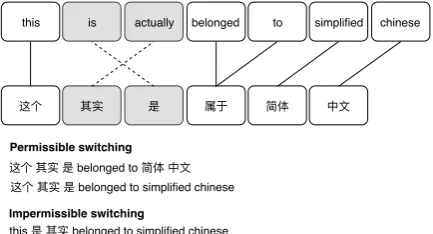
Figure 2: Example of equivalence constraint (Li and Fung, 2012). Solid lines show the alignment be-tween the matrix language (top) and the embedded lan-guage (bottom). The dotted lines denote impermissible switching.
We use a beam search to select theN-best code-switching sentences.
2.2 Equivalence Constraint
Studies on the EC (Poplack,1980,2013) show that code-switching only occurs where it does not vi-olate the syntactic rules of either language. An example of a English-Mandarin mixed-language sentence generation is shown in Figure 2, where EC theory does not allow the word “其实" to come after “是" in Chinese, or the word “is" to come af-ter “actually".Pratapa et al.(2018) apply the EC in English-Spanish language modeling with a strong assumption. We are working with English and Mandarin, which have distinctive grammar struc-tures (e.g., part-of-speech tags), so applying a con-stituency parser would give us erroneous results. Thus, we simplify sentences into a linear struc-ture, and we allow lexical substitution on
non-crossing alignments between parallel sentences. Alignments between an L1 sentence Qt and an
L2 sentenceEtcomprise a source vector with in-dicesut ={a1, a2, ..., am} ∈Wmthat has a
cor-responding target vector vt = {b1, b2, ..., bm} ∈
Wm, where u is a sorted vector of indices in an
ascending order. The alignment between ai and bi does not satisfy the constraint if there exists a pair ofaj andbj, where (ai < aj, andbi > bj) or (ai > aj, and bi < bj). If the switch occurs at this point, it changes the grammatical order in both languages; thus, this switch is not acceptable. During the generation step, we allow any switches that do not violate the constraint. We propose to generate synthetic code-switching data by the fol-lowing steps:
1. Align the L1 sentences Q and L2
sen-tencesEusingfast_align2 (Dyer et al.,
2013). We use the mapping from theL1
sen-tences to theL2sentences.
2. Permute alignments from step (1) and use them to generate new sequences by replacing the phrase in theL1sentence with the aligned
phrase in theL2 sentence.
3. Evaluate generated sequences from step (2) if they satisfy the EC theory.
3 End-to-End Code-Switching ASR
To show the effectiveness of our proposed method, we build a transformer-based end-to-end
code-2The code implementation can be found at
[image:3.595.74.291.299.416.2]switching ASR system. The end-to-end ASR model accepts a spectrogram as the input, instead of log-Mel filterbank features (Zhou et al.,2018), and predicts characters. It consists ofN layers of an encoder and decoder. Convolutional layers are added to learn a universal audio representation and generate input embedding. We employ multi-head attention to allow the model to jointly attend to in-formation from different representation subspaces at a different position.
For proficiency in recognizing individual lan-guages, we train a multilingual ASR system trained from monolingual speech. The idea is to use it as a pretrained model and transfer the information while training the model with code-switching speech. This is an effective method to initialize the parameters of low-resource ASR such as code-switching. The catastrophic forget-ting issue arises when we train one language after the other. Therefore, we solve the issue by ap-plying a multi-task learning strategy. We jointly train speech from both languages by taking the same number of samples for each language in ev-ery batch to keep the information of both tasks.
In the inference time, we use beam search, se-lecting the best sub-sequence scored using the softmax probability of the characters. We define P(Y)as the probability of the sentence. We incor-porate language model probability plm(Y) to se-lect more natural code-switching sequences from generation candidates. A word count is added to avoid generating very short sentences. P(Y) is calculated as follows:
P(Y) =αPtrans(Y|X) +βplm(Y) +γ p
wc(Y)
(3) where α is the parameter to control the decod-ing probability from the probability of characters from the decoderPtrans(Y|X),βis the parameter to control the language model probabilityplm(Y), andγ is the parameter to control the effect of the word countwc(Y).
4 Experiments
4.1 Data Preparation
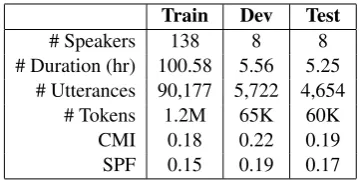
We use speech data from SEAME Phase II, a conversational English-Mandarin Chinese code-switching speech corpus that consists of spontaneously spoken interviews and conversa-tions (Nanyang Technological University, 2015). We split the corpus following information
from Winata et al. (2018a). The details are de-picted in Table 1. We tokenize words using the Stanford NLP toolkit (Manning et al.,2014). For monolingual speech datasets, we use HKUST (Liu et al., 2006), comprising spontaneous Mandarin Chinese telephone speech recordings, and Com-mon Voice, an open-accented English dataset col-lected by Mozilla.3 We split Chinese words into characters to avoid word boundary issues, simi-larly to Garg et al. (2018). We generateL1
sen-tences and L2 sentences by translating the
train-ing set of SEAME Phase II into English and Chi-nese using the Google NMT system (To enable re-production of the results, we release the translated data).4 Then, we use them to generate 270,531 new pieces of code-switching data, which is thrice the number of the training set. Table 2 shows the statistics of the new generated sentences. To calculate the complexity of our real and gener-ated code-switching corpora, we use the following measures:
Switch-Point Fraction (SPF) This measure calculates the number of switch-points in a sen-tence divided by the total number of word bound-aries (Pratapa et al., 2018). We define “switch-point" as a point within the sentence at which the languages of words on either side are different.
Code Mixing Index (CMI) This measure
counts the number of switches in a corpus ( Gam-bäck and Das, 2014). At the utterance level, it can be computed by finding the most frequent lan-guage in the utterance and then counting the fre-quency of the words belonging to all other lan-guages present. We compute this metric at the cor-pus level by averaging the values for all the sen-tences in a corpus. The computation is shown as follows:
Cu(x) =
N(x)−max(`i ∈`{t`i(x)}) +P(x)
N(x) ,
(4) whereN(x)is the number of tokens of utterance x, t`i is the tokens in language `i, and P(x) is
the number of code-switching points in utterance x. We compute this metric at the corpus-level by averaging the values for all sentences.
3
The dataset is available at https://voice.mozilla.org/.
4We have attached the translated data in the
4.2 LM Training Strategy Comparison
We generate code-switching sentences using three methods: EC theory, SeqGAN (Garg et al.,2018), and Pointer-Gen. To find the best way of leverag-ing the generated data, we compare different train-ing strategies as follows:
(1)rCS,(2a)EC,(2b)SeqGAN,
(2c)Pointer-Gen, (3a)EC & rCS,
(3b)SeqGAN & rCS, (3c)Pointer-Gen & rCS
(4a)EC→rCS(4b)SeqGAN→rCS, (4c)Pointer-Gen→rCS
(1) is the baseline, training with real code-switching data.(2a–2c)train with only augmented data. (3a–3c)train with the concatenation of aug-mented data with rCS. (4a–4c) run a two-step training, first training the model only with aug-mented data and then fine-tuning with rCS. Our early hypothesis is that the results from(2a) and (2b)will not be as good as the baseline, but when we combine them, they will outperform the base-line. We expect the result of (2c) to be on par with (1), since Pointer-Gen learns patterns from the rCS dataset, and generates sequences with sim-ilar code-switching points.
4.3 Experimental Setup
In this section, we present the settings we use to generate code-switching data, and train our lan-guage model and end-to-end ASR.
Pointer-Gen The pointer-generator model has 500-dimensional hidden states. We use 50k words as our vocabulary for the source and target. We optimize the training by Stochastic Gradient De-scent with an initial learning rate of 1.0 and decay of 0.5. We generate the three best sequences using beam search with five beams, and sample 270,531 sentences, thrice the amount of the code-switched training data.
EC We generate 270,531 sentences, thrice the amount of the code-switched training data. To make a fair comparison, we limit the number of switches to two for each sentence to get a sim-ilar number of code-switches (SPF and CMI) to Pointer-Gen.
SeqGAN We implement the SeqGAN model us-ing a PyTorch implementation5, and use our best
5To implement SeqGAN, we use code from
https://github.com/suragnair/seqGAN.
Train Dev Test
# Speakers 138 8 8 # Duration (hr) 100.58 5.56 5.25
# Utterances 90,177 5,722 4,654 # Tokens 1.2M 65K 60K
CMI 0.18 0.22 0.19 SPF 0.15 0.19 0.17
Table 1: Data statistics of SEAME Phase II. The dataset is split by speaker ID.
EC SeqGAN Pointer-Gen
# Utterances 270,531 270,531 270,531
# Words 3,040,202 2,981,078 2,922,941
new unigram 13.63% 34.67% 4.67%
new bigram 69.43% 80.33% 46.57%
new trigram 99.73% 141.56% 69.38%
new four-gram 121.04% 182.89% 85.07%
CMI 0.25 0.13 0.25
SPF 0.17 0.2 0.17
Table 2: Statistics of the generated data. The ta-ble shows the number of utterances and words, code-switches ratio, and percentage of new n-grams.
trained LM baseline as the generator in SeqGAN. We sample 270,531 sentences from the generator, thrice the amount of the code-switched training data (with a maximum sentence length of 20).
LM In this work, we focus on sentence genera-tion, so we evaluate our data with the same two-layer LSTM LM for comparison. It is trained us-ing a two-layer LSTM with a hidden size of 200 and unrolled for 35 steps. The embedding size is equal to the LSTM hidden size for weight tying (Press and Wolf, 2017). We optimize our model using SGD with an initial learning rate of 20. If there is no improvement during the evaluation, we reduce the learning rate by a factor of 0.75. In each step, we apply a dropout to both the embed-ding layer and recurrent network. The gradient is clipped to a maximum of 0.25. We optimize the validation loss and apply an early stopping pro-cedure after five iterations without any improve-ments. In the fine-tuning step of training strategies (4a–4c), the initial learning rate is set to 1.
[image:5.595.326.506.61.151.2] [image:5.595.308.528.197.301.2]Training Strategy Overall en-zh zh-en en-en zh-zh
valid test valid test valid test valid test valid test
Only real code-switching data
(1) rCS 72.89 65.71 7411.42 7857.75 120.41 130.21 29.31 29.61 244.88 246.71 Only generated data
(2a) EC 115.98 96.54 32865.62 30580.89 107.22 109.10 28.24 28.2 1893.77 1971.68 (2b) SeqGAN 252.86 215.17 33719 37119.9 174.2 187.5 91.07 88 1799.74 1783.71 (2c) Pointer-Gen 72.78 64.67 7055.59 7473.68 119.56 133.39 27.77 27.67 234.16 235.34 Concatenate generated data with real code-switching data
(3a) EC & rCS 70.33 62.43 8955.79 9093.01 130.92 139.06 26.49 26.28 227.57 242.30 (3b) SeqGAN & rCS 77.37 69.58 8477.44 9350.73 134.27 143.41 30.64 30.81 260.89 264.28 (3c) Pointer-Gen & rCS 68.49 61.57 7146.08 7667.82 127.50 139.06 26.75 26.96 218.27 226.60 Pretrain with generated data and fine-tune with real code-switching data
(4a) EC→rCS 68.46 61.42 8200.78 8517.29 101.15 107.77 25.49 25.78 247.3 258.95 (4b) SeqGAN→rCS 70.61 64.03 6950.02 7694.2 114.82 122.84 28.5 28.73 236.94 244.62
[image:6.595.75.525.61.240.2](4c) Pointer-Gen→rCS 66.08 59.74 6620.76 7172.42 114.53 127.12 26.36 26.40 216.02 222.49
Table 3: Results of perplexity (PPL) on a valid set and test set for different training strategies. We report the overall PPL, and code-switching points(en-zh)and(zh-en), as well as the monolingual segments PPL(en-en)and
(zh-zh).
10K 27K 78K 156K 270K(all)
Samples 75
100 125 150 175 200 225 250 275
P
erplexit
y
Perplexity vs Sample-Size
SeqGAN EC Pointer-Gen rCS
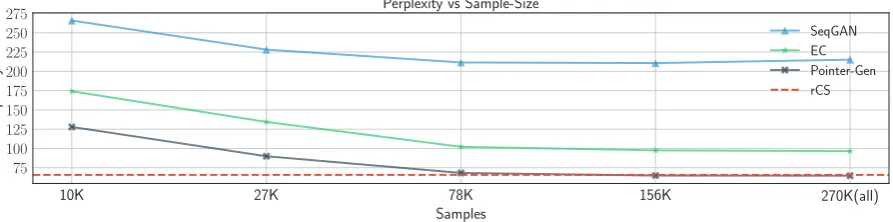
Figure 3: Results of perplexity (PPL) on different numbers of generated samples. The graph shows that Pointer-Gen attains a close performance to the real training data, and outperformsSeqGANandEC.
and a value dimension of 64. The training data are randomly shuffled every epoch. Our charac-ter set is the concatenation of English letcharac-ters, Chi-nese characters found in the corpus, spaces, and apostrophes. In the multilingual ASR pretraining, we train the model for 18 epochs. Since the sizes of the datasets are different, we over-sample the smaller dataset. The fine-tuning step takes place after the pretraining using code-switching data. In the inference time, we explore the hypothesis us-ing beam search with eight beams and a batch size of 1.
4.4 Evaluation Metrics
We employ the following metrics to measure the performance of our models.
Token-level Perplexity (PPL) For the LM, we calculate the PPL of characters in Mandarin Chi-nese and words in English. The reason is that some Chinese words inside the SEAME corpus are not well tokenized, and tokenization results are
not consistent. Using characters instead of words in Chinese can alleviate word boundary issues. The PPL is calculated by taking the exponential of the sum of losses. To show the effectiveness of our approach in calculating the probability of the switching, we split the perplexity computation into monolingual segments (en-en) and (zh-zh), and code-switching segments(en-zh)and(zh-en).
Character Error Rate (CER) For our ASR, we compute the overall CER and also show the indi-vidual CERs for Mandarin Chinese (zh) and En-glish (en). The metric calculates the distance of two sequences as theLevenshtein Distance.
5 Results & Discussion
[image:6.595.79.526.299.410.2]no it 's really a lot worse then 没有 就 真的 差 很多 然后
no
就
真的
差
很多 然后
generated sequence
input input
we share a room together so 我们 一起 共 享 一 个 房间 就 我们
一起
share
a
room
[image:7.595.77.527.63.167.2]就
Figure 4: The visualization of pointer-generator attention weights on input words in each time-step during the inference time. The y-axis indicates the generated sequence, and the x-axis indicates the word input. In this figure, we show the code-switching points when our model attends to words in theL1andL2sentences:left:(“no",“没 有") and (“then",“然后"),right:(“we",“我们"), (“share", “一起") and (“room",“房间").
the undesirable results that are also mentioned by Pratapa et al. (2018), but it does not apply to Pointer-Gen (2c). We can achieve a similar re-sults with the model trained using only real code-switching data, rCS. This demonstrates the qual-ity of our data generated using Pointer-Gen. In general, combining any generated samples with real code-switching data improves the language model performance for both code-switching seg-ments and monolingual segseg-ments. Applying con-catenation is less effective than the two-step train-ing strategy. Moreover, applying the two-step training strategy achieves the state-of-the-art per-formance.
As shown in Table2, we generate new n-grams including code-switching phrases. This leads us to a more robust model, trained with both gener-ated data and real code-switching data. We can see clearly that Pointer-Gen-generated samples have a distribution more similar to the real code-switching data compared with SeqGAN, which shows the advantage of our proposed method.
Effect of Data Size To understand the impor-tance of data size, we train our model with dif-ferent amounts of generated data. Figure3shows the PPL of the models with different amounts of generated data. An interesting finding is that our model trained with only 78K samples of Pointer-Gen data (same number of samples as rCS) achieves a similar PPL to the model trained with only rCS, while SeqGAN and EC have a sig-nificantly higher PPL. We can also see that 10K samples of Pointer-Gen data is as good as 270K samples of EC data. In general, the number of samples is positively correlated with the improve-ment in performance.
Model Overall en zh
Baseline 34.40% 41.79% 35.94% + Pre-training 32.76% 40.06% 32.44% + LM (rCS) 32.25% 39.45% 31.90%
+ LM (Pointer-Gen→rCS) 31.07% 38.39% 30.85%
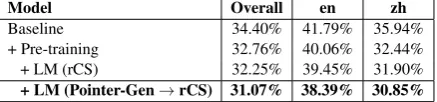
Table 4: ASR evaluation, showing the performance on all sequences (Overall), English segments (en), and Mandarin Chinese segments (zh).
ASR Evaluation We evaluate our proposed sen-tence generation method on an end-to-end ASR system. Table4shows the CER of our ASR sys-tems, as well as the individual CER on each lan-guage. Based on the experimental results, pre-training is able to reduce the error rate by 1.64%, as it corrects the spelling mistakes in the predic-tion. After we add LM (rCS) to the decoding step, the error rate can be reduced to 32.25%. Finally, we replace the LM with LM (Pointer-Gen→rCS), and it further decreases the error rate by 1.18%.
[image:7.595.310.529.251.302.2]rCS Pointer-Gen POS tags ratio POS tags ratio examples
English
NN
(noun) 56.16%
NN
(noun) 55.45%
那个consumer是不
(that consumer is not) RB
(adverb) 10.34%
RB
(adverb) 10.14%
okayso其实
(okay so its real) JJ
(adjective) 7.04%
JJ
(adjective) 7.16%
我很jealous的每 次
(i am very jealous every time) VB
(verb) 5.88%
VB
(verb) 5.89%
compared这个
(compared to this)
Chinese
VV
(other verbs) 23.77%
VV
(other verbs) 23.72%
讲的要用用用microsoft word
(i want to use microsoft word) M
(measure word) 16.83%
M
(measure word) 16.49%
我们有这个个个god of war
(we have this god of war) DEG
(associative) 9.12%
DEG
(associative) 9.13%
我们的的的result
(our result) NN
(common noun) 9.08%
NN
(common noun) 8.93%
我应该不会讲话话话because intimidated by another
[image:8.595.96.504.60.291.2](i shouldn’t talk because intimidated by another)
Table 5: The most common English and Mandarin Chinese part-of-speech tags that trigger code-switching. We report the frequency ratio fromPointer-Gen-generated sentences compared to the real code-switching data. We also provide an example for each POS tag.
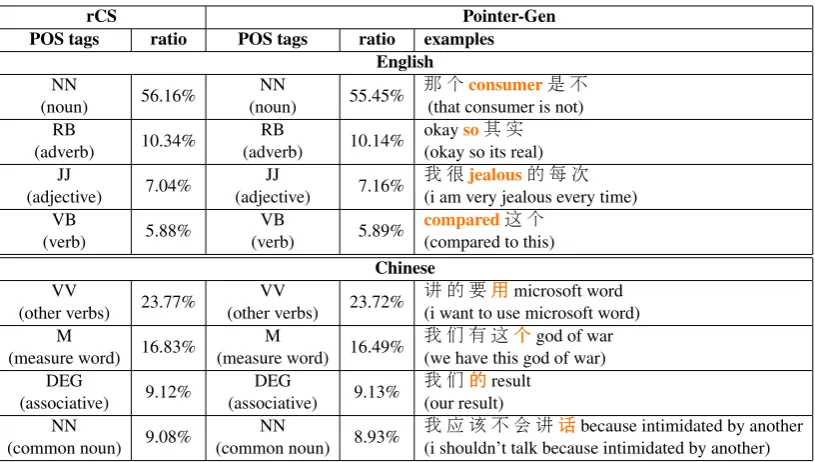
Code-Switching Patterns Table 5 shows the most common English and Mandarin Chinese POS tags that trigger code-switching. The distri-bution of word triggers in the Pointer-Gen data are similar to the real code-switching data, indicating our model’s ability to learn similar code-switching points. Nouns are the most frequent English word triggers. They are used to construct an optimal in-teraction by using cognate words and to avoid con-fusion. Also, English adverbs such as “then" and “so" are phrase or sentence connectors between two language phrases for intra-sentential and inter-sentential code-switching. On the other hand, Chi-nese transitional words such as the measure word “个" or associative word “的" are frequently used as inter-lingual word associations.
6 Related Work
Code-switching language modeling research has been focused on building a model that handles mixed-language sentences and on generating syn-thetic data to solve the data scarcity issue. The first statistical approach using a linguistic theory was introduced by Li and Fung (2012), who adapted the EC on monolingual sentence pairs during the decoding step of an ASR system. Ying and Fung(2014) implemented a functional-head con-straint lattice parser with a weighted finite-state transducer to reduce the search space on a code-switching ASR system. Then,Adel et al.(2013a)
extended recurrent neural networks (RNNs) by adding POS information to the input layer and a factorized output layer with a language identi-fier. The factorized RNNs were also combined with an n-gram backoff model using linear inter-polation (Adel et al.,2013b), and syntactic and se-mantic features were added to them (Adel et al.,
2015). Baheti et al. (2017) adapted an effective curriculum learning by training a network with monolingual corpora of two languages, and sub-sequently trained on code-switched data. A fur-ther investigation of EC and curriculum learning showed an improvement in English-Spanish lan-guage modeling (Pratapa et al.,2018), and a multi-task learning approach was introduced to train the syntax representation of languages by constrain-ing the language generator (Winata et al.,2018a).
Garg et al.(2018) proposed to use SeqGAN (Yu et al., 2017) for generating new mixed-language sequences. Winata et al.(2018b) leveraged char-acter representations to address out-of-vocabulary words in the code-switching named entity recog-nition. Finally, Winata et al. (2019) proposed a method to represent code-switching sentence us-ing language-agnostic meta-representations.
7 Conclusion
cor-pora. Our model can learn code-switching points by attending to input words and aligning the paral-lel words, without requiring any word alignments or constituency parsers. More importantly, it can be effectively used for languages that are syntacti-cally different, such as English and Mandarin Chi-nese. Our language model trained using outper-forms equivalence constraint theory-based mod-els. We also show that the learned language model can be used to improve the performance of an end-to-end automatic speech recognition system.
Acknowledgments
This work has been partially funded by ITF/319/16FP and MRP/055/18 of the Inno-vation Technology Commission, the Hong Kong SAR Government, and School of Engineering Ph.D. Fellowship Award, the Hong Kong Uni-versity of Science and Technology, and RDC 1718050-0 of EMOS.AI. We sincerely thank the three anonymous reviewers for their insightful comments on our paper.
References
Heike Adel, Ngoc Thang Vu, Katrin Kirchhoff, Do-minic Telaar, and Tanja Schultz. 2015. Syntactic and semantic features for code-switching factored language models. IEEE Transactions on Audio,
Speech, and Language Processing, 23(3):431–440.
Heike Adel, Ngoc Thang Vu, Franziska Kraus, Tim Schlippe, Haizhou Li, and Tanja Schultz. 2013a. Recurrent neural network language modeling for code switching conversational speech. In Acous-tics, Speech and Signal Processing (ICASSP), 2013
IEEE International Conference on, pages 8411–
8415. IEEE.
Heike Adel, Ngoc Thang Vu, and Tanja Schultz. 2013b. Combination of recurrent neural networks and fac-tored language models for code-switching language modeling. InProceedings of the 51st Annual Meet-ing of the Association for Computational LMeet-inguistics (Volume 2: Short Papers), volume 2, pages 206–211.
Ashutosh Baheti, Sunayana Sitaram, Monojit Choud-hury, and Kalika Bali. 2017. Curriculum design for code-switching: Experiments with language iden-tification and language modeling with deep neural networks. Proceedings of ICON, pages 65–74.
Hedi M Belazi, Edward J Rubin, and Almeida Jacque-line Toribio. 1994. Code switching and x-bar the-ory: The functional head constraint. Linguistic in-quiry, pages 221–237.
Susan Berk-Seligson. 1986. Linguistic constraints on intrasentential code-switching: A study of span-ish/hebrew bilingualism. Language in society, 15(3):313–348.
Chris Dyer, Victor Chahuneau, and Noah A. Smith. 2013. A simple, fast, and effective reparameteriza-tion of ibm model 2. InProceedings of the 2013 Conference of the North American Chapter of the Association for Computational Linguistics: Human
Language Technologies, pages 644–648.
Associa-tion for ComputaAssocia-tional Linguistics.
Björn Gambäck and Amitava Das. 2014. On measuring the complexity of code-mixing. InProceedings of the 11th International Conference on Natural Lan-guage Processing, Goa, India, pages 1–7. Citeseer.
Saurabh Garg, Tanmay Parekh, and Preethi Jyothi. 2018. Code-switched language models using dual rnns and same-source pretraining. InProceedings of the 2018 Conference on Empirical Methods in
Nat-ural Language Processing, pages 3078–3083.
Ying Li and Pascale Fung. 2012. Code-switch lan-guage model with inversion constraints for mixed language speech recognition. Proceedings of
COL-ING 2012, pages 1671–1680.
Zhaojiang Lin, Genta Indra Winata, and Pascale Fung. 2019. Learning comment generation by leveraging user-generated data. In ICASSP 2019-2019 IEEE International Conference on Acoustics, Speech and
Signal Processing (ICASSP), pages 7225–7229.
IEEE.
Yi Liu, Pascale Fung, Yongsheng Yang, Christopher Cieri, Shudong Huang, and David Graff. 2006. Hkust/mts: A very large scale mandarin telephone speech corpus. In Chinese Spoken Language Pro-cessing, pages 724–735. Springer.
Thang Luong, Hieu Pham, and Christopher D Man-ning. 2015. Effective approaches to attention-based neural machine translation. In Proceedings of the 2015 Conference on Empirical Methods in Natural
Language Processing, pages 1412–1421.
Christopher D. Manning, Mihai Surdeanu, John Bauer, Jenny Finkel, Steven J. Bethard, and David Mc-Closky. 2014. The Stanford CoreNLP natural lan-guage processing toolkit. InAssociation for
Compu-tational Linguistics (ACL) System Demonstrations,
pages 55–60.
Carol Myers-Scotton. 2001. The matrix language frame model: Development and responses. Trends
in Linguistics Studies and Monographs, 126:23–58.
Universiti Sains Malaysia Nanyang Technological Uni-versity. 2015. Mandarin-english code-switching in south-east asia ldc2015s04. web download. philadel-phia: Linguistic data consortium.
Shana Poplack. 1978. Syntactic structure and social
function of code-switching, volume 2. Centro de
Estudios Puertorriqueños,[City University of New York].
Shana Poplack. 1980. Sometimes i’ll start a sentence in spanish y termino en espanol: toward a typology of code-switching1.Linguistics, 18(7-8):581–618.
Shana Poplack. 2013. “sometimes i’ll start a sentence in spanish y termino en español”: Toward a typology of code-switching. Linguistics, 51(Jubilee):11–14.
Adithya Pratapa, Gayatri Bhat, Monojit Choudhury, Sunayana Sitaram, Sandipan Dandapat, and Kalika Bali. 2018. Language modeling for code-mixing: The role of linguistic theory based synthetic data. In
Proceedings of the 56th Annual Meeting of the As-sociation for Computational Linguistics (Volume 1:
Long Papers), volume 1, pages 1543–1553.
Ofir Press and Lior Wolf. 2017. Using the output em-bedding to improve language models. In Proceed-ings of the 15th Conference of the European Chap-ter of the Association for Computational Linguistics:
Volume 2, Short Papers, volume 2, pages 157–163.
Abigail See, Peter J. Liu, and Christopher D. Manning. 2017.Get to the point: Summarization with pointer-generator networks. InProceedings of the 55th An-nual Meeting of the Association for Computational
Linguistics (Volume 1: Long Papers), pages 1073–
1083. Association for Computational Linguistics.
Genta Indra Winata, Zhaojiang Lin, and Pascale Fung. 2019. Learning multilingual meta-embeddings for code-switching named entity recognition. In Pro-ceedings of the 4th Workshop on Representation
Learning for NLP (RepL4NLP-2019), pages 181–
186.
Genta Indra Winata, Andrea Madotto, Chien-Sheng Wu, and Pascale Fung. 2018a. Code-switching language modeling using syntax-aware multi-task learning. In Proceedings of the Third Workshop on Computational Approaches to Linguistic
Code-Switching, pages 62–67. Association for
Computa-tional Linguistics.
Genta Indra Winata, Chien-Sheng Wu, Andrea Madotto, and Pascale Fung. 2018b. Bilingual char-acter representation for efficiently addressing out-of-vocabulary words in code-switching named entity recognition. InProceedings of the Third Workshop on Computational Approaches to Linguistic Code-Switching, pages 110–114.
LI Ying and Pascale Fung. 2014. Language model-ing with functional head constraint for code switch-ing speech recognition. InProceedings of the 2014 Conference on Empirical Methods in Natural
Lan-guage Processing (EMNLP), pages 907–916.
Lantao Yu, Weinan Zhang, Jun Wang, and Yong Yu. 2017. Seqgan: Sequence generative adversarial nets with policy gradient. InThirty-First AAAI Confer-ence on Artificial IntelligConfer-ence.