Bonnie Webber
∗Matthew Stone
† Edinburgh University Rutgers UniversityAravind Joshi
‡Alistair Knott
§University of Pennsylvania University of Otago
We argue in this article that many common adverbial phrases generally taken to signal a discourse relation between syntactically connected units within discourse structure instead work anaphor-ically to contribute relational meaning, with only indirect dependence on discourse structure. This allows a simpler discourse structure to provide scaffolding for compositional semantics and reveals multiple ways in which the relational meaning conveyed by adverbial connectives can interact with that associated with discourse structure. We conclude by sketching out a lexicalized grammar for discourse that facilitates discourse interpretation as a product of compositional rules, anaphor resolution, and inference.
1. Introduction
It is a truism that a text means more than the sum of its component sentences. One source of additional meaning are relationstaken to hold between adjacent sentences “syntactically” connected within a larger discourse structure. It has been very difficult, however, to say what discourse relations there are, either theoretically (Mann and Thompson 1988; Kehler 2002; Asher and Lascarides 2003) or empirically (Knott 1996). Knott’s empirical attempt to identify and characterize cue phrases as evidence for discourse relations illustrates some of the difficulties. Knott used the following theory-neutral test to identify cue phrases: For a potential cue phrase φ in naturally occurring text, consider in isolation the clause in which it appears. If the clause ap-pears incomplete without an adjacent left context, whereas it apap-pears complete ifφis removed, then φis a cue phrase. Knott’s test produced a nonexhaustive list of about two hundred different phrases from 226 pages of text. He then attempted to charac-terize the discourse relation(s) conveyed by each phrase by identifying when (always, sometimes, never) one phrase could substitute for another in a way that preserved meaning. He showed how these substitution patterns could be a consequence of a set of semantic features and their values. Roughly speaking, one cue phrase couldalways
substitute for another if it had the same set of features and values, sometimesdo so if it was less specific than the other in terms of its feature values, andneverdo so if their values conflicted for one or more features.
∗School of Informatics, University of Edinburgh, 2 Buccleuch Place, Edinburgh, EH8 9LW, UK. E-mail: [email protected].
†Department of Computer Science, Rutgers Universtiy, 110 Frelinghuysen Road, Piscataway, NJ 08854-8019. E-mail: [email protected].
‡Department of Computer & Information Science, University of Pennsylvania, 200 South 33rd Street, Philadelphia, PA 19104-6389. E-mail: [email protected].
By assuming that cue phrases contribute meaning in a uniform way, Knott was led to a set of surprisingly complex directed acyclic graphs relating cue phrases in terms of features and their values, each graph loosely corresponding to some family of discourse relations. But what if the relational meaning conveyed by cue phrases could in fact interact with discourse meaning in multiple ways? Then Knott’s substitution patterns among cue phrases may have reflected these complex interactions, as well as the meanings of individual cue phrases themselves.
This article argues that cue phrasesdodepend on another mechanism for convey-ing extrasentential meanconvey-ing—specifically,anaphora. One early hint that adverbial cue phrases (called here discourse connectives) might be anaphoric can be found in an ACL workshop paper in which Janyce Wiebe (1993) used the following example to question the adequacy of tree structures for discourse:
(1) a. The car was finally coming toward him. b. He[Chee]finished his diagnostic tests, c. feeling relief.
d.But thenthe car started to turn right.
The problem Wiebe noted was that the discourse connectivesbut and thenappear to link clause (1d) to two different things:thento clause (1b) in asequencerelation (i.e., the car’s starting to turn right being the next relevant event after Chee’s finishing his tests) andbutto a grouping of clauses (1a) and (1c) (i.e., reporting a contrast between, on the one hand, Chee’s attitude toward the car coming toward him and his feeling of relief and, on the other hand, his seeing the car turning right). (Wiebe doesn’t give a name to the relation she posits between (1d) and the grouping of (1a) and (1c), but it appears to be some form ofcontrast.)
If these relations are taken to be the basis for discourse structure, some possible discourse structures for this example are given in Figure 1. Such structures might seem advantageous in allowing the semantics of the example to be computed directly by compositional rules and defeasible inference. However, both structures are directed acyclic graphs (DAGs), with acyclicity the only constraint on what nodes can be con-nected. Viewed syntactically, arbitrary DAGs are completely unconstrained systems. They substantially complicate interpretive rules for discourse, in order for those rules to account for the relative scope of unrelated operators and the contribution of syn-tactic nodes with arbitrarily many parents.1
We are not committed to trees as the limiting case of discourse structure. For example, we agree, by and large, with the analysis that Bateman (1999) gives of
(2) (vi) The first to do that were the German jewellers, (vii) in particular Klaus Burie. (viii) And Morris followed very quickly after, (ix) using a lacquetry technique to make the brooch, (x) and using acrylics, (xi) and exploring the use of colour, (xii) and colour is another thing that was new at that time.
b seq
d contrast
c c
b
elaboration
elaboration
a seq
a d
seq contrast
(i)
[image:3.612.107.426.85.230.2](ii)
Figure 1Possible discourse structure for example (1). Each root and internal node is labeled by the type of relation that Wiebe takes to hold between the daughters of that node. (i) uses ann-ary branching sequence relation, whereas in (ii), sequence is binary branching.
(ix)
(vi)
succession
manner
[image:3.612.107.272.285.341.2](viii)
Figure 2
Simple multiparent structure.
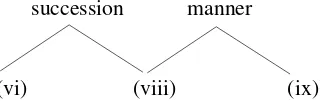
in which clause (ix) stands in amannerrelation with clause (viii), which in turn stands in asuccession(i.e., sequence) relation with clause (vi). This is illustrated in Figure 2, which shows a DAG (rather than a tree), but without crossing dependencies.
So it is the cost of moving toarbitraryDAGs for discourse structure that we feel is too great to be taken lightly. This is what has led us to look for another explanation for these and other examples of apparent complex and crossing dependencies in discourse. The position we argue for in this article, is that whereas adjacency and explicit conjunction (coordinating conjunctions such asand, or, so, andbut; subordinating con-junctions such as although, whereas, andwhen) imply discourse relations between (the interpretation of) adjacent or conjoined discourse units,discourse adverbials such as
then, otherwise, nevertheless, andinsteadare anaphors, signaling a relation between the interpretation of their matrix clause and an entity in or derived from the discourse context. This position has four advantages:
1. Understanding discourse adverbials as anaphors recognizes their behavioral similarityto the pronouns and definite noun phrases (NPs) that are the bread and butter of previous work on anaphora. This is discussed in section 2.
2. By understanding and exploring the full range of phenomena for which an anaphoric account is appropriate, we can better characterize anaphors and devise more accurate algorithms for resolving them. This is explored in section 3.
units. This is a goal that researchers have been pursuing for some time, using bothcompositionalrules and defeasible inference to determine these additional aspects of meaning (Asher and Lascarides 1999; Gardent 1997; Hobbs et al. 1993; Kehler 2002; Polanyi and van den Berg 1996; Scha and Polanyi 1988; Schilder 1997a, 1997b; van den Berg 1996) If that portion of discourse semantics that can be handled by mechanisms already needed for resolving other forms of anaphora and deixis is factored out, there is less need to stretch and possibly distort compositional rules and defeasible inference to handle everything.2 Moreover, recognizing the possibility of two separate relations (one derived anaphorically and one associated with adjacency and/or a structural connective) admits additional richness to discourse semantics. Both points are discussed further in section 4.
4. Understanding discourse adverbials as anaphors allows us to see more clearly how a lexicalized approach to the computation of clausal syntax and semantics extends naturally to the computation of discourse syntax and semantics, providing a single syntactic and semantic matrix with which to associate speaker intentions and other aspects of pragmatics (section 5.)
The account we provide here is meant to be compatible with current approaches to discourse semantics such as DRT (Kamp and Reyle 1993; van Eijck and Kamp 1997), dynamic semantics (Stokhof and Groenendijk 1999), and even SDRT (Asher 1993; Asher and Lascarides 2003), understood as a representational scheme rather than an interpretive mechanism. It is also meant to be compatible with more detailed analyses of the meaning and use of individual discourse adverbials, such as Jayes and Rossari (1998a, 1998b) and Traugott, (1995, 1997). It provides what we believe to be a more coherent account of how discourse meaning is computed, rather than an alternative account ofwhat that meaning is or what speaker intentions it is being used to achieve.
2. Discourse Adverbials as Anaphors
2.1 Discourse Adverbials Do Not Behave like Structural Connectives
We take the building blocks of the most basic level of discourse structure to be explicit structural connectivesbetween adjacent discourse units (i.e., coordinating and subor-dinating conjunctions and “paired” conjunctions such asnot only. . .but also, andon the one hand. . .on the other (hand)andinferred relationsbetween adjacent discourse units (in the absense of an explicit structural connective). Here, adjacency is what triggers the inference. Consider the following example:
(3) You shouldn’t trust John. He never returns what he borrows.
Adjacency leads the hearer to hypothesize that a discourse relation of something like explanationholds between the two clauses. Placing the subordinate conjunction (struc-tural connective)becausebetween the two clauses provides more evidence for this
tion. Our goal in this section is to convince the reader that manydiscourse adverbials, includingthen, also, otherwise, nevertheless, andinstead, do not behave in this way.
Structural connectives and discourse adverbials do have one thing in common: Like verbs, they can both be seen as heading a predicate-argument construction; unlike verbs, their arguments are independent clauses. For example, both the subordinate conjunction after and the adverbialthen(in its temporal sense) can be seen as binary predicates (e.g., sequence) whose arguments are clausally derived events, with the earlier event in first position and the succeeding event in second.
But that is the only thing that discourse adverbials and structural connectives have in common. As we have pointed out in earlier papers (Webber, Knott, and Joshi 2001; Webber et al., 1999a, 1999b), structural connectives have two relevant properties: (1) they admitstretchingof predicate-argument dependencies; and (2) they do not admit crossing of those dependencies. This is most obvious in the case of preposed subor-dinate conjunctions (example (4)) or “paired” coorsubor-dinate conjunctions (example (5)). With such connectives, the initial predicate signals that its two arguments will follow.
(4) AlthoughJohn is generous, he is hard to find.
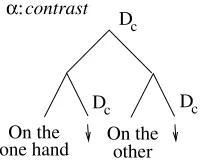
(5) On the one hand, Fred likes beans.On the other hand, he’s allergic to them.
Like verbs, structural connectives allow the distance between the predicate and its arguments to be “stretched” over embedded material, without loss of the dependency between them. For the verblikeand an object argumentapples, such stretching without loss of dependency is illustrated in example (6b).
(6) a. Apples John likes.
b. Apples Bill thinks he heard Fred say John likes.
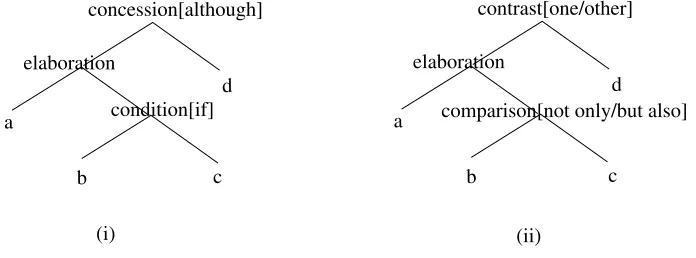
That this also happens with structural connectives and their arguments is illustrated in example (7) (in which the first clause of example (4) is elaborated by another pre-posed subordinate-main clause construction embedded within it) and in example (8) (in which the first conjunct of example (5) is elaborated by another paired-conjunction construction embedded within it). Possible discourse structures for these examples are given in Figure 3.
(7) a. Although John is very generous— b. if you need some money,
c. you only have to ask him for it— d. he’s very hard to find.
(8) a. On the one hand, Fred likes beans. b. Not only does he eat them for dinner.
c. But he also eats them for breakfast and snacks. d. On the other hand, he’s allergic to them.
But, as already noted, structural connectives do not admit crossing of predicate-argument dependencies. If we admit crossing dependencies in examples (7) and (8), we get
(i) (ii) a
b
d contrast[one/other]
elaboration
comparison[not only/but also] a
b
d elaboration
concession[although]
c c
[image:6.612.103.451.88.217.2] [image:6.612.107.474.247.348.2]condition[if]
Figure 3
Discourse structures associated with (i) example (7) and (ii) Example (8).
a b c
concession[although] condition[if] elaboration
a b
elaboration
contrast[one/other] comparison[not only...]
(i) (ii)
d c
d
Figure 4
(Impossible) discourse structures that would have to be associated with (i) Example (9) and (ii) example (10).
c. he’s very hard to find—
d. you only have to ask him for it. (10) a. On the one hand, Fred likes beans.
b. Not only does he eat them for dinner. c. On the other hand, he’s allergic to them. d. But he also eats them for breakfast and snacks.
Possible discourse structures for these (impossible) discourses are given in Figure 4. Even if the reader finds no problem with these crossed versions, they clearly do not mean the same thing as their uncrossed counterparts: In (10),butnow appears to link (10d) with (10c), conveying that despite being allergic to beans, Fred eats them for breakfast and snacks. And although this might be inferred from (8), it is certainly not conveyed directly. As a consequence, we stipulate that structural connectives do not admit crossing of their predicate-argument dependencies.3
That is not all. Since we take the basic level of discourse structure to be a conse-quence of (1) relations associated with explicit structural connectives and (2) relations
whose defeasible inference is triggered by adjacency, we stipulate thatdiscourse struc-ture itself does not admit crossing structural dependencies. (In this sense, discourse structure may be truly simpler than sentence structure. To verify this, one might examine the discourse structure of languages such as Dutch that allow crossing dependencies in sentence-level syntax. Initial cursory examination does not give any evidence of cross-ing dependencies in Dutch discourse.)
If we now consider the corresponding properties of discourse adverbials, we see that they do admit crossing of predicate-argument dependencies, as shown in exam-ples (11)–(13).
(11) a. John loves Barolo.
b. So he ordered three cases of the ’97. c. But he had to cancel the order
d. becausethenhe discovered he was broke.
(12) a. High heels are fine for going to the theater. b. But wear comfortable shoes
c. ifinsteadyou plan to go to the zoo.
(13) a. Because Fred is ill
b. you will have to stay home
c. whereasotherwise the two of you could have gone to the zoo.
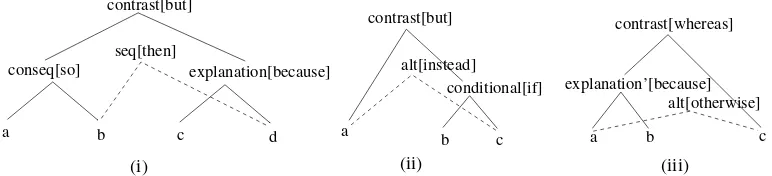
Consider first the discourse adverbial then in clause (11d). For it to get its first argument from (11b) (i.e., the event that the discovery in (d) is “after”), it must cross the structural connection between clauses (c) and (d) associated with because). This crossing dependency is illustrated in Figure 5(i). Now consider the discourse adverbial
instead) in clause (12c). For it to get its first argument from (12a) (i.e., going to the zoo is an alternative to going to the theater), it must cross the structural connection between clauses (12b) and (12c) associated with if. This crossing dependency is illustrated in Figure 5(ii). Example (13) is its mirror image: For the discourse adverbial otherwisein (13c) to get its first argument from (13a) (i.e., alternatives to the state/condition of Fred being ill), it must cross the structural connection associated with because. This is illustrated in Figure 5(iii).
Crossing dependencies are not unusual in discourse when one considers anaphora (e.g., pronouns and definite NPs), as for example in
b conseq[so]
contrast[but]
d c
seq[then]
b explanation[because]
conditional[if]
a
contrast[but]
alt[instead]
a c a b
contrast[whereas]
c explanation’[because]
alt[otherwise]
[image:7.612.104.490.552.640.2](i) (ii) (iii)
Figure 5
(14) Every mani tells every womanj hei meets that shej reminds himi of hisi
mother.
(15) Sueidrives an Alfa Romeo. Sheidrives too fast. Maryjraces herion
week-ends. Shejoften beats heri. (Strube 1998)
This suggests that in examples (11)–(13), the relationship between the discourse ad-verbial and its (initial) argument from the previous discourse might usefully be taken to be anaphoric as well.4
2.2 Discourse Adverbials Do Behave like Anaphors
There is additional evidence to suggest thatotherwise, then, and other discourse adver-bials are anaphors. First, anaphors in the form of definite and demonstrative NPs can take implicit material as their referents. For example, in
(16) Stack five blocks on top of one another. Now close your eyes and try knocking{the tower,this tower}over with your nose.
both NPs refer to the structure which is the implicit result of the block stacking. (Further discussion of such examples can be found in Isard [1975]; Dale [1992]; and Webber and Baldwin [1992].) The same is true of discourse adverbials. In
(17) Do you want an apple?Otherwise you can have a pear.
the situation in which you can have a pear is one in which you don’t want an apple— that is, one in which your answer to the question is “no.” But this answer isn’t there structurally: It is only inferred. Although it appears natural to resolve an anaphor to an inferred entity, it would be much more difficult to establish such links through purely structural connections: To do so would require complex transformations that introduce invisible elements into discourse syntax with no deeper motivation. For example, in (17), we would need a rule that takes a discourse unit consisting solely of a yes/no question P? and replaces it with a complex segment consisting of P? and the clause
it is possible that P, with the two related by something like elaboration. Then and only then could we account for the interpretation of the subsequentotherwise structurally, by a syntactic link to the covert material (i.e., to the possibility that P holds, which
otherwiseintroduces an alterative to).
Second, discourse adverbials have a wider range of options with respect to their initial argument than do structural connectives (i.e., coordinating and subordinating conjunctions). The latter are constrained to linking a discourse unit on theright frontier of the evolving discourse (i.e., the clause, sentence and larger discourse units to its immediate left). Discourse adverbials are not so constrained. To see this, consider the following example:
(18) If the light is red, stop.Otherwiseyou’ll get a ticket. (If you do something other than stop, you’ll get a ticket.) This can be paraphrased using the conjunctionor:
If the light is red, stop, or you’ll get a ticket.
Hereorlinks its right argument to a unit on the right frontier of the evolving discourse— in this case, the clausestopon its immediate left. Now consider the related example
(19) If the light is red, stop.Otherwisego straight on. (If the light is not red, go straight on.)
This cannot be paraphrased with or, as in (20) If the light is red, stop, or go straight on.
even though bothstopandIf the light is red, stopare on the right frontier of the evolving discourse structure. This is because otherwiseis accessing something else, so that (20) means something quite different from either (18) or (19). What otherwiseis accessing, which or cannot, is the interpretation of the condition alone.5 Thus discourse adver-bials, like other anaphors, have access to material that is not available to structural connectives.
Finally, discourse adverbials, like other anaphors, may require semantic represen-tations in which their arguments arebound variablesranging over discourse entities. That is, whereas it might be possible to representAlthough P,Qusing a binary modal operator
(21) although(p, q)
where formulas p and q translate the sentencesP and Qthat although combines, we cannot representP. . .Nevertheless,Qthis way. We need something more like
(22) p∧nevertheless(e, q)
The motivation for the variable e in this representation is that discourse adverbials, like pronouns, can appear intrasententially in an analog of donkey sentences. Donkey sentences such as example (23) are a special kind of bound-variable reading:
(23) Every farmer who owns a donkey feedsit rutabagas.
In donkey sentences, anaphors are interpreted as covarying with their antecedents: The it that is being fed in (23) varies with the farmer who feeds it. These anaphors, however, appear in a structural and interpretive environment in which a direct syn-tactic relationship between anaphor and antecedent is normally impossible, so they cannot be a reflex of true binding in the syntax-semantics interface. Rather, donkey sentences show thatdiscoursesemantics has to provide variables to translate pronouns,
and thatdiscoursemechanisms must interpret these variables as bound—even though the pronouns appear “free” by syntactic criteria.
Thus, it is significant that discourse adverbials can appear in their own version of donkey sentences, as in
(24) a. Anyone who has developed innovative new software has thenhad to hire a lawyer to protect his/her interests. (i.e.,after developing innovative new software)
b. Several people who have developed innovative new software have
neverthelessfailed to profit from it. (i.e.,despite having developed innovative new software)
c. Every person selling “The Big Issue” might otherwise be asking for spare change. (i.e.,if he/she weren’t selling “The Big Issue”)
The examples in (24) involve binding in the interpretation of discourse adverbials. In (24a), the temporal use of then locates each hiring event after the corresponding software development. Likewise in (24b), the adversative use of nevertheless signals each developer’s unexpected failure to turn the corresponding profit. And in (24c),
otherwiseenvisions each person’s begging if that person weren’t selling ”The Big Issue”. Such bound interpretations require variables in the semantic representations and alternative values for them in some model—hence the representation given in (22). Indeed, it is clear that the binding here has to be the discourse kind, not the syntac-tic kind, for the same reason as in (23), although we cannot imagine anyone arguing otherwise, since discourse adverbials have always been treated as elements of dis-course interpretation. So the variables must be the disdis-course variables usually used to translate other kinds of discourse anaphors.6
These arguments have been directed at the behavioral similarity between discourse adverbials and what we normally take to be discourse anaphors. But this isn’t the only reason to recognize discourse adverbials as anaphors: In the next section, we suggest a framework for anaphora that is broad enough to include discourse adverbials as well as definite and demonstrative pronouns and NPs, along with other discourse phenomena that have been argued to be anaphoric, such as VP ellipsis (Hardt 1992, 1999; Kehler 2002), tense (Partee 1984; Webber 1988) and modality (Kibble 1995; Frank and Kamp 1997; Stone and Hardt 1999).
3. A Framework for Anaphora
Here we show how only a single extension to a general framework for discourse anaphora is needed to cover discourse adverbials. The general framework is presented in Section 3.1, and the extension in Section 3.2.
3.1 Discourse Referents and Anaphor Interpretation
The simplest discourse anaphors arecoreferential: definite pronouns and definite NPs that denote one (or more) discourse referents in focus within the current discourse
context. (Undercoreferencewe includesplit reference, in which a plural anaphor such as the companies denotes all the separately mentioned companies in focus within the discourse context.) Much has been written about the factors affecting what discourse referents are taken to be in focus. For a recent review by Andrew Kehler, see chap-ter 18 of Jurafsky and Martin (2000). For the effect of different types of quantifiers on discourse referents and focus, see Kibble (1995).
Somewhat more complex than coreference is indirect anaphora (Hellman and Fraurud 1996) (also called partial anaphora[Luperfoy 1992], textual ellipsis [Hahn, Markert, and Strube 1996], associative anaphora [Cosse 1996] bridging anaphora [Clark 1975; Clark and Marshall 1981; Not, Tovena, and Zancanaro 1999], and in-ferrables[Prince 1992]), in which the anaphor (usually a definite NP) denotes a dis-course referentassociated withone (or more) discourse referents in the current discourse context; for example,
(25) Myra darted toa phone and picked upthe receiver.
Here the receiver denotes the receiver associated with (by virtue of being part of) the already-mentioned phone Myra darted to.
Coreference and indirect anaphora can be uniformly modeled by saying that the discourse referenteαdenoted by an anaphoric expressionαis either equal to or asso-ciated with an existing discourse referent er, that is, eα=er oreα ∈assoc(er). But
coref-erence and associative anaphora do not exhaust the space of constructs that derive all or part of their sense from the discourse context and are thus anaphoric. Consider “other NPs” (Bierner 2001a; Bierner and Webber 2000; Modjeska 2001, 2002), as in:
(26) Sue grabbed one phone, as Tom darted tothe other phone.
Although “other NPs” are clearly anaphoric, should the referent of the other phone
(eα)—the phone other than the one Sue grabbed (er)—simply be considered a case of
eα∈assoc(er)? Here are two reasons why they should not.
First, in all cases of associative anaphora discussed in the literature, possible as-sociations have depended only on the antecedent er and not on the anaphor. For
example, only antecedents that have parts participate in whole-part associations (e.g., phone→receiver). Only antecedents with functional schemata participate in schema-based associations (e.g., lock→key). In (26), the relationship betweeneα, the referent ofthe other phone, and its antecedent,er, depends in part on the anaphor, and not just
on the antecedent—in particular, on the presence of the word other. Second, we also have examples such as
(27) Sue lifted the receiver as Tom darted to the other phone.7
in which the referent ofthe other phone(eα) is the phoneother thanthe phoneassociated
withthe receiver that Sue lifted. Together, these two points argue for a third possibility, in which an anaphoric element can convey a specific function fα that is idiosyncratic to the anaphor, which may be applied to either er or an associate of er. The result of
that application iseα. For want of a better name, we will call these lexically specified anaphors.
Other lexically specified anaphors include noun phrases headed by other (exam-ple (28)), NPs withsuchbut no postmodifying as phrase (example (29)), comparative
NPs with no postmodifying than phrase (example (30)), and the pronoun elsewhere
(example (31)) (Bierner 2001b)
(28) Some dogs are constantly on the move. Otherslie around until you call them.
(29) I saw a 2kg lobster in the fish store yesterday. The fishmonger said it takes about five years to grow tosuch a size.
(30) Terriers are very nervous.Larger dogstend to have calmer dispositions.
(31) I don’t like sitting in this room. Can we moveelsewhere?
To summarize the situation with anaphors so far, we have coreference wheneα=er,
indirect anaphora wheneα∈assoc(er), and lexically specified anaphora wheneα=fα(ei)
whereei=erorei∈assoc(er).
3.2 Discourse Adverbials as Lexical Anaphors
There is nothing in this generalized approach to discourse anaphora that requires that the source of er be an NP, or that the anaphor be a pronoun or NP. For example, the
antecedent er of a singular demonstrative pronoun (in English, this or that) is often
an eventuality that derives from a clause, a sentence, or a larger unit in the recent discourse (Asher 1993; Byron 2002; Eckert and Strube 2000; Webber 1991). We will show that this is the case with discourse adverbials as well.
The extension we make to the general framework presented above in order to include discourse adverbials as discourse anaphors is to allow more general functions
fα to be associated with lexically specified anaphors. In particular, for the discourse adverbials considered in this article, the function associated with an adverbial maps its anaphoric argument—an eventuality derived from the current discourse context—to a function that applies to the interpretation of the adverbial’s matrix clause (itself an eventuality). The result is abinary relation that holds between the two eventualities and is added to the discourse context. For example, in
(32) John loves Barolo. So he ordered three cases of the ’97. But he had to cancel the order because hethendiscovered he was broke.
then, roughly speaking, contributes the fact that its matrix clause event (John’s find-ing he was broke) is after the anaphorically derived event of his ordering the wine.8 Similarly, in
(33) John didn’t have enough money to buy a mango. Instead, he bought a guava.
insteadcontributes the fact that its matrix clause event (buying a guava) is an alternative to the anaphorically derived event of buying a mango. The relation between the two sentences is something likeresult, as inSo instead, he bought a guava.
Note that our only concern here is with the compositional and anaphoric mech-anisms by which adverbials contribute meaning. For detailed analysis of the lexical semantics of adverbials (but no attention to mechanism), the reader is referred to Jayes and Rossari (1998a, 1998b, Lagerwerf (1998), Traugott (1995, 1997), and others.
Formally, we represent the function that a discourse adverbialαcontributes as a λ-expression involving a binary relation Rα that is idiosyncratic to α, one of whose arguments (represented here by the variableEV) is resolved anaphorically:
λx.Rα(x,EV)
Rα gets its other argument compositionally, when this λ-expression is applied to α’s matrix clause Sinterpreted as an eventualityσ, that is,
[λx.Rα(x,EV)]σ≡Rα(σ,EV)
The result of both function application and resolvingEVto some eventualityeiderived
from the discourse context either directly or by association is the propositionRα(σ,ei),
one of whose arguments (ei) has been supplied by the discourse context and the other
(σ) compositionally from syntax.
Note that this is a formal model, meant to have no implications for how pro-cessing takes place. We have not tried at this stage to instantiate our view of how discourse adverbials are resolved in the context of (simultaneous) sentence-level and discourse-level processing. Our basic view is that resolution is initiated when the dis-course adverbial (α) is encountered. Asα’s matrix clauseSis incrementally parsed and interpreted, producing eventualityσ, the resolution process polls the discourse context and either finds an appropriate eventuality ei(or creates one by a bridging inference,
as illustrated in the next section) such that Rα(σ,ei)makes sense with respect to the
discourse so far. As is the case with resolving adiscourse deictic(Asher 1993; Byron 2002; Eckert and Strube 2000; Webber 1991) this resolution process would use syn-tactic and semantic constraints that it accumulates as the incremental sentence-level parser/interpreter processes S. As with discourse deixis, this is best seen as a con-straint satisfaction problem that involves finding or deriving an eventuality from the current discourse context that meets the constraints of the adverbial with respect to the eventuality interpretation of the matrix clause. (Examples of this are given throughout the rest of the article.)
3.3 A Logical Form for Eventualities
Before using this generalized view of anaphora to show what discourse adverbials contribute to discourse and how they interact with discourse relations that arise from adjacency or explicit discourse connectives, we briefly describe how we represent clausal interpretations in logical form (LF).
Essentially, we follow Hobbs (1985) in using a rich ontology and a representation scheme that makes explicit all the individuals and abstract objects(i.e., propositions, facts/beliefs, and eventualities) (Asher 1993) involved in the LF interpretation of an utterance. We do so because we want to make intuitions about individuals, eventual-ities, lexical meaning, and anaphora as clear as possible. But certainly, other forms of representation are possible.
In this LF representation scheme, each clause and each relation between clauses is indexed by the label of its associated abstract object. So, for example, the LF inter-pretation of the sentence
would be written
e1:left(j)∧john(j)∧e2:left(m) ∧mary(m)∧e3:because(e1,e2)
where the first argument of the asymmetric binary predicatebecauseis the consequent and the second is the eventuality leading to this consequent. Thus whenbecauseoccurs sentence-medially, as in the above example, the eventuality arguments are in the same order as their corresponding clauses occur in the text. Whenbecause occurs sentence-initially (as inBecause Mary left, John did), the interpretation of the second clause (John
[left]) will appear as the first argument and the interpretation of the first clause (Mary left) will appear as the second.9
The set of available discourse referents includes both individuals likejandm, and also abstract objects like e1 and e2. We then represent resolved anaphors by reusing
these discourse referents. So, for example, the LF interpretation of the follow-on sen-tence
(35) This upset Sue. would be written
e4:upset(DPRO, s)∧sue(s)
where DPRO is the anaphoric variable contributed by the demonstrative pronounthis. Since the subject of upsetcould be either the eventuality of John’s leaving or the fact that he left because Mary left, DPRO could be resolved to either e1 ore3, that is,
a.e4:upset(e1, s)∧sue(s)
b.e4:upset(e3, s)∧sue(s)
depending on whether one took Sue to have been upset by (1) John’s leaving or (2) that he left because Mary left.
3.4 The Contribution of Discourse Adverbials to Discourse Semantics
Here we step through some examples of discourse adverbials and demonstrate how they make their semantic contribution to the discourse context. We start with exam-ple (32), repeated here as (36):
(36) a. John loves Barolo.
b. So he ordered three cases of the ’97. c. But he had to cancel the order
d. because hethendiscovered he was broke.
Using the above LF representation scheme and our notation from Section 3.2, namely,
• α= the anaphoric expression (here, the discourse adverbial) • Rα= the relation name linked with α
• S= the matrix clause/sentence containingα • σ= the interpretation ofSas an abstract object
and ignoring, for now, the conjunction because (discussed in section 4), the relevant elements of (36d) can be represented as:
α=then Rα= after
S= he[John]discovered he was broke σ=e4:find(j,e5), wheree5:broke(j)
This means that the unresolved interpretation of (36d) is
[λx .Rα(x,EV)]σ ≡ [λx .after(x,EV)]e4 ≡after(e4,EV)
The anaphoric argument EV is resolved to the eventuality e2, derived from (36b)— e2:order(j,c1).
after(e4,EV)→after(e4,e2)
That is, the eventuality of John’s finding he was broke is after that of John’s ordering three cases of the ’97 Barolo. The resulting proposition after(e4,e2) would be given its
own index,e6, and added to the discourse context.
When then is understood temporally, as it is above, as opposed to logically, it requires a culminated eventuality from the discourse context as its first argument (which Vendler (1967) calls an achievement or an accomplishment). The ordering event in (36b) is such a Vendlerian accomplishment. In example (37), though, there is no culminated eventuality in the discourse context for then), to take as its first argument.
(37) a. Go west on Lancaster Avenue. b.Thenturn right on County Line.
How does (37b) get its interpretation?
As with (36d), the relevant elements of (37b) can be represented as
α=then Rα= after
S= turn right on County Line σ=e3:turn-right(you,county line)
and the unresolved interpretation of (37b) is thus
As for resolving EV, in a well-known article, Moens and Steedman (1988) discuss several ways in which an eventuality of one type (e.g., a process) can be coerced into an eventuality of another type (e.g., an accomplishment, which Moens and Steedman call aculminated process). In this case, the matrix argument ofthen(the eventuality of
turning right on County Line) can be used to coerce the process eventuality in (37b) into a culminated process of going west on Lancaster Avenue until County Line. We treat this coercion as a type of associative or bridging inference, as in the examples discussed in section 3.1. That is,
e2 = culmination(e1)∈assoc(e1), wheree1:go-west(you,lancaster ave)
Taking thise2 as the anaphoric argumentEV ofthenyields the proposition
after(e3,e2)
That is, the eventuality of turning right onto County Line is after that of going west on Lancaster Avenue to County Line. This proposition would be indexed and added to the discourse context.
It is important to stress here that the level of representation we are concerned with is essentially an LF for discourse. Any reasoning that might then have to be done on the content of LFs might then require making explicit the different modal and temporal contexts involved, their accessibility relations, the status of abstract objects as facts, propositions or eventualities, and so on. But as our goal here is primarily to capture the mechanism by means of which discourse adverbials are involved in discourse structure and discourse semantics, we will continue to assume for as long as possible that an LF representation will suffice.
Now it may appear as if there is no difference between treating adverbials as anaphors and treating them as structural connectives, especially in cases like (37) in which the antecedent comes from the immediately left-adjacent context, and in which the only obvious semantic relation between the adjacent sentences appears to be the one expressed by the discourse adverbial. (Of course, there may also be a separate intentionalrelation between the two sentences [Moore and Pollack 1992], independent of the relation conveyed by the discourse adverbial.)
One must distinguish, however, between whether a theory allows a distinction to be made and whether that distinction needs to be made in a particular case. It is clear that there are many examples in which the two approaches (i.e., a purely structural treatment of all connectives, versus one that treats adverbials as linking into the discourse context anaphorically) appear to make the same prediction. We have already, however, demonstrated cases in which a purely structural account makes the wrong prediction, and in the next section, we will demonstrate the additional power of an account that allows for two relations between an adverbial’s matrix clause or sentence and the previous discourse: one arising from the anaphoric connection and the other inferred from adjacency or conveyed explicitly by a structural connective.
Before closing this section, we want to step through examples (19)–(20), repeated here as examples (38)–(39).
(38) If the light is red, stop.Otherwiseyou’ll get a ticket.
Roughly speaking,otherwiseconveys that thecomplementof its anaphorically derived argument serves as the conditionunder which the interpretation of its structural ar-gument holds. (This complement must be with respect to some contextually relevant set.)10
If we represent a conditional relation between two eventualities with the asym-metric relationif(e1,e2), wheree1is derived from theantecedentande2from the
conse-quent, and we approximate a single contextually relevant alternativee2 to an
eventu-alitye1using a symmetriccomplementrelation,complement(e1,e2), then we can represent
the interpretation ofotherwiseas
λx .if(VE, x), where complement(VE,EV)
where variableEVis resolved anaphorically to an eventuality in the current discourse context that admits a complement. That is, otherwise requires a contextually relevant complement to its antecedent and asserts that if that complement holds, the argument to theλ-expression will as well. The resultingλ-expression applies to the interpretation of the matrix clause of otherwise, resulting in the conditional’s being added to the discourse context:
[λx .if(VE,x)]σ≡if(VE,σ), wherecomplement(VE,EV)
Here the relevant elements of (38b) and (39b) can be represented as
α= otherwise
Rα= if
S38 = you get a ticket
σ38 =e3, wheree3:get ticket(you) S39 = go straight on
σ39 =e3, wheree3:go straight(you)
The unresolved interpretations of (38b) and (39b) are thus:
[λx .if(VE38,x)]e3 ≡if(VE38,e3), wherecomplement(VE38,EV38)
[λx .if(VE39,x)]e3 ≡if(VE39,e3), wherecomplement(VE39,EV39)
As we showed in section 2.2, different ways of resolving the anaphoric argument lead to different interpretations. In (38), the anaphoric argument is resolved toe2:stop(you),
10 Kruijff-Korbayov´a and Webber (2001a) demonstrate that theinformation structureof sentences in the previous discourse (theme-rheme partitioning, as well as focus within theme and within rheme [Steedman 2000a]) can influence what eventualitieserare available for resolving the anaphorically
derived argument ofotherwise. This then correctly predicts different interpretations for “otherwise” in (i) and (ii):
(i) Q. How should I transport the dog?
A. You shouldcarrythe dog. Otherwise you might gethurt.
(ii) Q. What should I carry?
A. You should carrythe dog. Otherwise you might gethurt.
whereas in (39), it is resolved to e1:red(light1). Thus the resulting interpretations of
(38b) and (39b) are, respectively,
if(e4,e3), wherecomplement(e2,e4) ande2:stop(you)
(If you do something other than stop, you’ll get a ticket.)
if(e4,e3), wherecomplement(e1,e4) and e1:red(light) (If the light is not red, go straight on.)
We have not been specific about how the anaphoric argument of otherwise (or of any other discourse adverbial) is resolved, other than having it treated as a con-straint satisfaction problem. This is the subject of current and future work, exploring the empirical properties of resolution algorithms with data drawn from appropriately annotated corpora and from psycholinguistic studies of human discourse interpreta-tion. To this end, Creswell et al. (2002) report on a preliminary annotation study of discourse adverbials and the location and type of their antecedents. This initial ef-fort involves nine discourse adverbials—three each from the classes of concessive, result, and reinforcing (additive) conjuncts given in Quirk et al. (1972). Meanwhile, Venditti et al. (2002) present a preliminary report on the use of a constraint satisfac-tion model of interpretasatisfac-tion, crucially combining anaphoric and structural reasoning about discourse relations, to predict subjects’ on-line interpretation of discourses in-volving stressed pronouns. In addition, two proposals have recently been submitted to construct a larger and more extensively annotated corpus, covering more adverbials, based on what we have learned from this initial effort. This more extensive study would be an adequate basis for developing resolution algorithms.11
3.5 Summary
In this section, we have presented a general framework for anaphora with the follow-ing features:
• Anaphors can access one or more discourse referents or entities associated with them through bridging inferences. These are sufficient for interpreting anaphoric pronouns, definite NPs and demonstrative NPs, allowing entities to be evoked by NPs or by clauses. In the case of clauses, this may be on an as-needed basis, as in Eckert and Strube (2000).
• A type of anaphorαthat we calllexically specified can also contribute additional meaning through a functionfα that is idiosyncratic toα, that can be applied to either an existing discourse referent or an entity associated with it through a bridging inference. In the case of the premodifierother,fα applied to its argument produces contextually
relevant alternatives to that argument. In the case of the premodifier
such, it yields a set of entities that are similar to its argument in a contextually relevant way.
• Discourse adverbials are lexically specified anaphors whose meaning functionfαis aλ-expression involving a binary relationRα that is idiosyncratic toα, one of whose arguments is resolved anaphorically and the other is provided compositionally, when theλ-expression is applied toα’s matrix clause interpreted as an eventualityσ.
In the next section, we move on to consider how the presence of both a semantic rela-tion associated with a discourse adverbial and a semantic relarela-tion associated with the adjacency of two clauses or a structural connective between them allows for interesting interactions between the two.
4. Patterns of Anaphoric Relations and Structural/Inferred Relations
Prior to the current work, researchers have treated both explicit structural connec-tives (coordinating and subordinating conjunctions, and “paired” conjunctions) and discourse adverbials simply as evidence for a particular structural relation holding between adjacent units. For example, Kehler (2002) takesbutas evidence of acontrast relation between adjacent units, in general as evidence of a generalization relation,
in other words as evidence of anelaboration relation, therefore as evidence of aresult relation, because as evidence of anexplanation relation, andeven though as evidence of a denial of preventerrelation (Kehler 2002, Section 2.1). Here Kehler has probably correctly identified the type of relation that holds between elements, but not which elements it holds between.
In one respect, we follow previous researchers, in that we accept that when clauses, sentences, or larger discourse units are placed adjacent to one another, listeners infer a relation between the two, and that the structural connective (coordinate or subordinate conjunction) gives evidence for the relation that is intended to hold between them.
Because we take discourse adverbials to contribute meaning through an anaphoric connection with the previous discourse, however, this means that there may be two relations on offer and opens up the possibility that the relation contributed by the discourse adverbial can interact in more than one way with the relation conveyed by a structural connective or inferred through adjacency. Below we show that this prediction is correct.
We start from the idea that, in the absence of an explicit structural connective, de-feasible inference correlates with structural attachment of adjacent discourse segments in discourse structure, relating their interpretations. The most basic relation is that the following segment in some way describes the same object or eventuality as the one it abuts (elaboration). But evidence in the segments can lead (via defeasible inference) to a more specific relation, such as one of theresemblancerelations (e.g.,parallel,contrast,
exemplification,generalisation), orcause-effectrelations (result,explanation,violated expecta-tion), orcontiguityrelations (narration) described in Hobbs (1990) and Kehler (2002). If nothing more specific can be inferred, the relation will remain simplyelaboration. What explicit structural connectives can do is convey relations that are not easy to convey by defeasible inference (e.g., if, conveying condition, and or, conveyingdisjunction) or provide nondefeasible evidence for an inferrable relation (e.g.,yet, so,and because).
have so far observed discourse adverbials to interact with relations conveyed struc-turally, we extend the notation used in the previous section:
• α= discourse adverbial
• Rα= the name of the relation associated withα • S= the matrix clause/sentence ofα
• σ= the logical form (LF) interpretation ofS
adding the following:
• D= the discourse unit that is left-adjacent toS, to which a relationship holds by either inference or a structural connective
• δ= the LF interpretation of D
• R= the name of the relation that holds withδ
Althoughδ is one argument ofR, we show below that the other argument ofRmay be one of at least two different abstract objects.
Case 1:σ separately serves as an argument to bothRα andR. This is the case that holds in example (36) (repeated here):
(36) a. John loves Barolo.
b. So he ordered three cases of the ’97. c. But he had to cancel the order
d. because hethendiscovered he was broke.
We have already seen that the interpretation of the clause in (36d) following because
involves
Rα= after
σ=e4:discover(j,e5), wheree5:broke(j)
[λx .after(x,EV)]e4 ≡after(e4,EV)
whereEV is resolved toe2:order(j,c1), and the propositionafter(e4,e2) is added to the
discourse context—that is, John’s discovering he was broke is after his ordering the wine.
Now consider theexplanationrelationRassociated withbecausein (36d). It relates
e4, John’s finding he was broke, to the intepretation of (36c), e3:cancel(j,o1)—that is, explanation(e4,e3). Clause 36d thus adds both explanation(e4,e3) and after(e4,e2) to the
discourse. Although these two propositions share an argument (e4), they are
neverthe-less distinct.12
Case 2: Rα(σ,ei) is an argument of R. In case 1, it is the interpretation of the
ad-verbial’s matrix clause σ that serves as one argument to the discourse relation R. In contrast, in case 2, that argument is filled by the relation contributed by the discourse adverbial (itself an abstract object available for subsequent reference). In both cases, the other argument toRisδ.
One configuration in which case 2 holds is with the discourse adverbialotherwise. Recall from section 3.4 that the interpretation ofotherwiseinvolves a conditional relation between the complement of its anaphoric argument and the interpretation σ of its matrix clause:
[λx .if(VE,x)]σ≡if(VE,σ), wherecomplement(VE,EV)
With variableEVresolved to an eventuality in the discourse context, it is the resulting relation (viewed as an abstract object) that serves as one argument toR, withδserving as the other. We can see this most clearly by considering variants of examples (38) and (39) that contain an explicit connective between the clauses. In (38), the conjunction
becauseis made explicit (example (40)), and in (39), the connective is simplyandorbut
(example (41)).
(40) If the light is red, stop, becauseotherwiseyou’ll get a ticket.
Rα= if
σ38 =e3:get ticket(you)
(41) If the light is red, stop, and/butotherwisego straight on.
Rα= if
σ39 =e3:go straight(you)
In the case of (40), resolvingotherwise contributes the relation
e6:if(e4,e3), wherecomplement(e4,e2) ande2:stop(you)
(If you do something other than stop, you’ll get a ticket.)
At the level of LF, the abstract objecte6 that is associated with the conditional relation
serves as one argument to theexplanationrelation contributed bybecause, withe2being
the other. That is,becauseand otherwisetogether end up contributingexplanation(e2,e6)
(i.e., your needing to stop is explained by the fact that if you do something other than stop, you’ll get a ticket).
In the case of (41), resolvingotherwise contributes the relation
e6:if(e4,e3), wherecomplement(e4,e1) ande1:red(light) (If the light is not red, go straight on.)
What is the discourse relation to which otherwise contributes this abstract object e6?
Whether the connective isandorbut, both its conjuncts describe (elaborate) alternative specializations of the same situatione0introduced earlier in the discourse (e.g.,e0could
be associated with the first sentence of Go another mile and you’ll get to a bridge. If the light is red, stop. Otherwise go straight on.) If the connective is and, what is added to context might simply be elaboration(e6,e0). (Note that without otherwise, the relation elaboration(e5,e0) would have been added to context, where e5 is the abstract object
red) you should stop is in contrast to the situation that if the light is not red, you should go straight on.13
As is clear from the original pair of examples (38) and (39), interpretations can arise through adjacency-triggered inference that are similar to those that arise with an explicit connective. In either case, the above treatment demonstrates that there is no need for a separateotherwiserelation, as proposed in rhetorical structure theory (Mann and Thompson 1988). We are not, however, entirely clear at this point when case 1 holds and when case 2 does. A more careful analysis is clearly required.
Case 3:Rαis parasitic onR. Case 3 appears to apply with discourse adverbials such as for example and for instance. The interpretation of such adverbials appears to be parasitic on the relation associated with a structural connective or discourse adverbial to their left, or on an inferred relation triggered by adjacency. The way to understand this is to first consider intraclausal for example, where it follows the verb, as in
(42) Q. What does this box contain?
A. It contains,for example, some hematite.
The interpretation of for example here involves abstracting the meaning of its matrix structure with respect to the material to its right, then making an assertion with respect to this abstraction. That is, if the LF contributed by the matrix clause of (42A) is, roughly,
i. contain(box1,hematite1)
then the LF resulting from the addition of for example can be written either with set notation (as in (ii)), taking an entity to exemplify a set, or withλ-notation (as in (iii)), taking an entity to exemplify a property:
ii.exemplify(hematite1,{X|contain(box1,X)}) iii.exemplify(hematite1,λX . contain(box1,X))
Both express the fact thathematiteis an example of what is contained in the box.14Since one can derive (i) logically from either (ii) or (iii), one might choose to retain only (ii) or (iii) and derive (i) if and when it is needed. In the remainder of the article, we use the λnotation given in (iii). Note that from the perspective of compositional semantics,for exampleresembles a quantifier, in that the scope of its interpretation is not isomorphic to its syntactic position. Thus producing an interpretation for for examplewill require techniques similar to those that have long been used in interpreting quantifiers (Woods, 1978; Barwise and Cooper 1981). We take this up again in section 5.
If we look at the comparable situation in discourse, such as (43)–(44), where for exampleoccurs to the right of a discourse connective, it can also be seen as abstracting
13 A much finer-grained treatment of the semantics ofotherwisein terms of context-update potential is given in Kruijff-Korbayov´a and Webber (2001b). Here we are just concerned with its interaction with structural connectives and adjacency-triggered relations.
14 The material to the right offor examplecan be any kind of constituent, including such strange ones as John gave, for example, a flower to a nurse.
the interpretation of its discourse-level matrix structure, with respect to the material to its right:
(43) John just broke his arm.So, for example, he can’t cycle to work now.
(44) You shouldn’t trust John because, for example, he never returns what he borrows.
In (43), the connectivesoleads to
result(σ,δ)
being added to the discourse, where σ is the interpretation ofJohn can’t cycle to work now, andδis the interpretation ofJohn just broke his arm.For examplethen abstracts this relation with respect to the material to its right (i.e.,σ), thereby contributing
exemplify(σ,λX .result(X,δ))
That is, John can’t cycle to work is an example of what results from John’s breaking his arm. Similarly,because in (44) leads to
explanation(σ,δ)
being added to the discourse, whereσ is the interpretation ofhe never returns what he borrows,δis the interpretation ofyou shouldn’t trust John, andfor exampleadds
exemplify(σ,λX .explanation(X,δ))
that is, thatσis an example of the reasons for not trusting John.
For example interacts with discourse adverbials in the same way:
(45) Shall we go to the Lincoln Memorial? Then, for example, we can go to the White House.
(46) As a money manager and a grass-roots environmentalist, I was very dis-appointed to read in the premiere issue of Garbage that The Wall Street Journal uses 220,000 metric tons of newsprint each year, but that only 1.4% of it comes from recycled paper.By contrast, the Los Angeles Times,for ex-ample, uses 83% recycled paper.[WSJ, from Penn Treebank /02/wsj-0269]
In example (45), the resolved discourse adverbial thenleads toafter(σ,δ) being added to the discourse context, whereσis the interpretation ofwe can go to the White House,δ is the interpretation ofwe shall go to the Lincoln Memorial, andfor exampleadds
exemplify(σ,λX .after(X,δ))
In example (46), the resolved discourse anaphorby contrastcontributescontrast(σ,δ), whereσis the interpretation ofthe Los Angeles Times’s using 83% recycled paperandδis the intepretation of only 1.4% of it[newsprint used by the WSJ]comes from recycled paper.
For example then contributes
exemplify(σ,λX .contrast(X,δ))
that is, that σ is one example of contrasts with the WSJ’s minimal use of recycled paper.
What occurs with discourse connectives and adverbials can also occur with rela-tions added through adjacency-triggered defeasible inference, as in
(47) You shouldn’t trust John.For example, he never returns what he borrows.
explanation(δ,σ)
exemplify(σ,λX .explanation(δ,X))
Here, as in (44), the relation provided by adjacency-triggered inference isR= explana-tion, which is then used byfor example.
But what about the many cases in which onlyexemplifyseems present, as in (48) In some respects they [hypertext books] are clearly superior to normal
books, for example they have database cross-referencing facilities ordinary volumes lack. (British National Corpus, CBX 1087)
(49) He[James Bellows]and his successor, Mary Anne Dolan, restored respect for the editorial product, and though in recent years the paper had been limping along on limited resources, its accomplishments were notable.For example, the Herald consistently beat its much-larger rival on disclosures about Los Angeles Mayor Tom Bradley’s financial dealings.
There are at least two explanations: One is thatfor examplesimply provides direct nondefeasible evidence for exemplify, which is the only relation that holds. The other explanation follows the same pattern as the examples given above, but with no further relation thanelaboration(σ,δ). That is, we understand in (48) that having database cross-referencing facilities elaborates the respects in which hypertext books are superior to normal books, whereas in (49), we understand thatthe Herald’s[newspaper]consistently beating its much-larger rivalelaborates the claim thatits accomplishments were notable. This
elaborationrelation is then abstracted (in response tofor example) to produce:
exemplify(σ,λX .elaboration(X,δ))
that is, that this is one example of many possible elaborations. Because this is more specific than elaboration and seems to mean the same as exemplify(σ,δ), one might simply take it to be the only relation that holds. Given that so many naturally occuring instances offor exampleoccur withelaboration, it is probably useful to persist with the above shorthand. But it shouldn’t obscure the regular pattern that appears to hold.
(50) In the case of the managed funds they will be denominated in a leading currency, for example US dollar,. . .(BNC CBX 1590)
for example relates the general concept denoted by a leading currency to a specific in-stance, U.S. dollars. (In British English, the BNC shows that most such examples occur withsuch as—i.e., in the constructionsuch as for example. This paraphrase does not work with the predicate-abstractingfor example that is of primary concern here, as in exam-ple (42).)
Butfor exampleoccurring after an NP, a PP, or a clause can, alternatively, contribute a more subtle parasitic relationship to the previous clause, as in
(51) All the children are ill, so Andrew,for example, can’t help out in the shop. This differs from both (43) and (50). That is, one cannot paraphrase (51) as (52) as in (43) wherefor examplefollowsso:
(52) All the children are ill, sofor exampleAndrew can’t help out in the shop.
Example (52) simply specifies an example consequence of all the children being ill, as does
(53) All the children are ill, so for example one of us has to be at home at all times.
In contrast, (51) specifies an example consequence for Andrew, as one of the children. Support for this comes from the fact that in (52), Andrew doesn’t have to be one of the children: He could be their nanny or child minder, now stuck with dealing with a lot of sick kids. But (51) is not felicitous if Andrew is not one of the children.
We suspect here the involvement of information structure (Steedman 2000a): Whereas the interpretation conveyed byfor example is parasitic on the adjacency rela-tion (result in example (51)), its position after the NPAndrew in (51) may indicate a contrastive themewith respect to the previous clause, according to which Andrewin contrast to the other childrensuffers this particular consequence. But more work needs to be done on this to gain a full understanding of what is going on.
Case 4: Rα is a defeasible rule that incorporates R. Case 4 occurs with discourse adverbials that carry the same presupposition as the discourse connectives although
and the concessive sense of while (Lagerwerf 1998). Case 4 shares one feature with case 1, in that the discourse relationRconveyed by a structural connective or inferred from adjacency holds between σ (the interpretation of the adverbial’s matrix clause) and δ (the interpretation of the left-adjacent discourse unit). Where it differs is that the result is then incorporated into thepresuppositionof the discourse adverbial. This presupposition, according to Lagerwerf (1998), has the nature of a presupposed (or conventionally implicated) defeasible rulethat fails to hold in the current situation. He gives as an example
(54) Although Greta Garbo was called the yardstick of beauty, she never mar-ried.
presupposes that, in general, if a woman is beautiful, she will marry. If such a pre-supposition can be accommodated, it will simply be added to the discourse context. If not, the hearer will find the utterance confusing or possibly even insulting.
We argue here that the same thing happens with the discourse adverbials never-thelessandthough. The difference is that, with discourse adverbials, the antecedent to the rule derives anaphorically from the previous discourse, whereas the consequent derives from the adverbial’s matrix clause. (With the conjunctions although and con-cessive while, both arguments are provided structurally.)
We first illustrate case 4 with two examples in which nevertheless occurs in the main clause of a sentence containing a preposed subordinate clause. The subordinate conjunction helps clarify the relation between the clauses that forms the basis for the presupposed defeasible rule. After these, we give a further example in which the relation between the adjacent clauses comes through inference.
(55) WhileJohn is discussing politics, he isneverthelessthinking about his fish.
In (55), the conjunctionwhile conveys a temporal relationR between the two clauses it connects:
during(e2,e1), wheree1:discuss(john,politics) ande2:think about(john,fish)
Whatnevertheless contributes to (55) is a defeasible rule based on this relation, which we will write informally as
during(X,E)∧E:discuss(Y,politics))>¬X:think about(Y,fish))
Normally, whatever one does during the time one is discussing politics, it is not thinking about one’s fish.
This rule uses Asher and Morreau’s (1991) defeasible implication operator (>) and abstracts over the individual (John), which seems appropriate for the general statement conveyed by the present tense of the utterance.
Similarly, in
(56) Even after John has had three glasses of wine, he is nevertheless able to solve difficult math problems.
the conjunctionafter contributes a relation between the two clauses it connects:
after(e2,e1), wheree1:drink(john,wine) ande2:solve(john,hard problems)
What nevertheless contributes to this example is a defeasible rule that we will again write informally as
after(X,E)∧E:drink(Y,wine)) >¬X:solve(Y,hard problems))