Shallow Convolutional Neural Network
for Implicit Discourse Relation Recognition
Biao Zhang1, Jinsong Su1∗, Deyi Xiong2, Yaojie Lu1, Hong Duan1 and Junfeng Yao1 Xiamen University, Xiamen, China 3610051
Soochow University, Suzhou, China 2150062
{zb, lyj}@stu.xmu.edu.cn, {jssu, hduan, yao0010}@xmu.edu.cn [email protected]
Abstract
Implicit discourse relation recognition re-mains a serious challenge due to the ab-sence of discourse connectives. In this pa-per, we propose a Shallow Convolutional Neural Network (SCNN) for implicit dis-course relation recognition, which con-tains only one hidden layer but is effec-tive in relation recognition. The shallow structure alleviates the overfitting prob-lem, while the convolution and nonlinear operations help preserve the recognition and generalization ability of our model. Experiments on the benchmark data set show that our model achieves comparable and even better performance when com-paring against current state-of-the-art sys-tems.
1 Introduction
As a crucial task for discourse analysis, discourse relation recognition (DRR) aims to automatically identify the internal structure and logical relation-ship of coherent text (e.g., TEMPORAL, CONTIN -GENCY, EXPANSION, etc). It provides important information to many other natural language pro-cessing systems, such as question answering (Ver-berne et al., 2007), information extraction (Cimi-ano et al., 2005), machine translation (Guzm´an et al., 2014) and so on. Despite great progress in ex-plicit DRR where the discourse connectives (e.g., “because”, “but” et al.) explicitly exist in the text (Miltsakaki et al., 2005; Pitler et al., 2008), im-plicit DRR remains a serious challenge because of the absence of discourse connectives (Prasad et al., 2008).
Conventional methods for implicit DRR di-rectly rely on feature engineering, wherein re-searchers generally exploit various hand-crafted features, such as words, part-of-speech tags and
∗Corresponding author
production rules (Pitler et al., 2009; Lin et al., 2009; Louis et al., 2010; Wang et al., 2012; Park and Cardie, 2012; McKeown and Biran, 2013; Lan et al., 2013; Versley, 2013; Braud and De-nis, 2014; Rutherford and Xue, 2014). Although these methods have proven successful, these man-ual features are labor-intensive and weak to cap-ture intentional, semantic and syntactic aspects that govern discourse coherence (Li et al., 2014), thus limiting the effectiveness of these methods.
Recently, deep learning models have achieved remarkable results in natural language processing (Bengio et al., 2003; Bengio et al., 2006; Socher et al., 2011b; Socher et al., 2011a; Socher et al., 2013; Li et al., 2013; Kim, 2014). However, to the best of our knowledge, there is little deep learning work specifically for implicit DRR. The neglect of this important domain may be due to the follow-ing two reasons: (1) discourse relation distribution is rather unbalanced, where the generalization of deep models is relatively insufficient despite their powerful studying ability; (2) training dataset in implicit DRR is relatively small, where overfitting problems become more prominent.
In this paper, we propose a Shallow Convolu-tional Neural Network (SCNN) for implicit DRR, with only one simple convolution layer on the top of word vectors. On one hand, the network structure is simple, thereby overfitting issue can be alleviated; on the other hand, the convolution operation and nonlinear transformation help pre-serve the recognition ability of SCNN. This makes our model able to generalize better on the test dataset. We performed evaluation for English im-plicit DRR on the PDTB-style corpus. Experi-mental results show that the proposed method can obtain comparable even better performance when compares against several baselines.
2 Model
In Penn Discourse Treebank (PDTB) (Prasad et al., 2008), implicit discourse relations are
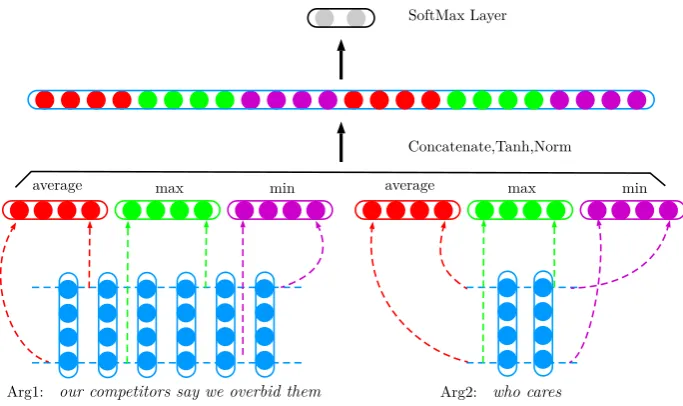
Arg1: our competitors say we overbid them Arg2: who cares
average max min average max min
SoftMax Layer
[image:2.595.128.470.63.266.2]Concatenate,Tanh,Norm
Figure 1: SCNN model architecture visualized with an instance.
tated with connective expressions that best convey implicit relations between two neighboring argu-ments, e.g.
Arg1: (But)our competitions say we overbid them
Arg2:who cares
the connective “But”, which is annotated manu-ally, is used to express the inferredCOMPARISON relation.
We learn a classifier for implicit DRR based on convonlutional neural network. The overall model architecture is illustrated in Figure 1.1 In our
model, each word in vocabularyV corresponds to ad-dimensional dense, real-valued vector, and all words are stacked into a word embedding matrix
L∈Rd×|V|, where|V|is the vocabulary size. Given an ordered list ofnwords in an argument, we retrieve thei-th word representationxvi ∈Rd
from L with its corresponding vocabulary index
vi. All word vectors in the argument produce the
following output matrix:
X = (xv1, xv2, . . . , xvn) (1)
Following previous work (Collobert et al., 2011; Socher et al., 2011a), for each row r in X, we explore three convolutional operations to obtain three convolution features average, minandmax
as follows:
cavgr = n1 Xn i
Xr,i (2)
cminr = min (Xr,1, Xr,2, . . . , Xr,n) (3)
1For better illustration, we assume that the dimension of word vectors is 4 throughout this paper.
cmax
r = max (Xr,1, Xr,2, . . . , Xr,n) (4)
In this way, SCNN is able to capture almost all im-portant information insideX(one with the highest, lowest and average values). Besides, each convo-lution operation naturally deals with variable argu-ment lengths (Note thatc ∈ Rd). Back to Figure
1, we presentcavg,cminandcmaxwith red, purple
and green color respectively.
After obtaining the features of both arguments, we concatenate all of them into one vector, and then apply tanh transformation and length nor-malization successively to generate the hidden lay-ers:
a=hcavgArg1;cminArg1;cmaxArg1;cavgArg2;cminArg2;cmaxArg2i
(5)
h= ktanh (tanh (aa))k (6)
where h ∈ R6d is the hidden layer
representa-tion. The normalization operation scales the com-ponents of a feature vector to unit length. This, to some extent, eliminates the manifold differences among different features.
Upon the hidden layer, we stack a Softmax layer for relation recognition,
y=f(W h+b) (7)
wheref is the softmax function,W ∈Rl×6dis the
parameter matrix,b∈Rlis the bias term, andlis
the relation number.
gold relationgin the annotated training corpus us-ing the traditional cross-entropy error,
E(y, g) =−Xl j
gj×log (yj) (8)
Combined with the regularization error, the joint training objective function is
J(θ) = 1 m
m X
t=1
E(yt, gt) +λ2kθk2 (9)
wheremis the number of training instances,ytis
thet-th predicted distribution, λis the regulariza-tion coefficient and θis parameters, includingL,
W andb.2
To train SCNN, we first employ the toolkit
Word2Vec3 (Mikolov et al., 2013) to initialize the
word embedding matrixLusing a large-scale un-labeled data. Then, L-BFGS algorithm is applied to fine-tune the parametersθ.
3 Experiments
We conducted a series of experiments on English implicit DRR task. After a brief description of the experimental setup and the baseline systems, we further investigated the effectiveness of our method with deep analysis.
3.1 Setup
For comparison with other systems, we formu-lated the task as four separate one-against-all bi-nary classification problems: one for each top level sense of implicit discourse relations (Pitler et al., 2009).
We used the PDTB 2.0 corpus4 (Prasad et al.,
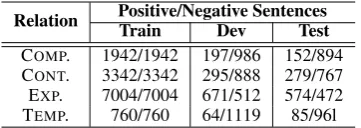
2008) for evaluation. The PDTB corpus contains discourse annotations over 2,312 Wall Street Jour-nal articles, and is organized in different sections. Following Pitler et al. (2009), we used sections 2-20 as training set, sections 21-22 as test set, and sections 0-1 as development set for parameter op-timization. For each relation, we randomly ex-tracted the same number of positive and negative instances as training data, while all instances in sections 21 and 22 are used as our test set. The statistics of various data sets is listed in Table 1.
We tokenized PDTB corpus usingStanford NLP Tool5. For all experiments, we empirically set
2The bias termsbis not regularized. We preserve it in the equation just for clarity.
3https://code.google.com/p/word2vec/ 4http://www.seas.upenn.edu/ pdtb/
5http://nlp.stanford.edu/software/corenlp.shtml
Relation Positive/Negative SentencesTrain Dev Test
COMP. 1942/1942 197/986 152/894
CONT. 3342/3342 295/888 279/767 EXP. 7004/7004 671/512 574/472 TEMP. 760/760 64/1119 85/96l Table 1: Statistics of positive and negative in-stances in training (Train), development (Dev) and test (Test) sets. COMP.=COMPARISON, CONT.=CONTINGENCY, EXP.=EXPANSION and TEMP.=TEMPORAL
d=128and λ=1e−4. Besides, the unlabeled data for word embedding initialization contains 1.02M sentences with 33.5M words.
3.2 Baselines
We compared our model against the following baseline methods:
• SVM: This method learns a support vector machine (SVM) classifier with the labeled data.
• TSVM: This method learns a transductive SVM (TSVM) classifiers given the labeled data and unlabeled data. We extracted unla-beled data from above-mentioned 1.02M sen-tences. After filtering the noise ones, we finally obtained 0.11M unlabeled instances, each of which contains only two clauses.
• RAE:This method learns a recursive autoen-coder (RAE) classifier with the labeled data. We first utilized standard RAEs to represent arguments, and then stacked a Softmax layer upon them. The hyperparameters were set as follows: word dimension64, balance factor for reconstruction error0.10282and regular-ization factor 1e−5. Word embeddings are initialized via Word2Vec.
Rutherford and Xue (2014) show that Brown cluster pair feature is very impactful in implicit DRR (Rutherford and Xue, 2014). This feature is superior to one-hot representation for the in-teractions between two arguments, such as cross-argument word pair features in our baseline meth-ods. We therefore conducted two additional exper-iments for comparison:
• Add-Bro: This method learns an SVM clas-sifier using baseline system features along with the Brown cluster pair feature.
[image:3.595.327.508.62.126.2]cross-Relation Model Precision Recall Accuracy MacroF1
COMP. vs Other
SVM 22.22 60.53 63.48 32.51
TSVM 20.53 66.45 57.74 31.37
Add-Bro 22.79 64.47 63.10 33.68
No-Cro 22.89 67.76 62.14 34.22
RAE 18.38 62.50 54.21 28.40
SCNN-No-Norm 21.07 54.61 63.67 30.40
SCNN 22.00 67.76 60.42 33.22
CONT. vs Other
SVM 39.70 67.03 64.05 49.87
TSVM 38.72 67.03 62.91 49.08
Add-Bro 39.14 72.40 62.62 50.82
No-Cro 39.50 74.19 62.81 51.56
RAE 37.55 68.10 61.28 48.41
SCNN-No-Norm 39.02 71.33 62.62 50.44
SCNN 39.80 75.29 63.00 52.04
EXP. vs Other
SVM 66.35 60.10 61.38 63.07
TSVM 66.48 61.15 61.76 63.70
Add-Bro 65.89 58.89 60.71 62.19
No-Cro 66.73 61.15 61.95 63.82
RAE 58.24 70.29 56.02 63.67
SCNN-No-Norm 59.39 74.39 58.03 66.05
SCNN 56.29 91.11 56.30 69.59
TEMP. vs Other TSVMSVM 15.7616.26 68.2477.65 67.7865.68 25.6126.88
Add-Bro 15.10 68.24 66.25 24.73
No-Cro 13.89 64.71 64.53 22.87
RAE 10.02 60.00 52.96 17.17
SCNN-No-Norm 18.26 67.06 72.94 28.71
[image:4.595.134.464.60.357.2]SCNN 20.22 62.35 76.95 30.54
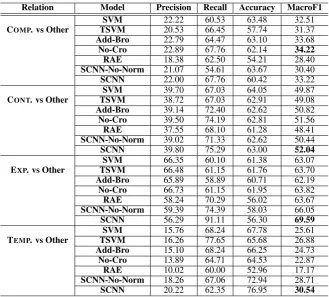
Table 2: Performance comparison of different systems on the test set.
argument word pair features.
In addition, to further verify the effectiveness of normalization, we also compared against SCNN model without normalization (SCNN-No-Norm). Throughout our experiments, we used the toolkit SVM-light6 (Joachims, 1999) in all the
SVM-related experiments. Following previous work (Pitler et al., 2009; Lin et al., 2009), we adopted the following features for baseline meth-ods:
Bag of Words: Three binary features that check whether a word occurs inArg1,Arg2 and both ar-guments.
Cross-Argument Word Pairs: We group all words from Arg1 and Arg2 into two setsW1,W2 respectively, then extract any possible word pair
(wi, wj)(wi ∈W1, wj ∈W2)as features.
Polarity: The count of positive, negated positive, negative and neutral words in Arg1 andArg2 ac-cording to the MPQA corpus (English). Their cross products are used as features.
First-Last, First3: The first and last words of each argument, the pair of the first words in two arguments, the pair of the last words in two argu-ments, and the first three words of each argument
6http://svmlight.joachims.org/
are used as features.
Production Rules: We extract all production rules from syntactic trees of arguments. We de-fined three binary features for each rule to check whether this rule appear in Arg1, Arg2 and both arguments.
Dependency Rules: We also extracted all de-pendency rules from dede-pendency trees of argu-ments. Similarly, we defined three binary features for each rule to check whether this rule appear in
Arg1,Arg2 and both arguments.
In order to collect bag of words, production rules, dependency rules, and cross-argument word pairs, we used a frequency cutoff of 5 to remove rare features, following Lin et al. (2009).
3.3 Results and Analysis
All models are evaluated by assessing the accuracy and F1 scores on account of the imbalance in test set. Besides, for better analysis, we also provided the precision and recall results.
ex-pected unlabeled data could obtain improvement, we observed negative results appeared inTSVM: COMP. and CONT. dropped 1.14% and 0.79% re-spectively7. The F1 scores of TEMP. and EXP. are
improved (1.27% and 0.63% respectively). The main reason may be that our unlabeled data is not strictly from the discourse corpus.
Incorporating Brown cluster pair features en-hances the recognition of COMP. and CONT.. Par-ticllarly,No-Croachieves the best result in COMP. 34.22%. But we found no consistent improve-ment in EXP. and TEMP.: No-Croloses 2.74% in TEMP.;Add-Broloses 0.88% and 2.12% in EXP. and TEMP. respectively. This result is inconsistent with the finding of Rutherford and Xue (2014). The reason may lie in the training strategy, where we used sampling to solve the problem of unbal-anced dataset while they reweighted training sam-ples.
Compared with SVM-based models,RAE per-forms poorly in three relations, except EXP. which has the largest training dataset. Maybe RAE needs more labeled training data for better re-sults. However, SCNN models perform remark-ably well, producing comparable and even bet-ter results. Without normalization, SCNN-No-Normgains 0.57%, 2.98% and 3.1% F1 scores for CONT., EXP. and TEMP. respectively, but loses 2.11% for COMP.. We obtain further improvement using SCNNwith normalization: 0.71%, 2.17%, 6.52% and 4.93% for COMP., CONT., EXP. and TEMP. respectively. This suggests that normaliza-tion is useful for generalizanormaliza-tion of shallow models. From Table 2, we found that our models do not achieve consistent improvements in precision, but benefit greatly from the gains of recall. Besides, our model works quite well for small dataset (Both accuracy and F1 score are improved in TEMP.). All of these demonstrate that our model is suitable for implicit DRR.
4 Conclusion and Future Work
In this paper, we have presented a convolutional neural network based approach to learn better DRR classifiers. The method is simple but effec-tive for relation recognition. Experiment results show that our approach achieves satisfactory per-formance against the baseline models.
In the future, we will verify our model on other 7Without special illustration, all improvements and de-clines are againstSVM.
languages, for example, Chinese and Arabic. Be-sides, since our model is general to classification problems, we would like to investigate its effec-tiveness on other similar tasks, such as sentiment classification and movie review classification, etc.
Acknowledgments
The authors were supported by National Nat-ural Science Foundation of China (Grant Nos 61303082 and 61403269), Natural Science Foundation of Jiangsu Province (Grant No. BK20140355), Natural Science Foundation of Fu-jian Province of China (Grant No. 2013J01250), the Special and Major Subject Project of the Industrial Science and Technology in Fujian Province 2013 (Grant No. 2013HZ0004-1), and 2014 Key Project of Anhui Science and Technology Bureau (Grant No. 1301021018). We thank the anonymous reviewers for their insightful comments. We are also grateful to Kaixu Zhang for his valuable suggestions.
References
Yoshua Bengio, R´ejean Ducharme, Pascal Vincent, and Christian Janvin. 2003. A neural probabilistic lan-guage model.JMLR, 3:1137–1155.
Yoshua Bengio, Holger Schwenk, Jean-S´ebastien Sen´ecal, Fr´ederic Morin, and Jean-Luc Gauvain. 2006. Neural probabilistic language models. In
Innovations in Machine Learning, pages 137–186. Springer Berlin Heidelberg.
Chlo´e Braud and Pascal Denis. 2014. Combining nat-ural and artificial examples to improve implicit dis-course relation identification. InProc. of COLING, pages 1694–1705.
Philipp Cimiano, Uwe Reyle, and Jasmin ˇSari´c. 2005. Ontology-driven discourse analysis for information extraction. Data & Knowledge Engineering, pages 59–83.
Ronan Collobert, Jason Weston, L´eon Bottou, Michael Karlen, Koray Kavukcuoglu, and Pavel Kuksa. 2011. Natural language processing (almost) from scratch. JMLR, pages 2493–2537.
Francisco Guzm´an, Shafiq Joty, Llu´ıs M`arquez, and Preslav Nakov. 2014. Using discourse structure improves machine translation evaluation. InProc. of ACL, pages 687–698. Association for Computa-tional Linguistics.
Yoon Kim. 2014. Convolutional neural networks for sentence classification. In Proc. of EMNLP, pages 1746–1751. Association for Computational Linguis-tics.
Man Lan, Yu Xu, and Zhengyu Niu. 2013. Leverag-ing synthetic discourse data via multi-task learnLeverag-ing for implicit discourse relation recognition. InProc. of ACL, pages 476–485. Association for Computa-tional Linguistics.
Peng Li, Yang Liu, and Maosong Sun. 2013. Re-cursive autoencoders for ITG-based translation. In
Proc. of EMNLP, pages 567–577. Association for Computational Linguistics.
Jiwei Li, Rumeng Li, and Eduard Hovy. 2014. Recur-sive deep models for discourse parsing. InProc. of EMNLP, pages 2061–2069. Association for Compu-tational Linguistics.
Ziheng Lin, Min-Yen Kan, and Hwee Tou Ng. 2009. Recognizing implicit discourse relations in the Penn Discourse Treebank. In Proc. of EMNLP, pages 343–351. Association for Computational Linguis-tics.
Annie Louis, Aravind Joshi, Rashmi Prasad, and Ani Nenkova. 2010. Using entity features to classify implicit discourse relations. In Proc. of SIGDIAL, pages 59–62. Association for Computational Lin-guistics.
Kathleen McKeown and Or Biran. 2013. Aggregated word pair features for implicit discourse relation dis-ambiguation. In Proc. of ACL, pages 69–73. The Association for Computational Linguistics.
Tomas Mikolov, Ilya Sutskever, Kai Chen, Greg Cor-rado, and Jeffrey Dean. 2013. Distributed represen-tations of words and phrases and their composition-ality. CoRR, abs/1310.4546.
Eleni Miltsakaki, Nikhil Dinesh, Rashmi Prasad, Ar-avind Joshi, and Bonnie Webber. 2005. Experi-ments on sense annotations and sense disambigua-tion of discourse connectives. InProc. of TLT2005.
Joonsuk Park and Claire Cardie. 2012. Improving Im-plicit Discourse Relation Recognition Through Fea-ture Set Optimization. InProc. of SIGDIAL, pages 108–112. Association for Computational Linguis-tics.
Emily Pitler, Mridhula Raghupathy, Hena Mehta, Ani Nenkova, Alan Lee, and Aravind K Joshi. 2008. Easily identifiable discourse relations. Technical Reports (CIS).
Emily Pitler, Annie Louis, and Ani Nenkova. 2009. Automatic sense prediction for implicit discourse re-lations in text. InProc. of ACL-AFNLP, pages 683– 691. Association for Computational Linguistics.
Rashmi Prasad, Nikhil Dinesh, Alan Lee, Eleni Milt-sakaki, Livio Robaldo, Aravind K Joshi, and Bon-nie L Webber. 2008. The penn discourse treebank 2.0. InProc. of LREC. Citeseer.
Attapol Rutherford and Nianwen Xue. 2014. Dis-covering implicit discourse relations through brown cluster pair representation and coreference patterns. In Proc. of EACL, pages 645–654. Association for Computational Linguistics.
Richard Socher, Eric H. Huang, Jeffrey Pennin, Christopher D Manning, and Andrew Y. Ng. 2011a. Dynamic pooling and unfolding recursive autoen-coders for paraphrase detection. InProc. of NIPS, pages 801–809. Curran Associates, Inc.
Richard Socher, Cliff Chiung-Yu Lin, Andrew Y. Ng, and Christopher D. Manning. 2011b. Parsing natu-ral scenes and natunatu-ral language with recursive neunatu-ral networks. InProc. of ICML, pages 129–136. Omni-press.
Richard Socher, Alex Perelygin, Jean Wu, Jason Chuang, Christopher D. Manning, Andrew Ng, and Christopher Potts. 2013. Recursive deep models for semantic compositionality over a sentiment tree-bank. InProc. of EMNLP, pages 1631–1642. Asso-ciation for Computational Linguistics.
Suzan Verberne, Lou Boves, Nelleke Oostdijk, and Peter-Arno Coppen. 2007. Evaluating discourse-based answer extraction for why-question answer-ing. InProc. of SIGIR, pages 735–736. ACM. Yannick Versley. 2013. Subgraph-based classification
of explicit and implicit discourse relations. InProc. of IWCS, pages 264–275. Association for Computa-tional Linguistics.