Joint Learning Templates and Slots for Event Schema Induction
Lei Sha, Sujian Li, Baobao Chang, Zhifang Sui
Key Laboratory of Computational Linguistics, Ministry of Education School of Electronics Engineering and Computer Science, Peking University Collaborative Innovation Center for Language Ability, Xuzhou 221009 China
shalei, lisujian, chbb, [email protected]
Abstract
Automatic event schema induction (AESI) means to extract meta-event from raw text, in other words, to find out what types (tem-plates) of event may exist in the raw text and what roles (slots) may exist in each event type. In this paper, we propose a joint entity-driven model to learn templates and slots simultane-ously based on the constraints of templates and slots in the same sentence. In addition, the entities’ semantic information is also con-sidered for the inner connectivity of the enti-ties. We borrow thenormalized cutcriteria in image segmentation to divide the entities into more accurate template clusters and slot clus-ters. The experiment shows that our model gains a relatively higher result than previous work.
1 Introduction
Event schema is a high-level representation of a bunch of similar events. It is very useful for the tra-ditional information extraction (IE)(Sagayam et al., 2012) task. An example of event schema is shown in Table 1. Given the bombing schema, we only need to find proper words to fill the slots when extracting a bombing event.
There are two main approaches for AESI task. Both of them use the idea of clustering the poten-tial event arguments to find the event schema. One of them is probabilistic graphical model (Chamber-s, 2013; Cheung, 2013). By incorporating tem-plates and slots as latent topics, probabilistic graphi-cal models learns those templates and slots that best explains the text. However, the graphical models
Bombing Template
Perpetrator: person Victim: person Target: public Instrument: bomb
Table 1:The event schema of bombing event in MUC-4, it has a bombing template and four main slots
considers the entities independently and do not take the interrelationship between entities into account. Another method relies on ad-hoc clustering algo-rithms (Filatova et al., 2006; Sekine, 2006; Cham-bers and Jurafsky, 2011). (ChamCham-bers and Jurafsky, 2011) is a pipelined approach. In the first step, it us-es pointwise mutual information(PMI) between any two clauses in the same document to learn events, and then learns syntactic patterns as fillers. How-ever, the pipelined approach suffers from the error propagation problem, which means the errors in the template clustering can lead to more errors in the s-lot clustering.
This paper proposes an entity-driven model which jointly learns templates and slots for event schema induction. The main contribution of this paper are as follows:
• To better model the inner connectivity between entities, we borrow the normalized cut in image segmentation as the clustering criteria.
• We use constraints between templates and be-tween slots in one sentence to improve AESI result.
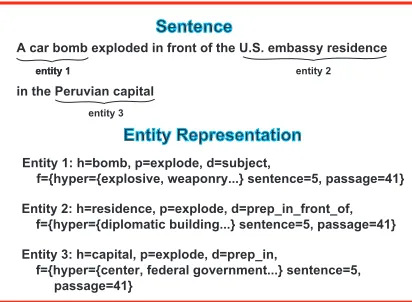
Sentence
A car bomb exploded in front of the U.S. embassy residence
in the Peruvian capital
entity 1 entity 2
entity 1
entity 3
Entity Representation
Entity 1: h=bomb, p=explode, d=subject,
f={hyper={explosive, weaponry...} sentence=5, passage=41} Entity 2: h=residence, p=explode, d=prep_in_front_of, f={hyper={diplomatic building...} sentence=5, passage=41} Entity 3: h=capital, p=explode, d=prep_in,
[image:2.612.83.289.55.206.2]f={hyper={center, federal government...} sentence=5, passage=41}
Figure 1:An entity example
2 Task Definition
Our model is an entity-driven model. This mod-el represents a document d as a series of entities
Ed= {ei|i= 1,2,· · · }. Each entity is a quadruple
e = (h, p, d, f). Here, hrepresents the head word of an entity,p represents its predicate, andd repre-sents the dependency path between the predicate and the head word,f contains the features of the entity (such as the direct hypernyms of the head word), the sentence id whereeoccurred and the document id whereeoccurred. A simple example is Fig 1.
Our ultimate goal is to assign two labels, a slot variablesand a template variable t, to each entity. After that, we can summarize all of them to get event schemas.
3 Automatic Event Schema Induction 3.1 Inner Connectivity Between Entities
We focus on two types of inner connectivity: (1) the likelihood of two entities to belong to the same tem-plate; (2) the likelihood of two entities to belong to the same slot;
3.1.1 Template Level Connectivity
It is easy to understand that entities occurred n-ear each other are more likely to belong to the same template. Therefore, (Chambers and Jurafsky, 2011) uses PMI to measure the correlation of two words in the same document, but it cannot put two words from different documents together. In the Bayesian model of (Chambers, 2013), p(predicate) is the key factor to decide the template, but it ignores the fact that entities occurring nearby should belong to the
same template. In this paper, we try to put two mea-sures together. That is, if two entities occurred n-earby, they can belong to the same template; if they have similar meaning, they can also belong to the same template. We use PMI to measure the distance similarity and use word vector (Mikolov et al., 2013) to calculate the semantic similarity.
A word vector can well represent the meaning of a word. So we concatenate the word vector of the
j-th entity’s head word and its predicate, denoted as
vechp(i). We use the cosine distancecoshp(i, j)to measure the difference of two vectors.
Then we can get the template level connectivity formula as shown in Eq 1. The P MI(i, j) is cal-culated by the head words of entity mention iand
j.
WT(i, j) =P MI(i, j) + coshp(i, j) (1)
3.1.2 Slot Level Connectivity
If two entities can play similar role in an event, they are likely to fill the same slot. We know that if two entities can play similar role, their head words may have the same hypernyms. We only consider the direct hypernyms here. Also, their predicates may have similar meaning and the entities may have the same dependency path to their predicate. There-fore, we give the factors equal weights and add them together to get the slot level similarity.
WS(i, j) = cosp(i, j) +δ(dependi =dependj)
+δ(hypernymi∩hypernymj ̸=ϕ) (2) Here, theδ(·)has value 1 when the inner expression is true and 0 otherwise. The “hypernym” is derived from Wordnet(Miller, 1995), so it is a set of direct hypernyms. If two entities’ head words have at least one common direct hypernym, then they may belong to the same slot. And againcosp(i, j)represents the cosine distance between the predicates’ word vector of entityiand entityj.
3.2 Template and Slot Clustering Using Normalized Cut
Normalized cut intend to maximize the intra-class similarity while minimize the inter class similarity, which deals well with the connectivity between en-tities.
points is their template level similarity / slot level similarity. Then the larger the similarity value is, the more likely the two entities (point) belong to the same template / slot, which is also our basis intu-ition.
For simplicity, denote the entity set as E =
{e1,· · · , e|E|}, and the template set as T. We
use the |E| × |T| partition matrix XT to repre-sent the template clustering result. Let XT =
[XT1,· · ·, XT|T|], where XTl is a binary indicator
for templatel(Tl).
XT(i, l) = {
1 ei ∈Tl
0 otherwise (3)
Usually, we define the degree matrix DT as:
DT(i, i) =∑j∈EWT(i, j), i = 1,· · ·,|E|. Obvi-ously, DT is a diagonal matrix. It contains infor-mation about the weight sum of edges attached to each vertex. Then we have the template clustering optimization as shown in Eq 4 according to (Shi and Malik, 2000).
max ε1(XT) = |T1|
|T|
∑
l=1
XT
TlWTXTl XT
TlDTXTl s.t. XT ∈ {0,1}|E|×|T| XT1|T|=1|E|
(4)
where1|E|represents the|E| ×1vector of all 1’s. For the slot clustering, we have a similar opti-mization as shown in Eq 5.
max ε2(XS) = |S1|
|S|
∑
l=1
XT
SlWSXSl XT
SlDSXSl s.t. XS ∈ {0,1}|E|×|S| XS1|S|=1|E|
(5)
whereSrepresents the slot set,XS is the slot clus-tering result with XS = [XS1,· · ·, XS|S|], where
XSlis a binary indicator for slotl(Sl).
XS(i, l) = {
1 ei∈Sl
0 otherwise (6)
3.3 Joint Model With Sentence Constraints
For event schema induction, we find an important property and we name it “Sentence constraint”. The entities in one sentence often belong to one template but different slots.
The sentence constraint contains two types of constraint, “template constraint” and “slot constrain-t”.
1. Template constraint: Entities in the same sen-tence are usually in the same template. Hence we should make the templates taken by a sen-tence as few as possible.
2. Slot constraint: Entities in the same sentence are usually in different slots. Hence we should make the slots taken by a sentence as many as possible.
Based on these consideration, we can add an extra item to the optimization object. LetNsentencebe the number of sentences. DefineNsentence× |E|matrix
J as the sentence constraint matrix, the entries ofJ
is as following:
J(i, j) =
{
1 ei∈Sentencej
0 otherwise (7)
Easy to show, the productGT = JTXT represents the relation between sentences and templates. In ma-trixGT, the(i, j)-th entry represents how many en-tities in sentenceiare belong toTj.
UsingGT, we can construct our objective. To rep-resent the two constraints, the best objective we have found is the trace value: tr(GTGTT). Each entry on the diagonal of matrixGTGTT is the square sum of all the entries in the corresponding line inGT, and the larger the trace value is, the less templates the sentence would taken. Sincetr(GTGTT) is the sum of the diagonal elements, we only need to maximize the valuetr(GTGTT)to meet the template constraint. For the same reason, we need to minimize the value
tr(GSGTS)to meet the slot constraint.
Generally, we have the following optimization ob-jective:
ε3(XT, XS) = tr (
XT
TJJTXT )
tr(XT
SJJTXS) (8)
de-tailed derivation1is shown in the supplement file.
XT, XS= argmax
XT,XS
ε1(XT) +ε2(XS) +ε3(XT, XS)
s.t. XT ∈ {0,1}|E|×|T| XT1|T|=1|E| XS∈ {0,1}|E|×|S| XS1|S|=1|E|
(9)
4 Experiment 4.1 Dataset
In this paper, we use MUC-4(Sundheim, 1991) as our dataset, which is the same as previous works (Chambers and Jurafsky, 2011; Chambers, 2013). MUC-4 corpus contains 1300 documents in the training set, 200 in development set (TS1, TS2) and 200 in testing set (TS3, TS4) about Latin American news of terrorism events. We ran several times on the 1500 documents (training/dev set) and choose the best |T| and |S| as |T| = 6, |S| = 4. Then we report the performance of test set. For each doc-ument, it provides a series of hand-constructed even-t schemas, which are called gold schemas. Wieven-th these gold schemas we can evaluate our results. The MUC-4 corpus contains six template types:
Attack, Kidnapping, Bombing, Arson, Robbery, and Forced Work Stoppage, and for each template, there are 25 slots. Since most previous works do not evaluate their performance on all the 25 slots, they instead focus on 4 main slots like Table 1, we will also focus on these four slots. We use the Stanford CoreNLP toolkit to parse the MUC-4 corpus.
4.2 Performance
Fig 2 shows two examples of our learned schemas: Bombing and Attacking. The five words in each s-lot are the five randomly picked entities from the mapped slots. The templates and slots that were joint learned seem reasonable.
Induced schemas need to map to gold schemas before evaluation. Previous works used two meth-ods of mapping. The first ignores the schema type, and simply finds the best performing slot for each gold template slot. For instance, a perpetrator of a bombing and a perpetrator of an attack are treated
1At https://github.com/shalei120/ESI 1 2 can the code be
found.
Bombing
Perpetrator
Victim
Target
Instrument
Attack
Perpetrator
Victim
Target
Instrument
El salvador The guerrillas The drag mafia Drug traffickers The Atlacatl battalion
The police chief Students The Peruvian embassy
The diplomat soldiers
ministry The embassy The police station
organization bridge
explosives car bomb dynamite incendiary bomb
vehicle bomb
troops criminals
combat murder person
driver soldiers children civilians journalists
organization helicopter
person livestock ministray building
vehicles
rifles weapons
[image:4.612.311.539.63.361.2]gun explosives machinegun
Figure 2:Part of the result
Prec Recall F1 C&J (2011) 0.48 0.25 0.33 Cheung (2013) 0.32 0.37 0.34 Chambers (2013) 0.41 0.41 0.41 Nguyen et al. (2015) 0.36 0.54 0.43 Our Model-SC 0.38 0.68 0.49 Our Model 0.39 0.70 0.50
Table 2:Slot-only mapping comparison to state-of-the-art un-supervised systems, “-SC” means without sentence constraint
the same. We call this theslot-only mapping eval-uation. The second approach is to map each tem-platetto the best gold templateg, and limit the slot mapping so that only the slots under t can map to slots underg. We call this thestrict template map-pingevaluation. The slot-only mapping can result in higher scores since it is not constrained to preserve schema structure in the mapping.
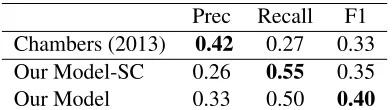
We compare our results with four works (Cham-bers and Jurafsky, 2011; Cheung, 2013; Cham(Cham-bers, 2013; Nguyen et al., 2015) as is shown in Table 2 and Table 3. Our model has outperformed all of the previous methods. The improvement of recall is due to the normalized cut criteria, which can better use the inner connectivity between entities. The sen-tence constraint improves the result one step further.
Prec Recall F1 Chambers (2013) 0.42 0.27 0.33 Our Model-SC 0.26 0.55 0.35 Our Model 0.33 0.50 0.40
Table 3:strict template mapping comparison to state-of-the-art unsupervised systems, “-SC” means without sentence constraint
amount of entities which has been assigned different templates or different slots in “Our Model-SC” and “Our Model”. Of all the 11465 entities, 2305 enti-ties has been assigned different templates in the two methods while only 108 entities has different slots. This fact illustrates that the sentence constraint can affect the assignment of templates much more than the slots. Therefore, the sentence constraint lead-s largely improvement to the lead-strict mapping perfor-mance and very little increase to the slot-only per-formance.
5 Related Works
The traditional information extraction task is to fill the event schema slots. Many slot filling algorithms requires the full information of the event schemas and the labeled corpus. Among them, there are rule-based method (Rau et al., 1992; Chinchor et al., 1993), supervised learning method (Baker et al., 1998; Chieu et al., 2003; Bunescu and Mooney, 2004; Patwardhan and Riloff, 2009; Maslennikov and Chua, 2007), bootstrapping method (Yangarber et al., 2000) and cross-document inference method (Ji and Grishman, 2008). Also there are many semi-supervised solutions, which begin with unlabeled, but clustered event-specific documents, and extrac-t common word paextrac-textrac-terns as exextrac-tracextrac-tors (Riloff and Schmelzenbach, 1998; Sudo et al., 2003; Riloff et al., 2005; Patwardhan and Riloff, 2007; Filatova et al., 2006; Surdeanu et al., 2006)
Other traditional information extraction task learns binary relations and atomic facts. Models can learn relations like “Jenny is married to Bob” with unlabeled data (Banko et al., 2007; Etzioni et al., 2008; Yates et al., 2007; Fader et al., 2011), or ontology induction (dog is an animal) and at-tribute extraction (dogs have tails) (Carlson et al., 2010a; Carlson et al., 2010b; Huang and Riloff, 2010; Van Durme and Pasca, 2008), or rely on pre-defined patterns (Hearst, 1992).
Shinyama and Sekine (2006) proposed an ap-proach to learn templates with unlabeled corpus. They useunrestricted relation discoveryto discover relations in unlabeled corpus as well as extract their fillers. Their constraints are that they need redun-dant documents and their relations are binary over repeated named entities. (Chen et al., 2011) also ex-tract binary relations using generative model.
Kasch and Oates (2010), Chambers and Jurafsky (2008), Chambers and Jurafsky (2009), Balasubra-manian et al. (2013) captures template-like knowl-edge from unlabeled text by large-scale learning of scripts and narrative schemas. However, their struc-tures are limited to frequent topics in a large corpus. Chambers and Jurafsky (2011) uses their idea, and their goal is to characterize a specific domain with limited data using a three-stage clustering algorith-m.
Also, there are some state-of-the-art works using probabilistic graphic model (Chambers, 2013; Che-ung, 2013; Nguyen et al., 2015). They use the Gibbs sampling and get good results.
6 Conclusion
This paper presented a joint entity-driven model to induct event schemas automatically.
This model uses word embedding as well as PMI to measure the inner connection of entities and us-es normalized cut for more accurate clustering. Fi-nally, our model uses sentence constraint to extract templates and slots simultaneously. The experiment has proved the effectiveness of our model.
Acknowledgments
This research is supported by National Key Basic Research Program of China (No.2014CB340504) and National Natural Science Foundation of China (No.61375074,61273318). The contact authors of this paper are Sujian Li and Baobao Chang.
References
1, pages 86–90. Association for Computational Lin-guistics.
Niranjan Balasubramanian, Stephen Soderland, and Oren Etzioni Mausam. 2013. Generating coheren-t evencoheren-t schemas acoheren-t scale.Proceedings of the Empirical Methods in Natural Language Processing. ACM. Michele Banko, Michael J Cafarella, Stephen Soderland,
Matt Broadhead, and Oren Etzioni. 2007. Open infor-mation extraction from the web. InProceedings of the 20th international joint conference on Artifical intelli-gence, pages 2670–2676. Morgan Kaufmann Publish-ers Inc.
Razvan Bunescu and Raymond J Mooney. 2004. Collec-tive information extraction with relational markov net-works. InProceedings of the 42nd Annual Meeting on Association for Computational Linguistics, page 438. Association for Computational Linguistics.
Andrew Carlson, Justin Betteridge, Bryan Kisiel, Burr Settles, Estevam R Hruschka Jr, and Tom M Mitchell. 2010a. Toward an architecture for never-ending lan-guage learning. InAAAI.
Andrew Carlson, Justin Betteridge, Richard C Wang, Es-tevam R Hruschka Jr, and Tom M Mitchell. 2010b. Coupled semi-supervised learning for information ex-traction. InProceedings of the third ACM internation-al conference on Web search and data mining, pages 101–110. ACM.
Nathanael Chambers and Daniel Jurafsky. 2008. Unsu-pervised learning of narrative event chains. InACL, pages 789–797.
Nathanael Chambers and Dan Jurafsky. 2009. Unsu-pervised learning of narrative schemas and their par-ticipants. InProceedings of the Joint Conference of the 47th Annual Meeting of the ACL and the 4th Inter-national Joint Conference on Natural Language Pro-cessing of the AFNLP: Volume 2-Volume 2, pages 602– 610. Association for Computational Linguistics. Nathanael Chambers and Dan Jurafsky. 2011.
Template-based information extraction without the templates. pages 976–986.
Nathanael Chambers. 2013. Event schema induction with a probabilistic entity-driven model. EMNLP. Harr Chen, Edward Benson, Tahira Naseem, and
Regi-na Barzilay. 2011. In-domain relation discovery with meta-constraints via posterior regularization. In Pro-ceedings of the 49th Annual Meeting of the Associa-tion for ComputaAssocia-tional Linguistics: Human Language Technologies-Volume 1, pages 530–540. Association for Computational Linguistics.
Jackie Chi Kit Cheung. 2013. Probabilistic frame induc-tion. arXiv preprint arXiv:1302.4813.
Hai Leong Chieu, Hwee Tou Ng, and Yoong Keok Lee. 2003. Closing the gap: Learning-based information
extraction rivaling knowledge-engineering methods. InProceedings of the 41st Annual Meeting on Associ-ation for ComputAssoci-ational Linguistics-Volume 1, pages 216–223. Association for Computational Linguistics. Nancy Chinchor, David D Lewis, and Lynette
Hirschman. 1993. Evaluating message under-standing systems: an analysis of the third message understanding conference (muc-3). Computational linguistics, 19(3):409–449.
Oren Etzioni, Michele Banko, Stephen Soderland, and Daniel S Weld. 2008. Open information extrac-tion from the web. Communications of the ACM, 51(12):68–74.
Anthony Fader, Stephen Soderland, and Oren Etzioni. 2011. Identifying relations for open information ex-traction. InProceedings of the Conference on Empiri-cal Methods in Natural Language Processing, pages 1535–1545. Association for Computational Linguis-tics.
Elena Filatova, Vasileios Hatzivassiloglou, and Kathleen McKeown. 2006. Automatic creation of domain tem-plates. InProceedings of the COLING/ACL on Main conference poster sessions, pages 207–214. Associa-tion for ComputaAssocia-tional Linguistics.
Marti A Hearst. 1992. Automatic acquisition of hy-ponyms from large text corpora. InProceedings of the 14th conference on Computational linguistics-Volume 2, pages 539–545. Association for Computational Lin-guistics.
Ruihong Huang and Ellen Riloff. 2010. Inducing domain-specific semantic class taggers from (almost) nothing. InProceedings of the 48th Annual Meeting of the Association for Computational Linguistics, pages 275–285. Association for Computational Linguistics. Heng Ji and Ralph Grishman. 2008. Refining event
ex-traction through cross-document inference. In ACL, pages 254–262.
Niels Kasch and Tim Oates. 2010. Mining script-like structures from the web. InProceedings of the NAA-CL HLT 2010 First International Workshop on For-malisms and Methodology for Learning by Reading, pages 34–42. Association for Computational Linguis-tics.
Mstislav Maslennikov and Tat-Seng Chua. 2007. Auto-matic acquisition of domain knowledge for informa-tion extracinforma-tion. InProceedings of the Association of Computational Linguistics (ACL).
Tomas Mikolov, Kai Chen, Greg Corrado, and Jeffrey Dean. 2013. Efficient estimation of word representa-tions in vector space.arXiv preprint arXiv:1301.3781. George A Miller. 1995. Wordnet: a lexical database for english.Communications of the ACM, 38(11):39–41. Kiem-Hieu Nguyen, Xavier Tannier, Olivier Ferret, and
induction with entity disambiguation. In Proceed-ings of the 53rd Annual Meeting of the Association for Computational Linguistics and the 7th Internation-al Joint Conference on NaturInternation-al Language Processing (Volume 1: Long Papers), pages 188–197, Beijing, China, July. Association for Computational Linguis-tics.
Siddharth Patwardhan and Ellen Riloff. 2007. Effective information extraction with semantic affinity patterns and relevant regions. In EMNLP-CoNLL, volume 7, pages 717–727.
Siddharth Patwardhan and Ellen Riloff. 2009. A unified model of phrasal and sentential evidence for informa-tion extracinforma-tion. InProceedings of the 2009 Conference on Empirical Methods in Natural Language Process-ing: Volume 1-Volume 1, pages 151–160. Association for Computational Linguistics.
Lisa Rau, George Krupka, Paul Jacobs, Ira Sider, and Lois Childs. 1992. Ge nltoolset: Muc-4 test results and analysis. InProceedings of the 4th conference on Message understanding, pages 94–99. Association for Computational Linguistics.
Ellen Riloff and Mark Schmelzenbach. 1998. An em-pirical approach to conceptual case frame acquisition. In Proceedings of the Sixth Workshop on Very Large Corpora, pages 49–56.
Ellen Riloff, Janyce Wiebe, and William Phillips. 2005. Exploiting subjectivity classification to improve in-formation extraction. In Proceedings of the Nation-al Conference On ArtificiNation-al Intelligence, volume 20, page 1106. Menlo Park, CA; Cambridge, MA; Lon-don; AAAI Press; MIT Press; 1999.
R Sagayam, S Srinivasan, and S Roshni. 2012. A sur-vey of text mining: Retrieval, extraction and indexing techniques. International Journal Of Computational Engineering Research, 2(5).
Satoshi Sekine. 2006. On-demand information extrac-tion. In Proceedings of the COLING/ACL on Main conference poster sessions, pages 731–738. Associa-tion for ComputaAssocia-tional Linguistics.
Jianbo Shi and Jitendra Malik. 2000. Normalized cuts and image segmentation. Pattern Analysis and Ma-chine Intelligence, IEEE Transactions on, 22(8):888– 905.
Yusuke Shinyama and Satoshi Sekine. 2006. Preemp-tive information extraction using unrestricted relation discovery. InProceedings of the main conference on Human Language Technology Conference of the North American Chapter of the Association of Computation-al Linguistics, pages 304–311. Association for Com-putational Linguistics.
Kiyoshi Sudo, Satoshi Sekine, and Ralph Grishman. 2003. An improved extraction pattern representation
model for automatic ie pattern acquisition. In Pro-ceedings of the 41st Annual Meeting on Association for Computational Linguistics-Volume 1, pages 224– 231. Association for Computational Linguistics. Beth Sundheim. 1991. Third message understanding
e-valuation and conference (muc-3): Phase 1 status re-port. InHLT.
Mihai Surdeanu, Jordi Turmo, and Alicia Ageno. 2006. A hybrid approach for the acquisition of information extraction patterns.Adaptive Text Extraction and Min-ing (ATEM 2006), page 48.
Benjamin Van Durme and Marius Pasca. 2008. Finding cars, goddesses and enzymes: Parametrizable acquisi-tion of labeled instances for open-domain informaacquisi-tion extraction. InAAAI, volume 8, pages 1243–1248. Roman Yangarber, Ralph Grishman, Pasi Tapanainen,
and Silja Huttunen. 2000. Automatic acquisition of domain knowledge for information extraction. In Proceedings of the 18th conference on Computational linguistics-Volume 2, pages 940–946. Association for Computational Linguistics.