
© Copernicus GmbH 2004
Advances in
Radio Science
Synchronization in MIMO OFDM systems
L. H¨aring and A. Czylwik
Department of Communication Systems, University of Duisburg-Essen, Bismarckstr. 81, 47057 Duisburg, Germany
Abstract. In this paper, an overview of carrier frequency off-set (CFO) estimation algorithms for Orthogonal Frequency Division Multiplexing (OFDM) systems is presented. It is well-known that multicarrier systems suffer from their high sensitivity to mismatches of transmitter and receiver oscilla-tor frequencies. The performance degrades since the CFO destroys the orthogonality of the subcarriers. Hence, exten-sive research has been done on the estimation and correc-tion of the CFO in Single-Input Single-Output (SISO) sys-tems. Mainly, the proposed algorithms can be categorized into data-aided and blind techniques. Several estimation techniques have been extended to the Single-Input Multiple-Output (SIMO) case where multiple receive antennas can be utilized to gain diversity. However, less attention has been paid on synchronization in the attractive Multiple-Input Multiple-Output (MIMO) case which is topic of tremendous interest in current research. The present paper concentrates on aspects of this new scenario. Starting with algorithms for SISO and SIMO, this contribution reviews briefly proposed carrier frequency synchronization techniques which could be implemented in forthcoming MIMO systems.
1 Introduction
In recent years, OFDM has become increasingly popular for future high data-rate wireless communication systems be-cause of its advantages in a multipath environment. It has been standardized for Digital Audio Broadcasting (DAB), Terrestrial Digital Video Broadcasting (DVB-T) as well as for broadband wireless local area networks (WLAN) i.e. Hiperlan/2 and IEEE 802.11a/g. However, one of the main drawbacks is its high sensitivity to frequency offsets since the orthogonality between subcarriers is destroyed thus lead-ing to a considerable system performance degradation (Pollet et al., 1995). Hence, the estimation and correction of
fre-Correspondence to: L. H¨aring
quency offsets have been subject of intensive research in the last decade. But it has not been investigated extensively in systems with multiple antennas at transmitter and receiver site. Recently, such MIMO systems have become attrac-tive since the capacity was proven (under ideal conditions) to scale with the minimum number of transmit and receive antennas (Foschini and Gans, 1998). Therefore, the contribu-tion introduces thoroughly a MIMO system model that con-siders CFOs. Furthermore, it gives an overview of important existing estimation algorithms for SISO systems and exten-sions to multiple antenna systems.
The remainder of the paper is organized as follows. Sec-tion 2 presents the OFDM system model for the SISO and MIMO case as well as impacts of frequency offsets on the system performance. In Sect. 3, important classes of SISO algorithms are reviewed. Extensions of these algorithms to multiple antenna systems are discussed in Sect. 4. To illus-trate some important aspects, Sect. 5 presents a brief simula-tion example. Finally, in Sect. 6 conclusions are drawn.
2 OFDM signal model
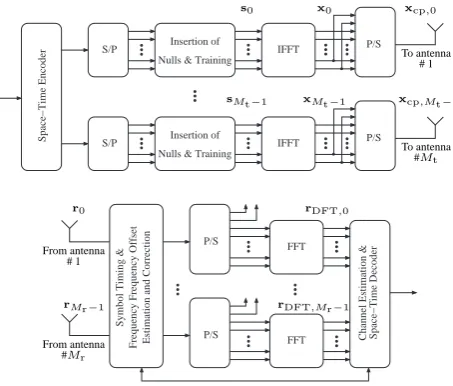
We start with the OFDM model formulation for the SISO case. Subsequently, we extend the model to a MIMO system (see Fig. 1).
2.1 System model in SISO
In OFDM, information data are transmitted blockwise. A se-quence of complex data symbols is split into blocks and fed to different subcarriers. For thek-th block, an IDFT opera-tion on the symbols of all carriers is carried out, which can be expressed as
xi(k)= 1
√
N Nu−1
X
n=0
sn(k)ej 2π
148 L. H¨aring and A. Czylwik: Synchronization in MIMO OFDM systems 5
factor Mt. Simulations have been carried out for an AWGN
and frequency-selective fading channel. The multipath channel is implemented as a tapped-delay line with Rayleigh fading coefficients and a power delay profile given by typical indoor models used for WLANs at 5 GHz [11]. Impinging signals at different antennas are assumed to be uncorrelated. We choose the DFT-sizeN = 64, the sampling periodT = 50ns (e.g. in IEEE 802.11a) and periodicity length Np = 16. As a cyclic
prefix, one period of 16 samples is preceded. The relative CFO error in all simulations isε= 0.2. To study the influence of multiple antennas, the mean squared error (MSE) ofεˆversus SNR per receive antenna for a different number ofMt and
Mr is simulated. In Fig. 7, the simulation results for both a
flat and frequency-selective (Model B for typical large open space and office environment [11], average rms delay spread of 100 ns) fading channel are depicted. For reference, also the CRB for AWGN is displayed.
As expected, we can observe a performance degradation in fading channels compared to the CRB (as well as for a simu-lated AWGN channel which is not displayed here), especially at low SNRs. (At high SNRs, apart from the SISO flat fading case, the MSE approximates the CRB, which reveals a ML estimator.) The degradation decreases with increasing delay spread due to the gain of frequency diversity. It is interesting to note that the estimator does not suffer from multipath since the periodicity of training symbols is preserved.
However, performance improvement is also achieved by
space diversity. The effect of transmit diversity becomes
apparent for Mt = 4versusMt = 1in a flat fading channel
using only a single receive antenna. Nevertheless, receive diversity plays the dominant role since for Mr > 1 the
estimator is less sensitive to fading and furthermore lowers the bound of the MSE. This simulation example shows that frequency offset estimation in MIMO systems is more robust under different fading conditions, which can be explained by the space diversity introduced by multiple antennas.
VI. CONCLUSION
A MIMO OFDM system model including a carrier fre-quency offset has been developed and the effects of such offsets on the system performance in OFDM systems have been illustrated. Basic SISO data-aided and blind estimation algorithms using time-domain samples have been reviewed. Moreover, some extensions to a SIMO and MIMO scenario that efficiently exploit spatial diversity have been presented. Finally, a simulation example has been shown to demonstrate the main aspects.
REFERENCES
[1] H. B¨olcskei, “Blind estimation of symbol timing and carrier frequency offset in wireless OFDM systems,” IEEE Trans. Comm., vol. 49, no. 6, pp. 988–999, Jun. 2001.
[2] A. Czylwik, “Synchronization for systems with antenna diversity,” in
Proc. of IEEE Veh. Technol. Conf., vol. 2, 1999, pp. 728–732.
[3] G. Foschini and M. Gans, “On limits of wireless communications in a fading environment when using multiple antennas,” Wireless Personal
Communications, vol. 6, no. 3, pp. 311–335, Mar. 1998.
[4] R. Frank and S. Zadoff, “Phase shift pulse codes with good periodic correlation properties,” IRE Trans. on Inform. Theory, vol. IT-8, pp. 381–382, Oct. 1962.
[5] F. Gini and G. B. Giannakis, “Frequency offset and symbol timing recovery in flat-fading channels: A cyclostationary approach,” IEEE
Trans. Comm., vol. 46, no. 3, pp. 400–411, Mar. 1998.
[6] P. J. Honan, R. Ambati, and U. Tureli, “Performance analysis of diversity combining method for OFDM blind carrier synchronization,” in Proc.
of IEEE Veh. Technol. Conf., vol. 4, Apr. 2003, pp. 2672–2676.
[7] P. J. Honan and U. Tureli, “Blind carrier offset estimation for MIMO OFDM systems: Cramer Rao bound and nonlinear least squares,” in
Proc. of Conf. on Inform. Sciences and Systems, Mar. 2003.
[8] J. Li, G. Q. Liu, and G. B. Giannakis, “Carrier frequency offset estimation for OFDM-based WLANs,” IEEE Signal Proc. Letters, vol. 8, no. 3, pp. 80–82, Mar. 2001.
[9] H. Liu and U. Tureli, “A high-efficiency carrier estimator for OFDM commucations,” IEEE Commun. Letters, vol. 2, no. 4, pp. 104–106, Apr. 1998.
[10] X. L. Ma, C. Tepedelenlioglu, G. B. Giannakis, and S. Barbarossa, “Non-Data-Aided carrier offset estimators for OFDM with null subcarriers: Identifiability, algorithms, and performance,” IEEE J. Select. Areas
Commun., vol. 19, no. 12, pp. 2504–2515, Dec. 2001.
[11] J. Medbo and P. Schramm, “Channel models for Hiperlan/2 in different indoor scenarios,” ETSI/BRAN document no. 3ERI085B, Mar. 1998. [12] A. N. Mody and G. L. St¨uber, “Synchronization for MIMO systems,”
in Proc. of IEEE Globecom Conf., vol. 1, Texas, USA, Nov. 2001, pp. 509–513.
[13] P. M. Moose, “A technique for orthogonal frequency division multiplex frequency offset correction,” IEEE Trans. Comm., vol. 42, no. 10, Oct. 1994.
[14] M. Morelli and U. Mengali, “An improved frequency offset estimator for OFDM applications,” IEEE Comm. Letters, vol. 3, no. 3, pp. 75–77, Mar. 1999.
[15] T. Pollet, M. van Bladel, and M. Moeneclaey, “BER sensitivity of OFDM systems to carrier frequency offset and Wiener phase noise,” IEEE Trans.
Comm., vol. 43, no. 2/3/4, pp. 191–193, Feb./Mar./Apr. 1995.
[16] G. Santella, “A frequency and symbol synchronization system for OFDM signals: Architecture and simulation results,” IEEE Trans. Veh. Technol., vol. 49, no. 1, pp. 254–275, Jan. 2000.
[17] T. Schenk and A. van Zelst, “Frequency sychronization for MIMO OFDM wireless LAN systems,” in Proc. of IEEE Veh. Technol. Conf., Florida, USA, Oct. 2003, pp. 509–513.
[18] T. Schmidl and D. Cox, “Robust frequency and timing synchronization for OFDM,” IEEE Trans. Comm., vol. 45, no. 12, pp. 1613–1621, Dec. 1997.
[19] N. Suehiro and M. Hatori, “Modulatable orthogonal sequences and their application to SSMA systems,” Trans. on Inform. Theory, vol. 34, no. 1, pp. 93–100, Jan. 1998.
[20] J. van de Beek, M. Sandell, and P. B¨orjesson, “ML estimation of time and frequency offset in OFDM systems,” IEEE Trans. Signal Proc., vol. 45, no. 7, pp. 1800–1805, Jul. 1997.
Space−Time Encoder S/P Insertion of P/S
Nulls & Training
IFFT
P/S
S/P Insertion of
Nulls & Training
IFFT To antenna
# 1
To antenna #Mt xMt−1
x0
sMt−1 s0
xcp,Mt−1 xcp,0
P/S P/S
Space−Time Decoder
Channel Estimation &
Frequency Frequency Offset Estimation and Correction
Symbol Timing &
FFT
FFT
From antenna #Mr
# 1 From antenna
rDFT,Mr−1 rDFT,0 r0
rMr−1
Fig. 1. Block diagram of transmitter and receiver in a MIMO OFDM system
Fig. 1. Block diagram of transmitter and receiver in a MIMO OFDM system.
where N, Nu (≤ N ) andsn(k) denote the IDFT-size, the number of used subcarriers and data symbols of then-th sub-carrier, respectively. IfNu< N, the residualN−Nu
subcar-riers referred to as null or virtual subcarsubcar-riers are filled with zeros. With the defined vectors
s(k)=s0(k), s1(k), . . . , sNu−1(k)
T
(2) x(k)=
x0(k), x1(k), . . . , xNu−1(k), . . . , xN−1(k)
T
and the IDFT-matrix
WNu = 1 √ N
1 1 . . . 1
1 ej2Nπ . . . ej2Nπ(Nu−1) ..
. ... . .. ... 1 ej2Nπ(N−1). . .ej
2π
N(N−1)(Nu−1)
,
thek-th block can be written in a more compact way:
x(k)=WNus(k) . (3)
Subsequently, a cyclic prefix of lengthGis preceded, which is just a duplication of the lastGsamples:
xcp(k)= [xN−G(k), . . . , xN−1(k)
| {z }
cyclic prefix
, x0(k), . . . , xN−1(k)]T .
In order to avoid interblock interference (IBI),G must be chosen larger than the lengthL of the channel impulse re-sponse. After passing through a pulse-shaping filter with the impulse responsegt(t )(e.g. root-raised cosine), the
transmit-ted time-continuous waveform yields
xt(t )=
∞
X
k=−∞ N−1
X
i=−G
xcp,i+G(k)gt t−kNbT −iT, (4)
whereT is the sampling period andNb=N+Gdenotes the
length of one OFDM block.
At the receiver, mismatches between transmitter and re-ceiver oscillators as well as Doppler effects result in a fre-quency offsetfo. Usually, the most dominant frequency
off-set arises from oscillator imperfections.
Assuming a frequency-selective channel with the time-invariant impulse response hc(t ) and a receiver filter with
gr(t )which is matched to the transmit filter, we can write for
the effective channel impulse responseh(t )=gt(t )∗hc(t )∗
gr(t ). The received time-continuous waveform containing a
frequency offset yields then
r(t )=ej(2πfot+φ) ∞
X
k=−∞ N−1
X
i=−G
xcp,i+G(k)h t−kNbT −iT,
where noise contributions are omitted andφis an arbitrary phase. Without loss of generality, we setφ=0.
Sampled at time instantst =k0NbT +i0T1and using the
normalized offsetε = fo/1f related to the carrier
subspa-cing1f =1/(N T ), one obtains with Eq. (1)
ri0(k0)=ej
2π Nε(k
0N
b+i0)√1 N
∞
X
k=−∞ N−1
X
i=−G Nu−1
X
n=0
sn(k)·
ej2Nπnih (k0−k)NbT +(i0−i)T. (5)
Furthermore, we assume that the duration of the combi-ned channel impulse response is limited such that h(t ) =
0 ∀t\[0, LT], whereL < G. Hence, the only nonzero con-tribution in Eq. (5) comes fromk=k0:
ri0(k0)=ej
2π Nε(k
0
Nb+i0)√1 N
Nu−1
X
n=0
sn(k0) i0−L X
i=i0
h i0−i
ej2Nπni.
The sampling periodT was omitted for notational conveni-ence. Using the combined channel transfer functionHn = PL
i=0h i
e−j2Nπni, the k0-th received OFDM-block fori0 ∈
[0, . . . , N−1] after removal of the cyclic prefix is given by
ri0(k0)=ej
2π Nε(k
0
Nb+i0)√1 N
Nu−1
X
n=0
sn(k0)·
L X
i0−i=0
h i0−ie−j2Nπn(i
0−i)
| {z }
Hn
ej2Nπni
0
=ej2Nπε(k
0N
b+i0)·IDFT
i0sn(k0)Hn . (6)
Alternatively, in matrix formulation ifk0is substituted byk and a block fading channel is assumed, we obtain
r(k)=ej2NπεkNbC
εWNuH(k)s(k) (7)
1For reasons of simplicity and space limitation, in this paper,
L. H¨aring and A. Czylwik: Synchronization in MIMO OFDM systems 149
6
−6 −4 −2 0 2 4 6
0 0.2 0.4 0.6 0.8 1
Relative frequency f−fc
∆f
Subcarrier
Spectra
Fig. 2. Effects of a CFO (ε= 0.2)
0 0.1 0.2 0.3 0.4 0.5
−5 0 5 10 15 20 25 30
Relative Frequency Offsetε
SINR
(in
dB)
Fig. 3. Lower Bound of SINR [13]
Np Np
Payload
∆φ= 2π NNpε
Fig. 4. Preamble structure consisting of two identical halves [13]
G N G N
∆φ= 2πε ∆φ= 2πε
Fig. 5. OFDM block structure with cyclic prefix
Payload
Np Np
Payload
Transmitted on:
Tx#1
Tx#2
Fig. 6. Modified preamble suitable for MIMO transmission [17]
−5 0 5 10 15 20 25 30
10−6 10−5 10−4 10−3 10−2 10−1 100
SNR per receive antenna (in dB)
Mean Squared Error (MSE)
flat, M
t=1
flat, M
t=4
ModB, M
t=1
ModB, M
t=4
CRB
Fig. 7. CRB and simulated MSE of the CFO estimation for different
combinations of Mt andMr = 1 (solid, —) and Mr = 4 (dashed, −−)
averaged over 20000 realizations Fig. 2. Effects of a CFO (ε=0.2).
with Cε = diag
1,ej2Nπε, . . . ,ej
2π Nε(N−1)
denoting the diagonal N×N carrier frequency offset matrix and H(k) = diag(H0(k), . . . , HNu−1(k)) representing the dia-gonalNu×Nu channel matrix. A CFO turns out to rotate
the phase of the received samples linearly with time. To de-modulate, we left-multiply r(k)with the DFT matrix WHN
u: rDFT(k)=ej
2π
NεkNbWH
NuCεWNuH(k)s(k) . (8) If the matrix WHN
uCεWNu is non-diagonal, the orthogona-lity between subcarriers is lost, thus resulting in inter-carrier interference (ICI). To analyze this further and using some straightforward derivation, we can find
rDFT(k)=ej
2π
NεkNbBH(k)s(k) (9)
with
B=
b0 . . . bNu−1 ..
. . .. ... b−Nu+1. . . b0
, (10)
where bn=
sin(π(ε+n)) Nsin Nπ(ε+n)e
jπNN−1(ε+n) . (11)
Equations (9)–(11) indicate two effects of CFOs: The am-plitudes of the desired subcarriers multiplied byb0 are
re-duced and cross terms (forn6= 0) are introduced thus con-firming the above mentioned statement. Figure 2 illustrates both issues.
In his work (Moose, 1994), MOOSE investigated the im-pact of a CFO analytically. He calculated a lower bound of the signal-to-interference-and-noise power ratio (SINR) vi-sualized in Fig. 3 for different signal-to-noise power ratios (SNR). It can be clearly seen, that especially at high SNR re-gions, the performance degradation caused by synchroniza-tion errors becomes considerable.
−6 −4 −2 0 2 4 6
0 0.2 0.4 0.6 0.8 1
Relative frequency f−fc
∆f
Subcarrier
Spectra
Fig. 2. Effects of a CFO (ε= 0.2)
0 0.1 0.2 0.3 0.4 0.5
−5 0 5 10 15 20 25 30
Relative Frequency Offsetε
SINR
(in
dB)
Fig. 3. Lower Bound of SINR [13]
Np Np
Payload
∆φ= 2π NNpε
Fig. 4. Preamble structure consisting of two identical halves [13]
G N G N
∆φ= 2πε ∆φ= 2πε
Fig. 5. OFDM block structure with cyclic prefix
Payload
Np Np
Payload
Transmitted on:
Tx#1
Tx#2
Fig. 6. Modified preamble suitable for MIMO transmission [17]
−5 0 5 10 15 20 25 30
10−6 10−5 10−4 10−3 10−2 10−1 100
SNR per receive antenna (in dB)
Mean Squared Error (MSE)
flat, M
t=1
flat, M
t=4
ModB, M
t=1
ModB, M
t=4
CRB
Fig. 7. CRB and simulated MSE of the CFO estimation for different
combinations of Mt andMr = 1 (solid, —) and Mr = 4 (dashed,−−)
averaged over 20000 realizations Fig. 3. Lower Bound of SINR (Moose, 1994).
2.2 Extension to MIMO
In the following, it is considered that Mt transmit and
Mr receive branches share the same oscillator, respectively.
With this practical assumption, still only one CFO emerges. Hence, thek-th signal block at themr-th receive antenna after
cyclic prefix removal can be written as
rmr(k)=e
j2NπεkNbC εWNu
Mt−1
X
mt=0
Hmr,mt(k)smt(k) ,
where smt(k)denotes the block vector transmitted from the mt-th transmit antenna. Hmr,mt(k)is a diagonalNu×Nu ma-trix describing the frequency channel characteristic from the mt-th transmit antenna to themr-th receive antenna. Stacking
blocks from all antennas together,
˜
s(k)=vec s0(k), . . . ,sMt−1(k)
(12)
˜
r(k)=vec r0(k), . . . ,rMr−1(k)
, (13)
we can find the following compact notation:
˜
r(k)=ej2NπεkNbC˜
εW˜Nudiag H0(k), . . . ,HMr−1(k)
| {z }
˜ H(k)
˘ s(k)
withMrMtNu×1 vector˘s(k)=vec s˜(k), . . . ,s˜(k)and
˜
Cε =IMr⊗Cε (14)
˜
WNu =IMr⊗WNu (15)
Hmr(k)=
Hmr,0(k), . . . ,Hmr,Mt−1(k)
. (16)
Here,⊗denotes the Kronecker product and IK theK×K identity matrix. Taking the DFT by left-multiplicationr˜(k) withW˜HN
u =IMr⊗W H Nu yields
˜
rDFT(k)=ej
2π
NεkNbW˜H Nu
˜
CεW˜NuH˜(k)˘s(k)
=ej2NπεkNb(I
150 L. H¨aring and A. Czylwik: Synchronization in MIMO OFDM systems
6
−6 −4 −2 0 2 4 6
0 0.2 0.4 0.6 0.8 1
Relative frequencyf−fc
∆f
Subcarrier
Spectra
Fig. 2. Effects of a CFO (ε= 0.2)
0 0.1 0.2 0.3 0.4 0.5
−5 0 5 10 15 20 25 30
Relative Frequency Offsetε
SINR
(in
dB)
Fig. 3. Lower Bound of SINR [13]
Np
Np
Payload
∆φ=2π NNpε
Fig. 4. Preamble structure consisting of two identical halves [13]
G N G N
∆φ= 2πε ∆φ= 2πε
Fig. 5. OFDM block structure with cyclic prefix
Payload
Np
Np
Payload
Transmitted on:
Tx#1
Tx#2
Fig. 6. Modified preamble suitable for MIMO transmission [17]
−5 0 5 10 15 20 25 30
10−6 10−5 10−4 10−3 10−2 10−1 100
SNR per receive antenna (in dB)
Mean Squared Error (MSE)
flat, M t=1 flat, M t=4 ModB, M
t=1
ModB, M t=4 CRB
Fig. 7. CRB and simulated MSE of the CFO estimation for different combinations ofMt and Mr = 1 (solid, —) andMr = 4 (dashed, −−) averaged over 20000 realizations
Fig. 4. Preamble structure consisting of two identical halves (Moose, 1994).
It can be seen that the influence of a CFO is the same for all receive antennas. Similarly to Eq. (8), to restore the or-thogonality between subcarriers, the unknown parameterε inC˜ε needs to be estimated, preferably before carrying out the DFT. The estimateεˆcan be used to derotate the received samples before demodulation.
Algorithms that find an estimate εˆ can be mainly clas-sified in data-aided and blind methods (dependent on the information that is available). Although also possible in the frequency-domain (after DFT processing) (e.g. Santella, 2000, and references therein), this paper only deals with methods working on time-domain samples.
3 Frequency synchronization in SISO systems
3.1 Data-aided approaches
In many data-aided synchronization approaches, algorithms are based upon the observation (e.g. in Eq. 6), that CFOs only cause linear (related to time) phase shifts of the re-ceived symbols. Hence, frequency offsets can be estimated by “measuring” the phase rotation (unless the phase rotation does not exceed an angle of 2π). To follow this approach, MOOSE proposed in Moose (1994) two identical training symbols as a preamble (see Fig. 4).
From one symbol to the other, the phase changes by1φ=
2π NNpε:
ri+Np =rie
j2NπNpε+n
i , i=0, . . . , Np−1, (18)
whereNpdenotes the length of one training symbol. In the
original work, MOOSE proposedNp = N und used
sam-ples in the frequency domain. Forni representing additive white Gaussian noise (AWGN), he calculated the Maximum-Likelihood (ML) estimator:
ˆ
ε= 1
2π N Np
6 R= 1 2π
N Np
6
Np−1
X
i=0
ri∗ri+Np
, (19)
where6 Rdenotes the angle of the complex correlation sum. The fact that some timing synchronization techniques rely upon computing the correlation sum in Eq. (19), argues for the practical usefulness of this algorithm. Furthermore, al-though mathematically shown only for an AWGN channel, the estimator in Eq. (19) turns out to perform well even in frequency-selective fading channels since the periodicity of
6
−6 −4 −2 0 2 4 6
0 0.2 0.4 0.6 0.8 1
Relative frequencyf−fc ∆f
Subcarrier
Spectra
Fig. 2. Effects of a CFO (ε= 0.2)
0 0.1 0.2 0.3 0.4 0.5
−5 0 5 10 15 20 25 30
Relative Frequency Offsetε
SINR
(in
dB)
Fig. 3. Lower Bound of SINR [13]
Np Np
Payload
∆φ=2π NNpε
Fig. 4. Preamble structure consisting of two identical halves [13]
G N G N
∆φ= 2πε ∆φ= 2πε
Fig. 5. OFDM block structure with cyclic prefix
Payload
Np Np
Payload
Transmitted on:
Tx#1
Tx#2
Fig. 6. Modified preamble suitable for MIMO transmission [17]
−5 0 5 10 15 20 25 30
10−6 10−5 10−4 10−3 10−2 10−1 100
SNR per receive antenna (in dB)
Mean Squared Error (MSE)
flat, M t=1 flat, M t=4
ModB, M t=1
ModB, M t=4 CRB
Fig. 7. CRB and simulated MSE of the CFO estimation for different
combinations ofMt andMr = 1(solid, —) andMr = 4(dashed,−−)
averaged over 20000 realizations
Fig. 5. OFDM block structure with cyclic prefix.
the training structure is still preserved (if a cyclic prefix is preceded).
However, one major drawback of this method is its short estimation range of |ε| < 2NN
p caused by phase ambigui-ties. Shortening the length of the training symbols increases the acquisition range, but lowers the estimation performance as well. Several researchers have investigated possibili-ties to extend the range by modifying the preamble – how-ever, mainly by cost of some increase in computational load. Moreover, two-step procedures with two different training sequences consisting of a course and fine estimation step have also been proposed as well as symbols with more than two identical halves. The interested reader is referred to e.g. Schmidl and Cox (1997), Morelli and Mengali (1999), Li et al. (2001).
3.2 Blind approaches
In van de Beek et al. (1997),VAN DEBEEKet al. proposed to
exploit the cyclic prefix which is essential anyway to prevent IBI and furthermore helps to simplify the channel equaliza-tion. Originally, the authors found an optimal joint estimator for both timing and frequency synchronization. With the cor-relation between received symbols of the cyclic prefix and of its duplicate for thek-th block (signal powerσs2)
E
ri∗(k)ri+N(k) =σs2ej2π ε, i=0, . . . , G−1, (20) the ML estimate of the CFO in an AWGN channel yields
ˆ
ε= 1
2π
6 R(k)= 1 2π
6
G−1
X
i=0
ri∗(k)ri+N(k) !
. (21)
In order to enhance the estimation performance, averaging over subsequent OFDM blocks is beneficial. Besides the fixed small estimation range of half of the carrier spacing, the estimator in Eq. (21) – in contrast to the data-aided ap-proach – suffers from considerable performance degradation in frequency-selective fading channels. At high SNR, it ex-hibits a large error floor. Recently proposed methods try to adapt VAN DE BEEK’s approach to multipath channels. The idea is to use statistical properties of the received signal to weight contributions in the correlation sum dependent on how heavily they are corrupted by IBI.
L. H¨aring and A. Czylwik: Synchronization in MIMO OFDM systems 151 the analog radio frequency (RF) front-end. Additionally, a
major advantage of these algorithms is the larger acquisition range.
The basic idea was found by LIU and TURELI (Liu
and Tureli, 1998) first: Let us assume N − Nu
vir-tual carriers, thus the “full” IDFT-matrix becomes W =
WNu,wNu+1, . . . ,wN
.
Due to the orthogonality property of column vectors of W, we obtain in absence of CFO and noise (n=1, . . . , N−Nu)
wHN
u+nr(k)=w H
Nu+nWNuH(k)s(k)=0. (22) This basic observation leads to the following problem formu-lation to estimateε:
J (e)= K−1
X
k=0
N−Nu
X
n=1
w
H Nu+nC
−1
e r(k)
2
ˆ
ε=arg min
e J (e) . (23)
The estimator in Eq. (23), similar to the (in array process-ing) well-known MUSIC algorithm, is equivalent to the non-linear least squares (NLS) solution. Under some uncritical assumptions, the cost function in Eq. (23) is shown to yield a unique minimum. However, MA et al. have proven in
Ma et al. (2001) the loss of identifiability in case of “chan-nel nulls”. To guarantee chan“chan-nel-independent identiafibi-lity, hopping virtual subcarriers (positions of these carriers change from block to block) have been suggested.
Yet another blind synchronization algorithms proposed by B ¨OLCSKEI that also has got a large acquisition range is based upon the second-order statistics of OFDM signals. B ¨OLCSKEI has shown in B¨olcskei (2001) that cyclostatio-narity is introduced by a cyclic prefix, pulse shaping or by the use of different transmit powers on the subcarriers such that the second-order statistics contain information on the syn-chronization parameters.
The interested reader is referred to B¨olcskei (2001) and Gini and Giannakis (1998).
4 Frequency synchronization in SIMO and MIMO sys-tems
As stated before, if transmitter and receiver branches share a common oscillator, respectively (which was considered throughout this paper), evidently still only one frequency off-set in Eq. (14) must be estimated. Thus in principle, all the described algorithms can be also used for such a MIMO sce-nario. However, spatial diversity can be exploited in order to enhance the estimator performance.
4.1 Data-aided approaches
Unfortunately, for the synchronization unit, channel state in-formation is not available which complicates any diversity approach. This general problem was investigated by CZYL
-WIKin Czylwik (1999) for SIMO systems; the synchroniza-tion algorithm used in his paper was based upon MOOSE’s
−6 −4 −2 0 2 4 6
0 0.2 0.4 0.6 0.8 1
Relative frequencyf−fc
∆f
Subcarrier
Spectra
Fig. 2. Effects of a CFO (ε= 0.2)
0 0.1 0.2 0.3 0.4 0.5
−5 0 5 10 15 20 25 30
Relative Frequency Offsetε
SINR
(in
dB)
Fig. 3. Lower Bound of SINR [13]
Np Np
Payload
∆φ= 2π NNpε
Fig. 4. Preamble structure consisting of two identical halves [13]
G N G N
∆φ= 2πε ∆φ= 2πε
Fig. 5. OFDM block structure with cyclic prefix
Payload
Np Np
Payload
Transmitted on:
Tx#1
Tx#2
Fig. 6. Modified preamble suitable for MIMO transmission [17]
−5 0 5 10 15 20 25 30
10−6 10−5 10−4 10−3 10−2 10−1 100
SNR per receive antenna (in dB)
Mean Squared Error (MSE)
flat, M
t=1
flat, M
t=4
ModB, M
t=1
ModB, M
t=4
CRB
Fig. 7. CRB and simulated MSE of the CFO estimation for different
combinations of Mt and Mr = 1 (solid, —) andMr = 4 (dashed,−−)
averaged over 20000 realizations
Fig. 6. Modified preamble suitable for MIMO transmission (Schenk and van Zelst, 2003).
approach. He found out that the optimum of any linear com-bination of uncorrelated received signals leads to a selection
combing (SC) concept, where only the strongest branch
sig-nal passes. However, if a non-linear operation is performed first, also information from other antennas can be advanta-geously utilized by a method similar to maximum ratio
com-bining (MRC), in which branch weights are set in order to
maximize the SNR.
A synchronization unit for MIMO systems based upon MOOSE’s andVAN DE BEEK’s approach was suggested by MODYet al. (Mody and St¨uber, 2001). But diversity
con-cepts have not been sufficiently explored in this proposal. The main novelty was the modification of training sequences. Generally, the same training sequences as for synchroniza-tion are also used for channel estimasynchroniza-tion. Hence, addisynchroniza-tional requirements have to be met. The authors suggested the us-age of chirp like orthogonal sequences proposed by Suehiro (Suehiro and Hatori, 1998).
Recently in 2003, SCHENKet al. (Schenk and van Zelst,
2003) analyzed a MIMO extension of Moose (1994) also from an analytical point of view. In this approach, they used constant-envelope orthogonal codes with good periodic cor-relation properties, such as FRANK-ZADOFF codes (Frank and Zadoff, 1962). Training sequences on different antennas are cyclically shifted as illustrated in Fig. 6 forMt=2.
Instead of averaging estimates on different antenna signals which is equivalent to equal gain combining (EGC), the esti-mator is calculated
ˆ
ε= 1
2π N Np
6 R˜= 1
2π N Np
6
Mr−1
X
mr=0 Rmr
!
, (24)
where Rmr denotes the complex correlation sum of each antenna branch. Rmr is composed in the same way as in Eq. (19). In a frequency-selective fading channel, the esti-mator yields a MRC-like performance since antenna signals with a higher SNR contribute more to the estimate.
For an AWGN channel, the Cramer-Rao bound (CRB) is Schenk and van Zelst (2003)
varεˆ≥ N
(2π )2·N3
p·Mr·SNR
. (25)
152 L. H¨aring and A. Czylwik: Synchronization in MIMO OFDM systems 6
−6 −4 −2 0 2 4 6
0 0.2 0.4 0.6 0.8 1
Relative frequencyf−fc ∆f
Subcarrier
Spectra
Fig. 2. Effects of a CFO (ε= 0.2)
0 0.1 0.2 0.3 0.4 0.5
−5 0 5 10 15 20 25 30
Relative Frequency Offsetε
SINR
(in
dB)
Fig. 3. Lower Bound of SINR [13]
Np Np
Payload
∆φ=2π NNpε
Fig. 4. Preamble structure consisting of two identical halves [13]
G N G N
∆φ= 2πε ∆φ= 2πε
Fig. 5. OFDM block structure with cyclic prefix
Payload
Np Np
Payload
Transmitted on:
Tx#1
Tx#2
Fig. 6. Modified preamble suitable for MIMO transmission [17]
−5 0 5 10 15 20 25 30
10−6 10−5 10−4 10−3 10−2 10−1 100
SNR per receive antenna (in dB)
Mean Squared Error (MSE)
flat, M t=1 flat, M t=4
ModB, M t=1
ModB, M t=4
CRB
Fig. 7. CRB and simulated MSE of the CFO estimation for different combinations ofMt andMr = 1(solid, —) andMr = 4(dashed,−−) averaged over 20000 realizations
Fig. 7. CRB and simulated MSE of the CFO estimation for different combinations ofMtandMr= 1 (solid, —) andMr= 4 (dashed,
−−) averaged over 20000 realizations.
4.2 Blind approaches
Again motivated by Czylwik (1999), HONANet al. also
ex-tended the blind estimation algorithm based on virtual sub-carriers to the SIMO case (e.g. in Honan et al., 2003). Path gainsγmr
are introduced in the cost function:
J (e)= K−1
X
k=0
Mr−1
X
mr=0 N−Nu
X
n=1
γmr
2 w
H Nu+nC
−1
e rmr(k)
2
ˆ
ε=arg min
e J (e) . (26)
The authors proved that the weightsγmr
facilitate estimator
MRC diversity gain when selected proportional to the branch SNR. They validated also in an experimental setup the su-perior performance of this approach compared to EGC espe-cially at low SNRs. At higher SNR, EGC and MRC coincide. The cost function in Eq. (26) can also be used in MIMO scenarios. In Honan and Tureli (2003) it is shown that the CRB in AWGN channels does not change with the number of transmit antennas. However, the frequency offset estima-tor benefits from transmit diversity which leads to an essen-tial performance improvement at lower SNR. In addition, the MIMO diversity gain helps the estimator to be less sensitive in case of channel nulls.
5 Simulation example
Due to space limitation, only a short simulation example of the MIMO estimation algorithm proposed by SCHENKis fol-lowing to demonstrate the main aspects.
To have a fair comparison, the total power radiated from Mt transmit antennas in MIMO is restricted to σs2, which means that the transmitted power per antenna is reduced by the factor Mt. Simulations have been carried out for an
AWGN and frequency-selective fading channel. The mul-tipath channel is implemented as a tapped-delay line with Rayleigh fading coefficients and a power delay profile given by typical indoor models used for WLANs at 5 GHz (Medbo and Schramm, 1998). Impinging signals at different anten-nas are assumed to be uncorrelated. We choose the DFT-size N = 64, the sampling period T = 50 ns (e.g. in IEEE 802.11a) and periodicity lengthNp=16. As a cyclic prefix,
one period of 16 samples is preceded. The relative CFO error in all simulations isε=0.2. To study the influence of multi-ple antennas, the mean squared error (MSE) ofεˆversus SNR per receive antenna for a different number ofMt andMris
simulated.
In Fig. 7, the simulation results for both a flat and frequency-selective (Model B for typical large open space and office environment (Medbo and Schramm, 1998), aver-age rms delay spread of 100 ns) fading channel are depicted. For reference, also the CRB for AWGN is displayed.
As expected, we can observe a performance degradation in fading channels compared to the CRB (as well as for a simu-lated AWGN channel which is not displayed here), especially at low SNRs. (At high SNRs, apart from the SISO flat fading case, the MSE approximates the CRB, which reveals a ML estimator.) The degradation decreases with increasing delay spread due to the gain of frequency diversity. It is interest-ing to note that the estimator does not suffer from multipath since the periodicity of training symbols is preserved.
However, performance improvement is also achieved by
space diversity. The effect of transmit diversity becomes
ap-parent forMt = 4 versusMt = 1 in a flat fading channel
using only a single receive antenna. Nevertheless, receive diversity plays the dominant role since forMr >1 the
esti-mator is less sensitive to fading and furthermore lowers the bound of the MSE. This simulation example shows that fre-quency offset estimation in MIMO systems is more robust under different fading conditions, which can be explained by the space diversity introduced by multiple antennas.
6 Conclusion
References
B¨olcskei, H.: Blind estimation of symbol timing and carrier fre-quency offset in wireless OFDM systems, IEEE Trans. Comm., 49, 6, 988–999, 2001.
Czylwik, A.: Synchronization for systems with antenna diversity, Proc. of IEEE Veh. Technol. Conf., 2, 728–732, 1999.
Foschini, G. and Gans, M.: On limits of wireless communications in a fading environment when using multiple antennas, Wireless Personal Communications, 6, 311–335, 1998.
Frank, R. and Zadoff, S.: Phase Shift Pulse Codes with good peri-odic correlation properties, IRE Trans. on Inform. Theory, IT-8, 381–382, 1962.
Gini, F. and Giannakis, G. B.: Frequency offset and symbol timing recovery in Flat-Fading channels: A cyclostationary approach, IEEE Trans. Comm., 46, 400–411, 1998.
Honan, P. J. and Tureli, U.: Blind Carrier Offset Estimation for MIMO OFDM systems: Cramer Rao Bound and Nonlinear Least Squares, in Proc. of Conf. on Inform. Sciences and Systems, 2003.
Honan, P. J., Ambati, R., and Tureli, U.: Performance Analysis of Diversity Combining Method for OFDM Blind Carrier Syn-chronization, Proc. of IEEE Veh. Technol. Conf., 4, 2672–2676, 2003.
Li, J., Liu, G. Q., and Giannakis, G. B.: Carrier frequency offset estimation for OFDM-based WLANs, IEEE Signal Proc. Letters, 8, 80–82, 2001.
Liu, H. and Tureli, U.: A high-efficiency carrier estimator for OFDM commucations, IEEE Commun. Letters, 2, 104–106, 1998.
Ma, X. L., Tepedelenlioglu, C., Giannakis, G. B., and Barbarossa, S.: Non-Data-Aided Carrier offset estimators for OFDM with null subcarriers: Identifiability, algorithms, and performance, IEEE J. Select. Areas Commun., 19, 2504–2515, 2001.
Medbo, J. and Schramm, P.: Channel Models for
HIPER-LAN/2 in Different Indoor Scenarios, ETSI/BRAN document no. 3ERI085B, 1998.
Mody, A. N. and St¨uber, G. L.: Synchronization for MIMO sys-tems, Proc. of IEEE Globecom Conf., 1, 509–513, Texas, USA, 2001.
Moose, P. M.: A technique for Orthogonal Frequency Division Mul-tiplex frequency offset correction, IEEE Trans. Comm., 42, 1994. Morelli, M. and Mengali, U.: An improved frequency offset esti-mator for OFDM applications, IEEE Comm. Letters, 3, 75–77, 1999.
Pollet, T., van Bladel, M., and Moeneclaey, M.: BER sensitivity of OFDM systems to carrier frequency offset and Wiener phase noise, IEEE Trans. Comm., 43, 191–193, 1995.
Santella, G.: A Frequency and Symbol Synchronization System for OFDM Signals: Architecture and Simulation Results, IEEE Trans. Veh. Technol., 49, 254–275, 2000.
Schenk, T. and van Zelst, A.: Frequency Sychronization for MIMO OFDM wireless LAN systems, in Proc. of IEEE Veh. Technol. Conf., 509–513, Florida, USA, 2003.
Schmidl, T. and Cox, D.: Robust frequency and timing synchro-nization for OFDM, IEEE Trans. Comm., 45, 1613–1621, 1997. Suehiro, N. and Hatori, M.: Modulatable Orthogonal Sequences and their Application to SSMA Systems, Trans. on Inform. The-ory, 34, 93–100, 1998.
![Fig. 6.Fig. 6.Modified preamble suitable for MIMO transmission [17] Modified preamble suitable for MIMO transmission (Schenkand van Zelst, 2003).](https://thumb-us.123doks.com/thumbv2/123dok_us/9663245.1949012/5.595.311.539.62.145/modied-preamble-suitable-transmission-modied-preamble-transmission-schenkand.webp)
![Fig. 3.Lower Bound of SINR [13]simulated.In Fig. 7, the simulation results for both a flat andfrequency-selective (Model B for typical large open space](https://thumb-us.123doks.com/thumbv2/123dok_us/9663245.1949012/6.595.51.283.64.249/bound-simulated-simulation-results-andfrequency-selective-model-typical.webp)
