Open Access
Software review
ParaHaplo: A program package for haplotype-based whole-genome
association study using parallel computing
Kazuharu Misawa*
1and Naoyuki Kamatani
2Address: 1Research Program for Computational Science, Research and Development Group for Next-Generation Integrated Living Matter Simulation, Fusion of Data and Analysis Research and Development Team, RIKEN, 4-6-1 Shirokane-dai, Minato-ku, Tokyo 108-8639, Japan and 2Laboratory for Statistical Analysis, RIKEN Center for Genomic Medicine, Tokyo, Japan
Email: Kazuharu Misawa* - [email protected]; Naoyuki Kamatani - [email protected] * Corresponding author
Abstract
Background: Since more than a million single-nucleotide polymorphisms (SNPs) are analyzed in any given genome-wide association study (GWAS), performing multiple comparisons can be problematic. To cope with multiple-comparison problems in GWAS, haplotype-based algorithms were developed to correct for multiple comparisons at multiple SNP loci in linkage disequilibrium. A permutation test can also control problems inherent in multiple testing; however, both the calculation of exact probability and the execution of permutation tests are time-consuming. Faster methods for calculating exact probabilities and executing permutation tests are required.
Methods: We developed a set of computer programs for the parallel computation of accurate P-values in haplotype-based GWAS. Our program, ParaHaplo, is intended for workstation clusters using the Intel Message Passing Interface (MPI). We compared the performance of our algorithm to that of the regular permutation test on JPT and CHB of HapMap.
Results: ParaHaplo can detect smaller differences between 2 populations than SNP-based GWAS. We also found that parallel-computing techniques made ParaHaplo 100-fold faster than a non-parallel version of the program.
Conclusion: ParaHaplo is a useful tool in conducting haplotype-based GWAS. Since the data sizes of such projects continue to increase, the use of fast computations with parallel computing--such as that used in ParaHaplo--will become increasingly important. The executable binaries and program sources of ParaHaplo are available at the following address: http://sourceforge.jp/projects/ parallelgwas/?_sl=1
Background
Recent advances in high-throughput genotyping technol-ogies have allowed us to test allele frequency differences between case and control populations on a genome-wide scale [1]. Genome-wide association studies (GWAS) are used to compare the frequency of alleles or genotypes of a
particular variant between disease cases and controls, across a given genome. A common approach is to test for differences in the allele frequencies of every single-nucle-otide polymorphism (SNP) between the case and the con-trol populations, by using the chi-square test [2-4]. The chi-square test uses the Pearson score, which increases as
Published: 21 October 2009
Source Code for Biology and Medicine 2009, 4:7 doi:10.1186/1751-0473-4-7
Received: 26 August 2009 Accepted: 21 October 2009
This article is available from: http://www.scfbm.org/content/4/1/7
© 2009 Misawa and Kamatani; licensee BioMed Central Ltd.
the difference in allele frequency between 2 populations increase. The chi-square test evaluates the Pearson score by way of the chi-square distribution.
One crucial problem in conducting SNP-based GWAS is performing corrections for multiple comparisons. A Bon-ferroni correction for a P-value is usually used to account for multiple testing under the assumption that all SNPs are independent. When SNP loci are in linkage disequilib-rium, Bonferroni corrections are known to be too conserv-ative and SNP-based GWAS may exclude truly significant SNPs [5,6].
To address the multiple-comparison problem in GWAS, Misawa et al. [5] have developed new algorithms to cor-rect for multiple comparisons at multiple SNP loci in a linkage disequilibrium, by treating linked loci as one hap-lotype block. This approach can be referred to as haplo-type-based GWAS. In the present study, a haplotype refers to a list of alleles at multiple linked polymorphic loci, while a haplotype copy denotes a list of alleles within a gamete. Misawa et al. [5] developed a method of calculat-ing the exact probability of a type-I error of haplotype-based GWAS, under the conditions that the haplotype fre-quencies in the population are known and the number of haplotype copies in the sample follows a multinomial dis-tribution. Since this algorithm calculates all possible terms, the complexity of the computational time of this exact test is O(2n1! 2 n2!), where n1 is the sample size of the case population and n2 is the sample size of the con-trol population. When the numbers of cases and concon-trols exceed 50, such exact probabilities cannot be calculated, since they require too much time. As an alternative method, Misawa et al. [5] developed algorithms to asymp-totically calculate the type-I error rates using a Markov-chain Monte Carlo (MCMC) sampler that provides a good approximation to values calculated by the exact method. The computational complexity of the MCMC algorithm is O(Nnm), where N is the number of generations, n is the total sample size, n = n1 + n2, and m is the number of loci.
The permutation test can also mitigate haplotype-based GWAS [6]. In the standard permutation test (SPT) for SNP-based GWAS, the test proceeds as follows. First, the Pearson score is calculated from the allele frequencies of the 2 populations at an SNP site; this score is the observed value of the Pearson score, S. Next, the 2 populations are pooled. The Pearson score is then calculated from the allele frequencies and recorded by randomly dividing these pooled values into two groups of size, n1 and n2. The one-sided P-value of the test is calculated as the propor-tion of sampled permutapropor-tions where the Pearson score was greater than or equal to S. When SPT is applied to haplotype-based GWAS, haplotype copies of 2 popula-tions are permuted, and Pearson scores are calculated for each SNP. The time complexity of the algorithm is
O(Nnm). To search for SNPs whose P-values are lower than p, at least 1/p permutations are needed; therefore, the time complexity can be written as O(nm/p). For instance, to reach a P value of 10-6 in a study that contains 1,000 cases and 1,000 controls with 10,000 loci, 1013 basic computer operations are required. Obviously, scal-ing up to larger studies comprisscal-ing 100,000 loci is com-pletely unattainable [6]. Therefore, to obtain small P-value bounds, one must expend a great deal of computa-tional effort. By using importance sampling, Kimmel and Shamir [6] developed the rapid association test (RAT); much less effort is needed to achieve accurate and very low P-values by RAT than by SPT. The complexity of the running time for RAT is O(nb + N nc), where N is the number of permutations drawn by RAT, b is a predefined sampling constant, and c is the upper bound on the dis-tance in SNPs between linked loci.
When the penetrance of a disease is small, a large number of SNPs from a large number of individuals from both case and control populations must be genotyped, to detect disease-associated genes [7]. There are currently more than a million SNPs for which accurate and com-plete genotypes have been obtained [8,9]; thus, neither the MCMC algorithm [5] nor the RAT algorithm [6] can obtain a haplotype-GWAS result.
To conduct haplotype-GWAS within a short time period, we developed ParaHaplo, a parallel-computation pro-gram that performs precisely these 2 functions for GWAS. ParaHaplo is based on data parallelism, a programming technique used to split large datasets into smaller datasets that can be run in a parallel, concurrent fashion [10]. ParaHaplo was developed on the basis of the Intel Mes-sage Passing Interface (MPI) and runs on PC clusters. ParaHaplo is a set of computer programs for SPT, RAT, MCMC, and the exact test, based on parallel computation. ParaHaplo is intended for use on workstation clusters using the Intel MPI, as well as on single-processor machines.
Using ParaHaplo, we conducted haplotype-based GWAS and SNP-based GWAS, to determine differences between Japanese in Tokyo, Japan (JPT) and Han Chinese in Bei-jing, China (CHB) of the HapMap dataset [11], because there are known to be small differences between JPT and CHB [9,12]. We compared the speed of calculation of our algorithm with that of the regular permutation test on chromosome 22 of JPT and CHB of HapMap.
Implementation
Software overviewPara-Haplo can conduct either haplotype-based GWAS or SNP-based GWAS; in the case of the former, the data must be phased. ParaHaplo tests differences in allele frequency between 2 populations, e.g., a case population and a con-trol population. ParaHaplo outputs the Pearson score for a chi-square test; a user can create ParaHaplo output by using a command-line option.
The ParaHaplo package includes both the calculation of exact probabilities and the algorithm to calculate asymp-totically type-I error rates using a MCMC sampler [2]. Per-mutation tests SPT and RAT are also included in the ParaHaplo package. RAT is a fast algorithm for computing P-values in association studies and is based on an impor-tance sampling developed by Kimmel and Shamir (2006) [3]. We did not incorporate the original source programs of Kimmel and Shamir (2006) into the package. The glo-bal type-I error is then obtained from the local type-I error by using a Bonferroni correction, because different haplo-type blocks are considered independent of each other.
Parallel computing using MPI methods
ParaHaplo is implemented in an MPI-C multithreaded package. The MPI package allows us to construct parallel computing programs on multiprocessors. The genome-wide polymorphism data are broken into user-defined haplotype blocks, and the MPI Bcast function is used to distribute a single set of haplotype block data into each processor. The haplotype frequency data of 1 haplotype block are analyzed by a single processor; in this step, the probability of a local type-I error is calculated, given the significance level at each SNP locus.
Once the analysis of each haplotype block is complete, the results are compiled into a single genome-wide dataset by using the MPI-Gatherv function. ParaHaplo is compatible with OpenMPI version 1.2.5, as well as MPICH version 1.2.7p1. Users can compile the source with a GCC com-piler or an Intel C comcom-piler. For single-processor machines, both the C and Java programs are also availa-ble.
Method
HardwareWhen computational time was measured, we used a Cen-tOS PC cluster at RIKEN comprising 1,024 nodes, each of which had a 1.6-GHz Core2duo processor. On this PC cluster, 2,048 threads can be processed in parallel. The program was compiled by an Intel C compiler. Numbers of processing unit(s) used were 1, 64, 128, 256, 512, 768, and 1536.
Example data
As an example of GWAS, we applied ParaHaplo to com-pare genome-wide haplotype frequencies between JPT and CHB of HapMap [11]; the number of individuals
therein were 44 and 45, respectively. In this study, we con-ducted 100,000 generations for RAT. Haplotype blocks were obtained as LD blocks, according to the method of Gabriel et al. [14] and using the Haploview program [15]. The entire genomes of JPT + CHB were divided into 106,149 haplotype blocks by Haploview [15].
Results
Haplotype-based GWAS between JPT and CHB
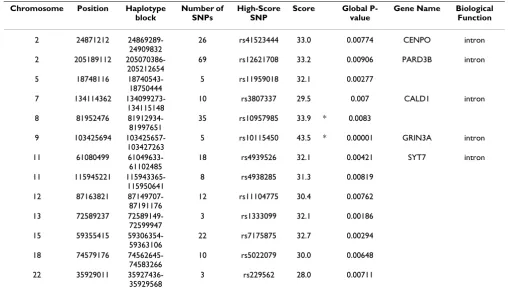
Table 1 shows a list of haplotype blocks whose haplotype frequencies were significantly different between JPT and CHB, as detected by ParaHaplo. ParaHaplo detected 13 haplotype blocks whose haplotype frequencies were nificantly different between JPT and CHB, when the sig-nificance level was set to 0.01. In contrast, when SNP-based GWAS was conducted on the same dataset, only 2 SNPs, rs10957985 and rs10115450--which are denoted by an asterisk in Table 1--were detected as being signifi-cantly different between JPT and CHB. Since there are 1,385,520 SNPs in this dataset, SNP-based GWAS consid-ers SNPs whose Pearson scores are greater than 33.48 as significantly different between the 2 populations at the same significance level. This result suggests that Para-Haplo, as compared to SNP-based GWAS, can detect smaller differences between 2 populations.
We found 5 genes on haplotype blocks whose haplotype frequencies were significantly different between JPT and CHB as shown in Table 1. According to OMIM [16], CENPO is a subunit of a CENPH-CENPI-associated cen-tromeric complex that targets CENPA to centromeres and is required for proper kinetochore function and mitotic progression [17]. In Drosophila, PARD3B regulates cell polarization and is precisely regulated by 2 apically local-ized multiprotein signaling complexes that are tethered by Inscuteable, which regulates the apical localization [18]. CALD1 is a potential actomyosin regulatory protein found in smooth muscle and nonmuscle cells [19]. GRIN3A encodes a subunit of the N-methyl-d-aspartate (NMDA) receptors; it functions in physiological and path-ological processes in the central nervous system [20]. SYT7 is a brain-specific, calcium-dependent phospholi-pid-binding protein that plays a role in synaptic exocyto-sis and neurotransmitter release [21]
Calculation time
Discussion
We developed ParaHaplo, a set of computer programs for the parallel computation of accurate P-values in haplo-type-based GWAS. ParaHaplo is intended for use in work-station clusters using the Intel MPI. By using ParaHaplo, we conducted haplotype-based GWAS as well as SNP-based GWAS, to find differences between JPT and CHB of the HapMap dataset [11].
Differences between Japanese in Tokyo, Japan, and Han Chinese in Beijing, China
We compared the performance of our algorithm with that of the regular permutation test in comparing JPT and CHB
of HapMap. By using haplotype-based GWAS, a total of 13 haplotype blocks were found to exhibit significant dif-ferences in haplotype frequency between JPT and CHB; meanwhile, by using SNP-based GWAS, only 2 SNPs were significantly different. The results suggest that ParaHaplo can detect smaller differences between 2 populations than SNP-based GWAS. Accounting for differences in substruc-ture is necessary for improving error rates in association studies [22,23].
Natural selection is considered to be one of the causes of change in allele frequency; however, these haplotype blocks did not overlap the regions suspected of being
Table 1: List of haplotype blocks whose haplotype frequencies are significantly different (P < 0.01) between CHB and JPT.
Chromosome Position Haplotype
block
Number of SNPs
High-Score SNP
Score Global
P-value
Gene Name Biological Function
2 24871212 24869289-24909832
26 rs41523444 33.0 0.00774 CENPO intron
2 205189112 205070386-205212654
69 rs12621708 33.2 0.00906 PARD3B intron
5 18748116 18740543-18750444
5 rs11959018 32.1 0.00277
7 134114362 134099273-134115148
10 rs3807337 29.5 0.007 CALD1 intron
8 81952476 81912934-81997651
35 rs10957985 33.9 * 0.0083
9 103425694 103425657-103427263
5 rs10115450 43.5 * 0.00001 GRIN3A intron
11 61080499 61049633-61102485
18 rs4939526 32.1 0.00421 SYT7 intron
11 115945221 115943365-115950641
8 rs4938285 31.3 0.00819
12 87163821 87149707-87191176
12 rs11104775 30.4 0.00762
13 72589237 72589149-72599947
3 rs1333099 32.1 0.00186
15 59355415 59306354-59363106
22 rs7175875 32.7 0.00294
18 74579176 74562645-74583266
10 rs5022079 30.0 0.00648
22 35929011 35927436-35929568
3 rs229562 28.0 0.00711
*Significantly different (P < 0.01) between JPT and CHB when SNP-based GWAS was used.
Table 2: Elapsed times and speedups obtained with ParaHaplo on the HapMap 3 JPT data and CHB of chromosome 22
Number of Processing Units Calculation Time Speed Ratio a
1 1 h 19 m 58 s 1
64 3 m 41 s 22
128 2 m 1 s 40
256 1 m 25 s 56
512 53 s 91
768 47 s 101
1536 41 s 116
influenced by natural selection Table 1 lists the genes on the haplotype blocks that have SNPs in which the JPT and CHP haplotype frequencies were significantly different (P < 0.01). It is unclear that the biological functions of the genes are different among JPT and CHB people.
Differences could also be caused by genetic drift [24], which brings about a change in allele frequency over time in a population, as a result of random sampling and chance. Archeological data suggest that there were proba-bly 2 migratory waves of incoming people to Japan, both from the Asian continent. The first migration took place about 38,000-37,000 years ago, before the Pleistocene land bridges became submerged. The last ice age ended and sea levels increased around 12,000 years ago; at this point, the Japanese people became isolated from the peo-ple of mainland Asia [25]. In the 12,000 years since then, the allele frequencies of the haplotype blocks listed on Table 1 may have changed due to genetic drift. Further studies may be necessary to determine whether these dif-ferences were maintained by natural selection, genetic drift, or both.
It is generally difficult to assess how many steps are neces-sary for the convergence of the MCMC algorithm and RAT. In this study, we conducted 7 runs of RAT for 100,000 generations by using different sets of processing units (table 2). We found the results of these runs were essen-tially the same; therefore, we considered 100,000 genera-tions to comprise a sufficiently large dataset. We recommend monitoring convergence by comparing sev-eral independent runs.
Parallel computation of haplotype-based GWAS
The results showed that the parallel computing of Para-Haplo was 100-fold faster than non-parallel programs. In this paper, we used only 89 JPT + CHB individuals whose genotypes had been determined by the HapMap project [11]. When a single processor was used, RAT for chromo-some 22 took more than 1 h; if 9,000 individuals were analyzed under the same conditions, it would take approximately 5 days. In contrast, when multiple proces-sors were used, RAT for chromosome 22 took less than 1 min; an analysis of 9,000 individuals under the same con-ditions would take approximately 1 h.
There are 1,536 haplotype blocks in chromosome 22. The speedup ratio was only 116 because of variations in the LD block size. Since ParaHaplo is based on data parallel-ism, the computational times of each of the RAT, SPT, and MCMC methods was proportional to the number of SNPs within the LD block [5,6]; as a result, a large LD block becomes a computational bottleneck. To archive faster parallel computing of haplotype-based GWAS, further studies into more fine-grained parallelization is required.
Conclusion
The results showed that the parallel computing of Para-Haplo was 100-fold faster than that of non-parallel pro-grams when the number of processors is sufficient. There are more than a million SNPs for which accurate and com-plete genotypes have been obtained, and thousands of people are now being genotyped [8,9]. Since the data sizes of such projects continue to increase, the use of fast com-putations with parallel computing--such as that used in ParaHaplo--will become increasingly important.
Availability and requirements
• Project name: ParaHaplo
• Project home page: http://sourceforge.jp/projects/ parallelgwas/?_sl=1
• Operating systems: Platform independent
• Programming language: Java and C
• Other requirements: OpenMPI version 1.2.5, or MPICH version 1.2.7p1
• License: MIT license
• Any restrictions to use by non-academics: License required
List of abbreviations used
RAT: Rapid Association Test; SPT: Standard Permutation Test; MCMC: Markov-chain Monte Carlo; JPT: Japanese Tokyo; CHB: Han Chinese Beijing.
Competing interests
The authors declare that they have no competing interests.
Authors' contributions
Kazuharu Misawa wrote the software and the manuscript, and Naoyuki Kamatani supervised the project. Both authors read and approved the final manuscript.
Acknowledgements
We thank Drs. Yumi Yamaguchi-Kabata, Akihiro Fujimoto, and Tatsuhiko Tsunoda for their useful comments. The present study was supported in part by grants from the Research Project for Personalized Medicine (MEXT). This work was supported by the National Project "Next-genera-tion Integrated Living Matter Simula"Next-genera-tion" of the Ministry of Educa"Next-genera-tion, Cul-ture, Sports, Science, and Technology (MEXT).
References
1. Hirschhorn JN, Daly MJ: Genome-wide association studies for common diseases and complex traits. Nat Rev Genet 2005,
6:95-108.
Publish with BioMed Central and every scientist can read your work free of charge "BioMed Central will be the most significant development for disseminating the results of biomedical researc h in our lifetime."
Sir Paul Nurse, Cancer Research UK
Your research papers will be:
available free of charge to the entire biomedical community
peer reviewed and published immediately upon acceptance
cited in PubMed and archived on PubMed Central
yours — you keep the copyright
Submit your manuscript here:
http://www.biomedcentral.com/info/publishing_adv.asp
BioMedcentral
3. Onouchi Y, Gunji T, Burns JC, Shimizu C, Newburger JW, Yashiro M, Nakamura Y, Yanagawa H, Wakui K, Fukushima Y, Kishi F, Hamamoto K, Terai M, Sato Y, Ouchi K, Saji T, Nariai A, Kaburagi Y, Yoshikawa T, Suzuki K, Tanaka T, Nagai T, Cho H, Fujino A, Sekine A, Nakamichi R, Tsunoda T, Kawasaki T, Hata A: ITPKC functional polymor-phism associated with Kawasaki disease susceptibility and formation of coronary artery aneurysms. Nat Genet 2008,
40:35-42.
4. Tokuhiro S, Yamada R, Chang X, Suzuki A, Kochi Y, Sawada T, Suzuki M, Nagasaki M, Ohtsuki M, Ono M, Furukawa H, Nagashima M, Yoshino S, Mabuchi A, Sekine A, Saito S, Takahashi A, Tsunoda T, Nakamura Y, Yamamoto K: An intronic SNP in a RUNX1 bind-ing site of SLC22A4, encodbind-ing an organic cation transporter, is associated with rheumatoid arthritis. Nat Genet 2003,
35:341-348.
5. Misawa K, Fujii S, Yamazaki T, Takahashi A, Takasaki J, Yanagisawa M, Ohnishi Y, Nakamura Y, Kamatani N: New correction algorithms for multiple comparisons in case-control multilocus associa-tion studies based on haplotypes and diplotype configura-tions. J Hum Genet 2008, 53:789-801.
6. Kimmel G, Shamir R: A fast method for computing high-signifi-cance disease association in large population-based studies.
Am J Hum Genet 2006, 79:481-492.
7. Ohashi J, Tokunaga K: The power of genome-wide association studies of complex disease genes: statistical limitations of indirect approaches using SNP markers. J Hum Genet 2001,
46:478-482.
8. Nakamura Y: The BioBank Japan Project. Clin Adv Hematol Oncol
2007, 5:696-697.
9. Yamaguchi-Kabata Y, Nakazono K, Takahashi A, Saito S, Hosono N, Kubo M, Nakamura Y, Kamatani N: Japanese population struc-ture, based on SNP genotypes from 7003 individuals com-pared to other ethnic groups: effects on population-based association studies. Am J Hum Genet 2008, 83:445-456.
10. Culler DE, Gupta A, Singh JP: Parallel Computer Architecture: A Hardware/Software Approach. San Francisco, CA: Morgan Kaufmann Publishers; 1997.
11. The_International_HapMap_Consortium: The International Hap-Map Project. Nature 2003, 426:789-796.
12. Tian C, Kosoy R, Lee A, Ransom M, Belmont JW, Gregersen PK, Sel-din MF: Analysis of East Asia genetic substructure using genome-wide SNP arrays. PLoS ONE 2008, 3:e3862.
13. Higasa K, Miyatake K, Kukita Y, Tahira T, Hayashi K: D-HaploDB: a database of definitive haplotypes determined by genotyping complete hydatidiform mole samples. Nucleic Acids Res 2007,
35:D685-689.
14. Gabriel SB, Schaffner SF, Nguyen H, Moore JM, Roy J, Blumenstiel B, Higgins J, DeFelice M, Lochner A, Faggart M, Liu-Cordero SN, Rotimi C, Adeyemo A, Cooper R, Ward R, Lander ES, Daly MJ, Altshuler D:
The structure of haplotype blocks in the human genome. Sci-ence 2002, 296:2225-2229.
15. Barrett JC, Fry B, Maller J, Daly MJ: Haploview: analysis and visu-alization of LD and haplotype maps. Bioinformatics 2005,
21:263-265.
16. Hamosh A, Scott AF, Amberger JS, Bocchini CA, McKusick VA:
Online Mendelian Inheritance in Man (OMIM), a knowledge-base of human genes and genetic disorders. Nucleic Acids Res
2005, 33:D514-517.
17. Okada M, Cheeseman IM, Hori T, Okawa K, McLeod IX, Yates JR 3rd, Desai A, Fukagawa T: The CENP-H-I complex is required for the efficient incorporation of newly synthesized CENP-A into centromeres. Nat Cell Biol 2006, 8:446-457.
18. Izaki T, Kamakura S, Kohjima M, Sumimoto H: Two forms of human Inscuteable-related protein that links Par3 to the Pins homologues LGN and AGS3. Biochem Biophys Res Commun
2006, 341:1001-1006.
19. Humphrey MB, Herrera-Sosa H, Gonzalez G, Lee R, Bryan J: Cloning of cDNAs encoding human caldesmons. Gene 1992,
112:197-204.
20. Micu I, Jiang Q, Coderre E, Ridsdale A, Zhang L, Woulfe J, Yin X, Trapp BD, McRory JE, Rehak R, Zamponi GW, Wang W, Stys PK:
NMDA receptors mediate calcium accumulation in myelin during chemical ischaemia. Nature 2006, 439:988-992. 21. Li C, Ullrich B, Zhang JZ, Anderson RG, Brose N, Sudhof TC:
Ca(2+)-dependent and -independent activities of neural and non-neural synaptotagmins. Nature 1995, 375:594-599.
22. Freedman ML, Reich D, Penney KL, McDonald GJ, Mignault AA, Pat-terson N, Gabriel SB, Topol EJ, Smoller JW, Pato CN, Pato MT, Pet-ryshen TL, Kolonel LN, Lander ES, Sklar P, Henderson B, Hirschhorn JN, Altshuler D: Assessing the impact of population stratifica-tion on genetic associastratifica-tion studies. Nat Genet 2004, 36:388-393. 23. Tian C, Gregersen PK, Seldin MF: Accounting for ancestry: pop-ulation substructure and genome-wide association studies.
Hum Mol Genet 2008, 17:R143-150.
24. Kimura M: Evolutionary rate at the molecular level. Nature
1968, 217:624-626.