A PID Controller Design Approach for Robust
Stability of Arbitrary Order Plants with Time
Delays
Partha Pratim Pathak
1, Neelanjana Baruah
2P.G. Student, Department of Electrical Engineering, Jorhat Engineering College, Jorhat , Assam, India 1 Associate Professor, Department of Electrical Engineering, Jorhat Engineering College, Jorhat, Assam, India 2
ABSTRACT: A controller designed specifically for a nominal process model often works well for the nominal plant
model, but may fail even by a little change in it. Robust control deals with analysis and controller design for such imperfect system with bounded modelling errors. A lot of research has been done and many methods are available for robust design of the plants. In this paper, a graphical technique is followed to find all PID controller gains that satisfy the robust stability constraint of a given DC motor model with time delay
.
KEYWORDS: Nominal plant,robust control, DC motor and time delay.
I. INTRODUCTION
The PID controllers are widely used in industrial control system for several decades since Ziegler and Nichols proposed their first PID tuning method. This is because the PID controllers are simple and it is easier to understand than most other controllers. Design methods leading to an optimal and effective operation of the PID controllers are economically vital for process industries. Robust control has been a recent addition to the field of control engineering that primarily deals with obtaining system robustness in presence of uncertainties [1]. Systems with delays are common. One reason is that nature is full of transparent delays. Another reason is that time delay systems are often used to model a large class of engineering systems, where propagation and transmission of information or material are involved. The presence of time delays makes system analysis and control design much more complicated [2]. In order for the methods to be applicable in the process control industry, it is particularly important that they can handle time delays effectively. And also the controller design methods should be simple to understand and easy to manipulate. The methods that depend only on the frequency response of the system eliminate the need for plant model, which may not be available in some applications.
II. RELATED WORK
Much of the early work done in this area concentrated on finding the PID controllers that robustly stabilize a nominal plant. Authors of [2] have shown that the first effective control method designed to deal with the time-delay systems was Smith predictor in which the minor feedback loop consisting of a predictor is introduced, then the controller design problem for a time-delay system is converted to a design problem for a delay free system. The disadvantage of Smith predictor, not being applied on unstable system motivated the modified smith predictor and finite spectrum assignment. H∞ control was introduced in the late „80s and is proved to be the most vital method in robust control. Extensive
In this paper mathematical formulations will be done as presented in [14].
III.DESIGNMETHODOLOGY
Consider a SISO linear time invariant system with additive uncertainity as shown in figure 1. Here GP(s) is the nominal
plant ,K(s) is the PID controller and WA(s) is the additive weight.The input signal and weighted output signal are R(s)
and Z(s) respectively [1].
Figure 1. Block diagram of system with additive uncertainty [1]
In figure 1 GΔ(s) represents the perturbed plants which includes ΔA(s), which is any stable transfer function such that
| ΔA(jω)|≤1 [1], for all ω. In the frequency domain we can represent the transfer functions as
GP(jω) = Re(ω) + jIm(ω) ... (1)
K(jω) = KP +
𝐾𝑖
𝑗𝜔 +Kd jω ... (2) WA(jω) =AA(ω) +j BA(ω) ... (3)
PID controller should be designed such that the nominal system remains stable and simultaneously satisfying robust stability constraint ||W(jω)K(jω)S(jω)||∞ ≤ɣ.
The robust stability constraint can be written as
... (5)
Or
... (6)
Where
The equation (6) should be satisfied for some values of ϴAϵ [0,2π].All PID controllers that would satisfy the robust
stability constraint have to lie at the intersection of all controllers that satisfy equation (5) for all ϴAϵ [0,2π].
From equation all PID controllers must satisfy
Where
... (7) Now substituting equation (1), (2), (3) and ejϴA=cos ϴA + jsin ϴA in (7), we get
... (8)
For ɣ→ ∞ Equation (8) reduces to the general characteristics polynomial. Expanding equation P (ω, ϴA, ɣ) =0 into real
and imaginary parts [14] we get
... (9)
And the imaginary components are
Now we are going to find the boundaries of equation in (Kp,Kd) plane for a fixed value of Ki. Let us consider Ki=
Ki
After the putting the value of Ki in equation (9), it can be written as
... (10)
Solving equation (10) for all ω≠0 and ϴA ϵ 0,2π, we obtain the controller gain as
... (11)
And
... (12)
Where
... (13)
Equation (10) can be written as
... (14)
For ω=0 a solution may exist if
Ki
=0. Solving we get
... (15)
We get –α(0)Kp=0 and β(0)Kd=-1 .So we can conclude that Kd (0,ϴA,ɣ) is arbitrary and
... (16) If α(0)=0 and β(0)≠0
IV.PIDCONTROLLERDESIGNFORADCMOTORWITHTIMEDELAY
In this section we seek to control a DC motor with a communication time delay. The nominal transfer function of the DC motor for controller design is chosen to be
... (17)
e-τs represents the τ seconds communication time-delay
.
In this paper the range of unknown communication delay is τϵ [0.05,0.5] and τ is selected to be the mean value of time delay range i.e.,
=0.1 .The additive uncertainty weight is designed as...(18)
The additive transfer funtion obtained was
...(19)
Figure 2. Additive weight representation
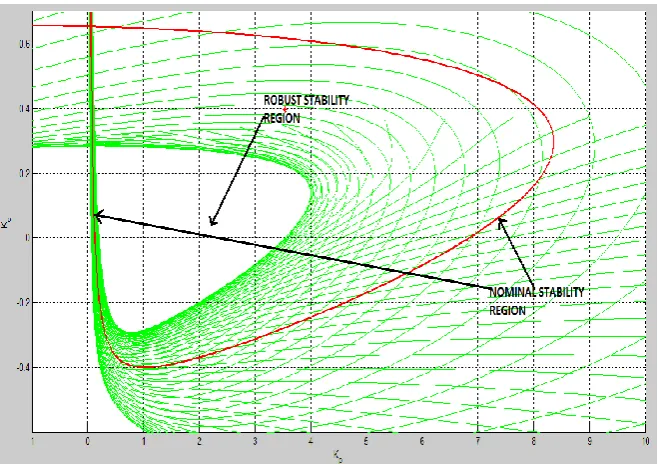
Figure 3 shows all the PID controllers in (Kp,Kd) plane for a constant value of Ki.The region that satisfies the robust
K1(s) = 0.7869 +
s
1
-0.2332s ...(20)
K2(s) = 1.6993 +
s
1
-0.3130s ...(21)
Substituting equations (20) and (19) in the robust stability constraint term we get ||W(jω)K1(jω)S(jω)||∞ =0.4606.
Repeating this procedure for equations (21) and (19) we get ||W(jω)K2(jω)S(jω)||∞>1. This clearly implies that the PID
controller selected from the robust stability region satisfies the robust stability constraint, while the other does not.
V. CONCLUSION
The robust controller design method suggested here is capable of ensuring closed loop stability for arbitrary order plants with additive uncertainty, which makes is applicable for wide range of plants. Future research can be done in the area of controller design for multi-area power system generation control, multivariable feed-back control systems, and robust performance for arbitrary order plants with additive uncertainty.
VI. ACKNOWLEDGMENT
I would like to extend my gratitude towards my guide Dr. Neelanjana Baruah (Associate professor) from the Electrical and Instrumentation Department of Jorhat Engineering College for her continued encouragement, support and motivation throughout my research. I would also like to thank my junior Himanshu Saikia for his helping hand in this research.
REFERENCES
[1] Skogestad, S. and I. Postlethwaite, Multivariable Feedback Control, John Wiley & Sons Ltd., Baffins lane, Chicester, West Sussex PO19 1UD, England, 2001, Chapters 2, 7, pp. 15-62, pp. 253-290
[2] Qing-Chang Zhong, Robust stability of time delay systems, Springer-Verlag London Limited 2006.Chapters 1, 2 pp. 1-40. [3] Bhattacharyya, S.P., Chapellat, H., and L.H. Keel, Robust Control: The Parametric Approach, Prentice Hall, N.J., 1995.
[4] Ho., K.W., Datta, A., and S.P. Bhattacharya, “Generalizations of the Hermite-Biehler theorem,” Linear Algebra and its Applications, Vol. 302-303, 1999, pp. 135-153.
[5] Ho., K.W., Datta, A., and S.P. Bhattacharya, “PID stabilization of LTI plants with time-delay,” Proc. 42nd IEEE Conf. on Decision and Control, Maui, Hawaii, 2003.
[6] Bhattacharyya, S.P. and L.H. Keel, “PID controller synthesis free of analytical methods,” Proc. of IFAC 16th Triennial World Congress, Prague, Czech Republic, 2005.
[7] Sujoldzic, S. and J.M. Watkins, “Stabilization of an arbitrary order transfer function with time delay using PI and PD controllers,” Proc. of American Control Conference, June 2006, pp. 2427-2432.
[8] Sujoldzic S. and J.M. Watkins, “Stabilization of an arbitrary order transfer function with time delay using PID controller,” Proc. of IEEE Conf. on Decision and Control, Vol. 45, December 2005.
[9] Emami, T. and J.M. Watkins, “Weighted sensitivity design of PID controllers for arbitrary-order transfer functions with time-delay,” Proc. of the IASTED International Conf. on Intelligent Systems and Control, November 2008, pp 20-25.
[10] Emami, T. and J.M. Watkins, “Complementary sensitivity design of PID controllers for arbitrary-order transfer functions with time delay,” Proc. of 2008 ASME Dynamic Systems and Control Conf., October 2008.
[11] Peter Dorato, “A historical review of robust control”, control systems magazine (volume 7, issue 2), April 1987.
[12] G. Zames, “Functional Analysis Applied to Nonlinear Feedback Systems,” IEEE Trans.. Circuit Theory. Vol. CT-10, pp. 392-4134, Sept. 1963. [13] R. E. Kalman, “When is a linear control system optimal?” Trans. ASME, Ser. D,J. Basic Engr, vol. 86, pp. 5 1-60, March 1964.
![Figure 1. Block diagram of system with additive uncertainty [1]](https://thumb-us.123doks.com/thumbv2/123dok_us/1671819.1210383/2.595.95.500.309.517/figure-block-diagram-additive-uncertainty.webp)