ISSN(Online): 2320-9801
ISSN (Print): 2320-9798
I
nternational
J
ournal of
I
nnovative
R
esearch in
C
omputer
and
C
ommunication
E
ngineering
(A High Impact Factor, Monthly, Peer Reviewed Journal) Website: www.ijircce.com
Vol. 5, Issue 11, November 2017
Performance Comparison of Extracted
features using Hybrid SIFT Approach
Rupal Shroti, Prof.Aishwarya Mishra
M.Tech Student, Dept. of Computer Science & Engineering, IES College, Bhopal, India
Professor, Dept. of Computer Science & Engineering, IES College, Bhopal, India
ABSTRACT:A fundamental difficulty in computer vision is object recognition: known an image collected of a grid of raw pixel values, one requires to plan a computer system that recognize the objects present in this image. It is recognized that humans are mainly good at such problems have driven the vision area forward during the modern years. With the exceedingly planned visual input, it is constantly a challenge to discover visual features that protect valuable information and make available pleasing invariance against discrepancies. Here a new and efficient technique for the Extraction of Features is implemented using an improved form of SIFT algorithm. The Proposed Methodology implemented here is based on the concept of Extracting Key Points from the image and then various other features such as Pixel Intensities and Histogram features are extracted.
KEYWORDS: Feature Extraction, Gabor filter, Scale invariant feature transform (SIFT), Support Vector Machines (SVMs).
I. INTRODUCTION
By its environment computer vision has been a indistinguishable difficulty need one to plan computer vision algorithms in addition to estimation criterion to accomplish human-like vision schemes. The texture extraction algorithms investigate the spatial allocation of pixels in grey scale images. The unusual techniques confine how common or well a texture. The textural character of an image depends on the spatial size of texture ancients [1]. Large prehistoric give increase to common texture (e.g. rock surface) and minute prehistoric give excellent texture (e.g. silk surface). The eight feature extraction techniques utilized here are supported on this spatial part to a certain extent than examine the occurrence domain data of the given images.
ISSN(Online): 2320-9801
ISSN (Print): 2320-9798
I
nternational
J
ournal of
I
nnovative
R
esearch in
C
omputer
and
C
ommunication
E
ngineering
(A High Impact Factor, Monthly, Peer Reviewed Journal) Website: www.ijircce.com
Vol. 5, Issue 11, November 2017
II. THEORETICAL BACKGROUND
The earliest pace for a computer program in semantic considerate on the other hand is to extract well-organized and efficient visual characteristics and construct models from them to a certain extent than human conditions information. So we can observe that how to remove image low-level visual characteristics and what type of characteristics will be removed participate an essential responsibility in different jobs of image processing. As we recognized the most widespread visual features include color, texture and shape, etc. [7] And most image annotation and retrieval schemes have been created based on these characteristics. When feature matches are concentrated in a region of a pair of images, it is generally found that the resulting homography is inaccurate, leading to e.g., poor mosaicking of the images or poor performance when tracking. Conversely, when matches are widely distributed around the overlapping part of a pair of images, calculated homographies is more accurate. Hence, it is valuable to be able to measure feature coverage in images to assess whether any resulting homography calculation is likely to be sufficiently accurate.
However, their performance is seriously needy on the use of image characteristics. In wide-ranging there are three characteristic demonstration techniques which are comprehensive, block-based and region-based features. Chow et al., [8] present an image classification technique through a tree-structured feature set, in which the root node denotes the whole image features while the child nodes represent the local region-based features. Tsai and Lin [9] compare various combinations of image feature representation involving the global, local block-based and region-based features for image database categorization.
III. IMAGE FEATURE EXTRACTION A. Image Feature Extractions using Color Space Models
Even though there are different methods executed for the removing the features of images but image feature removal using color based feature extraction is an important technique. There are various color space model discussed in the survey of [13]. Image can be classified as colored, gray or binary images. Color histogram is also a technique which is based on the extraction of colors in image processing, in spite of this Color Coherence vector and Color Moments based and color correlogram is also used for the extraction of features in image. In all the exceeding methods mean, skewness and standard deviation is calculated so that the characteristics can be removing without problems.
ISSN(Online): 2320-9801
ISSN (Print): 2320-9798
I
nternational
J
ournal of
I
nnovative
R
esearch in
C
omputer
and
C
ommunication
E
ngineering
(A High Impact Factor, Monthly, Peer Reviewed Journal) Website: www.ijircce.com
Vol. 5, Issue 11, November 2017
Color Method used for Extraction
Usages of the methodology
Histogram Simple to Compute
CM It is must compact and robust to use.
Correlogram It provides spatial information
CSD It provides spatial information
CCV It provides spatial information
SCD It is scalable and compact.
DCD It is compact to use and robust as well as perceptual. Table 1: Various Colors Space models for feature extraction
B. Image Feature Extraction using Textual Features
Some of the images can be progression using feature based in view of the fact that texture is a significant and frequent method of detecting the characteristics of images so that they can be utilized for recognition and explanation. Texture based Feature extraction can be secret as spatial and spectral texture based on their different benefits to exploit in the image processing.
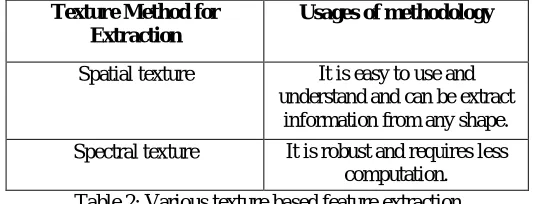
Texture Method for Extraction
Usages of methodology
Spatial texture It is easy to use and understand and can be extract
information from any shape. Spectral texture It is robust and requires less
computation. Table 2: Various texture based feature extraction
The figure-1 shown below is the example of feature points extracted from image
ISSN(Online): 2320-9801
ISSN (Print): 2320-9798
I
nternational
J
ournal of
I
nnovative
R
esearch in
C
omputer
and
C
ommunication
E
ngineering
(A High Impact Factor, Monthly, Peer Reviewed Journal) Website: www.ijircce.com
Vol. 5, Issue 11, November 2017
Texture is a very useful characterization for a wide range of image. It is generally believed that human visual schemes exploit texture for recognition and interpretation. In common, color is frequently a pixel possession while texture can only be calculated from a group of pixels. A huge number of methods have been recommended to remove texture characteristics. Based on the domain from which the texture feature is removed they can be generally confidential into spatial texture feature extraction techniques and spectral texture characteristic extraction techniques. For the previous move toward, texture features are removed by computing the pixel statistics or discovery the local pixel arrangements in unique image domain while the concluding alters an image into frequency domain and then computes characteristic from the altered image. Both spatial and spectral characteristics have benefit and drawbacks.
As the most widespread technique for texture characteristic removal Gabor filter has been extensively utilized in image texture feature withdrawal. To be precise, Gabor filter is planned to illustration the complete frequency domain of an image by distinguishing the center frequency and orientation parameters. The image is clean with a bank of Gabor filters or Gabor wavelets of unusual have a preference spatial frequencies and point of references. Each wavelet confines energy at a precise frequency and direction which make available a localized frequency as a feature vector. Consequently, texture features can be removed from this group of energy circulations [14]. Given an input image I(x,y), Gabor wavelet transform convolves I(x,y) with a set of Gabor filters of different spatial frequencies and orientations. A two-dimensional Gabor function g(x,y) can be defined as follows.
where σx and σy are the scaling parameters of the filter (the standard deviations of the Gaussian covers), W is the center frequency, and θ determines the orientation of the filter. Figure 1 shows the Gabor function in the spatial
domain.
C. Image Feature Extraction using Shape features
Shape is known as an significant indication for human beings to recognize and be acquainted with the real-world things, whose reason is to instruct straightforward geometrical shapes such as straight lines in dissimilar ways. Shape feature extraction techniques can be broadly classified into two groups [15], viz., contour based and region based methods. The former calculates shape features only from the limit of the figure, while the later technique removes characteristics from the complete area. For more features of image shape feature extraction and demonstration give pleasure to pass on to the literature [15]. additionally, spatial connection is as well think about in image processing which can tell object position within an image or the associations between objects. It principally comprises two cases: absolute spatial position of areas and comparative positions of areas.
IV. IMAGE FEATURE EXTRACTION TECHNIQUES
Feature extraction and demonstration is an essential step for multimedia processing. How to remove perfect characteristics that can replicate the fundamental substance of the images as complete as possible is still a challenging problem in computer vision. So they can distinguish that how to remove image low-level visual characteristics and what type of characteristics will be extracted play a essential responsibility in various tasks of image processing.
A. Image processing basics
Even the basics of image processing cannot be covered in this seminar. In this subsection only linear image filters are
described briefly. A linear filter has the property that any pixel of the filtered image can be expressed as a weighted sum
of the original image’s pixels. A subclass of these filters uses a weighted sum to map from only neighboring pixels to a new filtered pixel.
Then F as in describes a linear filter that takes into consideration only a 3 × 3 neighborhood of any pixel (x, y). It is
ISSN(Online): 2320-9801
ISSN (Print): 2320-9798
I
nternational
J
ournal of
I
nnovative
R
esearch in
C
omputer
and
C
ommunication
E
ngineering
(A High Impact Factor, Monthly, Peer Reviewed Journal) Website: www.ijircce.com
Vol. 5, Issue 11, November 2017
Figure 2: The x-component of the Sobel filter ([16])
From for an n × m image x and y would have to be in a range of {0, 1...n − 1} and {0, 1...m− 1} respectively. Thus for
border pixels the kernel could not be applied as (−1, y) and (x, −1) as well was (n, y) and (x, m) are out of range. The
solution is to either drop the border pixels, clamp x and y to image dimensions or “wrap” the image (eg. define I (−1,
y):= I (n−1, y) y accordingly). For a more intuitive description of these filters take a look at Figure 2.
B. Sobel edge detection
Edge detection is basic tool used in many image processing applications for extracting information from image. Sobel edge detection is gradient based edge detection method used to find edge pixels in image [17]. A pixel is at an edge when intensity sharply changes to its neighbors. The edge itself is linear shapes along which that change is maximal. Looking at images as functions of intensity, we can rephrase this property to “a maximum of the first derivative”. On
the level of pixels we have a discrete input (x, y) ∈ Z and we can use the discrete differential operator to approximate the first derivative in either direction.
For x that is thus the kernel filter
This is already the simplest edge detector, as the minima and maxima in the filtered image i.e. “darkest and brightest
spots” are edges. In Practice this Image filter is extremely sensitive to noise, though. Starting with E’X we will now derive the Sobel operator, which cannot be written as a convolution filter but is a nonlinear combination of such linear filters.
Firstly, to reduce noise we can blur the image using another linear filter1. In order not to degrade the edges, we only
ISSN(Online): 2320-9801
ISSN (Print): 2320-9798
I
nternational
J
ournal of
I
nnovative
R
esearch in
C
omputer
and
C
ommunication
E
ngineering
(A High Impact Factor, Monthly, Peer Reviewed Journal) Website: www.ijircce.com
Vol. 5, Issue 11, November 2017
Now, the only difference of the Sobel edge detection along x to the concatenation of our two kernels is the slight
change from E’X to EX .
C. Canny edge detection
Canny’s intention was to create a perfect edge detector. Unlike Sobel, Canny extracts thin, clear edges. It works by a two step algorithm in which firstly an edge filter just like Sobel is applied and secondly non-maxima suppression is applied to get thin lines that represent the edges. Be aware that Sobel considers 3 × 3 kernels and thus detects edges of that scale best. For Canny in a more general scheme, scale (or smoothing) is one parameter that critically influences the
results. For a basic understanding it is enough to think of the first step as a simple Sobel filter though. The second step
is essential to obtain thin lines as edges. Starting from a point of greater gradient magnitude than a threshold value T1, the algorithm follows a ridge, that’s to say a path of local maxima perpendicular to the edge direction. Points that are not along that ridge are suppressed; the path itself is the final edge. The path stops as soon as the gradient magnitude
falls below a second threshold T2. The introduction of a second threshold was to avoid “dashed” edges where the edge’s gradient magnitude is close to one threshold, noise would make it pass the threshold frequently. An Issue with the method as explained here, by the way, is that Y-junctions of edges are impossible, as only linear paths are followed. Where three edges meet in a point, two would connect and the third one would stop just before the actual junction because it is suppressed as the first two edges are tracked [18].
Figure 3: Canny edge detection applied [18]
Of course feature extraction is not all about edges. There exists a manifold of different techniques. For instance, it is possible to find corners by a local analysis of small regions with two different dominant edges. Blob detectors look for
local extrema in intensity rather than gradient.
D. Hough transformation
ISSN(Online): 2320-9801
ISSN (Print): 2320-9798
I
nternational
J
ournal of
I
nnovative
R
esearch in
C
omputer
and
C
ommunication
E
ngineering
(A High Impact Factor, Monthly, Peer Reviewed Journal) Website: www.ijircce.com
Vol. 5, Issue 11, November 2017
Transform peaks is proposed to address this problem. In this seminar we are going to deal only with the special case of
lines. Assuming the reader is familiar with the parametric representation d = cos(Θ)·x + sin(Θ)·y of a line, where Θ is
the angle between the line and the x-axis, d the distance to the origin and any (x, y)T which verifies the equation a point on that line, the Hough transformation for lines is a relatively simple construct.
The concept is to create a number of bins for lines of a certain range of their parameters (d, Θ) to (d́ ́ ́ ́′ , Θ′). A bin is an
accumulator cell for that range of parameters. For each edge point in image space we can assign a bin by taking the pixel position and gradient direction into account. We can employ Sobel to extract both gradient magnitude and angle, or alternatively any other means to do the same thing. Pixels along a straight edge all contribute to the same bin, because lines through these pixels of their gradient direction all have about the same distance to the origin. The fullest bins represent the most prominent or “best” lines. For a better fit the parameters used for that line can for instance be computed as the mean parameters of all edge pixels that contributed to that bin. Be aware that the number of bins used influence the minimum “difference” of two lines that are to be differed. Using too many bins “blurs” the maxima. Noise influences gradient information and pixels from the same original linear edge may fall into two neighboring bins when the bins are too small.
V. RELATED WORKS
In this paper [20] author has make use of a quantitative, strong calculation to estimate the spatial exposure of feature points in an image, intelligent to establish whether points are comprehensive at multiple scales. When matching images for relevance’s such as mosaicking and homography evaluation, the distribution of features across the overlap region affects the accuracy of the result show that SFOP commences extensively less aggregation than the other detectors tested and it is measured by Ripley’s K-function, to evaluate whether feature matches are clustered simultaneously or increase approximately the have common characteristics region. Based on this determine, an appraisal of a range of up to date feature detectors and then carried out using analysis of variance and a large image database was executed; the estimate method considered the imagery and the detector as the two self-determining variables have an effect on coverage, and consequence was evaluated using ANOVA. The results revealed that there is indeed statistical significance between the performances of detectors.
Figure 4: An output of the methodology [20].
When the detectors are rank-ordered by this act calculate, the order is generally comparable to those get hold of by other means, put it to some bodying that the arranging reveals authentic performance differences. SFOP was found to be better-quality to other detectors, while there are also some detectors whose performance differences were not statistically important. These findings are generally dependable with those get hold of by other investigators using
unusual come within reach of, increasing our self-assurance that these concert differences are authentic. Researches were also try to get completed on stitching have common characteristics regions into landscapes, substantiating that enhanced reporting give ways a better quality consequence.
ISSN(Online): 2320-9801
ISSN (Print): 2320-9798
I
nternational
J
ournal of
I
nnovative
R
esearch in
C
omputer
and
C
ommunication
E
ngineering
(A High Impact Factor, Monthly, Peer Reviewed Journal) Website: www.ijircce.com
Vol. 5, Issue 11, November 2017
and then represented as a segmentation graph by comparing walks in the particular segmentation graphs, and image classification is carried out with an SVM based on this kernel where each image is first segmented into a finite set of homogeneous segments and then represented as a segmentation graph. A set of features such as size, color, and texture are associated with each segment. We consider a method using support vector machines (SVMs) with walk-based graph kernels for high-level feature extraction from images.
Our aim is to extend a method of high-level feature extraction (HFE) from images, e.g., detecting whether an image is a background or contains an object such as a car or a dog. If a list of conceptions such as “is a landscape” or “contains a dog” is given, this task can also be considered as a set of take charge of binary classification tasks, where each image must be assigned a set of binary labels to indicate whether or not it belongs to each concept class. Unlike more precise undertakings such as face or character recognition, the importance in HFE is on acquiring nonspecific and multipurpose automatic tools that can “learn” any conception from a set of examples be in the right placing to the concept class. So the author gets acquired a relative increase of 58% measure up to with the baseline concert and this method of high-level feature extraction (HFE) substantiates the significance of our approach.
Here author [22] has presented a convex process for mutually learning feature weights and restrictions of SVM classifiers. Using support vector machine (SVM) classifiers for selecting appropriate features for significant for a
selection of reasons such as simplification concert, computational competence, and feature understandability. Additionally, we related the proposed framework with L1-SVMs and provided and theoretical justification for its use as a feature selection method. Conventional SVM approaches to feature selection characteristically remove features and learn SVM parameters separately. Independently achieving these two steps strength consequence in a loss of information communicated to the classification process. This paper proposes a convex energy-based structure to together complete feature selection and SVM constraint learning for linear and non-linear kernels. Experiments perform on seven standard datasets demonstrate significant reduction of features and different classification problems
showed that our method produced SVM classifier that used sparse sets of features and support vectors while
maintaining classification performance.
In this research author [23] has try to get involves the Iris Localization based on morphological or set theory which is well in shape detection. This algorithm implemented morphological operation for the inner and outer iris edge detecting and positioning and has the advantages of short localization time and high localization precision. Principal Component Analysis (PCA) is used for preprocessing, in which the elimination of superfluous and unnecessary data is completed. Applications such as Median Filtering and Adaptive thresholding are used for managing the differences in lighting and noise. Features are takeout using Wavelet Packet Transform (WPT). As a final point matching is completed using KNN. Experimental results of the proposed method are better than the prior method and are proved by the consequences of different parameters. This method signify that the proposed algorithm is a kind of efficient iris locating algorithm in the characteristic of time inspired and localization precision.
VI.PROPOSEDALGORITHM
1. Take an input image.
2. Apply PSO-SVM based SIFT algorithm for the extraction of features from the image.
PSO-SVM
The following algorithm is used for the optimization of SVM.
1. Initialize max-iterations and number of particle and dimensions. 2. for i= 1:no_of_particles
3. for j= 1:dimensions
4. particle_position(i,j) = rand*10; 5. particle_velocity(i,j) = rand*1000; 6. p_best(i,j) = particle_position(i,j); 7. end
8. end
ISSN(Online): 2320-9801
ISSN (Print): 2320-9798
I
nternational
J
ournal of
I
nnovative
R
esearch in
C
omputer
and
C
ommunication
E
ngineering
(A High Impact Factor, Monthly, Peer Reviewed Journal) Website: www.ijircce.com
Vol. 5, Issue 11, November 2017
10. p_best_fitness(count) = -1000; 11. end
12. for count = 1:max_iterations 13. for count_x = 1:no_of_particles 14. x = particle_position(count_x,1); 15. y = particle_position(count_x,2); 16. ker = '@linearKernel';
17. global p1 ; 18. p1 = x; 19. C = y; 20. trnX=X; 21. trnY=Y; 22. tstX=X'; 23. tstY=Y';
24. [nsv,alpha,bias] = svmTrain(trnX,trnY,C); 25. actfunc = 0;
26. predictedY = svcoutput(trnX,trnY,tstX,ker,alpha,bias,actfunc); 27. Result = ~abs(predictedY)
28. Percent = sum(Result)/length(Result) 29. soln = 1-Percent
30. if soln~=0
31. current_fitness(count_x) = 1/abs(soln)+0.0001; 32. else
33. current_fitness(count_x) =1000; 34. end
35. End
SIFT FEATURE EXTRACTION
1. Find the points, whose surrounding patches (with some scale) are distinctive 2. An approximation to the scale-normalized Laplacian of Gaussian
V. EXPERIMENTAL RESULT ANALYSIS
ISSN(Online): 2320-9801
ISSN (Print): 2320-9798
I
nternational
J
ournal of
I
nnovative
R
esearch in
C
omputer
and
C
ommunication
E
ngineering
(A High Impact Factor, Monthly, Peer Reviewed Journal) Website: www.ijircce.com
Vol. 5, Issue 11, November 2017
Images Existing Work Proposed Work
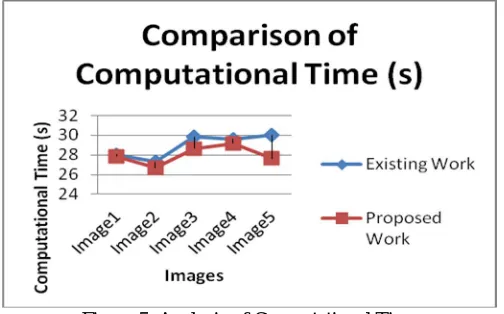
28.0334 27.8462
27.2846 26.6606
29.8274 28.6298
29.609 29.174
29.9834 27.649 Table 3. Comparison of Computational Time
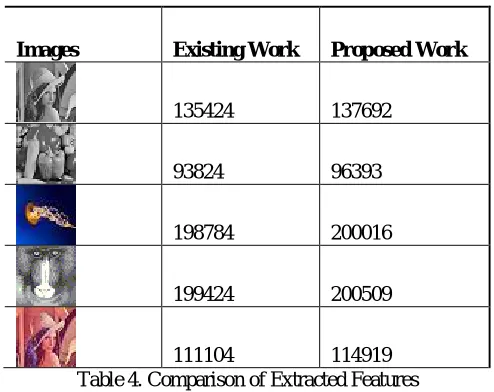
The table 4 shown below is the analysis and comparison of Number of Features Extracted in SFOP algorithm and proposed algorithm. The proposed technique extracts more features as compared to the existing SIFT algorithm.
Images Existing Work Proposed Work
135424 137692
93824 96393
198784 200016
199424 200509
111104 114919 Table 4. Comparison of Extracted Features
ISSN(Online): 2320-9801
ISSN (Print): 2320-9798
I
nternational
J
ournal of
I
nnovative
R
esearch in
C
omputer
and
C
ommunication
E
ngineering
(A High Impact Factor, Monthly, Peer Reviewed Journal) Website: www.ijircce.com
Vol. 5, Issue 11, November 2017
Images Existing Work Proposed Work
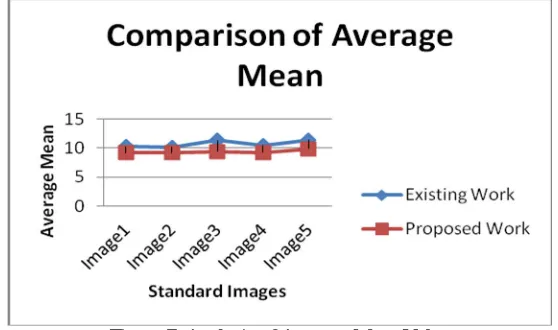
10.2795 9.1849
10.1854 9.1539
11.3428 9.3749
10.456 9.2586
11.3685 9.8356 Table 5. Comparison of Mean
The figure 5 is the analysis and comparison of Computational time of the SFOP algorithm and proposed algorithm. The proposed technique implemented here takes less computational time.
Figure 5. Analysis of Computational Time
ISSN(Online): 2320-9801
ISSN (Print): 2320-9798
I
nternational
J
ournal of
I
nnovative
R
esearch in
C
omputer
and
C
ommunication
E
ngineering
(A High Impact Factor, Monthly, Peer Reviewed Journal) Website: www.ijircce.com
Vol. 5, Issue 11, November 2017
Figure 6. Analysis of Features Extracted
The Figure 7 is the analysis and comparison of Average Mean in SFOP algorithm and proposed algorithm. The proposed technique mean is less than existing SFOP algorithm.
Figure 7. Analysis of Average Mean Value
VI. CONCLUSION AND FUTURE WORK
In this paper the existing techniques implemented for the Feature Extraction using SFOP provides efficient extraction of Features from the Standard Images. The Methodology adopted here is a new and efficient methodology for the Extraction of Features using an improved form of SIFT algorithm. The Proposed Methodology implemented here is based on the concept of Extracting Key Points from the image and then various other features such as Pixel Intensities and Histogram features are extracted. The Proposed methodology implemented provides more number of Features to be extracted from the image and Less Average Mean in Comparison with the existing SFOP Methodology.
REFERENCES
[1] K. Karu, A.K. Jain and R.M. Bolle, Is there any texture in the image? Pattern Recognition, 29(9):1437-1446, 1996.
[2] A Krizhevsky. “Convolutional deep belief networks on CIFAR-10" In: Technical Report (2010).
[3] A Krizhevsky, I Sutskever, and GE Hinton. “ImageNet Classification with Deep Convolutional Neural Networks". In: NIPS. 2012.
[4] Saliency, Scale and Image Description: T. Kadir & M. Brady, Robotics Research Laboratory, Department of Engineering Science, University of
Oxford, 2000.
ISSN(Online): 2320-9801
ISSN (Print): 2320-9798
I
nternational
J
ournal of
I
nnovative
R
esearch in
C
omputer
and
C
ommunication
E
ngineering
(A High Impact Factor, Monthly, Peer Reviewed Journal) Website: www.ijircce.com
Vol. 5, Issue 11, November 2017
[6] J Yang, K Yu, and Y Gong. “Linear spatial pyramid matching using sparse coding for image classification". In: CVPR. 2009
[7] C. F. Tsai, “Image mining by spectral features: A case study of scenery image classification”, Expert Systems with Applications, vol. 32, no. 1,
(2007), pp. 135-142.
[8] T. W. S. Chow and M. K. M. Rahman, “A new image classification technique using tree-structured regional features”, Neurocomputing, vol.
70, no. 4-6, (2007), pp. 1040-1050.
[9] C. F. Tsai and W. C. Lin, “A comparative study of global and local feature representations in image database categorization”, In Proc. 5th International Joint Conference on INC, IMS & IDC, (2009), pp. 1563-1566.
[10] A. Davison, I. D. Reid, N. D. Molton, and O. Stasse, “Mono SLAM: Real-time single camera SLAM,” IEEE Trans. Pattern Anal. Mach. Intell.,
vol. 29, no. 6, pp. 1–16, Jun. 2007.
[11] J. Civera, O. G. Grasa, A. J. Davison, and J. M. M. Montiel, “1-point RANSAC for EKF filtering: Application to real-time structure from motion and visual odometry,” J. Field Robot., vol. 5, pp. 609–631, Jan. 2010.
[12] H. Jin, S. Soatto, and A. J. Yezzi, “Multi-view stereo reconstruction of dense shape and complex appearance,” Int. J. Comput. Vis., vol. 63, no.
3, pp. 175–189, 2005.
[13] P. L. Stanchev, D. Green Jr. and B. Dimitrov. “High level colour similarity retrieval”, International Journal of Information Theories and Applications, vol. 10, no. 3, (2003), pp. 363-36.
[14] S. E. Grigorescu, N. Petkov and P. Kruizinga, “Comparison of texture features based on Gabor filters”, IEEE TIP, vol. 11, no. 10, (2002), pp.
1160-1167.
[15] D. Zhang and G. Lu, “Review of shape representation and description techniques”, Pattern Recognition, vol. 37, no. 1, (2004), pp. 1-19.
[16] Effective Programming in C and C++ - MIT OpenCourseWare: Electrical Engineering and Computer Science mit C++, CAMP chair summer
term 2007. Image processing learning resource, School for Informatics, University of Edinburgh,
[17] Girish N. Chaple, R. D. Daruwala, Manoj S. Gofane, "Comparisions of Robert Prewitt Sobel operator based edge detection methods for real
time uses on FPGA", Technologies for Sustainable Development (ICTSD) 2015 International Conference on, pp. 1-4, 2015.
[18] Rupalatha, Mr. C. Leelamohan, Mrs. M. Sreelakshmi” Implementation Of Distributed Canny Edge Detector On Fpga” International Journal of
Innovative Research in Science, Engineering and Technology Vol. 3, Issue5, 2013
[19] R. Varun, Yadunandan Vivekanand Kini, K. Manikantan S. Ramachandran, “Face Recognition Using Hough Transform Based Feature
Extraction”, Proceedings of the International Conference on Information and Communication Technologies, ICICT 2014, 3-5 December 2014.
[20] Erkan Bostanci, NadiaKanwal, Adrian F. Clark, “Spatial Statistics of Image Features for Performance Comparison” IEEE Transactions On
Image Processing, Vol. 23, No. 1, January 2014.
[21] Jean-Philippe Vert, Tomoko Matsui, “High-Level Feature Extraction Using Svm with Walk-Based Graph Kernel, 2007.
[22] Minh Hoai Nguyen, Fernando de la Torre, “Optimal feature selection for support vector machines” Pattern Recognition 43, 584–591, 2010.
[23] Suganthy, M. and P. Ramamoorthy, “Principal Component Analysis Based Feature Extraction, Morphological Edge Detection and Localization
![Figure 2: The x-component of the Sobel filter ([16])](https://thumb-us.123doks.com/thumbv2/123dok_us/1388583.1171562/5.595.59.427.184.424/figure-x-component-sobel-filter.webp)
![Figure 3: Canny edge detection applied [18]](https://thumb-us.123doks.com/thumbv2/123dok_us/1388583.1171562/6.595.181.420.426.652/figure-canny-edge-detection-applied.webp)
![Figure 4: An output of the methodology [20].](https://thumb-us.123doks.com/thumbv2/123dok_us/1388583.1171562/7.595.202.393.514.637/figure-output-methodology.webp)