An Enhanced Image Denoising technique
using Wavelet Threshold and Genetic
Algorithm
Sudama Sahu1, Bhupendra Verma2
PG Student, Dept. of ECE, Nagaji Institute of Technology & Management, Datia, India1
Assistant Professor, Dept. of ECE, Nagaji Institute of Technology & Management, Datia, India2
ABSTRACT: In the process of image acquisition and transmission, noise is always contained inevitably. So it is necessary to image denoising processing to improve the quality of image. Generally speaking, each algorithm has some filtering and threshold parameters. Taking variety kinds of images into account, it is a key problem of how to set these parameters in denoising algorithms under different conditions to achieve better performance. There are many algorithms for the determination of the parameters, and each of them has its application field. Because the wavelet transform has good performance, therefore, it has been widely applied as a kind of signal and image processing tools. In this paper, wavelet transform is used in the image denoising, and the genetic algorithm is used to estimate the denoising results. Experimental results show the validity of the new algorithm.
KEYWORDS: image denoising, threshold, wavelet transform, genetic algorithm.
I. INTRODUCTION
In the process of image acquisition and transmission, noise is always contained inevitably. So it is necessary to image denoising processing to improve the quality of image. Much practical noise can be approximated as white noise with Gauss distribution, and removal of superposition of Gauss white noise has become an important direction in image denoising research. Generally speaking, each algorithm has some filtering and threshold parameters. Taking variety kinds of images into account, it is a key problem of how to set these parameters in denoising algorithms under different conditions to achieve better performance.
Simple linear smoothing filter, such as Gauss filter [1-3], will cause the detail information loss of image. In recent years, a large number of complex denoising algorithms mean of nonlinear filter has appeared. Common algorithms include a variety of adaptive median filter algorithms: the wavelet threshold [4-8] (also called wavelet shrinkage) algorithm, the anisotropic diffusion equation algorithm [9-12], the total variation minimization algorithm [13-16], non-local mean filter algorithm [17-20], etc.
A. Wavelet Transform
Wavelet transform is a time-frequency analysis method with fixed window size and varied shape with time. Principle of removing noise by wavelet transform is that the noise mostly belongs to the high frequency information. Therefore, noise information is mostly concentrated in sub blocks with infra-low frequency, infra-high frequency, and high frequency. Sub blocks with high frequency are almost composed of noise information. Therefore, if we set high frequency sub block to zero and suppress low frequency and high frequency sub blocks on certain inhibition, it can achieve a certain effect of the noise removal. Usually the image denoising processing based on wavelet method is as the following: wavelet transform; threshold of wavelet detail coefficients; reconstruction.
recognize them. For the signal, wavelet denoising is a signal filtering problems. Although largely wavelet denoising can be seen as a low pass filter, it is still better than the traditional low pass filter due to the retaining of the image feature after denoising. Thus, wavelet denoising is actually a comprehensive feature extraction and low passes filter function.
Generally speaking, each algorithm has some filtering and threshold parameters. Due to the variety of the image content, how to set these parameters for denoising algorithms to achieve a better performance under different conditions is a key problem.
In research image denoising method, many algorithms have been developed, such as adaptive wavelet transform with soft threshold denoising algorithm [21], algorithm of systolic function considering the gradient, scale and spatial geometric consistency information into consideration in in adaptive process [22], adaptive wavelet transform with two step variance adaptive algorithm and local variance and balanced multi wavelet coefficient model [23], multivariate generalized Gauss model [24], estimation of threshold parameter with correlated noise and the edges of the image [25], steerable wavelet reconstruction algorithm [26], and so on.
Because the wavelet transform has good local character, therefore, it has been widely applied as a kind of signal and image processing tools.
Since the concept of wavelet threshold has been proposed, because it can obtain the optimal estimate in the Besov space and other linear estimators cannot get the same result, much attention has been paid on it. Wavelet thresholding is a nonlinear method, and denoising purpose can be achieved according to the process of wavelet coefficients in the wavelet domain. Its theoretical premise is coefficients of the image followed Gauss distribution, and wavelet coefficient with absolute larger magnitude is mainly obtained from the transformed signal and wavelet coefficient with absolute smaller magnitude is mainly obtained from the noise signal transformed. Then we can clear the noise by setting a threshold.
In this paper, wavelet transform is used in the image denoising, and the genetic algorithm is used to estimate the denoising results. The main contribution of the paper is to the proposal of an algorithm for image denoising. And the remainder of the paper is shown as the following: Threshold determination is listed in Section 2. Experimental method and verification is shown in Section 3. And the conclusion is described in Section 4.
II. THRESHOLD DETERMINATION A. Wavelet Transform Denoising
When the useful signal is transformed by wavelet, the energy will concentrate on the small number of wavelet coefficients. At the same time, noise will be distributed on the entire time axis at all-time scales due to the not related wavelet coefficients. In the processing, other points value will be set as zero or reduced maximum, and the processed wavelet would be inverse transformed. Then, noise will be suppressed. Threshold denoising is based on the comparison of transform domain coefficients and threshold value, and processed coefficient should be transformed to reconstruct the denoising image. Concrete steps of wavelet threshold denoising method are shown as the following:
Step 1: wavelet decomposition of the image: Determine the wavelet function and decomposition levels N, and decompose the image with N layer wavelet.
Step 2: Threshold selection: select the threshold for each wavelet coefficients of each layer, and judge the threshold of detail coefficients.
Step 3: Image reconstruction: coefficient with threshold processed will be used to reconstruct the image by inverse wavelet transform.
method used for the wavelet coefficients can reduce the error and improve the accuracy of the wavelet coefficient threshold judgment. There is no doubt that it will be more effectively for image denoising.
B. Threshold Correction
In the process of wavelet threshold denoising, threshold should be estimated, and the general threshold calculation method can be described as the following:
= . 2∗ln( )
Where, is the noise standard deviation, n is the length of sampling signal. The universal threshold formula may appear the phenomenon of “killing” in the denoising process, then some image edge details would be lost. In order to protect the image edge details, it should introduce a shrinkage factor in general the threshold formula. However, if the shrinkage factor value is too small, the threshold would be small too. When the wavelet coefficient threshold is applied, the noise component will be contained too much, and it cannot be an effective denoising. Some methods have been proposed to solve the problem. For example, denoising threshold for ground penetrating radar (GPR), the threshold would be as the following:
= . 2∗ln( ) (1 + lg )
Where, j is the level of decomposition. For the characteristics of infrared image, wavelet coefficients for signal are small, and the threshold determined by the threshold formula would be smaller. In order to keep the infrared image denoising effect, the shrinkage factor should not be too small. Then the modified function has been proposed and the mathematical expressions are shown as the following:
= . −1 + 1
Where, is the threshold determined by the threshold correction method, N is the total number of layers, and is the threshold calculated by universal threshold formula.
C. New Threshold Functions
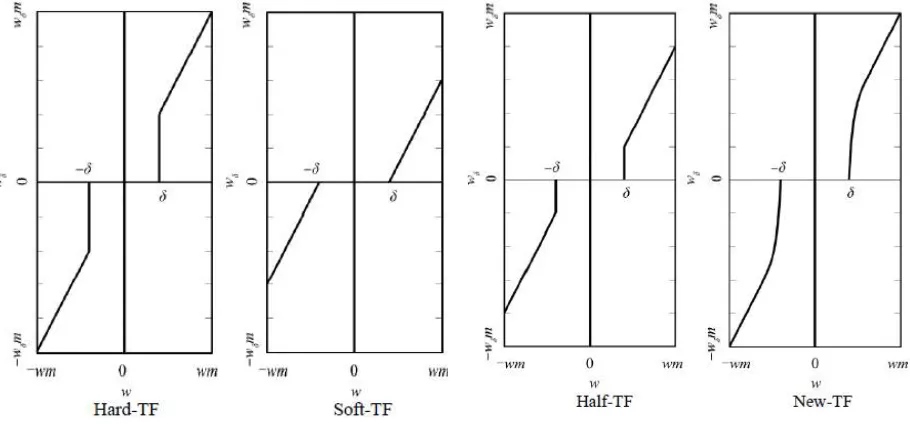
In the process of denoising, wavelet coefficient should be processed. There are mainly two methods to process: hard thresholding and soft thresholding. Equation (5) and equation (6) are hard thresholding function (Hard-TF) and soft threshold function (SoftTF), respectively. Both the equations are described as the following:
= , | | ≥ 0, | | <
= ( )(| | ≥ ), | | ≥ 0, | | <
where, is the threshold, is the magnitude of the wavelet coefficients, and is the wavelet coefficient which is processed with threshold. Although the hard threshold is the natural choice and it can preserve the image edge details, the hard threshold function is discontinuity and it would cause ringing and pseudo Gibbs effect when used in the denoising. For the image soft thresholding, due to the inherent deviation, it may cause the defect image fuzzy. Aiming at the defects of hard threshold and soft threshold function, a comprehensive treatment method, which named half thresholding function (Half-TF) has been proposed. It can be described as the following:
= ( )(| |– . ), | | ≥
0, | | <
properly preserve the image edge details. Therefore, based on the half threshold function, parameter should be adaptive, and it can be changed according to the different wavelet coefficients. When | | value is small and close to the threshold, parameter would be close to the value of 1 to have characteristics of soft threshold function. It will reduce ringing, pseudo Gibbs effect. When | | value is increasing, parameter would be rapidly approaching 0, which has the characteristic of hard threshold function and preserve image edge details. The exponential function can meet this demand. Adaptive is achieved according to the comparison between | | and . In order to make the threshold function can be extended, an adjustable parameter will be introduced in the exponential part. That is the new threshold function which is with adaptive features.
= ( ) | |–
exp( . )
exp( . | |). , | | ≥ 0, | | <
Where, is in the range of non-negative. Different values of would affect the property of new threshold function, of which two kinds of extremes are =0 and . When = 0, the new threshold function is converted into a soft threshold function, and when , the new threshold function into the hard threshold function. In the extreme conditions, the new threshold function has no help to overcome the defects of soft threshold function or hard threshold function, so in the new threshold function should be given a moderate value. When the value is given, the new threshold function can be carried out according to different treatment on the size of the wavelet coefficient. When the | | is small, the new threshold function is similar with soft threshold function, and when the | | is big, the new threshold function is similar with hard threshold function.
Fig. 1: Different Threshold Functions
Figure 1 shows the comparison of different threshold function. x axis means wavelet coefficients , is the maximum of . y axis represents which is wavelet coefficient applied with threshold. is the maximum of . is the threshold.
D. Modified Threshold Denoising Algorithm
The improved threshold based improved wavelet denoising of infrared image can be divided into some steps: Step 1: Wavelet decomposition: decomposition of the image with N layers wavelet discretion;
Step 2: Threshold processing: modified threshold processing scheme will be used to determine the threshold size, and new threshold function would be used to deal with the wavelet coefficients;
Step 3: Image reconstruction: reconstruct the image by inverse wavelet transformation.
E. Genetic Algorithm in Image Processing
(1) Basic principle of genetic algorithms used in image processing
Genetic Algorithm [21-25] is a method simulated with evolutionary of self-existence and fittest survival. It is repeated use the basic operation in genetics to continuously create new group for the population may contain the solution. It is in a style of continuous evolution of the group and with global parallel search technique in the optimization for the best individual to get the solution which meets the requirements. Genetic algorithm is simple, robust, and with prominent characteristics of self-organization, self-adaptive, self-learning and parallel in essence. In image denoising process, it is expected to get the denoising image, which contains all the information of the original image. That is to say that getting the optimal denoising image. In the paper, genetic algorithm is also taken into the threshold determination to find the optimal threshold. According to the comparison between denoised image and the original image, best threshold processing results would be determined. But both the two images are unknown, so it is still difficult to determine the optimal value. However, the noisy image x(T) is the original image of s(T) generated after the noise pollution, therefore the denoised image can be used to generate another noisy image according to same pollution process. The noisy image generated would be compared with the initial noisy image. The compared method can be described as:
( ) ≈ ‖ − ( )‖
When the comparison result is quite small, we will get the best denoising image. From the perspective of genetic algorithm, the smaller ( ) the higher image fitness the individual represents. The process of the denoising process is the minimize value of ( ) .
In the use of a genetic algorithm to find the optimal denoising image, initial population which contains initial solution should be firstly produced. Traditional genetic algorithm generates the initial population by a random form. It not only slows down the convergence speed of evolution, but also greatly increased the computing time. In the algorithm, we will firstly evaluate the initial population and encoding, and then genetic manipulation for the group. The sequence of the process would be as the following: selection, crossover and mutation operator. Selection principle is elimination of lower fitness individuals and retains high fitness individuals until to get the final optimal Solution
(2) Optimal threshold selection for wavelet transform based on genetic algorithm In the search process of the genetic algorithm, evaluation function is used to evaluate individual. The evaluation results would be taken as a basis for future operation. This evaluation function is determined by:
( ) ≈ ‖ − ( )‖
Selection or copy operation is designed to choose excellent individuals from the current population, so that they have the opportunity as a parent for the next generation. The fitness value is the criterion used to evaluate the individual quality. Higher individual fitness is the greater chance of survival.
III.METHODOLOGY
A. The proposed method of de-noising
The noise-corrupted image, which is expressed as = + , where is the standard deviation of noise, according to equation (1), is subjected to a DWT. The threshold level is usually estimated for = 1. Therefore, when is different than unity there should be a threshold rescaling. Estimating the noise standard deviation in one of the following ways may perform this rescaling of the threshold level.
a) A robust median estimator of the highest subband diagonal coefficients (i.e. HH
1) estimates the noise standard
=
0.6745
where represents the coefficients of subband. The threshold level is rescaled according to the thresholding criterion, which is selected and is applied in every coefficient of all the subbands. This case is mentioned as global threshold.
b) The same median estimator is employed in order to determine the standard deviation of noise for each level separately. In this case represents all the detail coefficients of the corresponding level (i.e. coefficients of the horizontal, vertical and diagonal subbands). The threshold level is rescaled according to the selected thresholding criterion and is applied on every coefficient of the corresponding level. Hence, the number of the threshold levels is equal to the number of decomposition levels. This case is mentioned as level dependent threshold.
c) The same median estimator is applied on the horizontal, vertical and diagonal detail coefficients of each level. The matrix represents the corresponding detail coefficients of each level. Therefore, the number of the threshold levels is equal to the number of decomposition levels times the decomposition sub bands of every level, which are three in the 2-D case.
The proposed de-noising algorithm is summed up to the following steps: A four level DWT transforms the noise-corrupted image.
Estimate the noise standard deviation with one of the above three proposed methods by employing a thresholding criterion.
For each sub band (except the low pass or approximation subband) apply hard or soft threshold to the subband coefficients.
Reconstruct the image by employing the inverse DWT.
IV.RESULT
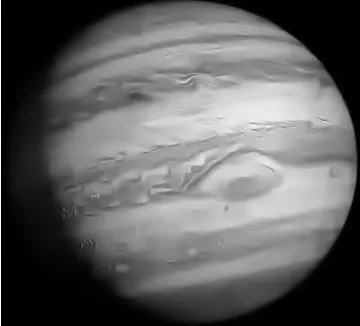
After development of this noble image Denoising algorithm, we have tested this algorithm on two different images in which first image is of NITM itself and second image is of planet Jupiter. In this validation process both the images were first contaminated with White Gaussian noise having noise variance (σ) = 0.02 and then de-noised using developed algorithm.
Fig. 4. De-noised image of NITM using proposed method
Fig 5. Gray Scale Image of Jupiter. Fig 6. Noisy image of Jupiter, (σ= 0.02)
After simulation of denoising algorithm we have calculated SNR value of the de-noised image with proposed method and traditional method. We have tabulated the result of this simulation in table 1 for NITM image and in table 2 for Jupiter image. From these two tables we can say that the proposed method will produce higher signal to noise ratio after denoising then traditional Wavelet based soft threshold method.
Table 1. Comparison of Signal-to-noise Ratio with Different Noise Intensity by Different Methods NITM.
Mixed Noise
Variance
SNR
Traditional Method Proposed Method
0.002 38.3710 40.8187
0.004 38.3622 40.8160
0.006 38.3601 40.8141
0.008 38.3582 40.8125
0.02 38.3564 40.8094
Table 2. Comparison of Signal-to-noise Ratio with Different Noise Intensity by Different Methods Jupiter.
Mixed Noise
Variance
SNR
Traditional Method Proposed Method
0.002 40.3830 41.6024
0.004 40.3817 41.5992
0.006 40.3811 41.5954
0.008 40.3802 41.5944
0.02 40.3764 41.5807
From the Table 1 and Table 2, we can find that the proposed wavelet based soft threshold with Genetic algorithm has better performance in denoising process of image.
V. CONCLUSION
It is necessary to image denoising processing to improve the quality of image. Much practical noise can be approximated as white noise with Gauss distribution, and removal of superposition of Gauss white noise has become an important direction in image denoising research. Since the concept of wavelet threshold has been proposed, for its optimal estimate in the Besov space, much attention has been paid on it and various algorithms based on it have been developed. Wavelet thresholding used for denoising is according to the adjustion of wavelet coefficients in the wavelet domain. Then we can clear the noise by setting threshold.
In this paper, wavelet transform is used in the image denoising, and the genetic algorithm is used to estimate the denoising results. Two typical images are used to verify the validity of the new algorithm, and the results show that the new algorithm can improve the signal to noise ratio compared with the traditional algorithm.
REFERENCES
[1]. L. X. Wen and L. C. Ying, “An optional Gauss filter image denoising method based on difference image fast fuzzy clustering”, Applied
[2]. Mechanics and Materials, pp. 411-414 (2013).
[3]. C. Nicola, S. Lorenzo and V. Luisa, “Image focusing using Gauss-Laguerre circular harmonic filters”, 2011 Joint Urban Remote Sensing
Event, JURSE 2011 - Proceedings, pp. 309-312, (2011).
[4]. B. –P. Wang, J. –L. Fan, W. –X. Xie and Y- Ho. Xin, “Adaptive filter for removing image Gauss noise based histogram, Systems Engineering
and Electronics, vol. 26, no. 1, pp. 1, (2004).
[5]. Z. Liu, T. He, Y. He and Y. Yu, “Discussion on the wavelet adjustment factor threshold noise reduction technology based on DSP”,
Advanced Materials Research, pp. 317-319, (2011).
[6]. J. Tang, Y. Xie, Q. Zhou, M. Tang and P. Li, “Study of the construction of complex threshold for complex wavelet transform suppressing
[7]. I. Mitsuru, M. Reiko and I. Kuniharu, “A new evaluation method for image noise reduction and usefulness of the spatially adaptive wavelet thresholding method for CT images”, Australasian Physical and Engineering Sciences in Medicine, vol. 35, no. 4, pp. 475-483, (2012).
[8]. O. Tischenko, C. Hoeschen and E. Buhr, “An artefact-free, structure-saving noise reduction using the correlation between two images for
threshold determination in the wavelet domain’, Progress in Biomedical Optics and Imaging - Proceedings of SPIE, vol. 5747, no. II, pp. 1066-1075, (2005).
[9]. N. Gupta, M. N. S. Swamy and E. I. Plotkin, “Video noise reduction in the wavelet domain using temporal decorrelation and adaptive
thresholding”, Proceedings - IEEE International Symposium on Circuits and Systems, pp. 4603-4606, (2006).
[10]. A. Yin, L. Zhao, Z. Yang and B. Chen, “Noise reduction method for vibration signals 2D time-frequency distribution using anisotropic
diffusion equation”, Mathematical Methods in the Applied Sciences, (2014).
[11]. Z. –h. Xi, T. Hai and Y. –h. Xiao, “Reversible image interpolation based on hybrid anisotropic partial differential equation diffusion”, Systems
Engineering and Electronics, vol. 35, no. 5, pp. 1098-1103, (2013).
[12].E. Nadernejad, S. Sharifzadeh and S. Forchhammer, “Using anisotropic diffusion equations in pixon domain for image de-noising. Signal,
Image and Video Processing”, vol. 7, no. 6, pp. 1113-1124, (2013).
[13].H. R. Hongbo, Y. Hongbo and L. Yihua, “Proceedings - 2013 5th International Conference on Intelligent Human-Machine Systems and