Available Online atwww.ijcsmc.com
International Journal of Computer Science and Mobile Computing
A Monthly Journal of Computer Science and Information Technology
ISSN 2320–088X
IJCSMC, Vol. 4, Issue. 3, March 2015, pg.172 – 179
RESEARCH ARTICLE
FINGERPRINT COMPRESSION BASED
ON SPARSE REPRESENTATION
Linda J Goldina
1, PG Scholar of CSE Dept, RVS Technical Campus, India
[email protected]
Dr. Y. Baby Kalpana
2, HoD of CSE Dept, RVS Technical Campus, India
Abstract— A new fingerprint compression algorithm based on sparse representation is introduced. Obtaining an over complete dictionary from a set of fingerprint patches allows us to represent them as a sparse linear combination of dictionary atoms. We first construct a dictionary for predefined fingerprint image patches. For a new given fingerprint images, represent its patches according to the dictionary by computing l0-minimization and then quantize and encode the representation. In this paper, we consider the effect of various factors on compression results. Three groups of fingerprint images are tested. The experiments demonstrate that our algorithm is efficient compared with several competing compression techniques (JPEG, JPEG 2000, and WSQ), especially at high compression ratios. The experiments also illustrate that the proposed algorithm is robust to extract minutiae.
Keywords— patches, sparse
I. INTRODUCTION
Recognition of persons by means of biometric characteristics is an important technology in the society, because biometric identifiers can’t be shared and they intrinsically represent the individual’s bodily identity. Among many biometric recognition technologies, fingerprint recognition is very popular for personal identification due to the uniqueness, Large volumes of fingerprint are collected and stored every day in a wide range of applications, including forensics and access control. Toward the public for any evidence in the finger print images over so many user authenticating profile is stored in the FBI for their country database to detect any suspicious activity enrolled by any of the person to have a personalized one, civic in a developed nations will enrolled their full database in their country, in that most precedence level is finger print.
It also allows extraction of different resolutions, pixel fidelities, regions of interest, components and etc. There are several other DWT-based algorithms, such as Set Partitioning in Hierarchical Trees (SPIHT) Algorithm The above algorithms are for general image compression. Targeted at fingerprint images, there are special compression algorithms. The most common is Wavelet Scalar Quantization (WSQ). It became the FBI standard for the compression of 500 dpi fingerprint images These algorithms have a common shortcoming, namely, without the ability of learning. The fingerprint images can’t be compressed well now. They will not be compressed well later. In this paper, a novel approach based on sparse representation is given. The proposed method has the ability by updating the dictionary.
1.1 Fingerprint Compression
The specific process is as follows: construct a base matrix whose columns represent features of\ the fingerprint images, referring the matrix dictionary whose columns are called atoms; for a given whole fingerprint, divide it into small blocks called patches whose number of pixels are equal to the dimension of the atoms; use the method of sparse representation to obtain the coefficients; then, quantize the coefficients; last, encode the coefficients and other related information using lossless coding methods In most instances, the evaluation of compression performance of the algorithms is restricted to Peak Signal to Noise Ratio (PSNR) computation.
The effects on actual fingerprint matching or recognition are not investigated. In this paper, we will take it into consideration. In most Automatic Fingerprint identification System (AFIS), the main feature used to match two fingerprint images are minutiae (ridges endings and bifurcations). The methods based on sparse representation don’t work very well in the general image compression field.
The reasons are as follows: the contents of the general images are so rich that there is no proper dictionary under which the given image can be represented sparsely; even if there is one, the size of the dictionary may be too large to be computed effectively. For example, the deformation, rotation, translation and the noise all can make the dictionary become too large. Therefore, sparse representation should be employed in special image compression field in which there are no above shortcomings. The field of fingerprint image compression is one of them.
II. LITERATURESURVEY
2
.1 Biometric identifiersImage enrollment, data storage, and bitmapped printing and display have brought about many applications of digital imaging. However, these applications tend to be specialized due to their relatively high cost. With the possible exception of facsimile, digital images are not commonplace in general purpose computing systems the way text and geometric graphics are. The majority of modern business and consumer usage of photographs and other types of images The key obstacle for many applications is the vast amount of data required to represent a digital image directly. A digitized version of a single, color picture at TV resolution contains on the order of one million bytes; 35mm resolution requires ten times that amount. Use of digital images often is not viable due to high storage or transmission costs.
Modern image compression technology offers a possible solution. State of the art techniques can compress typical images from 1/10 to 1/50 their uncompressed size without visibly affecting image quality. But compression technology alone is not sufficient. For digital image applications involving storage or transmission to become widespread in today’s marketplace, a standard image compression method is needed to enable interoperability of equipment from different manufacturers. Which proves attainable, not only will individual applications flourish, but exchange of images across application boundaries will be facilitated. This latter feature will become increasingly important as more image applications are implemented on general purpose computing systems, which are themselves becoming increasingly interoperable and internetworked.
2.2 JPEG
undesirable complexity, but they should actually be regarded as a comprehensive “toolkit” which can span a wide range of continuous one image applications. It is unlikely that many implementations will utilize every tool indeed, most of the early implementations now on the market The Baseline sequential codec is inherently a rich and sophisticated compression method which will be sufficient for many applications. Getting this minimum JPEG capability implemented properly and interoperably will provide the industry with
an important initial capability for exchange of images across vendors and applications.
2.3 WSQ FINGERPRINT COMPRESSION
The WSQ class of encoders involves a decomposition of the fingerprint image into a number of subbands, each of which represents information in a particular frequency band. The subband decomposition is achieved by a discrete wavelet transformation of the fingerprint image. Each of the subbands is then quantized
using values from a quantization table. No default values for quantization tables are given in this Specification. The quantized coefficients are then passed to a Huffman encoding procedure which compresses the data.
Huffman table specifications must be provided to the encoder shows the main procedures for WSQ encoding and decoding Compressed image data is described by a uniform structure and a set of parameters. The various parts of the compressed image data are identified by special two-byte codes called markers. Some markers are followed by particular sequences of parameters such as table specifications and headers. Others are used without parameters for functions such as marking the start-of-image and end-of-image. When a marker is associated with a particular sequence of parameters, the marker and its parameters comprise a marker segment.
2.4 MARKER CODES
The data created by the entropy encoder are also segmented, and one particular marker – the restart marker - is used to isolate entropy-coded data segments. The encoder outputs the restart markers,intermixed with the entropy-coded data, between certain sub band boundaries. Restart markers can be identified without having to decode the compressed data to find them. Because they can be independently decoded, entropy-coded data segments provide for progressive transmission, and isolation of data corruption. The first stage provides subband decomposition, which in the case of the WBCT is a wavelet transform, in contrast to the Laplacian pyramid used in contour lets.
The second stage of the WBCT is a directional filter bank (DFB), which provides angular decomposition. The first stage is realized by separable filter banks, while the second stage is implemented using non-separable filter banks. For the DFB stage, the iterated tree-structured filter banks using fan filters. The input image is split into various subbands using analysis filter banks and wavelet coefficients are calculated. The analysis directional filter banks are used to decompose all the high frequency subbands into angular subbands. The wavelet decomposition followed by DFB analysis is called Wavelet Based Contourlet Transform of an image.
2.5 LOWPASS AND HIGHPASS COMPONENT
At each level (j) in the wavelet transform, three highpass bands corresponding to the LH, HL, and HH bands are obtained. Non redundant DFB analysis is carried out with the same number of directions to each band in a given level (j). Starting from the maximum number of desired directions 2L on the finest level J, of the wavelet transform, the number of directions at every other dyadic scale is decreased through the coarser levels Since mostly vertical directions exist in the HL subband and horizontal directions are found in the LH image, it might seem logical to use partially decomposed DFBs with vertical and horizontal directions on the HL and LH bands, respectively.
III.EXISTINGSYSTEM
3.1 INTRODUCTION
In this finger print features has been extracted through minutia separated image
composition and it is overloaded in the sata (ie) we will be encrypt the images with basic
cryptographic method using cipher text variation and accomplished values will be Obtained
in a dictionary, which is represented as an over complete dictionary from a set of fingerprint
patches allows us to represent them as a sparse linear combination of dictionary atoms. In the
algorithm, we first construct a dictionary for predefined fingerprint image patches. So that,
minimum level of values can be loaded in the information block which enrich to have a less
number of patches and lower information will be exist in the displayed column which in turn
has less number of accuracy and no authentication to the user will be provided for higher
level of compact information.
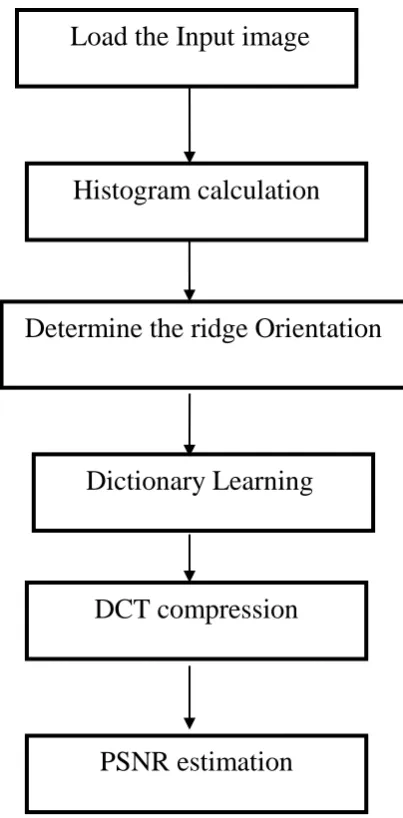
Fig 3.1: Flowchart for Existing System
Dictionary Learning
Histogram calculation
Determine the ridge Orientation
DCT compression
IV.PROPOSEDSYSTEM
4.1
Proposed systemIn this paper, a Novel approach has been proposed for the finger print images which helps to overcome the existing performance in which it supports to view the compressed image in a better manner throughout all the area of the minutia parts of the images and by performing l1 minimization approach for new approach compare to existing with jpeg 2000 images. Three groups of fingerprint images are tested. The experiments demonstrate that our algorithm is efficient compared with several competing compression techniques and we will be attaining good compression ratio for highly compressed images after the sparse representation of compressed format in which we will having good accuracy and dictionary format values in all area of the images.
Fig 4.1: Flowchart for Proposed System
DCT Compression
Dictionary Learning
Histogram Calculation
Determine the ridge
orientation
Sparse representation
4.2
SYSTEM MODULE4.2.1 Sparse Representation:
There will be any new sample y ∈RM×1, is assumed to be represented as a linear combination of few columns from the dictionary A, as shown in formula (1).This is the only prior knowledge about the dictionary in our algorithm. Later, we will see the property can be ensured by constructing the dictionary properly.
Obviously, the system y = Ax is underdetermined when M < N. Therefore, its solution is not unique. According to the assumption, the representation is sparse. A proper solution can be obtained by solving the following optimization problem
The compression of y can be achieved by compressing x. First, record the locations of its non zero entries and their magnitudes. Second, quantize and encode the records.
4.2.2Sparse Solution By Greedy Algorithm:
The optimization problem l0 directly. However, the problem of finding the sparse solution of the system. The Matching Pursuit(MP) because of its simplicity and efficiency is often used to approximately solve the l0 problem. Many variants of the algorithm are available, offering improvements either in accuracy or/and in complexity. Although the theoretical analysis of these algorithms is difficult, experiments show that they behave quite well when the number of non zero entries is low.
4.2.3 Compression Based On Representation
We give the details about how to use sparse representation to compress fingerprint images. The part includes construction of the dictionary, compression of a given fingerprint, quantization and coding and analysis of the algorithm complexity .In the preceding paragraphs, it is mentioned that the size of the dictionary may be too large when it contains as much information as possible.
Therefore, to obtain a dictionary with a modest size, the preprocessing is indispensable. Influenced by transformation, rotation and noise, the fingerprints of the same finger may look very different. What we first think is that each fingerprint image is pre-aligned, independently of the others. The most common pre-alignment technique is to translate and rotate the fingerprint according to the position of the core point. Unfortunately, reliable detection of the core is very difficult in fingerprint images with poor quality.
Even if the core is correctly detected the fingerprint images have simpler structure. They are only composed of ridges and valleys. In the local regions, they look the same. Therefore, to solve these two problems, the whole image is sliced into square and non-overlapping small patches. For these small patches, there are no problems about transformation and rotation. The size of the dictionary is not too large because the small blocks are relatively smaller.
4.2.4 Construction of the Dictionary
Here the dictionary will be constructed in three ways. First, we construct a training set. Then, the dictionary is obtained from the set. Choose the whole fingerprint images, cut them into fixed-size square patches. The first patch is added to the dictionary, which is initially empty. Then we check whether the next patch is sufficiently similar to all patches in the dictionary. If yes, the next patch is tested; otherwise, the patch is added into the dictionary. Here, the similarity measure between two patches
P1 and P2 are the corresponding matrices of two patches. t, a parameter of the optimization problem. Repeat the second step until all patches have been tested. First is to choose fingerprint patches from the training samples at random and arrange these patches as columns of the dictionary matrix.
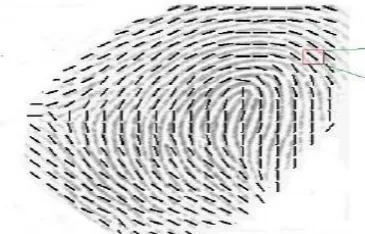
Second is to general, patches from foreground of a fingerprint have an orientation while the patches from the background .Each interval is represented by an orientation (the middle value of each interval is chosen). Choose the same number of patches for each interval and arrange them into the dictionary. The dictionary is obtained by iteratively solving an optimization problem
4.2.5 Compression of a Given Fingerprint:
The size of the patches has a direct impact on the compression efficiency. The algorithm becomes more efficient as the size increases. However, the computation complexity and the size of the dictionary also increase rapidly. The proper size should be chosen. How to choose this size will be given in Section V. In addition, to make the patches fit the dictionary better, the mean of each patch needs to be calculated and subtracted from the patch.
They are the mean value, the number about how many atoms to use, the coefficients and their locations. The tests show that many image patches require few coefficients. Consequently, compared with the use of a fixed number of coefficients, the method reduces the coding complexity and improves the compression ratio.
4.2.6 Coding and Quantization
Entropy coding of the atom number of each patch, the mean value of each patch, the coefficients and the indexes is carried out by static arithmetic coders. The mean value of each patch is also separately coded learnt off-line from the coefficients which are obtained from the training set by the MP algorithm over the dictionary.
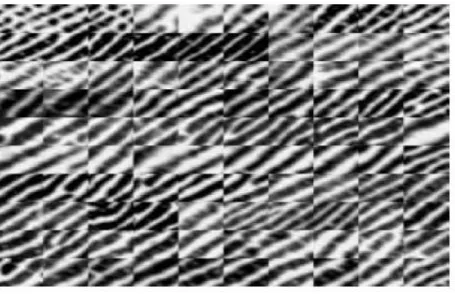
Fig 4.3 Different Patches
V. CONCLUSIONS
The
A new compression algorithm adapted to fingerprint images is introduced. Despite the simplicity of our proposed algorithms, they compare favorably with existing more sophisticated algorithms, especially at high compression ratios. Due to the block-by-block processing mechanism, however, the algorithm has higher complexities.The experiments show that the block effect of our algorithm is less serious than that of JPEG. We consider the effect of three different dictionaries on fingerprint compression. The experiments reflect that the dictionary obtained by the K-SVD algorithm works best. One of the main difficulties in developing compression algorithms for fingerprints resides in the need for preserving the minutiae which are used in the identification. We extract the feature portion and ridges portion of the finger images which produces sufficient compression and has better accuracy.
REFERENCES