Highly selective copper ion imprinted clay/polymer nanocomposites
designed by visible light radical photopolymerization
Radhia Msaadi
a, Gorkem Yilmaz
b, Andrit Allushi
b, Sena Hamadi
c,
Salah Ammar
a, Mohamed M. Chehimi
c,*, Yusuf Yagci
b,*aUniversité de Gabès, Faculté des Sciences, Unité de Recherche Électrochimie, Matériaux et
Environnement UREME (UR17ES45), Gabès, Tunisia [email protected] (RM), [email protected] (SA)
bIstanbul Technical University, Department of Chemistry, Maslak, Istanbul 34469, Turkey
[email protected] (GY), [email protected] (AA), [email protected] (YY)
cUniversité Paris Est, ICMPE (UMR 7182), CNRS, UPEC, F-94320 Thiais, France
[email protected] (SH), [email protected] (MMC)
Abstract
There is an urgent demand worldwide for the development of highly selective adsorbents and
sensors of heavy metal ions and other organic pollutants. Within these environmental and public
health frameworks, we are combining the salient features of clays and chelatant polymers to
design selective metal ion adsorbents. Towards this end, the ion imprinting approach has been
used to develop a novel nanohybrid material for the selective separation of Cu2+ ions in aqueous
solution. The Cu2+-imprinted polymer/ montmorillonite nanocomposite (IIP/Mt) and
non-imprinted polymer/montmorillonite nanocomposite (NIP/Mt) were prepared by radical
photopolymerization process in the visible light. Ion imprinting was indeed important as the
recognition of copper ions by IIP/Mt was significantly superior to that of NIP/Mt that is the
nanocomposite synthesized in the same way but in the absence of Cu2+ ions. The adsorption
process as batch study was investigated under the experimental condition affecting same
parameters such as contact time, concentration of ions metals and pH. The adsorption capacity
of Cu2+ ions is maximized at pH 5. Removal of Cu2+ ion achieved equilibrium within 15
minutes; the results obtained were found to be fitted by the pseudo-second order kinetics model.
The equilibrium process was well described by the Langmuir isothermal model and the
maximum adsorption capacity was found to be 23.6 mg/g.
Keywords: clay; diazonium salt; ion imprinted polymers; radical photopolymerization; visible light; adsorption; copper ions.
Corresponding authors:
Mohamed M. Chehimi: [email protected] ; Yusuf Yagci: [email protected]
1. Introduction
There is a global concern of heavy metal pollution of the environment with a high risk for these
elements to enter the food chain via natural and anthropogenic routes [1]. Heavy metal ions
pollutants affect humans after ingestion of water and food [2,3]. For example, children are
particularly vulnerable to the neurotoxic effects of lead, and exposure, even at relatively low
levels, may cause serious, and in some cases irreversible, neurological damage [4].
For these reasons, heavy metal pollution is regarded as one of the most challenging global
problems and requires combined actions such as detections at minute levels and removal at a
separation/filtration stage using high capacity selective adsorbents. The first issue of the
problem can be addressed by develop highly sensitive and selective sensors for a YES/NO
response of the sensors to indicate whether or not a sample is contaminated by heavy metals;
ideally the output response is processed to return a quantitative value of the metal ion
concentration in the target sample [5,6]. In addition to sensitive devices, the second important
issue is to develop high capacity adsorbents to remove or to pre-concentrate heavy metals in
order to have a complete picture of the pollution by metal ions from the surface
physico-chemical point of view. Towards this end, clays can be regarded as natural inorganic “sponges”
to retain heavy metal ions [7,8]. However, aluminosilicates are negatively charged and retention
of heavy metal ions could be achieved through cation exchange reactions. In this sense, clays
are not selective [8] and organo-modification permits to impart to clays functional groups for
the specific retention of metal ions. For example, NH2, SH, C=C, calixarene, crown-ethers and
cryptand, dendrimer among others have been attached to clays via ammonium salts, diazonium
salts, silane coupling agents or other strategies [9,10, 11,12,13,14,15,16,17]. In a more
elaborated picture, clay/polymer nanocomposites can also be envisaged if the polymer
possesses pendant functional groups able to complex metal ions [18], yet selectivity remains
challenging. Some of us reported various synthetic approaches for the syntheses of
clay-polymer nanocomposites including free radical, cationic and ring-opening poymerizations and
click chemistry [19,20,21,22,23]. By incorporating suitably selected functional groups onto
clay surface a wide variety of polymerization systems can successfully be applied in an in situ
manner.
To push the frontiers of selectivity further, a smart strategy consists of making clay/ion
imprinted polymer nanocomposites [24,25], therefore combining the best of the two worlds:
high capacity mineral adsorbent [26] and highly selective organic material c.a. ion imprinted
polymers [27,28,29,30,31]. We have previously demonstrated that such materials can be
presence of organo-clay [32]. In a unique approach, we have efficiently organo-modified clay
using the versatile aryl diazonium instead of ammonium salts or silane coupling agents bearing
photoinitiator.
Yet, the original design of nanohybrids we have reported recently requires UV light initiation.
Instead, herein we simplify the process by triggering radical photopolymerization under visible
light using diazonium-modified clay as a macro-initiator and camphorquinone (CQ) as
photosensitizer. CQ is indeed a very efficient photosensitizer for generating ultrathin polymer
coatings by simulated sunlight-induced surface-confined radical photopolymerization [33]. To
the very best of our knowledge, this strategy has never been reported previously, it is highly
interesting simply because the clay/IIP nanocomposite can be designed using natural day or
simulated day light or white light.
Herein, montmorillonite was first cation exchanged with a diazonium compound bearing
dimethyl amino groups to provide a macro-photoinitiator, and visible light radical
photopolymerization was conducted in the presence of the modified clay, the monomers
(4-vinylpyridine, (VP) methacrylic acid (MA), CQ and the heavy metal ions. Thorough rinsing of
the final product, permitted to remove the metal ions and to create the artificial receptor sites
for the selective recognition of copper.
2. Experimental
2.1. Chemicals and Reagents
All chemical reagents and materials were purchased from Aldrich and used without further
purification. Milli-Q Plus water purification system was employed to prepare deionized water.
2.2. Instrumentation and characterization
X’Pert PRO (PANalytical) instrument fitted with a Co Kα X-ray source (1.789Ǻ) was employed
to record the diffraction patterns of the samples.
Infrared spectra were recorded using a Nicolet Magna-IR 550 spectrometer in the attenuated
total reflection (ATR) mode, in the 4000-450 cm− 1 range.
AK Alpha instrument (Thermo) fitted with a monochromated Al Kα X-ray source (hν= 1486.6
eV, spot size = 400 µm) was used for XPSmeasurements. Aflood gun was employed for static
regions and survey spectra, respectively. Elemental atomic concentrations were computed using
the integrated peak areas and the corresponding sensitivity factors provided by the
manufacturer.
The determination of metal ion concentration was performed with Avanta/GBC flame atomic
absorption spectrophotometer equipped with a hollow cathode lamp and deuterium background
corrector at respective wavelength resonance line using an air-acetylene flame.
2.3. Synthesis of the diazonium salt Cl- N
2 C6H4N=NC6H4N-(CH3)2
N, N-Dimethy-4,4’ azoanilinediazonium salt was prepared as follows: the aromatic amine (4.16
mmol, 1g) is suspended in a hydrochloric acid and distilled water 50/50 v/v%. The mixture was
cooled in an ice bath, and then 1 equivalent of sodium nitrite was slowly added. The mixture
was stirred for 15 min. IR characterization of the diazonium salt 𝑁2+, 2204cm-1.
2.4. Diazonium modification of montmorillonite
To an aqueous suspension of clay (100 mg dispersed in 10 ml of de-ionized water) we added
dropwise an aqueous solution of diazonium salt (500 mg in 10 ml of deionized water). The
intercalated clay was washed thoroughly with deionized water and dried at 60°C overnight.
2.5. Synthesis of Cu2+_IIP/Mt nanocomposite
The IIP/Mt nanocomposite was prepared in two major sequential steps. First, 1 equivalent of
template Cu(NO3)2, 2 equivalents of 4-vinylpyridine (4-VP, 0.431mL) and 2 equivalents of
methacrylic acid (MA, 0.339mL)were dissolved in (4ml/4ml v/v) DMF and water in a glass
tube, and were kept under stirring for 1 hour. Then, 1 equivalent of cross-linker (EDGMA, V=
0.377ml), 41 mg of CQ (8 wt.% of the monomer 4-VP or MAA) and 200 mg of modified clay
(Mt-DZ) by diazonium (dimethyl-4,4-azoaniline diazonium ) were added in glass tube. The
glass tube was purged with nitrogen for 15 min. The mixture was irradiated using a Ker-vis
blue photoreactor equipped with six lamps (Philips Tl-D 18 W) emitting light nominally at
400-500 nm at room temperature for 4 hours.
Template ion (Cu2+) was removed by washing the nanocomposite in HNO3 (0.1M) in order to
obtain specific artificial recognition sites within the IIP/Mt nanocomposites.
The same clay-polymer nanocomposite was prepared but in the absence of copper; it is noted
2.6. Metal ion adsorption
Adsorption of Cu2+ on the IIP/Mt nanocomposite and NIP/Mt nanocomposite was examinated
using batch experiments. To prepare adsorption isotherms, a series of samples containing 4mg
of an appropriate IIP/Mt and NIP/Mt as equilibrated with 10mL solution containing various
concentrations (5- 20 mg/l) of Cu2+. The solution was shaken at room temperature for 2h. After
adsorption, the mixture was isolated by centrifugation, then filtered through a 0.45 µm
membrane filter and examined with atomic absorption spectroscopy (AAS). The adsorption
amount (qe; mg/g) was calculated using:
𝑞𝑒 = ( 𝐶0−𝐶𝑒)𝑉
𝑚 (1)
Where𝐶0 and 𝐶𝑒 are initial and equilibrium concentration (mg/L), m is the sorbent mass (g),
and V is the solution volume (L).
Kinetic studies were conducted to determine the adsorption rate of Cu2+ from water samples as
follows: 4mg of each sorbent were dispersed in 10mL solution containing the same initial Cu2+
concentration of 20 mg/L. Each mixture was continuously batch oscillated at room temperature
for 5,10,15,30,60,90 and 120 min. After each time period, solutions were filtered and analyzed
by AAS to determine the concentration of Cu2+ in the supernatant.
To investigate the effect of pH, 4 mg IIP/Mt and NIP/Mt were added to 20mL sample solutions
containing 20 mg/L of Cu(II) ion at pH range 2.0-9.0, respectively, pH values were adjusted by
1mol/L HNO3 and 1 mol/L NaOH.
2.7. Selectivity experiments
To estimate the selectivity of the ion-imprinted polymer/Mt nanocomposite and their
corresponding non-imprinted polymer/Mt nanocomposites materials for copper adsorption,
5mg of the sorbent was added into 10ml of 20mg/L binary solution of Cu2+/Zn2+, Cu2+/Pb2+,
and Cu2+/Fe3+ for 1h. The mixture was magnetically stirred at 300 rpm, then left to decant for
15 min, centrifuged, and filtered. Finally, the concentration of copper and the interfering ions
was measured by AAS.
The distribution coefficients, Kd (ml/g), of Cu2+, Zn2+, Pb2+, and Fe3+ were calculated using
equation:
𝐾𝑑= (𝐶0− 𝐶𝑒) 𝑉
The selectivity coefficients for the binding of a copper ion in the presence of other competing
ions in binary systems were calculated according to the following equations:
𝐾 = 𝐾𝑑(𝐶𝑢2+)
𝐾𝑑(𝑀𝑛+) (3)
Where Mn+ (n=2 or 3) represents Cu2+ competing ions mentioned above. The coefficients give
an indication as to how selective the nanocomposite is for Cu2+ ions in the presence of other
competing species in solution.
The relative selective coefficient K’, which represents the enhanced effect of imprinting on
selectivity and adsorption affinity for the template onto the ion imprinted
polymer/montmorillonite nanocomposite. The K’ of the IIP/Mt nanocomposite against the
NIP/Mt nanocomposite as determined using equation
𝐾′= 𝐾𝐼𝐼𝑃/𝑀𝑡
𝐾𝑁𝐼𝑃/𝑀𝑡 (4)
where KIIP/Mt and KNIP/Mt are the selectivity coefficients of the IIP/Mt and NIP/Mt, respectively.
2.8. Desorption and regeneration
To estimate the reuse ability of IIP/Mt nanocomposite, synthesized adsorbant were contacted
with Cu2+ solution for adsorption processus. After adsorption, the IIP/Mt were placed in the
desorption medium (1M, HNO3 solution) and stirred for 120 minutes at room temperature. This
procedure was repeated for many times until Cu2+ could not be detected in aqueous phase. Then,
the adsorbent was washed thoroughly with double distilled water to a neutral pH to determine
reusability of IIP/Mt nanocomposite, the desorption-adsorption procedure was repeated eight
3. Results and discussion
3.1. Synthesis strategy and mechanistic aspects
The synthesis strategy of IIP/Mt nanocomposites was carried out in two main steps starting by
a simple diazonium cation exchange reaction with Na+ (Scheme 1).
Scheme 1. Schematic representation of the synthesis procedure of Cu2+_IIP/ clay nanocomposite. NB: Under irradiation conditions the azo compound undergoes cis-trans isomerization. In fact, this behavior would be more beneficial since it would lead to a better intercalation.
The cation exchange reaction led to the intercalation of the diazonium cations into the clay.
Heating at 60 °C was achieved in order to obtain stable aluminosilicate-aryl bond by
dediazonation of the interfacial diazoether [32]. For the photopolymerization step, we have
deliberately selected CQ as the photosensitizer for two reasons. First, it absorbs the light in the
visible region of the electromagnetic radiation. Although there are many visible light acting
dental applications. Secondly, upon photolysis, the triplet CQ abstracts hydrogen from
hydrogen donors, i.e., amines. While the amine derived radicals initiate the polymerization
CQ-H. radicals are not reactive towards monomers, but readily form various coupling products.
This issue is particularly important for our case as chain growth occurs only on the clay surface.
The overall, mechanism is presented in Scheme 2.
Scheme 2. Mechanisn of visible light photopolymerization on the clay surface by using camhorquinone. The structure of the attached azoic initiator is simplified for the sake of clarity.
Separately, to form the pre-polymerization complex, Cu(NO3)2 (1equivalent) as mixed with
4-vinylpyridine (1 equiv), acrylic acid (2equiv) in DMF/H2O (4ml/4ml) and the mixture was
shaken for 1h. This solution was then mixed with EGDMA (1equiv), diazonium-modified clay
Mt_DZ (100mg) and camphorquinone (26.6mg). The suspension was purged with nitrogen for
15 min in order to prevent any unwanted reactions that inhibit the photopolymerization process.
The mixture was irradiated using a Ker-Vis blue photoreactor equipped with six lamps (Philips
TL-D 18 W) emitting light nominally at 400-500 nm at room temperature for 4h.
3.2.1. XRD
4 55 6 7 8 9 1010 11 12 13 14 1515 16 17 18 19 2020 21 22 23 24 2525 26 27 28 29 3030
d
001=1.34 nm
Mt_DZ Mt
(a)
d
001=1.66 nm
(b)
d
001=1.87 nm
d
003=0.52 nm
d
002=1.02 nm
(c)
IIP/Mt
In
ten
sit
y (
a.
u
.)
2
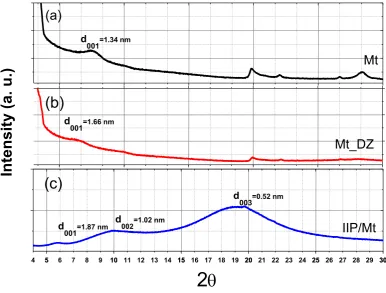
Figure 1. XRD patterns of montmorillonite Mt (g), Mt_DZ(h) and IIP/Mt(c) nanocomposite.
X-ray powder diffraction diagrams (DRX) for sodium montmorillonite clay (Mt),
montmorillonite interposed with diazonium salt (Mt_DZ) and montmorillonite after
photopolymerization (IIP/Mt) are shown in Figure 1.
For (Mt_DZ), the d001 peak position is shifted to lower values (Figure 1b) compared to the
untreated clay (Figure 1a). The inter-lamellar distance of soda montmorillonite (Mt), modified
montmorillonite (Mt_DZ) and montmorillonite/ionic imprinted polymer nanocomposite
(IIP/Mt) were estimated from the peak (001) using the Bragg equation n = d sin After the
cation exchange reaction between the Na+ cations and the diazonium salt, the interlayer distance
was increased from 1.34 nm to 1.66 nm, which proves the intercalation of diazonium salt
between the montmorillonite layers. After photopolymerization the distance d001 moves to the
lower value of 2 (d001=1.8 nm), which means that after the in-situ radical photopolymerization
the polymer chain is intercalated between the clay layers [37]. It is to note that Figure 1(c)
characterized by (00l) (1< l <4) reflection which testifies for regular distribution of the polymer
within the clay nanosheets. The positions (001), (002) and (003) peaks at d=1.87, 1.02 and 0.52
nm, respectively, indicate an intercalated crystalline structure of the IIP in the interlayers.
3.2.2. FTIR analysis
500 1000 1500 2000 2500 3000 3500 4000 4500
Mt (a)
1625
Tra
ns
m
itt
a
nc
e
(a
. u.)
Mt_Dz
2210 1015
3635
(b)
C-N
IIP/Mt (c)
NIP/Mt
Wavenumbers (cm-1)
2339
1718 1447
(d)
C-H C=O
1621
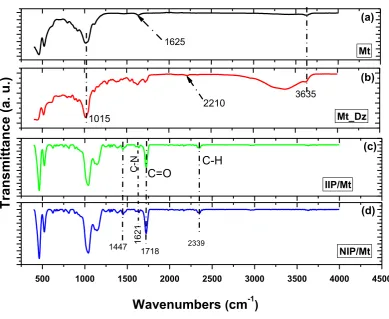
Figure 2. FTIRspectra of Mt (a), diazonium-modified montmorillonite, Mt_DZ (b), IIP/Mt (c), and NIP/Mt (d).
Figure 2 shows the FTIR spectra of Mt, Mt_DZ, IIP/Mt and NIP/Mt. The structure of the purified
montmorillonite is characterized by the bands located in the 1000-1200cm-1 range assigned to
Si-O-Si. The peaks at 3635 and 918cm-1 are in line with the dominant presence of dioctahedral
smectite with (Al, Al-OH) [38]. The absorption band at 1625 cm-1 corresponds to OH from the
water molecules absorbed by the clay. After clay modification the FTIR analysis confirmed the
presence of the diazonium in the clay interspacings. FTIR data of modified clay with diazonium
band at 1621cm-1 assigned to the pyridine ring, and an intense band at 1447cm-1which ascribed
to the stretching vibration of C-N of 4-vinylpyidine. One can also note the presence of a new
signal near 1718cm-1 corresponding to the carbonyl of the methacrylic acid. These FTIR
observations are in line with the coexistence of an organic polymer fraction in the final
composite material.
3.2.3. XPS analysis
0 200 400 600 800 1000
0 200k 400k 600k
Cu2p 930 940 950 960
Si2s Si2p Al2p N1s Na1s C1s (c) IIP/Mt_Cu (d) IIP/Mt (b) Mt_DZ I (cps)
Binding energy (eV)
(a) Mt O1s
280 285 290 295
0 20k 40k 60k IIP/Mt_Cu O-C=O C-N/C-O I (cps)
Binding energy (eV)
C-C/C-H
−* (e)
395 400 405
13k 14k 15k 16k IIP/Mt_Cu I (cps)
Binding energy (eV)
-N=
>N+=
(f)
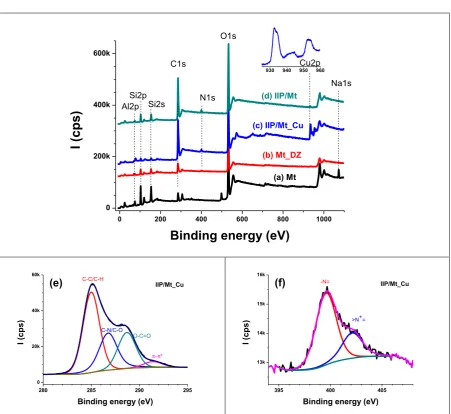
Figure 3. XPS analysis of Mt, Mt_DZ and IIP/Mt_Cu (before extraction of copper) and IIP/Mt (after extraction of copper). Survey regions: (a-d), peak-fitted C1s and N1s narrow regions of IIP/Mt_Cu: (e) and (f), respectively.
Figure 3 displays XP spectra of Mt, Mt_DZ and the nanocomposites before and after extraction
eV), Si2p (~102 eV), Si2s (152 eV), C1s (285 eV), N1s (400 eV), O1s (532 eV), Cu2p
(930-960 eV) and Na1s (1072 eV). It is demonstrated here that the diazonium salt intercalates
montmorillonite by cation exchange mechanism since one can see in Figure 3b the
disappearance of the Na1s peak compared to the pristine clay (Figure 3a). The intercalation
leads also to an increase in the C1s/Si2p intensity ratio and appearance of a tiny N1s peak (~400
eV) from the intercalated diazonium. The synthesis of the IIP/Mt_Cu results in a significance
change in the survey region (Figure 3c) which exhibits sharp C1s and O1s peaks from the
polymer and the existence of a Cu2p doublet. The high resolution Cu2p from IIP/Mt_Cu is
shown in insert. Nitrogen is also slightly more visible as vinylpyridine was used here as a
comonomer. After extraction, the Cu2p vanishes (Figure 3d).
Figures 3e and 3f display the high resolution C1s and N1s peaks of the IIP. Interestingly, the
C1s shows features due to C-N (~286 eV) and the functional group COOH (~peak component
at 289 eV). As far as the peak component at 292 eV is concerned, it is ascribed to aromatic
species from the vinylpyridine repeat units and the diazonium-derived aryl groups attached to
the clay sheets. The N1s feature from the IIP (Figure 3f) shows free and quaternized nitrogen
species. The latter could be due to protonation by the COOH group of the methacrylic acid or
by the OH groups from clay.
3.3. Adsorption of Cu2+
3.3.1. Effect of pH
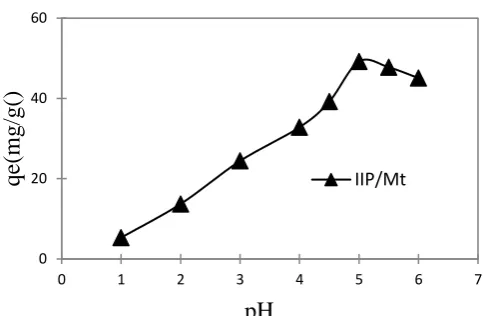
The pH of the solution has a significant influence on the adsorption process as it is well-known
to affect the protonation of surface functional groups. Figure 4 displays the adsorption capacity
of Cu2+ by the IIP/Mt support; the maximum is noted at pH 5. Above this value, adsorption
starts to decrease due to precipitation of copper [39]. For low pH values the adsorption of copper
ions is also low this could be due to the protonation of functional sites and consequently a
competition between protons from the acidic medium and Cu2+ ions towards the artificial
receptor sites of copper. In acidic medium, adsorption increases with pH as reported for clays
Figure 4. Effect of pH on adsorption capacity of IIP/Mt. Cu2+ initial concentration: 20 mg/l; adsorption time: 2h; IIP/Mt: 4 mg; room temperature.
3.3.2. Effect of contact time and a kinetic study
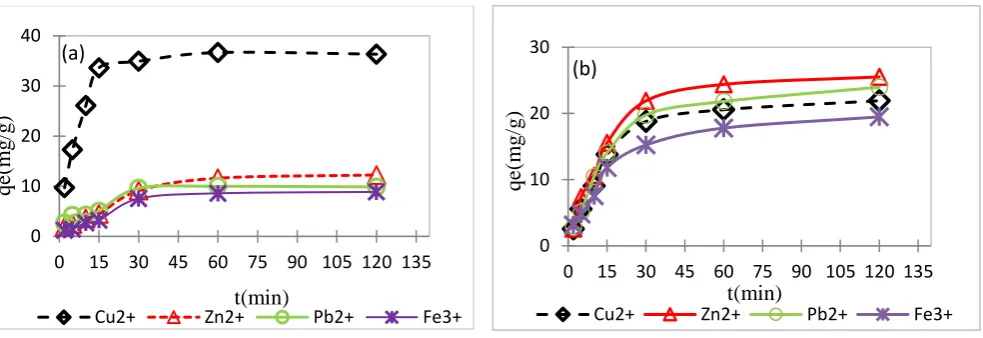
The effect of contact time on the adsorption of Cu2+, Zn2+, Pb2+ and Fe3+ on IIP/Mt and NIP/Mt
nanocomposites is displayed in Figure 5. The adsorption of Cu2+ ions is rapid; the adsorption
capacity increases with time and reaches a maximum during the first 15 minutes, then increases
to saturation. The extent of adsorption of Cu2+ is much higher than that of Zn2+, Pb2+ and Fe3+
ions (Figure 5a). This rapid equilibrium could be explained by the high affinity of complexation
and geometry between Cu2+ ions and the cavities of the nanocomposite structure. It is known
that the removal of the template from the polymer network creates smart cavities that allow us
to know the shape and chemical functionality of the Template Cu2+[41]. In contrast, for the
NIP/Mt adsorbent, there is no significantly distinct adsorption is noted for copper. As a matter
of fact, one can note in Figure 5b that the maximum adsorption is noted for zinc and not copper.
From Figures 5a-b, clearly it is essential to fabricate a copper ion imprinted polymer in order
to achieve selective removal of this template ion.
0 20 40 60
0 1 2 3 4 5 6 7
qe(
m
g
/g
()
pH
Figure 5. Effect of contact time on the removal Cu2+, Zn2+, Pb2+ and Fe3+ by IIP/Mt(a), and
NIP/Mt(b). Conditions: initial Cu2+ concentration = 20mg/L, and pH=5.
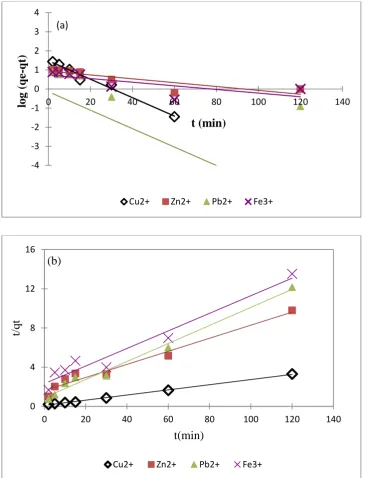
To study the adsorption process, pseudo-first order and pseudo-second order models were used
to control the check adsorption kinetics of IIP/Mt and NIP/Mt.
The pseudo-first-order and pseudo-second-order models are described as equations (5) [42] and
(6) [43], respectively.
log(𝑞𝑒− 𝑞𝑡) = log 𝑞𝑒− 𝑘1
2.303𝑡 (5)
𝑡 𝑞=
1 𝑘2𝑞𝑒2+
𝑡
𝑞𝑒 (6)
Where qt (mg/g) and qe (mg/g) are the adsorption capacities of metal ions on IIP/Mt and NIP/Mt
at time t and equilibrium, respectively; k1 (L/min) and k2 (g/mg min) are the first order and
second order adsorption constants, respectively. 0
10 20 30 40
0 15 30 45 60 75 90 105 120 135
qe(m
g
/g
)
t(min)
Cu2+ Zn2+ Pb2+ Fe3+
(a)
0 10 20 30
0 15 30 45 60 75 90 105 120 135
qe(
m
g
/g
)
t(min)
Cu2+ Zn2+ Pb2+ Fe3+
Figure 6. Pseudo-first-order (a), and pseudo-second-order (b) kinetic model applied to the
adsorption of Cu2+, Zn2+, Pb2+ and Fe3+ onto IIP/Mt nanocomposites.
The kinetic modeling for the adsorption of metal ions on IIP/Mt nanocomposites is shown in
Figure 6 and the adsorption kinetics constants and the correlation coefficient values R² are
summarized in Table 1. The values of the correlation coefficient R² of the pseudo-second-order
model are significantly higher than those of the other models and closer to unity which accounts -4
-3 -2 -1 0 1 2 3 4
0 20 40 60 80 100 120 140
log (q
e-q
t)
t (min)
Cu2+ Zn2+ Pb2+ Fe3+
0 4 8 12 16
0 20 40 60 80 100 120 140
t/
qt
t(min)
Cu2+ Zn2+ Pb2+ Fe3+
(b)
for pseudo-second order mechanism of the adsorption process on the IIP/Mt nanocomposite. It
follows that chemisorption is the driving force for the adsorption process on the actual IIP/Mt
nanocomposite [44].
Table1. Kinetic parameters of the pseudo-first-order and the pseudo-second –order rate
equations for ions metals adsorption on IIP/Mt nanocomposites.
Ions
Pseudo-first- order Pseudo-second –order
qe(mg/g) K1(L/min) R² qe(mg/g) K2.10-2(g/mg min) R²
Cu2+ 30.130 0.110 0.978 38.461 0.625 0.998
Zn2+ 8.689 0.023 0.728 15.151 0.269 0.966
Pb2+ 9.856 0.110 0.134 10.869 0.945 0.984
Fe3+ 5.457 0.0207 0.519 11.236 0.340 0.954
3.3.3. Adsorption isotherms
Figure 7 shows the effects of aqueous phase Cu2+ concentrations on equilibrium adsorption
capacity on IIP/Mt. The adsorption capacity increases with increasing concentration in the
aqueous phase. Adsorption of the metal ion saturates at 23.562 mg/g (qmax). In this study the
adsorption isotherm is applied to study the interactions between metal ions and the active sites
of our adsorbent (IIP/Mt). The adsorption isotherm is expressed for an adsorbent-adsorbate pair
as a function of concentration. The adsorption isotherm of Cu2 + ions was checked whether it
fits the Langmuir [45 ] or Freundlich [46] isotherm models (see Figure 8) as described by
equations (7) and (8), respectively. The Langmuir isotherm theory assumes that adsorption is
single-layer and takes place at homogeneous sites specific to the adsorbent and the Freundlich
isotherm assumes that adsorption is multi-layer and that the surface of the adsorbent is
heterogeneous.
.𝐶𝑒 𝑞𝑒 =
1 𝑄𝑚𝑘𝑙+
𝐶𝑒
𝑄𝑚 (7)
𝑙𝑜𝑔𝑞𝑒 = 𝑙𝑜𝑔𝐾𝐹+ 1
𝑛𝑙𝑜𝑔 𝐶𝑒 (8)
Where qe (mg/g) is the adsorbed amount at equilibrium, Ce is the equilibrium concentration of
Freundlich constants, respectively; qm the maximum adsorption capacity (mg/g), n is the
heterogeneity factor, and 1/n value is related to the sorption intensity.
Figure 7. Adsorption isotherms of Cu2+ on IIP/Mt nanocomposite at pH 5.
Figure 8. Isotherms models for adsorption of Cu2+ on IIP/Mt at room temperature: Langmuir
(a), and Freundlich (b).
Table 2 lists all isotherm parameters. The data show that Langmuir model (Figure 8a) is more
suitable to describe the adsorption reaction of Cu2+ on the IIP/Mt with the experimental data
with higher R² values. Therefore, these results imply that the adsorption process of IIP/Mt is
surface monolayer adsorption and the adsorption sites are homogeneous [47,48]. 0 4 8 12 16 20 24 28
0 2 4 6 8 10 12
q e (m g/ g) Ce(mg/l) IIP/Mt 0 0.2 0.4 0.6
0 5 10 15
C e/qe ( g /l ) Ce (mg/L) (a) 0 0.5 1 1.5 2
-1 -0.5 0 0.5 1 1.5
log
(qe
)
log (Ce)
Table2. Adsorption equilibrium constants for Langmuir and Freundlich isotherms.
Adsorbents Metal
ion Langmuir isotherm Freundlich isotherm
IIP/Mt Cu2+
qm(mg/g) KL(L/mg), R² KF(𝑚𝑔1−1/𝑛/𝑔𝐿1/𝑛) n R²
31.25 3.555 0.991 8.128 1.811 0.958
3.3.4. Adsorption selectivity
To evaluate the selective properties of the IIP/Mt and NIP/Mt nanocomposites, adsorption of
Cu2+was conducted in the presence of competitive ions in binary systems. In our work, the
binary solute solutions, including Cu2+/Zn2+, Cu2+/Pb2+ and Cu2+/Fe3+ were studied to explore
the selectivity to template Cu2+ at room temperature. The distribution coefficients (Kd), the
selectivity coefficients (K) and the relative selectivity coefficients (K ') were calculated (see
Table 3). It is noted that the distribution coefficient value of Cu2 + is greater than that of the
other metal ions. Therefore, high selectivity coefficients were determined for IIP/Mt and
NIP/Mt nanocomposites: 10.308, 6.515 and 8.524 for Cu2 +/Zn2 +, Cu2 +/Pb2 + and Cu2 +/Fe3 +,
respectively. The selectivity for Cu2 + is due to the ion imprints shaped in the polymer network
of the nanocomposite. The geometry, charge and size of the prints account for the selective
recognition of Cu2+ ions over the other cationic competitors.
Table3. Selectivity adsorption parameters for IIP/Mt and NIP/Mt nanocomposites.
Metals IIP/Mt NIP/Mt K’
kd k kd k
Cu2+ 29.904 2.073
Zn2+ 3.657 10.308 21.029 0.0985 104.568
Pb2+ 3.555 6.515 28.808 0.0719 90.538
3.3.5. Regeneration of IIP/Mt
In order to evaluate the reusability and the renewability of the synthesized sorbent, several
adsorption-desorption cycles were carried out on the same sample of IIP/Mt nanocomposite d
at the same Cu2 + concentration of 20 mg/l. The desorption of the Cu2 + ions adsorbed from the
IIP/Mt nanocomposites was carried out using a 2M HNO3 solution. Several cycles of
adsorption-desorption were applied to the IIP/Mt adsorbent. The results displayed in Figure 9
permit to claim stability of the IIP/Mt nanocomposite adsorbent which could be regenerated
without significant loss of performance. Indeed, up to 8 adsorption/desorption cycles were
applied to the robust adsorbent designed so far which did not show any sign of decrease in
performances.
.
0 5 10 15 20 25
1 2 3 4 5 6 7 8
qe
(m
g/
g)
Number of cycles
Figure 9. Recycling of the IIP/Mt in the removal of Cu 2+ from aqueous relations (C 0= 20
mg/l, pH=5, RT).
4-Conclusion
Montmorillonite-based ion imprinted polymer nanocomposite was prepared by radical
photopolymerization under visible light exposure. The pre-polymerization complex was
prepared by mixing Cu(NO3)2 and functional monomers of 4-VP and MAA mixed in
DMF/H2O. Then, this solution was mixed with the cross-linker (EDGMA), photoinitiator
diazonium salt is a good intercalant for clay and for triggering in situ radical
photopolymerization. In this study, Cu2+-imprinted polymer/ montmorillonite nanocomposite
was successfully prepared and applied for the pre-concentration and determination of Cu2+ ions
in aqueous solutions. The experimental data followed the Langmuir isothermal model and
pseudo-second order kinetics. In adition, these artificial sites shaped to accommodate Cu2+
could uptake copper at high extent compared to the competing metal ions Zn2+, Pb2+ and Fe3+,
but also much more than non-imprinted polymer/montmorillonite nanocomposite. The
selectivity with other ions confined that IIP/Mt showed high specific Cu2+ ions.
This work demonstrates for the very first time the efficiency of diazonium salt to initiate visible
light radical photopolymerization within the interlayer spacings of layered aluminosilicates.
The method could be applied to other nanomaterials which could serve as nanoscale platforms
to be coated by ion or molecularly imprinted polymers.
Author Contributions: Conceptualization of the research work by RM, SA, MMC and YY; Methodology by RM, GY, AA, YY, MMC; Validation by RM, SH, AA, YY, MMC; Formal Analysis by RM, AA, GY, SH, MMC; Writing of Original Draft was done by RM and MMC; Writing-Review & Editing, RM, MMC, YY; Supervision, SA, MMC and YY.
References
[1] Tóth, G.; Hermann, T; Silva, M.R.Da.; Montanarella, L. Heavy metals in agricultural soils of the European Union with implications for food safety. Environ. Int.2016, 88, 299-309 [2]Duruibe, J. O.; Ogwuegbu, M. O. C.; Egwurugwu, J. N. Heavy metal pollution and human biotoxic effects. Int. J. Phys. Sci.2007, 2, 112-118.
[3] Khan, A., Khan, S., Khan, M.A.; Qamar, Z.; Waqas, M. The uptake and bioaccumulation of heavy metals by food plants, their effects on plants nutrients, and associated health risk: a review. Environ. Sci. Pollution Res. 2015, 22, 13772–13799.
[ 4 ]http://www.who.int/ipcs/assessment/public_health/lead/en/ Last accessed 20 November 2018.
[5] Kamaruddin, N.H.; Bakar, A.A.A.; Mobarak, N.N; Zan, M. S. D.; Arsad, N. Binding affinity of a highly sensitive Au/Ag/Au/Chitosan-Graphene oxide sensor based on direct detection of Pb2+ and Hg2+ ions. Sensors. 2017, 17, 2277; doi:10.3390/s17102277.
[6] Lo, M.; Pires, R.; Diaw, K.; Gningue-Sall, D.; Oturan, M. A.; Aaron, J.-J.; Chehimi, M. M. Diazonium salts: versatile molecular glues for sticking conductive polymers to flexible electrodes, Surfaces2018, 1, 43-58; https://doi.org/10.3390/surfaces1010005
[7]Bailey,S. E.;. Olin, T.J.; .Bricka, R.M.; Adrian, D.D. A review of potentially low-cost sorbents forheavy metals. Wat. Res. 1999, 33, 2469-2479.
[8]Abollino, O.; Aceto, M.; Malandrino, M.; Sarzanini, C.; Mentasti, E. Adsorption of heavy metals on Na-montmorillonite. Effect of pH and organic substances. Water Res. 2003, 37, 1619–1627.
[9] (a) de Paiva,L.B.; Morales, A. R.; Díaz, F. R.V. Organoclays: Properties, preparation and applications, Appl. Clay Sci. 2008, 42, 8-24 / (b) Yao, H.; Zhu, J.; Morgan, A.B.; Wilkie, C.A. Crown ether-modified clays and their polystyrene nanocomposites. Polym. Eng. Sci.2002, 42, 1808–1814.
[10 ] Tchinda, A. J.; Ngameni, E.; Kenfack, I. T.; Walcarius, A. One-Step Preparation of Thiol-Functionalized Porous Clay Heterostructures: Application to Hg(II) Binding and Characterization of Mass Transport Issues. Chem. Mater. 2009, 21, 4111–4121
[11]Salmi, Z.; Benzarti, K.; Chehimi, M. M. Diazonium cation-exchanged clay: an efficient, unfrequented route for making clay/polymer nanocomposites. Langmuir, 2013,29, 13323– 13328.
[12] Jlassi, K.; Chandran, S.;Mičušik, M.; Benna-Zayani, M.; Yagci, Y.; Thomas, S.;
Chehimi, M. M. Poly(glycidyl methacrylate)-grafted clay nanofiller for highly transparent and mechanically robust epoxy composites. Eur. Polym. J.2015, 72, 89–101.
[13 ] Msaadi, R.; Gharsalli, A.; Mahouche‐Chergui, S.; Nowak, S.; Salmi, H.; Carbonnier, B.; Ammar, S.;Chehimi, M.M. Reactive and functional clay through UV‐triggered thiol‐ene interfacial click reaction. Surf. Interface Anal. 2016, 48,385-693.
14 ] Fei, Y.; Liu, C.; Li, F; Chen, M.; Tong, H; Liu, C.; Liao, C.; Combined modification of clay with sulfhydryl and iron: Toxicity alleviation in Cr-contaminated soils for mustard (Brassica juncea) growth. J Geochem Explor. 2017,176, 2–8.
[15] Monzavi, A.; Montazer, M.; Malek, R.M.A. A Novel Polyester Fabric Treated with Nanoclay/Nano TiO2/PAMAM for Discoloration of Reactive Red 4 from Aqueous Solution Under UVA Irradiation, J. Polym. Environ.2017, 25, 1321-1334.
[16 ]Jlassi, K.; Abidi, R.; Benna, M.; .Chehimi, M.M.; Kasak, P.; Krupa, I. Bentonite-decorated calix [4] arene: A new, promising hybrid material for heavy-metal removal; Appl Clay Sci. 2018, 161,15-22
[17 ] Kamboh, M. A.; Memon, S.; Zardari, L.A.; Nodeh, H.R.; Sherazi, S.T.H.; Yilmaz, M.; Removal of toxic metals from canola oil by newly synthesized calixarene-based resin; Turk J Chem. 2018, 42, 918 – 928.
[18]Unuabonah, E. I.; Taubert, A. Clay–polymer nanocomposites (CPNs): Adsorbents of the futurefor water treatment, Appl. Clay Sci. 2004, 99, 83–92.
[19] Nese, A.; Sen, S.; Tasdelen, M. A.; Nugay, N.; Yagci, Y. Clay‐PMMA nanocomposites by photoinitiated radical polymerization using intercalated phenacyl pyridinium salt initiators. Macromol. Chem. Phys. 2006, 207, 820–826.
[20] (a) Tasdelen, M. A. ; Van Camp, W.; Goethals, E.; Dubois, P.; Du Prez, F.; Yagci, Y. Polytetrahydrofuran/clay nanocomposites by in situ polymerization and “click” chemistry processes. Macromolecules2008, 41, 6035–6040 / (b) Akat, H.; Tasdelen, M. A.; Du Prez, F.; Yagci, Y. Synthesis and characterization of polymer/clay nanocomposites by intercalated chain transfer agent. Eur. Polym. J.2008, 44, 1949–1954.
[21] (a) Oral, A. Tasdelen, M. A.; Demirel, A. L.; Yagci, Y. Poly (cyclohexene oxide)/clay nanocomposites by photoinitiated cationic polymerization via activated monomer mechanism. J. Polym. Sci. Part A: Polym. Chem. 2009,47, 5328–5335. / (b) Yenice, Z.; Tasdelen, M. A.; Oral, A.; Guler, C.; Yagci, Y. Poly(styrene‐b‐tetrahydrofuran)/clay nanocomposites by mechanistic transformation. J. Polym. Sci. Part A: Polym. Chem.2009,47, 2190–2197 / (c) Oral, A.; Tasdelen, M. A.; Demirel, A. L.; Yagci, Y. Polymer 2009, 50, 3905–3910. [22]Tasdelen, M. A.; Kreutzer, J. ; Yagci, Y. In situ synthesis of polymer/clay
nanocomposites by living and controlled/living polymerization. Macromol. Chem. Phys. 2010, 211, 279–285.
[23]Demir, K. D.; Tasdelen, M. A.; Uyar, T.; Kawaguchi, A. W.; Sudo, A.; Endo, T.; Yagci, Y. Synthesis of polybenzoxazine/clay nanocomposites by in situ thermal ring‐opening polymerization using intercalated monomer. J. Polym. Sci. Part A: Polym. Chem.2011, 49, 4213–4220 / (b) Altinkok, C.; Uyar, T.; Tasdelen, M. A.; Yagci, Y. In situ synthesis of polymer/clay nanocomposites by type II photoinitiated free radical polymerization. J. Polym. Sci. Part A: Polym. Chem.2011, 49, 3658–3663.
[24] Pan, J.; Zou, X.; Yan, Y.; Wang, X.; Guan, W.; Han, J.; Wu, X. An ion-imprinted polymer based on palygorskite as a sacrificial support for selective removal of strontium (II). Appl. Clay Sci. 2010, 50, 260-265.
[25] Branger, C.; Meouche, W.; Margaillan, A. Recent advances on ion-imprinted polymers. React. Func. Polym. 2013, 73, 859–875.
[26] Uddin, M.K. A review on the adsorption of heavy metals by clay minerals, with special focus on the past decade. Chem. Eng. J. 2017, 308, 438–462.
[27] Hande, P. E.; Samui, A. B.; Kulkarni, P. S. Highly selective monitoring of metals by using ion-imprinted polymers, Environ. Sci.Pollut. Res. 2015, 22, 7375–7404.
[28] Xu, X;; Wang, M.; Wu, Q;; Xu, Z.; Tian, X. Synthesis and application of novel magnetic ion-imprinted polymers for selective solid phase extraction of cadmium (II). Polymers2017, 9, 360; https://doi.org/10.3390/polym9080360
[29] Nitrate ion selective electrode based on ion imprinted poly(N-methylpyrrole).
[30] A new ion-imprinted chitosan-based membrane with an azo-derivative ligand for the efficient removal of Pd(II)
Di Bello, M. P.; Lazzoi, M. R.; Mele, G.; Scorrano, S.; Mergola, L.; Del Sole, R. Materials 2017, 10, 1133; https://doi.org/10.3390/ma10101133
[31] Ait-Touchente, Z.; Sakhraoui, H.E.E.Y.; Fourati, N.; Zerrouki, C.; Maouche, N.;
Touzani, R.; Yaakoubi, N.; Chehimi, M. M.Zinc oxide nanorods wrapped with ion-imprinted polypyrrole polymer for picomolar selective and electrochemical detection of mercury II ions.
Proceedings2018, 2, 1004; https://doi.org/10.3390/proceedings2131004
[ 32 ]Msaadi, R.; Ammar, S.; Chehimi, M.M.; Yagci, Y. Diazonium-based ion-imprinted polymer/clay nanocomposite for the selective extraction of lead (II) ions in aqueous media. Eur. Polym. J. 2017, 89, 367-38.
[33] Bakas, I. ; Yilmaz, G. ; Ait-Touchente, Z. ; Lamouri, A. ; Lang, P. ; Battaglini, N.; Carbonnier, B.; Chehimi, M. M.; Yagci, Y. Diazonium salts for surface-confined visible light radical photopolymerization. J. Polym. Sci. A Polym. Chem. 2016, 54, 3506–3515.
[34] (a) Salmi, H; Tar, H; Ibrahim, A; Ley, C.; Allonas, X. Squarylium‐triazine dyad as a highly sensitive photoradical generator for red light, Eur. Polym. J.,2013, 49, 2275-2279 / (b) Jing Zhang, Nicolas Zivic, Frédéric Dumur, Pu Xiao, Bernadette Graff, Jean-Pierre Fouassier, Didier Gigmes, Jacques Lalevée. Naphthalimide‐Tertiary Amine Derivatives as Blue‐Light‐ Sensitive Photoinitiators, ChemPhotoChem2018, 2, 481-489.
[35] (a) Eibel, A; Radebner, J; Haas, M; Fast, DE; Freissmuth, H; Stadler, E; Faschauner, P; Torvisco, A; Lamparth, I; Moszner, N; Stueger, H; Gescheidt, G. From mono- to tetraacylgermanes: extending the scope of visible light photoinitiators, Polym. Chem.,2018, 9, 38-47. / (b) Mitterbauer, M; Knaack, P; Naumov, S; Markovic, M; Ovsianikov, A; Moszner, N; Liska, R. Acylstannanes: cleavable and highly reactive photoinitiators for radical photopolymerization at wavelengths above 500 nm with excellent photobleaching behavior, Angew. Chem. Int. Ed.,2018, 57, 12146-12150.
[ 36 ] (a) Yilmaz, G.; Aydogan, B.; Temel, G.; Arsu, N.; Moszner, N.; Yagci, Y. Thioxanthone−Fluorenes as Visible Light Photoinitiators for Free Radical Polymerization. Macromolecules, 2010: 43, 4520-4526. / (b) Tunc D, Yagci Y, Polymer Chemistry, 2011, 2(11), 2557-2563 / (c) Kiskan, B.; Zhang, J.; Wang, X.; Antonietti, M.; Yagci, Y. Mesoporous graphitic carbon nitride as a heterogeneous visible light photoinitiator for radical polymerization, ACS Macro Lett., 2012, 1, 546-549.
[37 ] Salmi-Mani, H.; Ait-Touchente, Z.; Lamouri, A.; Carbonniera, B.; Caronc, J.F.;
Benzarti, K.; Chehimi, M.M. Diazonium salt-based photoiniferter as a new efficient pathway to clay–polymer nanocomposites. RSC Adv. 2016, 6, 88126-88134
[38] Caillère, S.; Henin, S.; Rautrureau, M. Minéralogie Des Argiles. vol. I–II, Masson, Paris (France), 1982
[39] Aziz, H. A.; Adlan, M. N.; Ariffin, K. S. Heavy metals (Cd, Pb, Zn, Ni, Cu and Cr(III)) removal from water in Malaysia: Post treatment by high quality limestone. Bioresource Technol.2008, 99, 1578-1583.
[40] (a) Farrah, H.; Pickering, W. F. The sorption of copper species by clays.I kaolinite.Aust. J. Chem. 1976, 29, 1167-76. / (b) Hyun, S.P.; Cho, Y. H.; Kim, S. J.; Hahny, P. S. Cu(II) sorption mechanism on montmorillonite: an electron paramagnetic resonance study. J. Colloid Interface Sci.2000, 222, 254-261.
[42] Wang, Y.; Mu,Y.; Zhao, Q.B.; Yu, H.Q. Isotherms, kinetics and thermodynamics of dye biosorption by anaerobic sludge. Sep. Purif. Technol. 2006, 50, 1-7.
[43] Ho, Y. S.; McKay, G. Pseudo-second order model for sorption processes. Process Biochem., 1999, 34, 451–465.
[44] Ho, Y. S.; McKay, G. A comparison of chemisorption kinetic models applied to pollutant removal on various sorbents. Process Safety Environ. Protection, 1998, 76, 332 – 340.
[45] Langmuir, I. The adsorption of gases on plane surfaces of glass, mica and platinum. J. Am. Chem. Soc.1918, 40, 1361-1403.
[46] Freundlich, H.M.F. Over the adsorption in solution. J. Phys. Chem. 1906, 57, 385-470. [47] Sun, Y.; Yang, S.; Chen, Y.; Ding, C.; Cheng, W.; Wang, X. Adsorption and desorption of U(VI) on functionalized graphene oxides: acombined experimental and the oretical study; Environ. Sci. Technol.2015, 49, 4255-4262.