ISSN: 2303-3703 45
Active Power Loss Reduction by Improved Particle
Swarm Optimization Algorithm
K. LeninDepartment of EEE
Prasad V.Potluri Siddhartha Institute of Technology, Kanuru, Vijayawada, Andhra Pradesh - 520007
Email: [email protected]
Abstract
In this paper an Improved Particle Swarm Optimization (IPSO) algorithm is proposed to solve the optimal reactive power Problem. In order to overcome the drawbacks of standard genetic algorithm (GA) and particle swarm optimization (PSO) , some improved mechanisms based on non-linear ranking selection, competition and selection among several crossover offspring and adaptive change of mutation scaling are adopted in the genetic algorithm, & dynamical parameters are adopted in PSO. The new population is produced through three approaches to improve the global optimization performance, which are elitist strategy, PSO strategy and enhanced genetic algorithm strategy. The effectiveness of the proposed algorithm has been compared with Gas and PSO, synthesizing a circular array, a linear array and a base station array. In order to evaluate the efficiency of the proposed algorithm, it has been tested in standard IEEE 118 & practical 191 bus test systems and compared other algorithms. Simulation results show that real power loss considerably reduced and control variables are within the limits.
Keywords: Particle Swarm Optimization, Genetic Algorithm, Optimal Reactive Power.
1. Introduction
Various algorithms are employed to solve the Reactive Power problem. Dissimilar types of arithmetical methods like the gradient method [1-2], Newton method [3] and linear programming [4-7] have been previously used to solve the optimal reactive power problem. The voltage stability problem plays a central role in power system planning and operation [8].Evolutionary algorithms such as genetic algorithm, Hybrid differential evolution algorithm, Biogeography Based algorithm, a fuzzy based approach, an improved evolutionary programming [9-15] have been already utilized to solve the reactive power flow problem In [16-18] different methodologies are effectively handled the optimal power problem. In [19-20], a programming based approach and probabilistic algorithm is used to solve the optimal reactive power problem. Inthis paper an Improved Particle Swarm Optimization (IPSO) algorithm is proposed to solve the optimal reactive power Problem. Particle swarm optimization (PSO) and genetic algorithm (GA) both work with a population of solutions, combining the searching abilities of both methods seems to be a good approach. Some attempts have been made in this direction, but with a weak integration of the two strategies. Precisely, most of the time one technique has been used just as a pre-optimizer for the initial population of the other technique. Firstly, some improved mechanisms such as non-linear ranking selection, competition and selection among several crossover offspring and adaptive change of mutation scaling are adopted in the genetic algorithm. Then, the enhanced genetic algorithm is combined with PSO that is improved by dynamical parameters. During each iteration, the population is divided into three parts, which are evolved with the elitist strategy, PSO strategy and the enhanced genetic algorithm strategy respectively. Therefore, this kind of technique can make balance between acceleration convergence and averting precocity as well as stagnation. The simulation results show the effectiveness of the algorithm in synthesizing conformal array, linear array with prescribed nulls and array with complex pattern. In order to evaluate the efficiency of the proposed algorithm, it has been tested in standard IEEE 118 & practical 191 bus test systems and compared other algorithms. Simulation results show that real power loss considerably reduced and control variables are within the limits.
2. Research Method 2.1. Problem Formulation
The objective of the optimal reactive power problem is to minimize one or more objective functions while satisfying a number of constraints such as load flow, generator bus voltages, load bus voltages, switchable reactive power compensations, reactive power generation, transformer tap setting and transmission line flow.
2.1.1. Minimization of Real Power Loss
It is aimed in this objective that minimizing of the real power loss (Ploss) in transmission lines of a power system. This is mathematically stated as follows.
𝑃𝑙𝑜𝑠𝑠=∑ 𝑔𝑘(𝑉𝑖2+𝑉𝑗2−2𝑉𝑖 𝑉𝑗 cos 𝜃𝑖𝑗)
𝑛 𝑘=1 𝑘=(𝑖,𝑗)
(1)
Where n is the number of transmission lines, gk is the conductance of branch k, Vi and Vj
are voltage magnitude at bus i and bus j, and θij is the voltage angle difference between bus i and
bus j.
2.1.2. Minimization of Voltage Deviation
It is aimed in this objective that minimizing of the Deviations in voltage magnitudes (VD) at load buses. This is mathematically stated as follows.
Minimize VD = ∑𝑛𝑙𝑘=1|𝑉𝑘− 1.0| (2)
Where nl is the number of load busses and Vk is the voltage magnitude at bus k.
2.1.3. System Constraints
In the minimization process of objective functions, some problem constraints which one is equality and others are inequality had to be met. Objective functions are subjected to these constraints shown below.
Load flow equality constraints:
𝑃𝐺𝑖 − 𝑃𝐷𝑖− 𝑉𝑖 ∑ 𝑉 𝑗 𝑛𝑏 𝑗=1 [ 𝐺𝑖𝑗 cos 𝜃𝑖𝑗 +𝐵𝑖𝑗 sin 𝜃𝑖𝑗] = 0, 𝑖 = 1,2 … . , 𝑛𝑏 (3) 𝑄𝐺𝑖 − 𝑄𝐷𝑖 𝑉𝑖 ∑ 𝑉 𝑗 𝑛𝑏 𝑗=1 [ 𝐺𝑖𝑗 cos 𝜃𝑖𝑗 +𝐵𝑖𝑗 sin 𝜃𝑖𝑗] = 0, 𝑖 = 1,2 … . , 𝑛𝑏 (4)
where, nb is the number of buses, PG and QG are the real and reactive power of the
generator, PD and QD are the real and reactive load of the generator, and Gij and Bij are the mutual
conductance and susceptance between bus iand bus j. Generator bus voltage (VGi) inequality constraint:
𝑉𝐺𝑖 𝑚𝑖𝑛≤ 𝑉
𝐺𝑖≤ 𝑉𝐺𝑖𝑚𝑎𝑥, 𝑖 ∈ 𝑛𝑔 (5)
Load bus voltage (VLi) inequality constraint:
𝑉𝐿𝑖 𝑚𝑖𝑛≤ 𝑉𝐿𝑖 ≤ 𝑉𝐿𝑖𝑚𝑎𝑥, 𝑖 ∈ 𝑛𝑙 (6)
Switchable reactive power compensations (QCi) inequality constraint: 𝑄𝐶𝑖 𝑚𝑖𝑛 ≤ 𝑄
𝐶𝑖≤ 𝑄𝐶𝑖𝑚𝑎𝑥, 𝑖 ∈ 𝑛𝑐 (7)
Reactive power generation (QGi) inequality constraint:
𝑄𝐺𝑖 𝑚𝑖𝑛 ≤ 𝑄𝐺𝑖≤ 𝑄𝐺𝑖𝑚𝑎𝑥, 𝑖 ∈ 𝑛𝑔 (8)
Transformers tap setting (Ti) inequality constraint: 𝑇𝑖 𝑚𝑖𝑛≤ 𝑇
Transmission line flow (SLi) inequality constraint:
𝑆𝐿𝑖 𝑚𝑖𝑛 ≤ 𝑆
𝐿𝑖𝑚𝑎𝑥, 𝑖 ∈ 𝑛𝑙 (10)
Where, nc, ng and nt are numbers of the switchable reactive power sources, generators and transformers.
2.2. Hybridization of Genetic algorithm with Particle swarm optimization
The proposed Improved Particle Swarm Optimization (IPSO) algorithm combines Particle swarm optimization (PSO) and genetic algorithm (GA) to form a hybrid algorithm. Due to combination of different optimization mechanisms, not only the offspring can keep diversity, but also PSO can keep the balance of global search and local search, so the entire search ability of the algorithm can be improved.
2.2.1. Genetic Algorithm
Floating-point GA uses floating-point number representation for the real variables and thus is free from binary encoding and decoding. It takes less memory space and works faster than binary GA. Some practical schemes to improve GA performance are introduced in this paper. According to the optimal results, we can conclude that these measures are effective and helpful in improving convergence property and accuracy.
1. Nonlinear Ranking Selection
Ranking methods only require the evaluation function to map the solutions to a partially ordered set. All individuals in a population are ranked from best to worst based on their fitness values. It assigns the probability of an individual based on its rank (r) and it is expressed as follows: {𝑝(𝑟) = 𝑞 ′(1 − 𝑞)𝑟−1 𝑞′= 𝑞 1−(1−𝑞)𝑝 (11) Such that ∑𝑃 𝑝(𝑟) = 1 𝑟=1 (12) Where :
q = the probability of selecting the best individual = [0, 1],
r = the rank of the individual = {1, for the best individual
𝑃, for the worst individual
P = the population size
It can be seen that this selection probability doesn’t use the absolute value information of fitness value so that it avoid the fitness value scale transformation and control the prematurity to some extent.
2. Competition and Selection
In natural biological evolution, two parents after crossover can produce several offspring, and the competition also exists among the offspring which are produced by the same parents. Motivate by this phenomenon, we adopt competition and selection among several crossover offspring. Different from the conventional algorithm in which two parents only produce two offspring, the two parents, chromosomes as 𝑎𝑠= [𝑥1𝑠, 𝑥2𝑠, … , 𝑥𝑛𝑠]and 𝑎𝑡= [𝑥1𝑡, 𝑥2𝑡, . . , 𝑥𝑛𝑡] in this
algorithm will produce four chromosomes according to the following mechanisms : 𝑏1= [𝑏11, 𝑏 2 1, . . , 𝑏 𝑛 1]= 𝑎𝑠+𝑎𝑡 2 (13) 𝑏2= [𝑏12, 𝑏22, . . , 𝑏𝑛2] = 𝑎𝑚𝑎𝑥(1 − 𝜔) + 𝑚𝑎𝑥(𝑎𝑠, 𝑎𝑡)𝜔 (14)
𝑏3= [𝑏13, 𝑏 23, . . , 𝑏𝑛3] = 𝑎𝑚𝑖𝑛(1 − 𝜔) + 𝑚𝑖𝑛(𝑎𝑠, 𝑎𝑡)𝜔 (15) 𝑏4= [𝑏14, 𝑏 24, . . , 𝑏𝑛4] = (𝑎𝑚𝑎𝑥+𝑎𝑚𝑖𝑛)(1−𝜔)+(𝑎1+𝑎2)𝜔 2 (16) 𝑎𝑚𝑎𝑥= [𝑥1𝑚𝑎𝑥, 𝑥2𝑚𝑎𝑥, . . , 𝑥𝑛𝑚𝑎𝑥] (17) 𝑎𝑚𝑖𝑛= [𝑥1𝑚𝑖𝑛, 𝑥2𝑚𝑖𝑛, . . , 𝑥𝑛𝑚𝑖𝑛] (18)
Where 𝜔ϵ[0, 1] denotes the weight to be determined by users, 𝑚𝑎𝑥(𝑎𝑠, 𝑎𝑡) denotes the vector with each element obtained by taking the maximum among the corresponding element of 𝑎𝑠 and 𝑎𝑡.Among b1 to b4, the two with the largest fitness value are used as the offspring of the
crossover operation. As seen from Eqs. (13) to (17), the potential offspring spreads over the domain. At the same time, (13) and (17) results in searching around the centre region of the domain, (14) and (15) can move b2 and b3 to be near 𝑎𝑚𝑎𝑥 and 𝑎𝑚𝑖𝑛 respectively. Thus, the
offspring generated by this operator, is better than that obtained by arithmetic crossover or heuristic crossover.
3. Mutation
This is the unary operator responsible for the fine tuning capabilities of the system, so that it can escape from the trap of local optimum. It is defined as follows: For a parent p, if variable pk was selected at random for this mutation, the result is:
𝑃̅ = (𝑃1, . . , 𝑃̅̅̅, . . , 𝑃𝑘 𝑛) (19) 𝑃𝑘 ̅̅̅=ϵ{𝑚𝑎𝑥 (𝑃𝑘− 𝜇𝑃𝑘𝑚𝑎𝑥−𝑃𝑘𝑚𝑖𝑛 2 , 𝑃𝑘 𝑚𝑖𝑛) , 𝑚𝑖𝑛 (𝑃 𝑘+ 𝜇 𝑃𝑘𝑚𝑎𝑥−𝑃𝑘𝑚𝑖𝑛 2 , 𝑃𝑘 𝑚𝑎𝑥)} (10) and 𝑃𝑘𝑚𝑎𝑥, 𝑃
𝑘𝑚𝑖𝑛 are upper and lower bounds of Pk respectively,𝜇 decreased with the increase of
iterations.
𝜇(𝜏) = 1 − 𝑟[1−(𝜏 𝑇⁄ )]𝑏
(11)
Where r is uniform random number in [0, 1], Tis the maximum number of iterations, 𝝉is the current iteration number, and b is the shape parameter. From (11), at the initial stage of evolution, for small value of r, μ (𝝉) ≈1, the mutation domain is large in this case. However, in the later evolution, when 𝝉 approaches T, μ (𝝉) ≈ 0, the mutation domain become small and search in the local domain.
2.2.2. Particle Swarm Algorithm
The PSO conducts searches using a population of particles which correspond to individuals in GAs. The population of particles is randomly generated initially. Each particle represents a potential solution and has a position represented by a position vector 𝑥⃗⃗⃗ . A swarm 𝑖 of particles moves through the problem space, with the moving velocity of each particle represented by a position vector𝑣⃗⃗⃗ At each time step, a function 𝑓𝑖 𝑖representing a quality measure is calculated by using 𝑥⃗⃗⃗⃗⃗ as input. Each particle keeps track of its own best position, which is 𝑖
associated with the best fitness it has achieved so far in a vector 𝑝⃗⃗⃗ . Furthermore, the best position 𝑖 among all the particles obtained so far in the population is kept track of as 𝑝⃗⃗⃗⃗ . At each time step 𝑔
𝛕, by using the individual best position, 𝑝⃗⃗⃗ (𝝉) and global best position, 𝑖 𝑝⃗⃗⃗⃗ (𝝉)a new velocity for 𝑔
particle i is updated by 𝑣𝑖
⃗⃗⃗ (𝝉 + 𝟏) = 𝝎𝒗⃗⃗⃗ (𝝉) + 𝒄𝒊 𝟏∅𝟏(𝒑⃗⃗⃗ (𝛕)-𝒙𝒊 ⃗⃗⃗ (𝝉)) + 𝒄𝒊 𝟐∅𝟐(𝒑⃗⃗⃗⃗ (𝝉) − 𝒙𝒈 ⃗⃗⃗ (𝝉)) (12) 𝒊
Where 𝒄𝟏 and 𝒄𝟐 are acceleration constants and ∅𝟏&∅𝟐 are uniformly distributed random
numbers in [0, 1]. The term 𝑣⃗⃗⃗ 𝑖 is limited to its bounds. If the velocity violates this limit, it is set to
its proper limit.
𝜔 is the inertia weight factor and in general, it is set according to the following equation: 𝜔 = 𝜔𝑚𝑎𝑥−𝜔𝑚𝑎𝑥−𝜔𝑚𝑖𝑛
Where 𝜔𝑚𝑎𝑥 and 𝜔𝑚𝑖𝑛 is maximum and minimum value of the weighting factor
respectively. T is the maximum number of iterations and τ is the current iteration number. Based on the updated velocities, each particle changes its position according to the following:
𝑥𝑖 ⃗⃗⃗ (𝜏 + 1) = 𝑥⃗⃗⃗ (𝜏) + ℎ(𝜏)𝑣𝑖 ⃗⃗⃗ (𝜏 + 1) (14) 𝑖 Where ℎ(𝜏) = ℎ𝑚𝑎𝑥− (ℎ𝑚𝑎𝑥−ℎ0).𝜏 𝑇 (15)
Where ℎ𝑚𝑎𝑥 and ℎ0 are positive constants
According to (12) and (14), the populations of particles tend to cluster together with each particle moving in a random direction. The computation of PSO is easy and adds only a slight computation load when it is incorporated into GA. Furthermore, the flexibility of PSO to control the balance between local and global exploration of the problem space helps to overcome premature convergence of elite strategy in GAs, and also enhances searching ability. The global best individual is shared by the two algorithms, which means the global best individual can be achieved. Also it can avoid the premature convergence in PSO.
Step 1: Randomly initialize the population of P individuals within the variable constraint range. Step 2: Calculate the fitness of the population from the fitness function, and order ascendingly. Step 3: The top N individuals are selected as the elites and reproduce them directly to the next generation.
Step 4: The S individuals followed are evolved with PSO and their best positions are updated. Step 5: The bottom individuals are evolved with GA and produce P-S-N offspring.
Step 6: Combine the three parts as the new generation and calculate the fitness of the population. Choose the best position among all the individuals obtained so far kept as the global best. Step 7: Repeat steps 3–6 until a stopping criterion, such as a sufficiently good solution being discovered or a maximum number of generations being completed, is satisfied. The best scoring individual in the population is taken as the final answer.
3. Results and Analysis
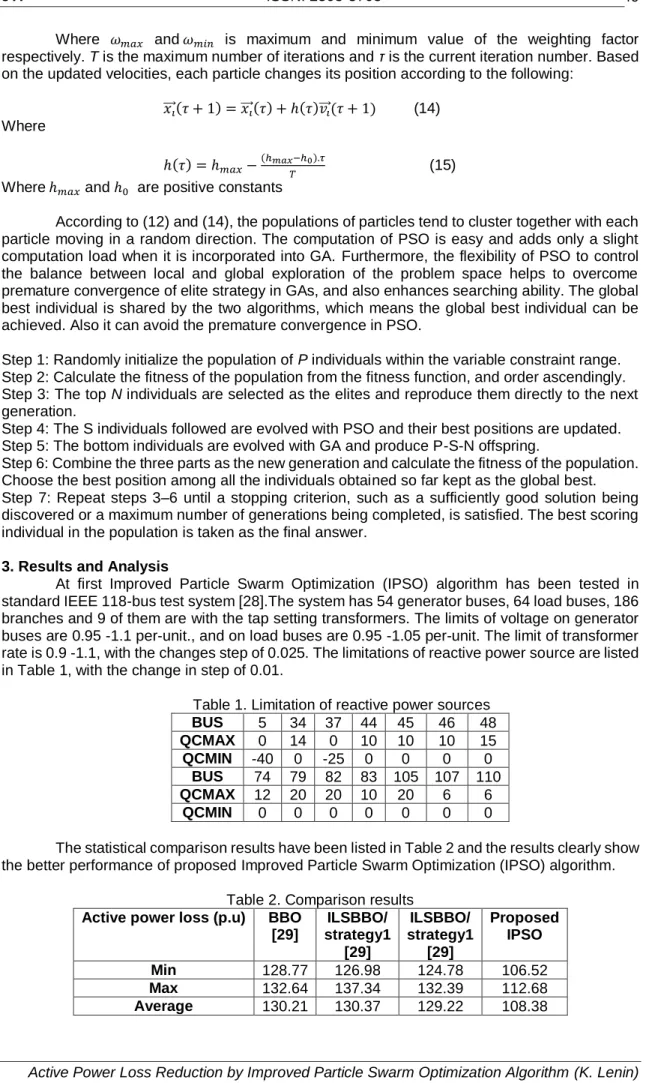
At first Improved Particle Swarm Optimization (IPSO) algorithm has been tested in standard IEEE 118-bus test system [28].The system has 54 generator buses, 64 load buses, 186 branches and 9 of them are with the tap setting transformers. The limits of voltage on generator buses are 0.95 -1.1 per-unit., and on load buses are 0.95 -1.05 per-unit. The limit of transformer rate is 0.9 -1.1, with the changes step of 0.025. The limitations of reactive power source are listed in Table 1, with the change in step of 0.01.
Table 1. Limitation of reactive power sources BUS 5 34 37 44 45 46 48 QCMAX 0 14 0 10 10 10 15 QCMIN -40 0 -25 0 0 0 0 BUS 74 79 82 83 105 107 110 QCMAX 12 20 20 10 20 6 6 QCMIN 0 0 0 0 0 0 0
The statistical comparison results have been listed in Table 2 and the results clearly show the better performance of proposed Improved Particle Swarm Optimization (IPSO) algorithm.
Table 2. Comparison results Active power loss (p.u) BBO
[29] ILSBBO/ strategy1 [29] ILSBBO/ strategy1 [29] Proposed IPSO Min 128.77 126.98 124.78 106.52 Max 132.64 137.34 132.39 112.68 Average 130.21 130.37 129.22 108.38
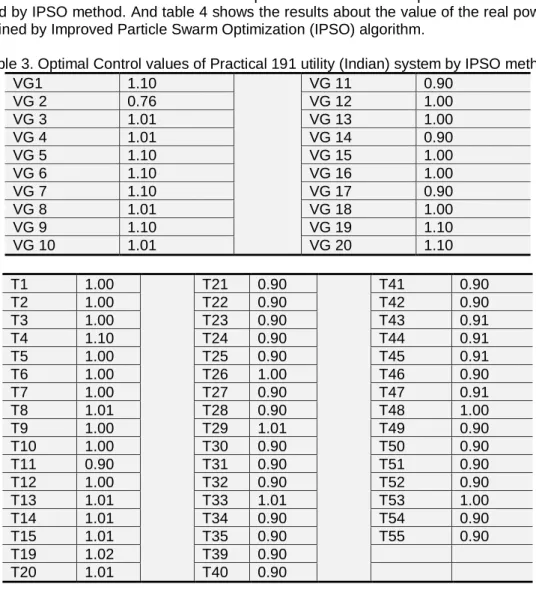
Then the Improved Particle Swarm Optimization (IPSO) algorithm has been tested in practical 191 test system and the following results have been obtained. In Practical 191 test bus system – Number of Generators = 20, Number of lines = 200, Number of buses = 191 Number of transmission lines = 55. Table 3 shows the optimal control values of practical 191 test system obtained by IPSO method. And table 4 shows the results about the value of the real power loss by obtained by Improved Particle Swarm Optimization (IPSO) algorithm.
Table 3. Optimal Control values of Practical 191 utility (Indian) system by IPSO method
VG1 1.10 VG 11 0.90 VG 2 0.76 VG 12 1.00 VG 3 1.01 VG 13 1.00 VG 4 1.01 VG 14 0.90 VG 5 1.10 VG 15 1.00 VG 6 1.10 VG 16 1.00 VG 7 1.10 VG 17 0.90 VG 8 1.01 VG 18 1.00 VG 9 1.10 VG 19 1.10 VG 10 1.01 VG 20 1.10 T1 1.00 T21 0.90 T41 0.90 T2 1.00 T22 0.90 T42 0.90 T3 1.00 T23 0.90 T43 0.91 T4 1.10 T24 0.90 T44 0.91 T5 1.00 T25 0.90 T45 0.91 T6 1.00 T26 1.00 T46 0.90 T7 1.00 T27 0.90 T47 0.91 T8 1.01 T28 0.90 T48 1.00 T9 1.00 T29 1.01 T49 0.90 T10 1.00 T30 0.90 T50 0.90 T11 0.90 T31 0.90 T51 0.90 T12 1.00 T32 0.90 T52 0.90 T13 1.01 T33 1.01 T53 1.00 T14 1.01 T34 0.90 T54 0.90 T15 1.01 T35 0.90 T55 0.90 T19 1.02 T39 0.90 T20 1.01 T40 0.90
Table 4. Optimum real power loss values obtained for practical 191 utility (Indian) system by IPSO method.
Real power Loss (MW) IPSO Min 138.128 Max 144.146 Average 140.162 4. Conclusion
In this paper, Improved Particle Swarm Optimization (IPSO) algorithm successfully solved the optimal reactive power problem. The proposed algorithm combines Particle swarm optimization (PSO) and genetic algorithm (GA) to form a hybrid algorithm. Due to combination of different optimization mechanisms, not only the offspring can keep diversity, but also PSO can keep the balance of global search and local search, so the entire search ability of the algorithm can be improved. In order to evaluate the efficiency of the proposed algorithm, it has been tested in standard IEEE 118 & practical 191 bus test systems and compared other algorithms. Simulation results show that real power loss considerably reduced and control variables are within the limits.
References
[1] Author1 A, Author2 B. Title of Manuscript. Name of Journal or its Abbreviation. year; Vol.(Issue): pages.
[2] O.Alsac,and B. Scott, “Optimal load flow with steady state security”,IEEE Transaction. PAS -1973, pp. 745-751.
[3] Lee K Y ,Paru Y M , Oritz J L –A united approach to optimal real and reactive power dispatch , IEEE Transactions on power Apparatus and systems 1985: PAS-104 : 1147-1153
[4] A.Monticelli , M .V.F Pereira ,and S. Granville , “Security constrained optimal power flow with post contingency corrective rescheduling” , IEEE Transactions on Power Systems :PWRS-2, No. 1, pp.175-182.,1987.
[5] DeebN ,Shahidehpur S.M ,Linear reactive power optimization in a large power network using the decomposition approach. IEEE Transactions on power system 1990: 5(2) : 428-435 [6] E. Hobson ,’Network consrained reactive power control using linear programming, ‘ IEEE
Transactions on power systems PAS -99 (4) ,pp 868=877, 1980
[7] K.Y Lee ,Y.M Park , and J.L Oritz, “Fuel –cost optimization for both real and reactive power dispatches” , IEE Proc; 131C,(3), pp.85-93.
[8] M.K. Mangoli, and K.Y. Lee, “Optimal real and reactive power control using linear programming” , Electr.PowerSyst.Res, Vol.26, pp.1-10,1993.
[9] C.A. Canizares , A.C.Z.de Souza and V.H. Quintana , “ Comparison of performance indices for detection of proximity to voltage collapse ,’’ vol. 11. no.3 , pp.1441-1450, Aug 1996 . [10] K.Anburaja, “Optimal power flow using refined genetic algorithm”,
Electr.PowerCompon.Syst , Vol. 30, 1055-1063,2002.
[11] D. Devaraj, and B. Yeganarayana, “Genetic algorithm based optimal power flow for security enhancement”, IEE proc-Generation.Transmission and. Distribution; 152, 6 November 2005. [12] A. Berizzi, C. Bovo, M. Merlo, and M. Delfanti, “A ga approach to compare orpf objective functions including secondary voltage regulation,” Electric Power Systems Research, vol. 84, no. 1, pp. 187 – 194, 2012.
[13] C.-F. Yang, G. G. Lai, C.-H.Lee, C.-T. Su, and G. W. Chang, “Optimal setting of reactive compensation devices with an improved voltage stability index for voltage stability enhancement,” International Journal of Electrical Power and Energy Systems, vol. 37, no. 1, pp. 50 – 57, 2012.
[14] P. Roy, S. Ghoshal, and S. Thakur, “Optimal var control for improvements in voltage profiles and for real power loss minimization using biogeography based optimization,” International Journal of Electrical Power and Energy Systems, vol. 43, no. 1, pp. 830 – 838, 2012. [15] B. Venkatesh, G. Sadasivam, and M. Khan, “A new optimal reactive power scheduling
method for loss minimization and voltage stability margin maximization using successive multi-objective fuzzy lp technique,” IEEE Transactions on Power Systems, vol. 15, no. 2, pp. 844 – 851, may 2000.
[16] W. Yan, S. Lu, and D. Yu, “A novel optimal reactive power dispatch method based on an improved hybrid evolutionary programming technique,” IEEE Transactions on Power Systems, vol. 19, no. 2, pp. 913 – 918, may 2004.
[17] W. Yan, F. Liu, C. Chung, and K. Wong, “A hybrid genetic algorithminterior point method for optimal reactive power flow,” IEEE Transactions on Power Systems, vol. 21, no. 3, pp. 1163 –1169, aug. 2006.
[18] J. Yu, W. Yan, W. Li, C. Chung, and K. Wong, “An unfixed piecewiseoptimal reactive power-flow model and its algorithm for ac-dc systems,” IEEE Transactions on Power Systems, vol. 23, no. 1, pp. 170 –176, feb. 2008.
[19] F. Capitanescu, “Assessing reactive power reserves with respect to operating constraints and voltage stability,” IEEE Transactions on Power Systems, vol. 26, no. 4, pp. 2224–2234, nov. 2011.
[20] Z. Hu, X. Wang, and G. Taylor, “Stochastic optimal reactive power dispatch: Formulation and solution method,” International Journal of Electrical Power and Energy Systems, vol. 32, no. 6, pp. 615 – 621, 2010.
[21] A. Kargarian, M. Raoofat, and M. Mohammadi, “Probabilistic reactive power procurement in hybrid electricity markets with uncertain loads,” Electric Power Systems Research, vol. 82, no. 1, pp. 68 – 80, 2012.
fuzzy logic and genetic programming,” Integrated Computer-Aided Engineering, vol. 14 pp. 141–159, 2007.
[23] T. Shima, S. J. Rasmussen, A. G. Sparks, and K. M. Passino, “Multiple task assignments for cooperating uninhabited aerial vehicles using genetic algorithms,” Computers & Operations Research, vol. 33, pp. 3252–3269, 2006.
[24] Jin, N. and Y. Rahmat-Samii, “Advances in particle swarm optimization for antenna designs: Real-number, binary, singleobjective and multiobjective implementations,” IEEE Trans. Antennas Propagat., Vol. 55, 556–567, 2007.
[25] Lee, K. C. and J. Y. Jhang, “Application of particle swarm algorithm to the optimization of unequally spaced antenna arrays,” Journal ofEle ctromagnetic Waves and Applications, Vol. 20, 2001–2012, 2006.
[26] Liu, X. F. Y. B. Chen, Y. C. Jiao, et al., “Modified particle swarm optimization of patch antenna design based on IE3D,” Journal of Electromagnetic Waves and Applications, Vol. 21, 1819– 1828, 2007.
[27] Robinson, J., S. Sinton, and Y. Rahmat-Samii, “Particle swarm, genetic algorithm, and their hybrids: Optimization of a profiled corrugated horn antenna,” IEEE International Symposium on Antennas Propagat., Vol. 1, 314–317, 2002.
[28] Juang, C. F., “A hybrid of genetic algorithm and particle swarm optimization for recurrent netword design,” IEEE Trans. Syst., Man, Cybern. - Part B: Cybern., Vol. 34, 997–1006, 2004.
[29] IEEE, “The IEEE 30-bus test system and the IEEE 118-test system”, (1993), http://www.ee.washington.edu/trsearch/pstca/.
[30] Jiangtao Cao, Fuli Wang and Ping Li, “An Improved Biogeography-based Optimization Algorithm for Optimal Reactive Power Flow”, International Journal of Control and Automation Vol.7, No.3 (2014), pp.161-176.