Khyber Medical University
2012-13
Master in Health
Research
_____________________________________________________________________________________________________
Disclaimer
The information in this online prospectus relates primarily to the session 2012/13 and every effort has been made to ensure that it is correct. The University will use all reasonable efforts to deliver the programmes as described.
However, the University reserves the right for any reason without notice to withdraw or change any of the information included in this online prospectus, to alter tuition fees, entry requirements, the facilities and/or services available from or provided by or on behalf of the University.
TABLE OF CONTENTS
1 INTRODUCTION
1.1 Mission statement 1.2 Goal of KMU
1.3 Institutional Objectives
2 INTRODUCTION TO THE KMU – MHR Programme
3 PROGRAMME ORGANIZATION & STRUCTURE
3.1 Programme Details
3.2 Semester Wise Distribution of Courses
4 MHR COURSES
4.1 Orientation to Health Research
4.2 Qualitative Health Research & Bioethics
4.3 Biostatistics, Evidence based Practice & Meta Analysis 4.4 Research Communication & Dissemination, Medical writing 4.5 Health Research Management
4.6 Health Economics 4.7 Thesis
5 ACADEMIC QUALITY
5.1 Examination and Methods of Assessment 5.2 Grading
6 ADMISSION CRITERIA AND PROCEDURE
6.1 Introduction 6.2 Admission
6.3 Application procedure 6.4 Admission procedure
7. APPENDICES
7.1 Evaluation Performa For MHR
7.1.1 Research proposal Evaluation Performa
7.1.2 Thesis defense – Viva Voce Evaluation Performa 7.1.3 Thesis Evaluation Performa
_____________________________________________________________________________________________________
Message from the Vice Chancellor
The knowledge and information revolution continues in the 21st century world with unprecendented vigour and speed. Countries which become active partners in this revolution are likely to exploit the development opportunities thrown up by the revolution and keep pace with global competitiveness. Knowledge and information have become the key drivers of international competitiveness and the global economy, making it crucial for countries to respond rapidly and efficiently to changes. Higher education and capacity for research and development (R&D) are fundamental to establishing and developing knowledge economies. Developing countries like Pakistan need to establish and enhance their capacity in the areas of basic and precompetitive research, applied research and research to address areas of special concern, such as health and environment. Also needed is capacity development for tapping and effectively utilizing global knowledge and learning from the experiences of others. In fact capacity related to producing, disseminating, acquiring and applying various kinds of knowledge which lead to innovation and technical progress need to be developed among all stakeholders to establish effective R&D Systems.
Universities have a critical role in strengthening the R&D systems of their countries and in the establishment of knowledge economies. Beside their well recognised role in research and knowledge generation and education and training, universities are increasingly getting involved in entrepreneurial ventures and linkages with the market place. They are also establishing programmes for life-long learning considered essential for a knowledge based economy. Khyber Medical University Peshawar has been acutely aware of the health research capacity needs of the health care system in Pakistan in general and Khyber Pakhtunkhwa province in particular. Since its establishment in January 2007 the university has undertaken the task of research capacity building on a priority basis. To oversee its R&D programmes, the university established its Directorate of R&D in parallel with its Directorate of Academics. The university organized a national consultation in April 2007 to identify priorities and develop a road map for its academic and research programmes. In May 2009, the university prepared its strategy for promoting R&D and building capacity for research and shared it in a seminar with key stakeholders in the health system of KPK. A clinical Research Capacity Development programme was subsequently developed and is being offered in cycles of 6 months duration since July 2009. Todate over 1500 have participated in the 48 work shops organized under the programme todate. Experience from the programme and feed back from participants has led to the development of this Masters of Health Research Degree programme.
The Masters of Health Research Degree programme is primarily aimed at strengthening health research capacity in the health academic institutions of KPK
but we hope the course will contribute to overall research capacity enhancement in Pakistan. The course curriculum covers fundamental topics related to a better understanding of science and research, which are not part of the general and health professional‟s education systems of the country. The study of these topics will we hope stimulate the participants to go beyond learning just the research process and methods and become researchers in the true sense of the term. The learning methods include interactive workshops, classroom sessions and tutorials during well-spaced direct contact sessions of 10 days or less and guided self learning using information communication technologies. The programme puts special emphasis on the development of writing skills among the participants who are assigned a writing task at the conclusion of each direct contact session. We are confident the programme will produce learned and skilled health research professionals who will contribute to creating vibrant research environments in their respective institutions.
Prof. Dr. Mohammad Hafizullah Vice Chancellor
_____________________________________________________________________________________________________
1. INTRODUCTION
Khyber Medical University (KMU), Peshawar is the first Public Sector Medical University in North West Frontier Province, established through an Act of law on 13th Jan, 2007 with jurisdiction on the entire province including Federally Administered Tribal Areas, on all institutions of health sciences, including Medical and Dental colleges recognized by PMDC. The University is:
Committed to developing future leaders in medical research.
Committed to promoting and maintaining faculty of the highest quality to conduct research and become teachers and mentors for students and trainees.
Committed to provide a common place for faculty, health educators, community partners, and students to come together to share and develop ideas that will improve the health of our society.
1.1 Mission Statement
Service to humanity with a commitment for excellence in medical education and research, providing medical students with state of the art knowledge, skills and attitude to deliver the highest standards of health care to the people.
1.2 Goal of KMU
• Create state of the art learning opportunities for faculty and students.
• Promote an environment of academic freedom.
• Develop valid assessment techniques for evaluation of knowledge, skill and attitude.
• Provide a supportive environment to promote lifelong learning to all health care providers for enhancing their knowledge, technical capabilities and professional conduct.
• Establish collaborations and partnerships within the KMU constituent colleges and other educational and health care institutes.
• Advocate for good public health policy, evidence based clinical practice and efficient health care delivery systems.
1.3 Institutional Objectives
1. Develop a multi-dimensional Comprehensive Health Care Approach encompassing all the four elements of health i.e. prevention, promotion, curative intervention & rehabilitation.
2. Include a Health Care Team approach at all levels of health care delivery for a comprehensive health care delivery system.
3. Set up the SemesterSystem of Education.
4. Create the Health Education Continuum (UGME, PGME, CME, CPD, & CED) with opportunities & commitment for life long learning.
5. Incorporate Behavioral Sciences and Humanities in the Medical Education Curriculum.
6. Promote and enhance the level of Education in Basic Medical Sciences, Nursing and Allied Health Sciences, And Public Health.
7. Learning innovations defined by a dynamic, relevant, comprehensive, evidence and outcome based curricula that accommodate healthy extra curricular, literary and cultural activities.
8. Implement an objective and Continuous System of Evaluation.
9. Nurture evidence based medical practice through Innovation, Scholarship, Partnership & Collaborations and Biomedical Research.
10.Establish the concepts of Academic Audit, Research Audit & Clinical Audit.
Mission Statement of the Directorate of Research & Development, KMU:
“To institutionalise health research in the health academic institutions and health care system of the Khyber Pakhtunkhwa (KPK) province”.
2. Introduction to the KMU – Master in Health Research (MHR) Goal of Programme
Promote and establish evidence-based health care in Khyber Pakhtunkhwa Province.
Objective of the MHR Programme
Develop capacity for high quality health research in health academic institutions Of Khyber Pakhtunkhwa Province
The Khyber Medical University (KMU)„s Master in Health Research (MHR) degree programme is aimed at the development of health research capacity among health care professionals with the purpose to promote research in health academic institutions and the health care system of Khyer Pakhtunkhwa province specifically
_____________________________________________________________________________________________________
and Pakistan generally. The development of research capacity is also expected to equip the health professionals with knowledge and skills to practice evidence based medicine and evidence based decision-making in health care policy-making and management and public health interventions implementation.
The programme will stress upon hands-on training to develop knowledge and skills for research problems identification and prioritization, preparation of research project proposals and protocols, searching for literature, preparation of research plans and budgets, research reports and publications writing and reviewing of research proposals and publications. The programme covers all essential and relevant subjects in the direct contact sessions with students in workshops, lectures and tutorials and constantly challenges the students to enhance their learning and skills by giving them regular assignments and encouraging guided self learning. The assignments are specifically aimed at developing writing skills and critical appraisal of published literature. Students are encouraged to learn to systematically develop research questions, identify and apply most appropriate research design, review research literature, critically evaluate evidence, and apply a range of research approaches and skills relevant to health services and clinical problems in developing country setting. This is an innovative masters programme, first of its kind being offered in Pakistan and is designed to enhance career prospects and professional development of participants.
3. Programme Organisation and Structure 3.1. Programme Organisation
The emphasis in this course will be on developing practical skills in formulating research question, developing appropriate methodology, collect valid data and disseminate the results using effective communications. The course will therefore use variety of modes of information transfer with particular emphasis on problem based learning, hands on training and interactive learning. Following modes of information transfer will be used
Lectures - Introduce key concepts, principles and knowledge content for each module.
Workshops for hands on training and developing critical appraisal skills. Small group tutorials to develop presentations and discussions skills and encourage group working, and peer support
Web-based learning and Computer/practical exercises are expected to develop capacity for the optimum use of information and communication technologies in health research and health care
students to work through concepts in more detail, and develop self learning skills.
Manuscripts‟ writing is aimed at developing analytical skills and writing capacity.
Critical appraisal of published research is expected to develop capacity for critical review of published literature and research proposals.
The total programme duration will be two years with a total of sixty (60) contact days spread over six contact sessions spread evenly over the two years. Attendance at these contact sessions will be mandatory.
Web based learning will be done through a Virtual Learning Environment (VLE) with support from the teaching and university I.T staff. Web access to a virtual library will be allowed for every student, other resources and learning materials will be available on the programme website.
Total credit hours for the course are 60 satisfying both HEC and PMDC criteria for recognition, breakdown of the credit hours is as follow:
Total Contact Days = 60 Total Contact Hours = 420
Total Credit hours for Contact Sessions = 30
Total Credit Hours for Assignments (Web based, guided learning) = 18 Total Credit hours for thesis = 6
Total Credit hours Final exam (OSTE/OSRE) = 6 Total Programme Credit Hours = 60
The medium of instruction for the course will be English and computer proficiency at the time of admission will be a must.
_____________________________________________________________________________________________________
Programme Structure
Module 1: Quantitative Health Research
January 2012 Direct Contact Session
1.1 1. Orientation to Health Research Foundations, Terms and Concepts Knowledge, science and research Health systems
Health Research (HR) & HR Process. History of Scientific Thought,
Post--‐Positivists and Critical Realism Overview of Biostatistics Evidence –Based Medicine.
2. Methodology & Proposal development, Step by step development of research proposal.
Literature search, Boolean operators and searching on INTERNET, writing of a literature review
Epidemiology, Social determinants of health and health equity
Variables
Research study types, Experimental Research and clinical trials
Validity, reliability, bias
Contact Hours = 14 Contact Hours = 56 Total Credit Hours 5 Duration of the Contact Period 12 days
1.3 Students‟ presentations & discussions on draft concept notes and research proposals
Contact Hours = 14
1
Assignments February – March , 2012
1.4 Concept note writing finalisation Research Proposal finalisation Research Proposals review
Critical Appraisal of original research paper for scientific validity
Self learning & Web-based guided learning 4
Total credit hrs Module 1 10
Module 2: Qualitative Health Research & Bioethics April, 2012 Direct Contact Session
2.1 Qualitative Research
Introduction to qualitative research Narrative research, phenomenology, grounded theory, Ethnography, case study, action research, evaluation research.
Data gathering (common methods): sampling, surveys, interviews, focus. groups, consensus panels
Data gathering (less common methods): observation, text documents.
Making sense of your data
Data management and analytic techniques.
Qualitative methods in health services research.
Quality and rigour in qualitative research.
Translational research.
Health Care and Environmental Sustainability.
Health Systems and Policy Research. Global research and the 10/90 gap in research. Contact Hours = 49 3.5 10 days 2.2 Bioethics Historical perspective Principles Informed consent Confidentiality Conflict of interest Contact Hour = 21 1.5
Assignments April - May. 2012 2.2 Review of published qualitative
research manuscript
Ethics Review of published manuscript Attending Meetings of the Ethical Review Boards Self learning & Web-based guided learning 3
Practical –Data Collection May – September , 2012
_____________________________________________________________________________________________________
Total credit hrs Module 2 8
Module 3: Biostatistics,
Evidence Based Practice and Meta Analysis October Direct Contact Session
3.1
Biostatistics & SPSS (Practical) Contact Hours = 28
2
12 days 3.2 1. Biostatistics
Basic data types, distributions and analyses, estimation of confidence intervals
Sample size calculation
Hypothesis testing – statistical tests for demonstrating differences, associations and cause and effect relationships Parametric and non-parametric tests for comparisons
Correlations and regression, ANOVA; Multiple regression; Logistic regression Statistical Power- type I and II errors, calculating power
Effect size calculation-Odds ratio and Relative Risk
2. Evidence-based Medicine
Evidence Based Medicine: concept and application
Identifying evidence: resources and their limitations
Systematic reviews and meta analysis of randomised controlled trials
Introduction to software for meta analysis
Contact
Hours = 42 3
Review and discussion of published literature for statistical quality
Contact hours = 14
1
Assignment October – November, 2011
Practical- Data Analysis of own research.
3.2 Critical appraisal of the data analysis & results of published papers.
Total credit hrs Module 3 7 Module 4: Research Communication and
Dissemination- Medical Writing
January 2012 Direct Contact Session
4.1 Why communicate-verbal & written communications
Medical writing special features Journal publication-types of journals Types of publications- formats of original papers, reviews, research reports & theses
Oral & Poster presentations Writing style
Contact
hours = 21 1.5
9 days
4.2 Journal Indexing, citation & Impact Factor
Open access and online publishing Scientific misconduct
Current issues in publishing Systematic reviews
Grey Literature
Reporting of qualitative research Knowledge divide
Contact
Hours = 28 2
4.3 Presentation Skills Contact Hours = 14
1 Assignment
4.4. Paper/poster for presentation at KMU annual symposium
Critical Appraisal of published paper for writing & style.
Attendance at the meeting of editorial boards of local journals
Web-based Guided
Learning 3
Total credit hrs Module 4 7.5 Year 2- 2013
Module 5: Health Research Management
April, 2012 Direct Contact Session
5.1
Project Management:
Project Management Process
o project-the project terms of
Contact Hours = 35
_____________________________________________________________________________________________________
reference
o Work Plan
o Project team enablement
o Project monitoring
9 days
5.2 Research Governance
Priority setting for health research Intellectual Property Rights and Patents Academia Industry linkages
Requirements for auditing and monitoring research
Contact Hours = 28
2
Assignment
5.3 Situation analysis of Academia- Industry linkages and IPR in Pakistan Research Report writing
Web-based Guided
Learning 3 Total Credit hours Module 5 7.5 Module 6: Health Economics August, 2012 Direct Contact Session April (8 days)
6.1 Defining health, healthcare and their distribution
The relationship between economic and health indicators
Measures of disease and quality of life in health economics.
The economics of healthcare provision economic evaluation, of health care Clinical and health-related measures: preference and utility
Theory and practice of economic analysis
Decision analysis: decision trees Discrete choice methods
Policy applications Contact Hours= 56 4 8 days Assignment September, 2012 6.2 Review of health care financing in
Pakistan
Critical Appraisal of a published paper on health economics
2 Total Credit hours Module 6 6
Thesis writing Completion September 30, 2013 6 Credit Hours
Annual Examination November , 2013 6 credit Hours
_____________________________________________________________________________________________________
Programme Courses
This programme offers the following 6 modules
1. Quantitative Research Methods
2. Qualitative Research Methods
3. Biostatistics, Evidence Based Practice, Systematic Reviews and Meta analysis
4. Medical writing and research dissemination
5. Research Management and Governance
6. Health Economics
Additionally students will also present a dissertation based on the research project prepared and carried out by them during the training.
4.1 Quantitative Research Methods: Epidemiology and Biostatistics
Aims
This module aims to provide knowledge and skills for applying quantitative research methods for generating knowledge and evidence. The student are expected to develop a clear understanding of types of data, distributions and statistical tests and different study designs and their application for addressing a specific research question.
Content
1. Orientation to Health Research Foundations, Terms and Concepts Knowledge, science and research Health systems
2. Methodology & Proposal development
3. History of Scientific Thought, Post--‐Positivists and Critical Realism
4. Literature search, Boolean operators and searching on INTERNET, writing of a literature review
5. Epidemiology, Social determinants of health and health equity 6. Variables
7. Research study types, Experimental Research and clinical trials 8. Validity, reliability, bias
9. Translational research
10.Health Care and Environmental Sustainability 11.Health Systems and Policy Research
12.Global research and the 10/90 gap in research
Training in the use of Information Technology (IT) and computer software in research is an integral part of the course
Learning outcomes
The student will be able to demonstrate an understanding of the main
theoretical and
practical issues in medical research. This will include
The fundamental concepts of research and philosophy of research
The design of different types of research studies including descriptive, analytical and experimental studies
Priority setting in health research
Understanding of and application of evidence in clinical practice, health management and implementation of public health interventions,
The students will develop skills to
Identify researchable problems and develop research questions Design research studies and write research proposals
Critical appraisal of published research
4.2Qualitative Research Methods
Aims
This module aims to provide students with knowledge of commonly used techniques and methods in qualitative research studies. This will cover data types and qualitative research data collection techniques and their use in health research.
Content
Introduction to qualitative research
Narrative research, phenomenology, grounded theory, Ethnography, case study, action research, evaluation research
Data gathering (common methods): sampling, surveys, interviews, focus Groups, consensus panels
Data gathering (less common methods): observation, text documents, Making sense of your data
Data management and analytic techniques Qualitative methods in health services research Quality and rigor in qualitative research
Learning Outcomes
Students will have an understanding of:
The variety of qualitative research techniques commonly used in social sciences research
_____________________________________________________________________________________________________
Strengths and weaknesses of different designs, in terms of their vulnerability
to forms of bias.
Designing qualitative research projects Understanding of qualitative data
Use of qualitative methods in health services research in developing country
settings
The students will develop skills to
Identify and develop research question suitable for qualitative research Design quantitative research in health care
Manage qualitative data
Critically appraise articles using qualitative methods.
4.3 Biostatistics, Evidence Based Practice, Systematic Reviews and Meta-analysis
Aims
This module aims to develop knowledge and skills for processing and statistical analysis of health research data and the use of research generated evidence in medical practice and decision-making. The students are expected to develop an understanding of selecting and applying appropriate statistical methods for different research designs and of critically appraising the evidence and translating.
Contents Biostatistics
Basic data types, distributions and analyses, estimation of confidence intervals
Sample size calculation
Hypothesis testing – statistical tests for demonstrating differences, associations and cause and effect relationships
Parametric and non-parametric tests for comparisons
Correlations and regression, ANOVA; Multiple regression; Logistic regression
Statistical Power- type I and II errors, calculating power Effect size calculation-Odds ratio and Relative Risk
Evidence-based Medicine
Evidence Based Medicine: concept and application Identifying evidence: resources and their limitations
Systematic reviews and met analysis of randomised Controlled trials Evidence syntheses
Introduction to software for meta analysis
Learning Outcomes:
By the end of the module students will have the knowledge and understanding to:
Select appropriate statistical techniques for different types of research studies and hypothesis testing
Select and use appropriate computer software for data processing and analysis and communication of research results
Have advanced knowledge and critical understanding of types and uses of evidence in health care.
Understand the application of evidence based medicine in clinical practice. Understand treatment effect measures
Understand the principles of systematic reviews and meta-analysis.
4.4 Medical Writing And Dissemination Of The Research Aim
This module will aim to equip participants with the knowledge and skills to understand the requirements of scientific writing for medical journals, policy documents and conferences. The students will develop skills to communicate clearly and logically the results of research.
Contents
Why communicate-verbal & written communications Medical writing special features
Journal publication-types of journals and Journal Indexing, citation & Impact Factor
Types of publications, original papers, reviews, research reports & theses Oral presentations & Poster presentations
Writing style
Open access and online publishing Scientific misconduct
Current issues in publishing Systematic reviews
Grey Literature
Reporting of qualitative research
_____________________________________________________________________________________________________
Learning Outcomes
The students will be able to develop an
Understanding of different types of medical writing
Knowledge of journals access to published literature and publication issues Understanding of different ways of research dissemination
Skills Development
The students will be able to develop the following skills:
Write different types of manuscripts Prepare oral and poster presentations Present research results in different forums Critically review published literature
4.5 Research Management and Governance
This module will help students to develop an understanding of the principles and practice of health research management and governance and skills to plan, implement, monitor and oversee the implementation of health research projects.
Content
Project Management:
Project Management Process
o project-the project terms of reference
o Work Plan
o Project team enablement
o Project monitoring Research Governance
Priority setting for health research Intellectual Property Rights and Patients Academia Industry linkages
Requirements for auditing and monitoring research
Learning Outcomes
The students will learn to:
Develop and implement research plans Develop and train research teams
see the ethical implementation of research projects
4.6 Health Economics
Aims
This module will enable students to understand the role of economics in healthcare
provision and decision-making and provide skills to interpret and undertake economic
evaluations of health care interventions in context of developing countries.
Content
The relationship between economic and health indicators Measures of disease and quality of life in health economics. The economics of healthcare provision
economic evaluation, of health care
Clinical and health-related measures: preference and utility Theory and practice of economic analysis
Decision analysis: decision trees Discrete choice methods
Policy applications
Learning Outcomes
By the end of module students will:
Have a working knowledge of the conceptual foundations of economics Understand the strengths and weaknesses of economic methods when applied
to the health sector particularly in relation to developing countries context. Grasp the policy implications that may result from economic evaluations Understand how economic forces can affect resource allocation and, with that,
service provision in their various fields of work.
The students will develop skills to:
Undertake cost-effectiveness analysis of research
Interpret and conduct basic economic analyses of healthcare interventions Interpret comparative analysis and sources of variation
_____________________________________________________________________________________________________
4.7 Research Report / Thesis
Objectives
The Thesis represents the culminating experience required for the Programme and may take the form of a research thesis, an evaluation study, or an intervention study. Each student is required to formally present the research experience and research findings in a viva voce or thesis defense.
As a requirement of the Programme all students are required to develop a research protocol, collect and analyze data and write a thesis. This provides the students an opportunity to gain first-hand experience of conducting a complete research study. Thesis committees supervise the students‟ research projects. Each thesis committee comprises of a thesis supervisor and at least one other faculty member from within the Programme or within the University. In order to conduct their MHR thesis research, students are encouraged to seek funds by applying to the University or to national and international funding agencies.
3.3 Teaching Faculty
Dr. Tasleem Akhtar, FRCP
Consultant Research and Development, KMU
Dr. Farhat Moazam, PhD
Professor and Founding Chairperson of the Centre of Biomedical Ethics and Culture (CBEC) SIUT, Karachi
Dr. Aamir Jafarey, FCPS, FRCS
Associate Professor, Centre of Biomedical Ethics and Culture (CBEC) SIUT, Karachi
Dr. Zahid Jadoon, MSc Epidemeliology,
Vice Dean Pakistan Institute of Community Ophthalmology, Peshawar.
Dr. Salim Wazir, MSc, MPhil
Assistant Professor, Community Medicine, Ayub Medical College, Abbottabad
Dr. Hamid Hussain, MSc Epi & Biostatistics Assistant Professor Community Medicine, KMC
Mr. Iftikhar ud Din MSc, MPhil, PHD
Assistant Professor, Statistics, Agriculture University Peshawar
Dr. Zohaib Khan , MPH
Assistant Director R&D, KMU
Mr. Syed Azmat Ali Shah, MSCS
_____________________________________________________________________________________________________
International Technical Advisory Panel
Name Designation
Prof. Zulfiqar Bhutta, FRCP, PhD Head of Maternal & Child Health Division, Aga Khan University, Karachi,
Prof. Saeed Farooq Visiting Professor Centre for Ageing and Mental
Health, Staffordshire University UK & PGMI LRH Peshawar.
Dr. Adnan Hyder, PhD Assistant Professor, Department of Health Policy &
Management, Center for Injury Research & Policy, Phoebe R. Berman Bioethics Institute, Johns Hopkin University, USA
Dr. Gregory Pappas, PhD Former Chairman and Professor, Department of
Community Health Sciences, Aga Khan University
Prof. Dr. Idrees Anwar Head of surgery, Sheikh Zayed Medical College
Director Medical Education , Programme Director Masters In Health Professions Research, Visiting Faculty College Of Physicians And Surgeons Karachi
5. Academic Quality
A course file will be maintained in the Institute for each course. Before the beginning of the classes, each teacher will submit a course plan, including topics to be taught each week, the number of assignments and quizzes, and the distribution of marks. Complete record of the course will be maintained and submitted by the teacher on monthly basis, including attendance, topics covered, home assignments graded, etc. The course director will review course files periodically to ensure that course plans have been followed faithfully.
The Board of Studies of the university will meet bi annually to review student performance for the previous assessments.
A student must have attended at least 90 % of the classes (Contact Sessions) held in a course in order to be allowed to sit in the Final Examination.
5.1 Examination and Methods of Assessment
The students are evaluated during each course on the basis of:
1. Continuous assessment which includes short quizzes, tests, class and home assignments, class participation, interactive discussions, practical exercises and / or group work depending on the course outline. These assessments will be weighted towards 25% of the total grade for the course.
2. For the Final Examination the class teacher will prepare two question papers in the University approved format and submit these to the Course Director of the Institute in a sealed envelope. The Course Director will forward these papers to the University Examination Section. By random selection the Final Exam question paper will be issued by the University Exam Section. The final exam will be weighted towards 50% of the total grade for the course. 3. The format of paper for the final exam will include 50 multiple choice
questions, four out of five short questions and one out of two long questions (Essay Type).
_____________________________________________________________________________________________________
4. If a student fails an exam, the student needs to discuss his/her standing in the course with the course instructor. The course instructor will advise the student on coping strategies to improve the grade in the final exam.
5. If a student fails in the final exam, and the overall grade is an F, the student needs to repeat the course. However, the student may discuss with the course instructor who may give an incomplete grade for the course and may instruct the student to do some additional assignments to improve and gain a passing grade.
5.2 Grading
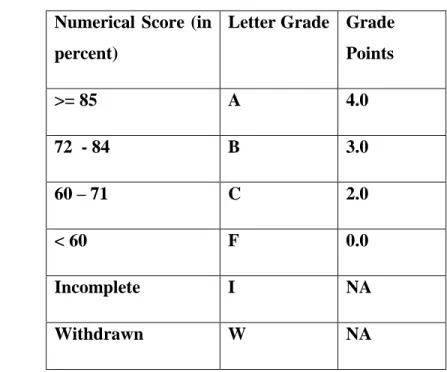
a. Grading of students will be through letter grades as defined in Table 1. Grades will be assigned by the course instructor. The course instructor will sign and submit the grades to the course coordinator, who will forward the same to the Director of the MHR Course. The Director will then forward them to the Controller of Examination at the University. The numerical scoring in the continuous assessment, mid-term exam and final exam will be converted to a letter grade and grade points as follows:
Table 1: Grade Points
Numerical Score (in percent)
Letter Grade Grade Points >= 85 A 4.0 72 - 84 B 3.0 60 – 71 C 2.0 < 60 F 0.0 Incomplete I NA Withdrawn W NA
b. Students receiving an F grade in any course will have to repeat the course whenever it is offered again. A student obtaining a D grade in the course may also repeat that course, if necessary to improve his/her cumulative grade point average (CGPA). In case of repeated courses, all grades earned by the student will appear in the Transcript/Detailed Mark Certificate (DMC); however, only the latest grade will be counted for calculating the CGPA. If a large number of students fail a course, that course may be offered again during the Summer Semester.
c. Grade I (Incomplete) should be awarded to a student only if he/she has missed the Final Examination, Project Report Submission, Thesis Defense, etc., due to genuine reason, but has completed all the other work of the course successfully. The award of grade I should not cover a student‟s lethargic attitude, willful absence, or bad performance in class.
Grade I should be converted to an appropriate letter grade by the end of the next semester, otherwise it would stay permanent and the student will have to repeat the course. The course instructor concerned should specify the conditions for conversion of grade, in the Grade Conversion Form (FORM-GCF) to be supplied by the Controller of Exams at the University, and explain the same to the student while assigning grade I.
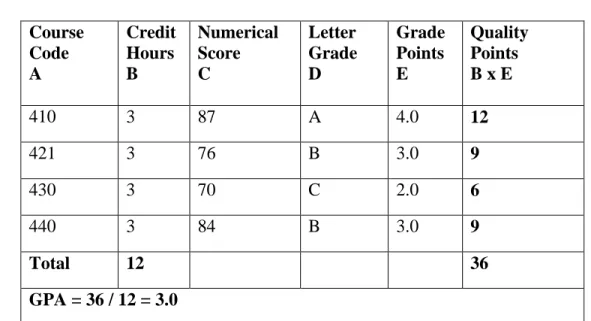
d. The Grade Point Average (GPA) for a semester will be calculated as: Quality Points of each course = Grade Points of grade awarded x Course credit hours. GPA = Sum of Quality points of all courses / Total credit hours An example of the GPA calculation for a generic semester in the MHR programme is given in Table 2.
_____________________________________________________________________________________________________
Table 2: Example of GPA calculation for a semester Course Code A Credit Hours B Numerical Score C Letter Grade D Grade Points E Quality Points B x E 410 3 87 A 4.0 12 421 3 76 B 3.0 9 430 3 70 C 2.0 6 440 3 84 B 3.0 9 Total 12 36 GPA = 36 / 12 = 3.0
e. The Cumulative Grade Point Average (CGPA) will be calculated over all courses taken to date in a similar manner. In case a course is repeated, all grades will be reported on the transcript; however, only the latest grade will be used to calculate the GPA.
f. The written thesis and the thesis defense will be graded as pass or fail. The pass or fail grade will not be counted towards the calculation of the GPA or the CGPA.
g. Students at the Masters level are expected to maintain a CGPA of 2.5 during the course of study.
h. A student who obtains a GPA of less than 2.5 for two consecutive modules will be issued a warning letter from the Director.
6. Admission Criteria and Procedures
6.1Introduction:
The University abides by its strict merit based criteria with absolute transparency to select its student for its various programmes. Every year, the number of Pakistani and foreign students is fixed by the Graduate & Research Management Council of the University.
6.2 Admission
Student Selection Criteria Application Requirements Evaluation of Applications
Short Listing and
Interviews
Application Timeline
Tuition and Other
Charges
Student Selection Criteria
This is an equal opportunity programme and there is no discrimination based on gender, religion or ethnicity. However, females and minority groups are encouraged to join this programme.
Entry into the Masters programme will require:
Minimum four years of undergraduate study or a PMDC recognized degree in medicine for (MBBS, MD, BDS or eqvivalent) or Allied Health sciences (DPT, Pharm D, BSc (Hons) Nursing or equivalent. Masters degree in Sciences recognized by PMDC.
Masters degree in Social Sciences with experience in the field of Health Research.
Applicant's background should reflect significant interest in Public Health e.g. research projects, publications, symposia and workshops attended;
_____________________________________________________________________________________________________
credentials. Applicant must demonstrate evidence of scholarly ability and personal maturity;
Basic computer literacy is a MUST.
Application Requirements
The Application Form must be completed and submitted, along with the following supporting documents:
Scholastic Achievements
A complete set of official transcripts of academic record in college, graduate school, and/or professional schools, with certification of degrees conferred, courses taken and grades received.
Statement of Objectives
A statement of objectives, summarizing past education, training and experience, as well as interests and future aims is required. A curriculum vitae and list of publications, if any, should be included.
Evaluation of Applicants
Applicants will be evaluated in three stages:
Stage I: Applications are reviewed and short listed.
Stage II: Includes interviews with the senior faculty members of the programme.
Stage III: Final selection will be made by the KMU Admission Committee after approval from KMU Graduate & Research Management Council (GRMC).
The Admission Test
All short listed applicants are required to write the MHR admission test. The test consists of four components: English, Analytical, Simple Mathematics and Subject Knowledge. The English language component evaluates English competency and reading comprehension. The Analytical component is aimed to assess the logical thinking and analytical ability of the candidates. The Mathematics component is designed to assess basic knowledge of the subject, including critical reasoning, deduction and problem solving ability and the subject knowledge will assess the basic knowledge of the participants regarding health research.
The University has not authorized any publication or preparatory classes for the Admission Test.
Short-listing and Interviews
Applicants will be short listed on the basis of the Admission Test. The purpose of the interview is to assess a variety of attributes, including integrity, motivation for the interest in the programme, maturity, social and cultural awareness, knowledge of public health issues in developing nations and evidence of initiative and commitment to the profession.
Interviews will be conducted at Khyber Medical University, Peshawar.
Tuition Fee and Other Charges
Educational expenses for selected candidates, including tuition fee, course material, computer lab fee, and examination fee, will be Rs. 200,000/- for the complete course, due in two equal installments
_____________________________________________________________________________________________________
6.2Application Procedure
Application must be made on the prescribed original application form available in the prospectus of the university. The application form is provided as part of the student prospectus. The prospectus may be obtained after payment in the following ways:
1. Direct from the KMU Director Academics and Admission Office.
2. Alternately the prospectus and application may be downloaded from the university website.
A non refundable Admission Test fee of Rs.1000/- will have to be paid as well. Completed applications should contain the following:
Domicile certificate Attested photocopy of identity card Attested photocopy of
matriculation certificate (SSC)
3 passport sized photographs
Attested photocopy of intermediate certificate (FSC)
Professional resume (preferably one page)
Final degree certificate along with transcripts
Attested photocopies of experience certificates
Foreign Students must submit attested photocopies of any language proficiency tests taken such as TOEFL/IELTS
Foreign students must submit two reference letters from teachers supervisor or employers
Completed application must reach the office of Director Academics & Admissions of the University by the closing date. Incomplete applications and application received after the closing date will not be entertained. Government employees can send applications in advance, but are required to get their NOC from their respective department to enroll in the programme.
6.4 Admission Procedure
MHR Admission Committee
University has its own admission committee, comprising of the Director, the MHR programme Coordinator, the Registrar and senior faculty members. The MHR admission committee is responsible for the selection of applicants to be admitted to the MHR programme. It establishes procedure for the timely review of applications to the programme. Deferrals of admission are at the discretion of the MHR admission committee.
Final Selection
The applicant‟s acceptance is contingent upon all required documents including official transcripts. The MHR admission committee is responsible for identifying those students with missing documents and / or credentials which do not meet eligibility standards.
The final selection shall be done on the basis of the following distribution of marks;
Criteria Maximum Weightage
Previous academic record score 10% Previous public health experience score 10% Admission Test score 40% Interview score 40% Total score 100%
Any applicant who fails the interview i.e. declared unsuccessful by the interview panel, will not be considered for admission in the programme, irrespective of other marks such Admission test and previous academic record. The final decision regarding the selection of the candidates rests with the MHR Admission Committee and cannot be contested. Students offered admission should submit a letter of acceptance to the Director Academics & Admission, within seven days of selection.
_____________________________________________________________________________________________________
Admission Committee :
1. Director Academics & Admission
2. Director MHR Programme
3. One senior faculty member of the MHR Programme.
4. Representative of Secretary Health (Govt of KPK)
Appellate Committee :
1. Vice Chancellor, KMU.
2. Registrar, KMU.
3. Representative of Health Department, Government of Khyber