Abstract—Face has been one of the widely used modality from very beginning of biometrics recognition technology because of its worldwide acceptability. It is easy to capture and easy to process. On literature study it is found that one of widely used feature extraction technique i.e principal component analysis has been improved by two dimensional principal component analysis. But it is still required improvement. In this work 2DPCA is tried to improve by adopting Rotated two dimensional principal component. This R2DPCA algorithm is applied over different face databases to check it performance. R2DPCA is giving performance over traditional techniques which are PCA and 2DPCA.
Index Terms— PCA, R2DPCA, Tanh Estimator Normalization, Weighted Summation Fusion Technique
I. INTRODUCTION
Face recognition is a daily task for humans which he performs effortlessly. Since last few decades there has been increasingly omnipresent development of computing environment, where dominant and cost efficient computing systems are developed and are being integrated into cell phones, cabs, biomedical instruments etc. Face Recognition has been used in lots of automatic digital images processing and videos applications, including biometric authentication, human-computer interaction, surveillance and multimedia management. There have been lots of studies by researchers in this field since the last thirty years which had brought progress in development of computer vision algorithms. These algorithms can be used to recognize individuals on the basis of their facial images. Accuracy of such algorithms has been increased with development of modern and high technology computers. However in practical and non-controlled situations, face recognition system is having challenge and problems which are required to be solved. Faces are complex three-dimensional objects which keep on affected by lots of other factors also like aging, identity, pose, occlusion, expressions, face blocking effects and facial look. Thus, FR becomes one of the most fundamental problems in pattern recognition
Biometrics-Biometrics is pattern recognition techniques based automatic human recognition technologies. Biometrics use either physiological or behavioral characteristics of any persons. These characteristics are referred as biometric authenticators. Human characteristics which have been used in biometrics are include iris, fingerprints, retina, speech, facial patterns, hand-written, keystroke patterns, signature and gait. These biological or behavioral characteristics
remain unique for an individual as they cannot be elapsed, misplaced, copied or lost.
Properties which biometric characteristics have to have are:
1. Universality: Each and every individual should have characteristics.
2. Uniqueness: Characteristics have to be distinctive for any two persons so that they are sufficient for distinguishing them.
3. Permanence: They should remain constant or persistent over a period of time.
4. Collectability: Characteristic s can be collected and stored for future use.
In real time environment, there are some problems which have to be taken care off. They are:
1. Circumvention: These characteristics cannot be tempered.
2. Performance: They must be capable of giving high performance.
3. Acceptability: Collection of these biometrics should be easy and acceptable by humans
Face biometric is attracting lots of researchers from areas as image processing, neural networks, pattern recognition, neuroscience, psychology etc. Now a day’s faces are finding its use in lots of areas like Entertainment, Smart Cards, Information Security, Surveillance, Recognition and Authentication.
II. LITERATURE SURVEY
The widely used Principal component analysis is a conventional method, which is vector based and in which firstly image is transformed into 1D vector. But it leads to loss of information. To overcome this drawback, 2DPCA technique is used. 2DPCA method is a matrix based method which is highly accurate and efficient than PCA. But 2DPCA doesn’t extract any directional feature. So rotated 2DPCA is used to extract the features by rotating facial image in different direction
Qi Zhu et. Al. [2012] proposed directional 2DPCA (D2DPCA) that can extract features from the matrixes in any direction. Then a bank of D2DPCA is combined to develop a matching score level fusion method, i.e., MD2DPCA. D2DPCA used to rotate the sample matrix in certain angle
An Enhanced Face Recognition System based on
Rotated Two Dimensional Principal Components
and perform 2DPCA on the rotated matrixes, which is equivalent to performing 2DPCA in the corresponding direction. The results of experiments on AR database which recognize 60.47% in six direction and FERET datasets which recognize 57.60 %.
Sang-Heon Lee et. al. [2012] proposed an illumination robust face recognition system using a fusion approach based on efficient facial feature called differential two-dimensional principal component analysis, D2D-PCA. Face images are divided into two sub-images to minimize illumination effects, and then applied D2D-PCA separately to each sub-images. Proposed D2D-PCA is easily derived from 2D-PCA; thus, their algorithms can be easily utilized in a real-time face recognition system under illumination-variant environments.
Yue Zeng et. al. [2011] proposed an algorithm of face recognition which was based on the variation of 2DPCA (V2DPCA) which make the most useful of the discriminant information of covariance, and use the fewer coefficients to representing image. the two-dimensional PCA method (2DPCA) is a more efficient technique for dealing with 2D images, as 2DPCA works on matrices (2D arrays) rather than on vectors (1D arrays). Comparing with traditional PCA, it has the lower computation complexity and enhances the recognition accuracy.
Yang et. al. [2011] designed Sequential Row–Column 2DPCA (RC2DPCA) which uses 2DPCA operated in the row direction and alternative 2DPCA operated in column direction. RC2DPCA can compress image in row and column direction. RC2DPCA needs fewer coefficients for image representation than 2DPCA. The experiments on the ORL 96.65% of recognition rate and FERET databases 77.25% of recognize rate [18].
Oliveira et. al. [2011] designed a feature-selection algorithm based on a multi objective genetic algorithm to analyze and discard irrelevant coefficients offers a solution that considerably reduces the number of coefficients, while also improving recognition rates. Their method was an alternative to PCA and (2D)2PCA for finding 2DPCA’s most discriminant coefficients.
Yang et. al. [2010] extended 2DPCA and Bi-directional PCA (BDPCA) to non Euclidean space i.e. Laplacian BDPCA method to improve the robustness of 2DPCA and BDPCA. 2DPCA needs more coefficients than PCA for image representation and needs more time for classification. BDPCA is overcome the drawbacks of 2DPCA. BDPCA is bidirectional method in which both row and column wise extract the features. Both 2DPCA and
III. METHODOLOGY
In this section, methodology is being explained for the facial recognition system by traditional principal component analysis, two dimensional principal component analysis and rotated two dimensional principal component analysis
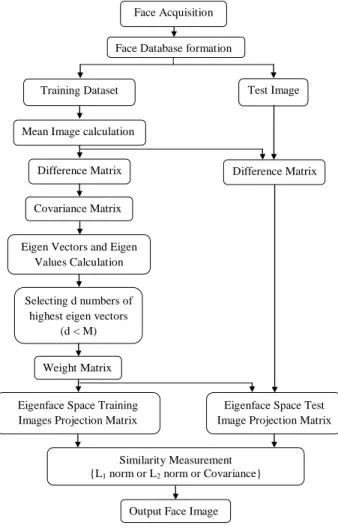
Principal Component Analysis- PCA reduces dimension of space by considering the variance of input data for representing the structure of the input data. Projected face space are chosen in such a way that the maximum amount of information is acquired in a small dimension of feature space. The data is projected to a subspace which is built by the eigenvector from the data. Basic flow chart of PCA is shown in figure 1.
Mean Image calculation Training Dataset
Face Database formation Face Acquisition
Difference Matrix
Eigen Vectors and Eigen Values Calculation
Selecting d numbers of highest eigen vectors
(d < M)
Weight Matrix Covariance Matrix
Eigenface Space Training Images Projection Matrix
Test Image
Output Face Image
Eigenface Space Test Image Projection Matrix
Similarity Measurement {L1 norm or L2 norm or Covariance}
Difference Matrix
Figure 1 Flowchart of Principal Component Analysis
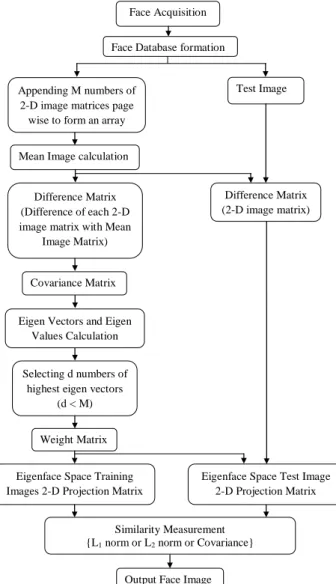
Two Dimensional Principal Component Analysis- Yang et. al. proposed 2DPCA for image based feature extraction. Figure 4.3 is giving flowchart of 2DPCA Based face recognition system. The main idea behind 2D PCA is that, it does not perform the matrix to vector operation, but directly process image matrixes. 2DPCA directly computes eigen vector of the image co-variance matrixes without matrix to vector covariance. It evaluates the image covariance matrix
Mean Image calculation Appending M numbers of
2-D image matrices page wise to form an array
Face Database formation Face Acquisition
Difference Matrix (Difference of each 2-D image matrix with Mean
Image Matrix)
Eigen Vectors and Eigen Values Calculation
Selecting d numbers of highest eigen vectors
(d < M)
Weight Matrix Covariance Matrix
Eigenface Space Training Images 2-D Projection Matrix
Test Image
Output Face Image
Difference Matrix (2-D image matrix)
Eigenface Space Test Image 2-D Projection Matrix
Similarity Measurement {L1 norm or L2 norm or Covariance}
Figure 2. Flowchart of Two Dimensional Face Recognition System
Rotated Two Dimensional Two Dimensional Principal Component Analysis- In R2DPCA, eigen features of the rotated images are obtained by looking for the maximum deviation of each image from the mean image. This variance is used for getting the eigenvectors of the covariance matrix of all the images. The eigenface space is obtained by applying the eigen face method to the training images, rotated in six different directions. Then all training images are projected into the eigenface space. Also test image is projected into this eigenface space and the distance of the projected test image to the training images is calculated to classify the test image. Figure 3 show the block diagram of Rotated Two Dimensional PCA.
Face Image under Test
Rotated Image under test Rotated By 0O Rotated By 10O Rotated By nO TanhEstimator Normalization Function Match Score for 0O Match Score for 10O Match Score for nO
Weighted Summation Based Score Fusion
Nearest Neighbor Classification Technique
Final Resultant Image
Figure 3. Block Diagram of Rotated 2Dimensional PCA Algorithm
IV. EXPERIMENTAL RESULTS
These algorithms are implemented over a 2.67 GHz PC with 3.2 GB RAM and software tool used is MATLAB version R2010a.
Face recognition system is applied with feature extraction techniques, Principal Component Analysis, Two Dimensional Principal Component Analysis and Rotated Two Dimensional Principal Component Analysis, for checking its performance in three databases.
By taking a test image as input to the face recognition system, it calculates image based features on eigen face space and hence the system compares this feature with features of all other images which were used for training of the system. Figure 4 is showing rotated facial images in six different angles which will be used to extract features. Fig. 5 is showing one such output.
Rotated By 0degrees Rotated By 10degrees Rotated By 20degrees
Rotated By 30degrees Rotated By 40degrees Rotated By 50degrees
Testing Image Result Image
Figure 5 Output of rotated 2DPCA on AR Face Database
A. RESULTS ON ORL FACE DATABASE
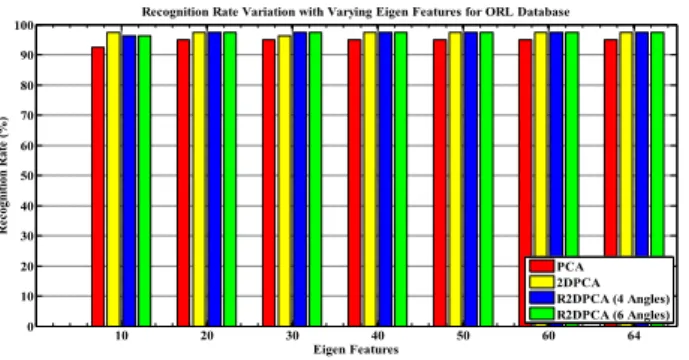
ORL database is providing 400 images of 40 persons which are divided into 320 images for training and 80 images for testing purpose. Graph in figure 6 is comparing recognition rates by PCA, 2DPCA & Rotated 2DPCA algorithms with varying eigen features from 1 to 64.
10 20 30 40 50 60 64 0 10 20 30 40 50 60 70 80 90 100 Eigen Features R ec ogn it ion R at e (%)
Recognition Rate Variation with Varying Eigen Features for ORL Database
PCA 2DPCA R2DPCA (4 Angles) R2DPCA (6 Angles)
Figure 6 Comparison of Recognition Rates in ORL Face Database with
varying eigen features
Best Recognition Rate obtained in PCA, 2DPCA, R2DPCA (4 angles), and R2DPCA (6 angles) are 96.25%, 97.5%, 97.5%, and 97.5% respectively
B. RESULTS ON AR FACE DATABASE
AR database is providing 2600 images of 100 persons which are divided into 1300 images for training and 1300 images for testing purpose. Graph in figure 7 is comparing recognition rates by PCA, 2DPCA & Rotated 2DPCA algorithms with varying eigen features from 1 to 64.
15 25 35 45 55 65 0 10 20 30 40 50 60 70 Eigen Features R ec og n it io n R at e (%)
Recognition Rate Variation with Varying Eigen Features for AR Database
PCA 2DPCA R2DPCA (4 Angles) R2DPCA (6 Angles)
Figure 7 Comparison of Recognition Rates in AR Face Database with varying
C. RESULTS ON FERET FACE DATABASE
FERET database is providing 1500 images of 300 persons which are divided into 900 images for training and 600 images for testing purpose. Graph in figure 8 is comparing recognition rates by PCA, 2DPCA & Rotated 2DPCA algorithms with varying eigen features from 1 to 64.
Highest recognition results in PCA, 2DPCA & R2DPCA (4 and 6 Direction) are 50.17%, 52.5%, 53.17% and 53.3% respectively. 15 25 35 45 55 64 0 10 20 30 40 50
60 Recognition Rate Comaprison with Varying Eigen Features for FERET Database
Eigen Features R ec og n it io n R at e (%) PCA 2DPCA R2DPCA (4 Angles) R2DPCA (6 Angles)
Figure 8 Comparison of Recognition Rates in FERET Face Database with
varying eigen features V. CONCLUSIONS
In this work, a face recognition system is designed in which principal component analysis, two dimensional principal component analysis and rotated two dimensional principal component analysis algorithms are implemented. Their results are compared with varying eigen features. Rotated 2DPCA is best for features extraction and gives more recognition rate than PCA and 2DPCA. On comparing with previous work of Zhu et. al.[11], recognition rate for AR database was 64.67% and in this work it is 69.15%. However for FERET database highest recognition rate achieved by Zhu et. al. [11] was 57.60% and in this work it is 53.3%.
REFERENCES
[1] Rama Chellappa, Charles L. Wilson and Saad Sirohey, ‘‘Human and
Machine Recognition of Face: A Survey’’, IEEE Proceeding, vol83, 5
May 1995.
[2] Anil K. Jain, Arun Ross and Salil Prabhakar,‘‘ An Introduction to Biometric Recognition’’, IEEE Transactions on Circuits and Systems for Video Technology, Special Issue on Image- and Video-Based Biometrics’’, Vol. 14, No. 1, January 2004.
[3] Lin Hong and Anil Jain,‘‘Integrating Faces and Fingerprints for Personal Identification’’, IEEE Transactions On Pattern Analysis And Machine Intelligence’’, Vol. 20, No. 12, December 1998.
[4] J. Coetzer, B. M. Herbst and J. A. du Preez,‘‘ Offline Signature
Verification Using the Discrete Radon Transform and a HiddenMarkovModel’’, EURASIP Journal on Applied Signal
Processing, Pg No. 559–571, 2004.
[5] Hasan Demirel and Gholamreza Anbarjafari,‘‘ Pose Invariant Face Recognition Using Probability Distribution Functions in Different Color Channels’’, IEEE Signal Processing Letters, VOL. 15, 2008.
[6] Yong Zhang, Christine McCullough , John R. Sullins and Christine R. Ross,‘‘ Hand-Drawn Face Sketch Recognition by Humans and a
[8] Patil A.M, Kolhe S.R and Patil P.M,‘‘ 2D Face Recognition Techniques:
A Survey’’, Bioinfo Publications, International Journal of Machine
Intelligence, ISSN: 0975–2927, Volume 2, Issue 1, 2010.
[9] M. Turk and A. Pentland,‘‘ Eigenfaces for Face Detection/Recognition’’, Journal of Cognitive Neuroscience, vol. 3, no.
1, pp. 71-86, 1991.
[10] Dong-Ju Kim, Sang-Heon Lee and Myoung-Kyu Sohn,‘‘ Face
Recognition via Local Directional Pattern’’, International Journal of
Security and Its Applications Vol. 7, No. 2, March, 2013.
[11] Qi Zhu and Yong Xu, ‘‘Multi-directional two-dimensional PCA with matching score level fusion for face recognition’’, Springer-Verlag London Limited 31 January 2012.
[12] Sang-Heon Lee, Dong-Ju Kim and Jin-Ho Cho,‘‘ Illumination-Robust
Face Recognition System Based on Differential Components’’, IEEE
Transactions on Consumer Electronics, Vol. 58, No. 3, August 2012.
Garima. received her BE degree in computer science & engineering from
PT.R.S.S.U Raipur in 2008 and pursuing Mtech in CSE from R.G.P.V,Bhopal, M.P. From 2013 to 2015.Her area of interest is image processing.she is having one international conference in her credit.
Sujit Tiwari recived her B.E. degree in Information Technology from
R.G.P.V.Bhopal,M.P. and Mtech in Computer Technology & application From R.G.P.V.Bhopal, M.P.His area of interest is web mining . He is having four international conference in his credit. He has organized four workshops.