Green and Healthy Building using High
Performance Concrete
Luma Ahmed Aday 1*, Ibtihaj A. Abdulrazzak 1 1 Al-Iraqia University/ Collage of Engineering / (Iraq) *Corresponding author E-mail: [email protected]
Abstract-- Many efforts present to improve the environmental friendliness of the concrete to make it suitable as a “Green Building” material. In this regard successful by using suitable substitutes of Portland cement, especially those are byproducts of industrial processes, like as rice husk ash, ground granulated blast furnace slag, fly ash and silica fume Known as sustainable materials.
This research presents different models of concrete and the equations required by the American standard code ACI 318-11 in calculating the deflection, modulus of rupture, moment and shear strength and comparison between results.
Index Term-- High Strength Concrete, Sustainable Materials, Green Building
1. INTRODUCTION
Green buildings sometimes called "sustainable buildings," are environmentally friendly buildings that have high efficiency in the use of natural resources throughout their life cycle. The word sustainability has become popular now for the proliferation of unsustainable construction methods that negatively affect the environment as a result of the emission large quantities of CO2 and for the future a better place for leave the world, we need to use natural resources at a rate that meets our needs and the needs of future generations [1].
There are main steps in designing sustainable buildings, including identifying "green" building materials from local sources, improving systems, reducing loadsو and generating renewable energy at the site. Also increases reliance on recycled materials. An effective recycling will reduce the demand for raw materials since aggregate constitutes the bulk of concrete.
supplementary cementitious materials is a sustainable materials produced by the industrial processes have a significant positive effect such as fly ash, rice husk ash, slag, silica fume and kaolin, That reduces the amount of CO2 generated and that the amount of embedded energy has a role in improving the environment [1, 2].
Mechanical properties are also enhanced. The increase in mechanical strength, similar properties, durability, and improved durability results in lower materials used.
2. CONCEPTS OF SUSTAINABILITY AND GREEN BUILDINGS
The new buildings are designed and implemented and their operation with advanced methods and techniques that contribute to reducing the environmental impact, while at the same time leading to reduction running costs, and maintenance, it also Contribute to providing a safe and comfortable urban environment. Thus, the motivation to embrace the concept of sustainability is the urban sector is no different from the motives which led to the emergence and adaptation concept of sustainable development economic and social dimensions [3].
Energy conservation.
Adaptation with climate.
Minimize the use of new resources.
Respect the site.
Respect for customers and users.
Comprehensive design.
The non-application of these concepts in the buildings leads to the appearance the sick buildings. This has three negative characteristics which are:
Drain energy and resources.
Pollution of environment.
Negative impact on the health of building users.
3. BUILDING MATERIALS SELECTION CRITERIA
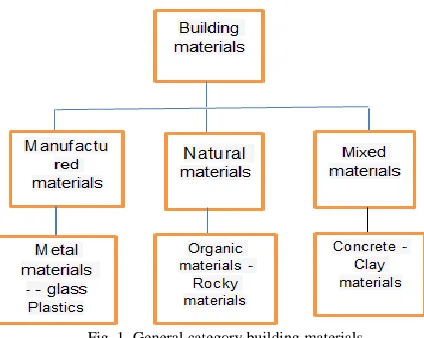
Construction materials are classified in general into three groups as in Fig. 1.
Manufactured materials.
Natural materials.
Mixed materials.
Fig. 1. General category building materials.
Foundations must be adopted when it’s choosing building materials to be more suitable for the green building [4].
Use materials available locally.
Natural suitability.
Climate suitability.
Sustainability.
se materials containing a high percentage of recycled
Avoid using substances that have environmentally harmful emissions.
4. EFFECT OF SUPPLEMENTARY CEMENTITIOUS MATERIALS ON GREEN CONCRETE
Supplementary cementitious materials are used to gain a better understanding of how the concrete can be contribute to sustainable construction; the green building movement in general and Leadership in Energy and Environmental Design (LEED) [4].
There are many types of cement, supplementary cementing materials, aggregate, and admixtures that can be incorporated in different quantities. By incorporating a higher quantity of supplementary cementing materials the amount of cement may be reduced, lowering the emissions and energy with a mix [3].
When we replacement of Portland cement by some other cementitious materials can be reduce considerably the environmental impact of the concrete production. Now, there are a number of such materials available [5].
4.1 Fly ash
Recently, the emphasis is on preserving the environment and your attention to large quantities of waste or industrial waste products. In the 1970s, the Environmental Protection Agency (EPA) imposed stricter emissions which controls on electricity manufactures, it’s started collecting more fly ash and increasingly began marketing its use [5]. When coal is burned to generate heat, the combustion residues contain
20% of the remaining ash in the bottom and 80% of the fly ash.
The use of fly ash for concrete instead of Portland concrete cement will not only provide significant savings in cement and energy consumption, but also economically. Use fly ash in concrete for optimal ratio improves concrete performance in both cases, fresh and hardened; it increases the workability of the fresh concrete, and increases the resistance and durability of hardened concrete [4].
4.2 Granulated Blast-furnace slag
Slag is the product of the iron industry. The amount of slag produced during the industry is estimated to be the same as the amount of iron produced. Slag is composed of lime, silica and alumina, which is the same as the components of cement but differs in composition ratio.
The Ground-Granulated Blast Slag (GGBS) are used with different substitution ratios to improve workability of fresh concrete, used to increase the strength of concrete and reduce water demand, shrinkage and permeability of the finished product [3, 5].
As Ground-Granulated Blast-Furnace Slag (GGBFS or GGBS) is a lower carbon building material, and considerably more environmentally friendly. The reduction of in greenhouse gas emission can be utilized as high as 45%, depending on the mix and application. GGBFS has less embodied carbon, which allowing meeting increasingly tough sustainability requirements. It's the product that needed to improve the built environment [4].
4.3 Rice Husk Ash (RHA)
RHA is obtained by burning rice husk by controlled manner without causing environmental pollution. It is a by-product of agricultural industry. The use of this by product is an environmentally friendly way of elimination of large quantities of material [4].
It is well known that concrete containing to rice husk ash has gained spreading in the construction industry due to its easiness in construction, its acceptable performance in strength requirements and better durability in normal environment.
RHA play a role in lowering the cost of materials and emission of CO2 due to less cement usage a way to utilize, these by-products to make a new product is the best sustainable idea to reuse this product, concrete manufacturing industries, and cement are the ones who can use rice husk in a better way [3].
4.4 Silica Fume
Silica Fume interacts with calcium hydroxide, forming calcium silicate hydrate, which dissolves to reduce internal cavities and pores in concrete. Silica fume is added to concrete to improve durability or to increase compressive strength and enhances durability by decreasing the permeability of concrete. In addition, it enhances the freeze-thaw durability, the abrasion resistance, the bond strength with steel rebar's, the chemical attack resistance, the vibration damping capacity and the corrosion resistance of reinforcing steel [6].
4.5 Concrete
Concrete is a semi-brittle material and its behavior in tension is different from its behavior in compression. Fig. 2 illustrates the typical stress curve of concrete. In compression the stress strain of concrete semi-linear flexibility, is approximately 30% of maximum compressive strength. In the tensile be curved stress-strain of concrete is linearly flexible until maximum tensile strength [7]. Then concrete cracks and resistance gradually decreases to zero. High-strength concrete behaves more linearly than low-strength concrete at stress level. But show a more brittle behavior in the second part of the stress-strain curve after compressive strength Maximum.
Fig. 2. Curved (stress stress) typical for compression and tensile strength in concrete [7].
5. ANALYTICAL CALCULATION
The materials [8-10] are used in this work of experimental program as the followings: An analytical calculation of deflection of seven models concrete beams was conducted according to the ACI 318 -11, under the load conditions shown in Fig. 3.
Fig. 3.Load condition for beams.
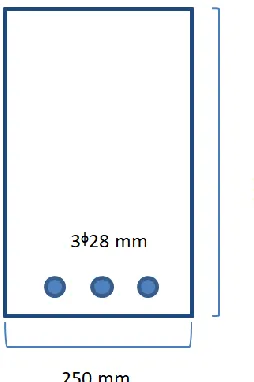
The properties of used Sustainable Materials, as well as geometry characteristics and load condition, dead load 15 KN/m and live load 10 KN/m for beams. The cross section of the beams are shown in Fig. 4, within the context of the present study is seen the clarification of the relationships and characteristics of the materials constituting the concrete thresholds.
The results of deflection of the concrete beam were compared between ordinary concrete with compression strength 27Mpa and concrete containing sustainable materials. The materials that were used are silica fume (SF), steel slag coarse aggregate (SSCA); waste perlite powder (WPP), waste fly ash (WFA) and Metakaolin (MK). The properties of the concrete are shown in Table 1.
Table I
Material properties of beams.
Young's Modulus of Concrete Ec 24855 Mpa
Young's Modulus of Concrete with silica fum Ec
37100. Mpa
Young's Modulus of Concrete with 20% SF+33% steel slag coarse aggregate(SSCA) Ec 39600 Mpa
Young's Modulus of Concrete with 20% SF+100 % steel slag coarse aggregate(SSCA) Ec 36800 Mpa
Young's Modulus of Concrete with 15% waste fly ash (WFA) Ec 37000 Mpa
Young's Modulus of Concrete with 15% waste perlite powder (WPP) Ec 40000 Mpa
Young's Modulus of Concrete with Metakaolin (MK) Ec 56210 Mpa
Compressive Strength of Concrete fˋc = 27 Mpa
Compressive Strength of Concrete with silica fum fˋc
= 80.8 Mpa
Compressive Strength of Concrete with 20 SF+33% steel slag coarse aggregate(SSCA) fˋc =82 Mpa
Compressive Strength of Concrete with 20 SF+100% steel slag coarse aggregate(SSCA) fˋc =76 Mpa
Compressive Strength of Concrete with 15% waste fly ash (WFA) fˋc = 76 Mpa
Compressive Strength of Concrete with waste perlite powder 15% (WPP) fˋc = 80 Mpa
Compressive Strength of Concrete with Metakaolin (MK) fˋc = 72 Mpa
6. CALCULATION OF DEFLECTION ACCORDING TO ACI 318 -11
ACI318-11 requires that the immediate deflection be calculated by elastic analysis using an effective moment of inertia (Ie) not greater than (Ig) [11,12]. For the uncracked
rectangular beam shown in Fig 5.
Fig. 5. Uncracked rectangular beam [13].
The effective moment of inertia of simple beams, cantilevers and continuous beams between inflection points are given by; and as shown Fig. 5.
𝐼𝑒= (𝑀𝑐𝑟 𝑀𝑎)
3
𝐼𝑔 +(1− (𝑀𝑐𝑟 𝑀𝑎)
3
𝐼𝑐𝑟 ≤ 𝐼𝑔 …………(1)
Where,
𝑀𝑐𝑟= 𝑓𝑟 𝐼𝑔
𝑌𝑡 .……….……… (2)
Mcris the cracking moment.
Mais the maximum moment member for the stage deflection
is calculatedas follows:
(𝑊𝐿2
8 ) ………..……….………(3)
𝑓𝑟 is modulus of rupture s calculatedas follows:
0.62√𝑓𝑐 ……….……… (4)
yt= the maximum distance from the tension side to the
neutral axis.
Ig is the moment of inertia of concrete; the gross moment of
inertia is used;
(𝑏ℎ3
12) … … … .. (5)
Icris the moment of inertia of cracked section; is computed
in the following method:
𝐼𝑐𝑟= 𝑏(𝑘𝑑3)
3 +𝑛 𝐴𝑠 (𝑑−𝑘𝑑)2
…………......….(6)
Find " kd " ues
𝐵 = 𝑏
𝑛𝐴𝑆 …………... . . ...….(7)
𝑘𝑑 = √2𝐵𝑑+1−1
𝐵 ………….……….. … (8)
Fig. 6. The moment of inertia of a cracked beam with tension reinforcement (Icr).
The initial deflection (Δi ) for simple and cantilevers and continuous beams may be computed using the equation given below, the mid-span deflection may usually be utilized as an approximation for the maximum deflection,
∆𝑖= 384 𝐸5𝑤𝑙4
𝐸 = 4700√𝑓𝑐 . . ……….. . . (10)
7. ACI SHEAR STRENGTH [11]
Shear strength of concrete 𝑉𝐶is estimated by loading a plain concrete beam to failure. Shear strength are computed by the following equation:
𝑉𝐶 = 1
6√𝑓𝑐 𝑏𝑤𝑑 . . ………. . . .(11)
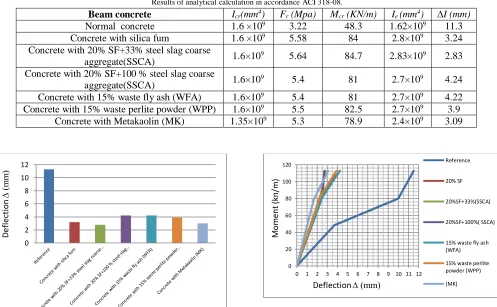
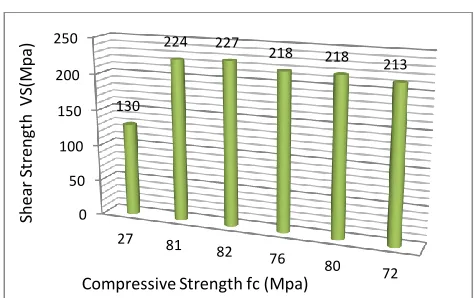
The results of the analytical calculation, as well as the load impact on beam deflection, and shear strength are shown in Table 2 and Figs. 7-10 .
This study investigated the effect of using sustainable materials instead of cement in improving cement properties. Laboratory experiments were used from the previous research using the results of Flexural strength, compression strength and Modulus of Elasticity in the analysis of beam concrete. .
The results of the Analytical calculation note the effect of the use of sustainable materials in reducing the deflection, and enhancement the shear strength which contributes economically to the design of concrete mixtures.
Table II
Results of analytical calculation in accordance ACI 318-08.
∆I (mm)
Ie (mm4)
Mcr (KN/m)
Fr (Mpa)
Icr(mm4)
Beam concrete
11.3 1.62×10⁹
48.3 3.22
1.6 ×10⁹ Normal concrete
3.24 2.8×10⁹
84 5.58
1.6 ×10⁹ Concrete with silica fum
2.83 2.83×10⁹
84.7 5.64
1.6×10⁹ Concrete with 20% SF+33% steel slag coarse
aggregate(SSCA)
4.24 2.7×10⁹
81 5.4
1.6×10⁹ Concrete with 20% SF+100 % steel slag coarse
aggregate(SSCA)
4.22 2.7×10⁹
81 5.4
1.6×10⁹ Concrete with 15% waste fly ash (WFA)
3.9 2.7×10⁹
82.5 5.5
1.6×10⁹ Concrete with 15% waste perlite powder (WPP)
3.09 2.4×10⁹
78.9 5.3
1.35×10⁹ Concrete with Metakaolin (MK)
Fig. 7. Graphical representation of the analytical results for deflection.
Fig. 8. Bending moment - deflection diagrams for beams with Sustainable Materials.
0 2 4 6 8 10 12
D
ef
lect
ion
∆
(
m
m
)
0 20 40 60 80 100 120
0 1 2 3 4 5 6 7 8 9 10 11 12
M
om
en
t
(k
n/
m
)
Deflection ∆ (mm)
Reference
20% SF
20%SF+33%(SSCA)
20%SF+100%( SSCA)
Fig. 9. Normalized value of deflection and modulus of rupture for Sustainable Materials.
Fig. 10. Histogram representation of the analytical results for shear strength.
8. CONCLUSIONS
The major objective of this paper is to find out how the analytically obtained results according to ACI 318-08. In this research an analytical calculation of the deflection, shear strength and know the effect cracking moment and modulus of rupture for Sustainable Materials concrete beams according to ACI 318-11. This showed significant improvement in properties and enhancement of shear strength by 73%.
The results of the analysis note that the effect of the use of sustainable materials in reducing the deflection, which contributes economically to the design of concrete mixtures, adding to being environmentally friendly materials.
ACKNOWLEDGEMENTS
We would like to present many thanks of gratitude to colleagues who helped to complete this project within the
limited time. The authors declare that they have no conflict of interest.
REFERENCES
[1] C. Meyer, "Concrete as a Green Building Material",
Columbia University, New York, NY 10027, USA. [2] Tarun R. Naik, (2002), "Greener Concrete Using Recycaled
Materials", Concrete International.
[3] Per Jahren and Tongbo Sui, (2013), "Concrete and Sustainability", CRC Press, Taylor & Francis Groups, 1st Edition.
[4] Gajanan M. Sabnis, (2012), "Green Building with Concrete", Sustainable Design and Construction, CRC Pres Taylor & Francis Groups.
[5] M L Gambhir, (2004),"Concrete Technology", Civil Engineering Series, Third Edition, PP. 41- 116, the McGraw-Hill Education.
[6] ACI Committee 234, "Guide for the Use of Silica Fume in
Concrete", Reported ACI 234R-96 American Concrete
Institute.
[7] M. Bangash, (1989), "Concrete and Concrete Structures: Numerical Modeling and Applications", Elsevier Applied Science.
[8] Mohammed Abed and Rita Nemes, (2019),"Mechanical Properties of Recycled Aggregate Self-Compacting High Strength Concrete Utilizing Waste Fly Ash, Cellular Concrete and Perlite Powders", Periodical Polytechnica Civil Engineering, 63(1), 266–277.
[9] Mohamed Ahmed Khafaga, Walid Safwat Fahmy, Mohamed Amen Sherif and Asmaa Mohamed Nageib Abdel Hamid, (2014), "Properties of High Strength Concrete Containing Electric Arc Furnace Steel Slag Aggregate", Journal of Engineering Sciences Assiut University Faculty of Engineering, 42(3), 582–608.
[10] Luma Ahmed Aday, (2018)," Effects of Reactivity
Metakaolin on Properties of High Strength Concrete",
International Journal of Engineering & Technology, 7(4), 2132-2136.
[11] ACI Committee 318, "(2011), "Buildings Code Requirement
for Structural Concrete (ACI 318-2011)", American Concrete
institute, Detroit, U.S.A.
[12] Jack C. McCormac and Russell H. Brown, (©2014), "Design of Reinforced Concrete", 9th Edition, , John Wiley & Sons. [13] Ramchandra V. Gehlot, (2018), "Limit State Design of
Concrete Structures", 3rd edition, Scientific publishers (India).
0 1 2 3 4 5 6
11.3 3.28 3.8 4.2 4.2 3.9 3
M
odul
us
of
r
upt
ur
e
fr
(M
pa
)
Deflection ∆(mm)
0 50 100 150 200 250
27 81
82 76
80 72
130
224 227
218 218
213
She
ar
S
tr
en
gt
h
V
S(
M
pa
)
![Fig. 5. Uncracked rectangular beam [13].](https://thumb-us.123doks.com/thumbv2/123dok_us/1349534.1643380/4.612.68.250.528.688/fig-uncracked-rectangular-beam.webp)