DEVELOPMENT AND VALIDATION OF ORGANISMAL CLASSIFICATION
ACHIEVEMENT TEST (OCAT): BASIS FOR IMPLEMENTATION AND
STANDARDIZATION FOR TEST CONSTRUCTION IN JUNIOR SCIENCE
HIGH SCHOOL
Berame, J.S.[1][2],Lawsin, N.L.P[1], Gacosta, H.[1][3], Yadao, M.[1][4]Orleans, A.V.[1][5] [1]
Navotas Polytechnic, Manila, Philippines [2]
Caraga State University, Butuan City, Philippines [3]
Mayamot National High School, Manila, Philippines [4]
University of San Jose-Recoletos, Cebu City, Philippines [5]
Philippine Normal University-Manila, Philippines
Abstract
This study aimed to develop, validate and administer an achievement test in organismal classification for grade 8 junior high school. In the development stage, the researchers followed the topics in the Philippine K to 12 curriculum guide for grade 8 science focused on taxonomy and systematics and these were the basis for the development of the achievement test. The developed Organismal Classification Achievement Test (OCAT) was validated by content experts in biology. The initial version of the instrument is 60-item test which was administered to grade 8 high school students. Reliability coefficient, (KR20), difficulty index and discrimination index were used to select which items were retained, revised or rejected. Result of pilot-testing retained 40 items in which 19 items were described as average to excellent items (x > 0.20) while 21 questions were described as items subject for revision (between 0.10 and 0.20) in terms of discrimination index.
Taxonomy and systematics are the branches of biology that deals with naming and classification of organisms based on their phylogenetic relationship. Rules and principles in naming and classifying organisms make these branches difficult to learn. NERC (2015) revealed that taxonomy is less important in many of the sciences in the country. Recently, taxonomic research may have seemed less difficult, involving a more degree of bias, encountered in other biological sciences taught in the school. Gershenson and Stauffer (2014) found out that both areas acquired the least attention inside the classroom taken by teachers who recognized low level of importance to fieldwork. These areas, handled by novice or uninterested biology teachers, had least self-confidence and this activity received the least importance as a result.
Wilson (2014), as cited by Lawsin & Garcia (2017), posited that taxonomy is one of the competencies in biology with numerous misconceptions and low conceptual understanding as perceived by in-service biology teachers. Related problems also exist in same education levels. There is a tough form of view in junior high school education that promotes the escaping of taxonomy and systematics as subjects, yet compulsory among the students (Godfray, 2014). This this approach seems questionable set the natural inquisitiveness of students that most science teachers now agree that some basic training in taxonomy,by the matured secondary students at least (Ostergaard, 2015).
Meanwhile, adoption of the K to 12 science curriculum re-introduces the teaching of taxonomy, or identification methods at least, into many classrooms in the school. However, these competencies are supposedly discussed in the last quarter of the school year making it difficult to be taught due to possible lack of instructional time allotment for the school year in the event of emerging special holidays or unforseen “no class” periods. Therefore, assessing the content of the students’ achievement always suffers.
In addition, there are two main categories which teachers need to consider to these existing problems in the school. First, the main concern is the traditional approach to the teaching used of systematics and identification. Much emphasis is being put on achieving the names, instead of giving thought to the aims or objectives, principles, and methods include (Stacey, 2014; Tilling, 2016). The teaching method of taxonomy should not involve rote learning as long lists of names and taxonomically significant structures, yet an overdependence on rote learning. Second, there is lack of insufficient resource materials for students and teachers. Much dependence is placed on poorly designed or inappropriate resource materials and there is a need for a comprehensive range of instructional materials (Wheeler, 2015).
With this, the researchers, being the science teacher themselves, were motivated to develop a validated achievement test in organismal classification focusing on Philippine biodiversity suited for the Grade 8 high school students to help assess their OCAT deficiencies.
Methodology
Research design
Research instruments
Organismal Classification Achievement Test (OCAT) was the primary instrument in this study. Comments and suggestions of the content-validators were immediately written on this instrument and were used to further improve the content of this instrument.
Sampling and participants
This study used two groups of participants. The first group is composed of 3 content-expert validators. They are all doctorate biology students who are teaching biology subjects in junior high school or tertiary education. The second group is composed of 100 students from the DepEd high school of Rizal province. The 100 students were all from two heterogeneous classes of the school. There were 66 males and 34 females in this set of sample. They were evaluated after three weeks of implementing the organismal topics in the classroom.
Research procedure
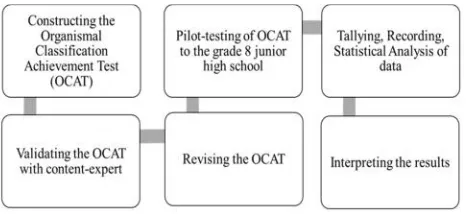
Input-Process-Output (IPO) Model served as the guide in the development of this achievement test. Figure 1 shows the flowchart of the procedure in this study.
Fig. 1. Flowchart of the study
The analysis of the content from the curriculum guide in science was served as the basis in the development of the Table of Specification (TOS) and OCAT. The number of hours in teaching the competency was considered. After the development of the OCAT, it underwent content validation of the 3 biology experts. Comments and suggestions were gathered and followed in revising the OCAT. The instrument has 50-item test prior to the pilot-testing. The validated OCAT was administered to the 100 junior high school students. Students’ responses were checked, tallied and subjected to item analysis. After analysing which items to be retained, revised and/or disposed, the table of specifications (TOS) OCAT and answer sheets were finalized through removing the items that were not passed the criteria in distractor analysis.
Quantitative Evaluation and Statistical Treatment
This study used only descriptive statistics derived from the pilot-testing and these are as follows:
Reliability Coefficient (KR20) Test reliability is an indication of the consistency of the test construction. Upper test reliability indicates that the test measures whatsoever it measures in a consistent way.
Difficulty Index, d. is a measure of the proportion of respondent who respond to an item correctly.
Discrimination index. This shows the extent to which an item has discriminated amongst the high scorers and low scorers on the test.
Item analysis. It is used to assess which test items to be rejected, revised or retained in order to improve the reliability of the instrument.
After the test was administered to 100 Grade 8 biology student-respondents, the item analysis of the test construction was carried out in calculating the difficulty and discrimination indices for each test items, validity and reliability survey of the test was done. Inappropriate questions were omitted, KR-20 reliability coefficient was calculated until the test achieved its final form.
The test items in the study were evaluated based on its difficulty levels (Kelley, 2001) provided in Table 1 and discrimination power by Ebel and Frisbie (2012) provided in Table 1.
Table 1: Difficulty Index (p)
Difficulty Index (p) Interpretation
0.75-1.0 Easy
0.25-0.75 Average
0.25 or below Hard
Ebel and Frisbie (2012) gave the subsequent rules for determining the quality of the item constructed in the test in terms of the discrimination index (d). Table 2 presents the d values and their corresponding interpretation.
Table 2: Discrimination Index (d)
Range Remarks Recommendations
> 0.39 0.30 - 0.39
0.20-29 0.00-0.19
Excellent Good
Average Poor
Preserve
Possibilities for enhancement Need to review/verify Reject of review in-depth (Items having good difficulty value but discrimination index up to 0.10 is considered for
revision and finally included in the test)
Findings
Development and validation results
Content experts gave comments and suggestions to improve the quality of OCAT as an assessment tool in systematics-taxonomy, the summary of their comments and suggestions are enumerated below: (1) use contextualized examples of organisms that can be found in the Philippines;
(2) rephrase some items and apply the knowledge in situation cases so students will gain more knowledge as their read the content of the test item;
(3) give more descriptions on words that are highly technical; (4) fuse some items that measure almost the same competencies;
(5) alphabetized the options and/or arrange them in increasing and decreasing order; and, (6) remove repetitive words in the choices;
Item Analysis
After the administration of the OCAT to the intended respondents, the answer sheets were checked. Each students’ letter answers were recorded per test item. The scores were ranked from highest to lowest scores where the upper and lower 27 scores were separated for item analysis. In each item, the frequency of correct scores for upper 27 and lower 27 were recorded as basis for computing the item difficulty and item discrimination indices computed as follows:
difficulty index, p = Ru +RL 54
discrimination index, d = Ru - RL 27
All the calculations were done with the use of MS Excel 2010, i.e., the descriptive statistics and the item analysis. The result of the item analysis together with the recommended action is presented in Table 3.
Test Reliability
As an important element of a constructed test, the test of reliability was calculated using Kuder-Richardson formula 20 (KR-20). The resulting reliability coefficient marked 0.725 for the 60-item test. Table 4 shows the descriptive statistics for the developed test questionnaire.
Table 4. Descriptive values of the data
Descriptive Values
Number of Items 60
Sample size 100
Sample Mean 29.02
Discussion
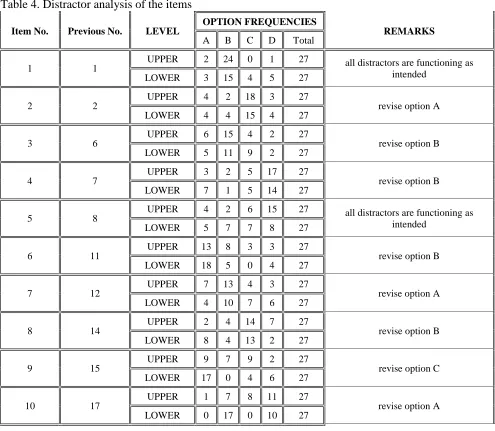
Table 4 shows the distractor analysis with suggestions on revision in particular choice of answer. The table contains the previous item number and newly designated item. Distractor analyses considered the upper and lower 27% of the respondents and tallied their responses per item in order to determine which items need to be retained, revised or disposed.
Based on the results (see table 4), the following 40 test items were retained and/or revised from the original OCAT, #1, 2, 6, 7, 8, 11, 12, 14, 15, 17, 20, 21, 22, 23, 24, 25, 26, 27, 28, 29, 30, 31, 32, 34, 36, 37, 39, 40, 42, 43, 44, 45, 46, 50, 51, 53, 54, 56, 58, and 59. Initially, there were 9 items that are functioning as intended in such a way that they can completely distract or discriminate several items while there are 31 items which required revisions of one option. Revising the option per item was required because those 31 items had good difficulty index yet the discrimination index for the two options was not fully discriminated by the upper and lower 27% of the population.
Table 4. Distractor analysis of the items
Item No. Previous No. LEVEL
OPTION FREQUENCIES
REMARKS
A B C D Total
1 1
UPPER 2 24 0 1 27 all distractors are functioning as
intended
LOWER 3 15 4 5 27
2 2
UPPER 4 2 18 3 27
revise option A
LOWER 4 4 15 4 27
3 6
UPPER 6 15 4 2 27
revise option B
LOWER 5 11 9 2 27
4 7
UPPER 3 2 5 17 27
revise option B
LOWER 7 1 5 14 27
5 8
UPPER 4 2 6 15 27 all distractors are functioning as
intended
LOWER 5 7 7 8 27
6 11
UPPER 13 8 3 3 27
revise option B
LOWER 18 5 0 4 27
7 12
UPPER 7 13 4 3 27
revise option A
LOWER 4 10 7 6 27
8 14
UPPER 2 4 14 7 27
revise option B
LOWER 8 4 13 2 27
9 15
UPPER 9 7 9 2 27
revise option C
LOWER 17 0 4 6 27
10 17
UPPER 1 7 8 11 27
revise option A
11 20
UPPER 4 1 3 19 27
revise option C
LOWER 7 5 0 15 27
12 21
UPPER 5 0 22 0 27
revise option D
LOWER 9 2 16 0 27
13 22
UPPER 21 3 3 0 27
revise option D
LOWER 11 8 8 0 27
14 23
UPPER 3 1 17 6 27
revise option C
LOWER 6 0 14 7 27
15 24
UPPER 4 2 5 16 27
revise option B
LOWER 8 2 4 13 27
16 25
UPPER 3 0 23 1 27 all distractors are functioning as
intended
LOWER 4 10 8 5 27
17 26
UPPER 25 2 0 0 27
revise option C
LOWER 19 6 0 2 27
18 27
UPPER 1 7 17 2 27
revise option A
LOWER 1 4 20 2 27
19 28
UPPER 1 5 7 14 27
revise option B
LOWER 4 4 3 16 27
20 29
UPPER 5 9 6 7 27
revise option C
LOWER 2 10 5 10 27
21 30
UPPER 4 22 1 0 27
revise option D
LOWER 8 17 2 0 27
22 31
UPPER 3 4 18 2 27
revise option D
LOWER 6 8 11 2 27
23 32
UPPER 20 2 0 5 27
revise option B
LOWER 17 2 2 6 27
24 34
UPPER 1 0 6 20 27
revise option C
LOWER 6 6 2 13 27
25 36
UPPER 10 0 5 12 27
revise option A
LOWER 1 3 2 21 27
26 37
UPPER 8 4 11 4 27
revise option B
LOWER 13 3 8 3 27
27 39
UPPER 0 20 3 4 27 all distractors are functioning as
intended
28 40 all distractors are functioning as intended
LOWER 9 4 6 8 27
29 42
UPPER 20 2 5 0 27
revise option C
LOWER 17 4 3 3 27
30 43
UPPER 25 1 0 1 27 all distractors are functioning as
intended
LOWER 18 2 2 5 27
31 44
UPPER 4 0 23 0 27 all distractors are functioning as
intended
LOWER 8 4 14 1 27
32 45
UPPER 2 6 3 16 27
revise option B
LOWER 8 4 4 11 27
33 46
UPPER 4 20 3 0 27
revise option C
LOWER 7 14 2 4 27
34 50
UPPER 7 0 0 20 27
revise option A
LOWER 4 9 14 0 27
35 51
UPPER 2 20 1 4 27
revise option B
LOWER 3 15 5 4 27
36 53
UPPER 5 0 2 20 27
revise option B
LOWER 16 0 0 11 27
37 54
UPPER 8 11 2 6 27
revise option A
LOWER 6 17 4 0 27
38 56
UPPER 4 0 20 3 27
revise option A
LOWER 4 0 8 15 27
39 58
UPPER 4 0 20 3 27 all distractors are functioning as
intended
LOWER 7 3 12 5 27
40 59
UPPER 9 2 2 14 27
revise option B
LOWER 16 1 0 10 27
Conclusion
Recommendations
The researchers highly recommend other science teachers to re-validate this instrument to other sample of the students in order to further increase and establish its validity and reliability as an developing and validating OCAT assessment tool in taxonomy and/or systematics.
Lastly, developing OCAT instrument will become more reliable and standardize to re-consult the K to 12 science curriculum makers and biology teachers to become more suitable for science high school students.
Acknowledgment
The researchers express their appreciation to the principal, faculty, and student participants in Rizal Province for their active participation in contributing to this research paper.
Declaration
The researchers declare that all works are authentic and this research paper has not been published in any journals.
References
DOST-SEI Science Framework for Philippines Basic Education. 2012
Ebel, R. L. & Frisbie, D. A. (2012). Essentials of education measurement. Englewood Cliffs, NJ: Prentice Hall.
Gershenson, J. & Stauffer, L. (2014). The role of taxonomy in ecological research. Norwell, MA: Kluwer Academic Publishers.
Godfray, H. (2014). Taxonomy as information science. Proceedings of the California Academy of Science 56 (Suppl. I): 170–181.
Işman, A., & Eskicumalı, A. (2003). Eğitimde Planlama ve Değerlendirme. İstanbul: Değişim Yayınları.
Kelley, T. L. (2001). The selection of upper and lower groups for the validation of test items. Journal of Educational Psychology, 30, 17-24.
Lawsin, N.L. & Garcia. G. (2017). Development of digital courseware in transmission genetics. PNU-Manila. Unpublished Master’s Thesis
NERC, (2015). Improving human performance on Grid A conference on improving students performance and increasing reliability. Retrieved on April 10, 2019 from https://www.nerc. com/pa/rrm/hp/2012%20students%20PerConference/Speaker_Bios_2012.pdf
biology. Cambridge, UK: Cambridge University Press.
Tilling, S. (2016). Education and taxonomy: the role of the Field Studies Council and AIDGAP. Leonard Wills Field Centre, Nettlecornbe, Williton, Taunton TA4 4HT.
Wheeler, D. (2015). The new taxonomy. The Systematics Association special volumes series; 76. Boca Raton, FL: CRC Press.