Copyright © 1988, American Society for Microbiology
Specific Interaction between Coronavirus Leader RNA and
Nucleocapsid Protein
STEPHEN A. STOHLMAN,l2* RALPH S. BARIC,3 GARY N. NELSON,2 LISA H. SOE,2 LISA M. WELTER,
ANDROBERT J. DEANS2
Departments of Neurology' and Microbiology,2 University of Southern California School of Medicine, LosAngeles, California 90033, and the Departmentof Parasitology and Laboratory Practice, University of North Carolina School of
Public Health, Chapel Hill, North Carolina 275143 Received 28 April 1988/Accepted 1 August 1988
Northwesternblotanalysisinthepresenceof competitor RNAwasusedtoexamine the interaction between themousehepatitis virus(MHV) nucleocapsid protein (N) and virus-specific RNAs. Our accompanying article demonstrates thatanti-Nmonoclonal antibodies immunoprecipitated allsevenMHV-specific RNAsaswellas
the small leader-containing RNAsfrom infectedcells. Inthis article we reportthata Northwestern blotting
protocol usingradiolabeledviral RNAs in thepresenceof host cell competitor RNAcanbe usedtodemonstrate
a high-affinity interaction between the MHV N protein and the virus-specific RNAs. Further, RNA probes prepared by in vitro transcription were used to define the sequences that participate in such high-affinity binding. A specific interaction occurs betweenthe N protein andsequences contained with the leaderRNA which isconserved atthe5' end ofall MHV RNAs. We havefurther definedthe binding sitestothe areaof nucleotides 56to65atthe3' endofthe leader RNA andsuggestthat this interactionmayplay animportant
rolein the discontinuous nonprocessive RNA transcriptional processuniquetocoronaviruses.
The murine coronavirus mouse hepatitis virus (MHV)
containsasingle-stranded positive-polarity RNAof
approx-imately 6 x
106
daltons (20). This RNA interacts with the 60,000-dalton nucleocapsid (N) protein to form a helical nucleocapsid structure (34). The MHV envelope contains two virus-specified envelope glycoproteins, designated Eland E2, whichare acquired during maturation at intracyto-plasmic membranes (34). E2 is a 180,000-dalton N-linked
glycoprotein whichmediates cell-cell fusion and is the site of
neutralizing-antibody attachment (13, 15, 35). El is an
0-linked matrixglycoprotein of 23,000 daltons that is believed tointeract with N in the formation of virions (34, 35).
Genomic-length mRNAand six subgenomic mRNAs are transcribed from a full-length negative-stranded template (19, 31). These intracellular mRNAs are both capped and
polyadenylatedandarearranged intheformofanested-set arrayfromthe3' endof the genome,i.e.,they havecommon 3' termini and extendforvarious lengths in the 5' direction (18, 31). Inaddition, eachvirus-specific mRNAcontainsan
identicalleader sequenceapproximately 72nucleotides long
which is derived from the 5' end of genomic RNA (17, 18).
After synthesis, the leader RNA disassociates from the
negative-stranded templateand rebindsattheinitiationsites
foreach of the sixsubgenomic mRNAs, therebyservingas a
primer for transcription(6,8, 22). Transcription ofthe MHV mRNAs is discontinuous, and pausing occurs in AU-rich regions orregions of secondary structure (6). This leads to the generation of discrete small leader-containing RNAs which are present both as nascent plus-strands on the replicative intermediate (RI) RNA and as free molecules
dissociatedfrom thetranscript complex. RNA species
orig-inateduring synthesis of the individual genes, with3' termi-nationcorresponding to regions of the RNA with secondary structure or AU-rich regions (6). These discrete functional intermediate RNAs probably also function intrans as inter-mediates ofRNA-RNArecombination (22).
* Correspondingauthor.
In the accompanying article we have shown that MHV virion RNA as well as all seven intracellular RNAs are
complexed with the N protein (5). Immunoprecipitation of thesmallleader-containingRNAspecies frominfected cells demonstrated that the leader RNA sequencesweresufficient
to bind the N protein. Our inability to demonstrate N
complexedtoleader RNAsofless than 57nucleotides along
with its presence on RNAs of greater than 65 nucleotides
suggested that eitherthe N-RNAbinding sitewas encoded within this 10-nucleotide stretch or there was a minimum-size constraint on the N-RNA interaction. Inaddition, the datasuggestedthat N proteinisassociatedwith the RI RNA
complexin infected cells. This may be duetothe presenceof N proteinassociated with the leader RNA sequencesat the 5' end of the nascent strands; however, we could not determine whether N bound the negative-stranded RNA
directlyvia antisense leader RNA sequences. In this report, we describe the use of competitor RNA in a Northwestern blot analysis to identify high-affinity RNA-protein interac-tions and presentadditional evidence forthespecificityof N
binding to the leader segment of MHV RNA. Previous studies using this assay in the absenceofcompetitorRNA were unable to detect sequence-specific binding of the N
protein (26). This assay was used to
distinguish
betweenbinding to the positive- and negative-stranded RNAs and provides additional evidence which suggests thatN protein
bindstoleaderRNAbetween nucleotides 56 and 65 from the 5' end of all the MHV mRNAs.
MATERIALS AND METHODS
Virus and cells.The studies described used the A59strain ofMHV.Viruswaspropagatedin the DBTmurine astrocy-tomacell lineorL2cellsaspreviouslydescribed(20). Cells weregrown in 150-or100-mm-diameterpetriplates (Becton Dickinson Labware, Oxnard, Calif.) and infected at a
mul-tiplicityofinfection of1 to5. Forexperiments using
32p;
to radiolabel MHV-specific mRNAs, infected cells were treated with 2Rg
ofactinomycin D per ml at 2.5 hGENOMIC RNA
5'.- A B C D E F Go 3
5'm_- P*3' 2kb
5' - F82P (nucleotides 5-1149)
5' * n - F82D (nucleotides 56-1149)
5' F82N (nucleotides 187-1989)
L Gene F G
- El -L (nucleotides 1-90)
E1-500 (nucleotides 90-609)
C) a XXC]
L LEADER E1-L
_- -4- (90 nucleotides)
1-(--'-*(56nucleotides) '""'(24 nucleotides)
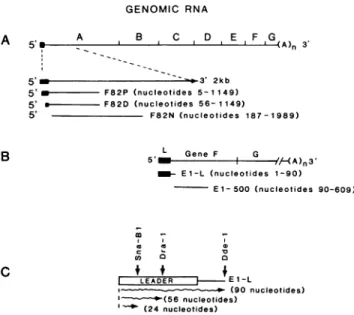
FIG. 1. Structure of the MHV cDNA probes used for
North-westernblotexperiments. (A) Clone pF82P contains nucleotides 5
through1149derived from the 5' end of thegenome. Clone F82Dis
derived fromF82P and contains nucleotides 56through 1149from the5'end ofthegenome.Clone F82N is derived from cDNA clone
F82 andcontainsnucleotides 187 through 1989 from the 5' end of the
genome. (B) Clone E1-L contains the leader RNA (nucleotides 1 through 90) derived from the 5' end of mRNA 6 (gene F). Clone E1-500 lacks the leader RNA (nucleotides 90 through 609) and is derivedfrom the 5' endof mRNA 6.(C) The derivation of the 24 and 56 nucleotide RNAs synthesized from E1-L after digestion with
either SnaBIorDraI.
fection (p.i.) andlabeled with 500 p.Ci of32p; (ICN Pharma-ceuticalsInc.,Irvine, Calif.)at4.5 hp.i.RNAwasharvested byphenol extractionofnucleus-free lysates of infected cells
at 7.5 to8.5 h p.i.
Invitro transcriptionofMHVstrand-specificprobes.The in vitro transcripts used in this study were derived from pT7 plasmids containing the bacterial T7 RNA polymerase initi-ationsite. Inserts were obtained bycDNAcloningof either theA59 orJHMstrains of MHV andaredepictedinFig. 1.
The E1-L'plasmidswereobtainedfrom the 5' end ofgeneF
ofA59 virusbysubcloningaBamHI-DdeI fragment into the
BamHIsiteof pT7.1orpT7.2. Theseconstructscontain the 72-base leader plus 18 bases extending into the El coding region (2). The plasmid E1-L'(+) synthesizes RNA in the plus-stranded configuration, while the plasmid E1-L'(-) synthesizes the identical sequences in the negative-sense configuration. Plasmid E1-500 contains thecoding region of geneFwithout theleader RNAsequences(nucleotides90to
609) and synthesizes plus-stranded RNA from the T7 pro-moter(5, 6).
Detailsof the construction of pT7F82P (F82P), pT7F82D (F82D), and pT7F82N (F82N) have been previously de-scribed(28, 30).Briefly, plasmid F82P contains the initial 1.2 kilobases ofnucleotides from the 5' end of genomic RNA, includingall but 5nucleotides from the5' end ofthe leader sequence. Plasmid F82P(+) produces RNA in the
plus-strandedconfiguration, while plasmid F82P(-) contains the identical insert in the opposite orientation and produces negative-stranded RNA. Plasmid F82D contains nucleotides 56through 1149 from the 5' end ofgenomic RNA. Plasmid F82N contains nucleotides 187 to 1989 from the 5' end of genomic RNA. Both plasmids F82D and F82N produce plus-stranded RNAfrom the T7promoter.
Recombinant pT7 plasmids were transcribed in vitro by
using T7 RNA polymerase as previously described (5).
Briefly, transcription was carried out in 100
RI
of reaction buffer containing approximately 2 ,ug of linearized plasmid DNA; 40 mM Tris hydrochloride (pH 7.5); 6 mM MgCl2; 2 mM spermidine; 10 mM NaCl; 10 mM dithiothreitol; 1 mM each of ATP, CTP, and GTP; 0.01 mM UTP; 100p,Ci
of [a-32P]UTP; 10 U of T7 RNA polymerase (Boehringer Mannheim Biochemicals, Indianapolis, Ind.); and 40 U of RNasin ribonuclease inhibitor (Promega Biotec, Madison, Wis.). Reaction mixtures were incubated at 37°C for 1 h. DNA templates were removed by digestion with 2 U of RNase-free DNase I(New EnglandNuclearCorp., Boston, Mass.) for 30 min at 37°C. RNA products were extracted twice with phenol:chloroform (1:1) and precipitated with ethanol at -20°C overnight.Northwestern blot analysis. RNA binding proteins were detected by the procedure described by Robbins etal. (26). Briefly, the proteins in nucleus-free lysates of infected and uninfected DBT cells were separated by electrophoresis on 10% sodiumdodecyl sulfate-polyacrylamide gel electropho-resis aspreviously described (32, 33). Each gel contained a lane of[35S]methionine-labeled infected-celllysate to local-ize the N protein (32, 33). Afterpolyacrylamide gel electro-phoresis the separated proteins weretransferredto nitrocel-lulose paper (0.22 ,um, Bio-Rad Laboratories, Richmond,
Calif.)at14Vovernightwithoutcoolinginabuffer
contain-ing25 mMTris, 192 mM glycine (pH 8.3), and 20% metha-nol. Blots were stored -20°C.
Before assay, the blots were washed for 30 min in SBB buffer (10mMTris [pH 7.0] containing50 mMNaCl, 1 mM
EDTA, 0.02% bovine serum albumin, 0.02% Ficoll, and 0.02% polyvinyl pyrrolidone). Strips (0.5 cm) of the blots were placed in test tubes (2025, BectonDickinson)
contain-ing 4 ml of SBB and approximately 2 x 10⁵ cpm of 32p_ labeledRNA, extracted from either virus-infected cellsor in vitro transcription products. Competitor RNA (total
cyto-plasmic RNAfrom uninfected cells) was added at various
concentrations to demonstrate the specificity of binding. Amounts of competitor RNA represented a 103 and 104 molarexcessrelativetotheprobestested. After 1 hat room temperature withconstantagitation, thestripswere washed
with three changes ofSBB and dried, and the bound RNA was visualized by autoradiography.
Western blots(immunoblots). Nproteinwasalsolocalized
on thenitrocellulose paperstrips by Western blotting
anal-ysis. Briefly, 0.5-cm nitrocellulose strips were washed in buffer containing 10 mM Tris (pH 8.0) containing 150 mM
NaCl, 1 mM EDTA, and 0.5% Triton X-100 for 15 min at roomtemperatureand thenincubatedovernight in thesame buffer containing 3% bovine serum albumin at 4°C. The
stripswere placedin testtubesasdescribed above with 4.0 ml of buffer containing 3% bovine serum albumin and monoclonalantibodyA.1.10, specificfor the Nprotein (15), andincubated overnightat4°C with constantagitation.The
antibodywas removed,and the stripswere washed at least three times before the addition of 1.0 RCi of 125I-labeled StaphylococcusAprotein(ICN).Afterovernightincubation at 4°C with constant agitation, the strips were washed at least four times with 10mMTris buffer (pH 8.0)containing
1.0 M NaCl, 1.0 mM EDTA, 0.5% Triton X-100, and 3% bovineserumalbumin. Thestripsweredried,and thebound
125I
wasvisualized asdescribed above. AB
1 2 3 4
uw
z
0 z
COMPETITOR ug/mi Ul) Clf) U)Q0) C%j U)
N- (ID C,4 - 1- ( ' 6
0
*4 _~
~~~~~~~~~~~~~~~~~~~~~~~~~~~~
W
.. ...N
.. .
RESULTS
Specificityof thevirus RNA-Nproteininteraction. The data presentedintheaccompanyingarticlesuggestthatthere isa specific interaction betweenthe N protein and MHV RNA
on thebasis of the specific coimmunoprecipitation of virus
RNA in complexes formed by the N protein and anti-N monoclonalantibody (5). The datafurthersuggestthat theN protein-RNAinteraction is mediated,at leastinpart,bythe
sequences present in the MHV leader RNAsequences. To explorethespecificity ofthe N protein-MHV RNA interac-tion andtodevelopanapproachthatwould allowustomore clearly map the N binding site, RNA binding proteins in
infected and uninfected cells wereexamined by Northwest-ern blot analysis (9, 26). Lysates of MHV-infected and
uninfected cells were separated by sodiumdodecyl sulfate-polyacrylamide gel electrophoresis andtransferred to nitro-cellulosepaper.Thepositionof the Nproteinwasverifiedby
Westernblotanalysis of adjacentlanes in allexperiments. In theinitialexperiments, 32P-labeled MHV-specificRNA was
extracted from infected actinomycin D-treated cells and used as a probe in the binding assays. We sought to
determine whether the N protein-RNA binding previously described (26) exhibited the high-affinity binding character-istics of other sequence-specific nucleic acid-binding
pro-teinsby using competitor RNAtodistinguish between high-and low-affinity binding (9, 14).
RNA extracted from MHV-infected cells, containing all seven MHV RNA species (18, 31), binds to the MHV N
FIG. 2. Northwestern blot analysis of MHV-intracellular RNA inthepresence ofcompetitorRNA.(A) Lanes: 1and2,bindingof MHV-RNA totheproteins in uninfected (lane 1) and infected (lane 2)cellsintheabsence ofcompetitor RNA; 3 (uninfectedcells) and 4(infectedcells), residualbindingtoNin thepresenceof 100,ugof competitorRNA perml.(B)Titration of thecompetitorRNAlevels, demonstrating thespecificity of N-RNA binding.None,Absence of competitor RNA.
protein as well as to avariety of proteins derived from the cytoplasm of both uninfected and infected cells (Fig. 2A, lanes 1 and 2, respectively). To determine the relative affinity of binding of MHV RNA to the host cell-derived RNA-binding proteins,RNAprepared fromuninfected DBT cells was used as acompetitor.CompetitorRNA(100 ,ug/ml) effectively inhibited the binding of MHV RNA tothe host cellproteinsbut not to the Nprotein (Fig. 2A,lanes 3 and4). Densitometric analysis indicated approximately 20% reten-tion ofbinding of viral RNA to N at 100
l.g
of competitor RNA per ml, whereas there was less than 1% retention ofbindingtohost cellRNA-binding proteins. Hence, thisstudy demonstrates thatviral RNAis bound specifically bythe N
proteinandprovides auseful approachformapping binding
signals within the MHV genome.
Similar results were obtained with individual MHV mRNAs1, 6, and 7isolated from infected cells andseparated byagarosegelelectrophoresis (datanotshown). Theuseof
specific MHV RNAs confirmed the presence of specific binding sites on all MHV RNAs, as suggested
by
theimmunoprecipitation data presented in the accompanying
article (5). In addition, we determined that mouse liver
RNA, as well as L2 cell RNA, was a source of effective
competitor RNA, while Escherichia coli rRNA and yeast tRNA were not effective competitors (datanot shown). In separate assays, we demonstrated that double-stranded DNA also failedtocompetewith N-proteinbindingto viral leader sequences(L. M. Welter, unpublished results).
To more clearly demonstratespecificity of
binding,
com-petitorRNA wastestedover awide range(75to0.5 ,ug/ml)
for itsabilitytoquantitativelyinhibitbindingof viralRNAto the host cell RNA-binding proteins relative to N. The
binding of MHV RNA to host cell proteins can be signifi-cantlyreduced bythe presence of75
p.g
ofcompetitor
RNA perml,and thisbindingchangesinadose-dependentmanner(Fig. 2B).Incontrast, thebindingtoNproteinwasrelatively
unaffected by the presence ofcompetitor RNA, suggestive
N--O- AM "
IW'
0 fe
4"
COMPETITOR LEVEL
uc/ml
LLU z
0
z
COMPETITOR [..EVEL1. ug/ml
O 0 0O
0000O °
StmC
-LUI
z
0 0
Z T
COMPETITO1 LLEVEL LJ(j /rn
000LoM 4
C\J-N
:
_
-.
N__*
* me_
L
5
500
5,
NUCLEOTIDES 5- 1149 (+)
L 500
NUCLEOTIDES 5-1149 (-)
GENOME
PLASMID CONTROL FIG. 3. SpecificN-protein bindingtoinvitro RNAtranscripts. (A) Specific binding ofRNAtranscriptsfromplasmidF82P in thepresence ofcompetitor RNA.(B) Absence of specificNbindingby usingaplasmid F82PRNAtranscriptinthenegativesense.(C)Absence ofspecific Nbinding the RNA transcribed from plasmid F82P linearizedatthe Xho site 5' of the MHVcDNA insert.None, Absence of competitorRNA.
ofaspecificandhigh-affinity binding. Therefore, these data confirm thespecificity of the Nprotein-MHV RNA interac-tiondemonstrated in the accompanyingarticle (5).
Polarity-specific binding. The data in the accompanying article show that anti-N monoclonal antibody immunopre-cipitates negative-strandedRNA(5). We suggestedthat this
was due to the presence of N associated with the leader-containing nascent plus-strands on the RI RNA. However, we could not determine whether the negative-stranded RNA,aspartof theRIcomplex,binds Nvia interactionwith leader RNA sequences on the nascent plus-strands or whether Nwasassociated with the transcription complex via protein-protein interactions. To determine whether an N binding site is present on plus- and negative-sense MHV
RNA sequences, we first tested a 1.2-kilobase plus-sense leader-containinginvitro RNAtranscriptderivedfromthe5' end of the MHV genome (F82+) (Fig. 1) for high-affinity binding to N. Figure 3A shows specific binding of this leader-containing transcripttothe N protein.Asecond band ofN,which migratesatafasterapparent molecularweight, wasdetectedin some lysates(Fig. 2 and 3;seealso Fig. 5).
Thisband reacted withsome,butnotall, anti-N monoclonal antibodies(datanotshown). Whether this speciesrepresents
a degradation product or altered phosphorylated species is
unclear. In contrast to the specific binding of the leader-containing transcript, thecompetitorRNAclearly inhibited binding ofanidentical transcript inthe negative-sense con-figuration (Fig. 3B), as well as a transcript lacking MHV-specificRNAsequences (Fig. 3C). These dataindicate that
Nbindstoviral RNA via basesequencespecificinteractions
contained within plus-sense sequences at the 5' end ofthe genomeandthat in vitrotranscriptscanbe usedtodefinethe N protein-RNA interaction. Conversely, negative-sensed RNAs derived from the 5' end did notbind N. These data suggestthat the N protein does not directly associate with negative-stranded RNA unless other binding sites are
con-tained elsewhere on the genomic-length negative-stranded
RNAspecies.
Binding by leader-containing RNAs. Small leader-con-tainingRNAspeciesimmunoprecipitatedwith anti-N
mono-clonalantibody suggested that the N-RNAbindingsite was
contained within the MHV leader RNA(5). To confirm the directbindingof Nproteintothesequencescontained within
the leaderRNA,we examined in vitrotranscripts prepared from a pT7 plasmid containing an insert composed of the
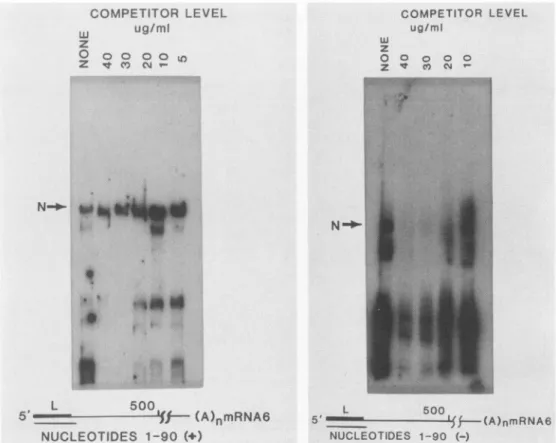
leadersequencesplus18additional nucleotides derived from the 5' end of MHV mRNA 6 (Fig. 1). This plus-stranded RNAboundtothe N protein,andbindingwasnotinhibited inthepresenceofcompetitorRNA(Fig. 4A). Confirmingthe requirementsforpolarity specificity, bindinginthepresence
ofcompetitor RNAwasnot detectedby usingthe negative-sense 90-base transcript derived from plasmid E1-L'(-) (Fig. 4B). These data support the findings presented in the accompanying article andclearly indicate thatan N-protein binding site is presentwithinthe leader RNAsequence.
Localization of the binding site. In the accompanying article (5)we demonstrate that N bindstothe 65-nucleotide butnotthe 57-nucleotide leaderRNA, suggesting that these leader RNA sequences are critical for N-RNA binding. However, it is not clear whethersequence5' toposition 57
z cc
LUL
U) Z LU 0
AIMLAdk
0
4
I
JIM., ,MM
M. 4
.u i,.,
COMPETITOR LEVEL
LLI
ug/ml
z
0 oo o o o
Z -t Cc v
... .:... ::...
COMPETITOR LEVEL
ug/mi
w z
0 0 o o o
Z t ceC N
N -0
P.^.. >s | WF'~~~~~~~~~~~~...
. .... _..
L 500
5'
IIIWMMMMA%fr
~(A)nmRNA6
NUCLEOTIDES 1-90 (4.)
L
NUCLEOTIDES
500
1-90 (-)
FIG. 4. SpecificNbindingactivity in positive- but notnegative-sensed leader RNA transcripts. RNA transcripts from plasmidE1-L in the positive (A) and negative (B) sense orientations were analyzed for their ability to bind N protein in the presence of various amounts of competitorRNA. None,Absence of competitorRNA.
also participates as part ofthe N binding site. To further localize the binding site, the plasmid E1-L'(+), containing the90-base leader insert, was digested witheither the DraI
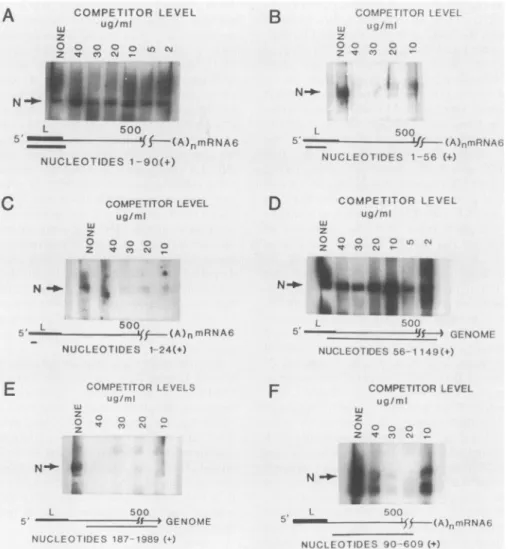
ortheSnaBI restriction endonucleases beforeinvitro tran-scription (Fig. 1). Digestion of this template withDraIyields invitroRNAtranscripts containing the first 56 nucleotidesat the 5' end of leader RNA, while digestion with the SnaBI endonuclease yields a24-nucleotide 5' transcript. The sizes andintegrity ofthesetranscriptswereconfirmed by electro-phoresis on denaturing polyacrylamide gels (data not shown).Thesetruncatedinvitro leaderRNAtranscriptsdo not exhibit specific binding in the presence of competitor RNA (Fig. SB and C). This can be compared with the high-affinity binding detected with the full leadercontained within the 90-base transcript (Fig. SA). These data suggest that the sequences exhibiting specific N binding require nucleotides 56through 90 in mRNA6. To rule out specific interactions with the 18 nucleotides 3' to leadersequences
derivedfromgene F which arecontained in E1-L' (Fig. 1), we examined transcripts derived from plasmid F82D con-taining a cDNA insert representing nucleotides 56 through
1149fromthe5' endofgenomicRNA (30).This cDNA clone diverges from the mRNA 6 sequence at position 67 (28). Specific high-affinity binding ofthisprobetotheNproteinin thepresence ofcompetitor RNAwasfound by usingRNA
transcribedfrom this plasmid (Fig. 5D). Toconfirm that no crypticsiteswerecontainedin thisrelativelylong transcript, we also tested a transcript derived from plasmid F82N containingacDNA insertofnucleotides187to1989 fromthe 5'end ofgenomicRNA(Fig. 1)andfoundnospecific binding (Fig. 5E). It is unclear whether additional N binding
se-quencesarepresentbetweennucleotides67and187in gene A,whichpotentially providesapackagingsignalforgenomic
RNA.
RNA was also synthesized from a plasmid containing
internal nucleotides 90 to 609from the 5' end ofmRNA 6
(E1-500) which lacks the first 90 nucleotides tested forFig.
4A.These internal sequences do notexhibit specific binding to N (Fig. SF). Therefore, these data suggest that specific
and high-affinity binding ofviral RNA by the N protein is necessary and sufficiently supplied by nucleotides in the
viral leaderspanning positions 56to 67ofgenomicRNA. DISCUSSION
In the accompanying article we have demonstrated that the MHV Nprotein bindsnotonly tothe
positive-stranded
genomic-length RNAbut alsotoallsixsubgenomic
mRNAs (5). This binding appears to be mediated by sequences located at the 5' end of each mRNA. After infection, the MHVgenomic RNA istranscribedby an early polymerase activity into a full-length negative-stranded RNA (10, 11,19).Transcriptionofplus-strandedgenomic-lengthRNAand thesixsubgenomic-lengthRNAs thatmakeup thenestedset ofMHV mRNAs is via aunique leader-primed
discontinu-ous
nonprocessive
mechanism (8, 22). Evidence for thismechanism includes the finding offree leader dissociated
from the negative-stranded template and a
A
COMPETITOR LEVELuig/mi
z
O o 0 0 0 e N z s mcm _
N
|^-L T S 0
I
f
WnMRNA r NUL; EOTID:?ES 1-90(+)COMPETITOR LEVEL ug/ml
z
0 o o Z v n CM
N
_0
4
I
L 500
5 '--m--(A)nmRNA6
NUCLEOTIDES 1-24(+)
E
COMPET
lITOR LEVELSLi
O o 0 00
z -t m N _
&~~~~~~
N iF
L 500
15 -- - --- -- GENOME
NUCIEoITD S 1-17 19119 (4)
B
C.C)MPF:TIThF E V LL,L 11tX.,nli
z
Q oc0 0
C IT ) N
500
_--V---b---f- --(A)rnRNA NUCLEOTIDES 1 '56 (+)
D COMPETITOR LEVEL
ug/mi
z
O o o 0o N
500
zi GENOME
NUCLEOTIDES 561s149()
F
COMPETITOR LEVEL9g/ml
z
O00C 00
Z o co Co
N4 v N
_- _-() iNAf
NLJCI.EOTIDES 90-) 0"I(*)
FIG. 5. Localization of the RNAbinding site withinthe leader RNAsequence. (A)High-affinity bindingbythe RNA transcribed from
E1-L(+). (B) Absence of specificbinding byRNAcontaining nucleotides1through56.(C)Absence ofspecificbinding byRNAcontaining nucleotides1through 24. (D) SpecificbindingbyRNAtranscriptsfromplasmidF82D(nucleotides56through 1149). (E)Absenceofspecific binding by RNA transcriptsfromplasmid F82N(nucleotides 187through 1989). (F)Absence ofspecificbinding byRNA transcriptsfrom
plasmid E1-500 (nucleotides 90 through 609).None, AbsenceofcompetitorRNA.
complex (7, 17, 18). Further, the leader RNA sequences
reassort athighfrequency duringmixedinfection, indicating thattheseRNAsactintrans(21). The datapresentedinthis and theaccompanyingarticle suggest thatanN bindingsite ispresent within the MHV leaderRNA sequence.
Negative-stranded as well as positive-stranded RNA is coimmunoprecipitated with N protein (5), suggesting either that N binds to negative-sensed RNA or that the leader-containingnascent chains ofthe RI complex (7) were
asso-ciated with the Nprotein.Theexperimentsdescribed in this article examined thepossibility of N binding domainsonthe negative-strandedRNA.Neitherthe 1.2-kilobaseRNA tran-script derived fromthe 5' end sequences ofgenomicRNA
northe90-base leader-containing RNA, both transcribed in the negative-sense configuration, was bound to N with specificity. Incontrast, thecomplementary plus-senseRNA derived from the 5' ends of both gene A and gene F
sequencesshowed specifichigh-affinity binding. These data indicate that an N protein binding site is present on the leader RNA sequences contained on the nascent plus-strands of the RIcomplex (7)and furthersuggestarole for N
inthetranscription complex, aspreviously suggested by the
inhibition of transcription by anti-N monoclonal antibody (12). These data also suggest that if the N protein bindsto negative-stranded RNA, the interaction is mediated by se-quences other than those at the 5' end.
Analysis of the small MHV-specific leader-containing RNAs in infected cellsby immunoprecipitation with anti-N monoclonal antibody suggests that N waspresent on RNA species greater than 65 nucleotides long (5). However, it couldnotbe determined whether N bound directlytoleader RNAsequences orwhether itbound indirectly via associa-tion with other viral RNA-binding proteins. We have used RNAsproducedby invitrotranscriptionto localize the site of N protein bindingto the leader RNA.Northwestern blot analysisofhigh-affinity N-proteinRNAbindingin the
pres-enceofcompetitorRNAshowedthat N bindsdirectlytothe 90-base leader-containing RNA sequences derived from
geneF.Analysis of RNAsdeletedfor the bases 1through56 confirmed that the sequences 1 through 56 alone do not exhibit high-affinity N binding. However, these data do not rule out the possibility of a minor contribution from the
nucleotides 5' of nucleotide 56. Inaddition, specific binding was demonstrated by using transcripts from the plasmid
F82D, which contains nucleotides 56 through 1149 from the 5' end of genomic RNA (30). In contrast, plus-stranded sequences derived from the body of gene F (plasmidE1-500) or from the 5' end of genomic RNA (plasmid F82N), both of which lacked the leader RNA sequences, did not show demonstrable specific binding by the N protein (Fig. 5).
We have previously shown that the 3' end of leader RNA contains a weak potential hairpin loop involving nucleotides 52 through 76 (28). The predicted N binding site corresponds to sequences within this potential hairpin loop. Further, the demonstration of N in the RI complex and on the free leader-containing MHV-specific RNAs as well as the finding that free leader RNA binds N suggests that N may play a role in regulation of leader-primed transcription. We have no direct evidence that an N-leader RNA complex is required for subgenomic transcription other than the inhibition of transcription by anti-N but not anti-El or anti-E2 monoclo-nal antibodies (11; P. R. Brayton, unpublished data). In addition, the precise length of the free leader RNA that functions as primer is not known. However, we have sug-gested that it may contain more than 72 nucleotides, on the basis of homology with the negative-sense intergenic regions preceeding genes E, F, and G (28). We have also suggested that expression of the subgenomic mRNAs may beregulated by the extent of the homology between the extended 3' leader sequences derived from the 5' end of the genomic RNA and the intergenic regions (28). For example, the homology between leader RNA and the intergenic region of mRNA 7, the most abundant viral mRNA, covers 18 bases between nucleotides 63 and 81. These data suggest that such an RNA will have a functional N binding site. Therefore, a possible function for N in transcription may be to prevent base pairing at this potential hairpin loop and obviate the need to overcome the energy requirement to linearize the leader RNA before binding to theintergenic transcriptional start sites. An alternate possibility is suggested by the cytoplasmic small free leader-containing RNAs. These RNAs are believed to represent functional transcriptional intermediates (6) that may participate in the high-frequency RNA-RNA recombinational events described during coro-navirus replication (22). N binding to leader transcripts of sufficient length to contain the specific binding site, i.e., longer than 72 nucleotides, may serve to target these RNA-protein complexes to the transcription complex through protein-protein interactions. This issupported by our finding that anti-N monoclonal antibody immunoprecipitates nega-tive-stranded RNA from the membrane fraction (5), the site of RNA polymerase activity in infected cells (10, 11). Fi-nally, our data cannot rule out the possibility that the binding of N and its subsequent self-assembly on the nascent strands may serve to prevent RNA-RNA base pairing after tran-scription.
We have tentatively localized the N-RNA binding site betweennucleotides 56 and 65 in the leader RNA; therefore, it is not surprising that the subgenomic viral mRNAs are bound inribonuclear protein complexes. Similar complexes involving mRNAs that are not packaged into virions have beenidentified during both vesicularstomatitis virus and La Crosse virus replication (4, 25, 27). These data suggest that additionalcis-acting sequences must be present in the MHV genome to ensure efficient encapsidation of the genomic RNA.Alternatively, either a size constraint permitting only encapsidation of full-length genomic RNA or subcellular compartmentalization of genomic RNA may be required for proper packaging. The first two possibilities are supported by studies characterizing the defective interfering RNAs of
MHV, which contain leader RNA sequences as well as internal deletions and rearrangements in the internal se-quences (21). Only the RNA designated DIssAispackaged intovirions, while thesmallerdefectiveinterfering RNAsof
MHV are not (21). This may be due either to the lack of additional packaging signals or to size constraints placed
uponnucleocapsidformationrequiring a full-length ornearly
full-lengthgenomic RNA. Interestingly,Rous sarcomavirus andMoloneymurineleukemiavirus appear to haveat least
two sites forencapsidation (23)which coordinatein
provid-ing genomic RNA with the proper specificity required for efficient packaging. In addition, while vesicular stomatitis
virus mRNAsassociate with its Nprotein in infectedcells,
only the genome-length RNA and leader RNAare
encapsi-dated (3, 4, 16). The third possibility is suggested by the separation of the MHV-induced polymerases (11). The en-zymatic activity synthesizing genomic-length RNA is asso-ciated with apopulation ofcellular membranes thatdiffer in density from those associated with thepolymerase activity
synthesizing virus-specific mRNA(11). These data suggest that encapsidation is a complex process which involves a variety of factors andthat the presenceof bound N protein
may be insufficient to provide the appropriate packaging
signal(s).
Several models areused todescribethestructureofDNA protein interactions, such as the helix-turn-helix model ex-emplified by the lambda repressor and the
zinc-binding
fingers of theglucocorticoid receptor(1, 24). The mannerin
which proteins bind RNAs is less predictable, because of
their less ordered secondary and tertiary structures. The
complete gene sequence of the N protein has been deter-mined (3, 29), andasearch ofthepredictedprotein sequence doesnot revealobvious paradigms for nucleic acid
binding.
It is our current goal to rigorously define the nucleic acid binding including domains ofthe N protein by site-directed mutagenesis.
ACKNOWLEDGMENTS
WethankMichael M.C. Lai forhelpful discussions and criticism andCarol Flores forpreparation ofthemanuscript.
This work was supported by National Science Foundation grant DMB-87-17148,American Heart Association grant40073, and U.S. Public Health Service grants Al 31386, Al 19244, NS 18146, NS 00796, andAl23946fromtheNational Institutes of Health.
LITERATURE CITED
1. Anderson, J. E., M. Ptashne, and S. Harrison. 1985. A phage repressor-operator complex at7Aresolution. Nature (London) 316:596-601.
2. Armstrong, J., S. Smeekens,and P. Rottier. 1983. Sequence of the nucleocapsid gene from murine coronavirus MHV-A59. Nucleic Acids Res. 11:883-891.
3. Arnheiter, H., N. L. Davis, G. Wertz, M. Schubert, and R. A. Lazzarini. 1985. Role ofthe nucleocapsid protein in regulating vesicularstomatitis virusRNA synthesis. Cell41:259-267. 4. Banerjee, A. 1987. Transcription and replication of
rhabdovi-ruses. Microbiol. Rev. 51:66-87.
5. Baric, R. S., G. W. Nelson, J. 0. Fleming, R.J. Deans, J. G. Keck, N. Casteel, and S. A. Stohlman. 1988. Interactions be-tweencoronavirus nucleocapsidprotein and viral RNAs:
impli-cations for viral transcription. J. Virol. 62:4280-4287. 6. Baric, R. S., C.-K. Sheih, S. A. Stohlman, and M. M. C. Lai.
1987. Analysis of intracellular smallRNAs ofmouse hepatitis
virus: evidence for discontinuous transcription. Virology 156: 342-354.
Virol. 48:633-640.
8. Baric, R. S., S. A.Stohiman, M. K. Razavi, and M. M. C. Lai. 1985. Characterization of the leader-related small RNAs in coronavirus-infected cells: further evidence forleader-primed mechanism of transcription. Virus Res. 3:19-33.
9. Bowen, B., J. Steinberg, U. K. Laemmli, and H. Weintraub. 1980. Thedetection of DNA-binding proteins by protein blot-ting. Nucleic Acid Res. 8:1-20.
10. Brayton, P. R., M. M. C. Lai, C. D. Patton, and S. A. Stohiman. 1982. Characterization oftwo RNA polymerase activities in-duced bymousehepatitis virus. J. Virol. 42:847-853.
11. Brayton, P. R., S. A.Stohlman, and M. M. C. Lai. 1984. Further characterization ofmousehepatitis virus RNA-dependentRNA polymerases. Virology 133:197-201.
12. Compton, J. R., D. B. Rogers, K. V. Holmes, D. Fertsch, J. Remenick, and J. J. McGowan. 1987. In vitro replication of mouse hepatitis virus strainA59.J. Virol.61:1814-1820. 13. Fleming, J. O., S. A. Stohiman, R. C. Harmon, M. M. C. Lai,
and J. A. Frelinger. 1983. Antigenic relationship of murine coronaviruses: analysis using monoclonal antibodies to JHM (MHV-4) virus. Virology 131:296-307.
14. Fried, M. G., and D. M. Crothers. 1984.Equilibrium studies of the cyclicAMP receptorprotein-DNA interaction.J. Mol. Biol. 172:241-262.
15. Gilmore, W., J. 0. Fleming, S. A.Stohlman,and L. P. Weiner. 1987. Characterization ofthe structuralproteins of the murine coronavirus strainA59using monoclonal antibodies.Proc.Soc. Exp. Biol. Med. 185:177-186.
16. Kurilia, M. G., and J. D. Keene. 1983. The leader RNA of vesicular stomatitis virus is bound byacellularprotein reactive with anti-Lalupusantibodies. Cell34:837-845.
17. Lai, M. M. C., R. S. Baric, P. R. Brayton, and S. A.Stohlman. 1984.Characterization ofleader RNA sequences on the virion andmRNAsofmousehepatitis virus,acytoplasmicRNAvirus. Proc. Natl.Acad. Sci. USA 81:3626-3630.
18. Lai, M. M. C., C. D. Patton, and S. A.Stohlman.1982. Further characterization ofmRNAsofmouse hepatitis virus: presence ofcommon5'-end nucleotides. J. Virol.41:557-565.
19. Lai, M. M. C., C. D. Patton, and S. A. Stohlman. 1982. Replication ofmouse hepatitis virus: negative-stranded RNA andreplicative formRNA are of genomic length. J. Virol.44: 487-492.
20. Lai, M. M. C., and S. A. Stohlman. 1978. RNA of mouse hepatitis virus. J. Virol. 26:236-242.
21. Makino, S., N. Fujioka, and K. Fujiwara. 1985. Structure of the intracellular defective viralRNAsof defective interfering
parti-cles of mouse hepatitis virus. J. Virol. 54:329-339.
22. Makino, S., S. A. Stohlman, and M. M. C. Lai. 1986. Leader sequences of murine coronavirus mRNAs can be freely reas-sorted:evidence for the role of free leader in RNAtranscription. Proc. Natl. Acad.Sci. USA 83:4204-4208.
23. Mann, R., and D. Baltimore. 1985. Varying the position of a retrovirus packaging sequence results in the encapsidation of bothunsplicedandspliced RNAs. J. Virol. 54:401-407. 24. Miller, T., A. D. McLachlan, and A. Klug. 1985. Repetitive
zinc-bindingdomains in the protein transcription factor III A from Xenopus oocytes. EMBO J. 4:1609-1614.
25. Raju, R., and D. Kolakofsky. 1987. Unusual transcripts in La Crosse virus-infected cells and the site ofnucleocapsid assem-bly. J. Virol. 61:667-672.
26. Robbins, S. G., M. F. Frana, J. J. McGowan, J. F. Boyle, and K. V. Holmes. 1986. RNA-binding proteins of MHV:detection of monomericand multimeric Nproteinwith an RNA overlay-protein blot assay. Virology 150:402-410.
27. Rosen, C. A., H. L.Ennis, and P. S. Cohen. 1982. Translational control of vesicular stomatitis virus protein synthesis: isolation ofanmRNA-sequestering particle.J. Virol. 44:932-938. 28. Shieh, C.-K., L. H. Soe, S. Makino, M.-F. Chang, S. A.
Stohlman, and M. M. C. Lai. 1987. The 5'-end sequences of murine coronavirus genome: implications for multiple fusion sites inleader-primed transcription. Virology 156:321-330. 29. Skinner, M. A., and S. G. Siddell. 1983. Coronavirus JHM:
nucleotide sequence of themRNA that encodes nucleocapsid protein. Nucleic Acids Res. 11:5045-5054.
30. Soe, L. H., C.-K. Shieh, S. C. Baker, M.-F. Chang, and M.M. C. Lai. 1987. Sequence and translation of the murine coronavirus 5'-endgenomicRNAreveals theN-terminal struc-tureoftheputativeRNApolymerase. J. Virol. 61:3968-3976. 31. Spaan, W. J. M., P. J. M. Rottier, M. C. Horzinek, and B. A. M.
van derZeiJst.1981.Isolation and identification ofvirus-specific mRNAs in cells infected with mouse hepatitis virus (MHV-A59).Virology 108:424-434.
32. Stohlman, S. A., J.0.Fleming, C. D. Patton, and M. M. C. Lai. 1983.Synthesisandsubcellular localizationof themurine coro-navirusnucleocapsid protein. Virology 130:527-532.
33. Stohlman, S. A., and M. M. C. Lai. 1979. Phosphoproteins of murinehepatitis viruses. J.Virol. 32:672-675.
34. Sturman,L.S.,andK. V. Holmes.1983. Themolecularbiology of coronaviruses. Adv. VirusRes.28:35-112.