FACULTY AND STUDENTS PERCEPTIONS ABOUT E-LEARNING FOR ENHANCING INTERACTIVE LEARNING IN HIGHER LEARNING
INSTITUTIONS IN TANZANIA
ANTHONY MARWA
A THESIS SUBMITTED IN FULFILLMENT OF THE REQUIREMENTS FOR THE DEGREE OF DOCTOR OF PHILOSOPHY IN EDUCATION OF THE
OPEN UNIVERSITY OF TANZANIA 2016
ii
CERTIFICATION
The undersigned certify that they have read and hereby recommend for acceptance by The Open University of Tanzania a thesis entitled: Faculty and Students Perceptions about E-learning for Enhancing Interactive Learning in Higher Learning Institutions in Tanzania, in fulfillment of the requirements for the degree of Doctor of Philosophy in Education of The Open University of Tanzania.
……… Professor Honoratha M. K. Mushi
(Principle Supervisor)
……… Date
………. Professor Elinami Swai
(Supervisor)
……… Date
iii
COPYRIGHT
This thesis is a copyright material protected under the Berne Convention, the Copyright Act of 1996 and other international and national enactments, in that behalf, on intellectual property. No part of this thesis may be reproduced, stored in any retrieval system or transmitted in any form by any means, electrical, mechanical, photocopying, recording or otherwise, without prior written permission of the author or The Open University of Tanzania in that behalf.
iv
DECLARATION
I, Anthony Marwa, do hereby declare that this thesis is my own original work and that it has not been presented and will not be presented at any other University for similar or any other degree award.
……… Signature
……… Date
v
DEDICATION
This study is dedicated to the memory of my parents, Marwa Mwita and Agnes Mwita Werema, who always believed in me, my lovely wife Mbilijao and children, Wilbroad, Taragwa, Sophia and Mosi, for their love, care, blessings, inspiration and moral support when conducting this study.
vi
ACKNOWLEDGEMENT
First and foremost, I thank GOD, THE ALMIGHTY for his blessings and protection which enabled me to accomplish this work. Secondly, I express my sincere appreciation and gratitude to many people who have encouraged and supported me in completing this thesis. I am indebted to all of them and want to call attention to some whose contribution proved valuable.
Firstly, I would like to extend my gratitude and thanks to my supervisors, Honoratha M. K. Mushi and Elinami Swai who provided the coaching and guidance that kept me on track. Words cannot express the appreciation, and respect that I have for them. Special thanks go to higher learning students and academic faculties at The Open University of Tanzania, the University of Dar es Salaam, Muhimbili University of Health and Allied Sciences and Mzumbe University for taking their valuable time to fill in the questionnaires and respond to in-depth interview questions. Special thanks to The Open University of Tanzania for offering me the opportunity to learn, without affecting my social and economic responsibilities.
I would also like to express my genuine gratitude to my research assistants, Simon Anthony and Naomi Morris for their acceptance in taking that difficult role of collecting some of the data which proved to be a crucial step in my study. Nevertheless I take full responsibility for anyerrors, weaknesses or shortcomings contained.
vii
ABSTRACT
This study investigated academic faculty and students’ perceptions about e-learning for enhancing interactive learning in universities in Tanzania. The study employed quantitative and qualitative methods to generate rich, contextual data from the four higher learning institutions namely The Open University of Tanzania (OUT), the University of Dar es Salaam (UDSM), Muhimbili University of Health and Allied Sciences (MUHAS) and Mzumbe University (MU). The study involved 225 students, 12 lecturers and four ICT administrators from the four higher learning institutions obtained through purpose sampling. Questionnaires, interviews, documentary analysis, observations of e-learning facilities, and content analysis of posts through social media (Jamii forums) were used in data collection. Data were analysed using the SPSS package. Findings show that 62.0% of faculty and 73.89% of students respondents perceived e-learning to have relative advantage over traditional forms of interactive learning, strategies employed to effect wide adoption of e-learning among students and academic faculty were; skill training, ICT policy development, erection of e-learning infrastructure and use of the Moodle as official e-learning. Students engaging in interactive learning through e-learning were those; exposed to high engaging tools, owning smart phones, skilled in using e-learning technologies, while distance, cost, social roles and slow internet speed were considered to be influencing factors to adoption of e-learning for interactive learning purposes. The study recommends that; further research be conducted in the area, learning theory and or research be an integral part of need assessment, teachers selected to teach through e-learning should have required skills or be trained in e-teaching, design and frequent review of ICT policy should be implemented.
viii TABLE OF CONTENTS CERTIFICATION ... ii COPYRIGHT ... iii DECLARATION ... iv ACKNOWLEDGEMENT ... v ABSTRACT ... vi
TABLE OF CONTENTS ... vii
LIST OF TABLES ... viii
LIST OF FIGURES ... xii
LIST OF APPENDICES ... xiii
LIST OF ABBREVIATIONS ... xv
CHAPTER ONE: INTRODUCTION ... 1
1.1 General Introduction ... 1
1.2 Statement of the Problem ... 19
1.3 The main Objective of the Study ... 22
1.3.1 Specific Objectives ... 22
1.3.2 Research Questions ... 22
1.4 Significance of the Study ... 23
1.5 Limitations of the Study ... 24
1.6 Conceptual Framework ... 25
1.7 Definition of Key Terms and Concepts ... 36
1.8 Chapter Summary ... 37
CHAPTER TWO: LITERATURE REVIEW ... 38
2.1 Introduction ... 38
2.2 E-learning Interaction Theories ... 38
2.2.1 Behaviorism Learning Theory and E-learning ... 39
ix
2.2.3 Constructivism Learning Theory and E-learning ... 41
2.2.4 Connectivism Learning Theory for Digitally Connected Learning ... 42
2.2.5 Effective Application of E-learning Interaction Theories ... 45
2.3 Empirical Studies ... 47
2.3.1 Perceived Role of Technology in Enhancing Interactive Learning ... 49
2.3.1.1 Technology as a Driving Force for Quality Teaching and Learning ... 49
2.3.1.2 Technology as a False Promisse to Interactive Learning ... 51
2.3.2 Relative Advantage of E-learning in Enhancing Interactive Learning ... 54
2.3.3 Strategies for Diffusion of Interactive Learning Through E-learning ... 59
2.3.3.1 Diffusion of Innovation Strategy ... 59
2.3.3.2 Course Design for Interactive Teaching Through E-learning ... 67
2.3.4 Type of Students Engaged in Interactive Learning Through E-learning ... 75
2.3.4.1 Students who Perceive E-learning has Potential for Interactive Learning ... 75
2.3.4.2 Students Motivated to use e-learning for Interactive Learning Purposes ... 77
2.3.4.3 Students Using Tools that Provide High levels of Interactive Learning ... 79
2.3.4.4 Students Encouraged into Interactive Learning Through E-learning ... 80
2.3.4.5 Students with Technology user Skills and Information Processing Skills ... 81
2.3.4.6 Students Accessible to E-learning Facilities ... 84
2.3.4.7 Non – Physically Challenged Students ... 85
2.3.5 Factors Influencing Interactivity in E-learning ... 86
2.3.6 Potential for Adoption of Interactive Learning Through E-learning ... 89
2.3.7 Existing Gaps in Reviewed Literature ... 92
2.3.8 Chapter Summary ... 93
CHAPTER THREE: RESEARCH METHODOLOGY ... 95
3.1 Introduction ... 95
3.2 Research Design ... 95
x
3.4 Study Population ... 96
3.5 Study Sample ... 97
3.6 Sampling Technique ... 98
3.7 Demographic Characteristics of Students Respondents ... 99
3.8.1 Semi Structured Questionaire for Students ... 100
3.8.2 Documentary Reviews ... 102
3.8.3 In-depth Interview Schedule ... 103
3.8.4 Content Analysis Guide ... 104
3.8.5 Observation Checklist ... 104
3.9 Data Collection Procedure ... 105
3.10 Validity and Reliability ... 106
3.11 Data Analysis Procedure ... 108
3.12 Ethical Considerations ... 108
3.13 Chapter Summary ... 111
CHAPTER FOUR: RESEARCH FINDINGS AND DISCUSSIONS ... 113
4.1 Introduction ... 113
4.2 Relative Advantage of E-learning in Promoting Interactive Learning ... 113
4.3 Strategies for Wide Adoption of Interactive Learning Through E-learning ... 118
4.4 Type of Students Engaged in Interactive Learning Through E-learning ... 125
4.5 Factors Influencing E-learning Interactivity ... 135
4.6 Potential for Adoption of E-learning ... 149
4.7 Chapter Summary ... 160
CHAPTER FIVE: CONCLUSSIONS AND RECOMMENDATIONS ... 161
5.1 Introduction ... 161
5.2 Summary of the Study ... 161
5.3 Findings ... 163
xi
5.5 Recommendations ... 174 REFERENCES ... 177 APPENDICES ... 193
xii
LIST OF TABLES
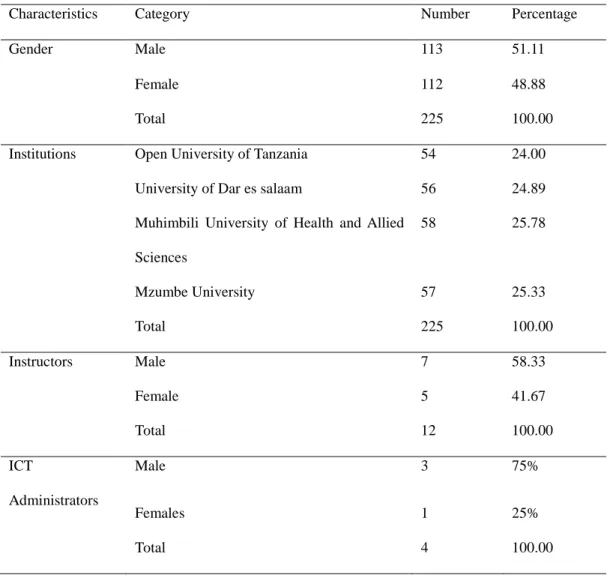
Table 3.1 : Summary of Study Respondents ... 98
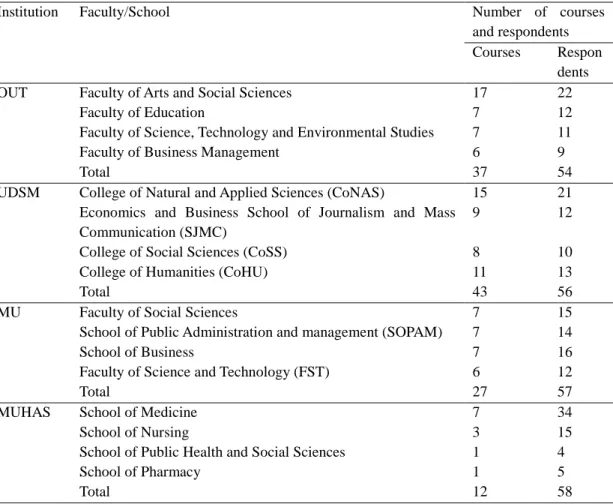
Table 3.2 : Students Respondents by Course ... 99
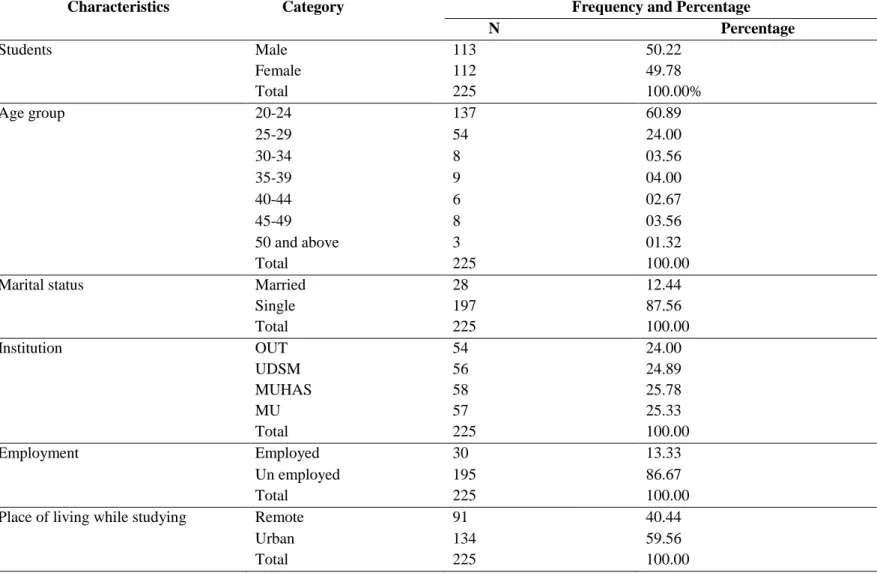
Table 3.3 : Descriptive statistics of students' respondent’s characteristics ... 101
Table 4.1 : Students Perceived Relative Advantages of Interactive Learning Through E-learning ... 116
Table 4.2 : Policies strategic plans learning management system e-learning coordination and training ... 119
Table 4.3 : E-learning Infrastructure in the four Higher Learning Institutions ... 123
Table 4.4 : Students perceived 2.0 web sites that meet course learning needs ... 130
Table 4.5 : Use of Jamii Forums for interactive learning purposes ... 132
Table 4.6 : Categories of academic posts and contributions in the Jamii Forum ... 133
Table 4.7 : Reasons for inadequate interactive learning through e-learning ... 136
Table 4.8 : Lecturers and students who perceive e-learning meet interactive learning needs ... 153
xiii
LIST OF FIGURES
Figure 1.1 : Differing interactive teaching and learning methods. Adapted from
Anderson (2003) ... 13
Figure 1.2 : E-Learning Acceptance Model (Umrani-Khan and Iyer, 2009) ... 26
Figure 1.3 : Conceptual framework for the study. Adapted from Umrani-Khan and Iyer (2009) ... 28
Figure 2.1 : Issues to consider when designing e-learning course for interactive learning purposes. Adapted from Anderson (2003). ... 46
Figure 2.2 : The rate and pace of adoption of technology when introduced to targeted population. Source Rogers (1995) ... 60
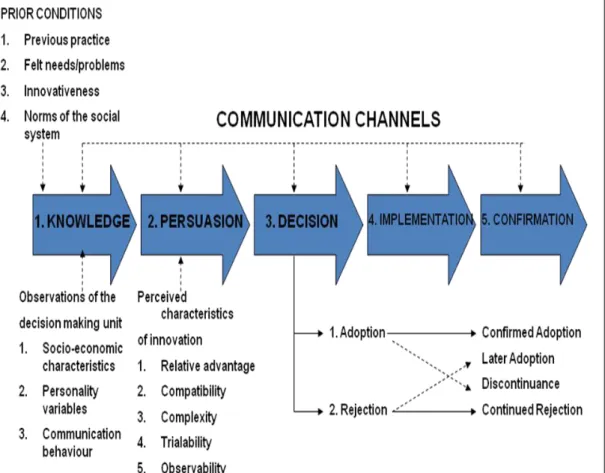
Figure 2.3 : The five stages of technology diffusion in targeted population. Source, Rogers (1995). ... 65
Figure 4.1 : Academic Faculty Perceived Relative Advantages of E-learning. ... 114
Figure 4.2 : Students’ preferred levels of integration of interactive activities in their courses. ... 125
Figure 4.3 : Type of e-learning tools utilized most by students. ... 128
Figure 4.4 : Students who attended course on computer user skills ... 141
Figure 4.5 : Academic faculty who attended course in e-teaching ... 143
Figure 4.6 : Students’ perceived influences in using e-learning for interactive learningpurposes by students ... 150
Figure 4.7 : Faculty perceived influences in using e-learning for interactive teaching purposes ... 151
xiv
LIST OF APPENDICES
Appendix A : Students' Questionaire Schedule ... 193
Appendix B : Interview Guide for students ... 200
Appendix C : Interview Guide for Instructors ... 202
Appendix D : Semi Structured Interview Guide for ICT Adminstrators ... 205
Appendix E : Documentary review checklist ... 214
Appendix F : Social Media review Guide ... 215
Appendix G : Computer Laboratory observation checklist ... 216
Appendix H : Research Clearence Letter ... 216
Appendix I : Learning theories ... 218
Appendix J : Perceptions and Assumptions on e-learning ... 221
Appendix K : Perceptions about Interactive Learning through e-learning from reviewed literature ... 222
Appendix L : Strategies to promote interactive through e-learning ... 225
Appendix M : Type of Students using e-learning for interactive learning purposes from reviewed literature ... 229
Appendix N : Barriers in interactive teaching and learning through e-learning from reviewed literature ... 232
Appendix O : Findings Reccomendations and remaining unanwered questions from reviewed Literature ... 234
Appendix P : OUT Jamii forum content review extracts ... 238
Appendix Q : Mzumbe University Jamii Forum content review extracts ... 258
Appendix R : UDSM Jamii forum content review extracts ... 276
Appendix S : MUHAS Jamii forum content review extracts ... 289
xv
LIST OF ABBREVIATIONS AND ACRONYMS ARU Arusha University
CoICT College of Information and Communication Technology DICT Directorate of Information and Communication Technology E-learning Electronic Learning
HLIs Higher Learning Institutions IAE Institute of Adult Education
ICT Information and Communications Technology IET Institute of Education Technology
IEMT Institute of Educational and Management Technologies IFM Institute of Finance Management
JF Jamii Forum
KIU Kampala International University LAN Local Area Network
LMS Learning Management System Mbps Megabits per second
MOODLE Modular Objective Oriented Development Learning Environment MUHAS Muhimbili University of Health and Allied Sciences
MU Mzumbe University
ODL Open and Distance Learning OER Open Educational Resources OSNs Online Social Networks
OUT The Open University of Tanzania
PC Personal Computer
xvi
SAUT St. Augustine University of Tanzania SPSS Statistical Package for Social Sciences SUA Sokoine University of Agriculture TCU Tanzania Commission for Universities UDSM University of Dar es salaam
VLE Virtual Learning Environment Wi-Fi Wireless Fidelity
1
CHAPTER ONE 1.0 INTRODUCTION 1.1 General Introduction
The value and importance of interactive learning in teaching and learning is globally acknowledged and well established in literature (Yusuf and Balogun, 2011; Garrison, 2000; Mushi, 2006). Interactive learning is considered for its capacity to facilitate knowledge generation among students by engaging them in critical thinking, exploring personal attitudes and values, expressing ideas, and reflecting on learning. Interaction also fosters teacher presence by giving and receiving feedback and fostering a feeling of belongingness to a learning community among students (Abawajy, 2012). Given such attributes, most educators consider interaction as an important ingredient for effective teaching and learning (Yusuf and Balogun, 2011) and one of the indicators of quality that has emerged in the practice and research in University-level education (Anderson, 2003).
The concept of interaction in classroom teaching and learning has various meanings. One is the condition in which students are engaged in an activity assigned after a lecture or a discussion. Sometimes an instructor and students can collaboratively interact to brainstorm or translate important ideas or information. Brainstorming and translating are activities that call for interaction involving intense cognitive processes facilitating knowledge construction. This implies that interaction is not a void in a lecture; rather a lecture can be used as a starting point to engage the students in an interactive learning activity beyond the classroom online/cyber class. Interactive learning has its roots in Lev Vygostkian psychology (Vygotsky, 1978). According to Vygotsky (1978), interactive learning can materialize through the use of tools and signs. Tools in the case of learning may be anything to help the learner access information and construct knowledge (e.g.
2
books, television or computers/laptops/smart phones). Signs on the other hand have functions that have potentials to modify and improve human cognition (e.g., language, models or metaphors) (Lantolf and Poehner, 2009). Such functions are internal and psychological and can be used to organize thinking and making sense. They are often used to improve the psychological world (Vygotsky, 1978). Computer-mediated tools are currently regarded sources of interactive learning (Adair-Hauck, Willingham-McLain and Earnest 2000), because they have capacity to combine audio, video, graphics and text thus providing interactive learning opportunities of higher levels than previous technologies.
Various efforts aimed at promoting interactions in teaching learning have been documented in both conventional and distance education institutions with most of the studies showing that effective interactive learning are reached through promoting interactive activities in teaching and learning (Mtebe and Raisamo, 2014). While best achievements in promoting interactive learning in higher learning institutions have often been associated with face to face conventional teaching approaches, difficulties in promoting such form of teaching and learning have often been associated with distance education course delivery (Msuya and Maro, 2002). Some studies suggest that students and instructors in conventional education institutions as well as in distance education institutions are facing similar challenges in promoting interactive learning (Lwoga, 2014).
For distance education institutions, the major obstacle in promoting interactive learning has been the geographical distances between students and their institutions as well as teachers, which makes face to face teaching and learning difficult to achieve (Msuya and Maro, 2002). In order to compensate for this shortcoming distance education institutions use technologies as the media of course delivery. For instance before the advent of the internet, The Open University of Tanzania (OUT) has largely used correspondence forms
3
of teaching and learning, that is print course materials and postal services as the main media of course delivery (Nihuka, 2010).
Use of printed course materials provide limited interactive activities such as elaborate formal exercises, self corrected as well as instructor evaluated assignments supplemented by other forms of teaching learning activities such as face to face sessions (Mkuchu, 2000). High engaging interactive activities such as discussions could not be sufficiently supported by the print media, because when print media is used feedback takes long time to be accomplished unless print media is accompanied with internet provisions (Lema, 2006).
Furthermore a study by Babyegeya (2006) revealed that students completed assignments sent to instructors for marking were duly marked and returned to students but most lacked detailed comments. Among reasons for lack of detailed comments in student’s assignments is high workload on part of academic staff. It is reported that by 2015 high enrollment of students at OUT had resulted into student academic staff ratio of 1:103 while the recommended student-staff ratio is 1:35 as prescribed by TCU for a traditional ODL delivery mode (OUT, 2015).
Faculty members as a result, were required to mark more than 2,000 scripts, such immense workload deprived them chances to provide detailed explanations or comments on areas for improvement and or encouragement. This condition deprived students opportunities to interact with their instructors through comments on assignments for the purpose of finding out how well they are doing in their studies (Babyegeya, 2006). In addition, even attempts to promote discussions through formation of face to face study groups, could not work well as expected especially for students in remote areas. Most of
4
the students in remote locations are scattered, making it difficult for them to form and make use of such study groups (Lema, 2006). This has resulted into poor interactive learning, which in turn became part of the reasons of high dropout cases and poor performance by students studying through distance education mode (Msuya and Maro, 2002).
According to Knebel (2001), successful completion rates of distance education degree programmes in developing countries are often as low as 10 to 34% compared to the rates of 55 to 66% in conventional education institutions. A similar trend of low successful completion rates, whereby only 234 (31%) of 763 of the first batch of OUT students registered in 1994 and in four graduations that followed managed to complete successfully. This is not surprising, since even the number of active students in distance education institutions does not correspond with the number of enrolled students. At the Open University of Tanzania, for instance, active students were estimated to be only 60% of those registered during 2013/2014 academic year (OUT, 2014).
In conventional higher education institutions in Tanzania reasons which are considered to limit interactive learning has been ‘large class size’ which is regarded to impose restrictions on the use of certain active teaching and learning strategies such as class discussions.
Large classes are a result of increased enrollment of students which are not in line with expansion of facilities and teachers (Lwoga, 2012). For instance, while the number of undergraduate students enrolled at the University of Dar es salaam (UDSM) in 2003/04 was 2410 the enrolment rose to 5775 in 2007/08 almost twice as much (UDMS, 2009). While student enrollment has been increasing the infrastructure has basically remained
5
the same (Mtebe and Raphael, 2013), resulting into an average of lecturer student ratio of 1:20 compared to recommended ratio of 1:10 for natural sciences and 1:15 for social sciences for students learning through a conventional mode (Sarua, 2009). Since some of the academic staff engages in fulltime administrative work, the real number of academic staff directly involved in teaching is even lower.
At Muhimbili University of Health and Allied Sciences (MUHAS) high enrollment of students had resulted into making one lecture at the Biochemistry class to teach about 350 first year students as well as post graduate students (Olipa et al., 2012). While at the University of Dar es salaam, Hoven (2000) argues that, due to large number of students in one class. Some students were compelled to take lecture notes while standing outside the lecture halls.
The challenges facing conventional higher learning institutions have mainly been on how to strike a balance between enrollment of large number of students and intensified demand for the delivery of better education (Mtebe and Raphael, 2013). Large number of students in classes might impose restrictions on the use of interactive learning that fosters cognitive, social and teacher presence. Such restrictions cause teachers to rely on simplistic teacher–centred lecture method, considered by most contemporary scholars to be poor methods of enhancing interaction and retaining students’ attention in teaching and learning (Olipa et al., 2012).
Olipa et al. (2012) points out that in order to overcome the problem brought about by enrollment of large number of students which is not in line with available facilities and intensified demand for the delivery of better education some of the higher learning institutions have experimented with some innovative interactive teaching techniques. In
6
2009 MUHAS introduced competency based medical education system. The programme was aimed at enhancing interactive teaching in large classes that incorporates technology for teaching and assessment. The strategy comprised of instructor-facilitated small group activities within large group settings, peer-led tutorials to provide supplemental teaching and peer-assisted instruction using computer to enable access to online biochemistry learning resources.
It was considered that students would benefit from individual instruction in organized small group tutorials. However, neither faculty nor tutorial assistants were available. To tackle this problem, some of the students were trained to help teach their peers. While peer led tutorials were aimed at enhancing interactive teaching by focusing on preparing health professionals to lead a workforce composed largely of health workers with fewer years of education than themselves. Furthermore, in 2011 faculty and students were trained in Web 2.0 tools and sharing methods, evidence based practice, online search strategies and online reference management (Lwoga and Nagunwa, 2012).
MUHAS is not the only higher learning institution which has been attracted to employ e-learning on board. Given the advantages of enhanced interactive e-learning that e-e-learning provides, especially in a situation where high number of students and shortage of staff challenge higher learning institutions in providing quality education, e-learning has attracted the attention of most higher learning institutions as a solution (Mushi, 2006b; Nihuka, 2010). The use of multimedia technologies to enhance interactive learning is fast spreading in education institutions, because technologies make it possible to deliver clearer and more engaging learning (Mnyanyi et al., 2010). This information from the literature formed part of the efforts by the researcher of this study to investigate out the
7
effectiveness of such programmes in enhancing interactive learning in higher learning institutions in Tanzania.
Development of Information Communication Technologies (ICT) and the growth of its usage in teaching and learning purposes promise to overcome the mentioned challenges (Mushi, 2006b; Mnyanyi et al., 2010). ICT have acquired features that enable multimedia operations, that is, a combination of media operating at a time for education delivery purposes; such technologies include among others the computer and mobile technology with internet connectivity (Sife, Lwoga and Sanga, 2007).
Mushi (2006) notes that the application of e-learning for the purpose of enhancing interactive learning includes a wide range of a continuum of integrated educational technologies. At one end are applications of technologies such as print materials which have limitations in enhancing interactive learning. On the other end of the continuum are applications of digital technologies which provide virtual learning environments (VLES) with capacity for high levels of interactive learning.
This continuum of e-learning also depicts how technology could be applied in teaching learning, e-learning could be used to supplement other forms of teaching and learning such as the print based or face to face learning strategies. This could be done through blended or hybrid formats comprising of a mix of face to face and online instruction at initial stages to fully online learning environments delivered to all students at mature stages. This is achieved when appropriate online infrastructure and adequate facilities have been installed and initiated into effective application on online learning.
8
At the time of this study ICT have acquired features that enable multimedia operations, that is a combination of media operating at a time for education delivery purposes; such technologies include among others the computer and mobile technology with internet connectivity (Sife, Lwoga and Sanga, 2007).
The multimedia operations can exploit three-dimensional visual potentials in some way, typically by means of graphic representations, animations and videos productions. Visual e-learning includes many applications and processes: from Web broadcasts and self-paced computer based training to virtual classrooms (Mnyanyi, Bakari and Mbwette, 2010). This provides e-learning with the potential to accommodate interactive activities that enhance learner interaction to higher levels (Anders, 2003). Such activities include threaded discussions, participation in video conferencing, students listening to invited guest speakers and chatting (Garrison, 2000).
Thurmond and Wambach (2004) observe that such high level of interactions stimulate active learning whereby students have the freedom to share, discuss and contribute views and ideas, with their instructors and fellow students as well as creating opportunities for quick feedback. Such development in turn triggers the diversification of postgraduate courses, masters degrees, and doctoral studies through improved interactions and resulting into quality teaching, improved student retention and completion rates of registered students (Lwoga and Nagunwa 2012).
Scholars differ in defining the term interaction. According to Wagner (1994) interaction is an interplay and exchange in which individuals and groups influence each other. Wargner (1994) goes on to distinguish between interaction and interactivity by arguing that interaction focuses on people’s behaviours, that is the mutual action between participants,
9
while interactivity focuses on characteristics of the technology systems in allowing interactions between participants. Other scholars such as Arbaugh and Benbunan-Fich (2006) define interaction as a process in which shared events take place between learners, instructors, and learning environments to help learners achieve intended learning goals.
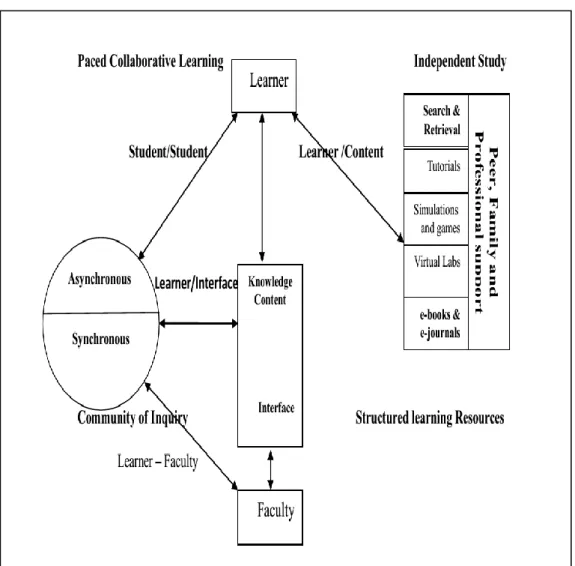
This study adopted the definition suggested by Mushi (2006b) who sees interaction as the learner’s engagement with the course content, with other learners, with the instructor and with the technological medium used in the delivery of courses. In this regard the term enhanced interactive learning refers to teaching learning activities that lead to more strengthened learner engagement with the course content, with other learners and with the instructor.
The term e-learning has been defined differently by scholars; Mason and Rennie (2006) for instance provide a technology driven definition by which they define e-learning as distance education through remote resources. Kochang and Harman (2005) provide an education delivery system oriented definition. They define e-learning as the delivery of education (all activities relevant to instructing, teaching, and learning) through various electronic media. Others like Bermejo (2005) provide a communication oriented definition by defining the term as an education system that uses computerized communication systems as the environment for communication, the exchange of information and interaction between students and instructors.
Some scholars provide educational paradigm oriented definitions (Alonso, 2005; Mnyanyi et al., 2010). Alonso (2005) for instance defines the term e-learning as the use of new multimedia technologies and the internet to improve the quality of learning by facilitating access to resources, services, remote exchange and collaboration. This study
10
adopts an educational oriented definition suggested by Mnyanyi et al. (2010) who defines e-learning as a learning situation whereby methods and techniques are enhanced by electronic devices, leading to interactive learning.
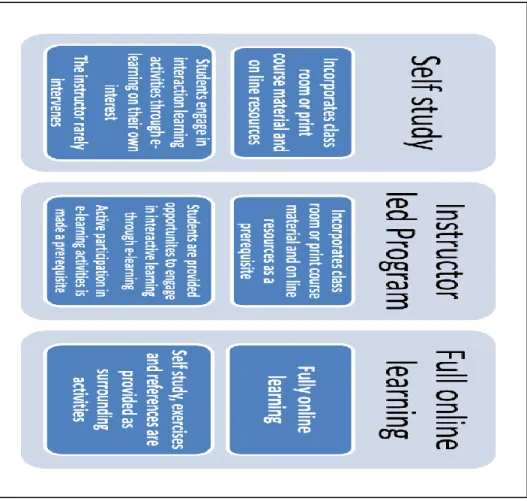
There are three ways through which e-learning could be used to enhance interactive learning in higher learning institutions (Abawajy, 2012). The simplest form of enhancing interactive learning is the application of the traditional face to face instruction or printed text course materials with a few online resources or communication (Mtebe and Raphael, 2013). This form of teaching and learning mainly focuses on the learner-to-learner interaction for the students to support one another.
Students engage in e-learning interactive activities out of their own interests. Students have the freedom to choose to take part in e-learning interactive activities using e-chat provisions or social media platforms. When they meet through such forum they clarify their own understanding of key concepts, and further develop their communication skills by answering each other’s questions (Osunade, 2003).
Rather than taking the role of a disseminator of knowledge, the instructors respond to the student queries so that they tend to be supportive to students’ learning needs. The instructor intervenes only when s/he needs to keep the discussion on track or to motivate students to keep the discussion going. Instructor intervention is also necessary to guide, moderate, scaffold and support the learners as they grow from prior knowledge and understanding towards construction of new learning (Mtebe and Raphael, 2013).
Since participation in teaching and learning activities is voluntary, students may choose not to engage in taking part in e-learning active learning activities, such as discussion
11
forums. Reasons for not doing so may include lack of time management, passivity and limited interest in the content. A small vocal group may naturally emerge as discussion leaders and consistently contribute to discussion topics on online discussion forums (Abawajy, 2012). In this case a small group may be moderately active, while the remaining students participate less frequently.
One way to alleviate this situation is for the instructors to encourage discussion by responding to posts in a timely manner to show that student comments are read while making sure that the comments do not inhibit further student responses (Osunade, 2003). In addition, unlike in face-to-face discussion where learners can have responses to their queries impromptu, the learners may have to wait for responses to their queries that they wish to be clarified urgently (Mtebe and Raphael, 2013). The feedback or response may not come in time; this may lead to students’ frustration and subsequently discouraging participation (Abajawy, 2012).
The second way to alleviate the situation is through the delivery of online teaching and learning with options for face to face instruction (Osunade, 2003). Interactive activities are designed to enhance the learning experiences of students by providing students with opportunity to work in groups collaboratively on assessable tasks such as term projects (Osunade, 2003). Each group may have a student facilitator who would be in charge of certain forms of interactive activities such as group discussions. When discussion groups are relatively small (6-8 people), high-quality sharing of notes and views are more common (Abawajy, 2012).
The other way provides for fully online teaching and learning with no face to face component (Abawajy, 2012). This form of e-learning is highly radical in focus (Osunade,
12
2003). This is because it emphasizes e-learning as the main form of teaching and learning with learners relying solely on online communication methods to interact with their lectures as well as their classmates (Abawajy, 2012). Such interactions can take place either at the same time “synchronously” and the exchange of information is done in real time such as video conferencing or at delayed time “asynchronously”, interaction that occurs at different times, not in real time such as e-mail (Osunade, 2003). In ‘wholly online’ delivery mode, all teaching occurs online and it requires students to be actively involved with and take more responsibility for their own learning (Mtebe and Raphael, 2013).
The loss of face-to-face contact possibility through online teaching and learning makes the relationship between the instructor and the learner get changed (Abawajy, 2012). Students and their instructors need to find new ways to express emotion, or passion for the subject matter, when communicating ideas to the learners; this may include use of greetings, self introductions and social icons to express emotions (Osunade, 2003).
The instructor makes major decisions on the interactive activities to be performed by learners. Such activities could be discussion topics through which learner to learner and learner to instructor interactions are enhanced (Abawajy, 2012). The instructor could post threaded discussion topics and each topic will have a specific deadline and students must contribute to the discussion before the deadline expires (Lwoga, 2012).
The threaded discussions represent class participation, which usually is evaluated based upon the quality and quantity of each student’s postings (Lwoga, 2012). The forum requires explicit and clear articulation of guidelines in order to promote participation and quality postings for online discussions. The model requires weighting for participation.
13
Such evaluation could focus on several aspects such as: depth, appropriateness, correctness, completeness, and usefulness (Abawajy, 2012).
The shortcomings of this method as observed by Abawajy (2012) are that; it does not support discussions that are too long to maintain interest or focus of students. Another possible problem is that students may feel like "everything has already been said" by the time it is their turn to post. This could possibly be handled by ensuring that when students enter the forum, they cannot see any other posts until they make a new post of their own. This way everyone is forced to post an original thought, even if it has already been generated in the discussion. This study attempt to identify e-learning interactive learning format adopted and used by each of the four higher learning institutions covered by this study.
Figure 1.1 : Differing interactive teaching and learning methods. Adapted from Anderson (2003)
14
There is existence of a number of multimedia tools used on the web to promote interactive learning. These include among others a combination of e-texts, images and audio programmes through asynchronous and synchronous communication formats. Discussion boards and voice chatting are two of the interactive learning formats (Mushi, 2006a; Nihuka, 2010).
Some of the reviewed studies show that many lecturers at higher learning institutions do not use such interactive teaching techniques (Mgendi, 2010). Some lecturers resort to place their traditional course material on web sites, in the form of transcripts or simple power point presentations (Nihuka, 2010). Others simply ignore application of e-learning for teaching and learning purposes.
In this regard it is not enough to make e-learning platforms available to students and teachers hoping that by itself would translate to wide adoption and application of the technology for teaching and learning purposes. Mgendi (2010) learnt this the hard way, when almost single handed he decided to introduce the Moodle e-learning platform at the Ardhi Institute (now Ardhi University in Tanzania) hoping that its demonstrated superior capabilities in enhancing communication is all that is required to encourage students and academic staff to apply it for teaching and learning purposes. However, only two faculty members at the institution used the system in the earnest way, despite availability of computers and accompanied software as well as the presence of academic staff who had already been trained in the use of an almost similar teaching learning platform (the blackboard) (Mgendi, 2010).
In exploring the reasons behind reluctance to use e-learning for interactive learning purposes by some of the teachers and students and continuation of using traditional forms
15
of teaching when using web based teaching and learning tools, Hall (2002) observes that the adoption of media in some learning institutions is led, not by pedagogical rationale but rather, by technology, and or personal rationale. Lears (2000) calls this techno-utopia, where the use of technology in the classroom teaching is led by serving and self-promotion, rather than serving the people that they intend to teach.
The observation that adoption of media in some of the learning institutions is led by technological rationale finds support form Lindsay (2004) who notes that, some of the lecturers who regard traditional methods of teaching learning in which the lecturers’ main function is to pump knowledge into learners heads tend to resist use of e-learning technologies for teaching and learning purposes. Lindsay (2004) goes on to argue that even the few who opt to adopt the technology for teaching and learning purposes tend to do so to please their students.
In explaining the reasons for such actions, Lindsay (2004) argues that, most contemporary students in higher learning institutions have been brought up in digital age and they expect and demand their teachers to use the technology for teaching learning purposes. This appears to be a challenging situation on part of lecturers, so in order to meet such challenges as well as appear modern before their students and peers, lecturers have no option but to fulfill their students’ expectations. Even then, lecturers are cautious and careful to select only those technologies which meet their students’ modest goal without affecting their teaching learning methods which they cherish and with which they are comfortable (Lindsay, 2004). Lindsay (2004) argues that such decisions often results into poor e-learning solutions which are far removed from the way in which students frequently use them to meet their interactive learning needs. Among poor solutions, includes selection of technologies that do not provide for high engaging interactive
16
teaching and learning opportunities. The view finds support from Waddington and Davidson (2010) who argue that the Moodle teaching and learning platform, which is popular among HLIs, is among poor e-learning course management systems which provide limited interactive teaching and learning capabilities.
Arguing on the same line as Lindsay (2004), Waddington and Davidson (2010) are of the view that the main reason why the Moodle has attracted the attention of some of the scholars, leading to its adoption by some of the higher learning education institutions is that, it mainly accommodates teaching and learning methods they most prefer, that is the traditional teaching and learning methods. Waddington and Davidson (2010) go further and claim that the Moodle has the ability to reproduce the worst elements of traditional education. This aspect was investigated by this study.
This experience suggests existence of an intricate relationship between technology, pedagogy and personal interest/commitment to change and adapt new trends (Lears, 2000). Lagging behind innovations is a situation which needs to be adequately explored to trigger education institutions in making decisions to use new technologies for the purpose of promoting quality teaching and learning (Nihuka, 2010).
This need was further strengthened by the observation that all four HLIs involved in this study had adopted the Moodle e-learning platform (Lwoga, 2012). The platform condemned by Waddington and Davidson (2010) as a less effective tool for enhancing interactive teaching and learning. This study attempted to investigate this aspect by examining interactive capabilities of e-learning technologies that were made available to academic faculty and students for purposes of enhancing interactive learning by higher learning institutions.
17
From the importance of interactive learning, many higher learning institutions in Tanzania have transformed their teaching by adopting technologies that provide two way communications (Lwoga, 2014). At the time of this study most higher learning institutions including Mzumbe University, the Institute of Finance Management (IFM), The Open University of Tanzania (OUT), Muhimbili University of Health and Allied Sciences (MUHAS), Kampala International University (KIU), University of Dar es Salaam (UDSM) and Arusha University (ARU) were at different stages of implementing e-learning in different models (Lwoga, 2014).
In order to accomplish their ambitions most higher learning institutions have adapted Moodle learning management system as the official course management platform as well as provision of virtual interactions between instructors and students (Lwoga, 2012). According to Lwoga and Nagunwa (2012), Moodle was selected because of its capability to manage courses, free license and has a largest user community comparing to any content management system. Major improvements to higher learning institutions’ ICT infrastructure have been done over the years. According to Lwoga (2012) by 2012 the UDSM had the highest Internet bandwidth of 155 Mbps followed by The Open University of Tanzania (OUT) with 10 Mbps, MUHAS with 8 Mbps, while MU had the lowest bandwidth of 512 Kbps.
Furthermore, most higher learning institutions have conducted training for students and instructors on how to use Moodle system, and had offered training to instructors on e-learning course development training. All e-learning materials are uploaded in the system for students to access; furthermore, students and instructors are encouraged to make use of course delivery using system tools like discussion forums and chat forums (Lwoga and Nagunwa, 2012). Higher learning institutions have opened own face book pages as part of
18
the strategy to encourage students and instructors to interact through social media (Mtebe and Raphael, 2013; Nihuka, 2010; Lwoga and Nagunwa, 2012).
In order for students to access internet, internet access centers equipped with computers connected to internet have been set up in most of the higher learning institutions in Tanzania. OUT for instance has set up internet services in all its regional centres for its students scattered across the country and beyond. The University of Dar es salaam (UDSM) which has study centres in four regions (Mwanza, Mbeya, Arusha and Dar es Salaam) has set up such facilities in each of its centers. The aim was to provide access to computers with internet connections for students who do not have access in their homes or workplaces (Mtebe and Raphael, 2013).
While acknowledging the development in access to e-learning interactive learning among students and instructors in higher learning institutions, there still is little agreement regarding which forms of teaching and learning promotes interactive activities. Some scholars feel that the traditional learning mode is better (Datuk and Ali, 2005). The disagreement on which form of teaching and learning best promotes interactive activities has become an interesting area of research in the sub-Saharan Africa and similar continents. Studies have been conducted mainly in developed world for the aims of establishing the quality of teaching and learning in higher learning institutions (Datuk and Ali, 2005; Villamejor-Mendoza, 2013).
Studies in a country like Tanzania are highly needed due to the importance discussed above and the challenges facing higher learning institutions in the country. This study explored conceptions from lecturers and students’ in higher learning institutions in Tanzania on understanding their perceptions of interactive learning through e-learning. In
19
conducting this study, the researcher was interested in a reciprocal quality development, whereby the number of students was rising while students’ achievements were challenged (Swai and Bitegeko, 2012). This reciprocal relationship was felt to create a gap between higher learning institutions quality and the realities existing at the institutions.
Without adequate information regarding faculty perceptions towards enhancement of interactive learning through e-learning which in turn guides the design of interaction activities, it was considered difficult for higher learning institutions to come out with strategies to buy in the commitment of all e-learning stakeholders towards the design and implementation of e-learning programmes that best combine interactive learning activities to meet interactive learning needs of students (Roblyer and Knezek, 2003).
Such information lacks because most of the studies in higher learning institutions have tended to focus on technology, begging with questioning how technology could be used to meet desired educational purposes instead of focusing on which technology led methods are most suitable for achieving desired educational purposes (Roblyer and Knezek, 2003).
Such beliefs are largely based on the assumption that new technologies are always good. But that rather begs the question; instead the focus should be on technology led methods that are most suitable for achieving desired educational purposes (Roblyer and Knezek, 2003).
1.2 Statement of the Problem
Students and faculty members in HLIs need to make use of e-learning for interactive learning purposes and overcome numerous barriers they had faced when attempting to
20
enhance leaner interaction through traditional teaching and learning approaches. However very few academic faculty and students in HLIs, were using e-learning for interactive learning purposes.
If academic faculties are to make effective use of e-learning for the purpose of transforming their classrooms, it requires examination of the valuladen nature of e-learning (Hodas, 1993; Howard, 2004), and more specifically, how the values embedded within technology shape teaching and learning and reinforce or disrupt social, cultural and historical factors in Tanzania higher learning institutions (Hodas, 1993; Howard, 2004).
The reviewed literature indicates existence of highly limited research that examines the value which lecturers and students put in interactive learning when engaged in teaching and learning through e-learning. Very few studies focused on technology mediated interactive learning (Nihuka, 2010; Mahai, 2014). Nihuka’s (2010) study which used structured interviews does not adequately answer why people hold negative attitude towards interactive learning through e-learning. Structured interviews provide limited scope for research respondents to answer questions in any detail or depth and for this reason the instrument cannot be used to explore people's understanding of their views or feelings about the issues being investigated (Yin, 2003). As a result information to explain why some of the lectures and students have yet to adopt e-learning for interactive learning purpose is missing.
The few studies, with a focus on e-learning enhanced interactive learning, have tended to compare forms of interactive learning, that promote learner-learner interaction compared to those which promote learner-content, learner-instructor interaction and learner – technology interactions (Sharp and Huett, 2005; Liu, 2008). Most of the researches have
21
been conducted in developed countries, where the learning environment and students learning needs might be different to a situation in a developing country such as Tanzania.
As a result information on faculty and students perceptions about interactive learning through e-learning for interactive learning purposes was noted to be missing, particularly whether academic faculty and students regard e-learning to have relative advantage over traditional forms of teaching and learning in enhancing interactive learning and quality of learning, and whether they consider strategies employed by their institutions for wide adoption and use of e-learning for interactive learning purposes are effective. Other missing information include type of students engaging in interactive learning through e-learning, factors influencing interactivity in e-learning and potentials that encourage adoption of e-learning for interactive learning purposes (Hodas, 1993; Howard, 2004).
This study sought to explore the challenges of enhancing interactive learning, by investigating students’ and teachers’ conceptions or perceptions when using such technologies for interactive teaching and learning purposes. Four higher learning institutions in Tanzania were involved in the study.
The premise of this thesis is that, understanding students and instructors’ perceptions towards enhanced interactive learning through e-learning will help higher learning institutions to develop strategies that might be incorporated in their programmes to buy in the commitment of all stakeholders, including instructors and students, in developing and implementing e-learning programmes that have high potential to enhance interactive learning. The positive effect of adequate interaction is the retaining of students and improvement of the quality of education (Mushi, 2006b).
22
1.3 The main Objective of the Study
The main objective of the study was to investigate HLIs students and teachers’ perceptions about the use of e-learning for enhancing interactive learning and how such perceptions relate to the strategies employed to enhance interactive learning through e-learning in four higher e-learning institutions in Tanzania.
1.3.1 Specific Objectives
The following were specific objectives of this study:
1. To investigate faculty and students perceived relative advantage of e-learning over traditional forms of teaching and learning in promoting interactive learning and the quality of learning in higher learning institutions in Tanzania.
2. To examine strategies employed by higher learning institutions, instructors and or students to enhance interactive learning through e-learning in Tanzania.
3. To determine the type of students in higher learning institutions in Tanzania who engage in e-learning for interactive learning purposes.
4. To identify factors influencing interactivity in e-learning for interactive learning in Tanzanian higher learning institutions.
5. To identify potentials that encourages adoption of e-learning for interactive learning in Tanzanian higher learning institutions.
1.3.2 Research Questions
In order to respond to the specific objectives related to the study on teachers and student’s perceptions about e-learning for enhancing interactive learning and how such perceptions relate to strategies employed to enhance interactive learning, the following questions were formulated:
23
1. What are the faculty and students’ perceptions on relative advantages of e-learning in enhancing interactive learning and quality of learning in higher learning institutions in Tanzania?
2. What strategies are employed by Tanzanian HLIs in order to enhance interactive learning through e-learning?
3. What type of students in higher learning institutions in Tanzania engage in interactive learning through e-learning?
4. What factors influence e-learning interactivity in higher learning institutions in Tanzania?
5. What potentials encourage academic faculty and students into adoption of e-learning for interactive e-learning in Tanzanian HLIs?
1.4 Significance of the Study
The study gained importance against the backdrop of the perceptions of students and teachers in higher learning institutions in Tanzania about e-learning for enhancing interactive learning. Though some of the high learning institutions have began to experiment with e-learning, actual application by academic faculty and students for interactive learning purposes remained very limited.
Therefore this study contributes at advancing knowledge regarding teachers and students’ perceptions about e-learning for enhancing interactive learning in HLIs and how such perceptions relate to strategies adopted to enhance interactive leaning. Thus findings may be used to enrich future studies in the area.
Results of this study could be used to advise HLIs that are unsure of perceptions faculty and students hold towards interactive learning through learning and think those not
24
adopting e-learning technology for interactive learning purposes are conservative. Knowledge of reasons behind so regarded as conservative attitude or perceptions towards interactive learning through e-learning is critical. Without such knowledge selecting an effective prescription for overcoming a given instructional problem becomes difficult.
The study will also contribute at demonstrating to policy makers the required inputs for effective planning of e-learning which includes types and forms of strategic plans and policy that explicitly guides implementation of e-learning for interactive learning purposes.
This study could had provided much information on this area if the study could had covered all higher learning institutions and if it had used different sample of students such as the physical challenged students in order to reveal differences in perceptions and application of e-learning technologies for enhancing interactive learning in higher learning institutions among different groups. Further studies could look into these aspects.
1.5 Limitations of the Study
This thesis focused on determining teachers and students perceptions about interactive learning through e-learning in four HLIs in Tanzania. The study therefore did not consider all students and faculty in other universities in Tanzania. Secondly information gathered was collected from 225 students 12 faculty members and four ICT administrators from the four higher learning institutions covered by the study, other stakeholders such as administrators and the ministry of education were left out.
This study used questionnaires as the main data gathering instrument, the major disadvantage of using this tool is the possibility of respondents to provide false responses, in order to minimize such possibilities, the researcher also used in-depth interviews, semi
25
structured questionnaires, documentary reviews and observations of e-learning facilities however, other type of instruments such as focus group discussions were left out which could had contributed at enriching much further findings of the study.
Another limitation of the study was related to the sampling procedure. It was planned that faculties in each of the four higher learning institutions be considered as clusters, then a set of clusters be selected for the study (four faculties in each of the higher learning institutions), lastly a fixed number of students was planned to be selected randomly from each of the selected clusters to make a total of 64 students from each higher learning institutions (Onwuegbuzie and Collins, 2007). In this study, only volunteering students participated in the study, so the sample of the study was not random. It is possible that only those who were positively inclined about e-learning participated in the study.
Data analysis techniques were limited to data categorization across all students, in-depth analysis across gender, age and location was not done, this might had limited the quality of findings that emerged. Findings of the study may therefore not be generalized to other contexts in higher learning institutions and the world.
1.6 Conceptual Framework
This study explicitly focused on the learners and their teachers’ perception of interactive learning through e-learning; the emphasis was on prediction of determinants of academic faculty and students perceptions towards interactive learning through e-learning. It was noted from reviewed literature that the E-learning Acceptance Model (ELAM) as put forward by Umrani-Khan and Iyer (2009) inform this study.
26
Figure 1.2 : E-Learning Acceptance Model (Umrani-Khan and Iyer, 2009)
Performance expectancy - Perceived usefulness - Interactivity * - Flexibility
Effort expectancy - Perceived ease of use
- Ease of learning - Perceived efficacy beliefs
Actualusage Behavioural intention Teaching Style Learning Style Social influence - Subjective norm - Image Facilitating conditions - ICT infrastructure - Institutional policies
- Training and support - Leadership
27
The E-learning Acceptance (ELAM) model regards the preferred learning style of students and teachers teaching style affect relationship between performance expectancy and behavioural intention to use e-learning. The behavioural intention, performance expectancy, social influence and facilitating conditions are considered to determine actual usage of technology (Umrani-Khan and Iyer, 2009).
The major difference between this study and ELAM model is that while ELAM focuses on understanding individual actual use of new technology, this study focused on understanding academic faculty and students perceptions about enhancement of interactive learning through e-learning.
Despite the difference some of the ELAM constructs were considered relevant to this study. The resulting modified model was used to predict academic faculty and students perceptions towards use of e-learning for enhancing interactive learning in HLIs.
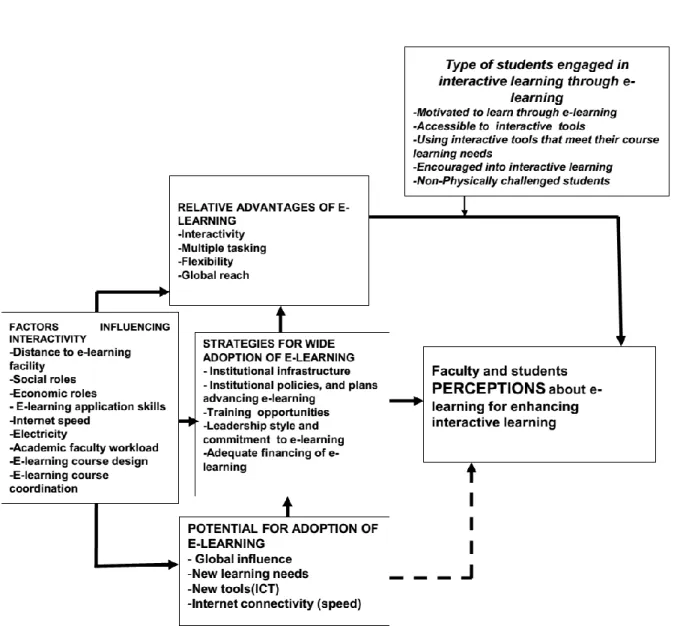
Key constructs considered in the model are Relative advantages of e-learning over other forms of teaching and learning for enhancing interactive learning, Strategies for wide adoption of e-learning among students and academic faculty, Type of students engaged in e-learning for interactive learning purposes, Potential for adoption of e-learning for interactive learning purposes and Factors influencing interactivity when learning through e-learning.
28
29
Relative Advantage of E-Learning
This study considered relative advantage of e-learning over other form of teaching and learning as the strongest predictor of positive perception by students and academic faculty towards the use of e-learning for interactive learning purposes. Determinants of relative advantage of e-learning were interactivity, multiple tasking, global reach and flexibility. This means HLIs faculty and students would perceive e-learning to have potential for interactive learning if they consider the technology in question provides for interactivity, multiple tasking, flexibility and global reach in teaching and learning.
While traditional forms of teaching and learning mainly provide limited interactivity mainly in the form of same time (synchronous) interactive teaching and learning, e-learning provides for higher forms of interactivity in the form of both timely (synchronous) and delayed (asynchronous) interactions. Students, who prefer same time interactions, could interact through video conferencing and through online charts and those who prefer delayed interactions, can use e-mails and discussion forums and other tools that allows for delayed interactions.
Flexibility in Learning: Flexibility in learning which allows students to study at their own convenience in terms of time and place was considered as another teaching and learning situation made possible by e-learning. Students who are shy to take part in face to face interactions, those who need time to form and structure their opinions before presenting their views as well as those with other social and economic roles could learn through interactive learning tools such as threaded discussions and delayed discussion. Traditional forms of teaching and learning cannot adequately accommodate such flexibility, in this regard it was felt that students whose interactive learning needs were limited by their
30
characteristics and large class size would find e-learning to have relative advantages over traditional forms of teaching and learning in enhancing interactive learning.
Multiple tasking : While conventional forms of interactive teaching and learning, force students to leave aside their social and economic responsibilities while studying, e-learning allows for multiple tasking in that students’ can be engaged in interactive learning while continuing with their employment and their social responsibilities (Mushi, 2006). It was thus conceived that students who find it difficult to leave aside their social and economic responsibilities to pursue fulltime studies would perceive e-learning to have relative advantages over conventional forms of teaching and learning.
Global Reach: Technological developments have made it possible for students to interact with their lectures and fellow students while being geographically apart to the extent of achieving a global reach. Students can even register for courses offered by an institution in another continent and still be able to communicate with other students in different parts of the globe; this aspect of e-learning was felt to have relative advantages over traditional forms of teaching and learning.
In this model it was considered that relative advantages of e-learning over traditional forms of teaching and learning mediates students engaged in interactive teaching and learning indicated by a single pointed arrow.
Type of Students Engaged in Interactive Learning Through E-Learning
The second construct considered in this model were the types of students engaging in interactive learning through e-learning. In this model, the type of students expected to be engaged in interactive forms of teaching and learning through e-learning were those
31
exposed to tools that provide high interactive learning, those encouraged into using interactive learning by their teachers, highly motivated students and those accessible to e-learning facilities. In this model students engaged in interactive e-learning was directly considered to positively influence academic faculty and students perceptions about e-learning as indicated by a single pointed arrow (Roblyer and Knezek, 2003).
Strategies for Wide Adoption of E-Learning
Though relative advantage of e-learning over other forms teaching and learning was considered very useful, the assumption that academic faculty and students would perceive interactive learning through e-learning positively merely out of perceived relative advantage over interactions enabled through traditional forms of teaching and learning was considered to be misleading (Umrani-Khan and Iyer, 2009). It was regarded that academic faculty and students can perceive e-learning not effective for interactive teaching and learning for reasons related to strategies used to effect wide adoption of e-learning (Umrani-Khan and Iyer, 2009).
For this case the fourth element considered in the model was Strategies for wide adoption and use of e-learning for interactive teaching and learning purposes which included: Institutional e-learning infrastructures, institutional e-learning policies and plans, training opportunities, leadership style and commitment and adequate financing (Ely, 1999; Schaper and Pervan, 2004). In due regard, HLIs and faculty would develop positive perceptions towards use of a particular technology for interactive teaching and learning purposes if they believe that HLIs in question has in place befitting strategies that meet their interactive teaching and learning needs (Ely, 1999; Fee, 2009).
32
This study regarded e-learning policy as essential document without which implementation of interactive teaching and learning through e-learning would be difficulty. It was considered that all HLIs which were using e-learning would have in place ICT policy which guides implementation of e-learning. Planning was also considered as essential ingredient of an effective strategy that is aimed at effecting wide adoption of e-learning, the most