Mohammed Alshahrani
A thesis submitted for the degree of Doctor of Philosophy
School of Computer Science and Electronic Engineering University of Essex
Textual data nowadays is being generated in vast volumes. With the proliferation of social media and the prevalence of smartphones, short texts have become a prevalent form of information such as news headlines, tweets and text advertisements. Given the huge volume of short texts available, effective and efficient models to detect the emotions from short texts become highly desirable and in some cases fundamental to a range of applications that require emotion understanding of textual content, such as human computer interaction, marketing, e-learning and health.
Emotion detection from text has been an important task in Natural Language Processing (NLP) for many years. Many approaches have been based on the emotional words or lexicons in order to detect emotions. While the word embedding vectors like Word2Vec have been successfully employed in many NLP approaches, the word mover’s distance (WMD) is a method introduced recently to calculate the distance between two documents based on the embedded words. This thesis is investigating the ability to detect or classify emotions in sentences using word vectorization and distance measures. Our results confirm the novelty of using Word2Vec and WMD in predicting the emotions in short text.
We propose a new methodology based on identifying “idealised” vectors that cap-ture the essence of an emotion; we define these vectors as having the minimal distance (using some metric function) between a vector and the embeddings of the text that contains the relevant emotion (e.g. a tweet, a sentence). We look for these vectors through searching the space of word embeddings using the covariance matrix adap-tation evolution strategy (CMA-ES). Our method produces state of the art results,
This thesis is dedicated to
My Parents, My siblings, My wife and My children
My grateful and sincere thanks goes to my supervisors Professor Maria Fasli and Dr Spyros Samothrakis for their help, guidance, motivation and usual support during this period of study. I really appreciate their help, guidance, valuable comments, feedback and time throughout the time of this study.
My hearty thanks filled with gratitude to my parents for their love, kindness, care and support. Also my deepest thanks to my siblings for their support and encouragement. To all of you my parents, brothers and sisters I am so sorry for missing many occasions and being away when you needed me.
I am also grateful to all my colleagues and friends. I apologise, I’m not going to mention anyone in particular. There have been many of you over the years, and you have all been great colleagues and good friends.
I would like to take the opportunity to express my gratefully thanks to my lovely wife (Zainab) who have been besides me all the time.
My deepest emotions are for my children Ali and Hazim, I know that I was busy with my study in the last few years. I have now finished my PhD thesis, and I will spend more time with you.
1 Introduction 14
1.1 Overview . . . 14
1.2 Understanding Emotions . . . 15
1.3 Research Aims and Objectives . . . 16
1.4 Contributions . . . 18
1.5 Thesis structure . . . 19
1.6 Publications . . . 21
2 Literature review 22 2.1 Introduction . . . 22
2.2 Formal and Informal Text . . . 23
2.3 Sentiment Analysis . . . 23 2.4 Emotion Frameworks . . . 25 2.4.1 Discrete Frameworks . . . 25 2.4.2 Dimensional Framework . . . 26 2.5 Emotion Detection . . . 28 2.5.1 Unsupervised Learning . . . 28 2.5.2 Supervised Learning . . . 33 2.6 multi-classification . . . 40
2.7 Emotion Related Lexicons . . . 41
2.8 Word Embedding . . . 42
2.8.2 Continuous Skip-gram Model . . . 43 2.8.3 Word2Vec Embedding . . . 44 2.8.4 GloVe Embedding . . . 44 2.8.5 ELMo . . . 45 2.8.6 BERT . . . 46 2.8.7 XLNet . . . 46
2.9 Word Mover’s Distance . . . 46
2.10 Evolution Strategies . . . 48
2.10.1 Brief history . . . 49
2.10.2 (1+1)-ES . . . 50
2.10.3 CMA-ES . . . 51
2.10.4 NES . . . 52
2.10.5 Separable NES (SNES) . . . 53
2.11 Summary . . . 54
3 Emotion detection using WMD 56 3.1 Introduction . . . 56
3.2 Dataset . . . 58
3.3 WMD-ED approach . . . 59
3.4 Experiments . . . 59
3.4.1 Word Net Affect experiment . . . 59
3.4.2 WMD-ED experiment 1 . . . 61
3.4.3 WMD-ED experiment 2 . . . 61
3.4.4 WMD-ED Experiments 3a and 3b . . . 62
3.4.5 Bootstrapping . . . 64
3.5 results . . . 64
3.5.1 Word Net Affect experiment . . . 64
3.5.2 WMD-ED Experiment 1 . . . 65
3.5.3 WMD-ED Experiment 2 . . . 66
3.5.5 bootstrapping . . . 77
3.5.6 Surrounding seed words . . . 77
3.6 Discussion . . . 79
3.7 Summary . . . 80
4 ES for emotion detection 82 4.1 Introduction . . . 82 4.2 Datasets . . . 84 4.3 Benchmark . . . 87 4.4 Methodologies . . . 88 4.4.1 WMD-ED . . . 88 4.4.2 CMA-ES . . . 89 4.5 CMA-ES Experiments . . . 89 4.5.1 WMD-ED Experiment 1 . . . 90 4.5.2 WMD-ED Experiment 2 . . . 90 4.6 ES Search Exp . . . 91 4.6.1 SNES . . . 91 4.6.2 CMA-ES . . . 93 4.7 Results . . . 95 4.7.1 WMD-ED Experiment 1 . . . 95 4.7.2 WMD-ED Experiment 2 . . . 95 4.7.3 ES Search Exp . . . 96 4.8 Different Datasets . . . 109 4.8.1 ISEAR Dataset . . . 109 4.8.2 EmoContext Dataset . . . 111 4.9 Different embedding . . . 112
4.9.1 Exploring domain specificity using GloVe . . . 112
4.9.2 Emotion Embedding . . . 114
4.10 Discussion . . . 115
5 Conclusions 119 5.1 Summary and Contributions . . . 119 5.2 Future Work . . . 121
2.1 Country and Capital Vectors in Word2Vec Projected by two dimen-sional PCA (Image taken from [66] page 5). . . 45 2.2 Illustration of WMD between documents while (top) with equal BOW
(Bottom) with different count of words (Image taken from [57] page 3). 47
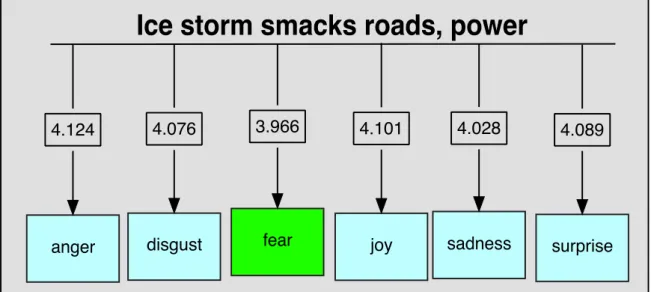
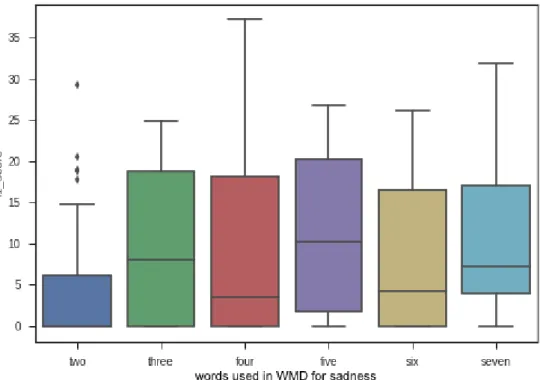
3.1 An example of WMD distances calculated directly for the six different emotions - the algorithm relates the sentence to “fear” - the word with the shortest distance from the sentence. . . 60 3.2 PCA of WMD-ED Experiment 2 seed words) . . . 68 3.3 WMD-ED Experiment 3a for anger - with basic word “anger” included
in the seed words . . . 71 3.4 WMD-ED Experiment 3a for disgust - with basic word “disgust”
in-cluded in the seed words . . . 71 3.5 WMD-ED Experiment 3a for fear - with basic word “fear” included in
the seed words . . . 72 3.6 WMD-ED Experiment 3a for joy - with basic word “joy” included in
the seed words . . . 72 3.7 WMD-ED Experiment 3a for sadness - with basic word “sadness”
in-cluded in the seed words . . . 73 3.8 WMD-ED Experiment 3a for surprise - with basic word “surprise”
in-cluded in the seed words . . . 73 3.9 WMD-ED Experiment 3b - basic word “anger” is deliberately not
3.10 WMD-ED Experiment 3b - basic word “disgust” is not deliberately included in the seed words . . . 74 3.11 WMD-ED Experiment 3b - basic word “fear” is not deliberately
in-cluded in the seed words . . . 75 3.12 WMD-ED Experiment 3b - basic word “joy” is not deliberately
in-cluded in the seed words . . . 75 3.13 WMD-ED Experiment 3b - basic word “sadness” is deliberately not
included in the seed words . . . 76 3.14 WMD-ED Experiment 3b - basic word, “surprise” is deliberately not
included in the seed words . . . 76 3.15 The python code used to obtain the most similar words . . . 78 3.16 The PCA of the surrounding seed words while separated . . . 79
4.1 Word-cloud of TEC corpus including annotation (hash-tag) words like joy, sadness and surprise. . . 86 4.2 Word-cloud of TEC corpus after removing the annotation words, like
joy and sadness (so that corpus can be used for training and testing). . 87 4.3 10-fold cross validation plots of CMA-ES best of generation scores, for
the 95th percentile for anger . . . 97 4.4 10-fold cross validation plots of CMA-ES best of generation scores, for
the 95th percentile for disgust . . . 98 4.5 10-fold cross validation plots of CMA-ES best of generation scores, for
the 95th percentile for fear . . . 98 4.6 10-fold cross validation plots of CMA-ES best of generation scores, for
the 95th percentile for joy . . . 99 4.7 10-fold cross validation plots of CMA-ES best of generation scores, for
the 95th percentile for sadness . . . 99 4.8 10-fold cross validation plots of CMA-ES best of generation scores, for
2.1 Basic emotions of discrete frameworks . . . 27
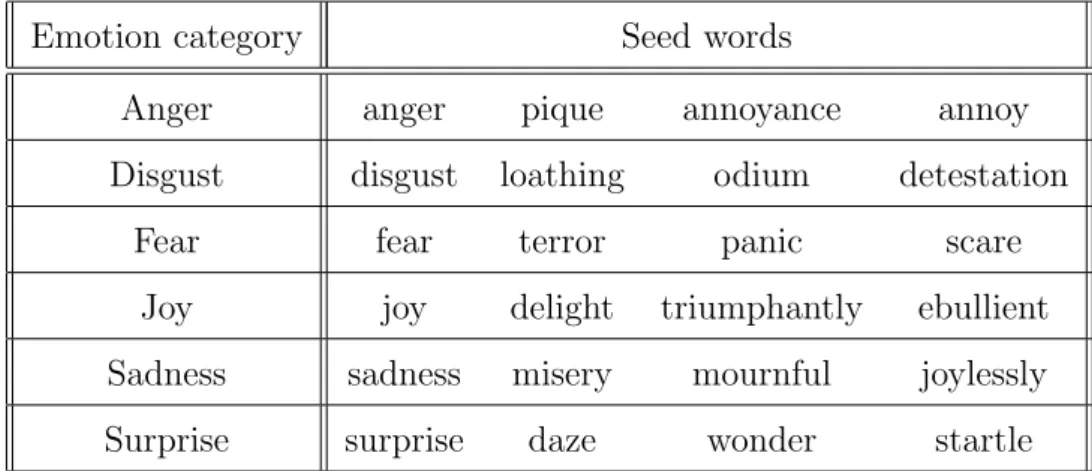
3.1 The emotion seed words that achieved the best results . . . 63
3.2 Performance of the Word Net Affect experiments . . . 65
3.3 Overall average results . . . 65
3.4 WMD-ED Experiment 1 results - including correct and incorrect clas-sification . . . 66
3.5 WMD-ED Experiment 2 overall F1 average results . . . 67
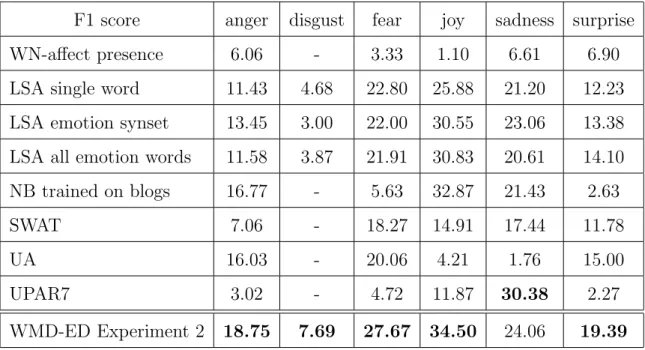
3.6 WMD-ED Experiment 2 F1 score results for each system for every emotion category . . . 68
3.7 WMD-ED Experiment 2 F1 score results compared with recent results from [16] . . . 69
3.8 Results obtained using the bootstrapping . . . 77
3.9 The emotion seed words which achieved the best results . . . 77
3.10 Results obtained using the surrounding seed words . . . 79
4.1 The emotion “idealised” words that achieved the best results for Ex-periment 1 . . . 91
4.2 The emotion “idealised” words that achieved the best results for Ex-periment 2 . . . 91
4.3 Experiments results . . . 95
4.4 Most similar words to each vector from cross-validation for each emo-tion and most similar word to the mean . . . 101
4.11 The F1 score of the results yielded by calculating the WMD distance between the mean vectors and the tweets . . . 102 4.5 The most similar words to the emotions anger and not-anger, the latter
being all other emotions . . . 103 4.6 The most similar words to the emotions Disgust and not-Disgust, the
latter being all other emotions . . . 104 4.7 The most similar words to the emotions Fear and not-Fear, the latter
being all other emotions . . . 105 4.8 The most similar words to the emotion Joy and not-Joy, the latter
being all other emotions . . . 106 4.9 The most similar words to the emotion Sadness and not-Sadness which
is the position of other emotions . . . 107 4.10 The most similar words to the emotions Surprise and not-Surprise, the
latter being all other emotions . . . 108 4.12 ISEAR experiments results . . . 110 4.13 EmoContext experiments results . . . 112 4.14 The emotion seed words that achieved the best results in the course of
the GloVe experiment . . . 113 4.15 GloVe experiment’s results . . . 113 4.16 The emotion seed words that provided the best results in the
Emotion-Word2Vec experiment. . . 115 4.18 Emotion Wor2Vec Experiment’s results . . . 115 4.17 Emotion embedding - most similar words for each category . . . 116
Introduction
1.1
Overview
Written text is a powerful tool which is not only used to communicate content in terms of data and information but it can carry emotional expression as well. It is clear that textual data such as stories, poems and novels carry with them a certain emotional content. However, the generated textual data, nowadays, is tremendous especially through the use of new technologies such as social media and the prevalence of smartphones. Of course, people use social media to post and express their emotions and feelings instantly via smartphones. Since emotions are involved in this huge volume of textual data, wherefore being able to automatically detect and identify emotions has become highly desirable and in some cases a requirement [112].
Emotions may be articulated by written text which is known as text based emo-tion. Nowadays, writings take many forms of social media posts, tweets, micro-blogs, news articles, etc. The content of these posts can be useful resource for emotion de-tection. Different types of dataset such as new headlines, tweets and micro-blogs are conceptually different and they might convey or contain emotions in different ways. For example, news headlines are written by experts to attract the reader. While, in tweets emotional state may be included as a hashtag or emoticons. Not to mention the fact that dataset like news headlines are written in a formal way while datasets like tweets are written in informal way which makes it more complicated.
Most works that have been presented in the literature and are described in this thesis can be considered to have used supervised learning. In the course of our research work, only a few studies that have proposed an unsupervised method for detecting emotions expressed in short informal text (tweets) such as [28]; this represents the motivation for at least part of the present study. Furthermore, in the other part of the study we used semi supervised learning while not relying on specific emotion keywords or lexicon. This present the second motivation by trying to generate and optimise vectors that capture the essence of emotion which can be used as an emotion representative, instead of the real emotional word vectors, in the process of emotion detection distance measurements. To the best of our knowledge we are the first to optimise artificial vectors which can be used to represent emotion category in emotion detection [4]. This publication [4] was published in July 2019. While, a relevant work [8] was published later in October 2019.
In this thesis we are interested in developing and extending emotion detection methods for short text such as news headlines and social media messages. We want to focus on the methods that deal with the word embeddings. Instead of dealing with text, word embeddings transform words into vectorial representations, thus allowing distance calculations. Thus, we seek to adapt the distance calculation methods to classify the emotion type based on the calculated distances between the embeddings of the sentences and emotional word vectors. We will also explore whether the use of optimization methods would be effective to generate vectors which can represent emotion types optimally in order to be used for emotion detection.
1.2
Understanding Emotions
Psychology and behaviour science have studied the emotions because it is an important aspect of human nature [101]. Computer science researchers are becoming increasingly interested in making emotion in text understandable by Natural Language Processing (NLP). The word vector representation, such as Word2Vec [66], is one of the proposed techniques to approach such problems. It can be argued that word vectorization
with representations for semantic relationships would be useful for improving the effectiveness of NLP applications [67]. Being able to detect the emotional state from the produced text would be very beneficial in many situations. Emotion detection from text systems has many potential applications such as:
• In Human computer interaction: based on the user’s emotional state, emotion detection could be used to produce a recommendation or sort of an interaction [111]
• In marketing: customers’ reactions to products can be analysed by using emotion detection approaches in order to make changes in a product and create a better relationship with customers [38]
• In e-learning: using emotion detection of the users’ state in e-learning applica-tions would help to create more effective tutoring systems [104]
• In health: psychologists can use emotion detection to predict the patients’ emo-tional state in the long term so they can infer whether a patient may be facing depression or stress [21]
Many approaches have been proposed towards detecting emotion categories in textual data. Some of these approaches will be mentioned in the following chapters of this thesis. Most of these approaches relied on a limited number of emotion keywords or a word lexicon and number of other such approaches were focused only on specific domain and tend to be inadequate in terms of being generalised to other domains. However, the problem is still unresolved, while the existence of word vectorization and distance measurements shows a possible solution.
1.3
Research Aims and Objectives
In this thesis, we are interested in developing methods and techniques by which to detect emotions from various types of short text, typically tweets and news headlines. We intend to focus on methods that deal with word embeddings. Hence, the main
aim is to study emotion detection methods from short text by exploiting and un-derstanding the word embeddings. Word embeddings have shown promise in similar domains by capturing the essence of the relationships between the different words. With respect to emotions, in general there are relationships between the emotional words. Thus we want to explore the word embeddings in regards to emotion detection. Guided by the above aim, we look forward to achieving the following core objectives:
• Textual emotion detection by calculating the distance between emotional words and general text using word embedding representation.
As short texts have become a prevalent form of information such as news headlines, tweets and text advertisements, we seek to develop methods that can detect the emotions within the short text by the aid of word embeddings. News headlines can be considered as short texts; which are typically written in emotional language and mainly to intrigue people. Therefore, it was considered as the source of data for part our experiments because its texts’ are written in formal language which is compatible with Google’s pre-trained Word2Vec embedding. We intend to develop a method for identifying emotions from news headlines, by using the word embedding approach and Word Mover’s Distance (WMD) [57]. We want to see if the emotions which are detected using the proposed method can better detect the emotions within text while training data labeling, ontologies and term extractors were not required.
• Search the word vector space for an “idealised” emotional vectors in order to identify emotion in informal text (tweets).
In regards to understand emotions from informal text we have chosen Tweets. As Tweets consist of a limited number of characters. Furthermore, Twitter1 is a social
media platform available and freely accessible to people regardless of their culture, age or education. Moreover, it is one of the most popular microblogging platforms [58] in existence, with almost 500 million tweets being posted on a daily basis [110]. More importantly, many of tweets load emotions as users of Twitter may express and
post their thoughts and emotions in real-time on a daily or shorter-duration basis. We intend to develop a method for optimising an “idealised” emotional vector using evolutionary strategies in order to be used for emotion detection. we intend to adopt the Euclidean Distance function to calculate the distance between the word embedding of tweets and the “idealised” emotional vector. We want to find out if the proposed method is going to show good results in detecting emotions from tweets by adopting an evolutionary strategy with Word2Vec through distance functions.
1.4
Contributions
The work presented in this thesis has two main contributions. The first makes a novel contribution in the field of emotion detection in literature. While the second contributes in using evolutionary algorithms to find optimal vectors for emotion de-tection. The main contributions are as follows: we have come across many literature papers that are making contribution in textual emotion detection field. Although we have found out that these approaches are either relying on a limited number of keywords or word lexicon like: [56], [98], [10], [25], [13], [115], [95] and [6] or they are performed only on specific domain and tend to be inadequate to be applied on different domains like: [59], [38], [3] and [30].
The vast availability of both online and offline data can augment our understanding of emotions with studies of scale previously unthinkable. Moreover, a recent method-ology has been developed in neural networks that transforms words into their vectorial representation [67]. It is possible to calculate the distance between emotional words and general text using this transformation [57].
Therefore, we focus on identifying and investigating what are the best novel meth-ods of word vectorization and distance measures towards identifying emotions, while at the same time aim at cataloguing the emotional content of documents across different genres. In particular, this work is motivated by Word Mover’s Distance (WMD) [57]. Unlike in other approaches, training data labeling, ontologies and term extractors are not required in this approach. Therefore, we want to demonstrate that using word
vectorization (Word2Vec) and WMD would gain a better results in regards to emotion detection. To the best of our knowledge, this work presents the first investigation into using the word vector representation along with WMD to detect emotions in text, as it was published in 2017 [5]. Not to mention that, a relevant work was published after our publication [85]. Emotion detection goes beyond sentiment analysis by detecting a set of emotions, through the expression of texts, for division of text. By considering the fact that, in this approach, data labeling, ontologies and term extractors are not required, our results surpassed the benchmark approaches’ results across all emotion categories.
From emotion detection and recognition stem the idea of optimal vector gener-ation that has the best guess of emotions. Generating an optimal vector that can be used effectively in emotion detection is challenging. We focus on identifying and demonstrating the best novel method of the evolutionary algorithms that should be able to optimise the optimal vector for each emotion category. Moreover, to the best of our knowledge evolutionary algorithms have not been adopted to optimise vectors for emotion detection in text before. We propose the new methodology based on iden-tifying “idealised” words that capture the essence of an emotion. We look for these “idealised” vectors through searching the space of word embeddings using covariance matrix adaptation evolution strategy ( CMA-ES ). Our results which we achieved by using this new methodology for emotion detection surpassed the benchmark’s re-sults which produces state of the art rere-sults, surpassing classic supervised learning methods.
1.5
Thesis structure
The rest of the thesis is composed of 5 chapters whose structure is as follows:
Chapter 2 summarises the main literature review and related work done on emotion detection. We start by defining sentiment analysis and review some of the related approaches. In the next section, we present the topic emotion frameworks, which are the discrete frameworks and the dimensional frameworks. Next we review many
emotion detection systems including two parts: unsupervised learning and supervised learning. After that, we illustrate the emotion related lexicons. Subsequently we discuss the formal and informal texts and next we explain the word embedding, which is transforming words into vectorial representations. Then, we introduce the word mover’s distance. After that, we describe the evolution strategies methods. First we introduce a brief history of evolutionary strategies. This is followed by a presentation of the (1+1)-ES which is the simplest evolution strategy (ES). The next subsection reviews the CMA-ES. After that we introduce the Natural Selection Strategies (NES) and Separable Natural Selection Strategies (SNES) which are another methods of evolution strategy. Next we present a summary of the chapter.
Chapter 4 describes the developed method for emotion detection using WMD. We introduced the dataset. After that, we show how WMD method is used in association with word embedding in order to detect emotion categories. Then we present the ex-perimental work, which starts by showing how we followed the preliminary approach, then present the main approach and how the experiments were carried out. After that, two experiments were carried out to distinguish the best approach whether to use basic emotion seed words deliberately or not. Moreover, we present the find-ings. Furthermore, a discussion is presented. Finally, we conclude the chapter by a summary.
In Chapter 5, we propose a new methodology based on identifying “idealised” words, which capture the essence of an emotion, by using evolution strategies to see whether it performs well in emotion detection with the association of word embedding and calculating the distance using some metric function. We discuss and analyse the performance of this methodology on tweets dataset. Moreover, we test our method on two other datasets. One of them, called ISEAR, contains formally written texts. The other one, called EmoContext, contains emotional dialogues (three-turn conversation per dialogue). The purpose of this test is to assess the robustness of our method against different domains of texts. Next, we describe different embedding experimental work and results. Furthermore, a discussion is presented. Finally, We summarise the
chapter.
Finally, in Chapter 6, we conclude the thesis with a summary regarding the work presented, the research contributions and the novelty of the achieved results. Fur-thermore, the planned future work is outlined which shows the research scope and the recommendations that might assist in future work in the same topics.
1.6
Publications
Portions of this thesis were produced in the following publications:
1. Alshahrani, M., Samothrakis, S., Fasli, M. (2017, October). Word mover’s distance for affect detection. In 2017 International Conference on the Frontiers and Advances in Data Science (FADS) (pp. 18-23). IEEE. [5]
2. Alshahrani, M., Samothrakis, S., Fasli, M. (2019, July). Identifying idealised vectors for emotion detection using CMA-ES. In Proceedings of the Genetic and Evolutionary Computation Conference Companion (pp. 157-158). [4]
3. More work performed as part of this thesis but has not been published yet, it will be prepared for another publication on the IEEE Transactions on Affective Computing.
Literature review
2.1
Introduction
The topic of emotion detection from texts is a diverse one. Emotion detection or emotion analysis of texts has the mission of identifying emotions from natural lan-guage texts such as news headlines, articles, customer reviews, tweets and blog posts. Emotion detection from textual data has become a field of interest within Natural Language Processing (NLP) and text analytics over the last few years [25] [1] [95]. Deducing emotions and opinions from textual information is a complicated task be-cause it relies on the information that can be gathered from the text only rather than on any information from external features such as body language [61] or tone of voice. This chapter will present an overview of the background to the research area and a literature review of relevant studies etc., including those focused on some of the existing approaches to detecting emotions in text. This literature review chap-ter covers the following aspects (in sequence): Formal and Informal Texts; Sentiment Analysis; Emotion Frameworks; Emotion Detection; Emotion Related Lexicons; Word Embedding; and finally, Word Mover’s Distance.
2.2
Formal and Informal Text
Inferring emotions from textual data is a challenging task because it depends on the information retrieved from text alone and from no other expressive features of an utterance, like face affect or tone of voice [39]. Textual data can be divided into two types: formal text and informal text [50]. It is generally accepted that recognising the emotions expressed in the latter type of text is more complicated than the same task in relation to the former [79]. This is for a number of reasons that will be discussed in more detail in this section.
Formal writing is commonly used in research papers, official documents and liter-ary arts such as poetry and novels whereas informal text is used in daily conversations, text chat and generally in social media applications such as Twitter and Facebook [49]. However, the nature of informal text makes it more difficult to analyse or to retrieve information from - due to the following [50]: Firstly, informal text may not follow the prescribed grammatical rules and may be less well-structured than for-mal text; Secondly, in inforfor-mal text the use of slang words and phrases is typical; Thirdly, abbreviations such as “OMG” referring to “oh my God” are commonly used; Fourthly, messages may contain spelling mistakes; Fifthly, there may also be incorrect repetitions of some letters in some words; Finally, some messages may include emoji, hash-tags, URLs and/or icons – which, of course, are not part of standard language.
2.3
Sentiment Analysis
One of the sub-fields of Natural Language Processing is sentiment analysis. Sentiment analysis is a computational technique that is used to identify the polarity of a text -that is, whether it is positive, negative or neutral [37]. Further, sentiment analysis can be considered as being the most analogous topic to emotion detection in the context of text [71].
According to Bhadane, Dalal, and Doshi [12] there are two major approaches to sentiment classification: machine learning, and lexical. Support Vector Machines
(SVMs) and na¨ıve Bayes are the commonly used machine learning methods employed in sentiment analysis. On the other hand, the lexical approach has many variants -such as the baseline approach, Part of Speech tagging (PoS), WordNet, stop words, the negation method, N-grams and stemming [12].
With regard to differences in data scope, Kang, Yoo, and Han [47] have argued that a lexicon assembled for analyses in one domain, such as movie reviews, will not work sufficiently well in another, e.g., restaurant review sentiment analysis. They stated that the lexicons which are constructed for general or specific domains wouldn’t have a clear polarity in some occasions. For instance, the polarity of the word “delicious” vary in the general domain and in the restaurant review. Therefore, they proposed a new type of lexicon based on unigrams and bigrams. Furthermore, to narrow the accuracy gap which is generally exists when making positive and negative classifications, two improved na¨ıve Bayes approaches were created.
A lexicon-based approach to performing text sentiment analysis was proposed by Singh, Bagla, and Kaur [98]. This approach was applied to classifying whether a Facebook 1 post’s comment was positive, neutral or negative. In that research,
a dataset of about 7,000 positive and negative words was created. It is useful to note, here, that the proportion of negative data encountered was about 70%. The words in the lexicon were labeled with +1 for positive and -1 for negative. After data collection, the pre-processing steps included removing punctuation, articles, pronouns, prepositions,“Wh” words and auxiliary verbs. Then the adjectives, verbs and adverbs were identified and assigned a magnitude of polarity. These magnitudes were 4, 3, 2 and 1 for adjectives, verbs, adverbs and simple words respectively. The sign changes depended on the label of the word. The authors of [98] stated that the reason behind assigning these different magnitudes was that the different types of word differed critically in terms of their influence on the sentiment expressed by a text overall, the adjectives having the most influence. Thus, subsequently, overall comment polarity could be calculated.
Gon¸calves et al. [35] made a comparison between the eight most widely used meth-ods in sentiment analysis: emoticons, linguistic inquiry and word count, SentiNet, SentiStrength, SentiWordNet, happiness index, SailAil sentiment analyzer and the PANAS-t (psychometric scale)). They discovered that, across all different literature domains, it was still the case that no best method could be found. Moreover, they concluded that their own combined method achieved better results.
2.4
Emotion Frameworks
Scientific studies and psychological literature have debated the categorization of hu-man emotions since before the 1960s [29]. While Sentiment Analysis (SA) research frameworks focus on classifying documents or sentences as either positive or negative -as does, for instance, The General Inquirer (GI) [100] - this section looks more closely on the theories that are focused on the classification of documents or sentences into more specific emotion categories. Even though it is outside the scope of this work to describe or list all of the various emotion frameworks which have been proposed, nevertheless, it is important to mention the main groups and the most commonly used frameworks. Discrete frameworks and dimensional frameworks are the two most pre-dominant categories in this regard [117]. Hence, the following section 2.4.1 presents some of the most common discrete models relating to emotions, and the subsequent section 2.4.2 discusses some of the most common dimensional models in this area.
2.4.1
Discrete Frameworks
In a discrete framework, distinct categories of emotions are employed. Ekman’s is one of the most commonly used basic emotional frameworks that follows the discrete model [24]. The six basic emotions as identified in Ekman’s framework are anger, disgust, fear, joy, sadness and surprise - see table 2.1. A further study by Shaver et al. [96] suggested the same six basic emotions but included “love” instead of “disgust”. These six emotion categories (as given in table 2.1) are used as the main branches of
a tree structure in [96] where the model specifies that each branch has a further cate-gorization. Plutchik [80] defined eight basic emotions “trust” and “anticipation” were added to Ekman’s six categories. A bipolar taxonomy was considered in Plutchik’s work: joy versus sadness, trust versus disgust, anger versus fear, and surprise versus anticipation. On the other hand, Izard [46] argued that there are ten basic emotions which included Ekman’s emotions except sadness (see table 2.1). Noticeably, there is not much in the way of re-enforcement across these theories, as regards the taxonomy of emotions, but it can be seen from table 2.1 that anger, fear, joy, surprise and sad-ness are among the most commonly suggested categories. However, using the discrete model is easier and clearer for humans to indicate or define the emotions in a text because its categories are comprehensible and natural to humans. Furthermore, Ek-man’s model has been used in this thesis to evaluate our approaches for three reasons. First, it was extensively verified by psychologists [2]. Second, it is the most popular used model [81] especially in discrete categorization [63]. Third, as Ghazi, Inkpen, and Szpakowicz [31] stated that Ekman’s model [24] is the most commonly adopted emotion model in NLP studies.
2.4.2
Dimensional Framework
Emotions in a dimensional framework are distributed, as the name suggests, across two or more dimensions. The circumplex model is one of the most popular dimensional models of emotion [88]. The authors suggested that emotions can be defined using two dimensions: valence and activation. “Valence” refers to the pleasure dimension, i.e, positive to negative emotions while activation, otherwise known as arousal, represents the intensity of the emotion.
The Pleasure, Arousal and Dominance (PAD) model, is another dimensional frame-work which uses three dimensions [89]. Pleasure and arousal measure the pleasantness and intensity of an emotion respectively, whereas the dominance dimension represents whether the emotion is dominant or submissive. However, there are three shortcom-ings for using the dimensional model. First, using dimensional labels are ambiguous
emotion Ekman [24] Shaver [96] Pultchik [80] Izard [46] anger fear joy surprise distress sadness disgust love contempt trust interest anticipation guilt shame
to humans [53] especially to lay person such as in self labelling data like tweets hash-tags which makes using the dimensional model impossible. Second, it is unnatural and more difficult for humans to identify minimal numbers of dimensions for differ-ent emotions in text. Thirdly, some categories of emotions are indistinguishable, for instance, both categories anger and fear overlap in the same quadrant of negative valence and arousal levels [53].
2.5
Emotion Detection
Clearly, emotions can be recognized by facial expression, by tone of voice and by other non-verbal cues, but these are not the only ways emotions can be detected. Classifying the texts, documents or sentences into different emotion categories such as anger, fear, disgust or joy is the task which is most commonly referred to as emotion detection [115, 13]. Emotion detection from texts is more complex than sentiment analysis because its outputs are not limited to just positive, negative and neutral. This section will cover unsupervised learning and supervised learning.
2.5.1
Unsupervised Learning
Unsupervised learning comprises a class of machine learning methods which are aimed at learning from data which has not been annotated or labeled [72]. In other words, it is a method that will find patterns without the need for human guidance or supervi-sion. Thus, the following approaches are considered to be unsupervised because they do not require annotated data for training purposes.
Kim, Valitutti, and Calvo [51] proposed some unsupervised learning techniques for emotion detection, based on both dimensional and categorical models. Three dif-ferent datasets were used, ISEAR, SemEval-2007 Affective Text, and a collection of children’s fairy tales. As regards categorical models, they used three different tech-niques: Latent Semantic Analysis (LSA), Probabilistic LSA (PLSA), Non-negative Matrix Factorization (NMF)- all using Word Net Affect [103] as a lexicon. In terms of
dimensional models, they used just Affective Norm for English Words (ANEW). Co-sine similarity between the sentence vector and an emotion vector was used to assign a sentence to the closest emotion category. Although this paper comprehensively cov-ered unsupervised emotion detection techniques, these techniques were applied only to formal texts; informal texts were not considered.
Another unsupervised emotion detection approach was proposed by Agrawal and An [1]. They started by extracting nouns, verbs, adjectives and adverbs from a sen-tence as a pre-processing step. Then, emotion vectors for such words were computed based on semantic relations involving the emotion concept. Also, the syntactical de-pendencies between the words in each sentence were considered – in order to “tune” the emotion vector. After this, the technique generated vectors for each sentence by aggregating the vectors of all the emotionally laden words in it. However, it should be noted here that this paper also looked at formal texts only.
Strapparava and Mihalcea [101] proposed both unsupervised and supervised ap-proaches, and they applied these to the News headlines dataset that was developed for SemEval 2007 [102]. This data was collected from different news websites and Newspapers such as BBC News, Google News and the New York Times. These news titles data were divided into two parts: the development data, which included 250 titles while the rest, the test data, consisted of 1000 titles [101]. Ekman’s basic emo-tions [23] were used for the data annotation; this annotation was done manually by six annotators. Each headline was tagged with at least one emotion category [101]. Uti-lizing the news data set, Strapparava and Mihalcea [101] implemented five approaches. For the unsupervised method, the Latent Semantic Analysis (LSA) vector space was adopted by three of these approaches. These three approaches adopted a Latent Se-mantic Analysis (LSA) vector space. The difference between these three approaches is that LSA is based on emotion words only; emotion words with the WordNet synset in order to take account of synonyms; or emotion words with all the labeled WordNet-Affect synsets for the same emotion. For the supervised approaches, first, the Word Net-Affect lexicon was employed to examine the presence of emotionally laden words
in news headlines, and for the second approach, a na¨ıve Bayes classifier was trained and then used [101]. Again, a limitation of these approaches is that they were used only to detect emotions in formal texts.
Strapparava and Mihalcea [101] also described three other systems (SWAT, UA and UPAR7) but these systems were by others, who participated in SemEval. These three approaches can be compared with the previous five methods described above; they all used the same dataset and were subject to the same metrics for evaluation. Each approach is briefly outlined in the following paragraphs.
The UPAR 7 was a rule-based approach developed by Chaumartin [17]. It used three different lexical dictionaries: WordNet, WordNet-Affect and SentiWordNet. De-capitalization was performed on common words as a pre-processing step. Then WordNet-Affect and SentiWordNet were employed in order to detect the emotion represented by each of the headline’s words. Finally, for each sentence, its emotional burden was classified using rules based on the examination of the main root of the dependency graph generated by the Stanford Parser as the main subject. Further, in order to obtain the emotional rating for each sentence, the rating of the ‘main’ word was multiplied by 6.
The UA [54] was another approach developed to classify emotions expressed in news headlines. This system was based on the hypothesis that a relatively frequent co-occurrence of words together with an emotion word is likely to mean that this co-occurrence expresses the same emotion (as the emotion word) very often. First, statistics were gathered from the Yahoo, MyWay, and AllWeb search engines. Second, the Point Mutual Information (PMI) technique was used to compute the emotion scores.
The SWAT system [48] was a supervised approach also developed to classify emo-tions in news headlines. In this approach, Roget’s New Millennium Thesaurus 6 was queried in order to create word emotion maps. Every word in each headline was then scored using such a map. In order to label the headline with a particular emotion, the average of the headline’s word scores was taken into consideration.
The first five approaches (as described above [101]) were applied to the same data, as has been mentioned, and were subjected to both coarse-grained and fine-grained evaluations. Moreover, Strapparava and Mihalcea [101] stated that the systems dif-fered in terms of their overall abilities. In addition, a noticeable limitation which can be gleaned from the results is that not one of these eight systems which have been described achieved the best (attained) F1 score for all or even most emotion categories.
Ezhilarasi and Minu [25] introduced an approach to classifying and recognizing emotions automatically using an ontology, relying on WordNet [68], which stores emotion verbs. This approach proceeds in three main steps: text processing, emotion ontology creation, and emotion classification. In order to extract the emotionally laden words in the first step, term extraction was applied to the input text. In the second step, emotions were inferred from the domain knowledge in order to perform concept and relationship identification, in turn, to create the emotion ontology. WordNet was then used for appropriate meaning checking and synset collection. In the last step, the synset of all the emotions encountered was used to create the ontology. Finally, based on the emotion-class hierarchy of the ontology, the sentence was classified into one of the emotion-classes. However, this approach had three main limitations. Firstly, the ontology only included verbs which contained less than 5500 verbs. Secondly, the ontology has to be recreated in order to be used for a different domain. Finally, the ontology is not published for others to re-use and build on.
In order to detect emotions expressed in emails Gupta, Gilbert, and Di Fabbrizio [38] used one of the “boosting” family of algorithms. The algorithm employed was one called BoosTexter which had been proposed by [90] as a classifier. For feature extraction, the authors used eight different feature lists which comprised a set they called “salient features”. These salient features included negative opinions, negative emotions and threats: for example, indicators that a customer was willing to take legal action. The authors [38] clarified that using salient features with n-gram resulted in significant improvements to the performance of the classifier. However, their work
only determines whether an email is emotionally laden or not; it does not annotate it in relation to any of the commonly used emotion types. Moreover, due to the following two reasons it would not be appropriate to use this approach as a first step, to filter whether the sentence is emotionally laden and then proceed with identifying the emotion, in another approach. Firstly, it is built specifically, to identify whether an email is emotional, for customer care domain. Secondly, it relied on limited size of training data which produced a limited number of words and phrases that are used as labels for salient features.
A Support Vector Machine (SVM) combined with the machine learning technique, Conditional Random Field (CRF), was used to classify emotions expressed in web blog corpora by Yang, Lin, and Chen [115]. In this approach, emoticons in the training data were considered as emotion indicators. An emotion lexicon is built by forming the features which could be used for emotion classification, sentence by sentence. The emotion category was then assigned to the sentence by the SVM classifier. The given context is considered by CRF to determine the appropriate emotion. Finally, the trained classifier was applied to the entire document. Emotions, in this experiment, were categorized as either positive or negative. The positive emotion category was further divided into happy or joyful while sad and angry were the subcategories for the negative emotion category. However, certain specific criteria were taken into account when applying classifications at the document level. For example, the emotional burden of the final sentence plays an important role in the overall emotion detection for the document. A limitation of this approach is that it relies on its own created emotion lexicon (which had a limited number of key words). Moreover, the final sentence at the document level may not, in all cases, necessarily be emotion representative of the whole text.
Aman and Szpakowicz [6] developed a method, which they tested on a blog dataset, that classified whether a sentence was emotional or non-emotional, using na¨ıve Bayes and SVM. They collected the dataset of blog posts from the web. The annotation was conducted at the sentence level and was based on Ekman’s six basic emotions plus
no-emotion and mixed-emotions classes. Each sentence was subject to two judgment processes. The authors themselves produced the first set of annotations, while another three annotators created the second set. The agreement of these two inter-annotator judgments was measured using Cohen’s kappa coefficient [19]. Further, the sentences from the blog posts were categorized into just the six basic emotions in the continued study [7]. They then applied corpus-based unigrams, the emotion lexicon features from Roget’s Thesaurus and Word Net Affect to the SVM trained classifier. They concluded that the combination of these (above) three features gave the best F1 score results in comparison to their baseline experiment - which relied on assigning each sentence the category to which the largest number of emotionally-laden words in the sentence belonged. A limitation of this approach is that it relies on words from emotion lexicons.
2.5.2
Supervised Learning
Supervised learning is a methodology whereby the learning process is provided with, alongside the input data, an annotation of this and/or the desired output. These data are required for the training phase of the model so that it can then generate outputs which are close enough to the desired outputs. The following approaches are considered to be supervised because they all require an annotated corpus for training purposes. This subsection can be divided into two main categories: lexicon-based methods and learning-based methods. Lexicon-based methods are mainly relying on predefined keywords and lexicons in order to classify emotions in text. While, learning-based methods are based on machine learning trained classifiers in order to detect emotions in text.
Lexicon-based methods
A lexicon-based approach to performing text sentiment analysis was proposed by Singh, Bagla, and Kaur [98]; the specific purpose of this approach was to classify whether a Facebook post’s comments were positive, neutral or negative. This
ap-proach was mentioned earlier in 2.3. However, despite the fact that this apap-proach was designed specifically for sentiment analysis purposes within this particular con-text, it had two main limitations in this regard. First, more than two thirds of the dataset examined in detail consisted of negative words. Second, word abbreviations were ignored by the technique employed.
An emotional lexical choice was defined by Bautista, Gerv´as, and Dıaz [10]. In this study, the proposed process was described as having two inputs, a term and an emotion, and one word as an output. While, the term here was defined by the vector (word, type) where type can be defined as: noun, adjective, verb or adverb. On the other hand, the emotion represented by a vector of emotional dimensions (activation, evaluation). In addition, it was carried out over four steps. First, a disambiguation process was performed on the term’s words – the procedure adopted for this was to select the first synset in Word Net for each word. The second step was to collect the lexical choice that represented the first synset. Thirdly, they assigned an emotional annotation to each of these lexical choices. Finally, depending on the emotion input, one output module was selected as being the one with the shortest vector from the results of calculating the Euclidean distance between the emotion which was input and the candidate words. The output of this process was positive, negative or neutral; there were no further emotion categorisations provided.
Lei et al. [59] described a technique for detecting emotions expressed in on-line news items. This method had the following phases: document selection, the Parts of Speech (PoS) were tagged then the generated lexicon-based emotions were used to estimate the emotions expressed. However, in this paper emotion detection was performed only on formal texts.
Tao [107] introduced the emotion estimation net (ESiN) which estimates the overall emotion expressed by looking at the combination of the emotion content words and emotion functional words (EFWs). Emotion keywords, modifier words and metaphor words are the three categories comprising the emotion functional words. The basic emotion values are provided by the emotion keywords. If the word is considered an
emotion keyword, then weights are assigned to six tags each representing an emotional state. Modifier words are the kind of words which influence (enhance or weaken the intensity) or change (negate) the emotional state expressed by the sentence. Metaphor words are of two types: spontaneous expressions and personal character indications; both of these types have only a latent influence on the emotional state. For both modifier and metaphor words, a coefficient is marked in the lexicon. ESiN followed three main steps in order to detect an emotion expressed in a sentence. Firstly, a PoS tagger was used to tag the input text and then the EFWs were checked and assigned emotional ratings. Secondly, a weight is assigned to the emotion keywords and the links among EFWs were found. Thirdly, a decision was made based on the emotional value and a propagation formula which used both nodes and routes. In this latter step, a word in ESiN is represented as a node that has three features: emotion states, a corresponding weight and semantics. In between these nodes there are routes, which indicate the propagation of the emotion. Such a route is composed of transmission probability, direction and a decreasing propagation coefficient. A limitation is that this experiment operated on a Chinese lexicon not an English one. The same experiment could be run in English but it is still limited to a number of emotional keywords.
A framework for emotion analysis which was focused on assessing the emotions expressed in tweets was proposed by Kumar, Dogra, and Dabas [55]; this employed opinion mining. In the proposed model, unwanted data are removed first as a pre-processing step. After this, opinion words (adjectives, verbs, and adverbs) were ex-tracted and emoticons that had an emotional meaning were replaced with a text translation. It is of note that adverbs (like “not”) were also considered by this sys-tem, as their use can change the meaning of a phrase from positive to negative or vice versa. After data tokenization, a PoS tagger was fed with the extracted words. Furthermore, a survey had been conducted on approximately 500 students in order to associate common adjectives with a number from 0 to 5, each number represent-ing one of a list of five main emotions. Moreover, each verb and adverb was given
a weight between -1 and +1, as specified in Kumar and Sebastian [56]. Then, the value vector of the adjectives was found by employing a corpus-based method while a dictionary-based approach was applied to find the semantic orientation of the verbs and adverbs. After the determination of these scores, the average score of the tweet’s emotion was calculated using a linear equation. One of the limitations of this method was that the corpus-based component only included about 1000 adjectives. Further, the verbs and adverbs recognised were limited to the most frequently used adverbs and verbs - along with their synonyms and antonyms [56].
Sykora et al. [105] created an “emotive ontology” in order to detect emotions expressed in informal texts. This approach was designed to detect emotions across a range of eight categories: anger, surprise, confusion, shame, disgust, fear, sadness and happiness. During the ontology creation process, many dictionaries were used as resources, such as: Dictionary.com, Word Net, the Oxford English on-line dictionary, the Merriam-Webster on-line dictionary and Thesaurus.com. Furthermore, in order to achieve the specific aim of detecting emotions in informal texts some slang dictionaries were taken into consideration, such as: the Dictionary of Slang, the Leicestershire Slang Page, and the On-line Slang Dictionary.
Learning-based methods
To categorise the emotions expressed by sentences taken from children’s fairy tales, Alm, Roth, and Sproat [3] proposed a method using supervised machine learning and the Sparse Network of Winnows (SNoW) learning architecture. A corpus of 185 children’s stories manually annotated with eight emotions was used in this study. The authors Alm, Roth, and Sproat [3] proposed a sentence level emotion classifier which used those annotations and employed a supervised machine learning technique based on a linear classifier, SNoW. This classifier required the input of a number of specific features - such as the first sentence in the story, the emotion words from WordNet and thematic story type. Their experiment was conducted on 22 children’s stories and the results were found to be better than the na¨ıve Bayes baseline and the results
of the Bag of Word (BOW) approach as reported in [3]. A noticeable limitation of this technique is that while it seemed to work well on children’s stories, it would be quite difficult to adapt it to other domains.
The framework presented by Shaheen et al. [95] was used to recognize the ex-pression of Ekman’s six emotions [23] within English sentences. Their methodology consisted of two main stages: an off-line stage (training) and a comparison and clas-sification stage. The first stage comprised three steps. The first step was to tag each word of the input text using the Stanford PoS tagger. In the second step, the Stanford dependency parser was applied to extract the input sentence’s dependency tree. The third step was non-emotional content removal; such content was deleted from the tree by following a set of rules - two separation rules and three deletion rules. Ignoring the sentence before the word “but” and ignoring the sentence after “as” were the two separation rules (these rules were also applied to words that have the same effect). The three deletion rules were as follows: verbs with no object and connected to WP pronouns (like “who” and “what”) or WRB adverbs (like “where” and “when”) were removed; “to be” verbs, and node and non-emotional verbs were also removed; and nodes of pronouns that have no other nodes connected to them were removed as well. This completed the off-line stage. The trees resulting from all the sentences used as training data in the first stage represented the Emotion Recognition Rules (ERRs) which were to be used in the next stage. This, the comparison and classification stage, consisted of comparing the annotated ERRs (which each exemplified a sen-tence in the training set) with the ERRs of the input sensen-tences by applying one of the three classifiers: k-Nearest Neighbours (KNN), Point Mutual Information (PMI), and Point Mutual Information with Information Retrieval (PMI-IR). This method was tested on two quite different training sets. The first experiment used the blog posts dataset from [6]. Their system achieved better results (F-score 84%) than the na¨ıve Bayes baseline (which recognized emotions based on the presence of emotion words). Moreover, this system’s results were better, across all emotion categories, than those of EmoHeart [73] with respect to the same dataset. The second experiment used a
dataset of tweets [112], which were labeled with an emotion derived from the emotion hash tags which were present. The ERR system yielded an average F-score of 84% over all the emotions except disgust (because this emotion was not covered in the dataset). The ERR system results outperformed EmoHeart [73] on this, latter, test data as well. A drawback of this approach is that it relies on annotations (limited to key words).
A multi class SVM emotion classifier for the tweets domain was presented in Balabantaray, Mohammad, and Sharma [9]. First, the collected data (a corpus of more than 8000 tweets) were manually labeled by five different annotators. The tweets were annotated in relation to seven emotional classes: neutral plus Ekman’s basic emotional classes [23] (anger, fear, sadness, disgust, joy and surprise). Then, an SVM was used for feature classification. The features presented to this were derived from the Word-net Affect emotion lexicon, the Word-net Affect emotion PoS, the Word Net Affect emotion lexicon with left/right context, adjectives, PoS, Unigrams, Bigrams, Personal-pronouns, PoS-Bigrams, Emoticons and a Dependency-Parsing Feature. In the process of this experimental work, leave-one-out cross-validation was also used.
Similarly, Roberts et al. [86] created a corpus which consisted of 7000 tweets. These tweets were manually annotated using Ekman’s [23] emotion categories and the addition of “love”. For each of these seven emotion classes, a binary SVM was used to determine whether a particular tweet expressed that particular emotion. This approach applied many sub-systems such as WordNet hypernyms, WordNet synsets, trigrams, unigrams, bigrams, and the noting of question marks and indicators of exclamation. The experiment was performed using a 10 fold cross validation.
Annotating tweets with the appropriate emotions manually is, nevertheless, very challenging and time consuming. Instead, emotional hash-tags actually contained in tweets have been used by some researchers to construct, in effect, self-labeled data – as in [69, 20, 112]. Wang et al. [112] surmised that emotional hash tag data are more accurate than manually labeled data because a post with such a hash tag has, effectively, been labeled by its author rather than by somebody else. Hasan, Agu,
and Rundensteiner [44] also argued that the conventional method of annotation is time-consuming, labour-intensive and tedious in comparison to annotation based on self-labelling.
Wang et al. [112] collected approximately 2.5 million tweets which were then la-beled automatically using the emotional hash-tags which were present. In order to verify the quality of the hash-tag annotation, 400 tweets were randomly selected and then manually labeled. Comparing the two, the manually labeled tweets and the hash-tag annotated tweets after some heuristic filtering, [112] stated that an accept-able level of consistency was demonstrated. They then explored the utilization of various different features such as differing emotion lexicons, PoS, n-grams and the processing of adjectives. For this research, two machine learning systems were used: Multinomial na¨ıve Bayes and LIBLINEAR.
The efficiency of using hash-tags for emotion self-labelling of tweets has also been validated by Hasan, Agu, and Rundensteiner [44]. Some heuristic rules were applied on the collected tweets and this resulted in their being 134,000 labeled tweets once this processing had been completed. In this study as well, a supervised classifier was trained to detect emotion. Specifically, they ran SVM and K-Nearest Neighbours (KNN) systems on the training data using features such as unigrams, emoticons, punctuation and a list of negation words.
Binali, Wu, and Potdar [13] introduced a hybrid approach to detecting emotions in text. This combines a keyword and a learning-based method. The keyword method used relied on the existence of emotion words (keywords) which could be found in an emotions lexicon. The authors [13] employed this keyword-based system as a pre-processing step which included tokenization, Part of Speech tagging (POS) and the use of gazetteer semantic information to categorise each emotion expressed in each sentence into one of the six basic emotion classes. Then, a trained SVM classifier was employed in the learning-based step; this used the pre-processing features from the first step to classify the input text according to the six classes of emotion. The final step was categorising each emotion as either positive or negative. They concluded that
96.43% of the test data were accurately classified. The limitation of this approach is that the final result was a categorisation of the input text only as either positive or negative.
Discussion
Many studies relied on annotated datasets for emotion detection such as Balabantaray, Mohammad, and Sharma [9] and Roberts et al. [86]. Whether manual or automatic annotation is used, annotation is always keyword-based since it relies on the presence of the emotionally charged words from a pre-determined emotion lexicon. However, such an approach has a number of limitations: the emotion lexicon is limited in extent, and, furthermore, some words are ambiguous or related to more than one emotion category. Moreover, in regard to manual annotation, this is time consuming due to the large quantity of training data required and other difficulties resulting from the ambiguity which arises when different people are asked to perform the annotation – based on their differing judgements.
All the studies that have been described in this subsection can be considered to have used supervised learning. In the course of our research work, we have not yet come across any study that has proposed an unsupervised method for detecting emotions expressed in short informal text (tweets); this represents the motivation for at least part of the present study.
2.6
multi-classification
Most multi-class classification approaches are based on binary classification methods. For instance, Sentiment Analysis is considered to be one verses one binary classifica-tion. moreover, Emotion detection approaches in many cases are based on The one verses rest strategies which work by reducing the problem into multiple binary classi-fication task. This single classiclassi-fication strategy is followed in this study. However, the multi-label classification will be mentioned here briefly as it is beyond the scope of this study. A sample of document or a sentence is assumed to have a single emotion while
in many cases the text can be multi-emotional which means it can contain several emotions at the same time. Probabilistic topic modeling is a suite of algorithms that aim to annotate textual documents with thematic information by using probability theory. probabilistic latent semantic analysis (PLSA) and Latent Dirichlet allocation (LDA) perhaps the most common topic models [64].
Luyckx et al. [63] proposed study on multi-label classification of emotional texts. They focued on a dataset of notes which were written by people who have committed suicide. The task is to predict labels of a note among 15 possible emotions, such as love, hopelessness, thankfulness, pride, etc.
2.7
Emotion Related Lexicons
It is common practice in emotion analysis to rely on emotion lexicons, this is especially so for studies that work on both learning-based and lexically-based methods (which, as has been said, are the ones studied here). As a lexicon is defined to be a list of words of a specific language [60], emotion lexicons are dictionaries of words that are labeled or annotated in terms of one or more of categories of emotions. This section highlights some of the predominant lexicons used for emotion analysis.
Affective Norms for English Words (ANEW) is one of the most popular emotion lexicons [14]. The ANEW lexicon consists of 1,034 English words that are related to emotions. These words have been labeled in relation to three dimensions by a group of students. The emotional dimensions used are valance, arousal and dominance, representing unpleasant and pleasant; calm and excited; and dominated and in control respectively.
WordNet-Affect is an emotion lexicon developed by Strapparava, Valitutti, et al. [103]. The authors built this lexicon based on the WordNet [68] lexicon by annotat-ing the synsets with a correspondannotat-ing emotion. WordNet-Affect employs six emotion categories which correspond to Ekman’s [24] basic emotions. They started their an-notation process by manually labelling the initial set of affective seed words and then they expanded this set by appending all these words’ correlated verbs, nouns, adverbs
and adjectives [103].
Another emotion lexicon is the EmoLex which is commonly known as the NRC (referring to National Research Council in Canada) lexicon, the word-emotion asso-ciation lexicon [70]. The authors developed EmoLex by using Amazon Mechanical Turk crowd-sourcing2. EmoLex contains more than 14,000 words which have been
annotated manually with one or more of Plutchik’ [80] basic eight emotions in addi-tion to the two sentiments positive and negative (making ten classificaaddi-tions in all). One major difference between this lexicon and WordNet-Affect is that, in this lexicon, each word can be associated with multiple emotion categories whereas each word of WordNet-Affect belongs to only one emotion category.
Another dictionary that is related to emotions is the Linguistic Inquiry and Word Count (LIWC) lexicon [76]. This lexicon provides a set of words and terms that are sorted into one or more categories, including emotional categories such as sadness, anger and anxiety. LIWC was first introduced in 1993. Since 1993, LIWC has been expanded and updated a great deal. The second and third updates were in 2001 and 2007 respectively. While LIWC 2007 contained 4500 words and word-terms, LIWC was recently expanded in 2015 to include 6400 words and term-words [76]. Clearly, there is always a requirement to improve any particular emotion related lexicon, even a very large one such as this one - which yet is still limited in terms of the number of words that have been included.
2.8
Word Embedding
Deducing emotions, opinions, facts and so on from contextual information is a com-plicated task because it relies on the information which can be gathered from the text only. However, word vector representations are one of the techniques proposed for solving the problems associated with this task. Word embeddings operate by trans-forming natural language text into vectors of real numbers that capture the essence of the relationships between the different words. This section will introduce some
of the methods that are related to word vectors or which use word vectors, as such, including those which will be used in our experimental approaches.
The words “happy” and “happier” are similar or, in other words, they have a strong relationship. In the same sense, which word is similar to sad? In this con-text, the target word must be in a similar relationship to “sad” that “happier” is to “happy”. This can be solved by applying primary algebra and calculating vector X = vector (“happier”) - vector (“happy”) + vector (“sad”). Now the cosine distance can be measured to find the closest word (vector) to X [67]. However, with respect to emotions there are relationships both between each emotion word and obviously between the emotion itself and its associated words. Mikolov et al. [67] recommended that word vectorization, given the existence of semantic relationships, might be useful for improving NLP applications.
2.8.1
Continuous Bag-of-Words Model
Bag-of-words (BOW) architecture is similar to a neural network model but the network itself here only has input, projection and output layers. Only one projection layer is included, which all words can be projected to; then the average will be taken for all the vectors. Continuous Bag of Words (CBOW) is a modified BOW model which employs a continues distributed representation based on the context to predict the target word [67].
2.8.2
Continuous Skip-gram Model
The skip-gram architecture is also similar in structure to a neural network model and has the same layer architecture as CBOW. However, in fact it is the inversion of CBOW because it works by employing the current word (as input) to predict a range of words surrounding it [67]. The skip-gram model tends to be faster in regard to training than other neural embeddings [26].
2.8.3
Word2Vec Embedding
Word2Vec is an open source word embedding predictive model which can be trained by the approach described in [66]. It contains 3 million embeddings related to English language words and phrases from Google News [57]. It is an adaptation of both models: continuous bag of words and skip-gram [67]. It ‘neighbours’ the vectors of similar words in the same vector space [57]. Word2Vec does not need data annotation or labelling in order to create meaningful representations. Word2Vec was designed to learn the features and relationships between words without any human supervision. For example, it can predict that the pair of words ‘Spain’ and ‘Madrid’ have a strong relationship (see Figure 2.1). So for example, in the same sense, which word is similar to France? the target word must be in a similar relationship to the word France as Madrid is to Spain. This problem can be solved by employing primary algebra and calculating vector X = vector (‘Madrid”) - vector (‘Spain’) + vector (‘France’). Now the cosine distance can be measured to find the closest word vector to X – which, of course, is Paris in this case [66]. However, in relation to emotions, there are relationships between each emotion word and obviously between the emotion category and its associated words.
2.8.4
GloVe Embedding
Global Vectors (GloVe) [77] is a count-based word embedding model which was de-veloped a year after Word2Vec. It is an open source model that was produced by Stanford3. GloVe has been trained on several corpora, including a corpus of two
bil-lion tweets which employs a vocabulary of approximately 1.2 milbil-lion words. Another corpora that was used to train the model consisted of 6 billion words extracted from a combination of both Wikipedia20144 and English Gigaword55. Furthermore, GloVe,
like Word2Vec is clearly an unsupervised model focused on obtaining word embed-ding. Moreover, word vectors from GloVe capture many linguistic regularities such as
3https://nlp.stanford.edu/projects/glove/ 4https://dumps.wikimedia.org/enwiki/20140102/ 5https://catalog.ldc.upenn.edu/LDC2011T07
Figure 2.1: Country and Capital Vectors in Word2Vec Projected by two dimensional PCA (Image taken from [66] page 5).
male and female as well as city and zip code
![Figure 2.1: Country and Capital Vectors in Word2Vec Projected by two dimensional PCA (Image taken from [66] page 5).](https://thumb-us.123doks.com/thumbv2/123dok_us/369616.2540691/45.892.196.808.115.549/figure-country-capital-vectors-word-projected-dimensional-image.webp)