University of Pennsylvania
ScholarlyCommons
Publicly Accessible Penn Dissertations
1-1-2016
Statistical Methods for High Dimensional Count
and Compositional Data With Applications to
Microbiome Studies
Yuanpei Cao
University of Pennsylvania, [email protected]
Follow this and additional works at:
http://repository.upenn.edu/edissertations
Part of the
Applied Mathematics Commons, and the
Statistics and Probability Commons
This paper is posted at ScholarlyCommons.http://repository.upenn.edu/edissertations/1634
Recommended Citation
Cao, Yuanpei, "Statistical Methods for High Dimensional Count and Compositional Data With Applications to Microbiome Studies" (2016).Publicly Accessible Penn Dissertations. 1634.
Statistical Methods for High Dimensional Count and Compositional Data
With Applications to Microbiome Studies
Abstract
Next generation sequencing (NGS) technologies make the studies of microbiomes in very large-scale possible
without cultivation in vitro. One approach to sequencing-based microbiome studies is to sequence specific
genes (often the 16S rRNA gene) to produce a profile of diversity of bacterial taxa. Alternatively, the
NGS-based sequencing strategy, also called shotgun metagenomics, provides further insights at the molecular level,
such as species/strain quantification, gene function analysis and association studies. Such studies generate
large-scale high-dimensional count and compositional data, which are the focus of this dissertation.
In microbiome studies, the taxa composition is often estimated based on the sparse counts of sequencing
reads in order to account for the large variability in the total number of reads. The first part of this thesis deals
with the problem of estimating the bacterial composition based on sparse count data, where a penalized
likelihood of a multinomial model is proposed to estimate the composition by regularizing the nuclear norm
of the compositional matrix. Under the assumption that the observed composition is approximately low rank,
a nearly optimal theoretical upper bound of the estimation error under the Kullback-Leibler divergence and
the Frobenius norm is obtained. Simulation studies demonstrate that the penalized likelihood-based estimator
outperforms the commonly used naive estimator in term of the estimation error of the composition matrix
and various bacterial diversity measures. An analysis of a microbiome dataset is used to illustrate the methods.
Understanding the dependence structure among microbial taxa within a community, including co-occurrence
and co-exclusion relationships between microbial taxa, is another important problem in microbiome research.
However, the compositional nature of the data complicates the investigation of the dependency structure
since there are no known multivariate distributions that are flexible enough to model such a dependency. The
second part of the thesis develops a composition-adjusted thresholding (COAT) method to estimate the
sparse covariance matrix of the latent log-basis components. The method is based on a decomposition of the
variation matrix into a rank-2 component and a sparse component. The resulting procedure can be viewed as
thresholding the
sample centered log-ratio covariance matrix and hence is scalable to large covariance matrice estimations
based on compositional data. The issue of the identifiability problem of the covariance parameters is
rigorously characterized. In addition, rate of convergence under the spectral norm is derived and the
procedure is shown to have theoretical guarantee on support recovery under certain assumptions. In the
application to gut microbiome data, the COAT method leads to more stable and biologically more
interpretable results when comparing the dependence structures of lean and obese microbiomes.
Degree Type
Dissertation
Degree Name
Doctor of Philosophy (PhD)
Graduate Group
Mathematics
First Advisor
Hongzhe Li
Subject Categories
STATISTICAL METHODS FOR HIGH DIMENSIONAL COUNT AND COMPOSITIONAL DATA WITH APPLICATIONS TO MICROBIOME STUDIES
Yuanpei Cao
A DISSERTATION
in
Applied Mathematics and Computational Science
Presented to the Faculties of the University of Pennsylvania
in
Partial Fulfillment of the Requirements for the
Degree of Doctor of Philosophy
2016
Supervisor of Dissertation
Hongzhe Li
Professor of Biostatistics
Graduate Group Chairperson
Charles L. Epstein, Thomas A. Scott Professor of Mathematics
Dissertation Committee
STATISTICAL METHODS FOR HIGH DIMENSIONAL COUNT AND COMPOSITIONAL DATA
WITH APPLICATIONS TO MICROBIOME STUDIES
c
COPYRIGHT
2016
Yuanpei Cao
This work is licensed under the
Creative Commons Attribution
NonCommercial-ShareAlike 3.0
License
To view a copy of this license, visit
ACKNOWLEDGEMENT
I would like to first and foremost express my deepest gratitude to my advisor Professor Hongzhe Li
for the continuous support of my Ph.D study and research. With his extensive knowledge, sharp
thinking and enthusiasm about problems in biostatistics, he provided me with an excellent research
atmosphere and patiently guided me through a lot of difficulties during my Ph.D study.
I would also like to thank my thesis committee members, Professor Tony Cai and Professor
Zong-ming Ma. They gave me tremendous help and great suggestions on my scientific research and
presentation skills.
I would like to express my gratitude to my collaborators, Professor Wei Lin and Professor Anru
Zhang, for their stimulating discussions and inspiring comments.
My sincere thanks also go to Professor Charles Epstein, the graduate chair of Applied Mathematics
and Computational Science, for offering me this wonderful opportunity to pursue graduate studies
at Penn. I also want to thank my fellow graduate students and program coordinators for their
continuous support.
Last but not the least, I am deeply grateful to my wife Xin Feng as well as my parents for their love
and support all the time. Whenever I met with difficulties, they always gave me unconditional love
ABSTRACT
STATISTICAL METHODS FOR HIGH DIMENSIONAL COUNT AND COMPOSITIONAL DATA
WITH APPLICATIONS TO MICROBIOME STUDIES
Yuanpei Cao
Hongzhe Li
Next generation sequencing (NGS) technologies make the studies of microbiomes in very
large-scale possible without cultivationin vitro. One approach to sequencing-based microbiome studies
is to sequence specific genes (often the 16S rRNA gene) to produce a profile of diversity of
bac-terial taxa. Alternatively, the NGS-based sequencing strategy, also called shotgun metagenomics,
provides further insights at the molecular level, such as species/strain quantification, gene function
analysis and association studies. Such studies generate large-scale high-dimensional count and
compositional data, which are the focus of this dissertation.
In microbiome studies, the taxa composition is often estimated based on the sparse counts of
se-quencing reads in order to account for the large variability in the total number of reads. The first
part of this thesis deals with the problem of estimating the bacterial composition based on sparse
count data, where a penalized likelihood of a multinomial model is proposed to estimate the
compo-sition by regularizing the nuclear norm of the compocompo-sitional matrix. Under the assumption that the
observed composition is approximately low rank, a nearly optimal theoretical upper bound of the
estimation error under the Kullback-Leibler divergence and the Frobenius norm is obtained.
Simu-lation studies demonstrate that the penalized likelihood-based estimator outperforms the commonly
used naive estimator in term of the estimation error of the composition matrix and various bacterial
diversity measures. An analysis of a microbiome dataset is used to illustrate the methods.
Understanding the dependence structure among microbial taxa within a community, including
co-occurrence and co-exclusion relationships between microbial taxa, is another important problem in
microbiome research. However, the compositional nature of the data complicates the investigation
of the dependency structure since there are no known multivariate distributions that are flexible
enough to model such a dependency. The second part of the thesis develops a
log-basis components. The method is based on a decomposition of the variation matrix into a rank-2
component and a sparse component. The resulting procedure can be viewed as thresholding the
sample centered log-ratio covariance matrix and hence is scalable to large covariance matrice
estimations based on compositional data. The issue of the identifiability problem of the covariance
parameters is rigorously characterized. In addition, rate of convergence under the spectral norm
is derived and the procedure is shown to have theoretical guarantee on support recovery under
certain assumptions. In the application to gut microbiome data, the COAT method leads to more
stable and biologically more interpretable results when comparing the dependence structures of
lean and obese microbiomes.
The third part of the thesis considers the two-sample testing problem for high-dimensional
composi-tional data and formulates a testable hypothesis of composicomposi-tional equivalence for the means of two
latent log-basis vectors. A test for such a compositional equivalence through the centered log-ratio
transformation of the compositions is proposed and is shown to have an asymptotic extreme value
of type 1 distribution under the null. The power of the test against sparse alternatives is derived.
Simulations demonstrate that the proposed tests can be significantly more powerful than existing
tests that are applied to the raw and log-transformed compositional data. The usefulness of the
proposed tests is illustrated by applications to test for differences in gut microbiome composition
between lean and obese individuals and changes of gut microbiome between different time points
TABLE OF CONTENTS
ACKNOWLEDGEMENT . . . iii
ABSTRACT . . . iv
LIST OF TABLES . . . viii
LIST OF ILLUSTRATIONS . . . ix
CHAPTER 1 : COMPOSITION ESTIMATION FROM SPARSE COUNT DATA VIA A REGULAR-IZED LIKELIHOOD . . . 1
1.1 Introduction . . . 1
1.2 Poisson-Multinomial Model for Microbiome Count Data and Penalized Estimation . . 3
1.3 Optimization Algorithm and Tuning Parameter Selection . . . 5
1.4 Theoretical Properties . . . 10
1.5 Simulation studies . . . 14
1.6 Gut Microbiome Data Analysis . . . 17
1.7 Discussion . . . 19
CHAPTER 2 : LARGECOVARIANCEESTIMATION FORCOMPOSITIONALDATA VIA COMPOSITION-ADJUSTEDTHRESHOLDING . . . 21
2.1 Introduction . . . 21
2.2 Identifiability of the Covariance Model . . . 24
2.3 A Sparse Covariance Estimator for Compositional Data . . . 27
2.4 Theoretical Properties . . . 29
2.5 Simulation Studies . . . 32
2.6 Gut Microbiome Data Analysis . . . 39
2.7 Discussion . . . 42
CHAPTER 3 : TWO-SAMPLE MEAN TESTS FOR HIGH-DIMENSIONAL COMPOSITIONAL DATA. 44 3.1 A testable hypothesis of compositional equivalence . . . 46
3.3 Theoretical Results for theCLRTransformation-based Global Test . . . 49
3.4 Two-sample Test for Paired Observations . . . 53
3.5 Simulation Studies . . . 54
3.6 Real Data Analysis . . . 59
3.7 Discussion . . . 61
CHAPTER A : APPENDICES . . . 62
A.1 Additional Lemmas and Technical Proofs for Chapter 1 . . . 62
A.2 Additional Lemmas and Technical Proofs for Chapter 2 . . . 79
A.3 Additional Lemmas and Technical Proofs for Chapter 3 . . . 90
LIST OF TABLES
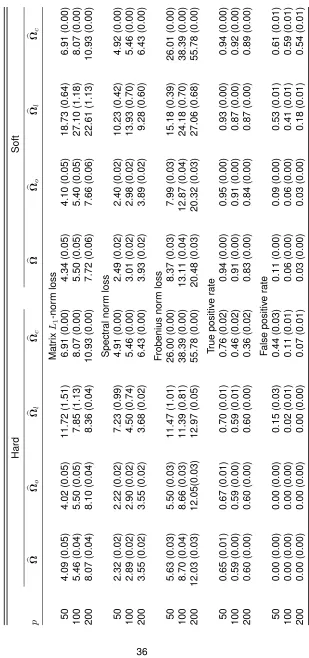
TABLE 2.1 : Means (standard errors) of various performance measures for four methods with hard and soft thresholding rules with normal-related distributions over 100 replications . . . 36 TABLE 2.2 : Means (standard errors) of various performance measures for four methods
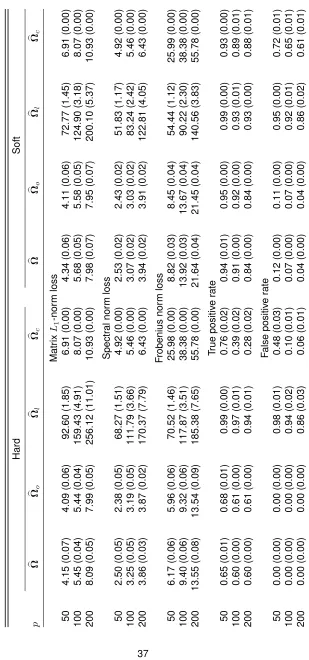
with hard and soft thresholding rules with gamma-related distributions over 100 replications . . . 37 TABLE 2.3 : Numbers of positive and negative correlations and stability of correlation
networks for three methods applied to the gut microbiome data . . . 40
TABLE 3.1 : Empirical size and power of the tests based on 1000 replications withα= 0.05andn = 100for basis generated from log-normal distributions. Model 1: α1 = α2 = 3, α3 =α4 = 10,β1 = β2 = 0.05. Model 2: α1 =α2 = 10, α3 =α4 = 20,β1= 0.15,β2 = 0.2. Model 3:α1 =α2= 10,α3=α4 = 20, β1 = 0.05, β2 = 0.1. Model 4: α1 = α2 = 10, α3 = α4 = 20, β1 = 0.15, β2= 0.2. . . 57 TABLE 3.2 : Empirical size and power of tests based on 1000 replications withα= 0.05
andn = 100for basis generated from log-Gamma models. Model 1: α1 = α2 = 3,α3 =α4 = 10,β1 =β2 = 0.05. Model 2: α1=α2 = 10,α3 =α4=
LIST OF ILLUSTRATIONS
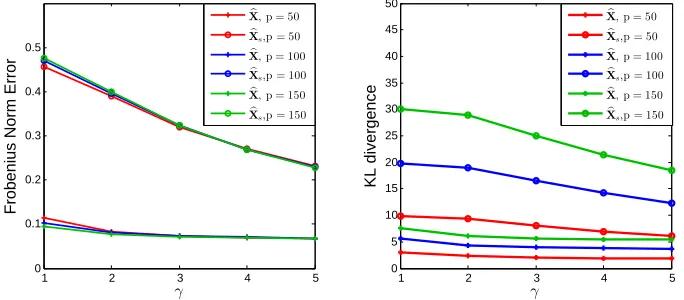
FIGURE 1.1 : Frobenius norm error and Kullback-Leibler divergence between the esti-mated and the true compositions for different numbers of taxapin Model 1, whereXb is the proposed estimator andXbsis the estimator with simple
zero replacement. . . 15 FIGURE 1.2 : Frobenius norm error and Kullback-Leibler divergence between the
esti-mated and the true compositions for different numbers of taxapin Model 2, whereXb is the proposed estimator andXbsis the estimator with simple
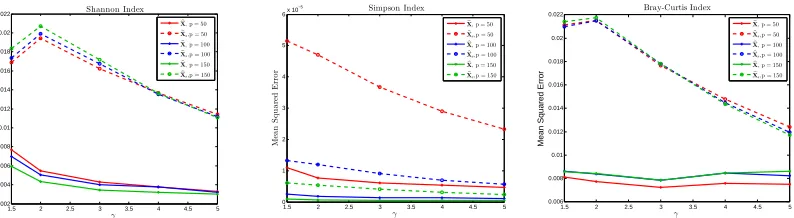
zero replacement. . . 16 FIGURE 1.3 : Losses on different diversity indices between the estimated and the true
compositions for different numbers of observed taxa pin Model 1. Left panel: Shannon index; Middle panel:Simpson index; Right panel: Bray-Curtis index . . . 16 FIGURE 1.4 : Losses on different diversity indices between the estimated and the true
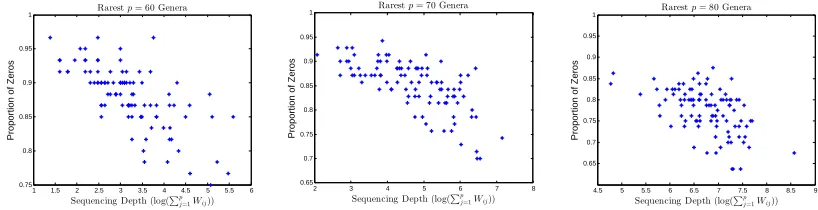
compositions for different numbers of observed taxa pin Model 2. Left panel: Shannon index; Middle panel:Simpson index; Right panel: Bray-Curtis index . . . 17 FIGURE 1.5 : Proportions of zeros observed versus the size library sizes, indicating that
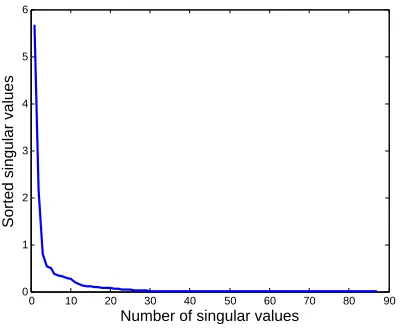
many observed zeros are due to under sampling. . . 17 FIGURE 1.6 : Decay of singular valuesdiifrom the SVD decomposition ofX=UDVT. 18
FIGURE 1.7 : Boxplots of the estimated compositions for each genus for those with zero observations (M) and those with non-zero observations (Mc). Top panel:
proposed estimatorXb; Bottom panel: estimator with zero-replacementXbs. 19
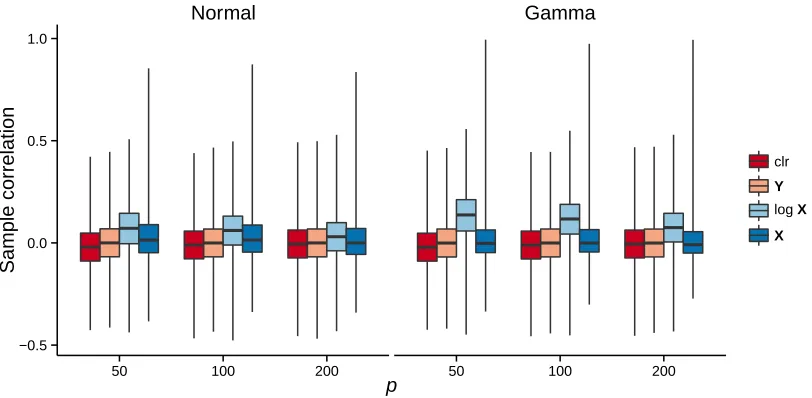
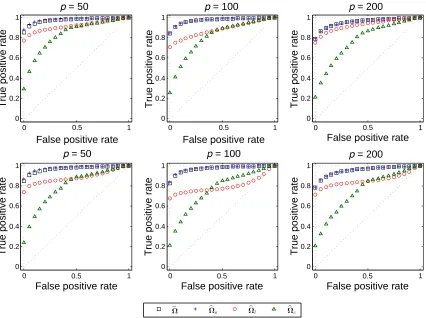
FIGURE 2.1 : Boxplots of sample correlations with simulated data under different trans-formations in Model 1. . . 34 FIGURE 2.2 : ROC curves for four methods in Model 2 with normal-related distribution
(top panel) and gamma-related distribution (bottom panel). . . 38 FIGURE 2.3 : Correlation networks identified by the COAT method for the lean and obese
groups in the gut microbiome data. Positive and negative correlations are displayed in green and red, respectively. The thickness of edges indicates the magnitude of correlations. . . 41
CHAPTER 1
C
OMPOSITIONE
STIMATION FROMS
PARSEC
OUNTD
ATA VIA AR
EGULARIZEDL
IKELIHOODIn microbiome studies, taxa composition is often estimated based on the sequencing read counts
in order to account for the large variability in the total number of observed reads across different
samples. Due to sequencing depth, some rare microbial taxa might not be captured in the
metage-nomic sequencing, which results in many zero read counts. Naive composition estimation using
count normalization therefore lead to many zero proportions, which underestimates the underlying
compositions, especially for the rare taxa. Such an estimate of the composition can further lead
to biased estimate of taxa diversity, and can also cause difficulty in downstream log-ratio based
analysis for compositional data. In this paper, the observed counts are assumed to be sampled
from a multinomial distribution, with the unknown composition being the probability parameter in
a high dimensional positive simplex space. Under the assumption that the composition matrix is
approximately low rank, a nuclear norm regularization-based likelihood estimation is developed
to estimate underlying compositions of the samples. The theoretical upper bounds and the
min-max lower bounds of the estimation errors measured by the Kullback-Leibler divergence and the
Frobenius norm are established. Simulation studies demonstrate that the regularized maximum
likelihood estimator outperforms the commonly used naive estimators. The methods are applied to
an analysis of a human gut microbiome dataset.
1.1. Introduction
The human microbiome is the totality of all microbes at different body sites, whose contribution to
human health and disease has increasingly been recognized. Recent studies have demonstrated
that the microbiome composition varies across individuals due to different health and the
environ-ment status (The Human Microbiome Project Consortium, 2012a), and may be associated with
complex diseases such as obesity, atherosclerosis, and Crohn’s disease (Koeth et al., 2013; Lewis
et al., 2015; Turnbaugh et al., 2009). With the development of next-generation sequencing
tech-nologies, the human microbiome organisms can be quantified by using direct DNA sequencing of
refer-ence microbial genomes, the observed count data (e.g., 16S rRNA marker gene reads or shotgun
metagenomic reads) depend on the amount of genetic material extracted from the community or
the sequencing depth, and they provide a relative measure of the abundances of community
com-ponents. In a microbiome study, these read counts are typically non-negative and over-dispersed,
and contain a large number of zeros.
In order to account for the large variability in the total number of reads obtained, the taxa
compo-sition is often estimated based on the observed counts of sequencing reads. Due to sequencing
depth, some rare microbial taxa might not be captured in the metagenomic sequencing, which
re-sults in zero read counts assigned to these taxa. Naive estimates of the taxa composition using
count normalization therefore lead to many zeros due to under sampling, especially for rare taxa.
Such a naive estimate of the composition can be biased and can lead to biased estimates of taxa
diversity. It can also cause difficulty in downstream data analysis for compositional data. Since the
pioneering work of Aitchison, (2003), several techniques have been proposed to deal with zeros
(see Martın-Fernandez, Palarea-Albaladejo, and Olea, 2011 for an overview) in count data. One
approach is to replace zero counts through a Bayesian-multiplicative model, followed by
normaliz-ing the count into the composition. Such a Bayesian method involves a Dirichlet prior distribution
as the conjugate distribution of multinomial distribution and a multiplicative modification of the
non-zero counts. The non-zero replacement results were determined by the parameterizations of the prior
distribution. However, such a prior information cannot be easily obtained, and the subjective
selec-tion of the parameter may yield misleading results. Other approaches normalized the count first and
treated zero compositions as the missing values. The missing part was then recovered by either
non-parametric imputation or EM algorithms. However, the non-parametric imputation lacks
theo-retical guarantees for selecting a reasonable replacement value. The EM algorithm is not feasible
when the number of taxa is very large, or every taxa contains at least one zero across the samples.
In addition, the multivariate additive log-ratio (alr) normality assumption used in these methods is
number of total count is a Poisson random variable. If the compositions across different individuals
are treated as a matrix by combining them together, an approximately low rank structure on this
matrix is indicated by recent observations on co-occurrence pattern (Faust et al., 2012) and various
symbiotic relationships in microbial communities (Chaffron et al., 2010; Horner-Devine et al., 2007;
Woyke et al., 2006). Motivated by much success in solving the matrix completion problem using
nuclear norm minimization (Cao and Xie, 2016; Klopp et al., 2015; Lafond et al., 2014; Lu and
Ne-gahban, 2014; Negahban and Wainwright, 2012), this paper solves the problem of the composition
estimation using a regularized maximum likelihood approach. However, it should be emphasized
that the multinomial likelihood function in this framework has not been studied and the sampling
scheme used in this article is also different from other matrix completion problems. The observed
zero counts are the result of under sampling, rather than the random missingness assumed in the
previous literature. We provide the asymptotic upper and min-max lower bounds of the resulting
regularized estimator and show through simulations that the estimator recovers low-rank
composi-tions accurately.
The rest of the paper is organized as follows. Section1.2presents details of the proposed
regu-larized likelihood approach when the underlying composition is approximately low-rank. The
imple-mentation is presented in Section 1.3. The theoretical properties of the estimators are analyzed in
Section1.4, where the upper bounds for the estimation error measured by average Kullback-Leibler
divergence and Frobenius norm are established. Simulation results are shown in Section1.5to
in-vestigate the numerical performance of the proposed methods. A real data application to a human
gut microbiome study is given in Section1.6.
1.2. Poisson-Multinomial Model for Microbiome Count Data and Penalized
Estima-tion
In this section, we consider a Poisson-multinomial statistical model for composition estimation from
the sparse count data observed in microbiome studies. The proposed procedure for composition
estimation relies on a regularized maximum likelihood. We start by introducing some notation that
will be used throughout the rest of the paper. For any integersN > 0, let[N] = {1,2,· · · , N}be
the set of integers ranging from 1 toN. We also denote1n = (1, . . . ,1)> ∈Rn,eias the canonical
vector if u≥ 0 andPp
i=1ui = 1. For any two composition vectorsu, v ∈ Rp, we can define the
Kullback-Leibler (KL) divergence as
DKL(u, v) = p
X
j=1 uilog
ui
vi
. (1.1)
For any matrix A = (aij), define itsL1, L∞, spectral, Frobenius, element-wise maximum, and
nuclear norm respectively askAk1,kAk∞,kAk2,kAkF,kAkmax, andkAk∗. Specifically,kAk1=
max
j
P
i|aij|,kAk∞= max
i
P
j|aij|,kAk2=
p
λmax(ATA),kAkF =
q P
i,ja2ij,kAkmax= max
i,j |aij|,
andkAk∗ =Piσi(A), whereλmax(·)denotes the largest eigenvalue and{σi(·)}denotes the set
of singular values. For two matricesAandB, lethA,Bi= tr(ATB) =P
i,jaijbijbe the trace inner product. Finally, for notational simplicity, we useC1, C2, . . .as generic symbols for constants whose
values may vary from line to line.
Our starting point is an×pmatrix of countsWwith elementWij representing the observed read
count of taxonj in individual i, wherei ∈ [n] andj ∈[p]. For i-th individual, the simplest model
for their count dataWi = (Wi1, Wi2,· · · , Wip)is the multinomial model with its probability function
given as
fM(Wi1, Wi2,· · ·, Wip;Xi) =
Ni
Wi
p
Y
j=1
Xij∗Wij,
where Ni = P p
j=1Wij and X∗i = (Xi∗1, Xi∗2,· · ·, Xip∗) are underlying bacterial composition with
Pp
j=1X
∗
ij = 1, Xij∗ >0. The total taxa countNiis determined by the sequencing depth and can be
treated as a Poisson random variable given byNi ∼Pois(νi), whereνiis a positive parameter, but
it is of less interest.
Our goal is to estimate X∗ = (X∗1T,X∗2T,· · · ,X∗pT)T based on W. The most natural estimate
is obtained by the maximum likelihood estimation. Denote by LN the (normalized) negative
positive simplex spaceS ={X∈Rn×p
X1p=1n,X>0}. Without further constraints, minimizing
(1.2) leads to the standard maximum likelihood estimateXb,
b
Xij =
Wij
Pp
k=1Wik
, i∈[n], j∈[p].
However, as a consequence of under sampling whenNis not sufficiently large, the estimatorXb will
contain a large number of zeros. These zeros underestimate the composition and cause difficulty in
downstream log-ratio based compositional data analysis (Aitchison, 2003). For an arbitrary matrix
X∗ in positive simplex space, clearly there is no good way to recover a positive X∗. However, in
the metagenomic study,X∗could be approximately low-rank in the sense that the singular values
decay gradually towards zero, which provides the possibility to recover X∗ with high accuracy.
In this paper, we propose a penalized estimator Xb based on a regularized maximum likelihood
formulation:
b
X= arg min
X∈S(αx,βx)
LN(X) +λkXk∗, (1.3)
whereS(αx, βx)is a bounded simplex space given by
S(αx, βx) =
X∈Rn×p
X1p=1n, αx/p≤Xij≤βx/p,∀(i, j)∈[n]×[p]
.
Hereλandαxandβxare tuning parameters. The constrained element-wise lower bound
guaran-tees the positive sign of the estimator. The element-wise upper bound constraint is only needed in
the theory, while in practice, such a constraint is not required.
1.3. Optimization Algorithm and Tuning Parameter Selection
In this section we consider the implementation of the proposed estimator specified as (1.3).
Specif-ically, we propose to solve the following constrained convex optimization:
b
X= arg min
X∈S(αX)
LN(X) +λkXk∗, (1.4)
S(αX) =
X∈Rn×p
X1p =1n, Xij ≥αX/p,∀(i, j)∈[n]×[p]
HereS(αX)is a positive simplex space and(λ, αX)is a pair of tuning parameters. Particularly, (1.4)
is a nuclear norm minimization problem, which can be solved by either semidefinite programing via
interior-point SDP solver, or first-order method via Templates for First-Order Conic Solvers
(TFOC-S), see Becker, Cand `es, and Grant, 2011. However, the SDP solver computes the nuclear norm
via a less efficient eigenvalue decomposition which does not scale well with high-dimensionsnand
p. Besides, Nesterov’s scheme used in TFOCS is not monotone in the objective function owing
to the introduction of the momentum term, which often results in oscillations or overshoots along
the trajectory of the iteration. In this article, we propose a more efficient algorithm based on the
generalized accelerated proximal gradient method (Su, Boyd, and Candes, 2014). To adapt to the
bounded simplex constraintS(αX), we develop a non-iterative projection scheme in the proposed
algorithm.
1.3.1. Generalized Accelerated Proximal Gradient Method
SinceLN(·)is convex and differentiable over the domainS(αX)and the nuclear norm is convex, the
accelerated Nesterov’s scheme can be formulated as follows. Given the count matrixW, we first
normalize it into the compositionXby Xij =Wij/Ppk=1Wikand initializeY0 =X0 =X−1 =X,
then updateXk andYkin thekth iteration as
Xk = arg min
X∈S(αX) Lk
2 kX−Yk−1+L
−1
k OLN(Yk−1)k2F+λkXk∗, (1.5)
Yk =Xk+
k−1
k+r−1(Xk−Xk−1). (1.6)
Here we provide the detailed explanation for (1.5) and (1.6).
• Lk is the step size in thek-th iteration, which is chosen by line search strategy. Denote by
FL(X,Y)the approximation error when approximating LN(X) with its second order Taylor
expansion aroundYand usingLas the second order coefficient,
FL(X,Y) =LN(X)− LN(Y)− hX−Y,OLN(Y)i −
L
2kX−Yk
2
• k−1
k+r−1 is the momentum term andris a friction parameter. In the standard accelerated gradi-ent method, the friction parameter is set byr= 3, and this scheme exhibits the convergence
rateO(1/k2)as long as the gradient function
OLN is Lipschitz continuous with a constant
Lip-schitz coefficient (Nesterov, 1983, 2013). The Nesterov’s scheme can be further generalized
by setting a high friction rate, for example r ≥9/2, and it succeeds in eliminating the
over-shooting and oscillation along the trajectory toward the minimizer and obtaining a O(1/k3)
convergence rate (Su, Boyd, and Candes, 2014).
• The minimization of the objective function (1.5) can be solved by a form of Singular Value
Thresholding (SVT) (Cai, Cand `es, and Shen, 2010):
Xk= ΠS(αX)
DλL−1
k
Yk−1−L−k1OLN(Yk−1)
.
HereΠS(αX)(X)is Euclidean projection ofXonto the positive simplex spaceS(αX)that we
will discuss in Section 1.3.2. If X= UΣVT is the singular value decomposition (SVD), the
soft-thresholding operatorDτ can be defined as
Dτ(X) =UDτ(Σ)VT, Dτ(Σ) = diag (max{σi−τ,0}).
Combining these steps together, the generalized accelerated proximal gradient method is
sum-marized in Algorithm1, where kmax is the maximum number of iteration. The complexity of the
algorithm are dominated byO(n2p+p3), which is the cost of singular value decomposition. The
convergence of Algorithm 1 cannot be easily established; however, the following proposition
pro-vides some insight.
Proposition 1. Let Xk be the sequencing generated in the iteration of Algorithm 1. Denote by
f(X) =LN(X) +λkXk∗. Suppose the Euclidean projection onto the simplex spaceΠS(αX) does
not influence the convergence rate, and the step size is always set byLk = max
ij Wijp/(αXN).
Then, for any friction parameterr≥9/2, we have,
f(Xk)−f(X?)≤C
v u u u t
max
ij W
3
ij
min
{ij|Wij>0} Wij
p3
N2
kX0−X?k2F
whereX?is any minimizer off andConly depends onrandαX.
Since the gradient functionOLN is Lipschitz continuous with the constantL = max
ij Wijp/(αXN)
and the negative likelihood function LN is µ−strongly convex with µ = min
{ij|Wij>0}
Wij/N on the
constrained simplex space, it is not hard to prove Proposition 1 by applying Theorem 9 in Su, Boyd,
and Candes, 2014. The parametersLandµvary with different observations, as a result, the rate of
convergence shows an interesting dependency on the dimensionpand the observation countW
Algorithm 1Generalized accelerated proximal gradient method
1: Input: CountWand its normalized compositionX
2: Initialize:Y0=X0=X−1=X,r≥9/2,γ >1,L= 10−4, andkmax∈N+
3: fork= 1tokmax do
4: Xk= ΠS(αX) Dλ/L(Yk−1−(1/L)OLN(Yk−1))
5: if FL(Xk,Yk−1)≥0,then 6: L=γL, go to Step 3
7: end if
8: UpdateYk =Xk+k+k−r−11(Xk−Xk−1) 9: if|FL(Xk,Yk−1)|<10−5then
10: returnXk
11: end if
12: end for
1.3.2. Euclidean Projection onto the Simplex Space
The remaining part is to deal with the Euclidean projection onto the simplex spaceS(αX)in
Algo-rithm 1. We introduce a non-iterative and efficient algoAlgo-rithm based on the standard KKT condition.
Consider a one-dimensional simplex projection problem given by
ΠS(αX)(y) = minx∈
Rp
1
2kx−yk
2 2 s.t.
p
X
i=1
xi= 1, xi≥αX/p. (1.7)
The following Proposition provides an implicit formulation for the minimizerx? to this optimization
problem (1.7).
Proposition 2. Suppose thaty1≥y2≥ · · · ≥yp, then the minimizerx?= (x1, x2,· · ·, xp)T is given
larger thanαX/p. We establish the the following formulation forρ,
ρ= max
(
j∈[p]
yj+j−1(1−αX− j
X
i=1 yi)>0
)
.
In the multi-dimensional case thatY∈Rn×p, we generalize the above simplex projection and
sum-marize this non-iterative optimization procedure in Algorithm2. The scheme is easy to implement
and its complexity isO(nplog(p)).
Algorithm 2Euclidean projection of a matrix onto the simplex spaceS(αX).
1: Input: Y∈Rn×pandS(αX)
2: Sort each row ofYintoU:Ui1≥Ui2· · · ≥Uip, i∈[p].
3: Find vectorρ= (ρ1,· · ·, ρn)T such that
ρi= max
(
j∈[p]
Uij+j−1 1−αX−
j
X
i=1 Uij
!
>0
)
, i∈[n].
4: Define vectorµ= (µ1,· · · , µn)T byµi=ρi−1
1−αX−Pρji=1Uij
+αX/p, i∈[n].
5: ReturnXsuch thatXij = max{Yij+µi, αX/p},(i, j)∈[n]×[p].
1.3.3. Data Driven Selection of the Tuning Parameters
The proposed nuclear norm minimization involves the tuning parametersλandαX. We propose
the following data-driven method for selecting these tunning parameters with a guaranteed
per-formance. Given a selected parameter αX, we choose λ = λ(αX,βbR)by plugging αX and the
estimated row probability parameter
b
βR=n· max
1≤i≤n
Pp
j=1Wij
Pn
k=1
Pp
l=1Wkl
λ(αX,βbR) =
v u u t32
b
β2
R/n+ (1∨βbRp/n)/αX
plog(n+p)
N ∨
8(1/αX+βbR/(np)1/2)nlog(n+p)
N .
This choice ofλis motivated by the theoretical results of Theorem 1 in the next Section.
It remains to find the estimated parameterαX, which can be selected usingK-fold cross-validation
t∈T, set
(λ, αX) = (λ(αX(t),βbR), αX(t)) = (λ((t·αbX),βbR), t·αbX),
where
b
αX =p· min
1≤i≤n,1≤j≤p
Wij
Pn
k=1
Pp
l=1Wkl
andβbR=n· max
1≤i≤n
Pp
j=1Wij
Pn
k=1
Pp
l=1Wkl
.
We randomly split the rows ofWinto two groups of sizesn1∼ (K−1)n
K andn2∼ n
K forItimes. We
used the second group with sample sizen2as the testing set. In order to estimate the composition
from the rows in testing set, we further randomly picked1/K proportion of observed columns in
each row from the second group and combined it with the first group as the training set. Denote
by Wi be the selected testing set in the ith split and let Xi be its compositions through Xi kl =
Wi
kl/
Pp
l=1W
i
kl. Denote byXb(−i)(αX(t))the estimator based on the training set. We consider the
Kullback-Leibler divergence to evaluate the prediction error.
b
R(t) =
I
X
i=1
D(Xi,Xb(−i)(αX(t))).
We select t∗ = arg minTRb(t)and choose the tuning parameters (λ(αX(t∗),βbR), αX(t∗)). If t∗ is
chosen on the boundary ofT, we expand the range ofT and repeat the above procedure. With the
chosen tuning parameters, we finally obtain estimate by solving (1.4) based on the full dataset.
1.4. Theoretical Properties
We prove that the proposed estimator Xb achieves the near optimal rate of convergence over a
class of low-rank compositions. The regularization assumptions we need for theoretical analysis
are formally stated as below.
Condition 1. LetRi =νi/P
p
j=1νj fori∈[n], then there exist constants(αR, βR)such that, for any
i∈[n],
αR/n≤Ri≤βR/n.
Here R = (R1,· · ·, Rn)T represents the probability of observing an element from each row, and
Xrepresents the column probability. Conditions 1 and 2are analogous to the incoherence
con-ditions that are commonly assumed in the matrix completion literature. The element-wise upper
bounds avoid the overly ”spiky” situation that some rows or columns are sampled with very high
probability. The element-wise lower bound onRhelps to establish bounds in Frobenius norm, and
the entry-wise bound onX∗ensure the gradient function ofLN(X)in (1.2) is Lipschitz continuous,
which helps to effectively bound Frobenius norm in terms of Kullback-Leibler (KL) divergence and
guarantee the feasibility of accelerated gradient descent algorithm in practice.
1.4.1. Rate of Convergence
To assess how close the estimatorXb from (1.3) to the real compositional matrixX∗, we use average
Kullback-Leibler divergenceD(X∗, b
X)and squared Frobenius normkX∗− b
Xk2
F. HereD(X∗,Xb)is
defined as the sum of Kullback-Leibler (KL) divergence between rows ofX∗andXb,
D(X∗,Xb) =
n
X
i=1
DKL(X∗i,Xbi) = n
X
i=1
p
X
j=1
Xij∗logX
∗
ij
b
Xij
.
The following theorem gives an upper bound on the loss of the proposed estimator X∗ for the
exactly low-rank composition matrixX.
Theorem 1. (Exactly low-rank matrices)Under Conditions 1 and2, suppose thatN ≥ c0(n∨
p) log(n+p)for some universal constantc0>0, and the tuning parameter is selected as
λ= 2
r
C1(n, p)plog(n+p)
N ∨
C2(n, p)plog(n+p) N
!
, (1.8)
whereC1(n, p) = 8 βR2/n+ (1∨βRp/n)/αX
andC2(n, p) = 4(1/αX+βR/(np)1/2). If the
compo-sitionX∗ has rank at mostr, then, with probability at least1−3(n+p)−1, the estimate
b
Xin(1.3)
satisfies
1
nD(X
∗, b
X)≤C1
(p+n)rlog(n+p)
N
, (1.9)
p
nkXb −X
∗k2
F ≤C2
(p+n)rlog(n+p)
N
, (1.10)
Theorem 1 states the rate of convergence for both KL divergence and Frobenius loss in terms
of probability. With some additional mild assumptions, the same rate of convergence holds in
expectation.
Corollary 1. Under the same conditions mentioned in Theorem 1, ifNfurther satisfiesN≤c1(n+
p)2rlog(n+p), then, there exists some constants C
1 andC2 only depending onc0, c1, αX, βX, αr
andβR, such that
1
nED(X
∗, b
X)≤C1
(p+n)rlog(n+p)
N ,
p
nE
Xb −X
∗
2
F ≤
C2
(p+n)rlog(n+p)
N .
We also have the corresponding lower bound that shows that the bound in Theorem1essentially
cannot be improved.
Theorem 2. Consider the matrix classes
B0(r, α, β) =
X∈Rn×prank(X)≤r,X1p=1n, α/p≤Xij ≤β/p, for any(i, j)∈[n]×[p] .
If2≤r≤p/2, there exists some constantsC1andC2which only depend onαX, βX, αR, βR, such
that
inf
b
X
sup
X∗∈B0(r,αX,βX)
αR≤Ri≤βR 1
nED(X
∗, b
X)≥C1
(p+n)r
N ,
inf
ˆ
X
sup
X∗∈B0(r,αX,βX)
αR≤Ri≤βR p
nE
Xb −X
∗
2
F ≥C2
(p+n)r
N .
In practice, the composition is typically approximately low-rank instead of exactly low-rank. In such
case, we formalize the class of approximately low-rank matrices via thelq-”ball” of matrices by
Bq(ρq) =
(
X∈Rn×p
n∧p
X
|σi(X∗)|
q
≤ρq,
)
the compositionX∗ further belongs to a class of approximately low-rank matrices, Then, with the
probability proceeding1−3(n+p)−1, the estimator
b
Xin(1.3)satisfies
1
nD(X
∗, b
X)≤C1ρq(p/n)
q
2
(n+p) log(n+p)
N
1−q2
, (1.12)
p
nkXb −X
∗k2
F ≤C2ρq(p/n)
q
2
(n+p) log(n+p)
N
1−q2
, (1.13)
where constantsC1andC2only depend onc0, αX, βX, αRandβR.
1.4.2. Estimation of Diversity Index
Various microbial diversity meaures are aften used to quantify the composition of the microbial
communities. GivenX∈Rp that representsp-bacteria composition acrossndifferent individuals,
three widely used measurements of microbial community diversity include
• Shannon’s index Hsh(Xi) =−P p
j=1XijlogXij,1≤i≤n;
• Simpson’s index Hsp(Xi) =P p j=1X
2
ij,1≤i≤n;
• Bray-Curtis index Hbc(Xi,Xj) =P p
k=1|Xik−Xjk|/2,1≤i, j≤n.
Here {Hsh(Xi)}ni=1 and {Hsh(Xi)}ni=1 are two vectors in which each component measures the
richness and evenness of microbial community in an individual;{Hbc(Xi,Xj)}n,pi,j=1is a matrix with
each entry ranging from[0,1]that quantifies the dissimilarity between two individuals. Higher value
of Bray-Curtis index indicates that two microbial communities are less likely to share similar taxa.
The penalized likelihood estimatorXb from (1.3) can be used to estimate Shannon’s, Simpson’s and
Bray-Curtis indices. The following Corollary provides the upper bound of these estimates.
Corollary 2. Under Conditions1and2, suppose thatN ≥c0(n∨p) log(n+p)for some constant
c0, and the tuning parameter is selected by (1.8). If the compositionX∗ has rank at mostr, then
the estimateXb in (1.3) satisfies
1 n
n
X
i=1
(Hsh(Xbi)−Hsh(X∗i))
2=O
p
(n+p)(logp)2rlog(n+p) N
,
1 n
n
X
i=1
(Hsp(Xbi)−Hsp(X∗i))
2=O
p
(n+p)rlog(n+p)
p2N
,
1 n2
X
1≤i<j≤n
(Hbc(Xbi,Xbj)−Hbc(X∗i,X
∗
j))
2=O
p
(n+p)rlog(n+p) N
If the compositionX∗belongs the class of approximately low-rank matrices (1.11), then the estimate
b
Xin (1.3) satisfies
1 n
n
X
i=1
(Hsh(Xbi)−Hsh(X∗i))
2=O
p ρq(logp)2(p/n)
q
2
(n+p) log(n+p)
N
1−q2!
,
1 n
n
X
i=1
(Hsp(Xbi)−Hsp(X∗i))
2
=Op ρqp
q
2−2/n
q
2
(n+p) log(n+p)
N
1−q2!
,
1 n2
X
1≤i<j≤n
(Hbc(Xbi,Xbj)−Hbc(X∗i,X
∗
j))
2=O
p ρq(p/n)
q
2
(n+p) log(n+p) N
1−q2!
.
1.5. Simulation studies
Simulations studies were performed to evaluate the proposed composition estimatorXb and to
com-pare the results with the naive estimatorXbsthat replaces zero count with the maximum rounding
error 0.5 (Aitchison, 2003) and transforms the counts into composition.
1.5.1. Simulation settings
Data (X∗,R) were generated as follows. The row probability vector{Ri}ni=1 was generated as
the normalization of i.i.d entries {Pi}ni=1 uniformly drawn from Unif[1,10]: Ri = Pi/P n
k=1Pk. In
order to generate the compositionX∗, we first generated a rank-rmatrixZbyZ =UVT, where
U ∈ Rn×r andV ∈ Rp×r. The components in Uare the absolute values of i.i.d N(0,1) normal
random variables. V = V1+V2 is a spike matrix, where the diagonal elements ofV1 are ones
and off-diagonal entries are equal to 1 with the probability 0.3 and equal to 0 with the probability
0.7, and the entries ofV2are independentN(0,10−3)normal random variables. This procedure is
repeated until we obtain a strict positive matrixZ. The following two models are considered forr.
• Model 1 (Exactly low rank):r= 20.
• Model 2 (Approximately low rank): r=n∧p.
ThenX∗ was obtained through the normalizationX∗ =Z /Pp Z
1.5.2. Composition Estimate
We applied the penalized maximum likelihood approach to simulated data in both low rank and
approximately low rank cases. The tuning parameters(λ, αX)in each estimator were chosen by
five-fold cross-validation. For comparison, we calculated the naive estimators Xbs that replaced
zero counts by 0.5 and converted the counts into composition. Losses under squared Frobenius
normkXb −X∗kF2 and Kullback-Leibler divergenceD(X∗,Xb)were used to measure the estimation
performance.
The simulation results for Model 1 and 2 are summarized in Figures1.1 and1.2respectively. We
observed that the proposed estimator Xb resulted in uniformly smaller errors thatn those based
on the naive estimatorXbsin all settings, demonstrating the superiority of the penalized likelihood
estimation. In addition, as expected, the difference in the loss ofXb and that ofXbsgot smaller as the
total counts increased since the number of zeros decreased as more read counts were observed.
1 2 3 4 5
0 0.1 0.2 0.3 0.4 0.5
γ
Frobenius Norm Error
b
X, p = 50 b
Xs,p = 50
b
X, p = 100 b
Xs,p = 100
b
X, p = 150 b
Xs,p = 150
1 2 3 4 5
0 5 10 15 20 25 30 35 40 45 50
γ
KL divergence
b
X, p = 50 b
Xs,p = 50
b
X, p = 100 b
Xs,p = 100
b
X, p = 150 b
Xs,p = 150
Figure 1.1: Frobenius norm error and Kullback-Leibler divergence between the estimated and the true compositions for different numbers of taxapin Model 1, whereXb is the proposed estimator
1 2 3 4 5 0 0.1 0.2 0.3 0.4 0.5 γ
Frobenius Norm Error
b
X, p = 50 b
Xs,p = 50
b
X, p = 100 b
Xs,p = 100
b
X, p = 150 b
Xs,p = 150
1 2 3 4 5
0 5 10 15 20 25 30 35 40 45 50 γ KL divergence b
X, p = 50 b
Xs,p = 50
b
X, p = 100 b
Xs,p = 100
b
X, p = 150 b
Xs,p = 150
Figure 1.2: Frobenius norm error and Kullback-Leibler divergence between the estimated and the true compositions for different numbers of taxapin Model 2, whereXb is the proposed estimator
andXbsis the estimator with simple zero replacement.
1.5.3. Diversity Index Estimate
To evaluate the ability to estimate the individual-level diversity and dispersion, we also calculated
vector L2 norm losses of the Shannon index and Simpson index, as well as the Frobenius norm
error of Bray-Curtis index. The simulation results for both models are summarized in Figures1.3
and1.4. We see that the proposed estimatorXb uniformly outperformed the naive estimatorsXbsby
a large margin.
1.5 2 2.5 3 3.5 4 4.5 5 0.002 0.004 0.006 0.008 0.01 0.012 0.014 0.016 0.018 0.02 0.022 γ M ea n S q u a re d E rr o r Shannon Index b
X, p = 50
b
Xs,p = 50
b
X, p = 100
b
Xs,p = 100
b
X, p = 150
b
Xs,p = 150
1.5 2 2.5 3 3.5 4 4.5 5 0 1 2 3 4 5 6x 10
−5 γ M ea n S q u a re d E rr o r Simpson Index b
X, p = 50
b
Xs,p = 50
b
X, p = 100
b
Xs,p = 100
b
X, p = 150
b
Xs,p = 150
1.5 2 2.5 3 3.5 4 4.5 5 0.006 0.008 0.01 0.012 0.014 0.016 0.018 0.02 0.022 γ
Mean Squared Error
Bray-Curtis Index
b
X, p = 50
b
Xs,p = 50
b
X, p = 100
b
Xs,p = 100
b
X, p = 150
b
Xs,p = 150
1.5 2 2.5 3 3.5 4 4.5 5 0 0.005 0.01 0.015 0.02 0.025 γ M ea n S q u a re d E rr o r Shannon Index b
X, p = 50
b
Xs,p = 50 b
X, p = 100
b
Xs,p = 100
b
X, p = 150
b
Xs,p = 150
1.5 2 2.5 3 3.5 4 4.5 5 0 0.5 1 1.5 2 2.5 3 3.5 4 4.5 5x 10
−5 γ M ea n S q u a re d E rr o r Simpson Index b
X, p = 50
b
Xs,p = 50
b
X, p = 100
b
Xs,p = 100
b
X, p = 150
b
Xs,p = 150
1.5 2 2.5 3 3.5 4 4.5 5 0.005 0.01 0.015 0.02 0.025 0.03 γ
Mean Squared Error
Bray-Curtis Index
b
X, p = 50
b
Xs,p = 50
b
X, p = 100
b
Xs,p = 100
b
X, p = 150
b
Xs,p = 150
Figure 1.4: Losses on different diversity indices between the estimated and the true compositions for different numbers of observed taxa p in Model 2. Left panel: Shannon index; Middle pan-el:Simpson index; Right panel: Bray-Curtis index
1.6. Gut Microbiome Data Analysis
The gut microbiome plays an important role in regulating metabolic functions and immune
home-ostasis and exerts a profound influence on human health and disease. We applied the proposed
method to a human gut microbiome dataset of a cross-sectional study of 98 healthy volunteers
at the University of Pennsylvania (Wu et al., 2011). DNA from stool samples of these individuals
were analyzed by 454/Roche pyrosequencing of 16S rRNA gene segments and yielded an
aver-age of 9265 reads per sample, with a standard deviation of 386, which led to identification of 3068
operational taxonomic units and 87 bacterial genera that were presented in at least one sample.
Figure 1.5 show the proportions of zeros observed versus the size library sizes, indicating that
many observed zeros are due to under sampling. It is therefore reasonably to assume that the true
compositions of these rare genera are not zero.
1 1.5 2 2.5 3 3.5 4 4.5 5 5.5 6 0.75 0.8 0.85 0.9 0.95 1
Sequencing Depth (log(Pp j=1Wij))
Proportion of Zeros
Rarestp= 60 Genera
2 3 4 5 6 7 8
0.65 0.7 0.75 0.8 0.85 0.9 0.95 1
Sequencing Depth (log(Pp j=1Wij))
Proportion of Zeros
Rarestp= 70 Genera
4.5 5 5.5 6 6.5 7 7.5 8 8.5 9 0.65 0.7 0.75 0.8 0.85 0.9 0.95 1
Sequencing Depth (log(Pp j=1Wij))
Proportion of Zeros
Rarestp= 80 Genera
0 10 20 30 40 50 60 70 80 90 0
1 2 3 4 5 6
Number of singular values
Sorted singular values
Figure 1.6: Decay of singular valuesdii from the SVD decomposition ofX=UDVT.
Figure 1.6 shows the decay of singular valuesdii from the SVD decomposition of X = UDVT,
indicating that the approximate low-rank nature of the compositional matrix. We applied the
pro-posed penalized likelihood method to estimate the positive compositions and used five-fold
cross-validation to select the tuning parameters. As a comparison, we also replaced the count zeros by
0.5to obtain the naive estimatorXbs.
To illustrate the result, we define M = {(i, j) ∈ [n]×[p]such thatWij = 0} as the set of zero
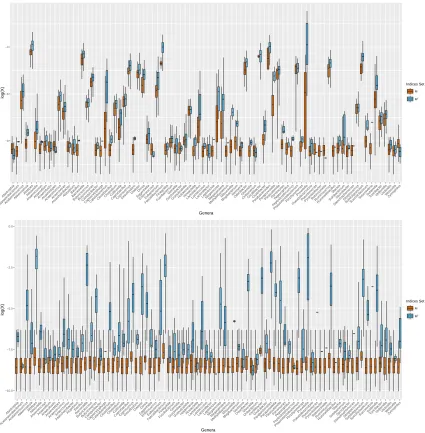
countsW. The top panel of Figure 2.1 shows the boxplots of the estimated compositionsXb except
common generaBacteroides, Blautiaand Roseburia that have been observed in all individuals.
Overall, we observed that the observed non-zero compositions had an effects in estimating the
compositions with zeros counts and the estimated compositions in those with zero observations
(M) were almost always smaller than those with non-zero observations (Mc). However, results
from the simple zero replacement (Xbs) gave almost the same estimates for all samples/taxa inM.
The observed non-zero compositions almost had no effects in estimating the compositions with
−9 −6 −3 Abiotrophia Acetanaerobacter ium Acidaminococcus Akk
ermansiaAlistipesAllisonella AnaerococcusAnaerofilumAnaerofustisAnaerostipesAnaerotr
uncus
Anaero vorax
Asaccharobacter AtopobiumBacillusBarnesiella
Butyr icicoccus Butyr icimonas Camp ylobacter CapnocytophagaCatenibacter ium CloacibacillusClostr idium Collinsella
CoprobacillusCoprococcusDesulf ovibr io DialisterDorea Egger thella EnterococcusEubacter ium Faecalibacter ium Finegoldia Fusobacter ium Gemella
GordonibacterGran ulicatella HoldemaniaHow
ardella
LactobacillusLactococcusLactonif actor Leptotr ichia MegamonasMegasphaer a Meth ylobacter ium Mitsuok ella Mogibacter ium Neisser ia Odor ibacter Olsenella Oribacter ium OscillibacterOxalobacter ParabacteroidesPar
apre votella
ParasutterellaPar vimonas Peptoniphilus Peptostreptococcus Phascolarctobacter ium Porph yromonasPrevotella
Pseudob utyr
ivibr io
PseudomonasPyramidobacterRobinsoniellaRuminococcusRummeliibacillus Slackia Solobacter ium Sporobacter Stenotrophomonas Streptococcus Subdoligr anulum Succiniclasticum Succinivibr io
SutterellaTuricibacterVeillonellaVictiv allis
WeissellaZymophilus
Genera log(X) Indices Set M Mc −10.0 −7.5 −5.0 −2.5 0.0 Abiotrophia Acetanaerobacter ium Acidaminococcus Akk
ermansiaAlistipesAllisonella AnaerococcusAnaerofilumAnaerofustisAnaerostipesAnaerotr
uncus
Anaero vorax
Asaccharobacter AtopobiumBacillusBar
nesiella Butyr icicoccus Butyr icimonas Camp ylobacter CapnocytophagaCatenibacter ium CloacibacillusClostr idium Collinsella
CoprobacillusCoprococcusDesulf ovibr io DialisterDorea Egger thella EnterococcusEubacter ium Faecalibacter ium Finegoldia Fusobacter ium Gemella
GordonibacterGran ulicatella
HoldemaniaHow ardella
LactobacillusLactococcusLactonif actor Leptotr ichia MegamonasMegasphaer a Meth ylobacter ium Mitsuok ella Mogibacter ium Neisser ia Odor ibacter Olsenella Oribacter ium OscillibacterOxalobacter Par
abacteroidesParapre votella
ParasutterellaPar vimonas Peptoniphilus Peptostreptococcus Phascolarctobacter ium Porph yromonasPre votella Pseudob utyr ivibr io
PseudomonasPyramidobacterRobinsoniellaRuminococcus Rummeliibacillus Slackia Solobacter ium Sporobacter Stenotrophomonas Streptococcus Subdoligr anulum Succiniclasticum Succinivibr io
SutterellaTuricibacterVeillonellaVictiv allis
WeissellaZymophilus
Genera
log(X)
Indices Set
M Mc
Figure 1.7: Boxplots of the estimated compositions for each genus for those with zero observations (M) and those with non-zero observations (Mc). Top panel: proposed estimator
b
X; Bottom panel: estimator with zero-replacementXbs.
1.7. Discussion
We have considered the problem of estimating the bacterial compositions based on sequencing
data, particularly for those taxa with zero observed counts, one of the first step in any microbiome
and metagenomic studies. We have developed a penalized likelihood estimation method for
utilizes data across different individuals and across different taxa, which is in contrast to most of
the available methods and has the flavor of shrinkage estimate. The estimation procedure makes
two key assumptions. First, it assume that the true microbial compositions are always positive and
the zero counts observed in metagenomic sequencing are due to under sampling. Our empirical
data (Figure 1.5) seems to support this assumption. Second, it assumes that the true composition
matrix has approximately low-rank structure. Under these assumptions, we have proposed a
pe-nalized likelihood estimation with a nuclear norm penalty function in order to obtain better estimate
of the composition matrix. We have obtained the estimation upper bounds and also the min-max
lower bounds and showed that our estimator is almost optimal. We have additionally obtained the
upper bounds for the estimates of various commonly used diversity indices, including Shannon’s
index, Simpson’s index and Brey-Curtis index. The resulting composition estimates can facilitate
other downstream compositional data analysis, such as high dimensional regression analysis (Lin
CHAPTER 2
L
ARGEC
OVARIANCEE
STIMATION FORC
OMPOSITIONALD
ATA VIAC
OMPOSITION-A
DJUSTEDT
HRESHOLDINGIn this chapter, we address the problem of covariance estimation for high-dimensional
composition-al data, and introduce a composition-adjusted thresholding (COAT) method under the assumption
that the basis covariance matrix is sparse. Our method is based on a decomposition relating the
compositional covariance to the basis covariance, which is approximately identifiable as the
di-mensionality tends to infinity. The resulting procedure can be viewed as thresholding the sample
centered log-ratio covariance matrix and hence is scalable for large covariance matrices. We
rig-orously characterize the identifiability of the covariance parameters, derive rates of convergence
under the spectral norm, and provide theoretical guarantees on support recovery. Simulation
s-tudies demonstrate that the COAT estimator outperforms some naive thresholding estimators that
ignore the unique features of compositional data. We apply the proposed method to the analysis of
a microbiome dataset in order to understand the dependence structure among bacterial taxa in the
human gut.
2.1. Introduction
Compositional data, which represent the proportions or fractions of a whole, arise naturally in a
wide range of applications; examples include geochemical compositions of rocks, household
pat-terns of expenditures, species compositions of biological communities, and topic compositions of
documents, among many others. This article is particularly motivated by the metagenomic analysis
of microbiome data. The human microbiome is the totality of all microbes at various body sites,
whose importance in human health and disease has increasingly been recognized. Recent studies
have revealed that microbiome composition varies based on diet, health, and the environment (The
Human Microbiome Project Consortium, 2012a), and may play a key role in complex diseases such
as obesity, atherosclerosis, and Crohn’s disease (Koeth et al., 2013; Lewis et al., 2015; Turnbaugh
et al., 2009).
the microbiome composition using direct DNA sequencing of either marker genes or the whole
metagenomes. After aligning these sequence reads to the reference microbial genomes, one can
quantify the relative abundances of microbial taxa. These sequencing-based microbiome studies,
however, only provide a relative, rather than absolute, measure of the abundances of community
components. The counts comprising these data (e.g., 16S rRNA gene reads or shotgun
metage-nomic reads) are set by the amount of genetic material extracted from the community or the
se-quencing depth, and analysis typically begins by normalizing the observed data by the total number
of counts. The resulting fractions thus fall into a class of high-dimensional compositional data that
we focus in this article. The high dimensionality refers to the fact that the number of taxa may be
comparable to or much larger than the sample size.
An important question in metagenomic studies is to understand the co-occurrence and co-exclusion
relationship between microbial taxa, which would provide valuable insights into the complex ecology
of microbial communities (Faust et al., 2012). Standard correlation analysis from the raw
propor-tions, however, can lead to spurious results due to the unit-sum constraint; the proportions tend to
be correlated even if the absolute abundances are independent. Such undesired effects should be
removed in an analysis in order to make valid inferences about the underlying biological processes.
The compositional effects are further magnified by the low diversity of microbiome data, that is, a
few taxa make up the overwhelming majority of the microbiome (Friedman and Alm, 2012).
LetX= (X1, . . . , Xp)T be a composition ofpcomponents (taxa) satisfying the simplex constraint
Xj>0, j= 1, . . . , p, p
X
j=1
Xj = 1.
Owing to the difficulties arising from the simplex constraint, it has been a long-standing question
how to appropriately model, estimate, and interpret the covariance structure of compositional data.
The pioneering work of Aitchison, (1982, 2003) introduced several equivalent matrix specifications
of compositional covariance structures via the log-ratios of components. Statistical methods based
is crucial for our applications to microbiome data analysis.
Covariance matrix estimation is of fundamental importance in high-dimensional data analysis and
has attracted much recent interest. It is well known that the sample covariance matrix performs
poorly in high dimensions and regularization is thus indispensable. Bickel and Levina, (2008) and
El Karoui, (2008) introduced regularized estimators by hard thresholding for large covariance
ma-trices that satisfy certain notions of sparsity. Rothman, Levina, and Zhu, (2009) considered a more
general class of thresholding functions, and Cai and Liu, (2011) proposed adaptive thresholding
that adapts to the variability of individual entries. Exploiting a factor model structure, Fan, Fan,
and Lv, (2008) proposed a factor-based method for high-dimensional covariance matrix estimation.
Fan, Liao, and Mincheva, (2013) extended the work by considering a conditional sparsity structure
and developed a POET method by thresholding principal orthogonal complements.
In this article, we address the problem of covariance estimation for high-dimensional compositional
data. LetW= (W1, . . . , Wp)T withWj >0for alljbe a vector of latent variables, called thebasis,
that generate the observed data via the normalization
Xj =
Wj
Pp
i=1Wi
, j= 1, . . . , p. (2.1)
Estimating the covariance structure ofWhas traditionally been considered infeasible owing to the
apparent lack of identifiability. By exploring a decomposition relating the compositional covariance
to the basis covariance, we find, however, that the nonidentifiability vanishes asymptotically as
the dimensionality grows under certain sparsity assumptions. More specifically, define thebasis
covariance matrixΩ0= (ω0ij)p×p by
ω0ij = Cov(Yi, Yj), (2.2)
whereYj = logWj. ThenΩ0is approximately identifiable as long as it belongs to a class of large
sparse covariance matrices.
The somewhat surprising “blessing of dimensionality” allows us to develop a simple, two-step
method by first extracting a rank-2 component from the decomposition and then estimating the
sparse component Ω0 by thresholding the residual matrix. The resulting procedure can
optimization-free and scalable for large covariance matrices. We call our method
composition-adjusted thresholding (COAT), which removes the “coat” of compositional effects from the
covari-ance structure. We derive rates of convergence under the spectral norm and provide theoretical
guarantees on support recovery. Simulation studies demonstrate that the COAT estimator
out-performs some naive thresholding estimators that ignore the unique features of compositional data.
We illustrate our method by analyzing a microbiome dataset in order to understand the dependence
structure among bacterial taxa in the human gut.
The covariance relationship, which was due to Aitchison, (2003 sec. 4.11), has recently been
ex-ploited to develop algorithms for inferring correlation networks from metagenomic data (Ban, An,
and Jiang, 2015; Fang et al., 2015; Friedman and Alm, 2012). Our contributions here are to turn
the idea into a principled approach to sparse covariance matrix estimation and provide statistical
insights into the issue of identifiability and the impacts of dimensionality. Our method also bears
some resemblance to the POET method proposed by Fan, Liao, and Mincheva, (2013) in that
un-derlying both methods is a low-rank plus sparse matrix decomposition. The rank-2 component
in our method, however, arises from the covariance structure of compositional data rather than a
factor model assumption. As a result, it can be obtained by simple algebraic operations without
computing the principal components.
The rest of the article is organized as follows. Section 2 reviews a covariance relationship and
addresses the issue of identifiability. Section 3 introduces the COAT methodology. Section 4
inves-tigates the theoretical properties of the COAT estimator in terms of convergence rates and support
recovery. Simulation studies and an application to human gut microbiome data are presented in
Sections 5 and 6, respectively. We conclude the article with some discussion in Section 7 and
relegate all proofs to the Appendix.
2.2. Identifiability of the Covariance Model
-In the latent variable covariance model (2.1) and (2.2), the basis covariance matrixΩ0is the
param-eter of interest. One of the matrix specifications of compositional covariance structures introduced
by Aitchison, (2003) is thevariation matrix T0= (τij0)p×p defined by
τij0 = Var(log(Xi/Xj)). (2.3)
In view of the relationship (2.1), we can decomposeτ0
ijas
τij0 = Var(logWi−logWj)
= Var(Yi) + Var(Yj)−2 Cov(Yi, Yj)
=ω0ii+ω
0
jj−2ω
0
ij, (2.4)
or in matrix form,
T0=ω01T+1ωT0 −2Ω0, (2.5)
whereω0 = (ω011, . . . , ωpp0 )T and 1= (1, . . . ,1)T. Corresponding to the many-to-one relationship
between bases and compositions, the basis covariance matrixΩ0 is unidentifiable from the
de-composition (2.5), since ω01T +1ωT0 and Ω0 are in general not orthogonal to each other (with
respect to the usual Euclidean inner product). In fact, using thecentered log-ratio covariance
ma-trix Γ0= (γij0)p×pdefined by
γij0 = Cov{log(Xi/g(X)),log(Xj/g(X))},
whereg(x) = (Qp
j=1xj)1/p is the geometric mean of a vectorx = (x1, . . . , xp)T, we can similarly
write
τij0 = Var{log(Xi/g(X))−log(Xj/g(X))}
= Var{log(Xi/g(X))}+ Var{log(Xj/g(X))} −2 Cov{log(Xi/g(X),log(Xj/g(X))}
=γ0ii+γjj0 −2γij0,
or in matrix form,
T0=γ01
T+1γT
whereγ0 = (γ110 , . . . , γpp0 )T and1= (1, . . . ,1)T. Unlike (2.5), the following proposition shows that
(2.6) is an orthogonal decomposition and hence the componentsγ01T+1γT
0 andΓ0are identifiable.
In addition, by comparing the decompositions (2.5) and (2.6), we can bound the difference between
Ω0and its identifiable counterpartΓ0as follows.
Proposition 3. The componentsγ01T+1γT
0 andΓ0in the decomposition(2.6)are orthogonal to
each other. Moreover, for the covariance parametersΩ0andΓ0in the decompositions (2.5)and
(2.6),
kΩ0−Γ0kmax≤3p−1kΩ0k1.
Proposition 3 entails that the covariance parameter Ω0 is approximately identifiable as long as
kΩ0k1 = o(p). In particular, suppose that Ω0 belongs to a class of sparse covariance matrices
considered by Bickel and Levina, (2008),
U(q, s0(p), M)≡
Ω:Ω0,max
j ωjj ≤M,maxi p
X
j=1
|ωij|q≤s0(p)
, (2.7)
where0≤q <1andΩ0denotes thatΩis positive definite. Then
kΩ0k1= max
i p
X
j=1
|ω0ij|1−q|ω0
ij|
q ≤max i
p
X
j=1
(ω0iiωjj0)(1−q)/2|ω0ij|q ≤M1−qs
0(p),
and hence the parametersΩ0andΓ0are asymptotically indistinguishable whens0(p) =o(p). This
allows us to useΓ0as a proxy forΩ0and greatly facilitates the development of new methodology
and associated theory. The intuition behind the approximate identifiability under the sparsity
as-sumption is that the rank-2 componentω01T +1ωT0 represents a global effect that spreads across
all rows and columns, while the sparse componentΩ0represents a local effect that is confined to
individual entries.
Also of interest is theexactidentifiability ofΩ0overL0-balls, which has been studied by Fang et al.,