Survey: Recent Trends and Techniques in Image Co-Segmentation
Challenges, Issues and Its Applications
Tri Daryanto1, Sheeraz Arif2 and Shu Yang3
1 Computer Science Faculty, Universitas Mercu Buana Jakarta, Indonesia 1, 2
School of Computer Science, Beijing Institute of Technology, Beijing 100081, China
3
Department of Information and Communication Engineering, Beijing Institute of Technology, Beijing 100081, China
1[email protected], 2[email protected], 3[email protected]
ABSTRACT
The processing on semantic and visual information has always been a challenging task and co-segmentation is one of them. Co-segmentation is a classic, demanding and most studied topic in literature of computer vision not only because of its challenging nature but also due to its countless applications. During the past 20 years, several general-purpose algorithms and techniques have been developed publicly available benchmarks, as well as the progress in the development of robust computer vision algorithms. In this paper, we review the current activities and recent advances in real-world image co-segmentation methodologies and techniques. These techniques are roughly categorized into two general schemes: Unsupervised and Interactive. Which are mainly based on energy optimization, clustering, random walk, heat diffusion based and others. This paper also explains the features, weaknesses and computational complexity of the different methods. Additionally, we also discuss some important issues, applications and future of the image co-segmentation.
Keywords: Image segmentation, Image co-segmentation, supervised learning, Interactive learning, computer vision.
1. INTRODUCTION
Low level image processing has been the bottleneck and became a challenging issue in the development of computer vision. Image segmentation is a one of the low level computer vision problem, which has been used for understanding and analyzing of images. It is also the foundation of various multimedia and computer vision applications such as object-based image retrieval, object recognition and video tracking and editing. Now a day full exploitation of consistent information among the set of images is the biggest challenge and research hotspot. Image co-segmentation addresses this problem and has
been actively studied in recent years. Social websites such as Facebook and twitter etc. share billions of photos every year such rich collection is just waiting to be exploited by vision researchers such as building a collage of all foreground to make something like complete 3D model of an object [1]. In such tasks it is very useful to extract a foreground object from all images in a group of related images. Co-segmentation is very suitable to deals in such kind of situations which automatically extracts meaningful similar information among images of the same subjects but with different (and unrelated) backdrops. The existing image segmentation methods can only exploits either prior from human supervision or the prior from single image based visual salience, which some time not very effective and efficient for cluttered background or non-salient foreground in complex images [9]. On the other hand, image co-segmentation can exploit both inter and intra-image priors, which provides the ideal solutions related to various multimedia and computer vision problems [47].
research targets, co-segmentation of heterogeneous class objects among large datasets is real world challenging problem because current methods work poorly due to the drastic increased variances in appearance with cluttered background among different images. Searching of the efficient energy function is also very demanding research because this function minimizes the energy problem and the super-pixel labels of all un-segmented images can be calculated simultaneously and speed up the whole procedure .Despite having many algorithms and approaches, there is still immense need of generalized solution. In this research review, we have outline the various approaches and current activities proposed to tackle the different co-segmentation problems.
Hence, the aims of the paper are:
Thoroughly discuss the extensions and variations of image co-segmentation algorithms mainly based on Un-supervised and Interactive schemes.
Describe the features, weaknesses and performance of the main families of the algorithms. And also comment on the benchmark dataset and metrics used for evaluating the performance of existing methods.
Outline applications, main issues and future research avenues on the topic and beyond.
The rest of the paper is structured as follows: Section 2, highlights the features of segmentation and co-segmentation. Section 3, briefly reviews previous relevant work about image co-segmentation. General classifications of image segmentation have been explained in Section 4. In Section 5, we discuss the various existing image co-segmentation methods. Description about different benchmark public datasets and evaluation metrics is given in Section 6. Applications, Challenges and Future work about the topic have been given in Section 7, Section 8 and Section 9 respectively. Finally, concluding remarks are presented in section 10.
2. SEGMENTATION VS.
CO-SEGMENTATION
Segmentation, which is the fundamental problem in computer vision is the process of partitioning a digital image into multiple homogenous region by grouping the pixels and usually we use common feature approach to do this. Common features can be textures, color, grey levels and searching of similarities between pixels related to the particular regions. The main goal of the segmentation to make a digital image rationalize, meaningful and easier to examine by changing and
simplifying the representation of an image. Image Engineering can be classified into three layers i.e. a) Image Understanding b) Image Analysis c) Image Processing so image processing lies in image analysis which is the middle level processing so this is the reason main motive of image segmentation to diminish the information for easy analysis.
The result of image segmentation is a groups of regions in which each pixel must be similar with respect to some characteristic such as intensity, color or texture. The main classes of image segmentation are clustering, region growing and edge detection which are based on measurement taken from image. Image segmentation is typically used to locate objects and boundaries (lines, edges, curves, etc.) in images.
Co-segmentation, which is the sub-class of segmentation is used to generate the binary masks to segment out the common objects by assigning multiple labels to segment both the common things and stuffs rather than just splitting the common foreground information. It is focuses the region of interest i.e. objects (common, multiple) such as car, human, birds and animal rather than stuffs (sky, grass, ground etc.). Due to the unsupervised way of mining and organizing the main object, it has very useful applications such as object localization for assistive robotics, visual summarization and image data mining and also because of the joint segmentation capability of similarities among set of images, it is getting popularity to apply in web image mining, object recognition and classification and video tracking.
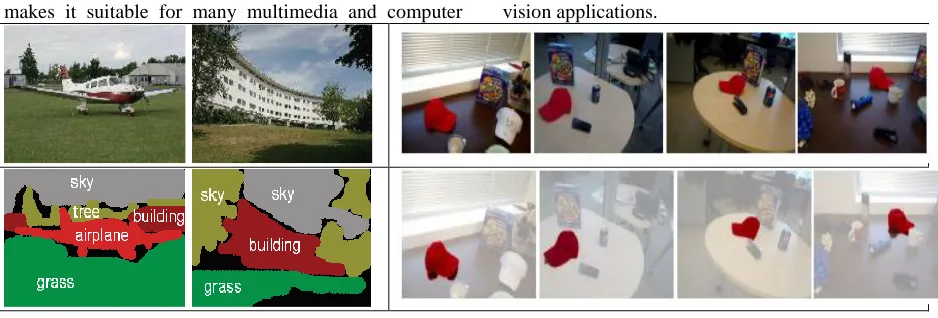
Compared with single image segmentation, co-segmentation has unique features and wide applications. Unlike simple segmentation to just partitioning an image into regions by assigning labelling, co-segmentation focuses on region of interest in multiple images which is the most distinct property of it, as given in figure -1. Compared with generic class segmentation where we need extra training datasets for learning a model or estimating the parameters, co-segmentation can retrieve automatic object segmentation with priors from the images to be segmented [37].
makes it suitable for many multimedia and computer vision applications.
Segmentation Co-segmentation
Fig. 1. Representation of Segmentation and Co-Segmentation
3. REVIEW WORK
Numerous researchers and experts have done many prominent and effective researches and given various effective approaches. We all know that the key point related to co-segmentation is to automatically extract common/multi-class information from multiple images by forcing the segments to be consistent. Early research focused on performing pixel-level segmentation and concentrate on improving the global energy term and corresponding optimization methods. Rother et al [1], was the first researcher who put forward the term co-segmentation, which received a lot of attention. This method used the color histogram matching in cooperate with corresponding additional constraint energy into the MRF framework. In this method segmentation is done for common objects through adding foreground similarity constraint into traditional MRF based segmentation methods. L1-norm was used to present the foreground similarity, and the co-segmentation energy. Mukherjee et al. replaced L1 by L2-norm and the Pseudo-Boolean optimization was used for the minimization in [8]. Later on, other types of features have been also utilized to exploit the relationship between image foregrounds information, such as SIFT [11] and Gabor features [9], but focused on segmenting a pair of images with one common object. After this, many researches in [8],[10] have been done to simplify the optimization by using other types of histogram consistency terms and [11] extended the application as well but color histogram consistency based method limits their application because these approaches only suitable for the targets which share the same color distribution.
To address the co-segmentation of multiple images, [2] set up the co-segmentation task as a discriminative
clustering problem by clustering the image pixels into foreground and background. Vicente in [5] formulated to extract objects from a group of images by using an object recognition scheme to generate a pool of object-like segmentations, and then selecting the most object-likely segmentations using a learned pairwise consistency term. In contrast, Chang et al. [20] proposed an MRF optimization model, by introducing a co-saliency prior as a hint about possible consistent foreground locations. The proposed model was then optimized using graph-cut techniques. Rubio et al. proposed a method based on establishing correspondences between regions in the images, and then estimating the appearance distributions of both the foreground and the background for better joint segmentation [18]. It was later extended for multiple images containing common object in [2], [10],[47] by using more effective and ideal approaches enforcing inter-image consistency.
variable value of k these two schemes are unsuitable and unreasonable. Mukherjee et al. [15] set up a successful experiment for extracting multiple objects of different class by exploiting pixel wise low-level consistent information and analyzing the subspace structure of different class objects.
Many researchers [12],[13],[14] have conducted experiments on very important multi-class image co-segmentation issue in which targets may not always appear in every image. Heterogeneous class object co-segmentation method was first introduced by Kim and Xing [12] by using iterative scheme which combines both foreground modeling and region assignment. Li et al. developed an ensemble clustering scheme to discover the implied objects in [13] after that wang at el. In [14] discovered multiple group of consistent function for segmentation to develop partial consistent relationship across different images. But main issue in such heterogeneous class methods is that targets are splitted into many pieces and their recombination are still very difficult.
Recent works suggest that there has been a significant trend of migrating from pixel-based analysis to region-based (or super-pixel-region-based) analysis. And also with the increasing diversity of consistent information feature selection has become another problem. Chai et al. in [16] introduced the bi-level segmentation by combining GrabCut and SVM alternately updates the class models and segmentation. This method shares a richer descriptor at the level of super-pixels stacked from multiple general sub-descriptors which represent the super-pixels’ color distribution. In [17] and [18], E.Kim and Rubio also got super-pixels involved both use color and SIFT/SURF histogram to identify the super-pixel’s similarity but main problem is weight for different terms are fixed. In [7], Meng et al. introduced the pioneer work, which aims at learning a suitable feature combination from the image with low complexity but this method fails for the group of images with high complexity.
In the recent research many investigators focusing on novel branch of visual saliency i.e. co-saliency, which aims to discover common and salient foregrounds from group of images. Co-saliency detection has been widely used in image/video co-segmentation. The main phenomena in this to highlight the regions which can attract the human visual attention in the single/multiple image. Based on the strategy co-saliency detection can be classified into 3 main categories: fusion-based method, bottom-up method, and learning-based method. Jacob et al. [41] first coined the term co-saliency and find the method for single saliency map by combining multi-features via SVM for pair of images. Chang et al. set up a method to construct data terms of MRF with co-saliency prior and construct a global constraint term in
[20]. Co-saliency object priors have been accurately used for co-segmentation in [20], [46] designed for images of the same object captured at different instances.
4. GENERAL CLASSIFICATIONS OF IMAGE
CO-SEGMENTATION
Although it is not easy to classify the all classifications of image co-segmentation methods in general, we classify the topic of image co-segmentation into following categories in general:
4.1 Based on Nature of Training Sample and Label
Data
4.1.1 Supervised Learning
In supervised classification, the data mostly used in algorithm is fully labelled. That means: machine has to reproduce that all examples are presented with a classification, here human interventions are also very important. In this case prior knowledge must be gathered by the investigator. The supervised segmentation method segments the object using object prior. Supervised segmentation method can achieve semantic segmentation depending on whether the object prior is precisely modeled or not [39]. Usually supervised classification techniques consist of following steps:
i. Identification of the training areas for each class. ii.Identification of Signatures i.e. (variance,
covariance, mean)
iii. Classification of all pixels.
Iv. Mapping of the informational class.
One of the main advantage of supervised classification is that detection and correction of errors are possible. The disadvantages of this technique are that computational cost is very high so it is time consuming and very much prone to human error. It usually require large datasets of manually labeled training data which is very expensive and tedious to collect and most training sets are several orders of magnitude too small in comparison to human level recognition [17].
4.1.2 Semi-Supervised Learning
large amount related images simultaneously. Semi-supervised co-segmentation uses the similarity from both the limited training image foregrounds, as well as the common object shared between the large amounts of un-segmented images.
It has been widely used to solve many kinds of machine learning and computer vision problems. Semi-supervised learning provide the good solution to segment large amount of data so this is the reason mostly researchers now a days using this technique for the solution of different multimedia and computer vision problems but defining of correct parameters and to propose the generic algorithm is still a challenge. But it require human intervention on each individual image which is some time not very helpful.
4.1.3 Un-Supervised Learning
In unsupervised classification, human intervention is not at all required as it is fully computer operated. It does not require any form of human intervention and no prior information is essential. This algorithm helps in identifying clusters in data. Unsupervised segmentation method usually segment the image into many homogeneous and uniform regions with respect to texture or color properties The steps in unsupervised classification are:
i. Clustering of data.
ii. Classification of all pixels based on clusters. iii. Spectral class map.
iv. Cluster labeling
v. Map the informational class
Unsupervised techniques are very fast, free from human errors and there is no requirement of detailed prior knowledge and human intervention. The main drawback of this technique is that, it work poorly in case of large variances appear between images and sometime usage of maximally-separable clusters is not suitable. On other thing is that it is completely rely on local image features and thus lack the necessary contextual information to accurately separate an image into coherent regions [17].
4.2 Based on Object Class in Variable Sets of
Images
In general, a co-segmentation techniques addresses the co-segmentation problem related to objects class and dataset from many aspects, i.e., single image segmentation, common objects segmentation in multiple images, multi-class segmentation and heterogeneous-class object segmentation. The single image segmentation technique extracts some uniform and homogeneous regions related to color or texture properties, and the common objects segmentation is
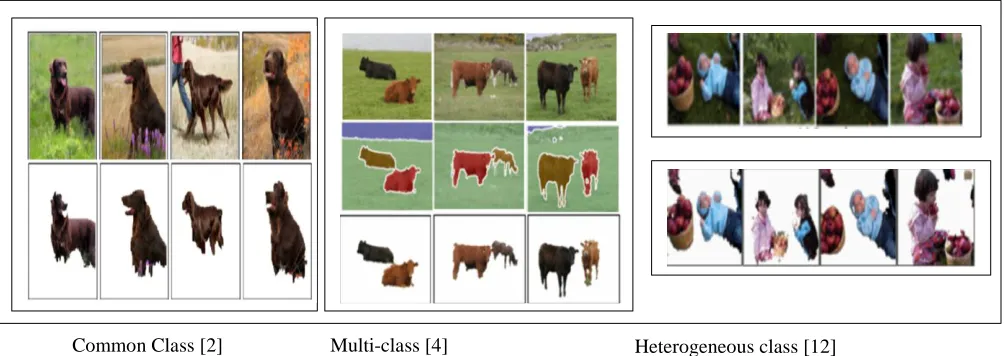
concerned with the segmentation of objects with similar features. Main key problem of co-segmentation is mining common objects and performing consistent constraint on segmentation process. Numerous experts and researchers have provided many effective co-segmentation approaches in different times with respect to the different object classes in variable sets of images. Early methods [1],[8],[9] focused on segmenting pair of images containing common object means same object lies in front different background but they can vary in shape, color and pose. After this research is extended to deal with one common object in multiple images with more efficient or effective models enforcing consistency in inter-image [2],[5],[7],[11],[19], [21],[24],[38],[40]. There are also some algorithm being designed for segmenting multiple common objects from set of images [3],[4],[18],[19],[31],[34],[35]. The successful multiple foreground co-segmentation depends on the accurate object prior generation. The existing multiple foreground methods generate the object priors based on two steps. The first step segments (clusters) the foreground regions that are repeatedly contained in the image group. The second step uses the segments to learn the multiple object priors. Some researchers have also worked on special kind of multi-class co-segmentation problem in which each target may or may not appear in every image means heterogeneous class object [12]-[14]. Representation of these different class object co-segmentation can be viewed in figure 2.
4.3 Feature Based
Co-segmentation methods based on the feature similarity have achieved great success in the past several years. In the features based co-segmentation methods, the accurate learning depends on the accuracy of the initial segments. Successful segments can provide useful information to accurately learn the feature model. Existing methods for co-segmentation related to the features learning can be roughly divided into two classes 1) Local Features 2) Shape features. Local features, such as [1,[8],[9],[11], 19], where image features such as color histogram, SIFT, Fisher vectors etc. are extracted at all the pixels or pixels, and pixels or super-pixels with similar features are encouraged to share the same segmentation results. The approaches based on color features perform very well, where common objects share the same appearances. it is not possible every time that the common objects in image set have same color distributions. Another potential problem with the local features is that they can be too local to be distinctive, so they cannot provide strong prior information for segmentation [23].
of one image serves as the dynamic prior for the other during the iterative evolution. These approaches are more powerful and improves the efficiency and accuracy of segmentation to a certain degree. However, when it comes to the co-segmentation problems, how to mine common shape pattern automatically and efficiently as
Common Class [2] Multi-class [4]
Fig. 2. Showing Co-Segmentation In Different Classes Of Objects
5. DISCUSSION ON EXISTING IMAGE
CO-SEGMENTATION METHODS
The existing co-segmentation methods have achieved impressive results under certain situations. However, co-segmentation still faces several challenges because there are still certain unresolved questions. Many authors have provided progressively better methods and it is not easy to define each of them, main reason is that they are mostly related to specific problem and these problems are so many. The existing image co-segmentation methods can be roughly grouped into two important categories, including unsupervised co-segmentation techniques and interactive co-segmentation approaches. History suggests mostly investigators have chosen unsupervised techniques to pursue their research [1], [2], [3], [6],[7], [11], [12], [13], [14], [19], [22], [23], [24], [25], [31], [32], [33], [34], [35], [36], [37], [38]. The common idea of the unsupervised techniques formulates image co-segmentation as an energy minimization and binary labeling problem. These techniques usually define the energy function using standard MRF terms and histogram matching term. MRF terms are generally
well as how to perform the common shape constraint on each particular image adaptively are still challenging problems they are even also fail to extract common objects when the background and foreground are similar.
Heterogeneous class [12]
solved by the optimization techniques such as linear programming, dual decomposition, half integrity and network flow model. These techniques work well and are widely used to solve combinatorial optimization problems in multimedia processing. It is also observed that many of the unsupervised methods do not perform well when the foreground and background are similar in one image, or when the backgrounds among images are similar as it is hard to find the common object automatically [36].
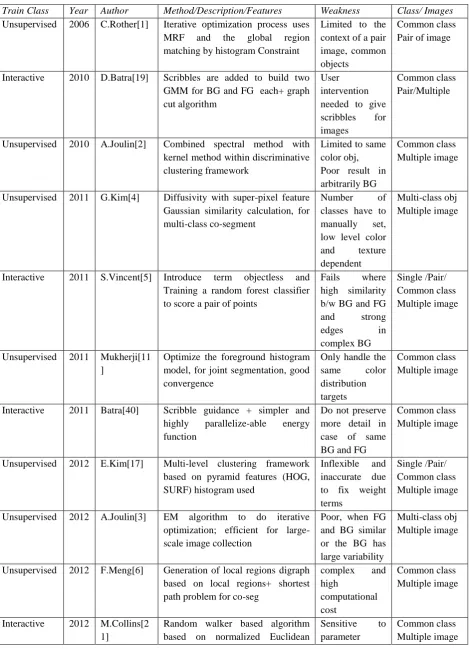
Table 1: Various Co-Segmentation Techniques with Their Features and Weaknesses
Train Class Year Author Method/Description/Features Weakness Class/ Images Unsupervised 2006 C.Rother[1] Iterative optimization process uses
MRF and the global region matching by histogram Constraint
Limited to the context of a pair image, common objects
Common class Pair of image
Interactive 2010 D.Batra[19] Scribbles are added to build two GMM for BG and FG each+ graph cut algorithm
User intervention needed to give scribbles for images
Common class Pair/Multiple
Unsupervised 2010 A.Joulin[2] Combined spectral method with kernel method within discriminative clustering framework
Limited to same color obj, Poor result in arbitrarily BG
Common class Multiple image
Unsupervised 2011 G.Kim[4] Diffusivity with super-pixel feature Gaussian similarity calculation, for multi-class co-segment
Number of classes have to manually set, low level color and texture dependent
Multi-class obj Multiple image
Interactive 2011 S.Vincent[5] Introduce term objectless and Training a random forest classifier to score a pair of points
Fails where high similarity b/w BG and FG and strong
edges in
complex BG
Single /Pair/ Common class Multiple image
Unsupervised 2011 Mukherji[11 ]
Optimize the foreground histogram model, for joint segmentation, good convergence
Only handle the same color distribution targets
Common class Multiple image
Interactive 2011 Batra[40] Scribble guidance + simpler and highly parallelize-able energy function
Do not preserve more detail in case of same BG and FG
Common class Multiple image
Unsupervised 2012 E.Kim[17] Multi-level clustering framework based on pyramid features (HOG, SURF) histogram used
Inflexible and inaccurate due to fix weight terms
Single /Pair/ Common class Multiple image
Unsupervised 2012 A.Joulin[3] EM algorithm to do iterative optimization; efficient for large-scale image collection
Poor, when FG and BG similar or the BG has large variability
Multi-class obj Multiple image
Unsupervised 2012 F.Meng[6] Generation of local regions digraph based on local regions+ shortest path problem for co-seg
complex and high
computational cost
Common class Multiple image
Interactive 2012 M.Collins[2 1]
Random walker based algorithm based on normalized Euclidean
Sensitive to parameter
distance for pixel settings and generate bad results in complicated image Unsupervised 2012 G.Kim[12] Iterative scheme with foreground
modeling and region assignment, heterogeneous class
Class number k must be input beforehand
Heterogeneous Class Mult-img
Unsupervised 2012 J.C.Rubio[1 8]
Double layer graph model+ inter-regional distance calculation RGB and SIFT histogram
Detection of common object is difficult in same BG & FG
Multi-class obj Multiple image
Unsupervised 2013 J.Dai[23] Co-segmentation combined with co-sketch by sharing shape templates
Only good for Similar
Outlines objects, Complex
Repetitive patt Multiple image
Unsupervised 2013 A.Faktor[43 ]
Discover the co-occurring regions+ co-segment by mapping between the co-occurring regions
Poorly segment the similar co-occurring objects in BG
Multi-class obj Multiple image
Unsupervised 2013 F.Meng[39] Color Histogram+ Rewarding Strategy for FG +Energy function by mutual minimization
Time complex and not very accurate in initial curves.
Common class Image Pair
Unsupervised 2013 Rubinstein[2 2]
Automatic visual object discovery method use dense correspondence among database images
Weak self-adaptability, fail
when BG
overlaps with FG
Common class Multiple image
Unsupervised 2013 F.Meng[7] Model is a linear combination of color, shape, SIFT, self-similarity and Hog features.
Fails with complex image and loss of features in targets
Common class Multiple image
Unsupervised 2013 F.Wang [44] Consistent functional maps across images in a reduce functional space
Requirement of training data to perform well
Common class Multiple image
Unsupervised 2014 H.Li[38] Segmentation propagation from good to bad, consistency and integrity+ quality of scoring
Not robust in irregular shape images with complicated BG
Common class Multiple image
Unsupervised 2014 F.Wang[14] Introduce consistent segmentation function to have partial relationship across multiple images
Recombination of splitted pieces of targets is difficult, worse in clutter background
Heterogeneous Class Mult-img
Unsupervised 2014 H.Li[13] Designed ensemble clustering to discover the unknown object+ pairwise energy potential to transfer
Dependent of constraints on the association
co-occurrence pattern between objects and images. Unsupervised 2014 C.Zhou [37] Saliency detection is used to get
seed super-pixels and salient region+ merging strategy
by hierarchal similarity measurement
Unsatisfactory results in multiple heterogeneous objects with clutter BG
Common class Multiple image
Unsupervised 2015 X.Dong[36] Energy optimization includes global labeling, local smoothing and the energy between images.
Poor in case of complex groups of images
Common class Multiple image
Unsupervised 2015 H.Fu[25] Fully-connected graph structure and mutex constraints, use depth information
Fail when the object
is composed of multiple highly diverse
component
Common class Multiple image
Unsupervised 2015 C.Lee[35] inter-image concurrence computation and intra-image MRW(Multi- Random Walker) clustering
Poorly handle shape
variations, posture changes
Multi-class obj Multiple image
Unsupervised 2015 F.Meng[34] Clustering generates priors+ priors are propagated+ Direct graph clustering method
Fails when BG and FG are similar, priors depended
Multi-class obj Multiple image
Interactive 2015 W.Tao[24] Grabcut segmentation + coherent point drift
registration+ affinity clustering+ refinement
Restricted to similar shapes object images, Time complex
Common class Multiple image
Unsupervised 2016 K.Li[31] Introduce adaptive multi-search feature weights selecting algorithm, simple and effective.
Limited to pairwise similar common class objects
Multi-class obj Multiple image
Unsupervised 2016 y.wang[32] Multi-partite graph based on super-pixels across images+ alternating random walk strategy
Not accurate and robust, only for individual images
Common class Multiple image
Interactive 2016 w.wang[33] Mean shift for super-pixel+Rough user estimation+ High order energy function
BG and FG Region overlaps
in color
distributions or complex scenes.
Common class Multiple image
BG = Background FG = Foregoround
Both Unsupervised and interactive approaches used many combinatorial optimization models, such as MRF, clustering, heat diffusion, Random Walk, object and matching based co-segmentation models, which are suitable only for specific type of problem. In table -2, we present the specification, features and weaknesses of different optimization techniques and it is unfair not to discuss some of
the models, so the description of some of models is given below:
5.1 MRF (Markov Random Field) - Based
processing. The key of the MRF-based co-segmentation method is how to measure foreground similarity. Furthermore, since the foreground similarity measurement affects the optimization of the energy function, so designing of efficient optimization method is another key problem In the existing MRF-based co-segmentation methods, similarity measurements such as L1-norm [1], L2-norm [8] , reward model [9], and Boykov–Jolly model [19] are very popular method.
5.2 Clustering - Based
Many researchers have used clustering methods, which aims to assign foreground/background labels jointly to all images so that a supervised classifier trained with these labels leads to maximal separation of classes. This classifier works well for the images that have small variability in background. But when the foreground and background are similar or in another case the background has large variability (such as bear), it will fail to segment out the objects. Joulin et al. [2] setup a discriminative clustering framework by using spectral clustering technique and positive definite kernels to train a classifier for the common-object classification. Later Joulin et al. [3] proposed an energy minimization approach to handle multiple class co-segmentation, which combined spectral- and discriminative-clustering terms. After that H.Li[13] used ensemble clustering via random feature sampling to identify the candidate object based on based on the local aspects of color, texture, and shape features. One major problem with clustering based techniques is that sometime unsuccessful segmentation and incorrect object prior generated in clustering step interferes the iteration and results in the local minimum solution of the EM algorithm.
5.3 Heat Diffusion-Based
This method is useful for co-segmentation of multiple common objects from a highly variable large scale images group. In [4], Kim et al. proposed a distributed via sub-modular property for the temperature under linear anisotropic diffusion, this method provided constant-factor greedy solution to the temperature maximization for finite heat sources. Later, it was extended in [12] by alternatively estimating the foreground models and the regions assignments, which allows irregularly occurring or partially recurring contents across images. These methods were color and texture dependents and another major problem is manually setting of number of classes K which is practically not very suitable solution.
5.4 Random Walker - Based
Random walk, is a process in which a walker moves randomly from one node to another in a graph, can be utilize to analyze the underlying data structure of the graph. This can segment out most background regions which are different in semantic features but similar to the foreground in visual features. Collins et al. [21] proposed an image co-segmentation method using the random walker algorithm where the smooth term is based on normalized Euclidean distance of pixel intensity. However, this method is sensitive to parameter settings and likely to generate different segmentation results. Recently [35] proposed a system of multiple random walkers (MRW) to simulate multiple agents on a graph simultaneously. Later Y.Wang et al. in [32] gave alternating random walk strategy on both the segment graphs and the similarity graph to borrow strengths across images for better segmentation.
5.5 Object - Based
Object-based co-segmentation techniques employ object proposal methods to establish a pool of foreground candidates for each image. Among these candidates, the co-segmentation result is determined primarily by its commonality with candidates in other images. These kinds of methods usually generate a pool of foreground candidates for each image. Build a graph where a layer of nodes represents the candidates in an image, and links that represent pairwise commonality energy are placed between each pair of nodes in different layers. F.Meng et al. proposed object based co-segmentation method by construct a digraph based on local region similarities and saliency maps in [6], later H.Fu et al. uses the depth channel to enhance identification of similar foreground objects via a proposed RGBD co-saliency map in [25]. These kinds of methods usually works on assumption that the common foreground objects must appear in all the image set. This assumption greatly limits the application of these methods.
5.6 Matching-Based
After reviewing all the proposed schemes, we can say, it is hard to provide generic, efficient and all round co-segmentation method for all kinds image dataset. The first reason of the unsuccessful segmentation is that there are distinct variations across the common objects, such as the variations of appearance, shape, pose and texture. It is difficult to accurately measure the foreground similarities under these variations without the object prior. The second reason is that the cluttered backgrounds may be contained in the realistic images. These cluttered backgrounds can distinctly interfere the foreground extraction and result in the redundant or incomplete segmentation. Thirdly, by adding the foreground similarity constraint, it is usually difficult to minimize the designed co-segmentation model [38].
6. BENCHMARK PUBLIC DATASETS
AND EVALUATION METRICS
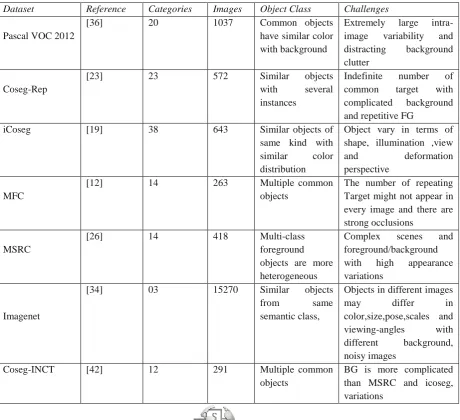
To inspire new techniques and objectively evaluate their performance and accuracy for certain applications, different datasets have been proposed, which contains challenging image groups. Images in these groups may change in viewpoints, instances, outlines and illuminations and contain indefinite number of common targets and background are usually more complicated and cluttered. Initially, the large labeling cost limits the size of the datasets [27], [28] typically in huge amount of images. Now a days, with the popularity of crowdsourcing platform, the label cost is shared over the internet users, which makes large datasets with millions of images and labels possible. In the table-2 given below we summarize the most influential but challenging datasets which are widely used in the existing co-segmentation literature.
Table 2: Showing the details of different public dataset with their challenges
Dataset Reference Categories Images Object Class Challenges
Pascal VOC 2012
[36] 20 1037 Common objects
have similar color with background
Extremely large intra-image variability and distracting background clutter
Coseg-Rep
[23] 23 572 Similar objects
with several
instances
Indefinite number of
common target with
complicated background and repetitive FG
iCoseg [19] 38 643 Similar objects of
same kind with similar color distribution
Object vary in terms of shape, illumination ,view
and deformation
perspective
MFC
[12] 14 263 Multiple common
objects
The number of repeating Target might not appear in every image and there are strong occlusions
MSRC
[26] 14 418 Multi-class
foreground objects are more heterogeneous
Complex scenes and
foreground/background with high appearance variations
Imagenet
[34] 03 15270 Similar objects
from same
semantic class,
Objects in different images
may differ in
color,size,pose,scales and
viewing-angles with
different background, noisy images
Coseg-INCT [42] 12 291 Multiple common
objects
To evaluate an algorithm’s effectiveness and its goodness remains an open question. In the past, the evaluation mostly conducted through subjective i.e. qualitative human inspections or by evaluating the performance of subsequent vision system or analysis the quality of the results produced by
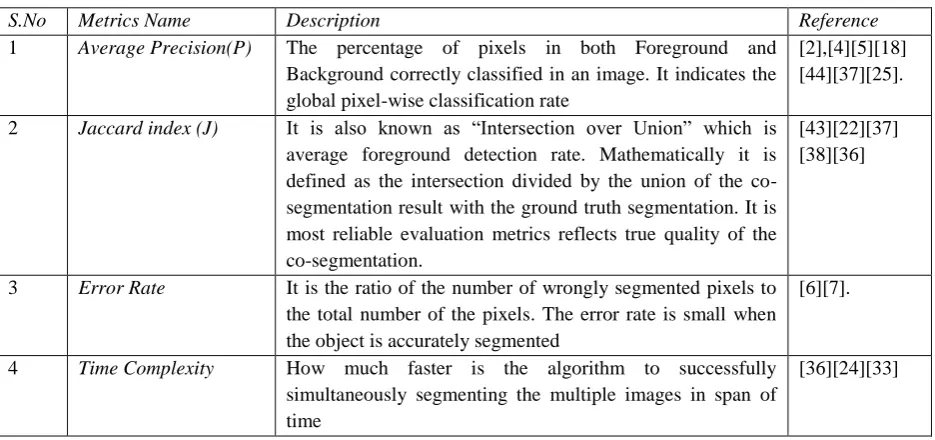
algorithms. But To objectively evaluate a method, it is desirable to associate the segmentation with perceptual grouping. Now a day various evaluation metrics have been proposed related to quantitative evaluation, some of them have been summarized and listed in the table-3:
Table 3: Description of different evaluation metrics used in Co-segmentation Methods
S.No Metrics Name Description Reference
1 Average Precision(P) The percentage of pixels in both Foreground and Background correctly classified in an image. It indicates the global pixel-wise classification rate
[2],[4][5][18] [44][37][25].
2 Jaccard index (J) It is also known as ―Intersection over Union‖ which is average foreground detection rate. Mathematically it is defined as the intersection divided by the union of the co-segmentation result with the ground truth co-segmentation. It is most reliable evaluation metrics reflects true quality of the co-segmentation.
[43][22][37] [38][36]
3 Error Rate It is the ratio of the number of wrongly segmented pixels to the total number of the pixels. The error rate is small when the object is accurately segmented
[6][7].
4 Time Complexity How much faster is the algorithm to successfully simultaneously segmenting the multiple images in span of time
7. CHALLENGES
Co-segmentation techniques as a community has achieved tremendous progress in the past years, there is still a long way to make it widely applicable to more practical applications. In terms of robustness and efficiency there are still many limitations and issues exists. In the following few paragraphs we summarize and address the challenges and problems in the area of co-segmentation as under.
Complexity in the set of images with non-salient background is the big challenge which need to be resolved. it is hard to distinguish the foreground from the complex background and also some time with similar background such as the background of the images may be all meadows which are similar with each other on many features and contours, only human visual system can observe it. A possible solution for this case is that employing more discriminative high-level feature, and searching the semantic context. Most of the co-segmentation methods do not provide the object level foreground in the case, when foreground consist of multiple components and features. This kind of problems require heavy learning and introduction of object constraints because in this way wholeness of the object can be preserved and can be handle multiple component foreground.
The discovery of multiple common foreground in the large scale original image dataset is also among the recent hot topics and big challenge and more expensive to compute for researchers because many of the recently developed techniques work well for small and medium size datasets and but they are not efficient and accurate to deal with large scale datasets There are still some issues which are still to solved, such as outlier and noisy image, variation of intra-class, fast optimization and discovery of unique co-segmentation model to be extendable to different scenarios . One major difficulty arises from the ambiguity between the foreground objects and the background, when no proper prior is given. How to deal with the large scale data is a direction for future work of co-segmentation.
8. APPLICATIONS
The proliferation of high-speed computers, the availability of high resolution and inexpensive video cameras, and the increasing need for automated video analysis has generated a great deal of interest in object detection, image segmentation and tracking of objects. There are many practical applications with different requirements such as huge-scale image co-segmentation, video co-segmentation and web image co-segmentation. There is immense need of co-segmentation model to be extendable to different scenarios.
Applying co-segmentation to improve image classification is an essential application of segmentation. Chai et al.[16] set up a bi-level co-segmentation method, and used it for image classification by using GrabCut algorithm to initialize the foregrounds and the top level with a discriminative classification. Later, a Tri-Cos model [140] having three levels were further proposed, including image level (GrabCut), dataset-level, and category level, which outperforms the bi-level model.
Another interesting and fruitful application of co-segmentation is in image retrieval system For example, if the input to the system is single image, so the retrieval system may provide a ranking which focuses on the similarity of the common object as opposed to the similarity of the full image. [10], [20] are some researches which deals in these kind of applications. Recent trend of c-segmentation have been widely used to solve recognition problems by associating an image with a large database of images, for example [30], where the images in the database have meta-data attached (e.g. class label, motion direction etc.). In this scenario co-segmentation can be helpful to find an object sensitive association. One more featured application of co-segmentation is that it can directly be applied to create a video summary by automatically segmenting common object instances from the video key frames [3], or to simultaneously edit all the objects from a rich personal collection, while avoiding overly exhaustive operation of all instances by the users [19]. Co-segmentation plays an important role on a large-scale set of images to analyze the object-of-interest information in many applications especially in the video segmentation for region of interest, which is extremely time consuming. Kim et al. [4] and Wang et al. [29] solved co-segmentation problems for the large scale of images.
9. FUTURE DIRECTIONS
Although significant research has been done in the field of co-segmentation but still it is very hot topic and various amount of problems and challenges still there to be solved. There is a long journey of co-segmentation research from single class object in image pair to heterogeneous class object in large set of images but still there is immense need of generalized model to solve all kind of co-segmentation related problems because all of the existing proposed methods up till now are mostly related to a specific problem. In this section, we try to discuss some future directions where researchers need to focus more to solve co-segmentation problems, which are as under:
prior generation very hard and also the segmentation of huge diversity of natural scenes and the variability of object class instances is the big challenge so there is need to consider spatial-temporal coherence in future methods to solve these problems.
In recent research investigator are using semi-supervised techniques and trying to generate the common template. Now there is immense need of changing the research direction from single shape pattern to multi-modal or deformable shape models to deal with complicated shape variations to make the co-segmentation research independent of the initial segmentation. Instead of considering local features such as color and shape, other features such as texture, scale and contour should be considered and in this regard the use of co-saliency model would be fruitful and effective. There are so also many multiple segmentation proposals that can be used to perform semantic segmentation.
Along with the these technical issues discussed above researchers must also concentrate on the research which can be directly applied to some important applications such as clothing co-segmentation in fashion industry and human centered object co-segmentation in film making and video tracking system. The clothing extraction can be integrated into the clothing visual search systems to improve the retrieval accuracy and automatically and simultaneously segmentation of all images and extraction the clothing regions van be possible which is very demanding in e-commerce websites. Human centered object co-segmentation is also very important in scene understanding and action recognition in videos.
10. CONCLUSION
This paper presents a comprehensive survey of co-segmentation approaches and also gives a brief review of some recent approaches widely used for image analysis. Various approaches are discussed as feature based, object based, matching based and others as per the reviewed papers. It is observed that there is no perfect technique for image co- segmentation because we have to considering many factors, i.e., pixel color, texture, intensity, object class and its shape with different scales and appearances. Therefore, it is not possible to consider a single method to solve all kind of problems related to image co-segmentation nor all methods can perform well for a particular type of problem. There is still immense need to setup an effective and generalized method to address and deal this problem. Hence, it is good to use hybrid solution consists of multiple methods. In this paper we made our best effort to highlight the recent and traditional image co-segmentation related problems and different useful techniques proposed by different investigators. We also try to explain different
applications and current issues relates to co-segmentations. This research survey with rich bibliography content can provide valuable insight into this important research topic and encourage new research.
REFERENCES
[1] C. Rother, T. Minka, A. Blake, and V. Kolmogorov, ―Cosegmentation of image pairs by histogram matching—Incorporating a global constraint into MRFs,‖ in Proc. IEEE Comput. Soc. Conf. Comput. Vis. Pattern Recognit., vol. 1. New York, NY, USA, Jun. 2006, pp. 993–1000.
[2] A. Joulin, F. Bach, and J. Ponce, ―Discriminative clustering for image co-segmentation,‖ in Proc. IEEE Comput. Vis. Pattern Recognition, Jun. 2010, pp. 1943– 1950.
[3] A. Joulin, F. Bach, and J. Ponce, ―Multi-class co-segmentation,‖ in Proc. IEEE Conf. Comput. Vis. Pattern Recognition., Providence, RI, USA, June. 2012, pp. 542-549.
[4] G. Kim, E. P. Xing, L. Fei-Fei, and T. Kanade,
―Distributed co-segmentation via submodular
optimization on anisotropic diffusion,‖ in Proc. IEEE Int. Conf. Comput. Vis., Nov. 2011, pp. 169–176. [5] S. Vicente, C. Rother, and V. Kolmogorov, ―Object
co-segmentation,‖ in Proc. IEEE Conf. Comput. Vis. Pattern Recognition., Providence, RI, USA, Jun. 2011, pp. 2217–2224.
[6] F. Meng, H. Li, G. Liu, and K. N. Ngan, ―Object co-segmentation based on shortest path algorithm and saliency model,‖ IEEE Trans. Multimedia, vol. 14, no. 5, pp. 1429–1441, Oct. 2012.
[7] F. Meng, H. Li, K. N. Ngan, L. Zeng, and Q. Wu, ―Feature adaptive co-segmentation by complexity awareness,‖ IEEE Trans. Image Process., vol. 22, no. 12, pp. 4809–4824, Dec. 2013.
[8] L. Mukherjee, V. Singh, and C. R. Dyer, ―Half-integrality based algorithms for co-segmentation of images,‖ in Proc. IEEE Conf. Computer. Vis.Pattern Recognit., Miami, FL, USA, Jun. 2009, pp. 2028–2035. [9] D. S. Hochbaum and V. Singh, ―An efficient algorithm for co-segmentation,‖ in Proc. IEEE 12th Int. Conf. Comput. Vis., Kyoto, Japan, Sep./Oct. 2009, pp. 269– 276.
[10]S. Vicente, V. Kolmogorov, and C. Rother,
―Cosegmentation revisited:Models and optimization,‖ in Proc. 11th Eur. Conf. Comput. Vis., vol. 6312. Crete, Greece, Sep. 2010, pp. 465–479.
[11]L. Mukherjee, V. Singh, and J. Peng, ―Scale invariant cosegmentation for image groups,‖ in Proc. IEEE Conf. Comput. Vis. Pattern Recognit., Providence, RI, USA, Jun. 2011, pp. 1881–1888.
[13]H. Li, F. Meng, Q. Wu, and B. Luo, ―Unsupervised multiclass region cosegmentation via ensemble clustering and energy minimization,‖ IEEE Trans. Circuits Syst. Video Technol., vol. 24, no. 5, pp. 789– 801, May 2014.
[14]F. Wang, Q. Huang, M. Ovsjanikov, and L. J. Guibas, ―Unsupervised multi-class joint image segmentation,‖ in Proc. IEEE Conf. Comput. Vis.Pattern Recognit., Jun. 2014, pp. 3142–3149.
[15]L. Mukherjee, V. Singh, J. Xu, and M. D. Collins, ―Analyzing the subspace structure of related images: Concurrent segmentation of image sets,‖ in Proc. 12th Eur. Conf. Comput. Vis., vol. 7575. 2012, pp. 128–142. [16]Y. Chai, V. Lempitsky, and A. Zisserman, ―BiCoS: A
bi-level co-segmentation method for image
classification,‖ in Proc. IEEE Int. Conf. Comput. Vis., Nov. 2011, pp. 2579–2586
[17]E. Kim, H. Li, and X. Huang, ―A hierarchical image clustering cosegmentation framework,‖ in Proc. IEEE Conf. Comput. Vis. Pattern Recognit., Providence, RI, USA, Jun. 2012, pp. 686–693.
[18]J. C. Rubio, J. Serrat, A. Löpez, and N. Paragios,
―Unsupervised co-segmentation through region
matching,‖ in Proc. IEEE Conf. Comput. Vis. Pattern Recognit., Providence, RI, USA, Jun. 2012, pp. 749– 756.
[19]D. Batra, A. Kowdle, D. Parikh, J. Luo, and T. Chen, ―iCoseg: Interactive co-segmentation with intelligent scribble guidance,‖ in Proc. IEEE Conf. Comput. Vis. Pattern Recognit., San Francisco, CA, USA, Jun. 2010, pp. 3169–3176.
[20]K.-Y. Chang, T.-L. Liu, and S.-H. Lai, ―From co-saliency to co-segmentation: An efficient and fully unsupervised energy minimization model,‖ in Proc.
IEEE Conf. Comput. Vis. Pattern Recognit.,
Providence, RI, USA, Jun. 2011, pp. 2129–2136. [21]J. C. Rubio, J. Serrat, A. L´opez, and N. Paragios,
―Unsupervised co-segmentation through region
matching,‖ in Proc. IEEE Conf. Comput. Vis. Pattern Recog., Jun. 2012, pp. 749–756.
[22]M. Rubinstein, A. Joulin, J. Kopf, and C. Liu, ―Unsupervised joint object discovery and segmentation in Internet images,‖ in Proc. IEEE Conf. Comput. Vis. Pattern Recognit., Jun. 2013, pp. 1939–1946.
[23]J. Dai, Y. N. Wu, J. Zhou, and S.-C. Zhu, ―Co-segmentation and co-sketch by unsupervised learning,‖ in Proc. IEEE Int. Conf. Comput. Vis., Dec. 2013, pp. 1305–1312.
[24]W. Tao, K. Li, and K. Sun, ―SaCoseg: Object co-segmentation by shape conformability,‖ IEEE Trans. Image Process., vol. 24, no. 3, pp. 943–955, Mar. 2015. [25]H. Fu, D. Xu, S. Lin, and J. Liu, ―Object-based RGBD
image co-segmentation with mutex constraint,‖ in Proc. IEEE Conf. Comput. Vis. Pattern Recognit., Jun. 2015, pp. 4428–4436.
[26]J. Shotton, J. Winn, C. Rother, and A. Criminisi, ―TextonBoost: Joint appearance, shape and context modeling for multi-class object recognition and segmentation,‖ in Proc. Eur. Conf. Comput. Vis., vol. 3951. 2006, pp. 1–15.
[27]D. R. Martin, C. Fowlkes, D. Tal, and J. Malik, ―A database of human segmented natural images and its application to evaluating segmentation algorithms and measuring ecological statistics,‖ in ICCV, 2001, pp. 416–425.
[28]C. Rother, V. Kolmogorov, and A. Blake, ―Grabcut: interactive foreground extraction using iterated graph cuts,‖ ACM Trans. Graph.,vol. 23, no. 3, 2004. [29]Z. Wang and R. Liu, ―Semi-supervised learning for
large scale image cosegmentation,‖ in Computer Vision (ICCV), 2013 IEEE International Conference on, 2013. [30]C. Liu, J. Yuen, A. Torralba, J. Sivic, and W. T.
Freeman. Sift flow: Dense correspondence across different scenes. In ECCV, 2008.
[31]Kunqian Li, Jiaojiao Zhang, ―Unsupervised Co-Segmentation for Indefinite Number of Common Foreground Objects IEEE TRANSACTIONS ON IMAGE PROCESSING, VOL. 25, NO. 4, pp. 1898-1909, APRIL 2016.
[32]Yijie Wang, Byung-Jun Yoon, and Xiaoning Qian, ―CO-SEGMENTATION OF MULTIPLE IMAGES THROUGH RANDOM WALK ON GRAPHS‖, in proc IEEE on Acoustics, Speech and Signal Processing (ICASSP), pp. 1811 – 1815, May 2016.
[33]Wenguan Wang and Jianbing, ―Higher order Image co-segmentation‖, in proc IEEE on MULTIMEDIA, VOL. 18, NO. 6, pp. 1011–1021, JUNE 2016.
[34]Fanman Meng, Bing Luo, Chao Huang, Bing Zeng,
―Constrained Directed Graph Clustering and
Segmentation Propagation for Multiple Foregrounds Co-segmentation‖, in proc. IEEE TRANSACTIONS ON CIRCUITS AND SYSTEMS FOR VIDEO TECHNOLOGY, VOL. 25, NO. 11, pp. 1735-1748 NOVEMBER 2015
[35]C. Lee, W.-D. Jang, J.-Y. Sim, and C.-S. Kim, ―Multiple random walkers and their application to image cosegmentation,‖ in Proc. IEEE Conf. Comput. Vis. Pattern Recog., Jun. 2015, pp. 3837–3845. [36]X. Dong, J. Shen, L. Shao, and M. H. Yang,
―Interactive co-segmentation using global and local energy optimization,‖ IEEE Trans. Image Process., vol. 24, no. 11, pp. 3966–3977, Nov. 2015.
[37]Chongbo Zhou, Chuancai Liu, ―Co-segmentation of multiple similar images using saliency detection and region merging‖, IET Comput. Vis., 2014, Vol. 8, Iss. 3, pp. 254–261,2014.
[38]Hongliang Li, Fanman Meng, Bing Luo, and Shuyuan Zhu, ―Repairing Bad Co-Segmentation Using Its Quality Evaluation and Segment Propagation‖, IEEE TRANSACTIONS ON IMAGE PROCESSING, VOL. 23, NO. 8, pp.3545-3559 AUGUST 2014.
[39]Fanman Meng, Hongliang Li, Guanghui Liu, and King Ngi Ngan,‖ Image Co-egmentation by Incorporating Color Reward Strategy and Active Contour Model‖, IEEE TRANSACTIONS ON CYBERNETICS, VOL. 43, NO. 2, APRIL 2013, pp. 725-737.
[41]D. E. Jacobs, D. B. Goldman, and E. Shechtman, ―Cosaliency: Where people look when comparing images,‖ in ACM Symposium on User Interface Software and Technology, 2010, pp. 219–228.
[42]K.Li, J.Zhang, ―Unsupervised Co-Segmentation for Indefinite Number of Common Foreground Objects‖, IEEE TRANSACTIONS ON IMAGE PROCESSING, VOL. 25, NO. 4, APRIL 2016, pp. 1898-1909
[43]A. Faktor and M. Irani, ―Co-segmentation by composition,‖ in Proc. IEEE Int. Conf. Comput. Vis., Dec. 2013, pp. 1297–1304..
[44]F.Wang, Q. Huang, and L. J. Guibas, ―Image co-segmentation via consistent functional maps,‖ in Proc. IEEE Int. Conf. Comput. Vis., Dec. 2013, pp. 849–856. [45]D. Batra, D. Parikh, A.Kowdle, T. Chen, and J. Luo,
―Seed image selection in interactive co-segmentation,‖ in Proc. IEEE Int. Conf. Image Processing, Nov. 2009, pp. 2393–2396.
[46]H. Fu, X. Cao, and Z. Tu, ―Cluster-based co-saliency detection,‖ IEEE Trans. Image Processing, vol. 22, no. 10, Oct. 2013, pp. 3766–3778.
[47]J. Yuan et al., ―Discovering thematic objects in image collections and videos,‖ IEEE Trans. Image Processing, vol. 21, no. 4, pp. 2207–2219, Apr. 2012.