Simulation of Probability of False Alarm and Probability of
Detection Using Cyclo Stationary Detection
Technique in Coginitive Radio
1
Tammana Mor,
2Dr. Dinesh Arora,
3Tulika Mehta
1,2Dept. of ECE, Panchkula Engineering College, Barwala, Panchkula (Haryana), India 3Researcher and Entrepreneur, UIET, Panjab University Chandigarh, UT, India
Abstract
Cognitive Radio (CR) advent in the technology which deals successfully with the growing demand and scarcity of the radio spectrum. The technique drives us the in-depth knowledge of
DSA technique where reconfiguration itself is the key feature. To exploit limited spectrum efficiently, CR technology allows
unlicensed users to access licensed spectrum bands obtaining reliable results enabling no interference is the main task for
spectrum sensing, challenges to the implementation of CR has
been discussed thoroughly including research achievements of cognitive radio.
Keywords
Cognitive Radio, Energy Detection, Primary Users, Spectrum
Sensing
I. Introduction
Communication through mobile systems have undergone an
emerging trend for the last few decades, it has been seen that there
is a tremendous growth in the particular sector. With the increasing number of users scarcity of electromagnetic spectrum is obvious. If we need to accommodate the increasing number of users in the given spectrum available becomes a problem. Keeping this
into consideration, the Federal Communications Commission (FCC) published a report prepared by Spectrum Policy Task Force (SPTF) [1]. It is seen that there is significant inefficient
spectrum utilization than the actual spectrum scarcity.
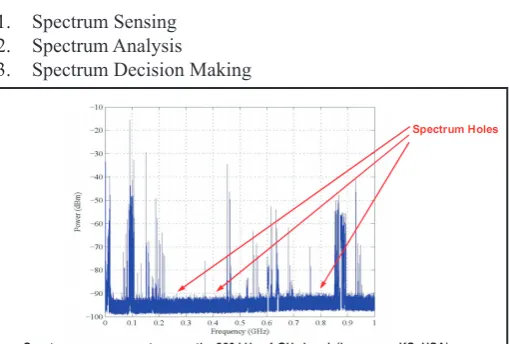
It has been seen that all the channels are not being utilized, some
are partially occupied while others are heavily used. The problem of underutilization of allocated spectrum or the underutilized area
is technically defined as a spectrum hole. A spectrum hole is band
of frequencies assigned to the primary user but at a given instant of time these frequency bands are not being utilized and thus are
free we also know them as white spaces [2]. All this is frequently
observed under static spectrum allocation of spectrum.
The spectrum management techniques are classified broadly
under DSM i.e. Dynamic Spectrum management: SDR and CR.
The software defined radio SDR is one of its kinds which has the feature of reconfigurability, however not on its own.
Whereas CR can reconfigure on its own. Here Cognitive
radio (CR) dynamically aims to innovate the traditional fixed
spectrum.
The CR has numerous performance metrics which have not been seen in any other kind of intelligent radio.
The Key features include:
Improving spectrum utilization and efficiency. •
Improving interoperability between legacy and emerging
•
systems.
Improving link reliability.
•
Less Expensive radio •
Extended coverage. •
(f) Enhancing SDR capabilities. •
Now CR is self aware, RF aware, user aware. It has high fidelity
and is language technology adaptable with machine vision. The
cognitive cycle helps CR to reconfigure them. In Cognitive cycle the CR follows these steps for reconfigurability i.e. Awareness, Perception, Reasoning and then Decision making.
In context to opportunistic spectrum sensing with cognitive
radio’s, it is to be noted that CR interacting with real time
environment has the capability to dynamically alter its operating
parameters such as transmitting power, carrier frequency,
modulation and assimilates itself with the environment whenever there is statistical change in incoming radio frequency with the sole purpose to take advantage of the available spectrum without causing any interference to the licensed users.
To detect the performance in spectrum sensing is crucial to see
the performance of both primary and CR networks [3-5].
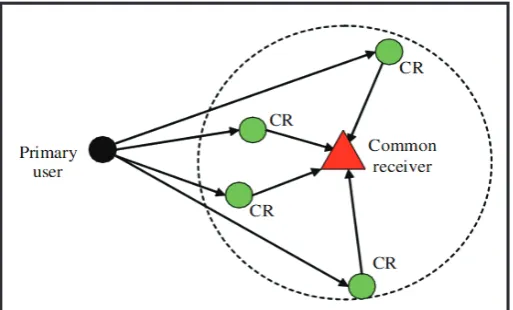
Fig 1. shows spectrum sensing structure in cognitive radio
network.
Fig. 1: Spectrum Sensing Structure in CRN
In case of CR we need to accurately detect whether the current band is occupied by a licensed user to ensure the licensed user’s
use of specific bands. Spectrum sensing algorithms in CR can be mainly divided into three types: energy detection, match filter detection, and cyclostationary detection. Among them,
energy detection has been widely applied since its algorithm is
simple, and it does not require transcendental knowledge of the licensed user’s signals. Due to the interference factors, such as multipath and shadow effect of wireless channels, energy sensing
II. Cognitive Cycle:
Fig. 2: Cognitive Cycle
This shows a basic Cognitive cycle. A basic cognitive cycle comprises of following three basic tasks:
Spectrum Sensing
1.
Spectrum Analysis
2.
Spectrum Decision Making
3.
Fig. 2(a): Underutilization of Spectrum [13]
III. Spectrum Sensing and Its Classification
The most tedious and crucial task to establish Cognitive radio Networks includes spectrum sensing.
The spectrum Sensing technique aims to determine the availability
of spectrum and the presence of the licensed users (PU).
This is being broadly categorized as: Individual Spectrum Sensing
•
Co operative spectrum Sensing
•
A. Individual Spectrum Sensing
Each of the secondary user detects the signal itself and takes the
decision whether the primary user is present or absent.
It needs to be taken care that if the Primary user is present the
secondary user should not interrupt.
To allow reliable operation of cognitive radios, we must be able to detect precisely the spectrum holes at the link level. In practice, the unlicensed users, also called secondary users (SUs), need to continuously monitor the activities of the licensed users, also called primary users (PUs), to find the spectrum holes (SHs), which is defined as the spectrum bands that can be used by the SUs without interfering with the PUs. This procedure is called
spectrum sensing.
B. Co-operative Spectrum Sensing
In case of co operative spectrum sensing the SU send the decision individually and then the final decision is taken by combining all
the individual decisions.
In the case of this type of sensing the issues related to shadowing, fading and hidden terminal are eliminated [7-9].
Fig. 3: Basic Principle of Primary Detection [6]
C. Basic Detection Principle
PU transmitter is sends data to the PU receiver in a licensed spectrum band Pair of SUs intends to access the spectrum now to protect the PU transmission, the SU transmitter performs spectrum sensing.The spectrum sensing by SU helps to detect whether there is a PU receiver in the coverage of the SU transmitter or not. However detection of PU receiver is difficult hence presence or absence of PU signal is done easily.
As per figure the radius of PU transmitter and PU receiver detections are different, which lead to some shortcomings and challenges. It may happen that the PU receiver is outside the PU transmitter detection radius, where the SH may be missed. Since the PU receiver detection is difficult, most study focuses on PU transmitter detection [10].
IV. Spectrum Sensing Techniques
The important requirement of cognitive radio network is to sense the spectrum hole. Cognitive radio has an important property that it detects the unused spectrum and shares it without harmful interference to other users. Spectrum sensing techniques can
be classified as frequency domain approach and time domain
approach. In frequency domain method estimation is carried out directly from signal so this is also known as direct method. In time
domain approach, estimation is performed using autocorrelation
of the signal. Another way of categorizing the spectrum sensing and estimation methods is by making group into model based parametric method and periodgram based non-parametric method
[2]. Another way of classification depends on the need of spectrum sensing as stated below [3]:
A. Spectrum Sensing for Spectrum Opportunities
1. Primary Transmitter Detection
In this approach, detection of a signal from a primary transmitter
is based on the received signal at CR users whether it is present or not. It is also known as non-cooperative detection.
2. Cooperative or Collaborative Detection
B. Spectrum Sensing for Interference Detection
1. Interference Temperature Detection
In this method the secondary users are allowed to transmit with lower power then the primary users and restricted by interference temperature level so that there is no interference.
2. Primary Receiver Detection
In this method, the interference and/or spectrum opportunities
are detected based on primary receiver’s local oscillator leakage power.
Centralized
Distributed
Relay-assisted Non- Cooperative
Sensing Cooperative Sensing
Interference based sensing
Energy Detection
Matched filter Detection
Spectrum sensing Techniques
Cyclostationary
Feature Detection
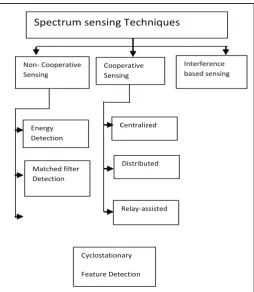
Fig. 4: Classification of Spectrum Sensing Techniques
Spectrum Sensing techniques are classified into three main types, transmitter detection or non cooperative sensing, cooperative
sensing and interference based sensing. Transmitter detection
technique is further classified into energy detection, matched filter detection and cyclostationary feature detection [4].
Non-cooperative detection This technique is based on the detection of the weak signal from a primary transmitter. In primary transmitter
based detection techniques, a cognitive user determines signal strength generated from the primary user. In this method, the
location of the primary receivers are not known to the cognitive users because there is no signalling between the primary users
and the cognitive users. Basic hypothesis model for transmitter detection can be defined as follows [6].
1. Cylostationary Feature Detection
It have been introduced as a complex two dimensional signal processing technique for recognition of modulated signals in the
presence of noise and interference [19]. To identify the received
primary signal in the presence of primary users it exploits
periodicity of modulated signals couple with sine wave carriers, hopping sequences, cyclic prefixes etc. Due to the periodicity, these
cyclostationary signals exhibit the features of periodic statistics
and spectral correlation, which is not found in stationary noise and interference [10- 13].
V. Result Analysis
In spectrum sensing, it is most desired to decrese the flase alram
or misdetection. With this it reduces collision probability with the primary user which increases the judious use of unused spaces in the allocated spectrum
The crtical issues holds in determining the valuse of the threshold
level. When determining threshold level, besides spectrum sensing error, spectrum sensing constraint which requires false alarm and
miss detection probabilities to be below target level should also be considered since it guarantees minimum required protection level of primary user and usage level of vacant spectrum
For cooperative spectrum sensing is suggested in the following
steps:
A code is developed for the spectrum sensing structure in
1.
a cognitive radio network. In this structure we define the
primary user and receiver.
It is followed by the code for the cognitive radio
2.
development.
Then the optimal voting rule for the energy detection is
3.
developed in spectrum sensing structure. It has been found that the optimal decision voting rule to minimize the total error probability is the half-voting rule. A method of can be presented.
By using additive white Gaussian noise (AWGN) channel, 4.
the error rate can be calculated.
Fig. depicts an algorithm for implementing cooperative spectrum
sensing with cyclostationary detection and calculating error rate.
To detect the Spectrum availability device code
Devise specific algorithm
False alarm rate to be calculated Develop for CRN ( DSA)
Fig. 5: Flow Chart for Calculating Error Rate
According to the equations plot the Probability of Detection (Pd) vs. Probability of False Alarm (Pf)
Table 1: Probability of False Alarm vs Probability of Detection for SNR = -10 dB
Probability of False Alarm (Pf) Probability of Detection (Pd)
0 0.7
0.1 0.87
0.2 0.93
0.3 0.95
0.4 0.96
0.6 0.98
0.8 0.99
In the simulation below we analyse the graph between probability of detection of the primary users vs signal to noise ratio. We have measured this for spectrum sensing methods ie energy detection as well as cyclo stationary
VI. Application Areas
The increasing number of users and les available spectrum has
resulted in the development of surrounding RF environment aware
of Cognitive radio networks. These networks have applications in almost every wireless communication where there is a need of
efficient utilization of radio spectrum.
The main application areas are given as under:
Cognitive radio Network is a promising technology to be used in
XG mobile networks.
Cognitive radio networks have a direct application for Military
and Public safety. [14- 15]
Sensing time for Individual Spectrum Sensing
This is another important parameter to check the performance of the system. Here we are calculating the perfomace metric Tp ( sensing time ). Sensing time can be monitored by running the
specific matlab code . The time which the systen consume in entire
run-time is the sensing time .
We calulate Tp using Intel (R) core (TM)2 duo CPU [email protected]
VII. Conclusion
The Spectrum sensing is a critical technique which helps us understanding the geography of the spectrum bandwidth utilization.
The Individual spectrum and co operative spectrum sensing has
been understood and the defined parametrs like false alarm are taken into care and worked to mininmise the error rate ,.
References
[1] Federal Communications Commission,“Spectrum Policy Task Force”, Rep. ET Docket no. 02-135, Nov. 2002. [2] FCC, ET Docket No 03-237 Notice of inquiry and notice of
proposed Rulemaking, ET Docket No. 03-237, Nov. 2003 [3] G.Faulhaber, D.Farber,“Spectrum management: Property
rights, markets, and the commons”, In Telecommunications Policy Research Conference Proceedings, 2003 [Onlin] Available: http://rider.wharton.upenn.edu/_faulhabe/ spectrum management 51.pdf
[4] Sai Shankar N, Carlos Cordeiro, Kiran Challapali, “Spectrum agile radios: Utilization and sensing architectures”, Proc. The first IEEE Symposium on New Frontiers in Dynamic
Spectrum Access Networks, pp. 160-169, 2005.
[5] W. H. W. Tuttlebee,“Software radio technology: a European perspective”, IEEE Communications Magazine, Vol. 37,( 2), pp. 118–123, 1999.
[6] B. Wang; Liu, K.J.R.,“Advances in cognitive radio networks: A survey”, Selected Topics in Signal Processing, IEEE Journal, Vol.5,.(1), pp. 5-23, Feb. 2011
[7] Joseph Mitola, Gerald Q.Maguire,“Cognitive Radio: Making Software Radios More Personal”, Jr.,Royal Institute of Technology, IEEE Personal Communications, August 1999.
[8] S.Haykin,“CognitiveRadio:Brain-empowered wireless communications", IEEE J. Sel. Areas Commun., Vol. 23, pp. 201-220, Feb. 2005.
[9] Ian F. Akyildiz, Won-Yeol Lee, Mehmet C. Vuran, Shantidev Mohanty,“NeXt generation/dynamic spectrum access/ cognitive radio wireless networks: A survey”, ELSEVIER Comet, Vol. 50 (13), pp. 2127-2159, May 2006.
[10] Danda B. Rawaty, Gongjun Yanz,“Signal Processing
Techniques for Spectrum Sensing in Cognitive Radio
Systems: Challenges and Perspectives”, IEEE J. Sel. Topics in Signal. Proc., July 2009.
[11] T. Yucek, H. Arslan,“A survey of spectrum sensing algorithms for cognitive radio applications”, IEEE Commun. Surveys Tutorials, Vol. 11, No. 1, pp. 116-130, First Quarter, 2009. [12] A. Ghasemi, E. Sousa,“Collaborative spectrum sensing for
opportunistic access in fading environments”, In Proc. IEEE Int. Symposium on New Frontiers in Dynamic Spectrum Access Networks, Baltimore, Maryland, USA, pp. 131-136, Nov. 2005.
[13] S. Nallagonda, S. Suraparaju, S. D. Roy, S. Kundu, “Performance of energy detection based spectrum sensing in fading channels”, In Proc. of IEEE International Conference on Computer and Communication Technology (ICCCT’11), pp. 575-580, Sep2011.
[14] B. Wang; Liu, K.J.R.,“Advances in cognitive radio networks: A survey”, Selected Topics in Signal Processing, IEEE Journal, Vol. 5,(1), pp. 5-23, Feb. 2011.
[15] Shahzad A.et. al.,“Comparative Analysis of Primary Transmitter Detection Based Spectrum Sensing Techniques in Cognitive Radio Systems", AustraliAan Journal of Basic and Applied Sciences, 4(9), pp. 4522-4531, INSInet Publication, 2010.
[16] Guan, YH Zeng, ECY Peh, YC Liang, YL,“Cooperative
spectrum sensing in cognitive radio networks with weighted
decision fusion schemes”, IEEE Trans Wire Commun. 9, pp. 3838–3847, 2010.
[17] J Unnikrishnan, VV Veeravalli,“Cooperative sensing for primary detection in cognitive radio", IEEE J Sel Topics Signal Process. 2(1), pp. 18–27, 2008.
[18] AW Min, X Zhang, KG Shin,“Detection of small-scale primary users in cognitive radio networks", IEEE J Sel Areas Commun. 29, pp. 349–361, 2011.
[19] C Song, Q Zhang,"Cooperative spectrum sensing with multi-channel coordination in cognitive radio networks", In Proc IEEE Int Conf Commun (ICC) (May 2010)
[20] P Kaligineedi, VK Bhargava, Sensor allocation and
quantization schemes for multi-band cognitive radio
Er. Tamanna Mor is a Diploma holder in ECE with first division from govt. Polytenic college roopnagar B.Tech in ECE with first division from punjab
technical university India. She is
currently pursuing M.Tech in ECE from Panchkula eng. College Mouli affiliated under kurukshetra university
India and working on research thesis in cognitive radios.
Dr. Dinesh Arora is B.tech in Electronics and Communication Engineering from Punjab Technical University, India 2002. He obtained his Master’s degree in Electronics and Communication Engineering from Punjab Technical University, India in 2007. He did his Ph.D in field Optical Fibers in 2012.
He is presently working as Associate
Professor at Panchkula Engineering College Mouli, India. He has presented 35 papers in International journals and has guided 12 M.tech thesis in Kurukshetra university. He is an approved guide in Punjab Technical University Jalandhar India to guide Ph.D students and he is a reviewer of many International Journals.
Er. Tulika Mehta is an Electronics Engineering professional having worked
previously with Telecom Industry. She is a young entrepreneur also associated
to Panjab University contributing in
research and development activities in
the field of wireless communications. She is ME MBA from Panjab University