2863
Smart Attendance System through face recognition
using machine learning algorithm
Dipti Kumbhar
1, Prof. Dr. Y. S. Angal
2,
Department of Electronics and Telecommunication, BSIOTR, Wagholi, Pune, India1,2 Email: [email protected]1, [email protected]2
Abstract-In the last decades face recognition systems have seen tremendous improvement in the field of security applications. In real life, the person is mostly recognized by its face because of its characteristics and distinguishable features. This paper present the automatic class attendance system using the face as a biometric. The main aim of this research work is to minimize the manual process of attendance. The approach is designed using the image and machine learning algorithm. The database is created manually by capturing the faces of the different student in the class. First, the face is detected using deep learning neural network approach. The features are extracted by PCA feature extraction technique and classify using SVM and back propagation neural network algorithm. The proposed algorithm achieved an accuracy of 98% for SVM and 93.33% for Decision Tree algorithm. The proposed system is deployed on Raspberry Pi 3 module.
Index Terms-Back propagation, DNN, Face detection, Face recognition, PCA, SVM
1. INTRODUCTION
With the rapidly improving in technology, the application of modern technologies for day to day life activities also increases rapidly. The technologies mostly focus on the automation of the activities and accuracy of the system. The biometric application has a wide range of application and there is a number of innovative ways which makes the development of biometric systems alive.
Basically, the biometric systems have two phases: First Enrolment and second in the recognition phase. In the enrolment phase, the biometric traits of the person are taken and stored in the form of features. The labels are assigned according to the person. In the recognition phase, the biometric trait of a random person is acquired and match with the features stored in the database. [1]
In the process of automatic attendance system using face recognition, lots of existing methods are available like RFID card based, web-based, fingerprint-based etc. These techniques are widely used in the various organization. The traditional method of attendance marking is very time consuming, difficult to maintain and becomes complicated if there are a number of students. Thus the aim of this project is to make the system automated which has more advantages over the traditional method, as it saves time and also helps to prevent fake attendance. Face recognition can also be used for security purpose. In this paper, a facial feature based attendance system has been proposed. In this approach, the faces are detected using an
improved Deep Neural Network (DNN) technique. The detected faces are cropped and stored in the database with the label. To improve the accuracy and generalization of the approach, the faces were captured in the various environment. The features were extracted using Principal Component Analysis (PCA) algorithm. Finally, the extracted features were trained and test using machine learning algorithms such as Support Vector Machine (SVM) and the backpropagation algorithm.
A system for face recognition is developed using Raspberry Pi module. In this system, the image is captured through the webcam. In the captured image face is detected and it is compared with the stored database. If the detected face matches the stored database then the attendance for that particular student will be marked automatically.
2. LITERATURE SURVEY
Chellappa et. al [2] proposed face recognition to identify the face from video database. Turk et al [3] present the face recognition system by using the PCA algorithm. This algorithm used to solve face features using Eigenvalues and Eigenvector. But this could not be an elegant solution for object recognition approach. Eigenfaces only could not be the exact solution for face recognition, but it required some machine learning algorithm to classify the facial features. This approach works well for simple and constrained environment.
2864 the face subspaces and proceed with the LDA to the
obtained the best linear classifier. The proposed approach is evaluated on the FERET dataset. Likewise, Joss Beveridge et al [5] also used PCA and ICA for face recognition.
Michael Bromby [6] proposed computerized face recognition system to detect and prevent the crimes. Vytautas Perlibakas [7] proposed a method for face recognition using PCA and Log-Gabor filters. The proposed approach tested on 5151 face images of 1311
person of FERET and AR database. This approach shows good accuracy for different facial expression, illumination, and age.
3. PROPOSED SYSTEM
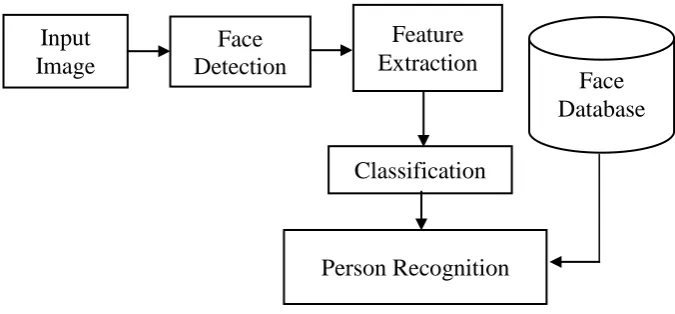
The proposed system uses face recognition to mark the attendance if the student is present. This approach is mainly divided into two steps: Face registration and Face recognition. The block diagram of the proposed system is represented in Fig. 1.
[image:2.595.149.487.236.393.2]Fig. 1 Block diagram of the attendance system using face recognition
A. Image recognition
Image registration is a process where the facial images of the user are captured and stored in the database. The image registration process is explained as follow.
a. Image acquisition
The image is captured through the webcam. The USB webcam of 5 MP is used for this purpose. The captured image contains facial images with some background information. But for the registration of the data, only face image is necessary. This task is achieved by face detection algorithm.
b. Face detection
Face detection is the basic step of the face recognition system. There are many algorithms were available for face detection. In this method robust deep neural network based face detection algorithm is used to detect the face. It is OpenCV's new Deep Neural Network (DNN) module which mainly consists of cv2.dnn.blobFromImage and cv2.dnn.blobFromImages preprocessing function. The functions perform Mean subtraction, scaling and channel swapping process. Mean subtraction is used to compensate for the illumination changes in the images. scaling is a process where the face image is scaled with the different scaling factor. This is important to match the facial
image of a different scale. The detected faces were cropped according to the height and width of the detected bounding box.
c. Feature Extraction
In this approach, the feature is extracted using the PCA algorithm. The face image then resizes to 128x128 pixels size. These face needs to convert into vectors because the PCA algorithm is working on the vector hence each image is converted into the vector. In most of the approach, the PCA is used as a feature reduction technique but PCA is one of the methods which represent the faces economically. In PCA, the face images are first converted into Eigenfaces and corresponding projection. The PCA sorted only meaningful features vectors from the vector of Eigenvectors.
The PCA is mathematically expressed as:
(1)
Where X is the face vector, Y is a vector of Eigenfaces, W is the feature vector, and μ is the average face vector.
In order to extract features principal component analysis (PCA) or Eigenfaces algorithm is chosen. Let
Input
Image
Person Recognition
Classification
Feature
Extraction
Face
Detection
2865 X=(x1, x2,…,xn) be a random vector with
observations Xi € Rd.
1. Compute the mean (μ):-
∑ (2)
2. Compute the Covariance Matrix (S):-
∑ (3)
3. Compute the eigenvalues (λi) and eigenvectors (vi) of S :-
(4)
4. Order the eigenvectors descending by their eigenvalue. The k principal components are the eigenvectors corresponding to the k largest eigenvalues.
5. The k principal components of the observed vector x are then given by:
(5) Where W = (v1,…,vk)
6. The reconstruction from the PCA basis is given by:
(6) Where W=(v1,…,vk)
B. Image Recognition
Image recognition is the process where the given samples are classified using a machine learning algorithm. In the proposed approach, SVM and DT are used for classification. Each classifier is explained in detail below.
a. SVM
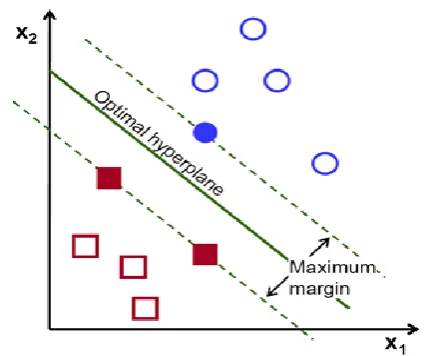
Support vector machine is a flawless method to find out the hyperplane between two different particular classes in high dimensional feature space which can be used for classification. SVM is a supervised algorithm of machine learning [10]. Supervised learning method processed through two steps: Training and Testing.
SVM classified into linear and Non-linear classification. The linear SVM classifier is worthwhile for the nonlinear classifier to map the input pattern into higher dimensional feature space. The data which can be linearly separable can be examined using hyper-plane and the data which is linearly non-separable those data are examined methodically with kernel function like higher order polynomial. SVM classification algorithm is based on different kernel methods i.e. Radial basic function (RBF), linear and quadratic kernel function. The RBF kernel is applied
on two samples x and x', which indicate as feature vectors in some input space and it can be defined as,
(7)
[image:3.595.308.522.205.383.2]The value of the kernel function decreases according to the distance and fluctuates between zero (in the limit) and one (when x = x').
Fig. 2 Optimal hyperplane margin
b. Decision Tree
DT is a supervised learning algorithm used for classification as well as regression. A DT consists of a node and root sections. At the root section, no classification is possible, whereas the node sections get classified into classes called leaves. Leaves are represented as class labels while branches represent a conjunction with the feature that further leads to the respective classes.
The decision tree algorithm, when trained on the labeled dataset created, produces a decision tree that has, at each node, a condition testing based on the PCA features. If the condition evaluates true, it traverses to left, otherwise to the right subtree and so on till it reaches the leaf nodes. The leaf nodes represent classes. So in this application, there will be two root nodes (correctly detected and incorrectly detected). In the testing phase, just put each test instance through the tree starting from the root. The leaf node that we end up in is predicted as the class.
4. IMPLEMENTATION AND RESULTS
2866 Python is an interpreter, object-oriented, high-level
programming language with dynamic semantics. Its high-level built in data structures, combined with dynamic typing and dynamic binding, make it very attractive for Rapid Application Development. Python is simple, easy to learn and syntax emphasizes readability, therefore, it reduces the cost of program maintenance. Python supports modules and packages, which encourages program modularity and code reuse. The Python interpreter and the extensive standard library are available in source or binary form without charge for all major platforms and can be freely distributed.
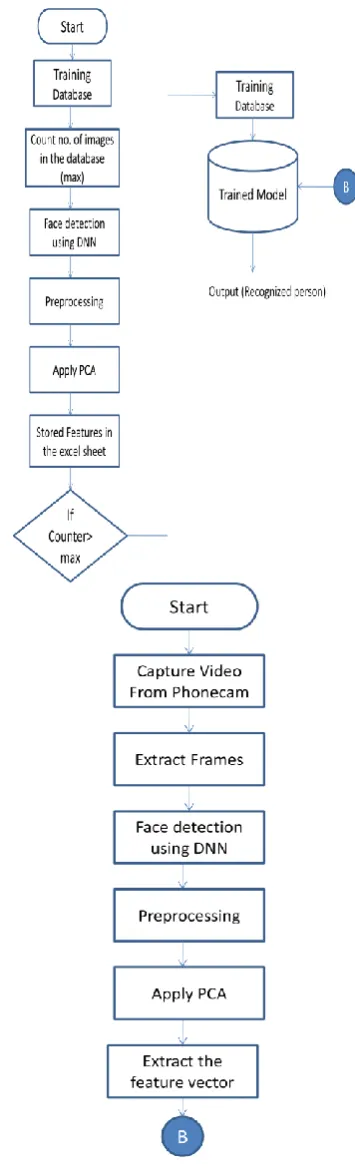
For the implementation of the proposed system used below algorithm:
1. Start 2. Input image
3. Face detection using the deep Neural network (DNN)
4. Crop detected faces
5. Face stored in the training database according to their label
6. Preprocess the database
7. Apply PCA as a feature extraction technique 8. Apply SVM and DT machine learning algorithm
and classify the extracted features
9. Output: Label assign to the label and mark as a attendance in the excel sheet.
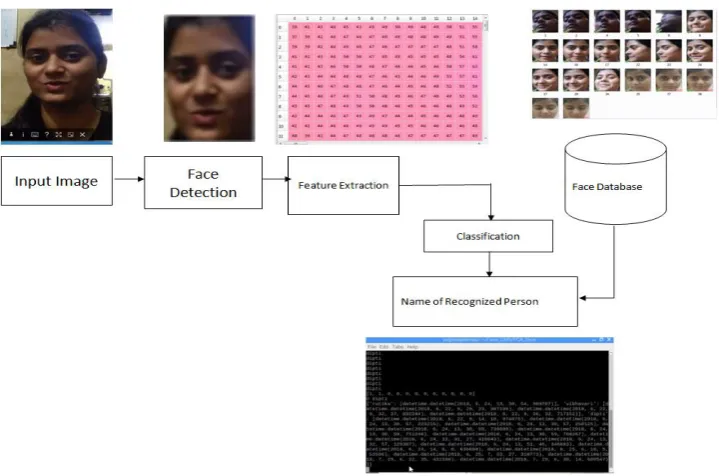
[image:4.595.324.502.95.683.2]The result of the proposed system is as shown below with qualitative and quantitative analysis. While checking result on own database in real time (actually taking input from the camera) there are many factors like camera, image quality, illumination, etc. Hence, these factors affect the accuracy of the output. In the qualitative analysis, the results of the recognized faces are shown in Fig. 4.
2867
Fig. 4 Attendance system logs
(a) (b)
2868
(e) (f)
Fig. 5 Qualitative analysis of the proposed method (a) (c) (e) Input face image (b)(d)( f) Recognized face
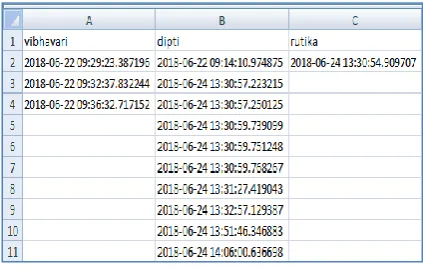
[image:6.595.140.478.103.240.2]Also, the attendance is marked in the excel sheet with respective time which is shown in Fig 6.
Fig.6. Attendance sheet with time
The quantitative analysis of the proposed system is calculated using the accuracy parameter. The accuracy of the face recognition system is given as (Eq.2)
(9)
able 1 present the cross-validation accuracy of presented algorithms.
Table 1. Performance Evaluation
Sr.
No. Classifier
Feature Extraction technique
Training Accuracy
Testing Accuracy
1 SVM PCA 98% 83%
2 DT PCA 93.33% 82%
5. CONCLUSION
In this paper, the facial recognition system using SVM and DT machine learning algorithm has been implemented. The faces are converted into a vector and meaningful features were sorted using principal component analysis. The extracted features are classified using SVM and DT. The system is implemented in the real-time environment using
Raspberry Pi 3 hardware platform. The proposed system achieved 98% cross-validation and 83% testing accuracy using SVM classifier while 93.33% cross-validation and 82% testing accuracy using DT classifier.
In the future, the system can be made more robust by increasing the database images in different light conditions. The accuracy of the system can be improved by deep learning method.
REFERENCES
[1]
W. Zhao, R. Chellappa, P.J. Phillips, and, A. Rosenfeld. “Face recognition: A literature survey”. ACM computing surveys (CSUR) 2003, 35(4), pp.399-458.[2] Zhao W., R. Chellappa, P. J. Phillips and A. Rosenfeld,(2006) "Face recognition: A literature survey", ACM Comput. Surv., Vol. 35, no. 4, pp.399 -459, 2006.
[3] Turk, M., and Pentland, A., "Eigenfaces for recognition", Journal of Cognitive Neu roscience, Vol. 3, pp. 71-86, (1991).
[4] W. Zhao, R. Chellappa, and A. Krishnaswamy, "Discriminant analysis of principal components for face recognition," Proceedings Third IEEE International Conference on Automatic Face and Gesture Recognition, Nara, 1998, pp. 336-341.
[5] B. Draper, K. Baek, M.S. Bartlett, and J.R. Beveridge, Recognizing Faces with PCA and
ICA, Computer Vision and Image
Understanding (Special Issue on Face Recognition), Vol. 91, Issues 1-2, July-August 2003, pp. 115-137
[6] Bromby, Michael C., Computerised Facial Recognition Systems: The Surrounding Legal Problems (September 1, 2000). L.L.M. Dissertation, Faculty of Law, University of Edinburgh
[image:6.595.72.284.310.445.2]