An Improvment of the Elliptic Net Algorithm
Binglong Chen and Chang-An Zhao*
Abstract
In this paper we propose a modified Elliptic Net algorithm to compute pairings. By reducing the number of the intermediate variables which should be updated in the iteration loop of the Elliptic Net algorithm, we speed up the computation of pairings. Experimental results show that the proposed method is about14%faster than the original Elliptic Net algorithm on certain supersingular elliptic curves with embedding degreetwo.
Index Terms
Pairing based cryptography, Elliptic curve, Tate pairing, Elliptic Net algorithm.
F
1
I
NTRODUCTIONPairings on elliptic curves have become one of the most popular cryptographic primitives in public key cryptography. There are a lot of interesting cryptographic schemes and signatures based on pairings. An excellent survey of pairing-based applications can be found in [1]. Since the computation of the pairings are the most expensive operation in pairing-based cryptosystems, reducing the computational complexity of pairing computations has been an important issue in pairing-based cryptography. Since then, there are much research devoted to the efficient computation of pairings. We refer the reader to [2], [3] for more information about pairings. To date, there are many variants that have been proposed for efficiency reasons based on the Tate pairing, such as Duursma-Lee [4],ηT [5], (optimized) ate [6], [7], atei [8], R-ate [9], pairing lattice [10] and optimal [11] pairings. On the other hand, there are also a few pairing variants constructed via the Weil pairing, such as theeilpairing [10], the omega pairing [12] and the improved self-pairings [13], [14], [15].
There only exist two polynomial-time algorithms to compute the pairings till now. One is Miller’s algorithm [16], [17] and the other is the Elliptic Net algorithm [18]. A lot of avenues of optimizing Miller’s algorithm have been investigated, and now it takes only a few milliseconds to compute pairings by using the optimized Miller’s algorithm.
However, all of optimizations of Miller’s algorithm can be seldom applied directly in speeding up the Elliptic Net algorithm except simplifying the final exponentiation. There is few work to improve the efficiency of the Elliptic Net algorithm compared with Miller’s algorithm. How to compute the ate-like pairings based on the Elliptic Net algorithm has been investigated in [19], [20]. The concept of elliptic nets has been generalized to hyper-elliptic curves for computing hyper-pairings in [21], [22].
Our goal in this paper is to shorten the theoretical gap in the studying of the Elliptic Net algorithm, and to this end we propose several efficient techniques for the arithmetic operations involved as follows.
• Observe that in many practical setting, when computing the evaluation of rational functionsfr,P(Q), the concrete parameterrwill be chosen reasonably sparse(a good survey of pairing-friendly curves, refer to [23]). This means that theDoublefunction will be more frequent than theDoubleAddone in the whole iteration loop of the Elliptic Net algorithm. Inspired by the work of Rachel Shipsey [24], we can reduce the number of the intermediate
• B. Chen and C.-A. Zhao are with the School of Mathematics and Computational Science, School of Mathematics and Computational Science, Sun Yat-sen University, Guangzhou 510275, P.R.China.
* Corresponding author.
E-mail:{mcscbl, zhaochan3}@mail.sysu.edu.cn
variables in the original Elliptic Net algorithm proposed by Stange [18]. This saves four multiplications and one squaring in the each doubling step compared to the original Elliptic Net algorithm. Although theDoubleAdd( or
DoubleSubtraction) step is somewhat slower than the previous one, this disadvantage is amply mitigated by the
proposed doubling because of the sparse form ofr.
• It is known that an integer has a non-adjacent form (NAF) representation. In this representation, the density of the number of non-zero digits in NAF representation will be approximately 1/3 on average, while it is 1/2 in the case of binary representation. This leads us to give a modified Elliptic Net algorithm in NAF form.
• When computing the pairing evaluationfr,P(Q)whereP is a rational point on an elliptic curve over a finite field Fq, we can choose the prime powerqsatisfyinggcd(q−1,3) = 1. Then we can change the valueW(2,0)to 1 by using the equivalence of elliptic nets as discussed in [18]. This makes the saving of four multiplications in each iteration loop practically possible.
Efficiency analysis indicates that all of the above optimizations can speed up the Elliptic Net algorithm indeed. It is shown that the presented method can be more efficient than the previously known Elliptic Net algorithm under the condition the density of non-zero digits of r is less than0.44and the cost of one inverse is about equal to that of ten multiplications. In addition, experimental results show that the proposed algorithm is about14%faster than the original Elliptic Net algorithm [18] on certain supersingular elliptic curves withk= 2at 128-bit security level. To the best of our knowledge, such a significant improvement of the Elliptic Net algorithm has not been appeared earlier, though it is slower than the state-of-the-art Miller’s algorithm.
The rest of the paper is organized as follows. In Section 2, we give an overview of the Tate pairing and the Elliptic Net algorithm. In Section 3, we derive the newDoubleandDoubleAdd(orDoubleSubtraction) steps in the Elliptic Net algorithm, and analyze operation counts for one typical iteration. Section 4 provides the efficiency analysis and some detailed suggestions in pratical implementations. Finally, we draw our conclusion in Section 5.
2
P
RELIMINARIESIn this section we first recall the definition of the Tate pairing, and the Elliptic Net algorithm to compute it.
2.1 Pairings
LetFq be a finite field withq=pmelements, wherepis a prime. LetEbe an elliptic curve defined overFq, and let∞be the point at infinity. Letrbe a prime such thatrdivides#E(Fq), where#E(Fq)denotes the order ofE(Fq). Assume that r2does not divideqk−1andkis greater than 1, wherekis the embedding degree. We denote byE[r]ther-torsion group
ofE. LetP ∈E[r]andQ∈E(Fqk). LetDP be a degree zero divisor which is equivalent to(P)−(∞). For every integer iand pointP, letfi,P be a rational function such that(fi,P) =i(P)−(iP)−(i−1)(∞).In particular,(fr,P) =rDP. Let
µrbe ther-th roots of unity inFqk. Then the reduced Tate pairing [25] is defined as follows
e:E[r]×E(Fqk)→µr,
e(P, Q) =fr,P(Q) qk−1
r .
Note that most of the pairing variants are constructed from the Tate pairing for efficiency reasons, such as the eta [5], ate [6], R-ate [9] and optimal [11] pairings. All of Tate-like and ate-like pairings can be calculated by the Elliptic Net algorithm [18], [19], [20].
2.2 Elliptic net algorithm
is a mapW from a finitely generated free abelian groupAto an integral domain such that the following recurrence holds for allp,q,r,s∈A:
W(p+q+s)W(p−q)W(r+s)W(r)
+W(q+r+s)W(q−r)W(p+s)W(p)
+W(r+p+s)W(r−p)W(q+s)W(q) = 0.
(1)
Theorem 1.[18] LetE be an elliptic curve over a finite fieldK,ra positive integer,P ∈E(K)[r]andQ∈E(K). Denote
byDQthe divisor equivalent to(Q)−(∞). IfWP,Qis the elliptic net associated toE, P, Q, then we have
fr,P(DQ) =
WP,Q(r+ 1,1)WP,Q(1,0) WP,Q(r+ 1,0)WP,Q(1,1) .
From the properties of elliptic nets, one can obtain theDoubleandDoubleAdd formulas which can be applied in the Elliptic Net algorithm. For simplicity, we abbreviateWP,Q(m, n)asW(m, n)from now on. According to the results of [18], it is essential to updatea block centered on iconsisting of a first vector ofeightconsecutive terms centered on termW(i,0) and a second vector of three consecutive terms centered on termW(i,1).
Assume thatW(1,0) =W(0,1) = 1. Then all ofW(n,0)can be updated by the following two formulas,
W(2i−1,0) =W(i+1,0)W(i−1,0)3−W(i−2,0)W(i,0)3, (2)
and
W(2i,0) = (W(i,0)W(i+ 2,0)W(i−1,0)2−W(i,0)W(i−2,0)W(i+ 1,0)2)/W(2,0). (3)
For obtaining the pairing values, one also requires the following important formula which can be used for computing the W(i,1)terms,
W(2i−1,1) = (W(i+ 1,1)W(i−1,1)W(i−1,0)2−W(i,0)W(i−2,0)W(i,1)2)/W(1,1), (4)
W(2i,1) =W(i−1,1)W(i+1,1)W(i,0)2−W(i−1,0)W(i+1,0)W(i,1)2, (5)
W(2i+ 1,1) = (W(i−1,1)W(i+ 1,1)W(i+ 1,0)2−W(i,0)W(i+ 2,0)W(i,1)2)/W(−1,1), (6)
and
W(2i+ 2,1) = (W(i+ 1,0)W(i+ 3,0)W(i,1)2−W(i−1,1)W(i+ 1,1)W(i+ 2,0)2)/W(2,−1). (7)
On the basis of the above formulas, one can use the Elliptic Net algorithm to compute the pairings. We remark that the values ofW(2,0),W(1,1),W(−1,1)andW(2,−1)heavily affect the efficiency of the Elliptic Net algorithm. Under certain circumstances, some of these values can be changed toonefor accelerating pairing computations by using the equivalence of elliptic nets [18].
3
D
OUBLE ANDD
OUBLEA
DD(
ORD
OUBLES
UBTRACTION)
STEPS IN THE ELLIPTIC NET ALGORITHMIn this section, we investigate how to modify the basic Doubleand DoubleAdd steps in the Elliptic Net algorithm by Stange [18], which leads to a further improvement in certain special cases.
3.1 New double steps
In the original Elliptic Net algorithm proposed by Stange [18], one needs a block centered onito consist of a first vector
ofeightconsecutive terms. There are two functionsDouble(V)andDoubleAdd(V)for updating the block. Observe that
if the integerrhas a low Hamming weight this indicates that theDouble(V)function can be used more frequently than
theDoubleAdd(V)one in the whole iteration loop. This means that fasterDoublesteps may lead to the improvement of
pairing computations although slowerDoubleAddorDoubleSubtractionones are employed.
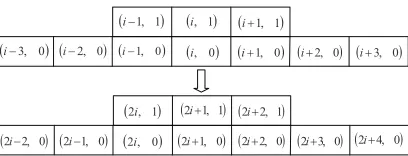
In the thesis of Rachel Shipsey [24], it has been pointed out that the first vector centered at iwithsevenconsecutive terms is sufficient for the doubling steps by the duplication formulas in the computation of elliptic divisibility sequences. This indicates that the first vector with seventerms may be sufficient for designing the whole Double(V) function in pairing computation.
The remaining task is to update the second vector withthree consecutive terms W(λ,1)2i−1≤λ≤2i+1 given the
val-ues of W(λ,0)i−3≤λ≤i+3 andW(λ,1)i−1≤λ≤i+1. Observe that updating the second vector only involves the values of
W(λ,0)i−2≤λ≤i+2andW(λ,1)i−1≤λ≤i+1by using Equations (2)-(7). Therefore, we can design a newDoublefunction with
10terms.
!
1 , 1
i !i, 1" i 1, 1!
!i 3, 0"
!2i 1, 1" !2i, 1" 2i 1, 1!
!i 2, 0" !i 1, 0" !i, 0" i 1, 0! !i 2, 0" !i 3, 0"
!2i 3, 0" !2i 2, 0" !2i 1, 0" !2i, 0" 2i 1, 0! !2i 2, 0" !2i 3, 0"
Fig. 1. Updating the block centered atito2i
Consequently, we can discard the 8-th termW(i+ 4,0)of the first vector in the original Elliptic Net algorithm [18] and then save the cost of updating it. ForP ∈E(Fq)andQ∈E(Fqk)(This corresponds to the Miller-lite or Tate-like case), we can give a newDouble(V)alogrithm as shown in Algorithm 3.1. When the pointsP andQare swapped for the ate-like case, it is not hard to modify Algorithm 3.1 for computing the pairings. For simplicity, we omit this case here.
When counting field operations, we useSandM to respectively represent the cost of a squaring and a multiplication in the ground fieldFq. Let Ss andMs denote the costs of a squaring and a multiplication in some extension fieldFqs respectively. Assume that the cost of multiplying an element of Fq by one of Fqs takessM. Then we give an estimate of each step in the newDouble(V)algorithm as shown in Algorithm 3.1. According to the discussion of [18], the value W(−1,1)can be adjusted to 1 butW(1,1)will be equal toxP −xQ, wherexP andxQdenote thex-coordinates of point
P andQrespectively. In summary, the total cost for the newDouble(V)algorithm is 5S+ (22 + 6k)M +Sk + 2Mk in
general.
Note that the embedding degreekcould be chosen to be even in most cases. This implies thatxP−xQcan be contained in the subfieldFqk/2exactly and then the total cost can be reduced to5S+ (22 + 6k)M + 1Sk+32Mk as discussed in [18], [30]. Finally, we summarize all discussions into Table 1. We see that the proposedDouble(V)algorithm will save1S+ 4M compared to the previous results from Table 1. This gain is from neglecting the computation of the term W(2i+ 4,0) actually.
TABLE 1
Cost of theDouble(V)algorithm for the different methods
Method Operation Count
Elliptic Net algorithm [18] 6S+ (26 + 6k)M+Sk+32Mk
Algorithm 3.1Double and DoubleAdd/DoubleSubtraction Algorithm
Input: BlockV centered ati in which the first vector hasseventerms and the second vector has threeterms. ArrayS andP with5elements.W(1,0) =W(0,1) = 1,α=W(2,0)−1,β =W(−1,1)−1,γ
1 =W(2,−1)−1,γ2=W(2,1)−1,
δ=W(1,1)−1,w2=W(2,0)2,w13=W(1,0)·W(3,0)andf lag∈ {−1,0,1}
Output: Block centered at2iiff lag= 0, centered at2i+ 1iff lag= 1and centered at2i−1iff lag=−1
1.S0←V[2,2]2;P0←V[2,1]∗V[2,3]; //1Sk+ 1Mk
2. for i := 1 to 5 do S[i]←V[1, i+ 1]2;
P[i]←V[1, i]∗V[1, i+ 2]; //5·(1S+ 1M)
end for;
3. iff lag eq0 then fori←1to 3 do
V[1,2∗i−1]←S[i]∗P[i+ 1]−S[i+ 1]∗P[i]; //3·(2M)
V[1,2∗i]←(S[i]∗P[i+ 2]−S[i+ 2]∗P[i])∗α; //3·(3M)
end for;
V[1,7]←S[4]∗P[5]−S[5]∗P[4]; //2M
V[2,1]←(S[2]∗P0−P[2]∗S0)∗δ; //2kM+Mk
V[2,2]←S[3]∗P0−P[3]∗S0; //2kM
V[2,3]←(S[4]∗P0−P[4]∗S0)∗β; //2kM
else iff lag eq1 then fori←1to 3 do
V[1,2∗i−1]←(S[i]∗P[i+2]−S[i+2]∗P[i])∗α; //3·(3M)
V[1,2∗i]←S[i+ 1]∗P[i+ 2]−S[i+ 2]∗P[i+ 1]; //3·(2M)
end for;
t1←V[1,4]∗V[1,6]; t2←V[1,5]2;
V[1,7]←(t1∗w2−t2∗w13)/V[1,3]; //1I+ 3M
V[2,1]←S[3]∗P0−P[3]∗S0; //2kM
V[2,2]←(S[4]∗P0−P[4]∗S0)∗β; //2kM
V[2,3]←(P[5]∗S0−S[5]∗P0)∗γ1; //2kM+ 1Mk
else
fori←1to 3 do
V[1,2∗i]←S[i]∗P[i+ 1]−S[i+ 1]∗P[i]; //3·(2M)
V[1,2∗i+1]←(S[i]∗P[i+2]−S[i+2]∗P[i])∗α; //3·(3M)
end for;
t1←V[1,2]∗V[1,4]; t2←V[1,3]2;
V[1,1]←(t1∗w2−t2∗w13)/V[1,5]; //1I+ 3M
V[2,1]←(S[1]∗P0−P[1]∗S0)∗γ2; //2kM+ 1Mk
V[2,2]←(S[2]∗P0−P[2]∗S0)∗δ; //2kM+Mk
V[2,3]←S[3]∗P0−P[3]∗S0; //2kM
3.2 New DoubleAdd/DoubleSubtraction steps
It is well-known that an integer has a non-adjacent form (NAF) representation. In this representation, the density of the number of non-zero digits will be approximately one-third on average. Therefore, the non-adjacent form (NAF) representation of an integer has been suggested for computing the pairings or scalar multiplication in efficiency. This leads us to consider a modified Elliptic Net algorithm when the parameterris represented in NAF form. The remaining task is to design twoDoubleAdd(V)andDoubleSubtraction(V)functions if the first vector only has7consecutive terms centered ati.
3.2.1 DoubleAdd function
Firstly, we consider how to update the next blockV centered at2i+ 1from the current block centered atiwhich has the first vector with7terms. In this case, the non-zero digit is1.
We now restrict that the first vector only has 7 terms W(λ,0)i−3≤λ≤i+3centered at i. It follows from the duplication
formula thatW(λ,0)2i−3≤λ≤2i+3 can be updated under such an assumption. However, we hope that the updated first
vector should be centered at2i+ 1. This indicates thatW(2i−3,0)should be omitted butW(2i+ 4)must be calculated in the newDoubleAdd(V)algorithm.
It is known that the sequence {W(i,0)} is an elliptic net of rank one [18](or equivalently, an elliptic divisibility sequence [24], [26]) and then satisfies the following well-known recursive formula,
W(h+2,0)W(h−2,0) =W(h+1,0)W(h−1,0)W(2,0)2−W(3,0)W(1,0)W(h,0)2. (8)
Replacinghby2i+ 2yields the following equality for computingW(2i+ 4,0),
W(2i+ 4,0) = W(2i+ 3,0)W(2i+ 1,0)W(2,0)
2−W(3,0)W(1,0)W(2i+ 2,0)2
W(2i,0) . (9)
By Equation (9), we see thatW(2i+4,0)can be computed provided that the valuesW(λ,0)2i≤λ≤2i+3are known. However,
all ofW(λ,0)2i≤λ≤2i+3can be obtained given the valuesW(λ,0)i−3≤λ≤i+3by Equations (2) and (3).
Since the second vector centered at2i+ 1can be updated provided that all ofW(λ,0)i−1≤λ≤i+3andW(λ,1)i−1≤λ≤i+1
are known, it is reasonable that the first vector of the block only hasseven terms for constructing the DoubleAdd(V) algorithm as shown Algorithm 3.1.
!
1 , 1
i !i, 1" i 1, 1!
!i 3, 0"
!2i, 1" !2i 1, 1" 2i 2, 1!
!i 2, 0" !i 1, 0" !i, 0" i 1, 0! !i 2, 0" !i 3, 0"
!2i 2, 0" !2i 1, 0" !2i, 0" !2i 1, 0" !2i 2, 0" !2i 3, 0" 2i 4, 0!
Fig. 2. Updating the block centered atito2i+ 1
It is obvious that the proposedDoubleAdd(V)step will be more costly than the originalDoubleAddone(see Algorithm 2 of [18]) since the inverse involves in the updating process. However, the new algorithm seems to be attractive possibly under the condition that the parameterrhas a low Hamming weight. We will give a detailed efficiency consideration in the later section.
We now estimate the cost of the new DoubleAdd(V) algorithm in the Tate-like case. Compared to the Double(V) algorithm in the previous section, discarding the computation ofW(2i−3,0)will save 2M. Now we consider the cost of computingW(2i+ 4,0). Note thatW(2,0)2 andW(3,0)W(1,0)can be precomputed. Therefore we neglect the cost
of computing them. We also remark that the cost of computing W(2i+ 3,0)W(2i+ 1,0) and W(2i+ 2,0)2 can be
TABLE 2
Cost of the DoubleAdd(V) algorithm for the different cases
Method Operation count
Elliptic Net algorithm [18] 6S+ (26 + 6k)M+Sk+ 2Mk
This work 5S+ (23 + 6k)M+I+Sk+ 2Mk
3.2.2 DoubleSubtraction function
We now consider the case of the non-zero digit−1. This means that we need consider how to move the center of the next block to2i−1provided that the current block centered atiwith the first vector havingseventerms is known.
According to the above discussions aboutDoubleAdd steps, we can discard the termW(2i+ 3,0) and calculate the termW(2i−4,0)by symmetry. In a similar manner, replacinghby2i−2in Equation (8) yields the following equality,
W(2i−4,0) = W(2i−3,0)W(2i−1,0)W(2,0)
2−W(2i−2,0)2W(3,0)W(1,0)
W(2i,0) .
In a similar manner, we can update all the termsW(λ,0)2i−4≤λ≤2i+2in the first vector.
! 1 , 1
i !i, 1" i 1, 1!
!i 3, 0"
!2i 2, 1" 2i 1, 1! !2i, 1"
!i 2, 0" !i 1, 0" !i, 0" i 1, 0! !i 2, 0" !i 3, 0"
!2i 4, 0" !2i 3, 0" !2i 2, 0" !2i 1, 0" !2i, 0" 2i 1, 0! !2i 2, 0"
Fig. 3. Updating the block centered atito2i−1
We now consider how to update the termsW(λ,1)2i−2≤λ≤2i in the second vector if the termsW(λ,1)i−1≤λ≤i+1 are
known. Observe that the term W(2i−1,1) and W(2i,1) can be computed by Equations (4) and (5) in this case. The remaining task is to compute the termW(2i−2,1)by using the recurrence relation (1). Replacingp,q,r, andsby(i−2,0), (i,1),(1,0)and(0,0)gives the following formula,
W(2i−2,1) = (W(i−1,1)W(i+ 1,1)W(i−2,0)2−W(i−1,0)W(i−3,0)W(i,1)2)/W(2,1).
Therefore, it is reasonable to design aDoubleSubtraction function on the basis of a block which has the first vector
withseventerms and the second vector withthreeterms. We summarize the results into Algorithm 3.1. In addition, we
remark that the cost of theDoubleSubtractionstep is the same as that of theDoubleAddone. On the basis of Algorithm 3.1 which consists of the basicDoubleandDoubleAdd/DoubleSubtraction, it is easy to give a modified Elliptic Net algorithm shown as Algorithm 3.2. Note that the initial index of every vector in a block will beone, notzeroin our algorithm.
4
E
FFICIENCY COMPARISONS AND IMPLEMENTATION RESULTSIn this section, we will analyze the whole operation count of computing the pairings by using the proposed Double and DoubleAdd steps, and compare it with the original Elliptic Net algorithm given by Stange in [18].
4.1 Efficiency comparison
Algorithm 3.2Elliptic Net Algorithm in NAF form
Input: Points P ∈ E(Fq)and Q ∈ E(Fqk). Initial terms a = W(2,0), b = W(3,0), c = W(4,0),d = W(2,1),e = W(−1,1),f =W(2,−1),g=W(1,1),h=W(2,1)of an elliptic net satisfyingW(1,0) =W(0,1) = 1and an integer
m= (dldl−1· · ·d0)2is represented in NAF form withdl= 1anddi∈ {0,±1}for0≤i≤l−2.
Output: W(m,0)andW(m,1) 1.V ←[[−a,−1,0,1, a, b, c],[1, g, d]] 2. fori:=l−1to0by 1 do
ifdi= 0then
V ←Double(V)
else ifdi= 1then
V ←DoubleAdd(V)
else
V ←DoubleSubtraction(V)
end if end if end for
3. returnV[1,4]andV[2,2] //termsW(m,0)andW(m,1)respectively
Tate-like pairingfr,P(Q)by using the two different methods and determine the critical value of the densityρ. The total cost of the modified Elliptic Net algorithm is
ρN(5S+ (23 + 6k)M +I+Sk+ 2Mk) + (1−ρ)N(5S+ (22 + 6k)M+Sk+
3 2Mk)
=N(5S+ (22 + 6k)M +Sk+
3
2Mk) +ρN(M+I+
1 2Mk). Similarly, the total cost of Stange’s algorithm [18] is
ρN(6S+ (26 + 6k)M +Sk+ 2Mk) + (1−ρ)N(6S+ (26 + 6k)M+Sk+
3 2Mk)
=N(6S+ (26 + 6k)M +Sk+
3 2Mk) +
1 2ρN Mk.
Therefore, the proposed algorithm will be faster than the original Elliptic Net algorithm by Stange [18] under the condition that
N(6S+ (26 + 6k)M+Sk+
3 2Mk) +
1 2ρN Mk
−N(5S+ (22 + 6k)M+Sk+
3
2Mk)−ρN(M+I+
1 2Mk)
=N(S+ 4M)−ρN(M+I)>0.
i.e.,
ρ < S+ 4M
M+I .
Assume that 1S = 0.8M. In table 3, we present the maximal value of the density ρ such that the proposed algorithm will be more efficient than the previous results for computing the Tate-like(or Miller-lite) pairings. It is well-known that for a randomly chosenn-bit integer the density of non-zero digits will be 1/3 on average by using NAF representation. This indicates that the proposed method will be most probably faster than the original Elliptic Net algorithm under the assumption ofI= 10M.
4.2 Implementation results
TABLE 3
Maximal value of the densityρfor the proposed method
Density I = 10M I = 20M I = 30M
ρ 0.44 0.23 0.15
drafts), such as IEEE P1363.3 draft [27] and RFC 5091 [31]. Curves of this form adopt many advantages that have been clarified in [32]. In particular, the order of the subgroup of points defined over the base field can be chosen flexibly.
Our running environment specifications are listed as follows: Ubuntu Kylin 14.04 64bits, Core i5-4670 CPU 3.40GHz× 4, and memory, 8GB. The code was written in Magma [33]. The concrete parameters for the supersingular elliptic curve with embedding degree 2 are given as follows.
• r= 2255+ 241+ 1;(256 bits) • p= 12·(21280+ 231+ 215)·r−1;
(1539 bits) • Fp2=Fp[i]/(i2+ 1);
• E:y2=x3−3x
overFp.
Notice that the prime psatisfies gcd(p−1,3) = 1. This implies that every nonzero element inFp has a cube root. In particular, one can find an elementη in Fp such thatη3 = W(2,0)−1. By using the equivalence of the elliptic nets, we can change W(2,0) to 1 and then save four Fp multiplications in each iteration as discussed in [18]. Assume that 1M2 = 3M and1S2 = 2M. Here we assume that1I = 10M and1S = 0.8M. In the whole comparison, we neglect the
pre-computations since the pointPcan be fixed for many pairing-based cryptographic protocols. The overall cost of the iteration loop by using the proposed method on the above curve will be
253·(5S+ (18 + 6k)M +Sk+
3
2Mk) + 2·(5S+ (19 + 6k)M+I+Sk+ 2Mk)
=253·40.5M+ 2·53M = 10352.5M.
In a similar manner, the cost of the whole iteration loop in Stange’s algorithm [18] will be
253·(6S+ (22 + 6k)M +Sk+
3
2Mk) + 2·(6S+ (22 + 6k)M+Sk+ 2Mk)
=253·45.3M+ 2·46.8M = 11554.5M.
From a performance point of view it is essential to compare the running time of the iteration loop with the orginal Elliptic Net algorithm given by Stange in [18]. We also give the cost of computingfr,P(Q)using Miller’s algorithm in projective coordinates for benchmarks. In Miller’s algorithm, the computational cost of each doubling step is8M+ 4S+Mk+Skand that of each addition step is11M+3S+Mk, respectively [30], [34]. The overall operation count of Miller’s algorithm will be about4164M. Table 4 summarizes the above estimation of the computational cost and some running times for calculating the pairings at 128-bit security level. All of the timings are shown in milliseconds. Our experimental results indicate that the presented method in this paper is about 14% faster than the previous Elliptic Net algorithm [18]. This shows that the proposed method will efficiently increase performance under the condition that the corresponding parameterrhas a low Hamming weight. However, it is still substantially slower than Miller’s algorithm in projective coordinate systems. This indicates that Miller’s algorithm is still a valid candidate for practical pairing-based implementations and more optimizations about the Elliptic Net algorithm should be required.
5
C
ONCLUSIONTABLE 4
Cost of computingfr,P(Q)by the different methods-128 security level
Method Operation Count Time(ms)
Stange’s algorithm [18] 11554.5M 37.8
This work 10352.5M 33.2
Miller’s algorithm 4164M 14.9
expensive compared to Miller’s algorithm in projective coordinate systems, it can be still implemented quite efficiently on modern personal computers. We believe that this work will lead to more developments of the Elliptic Net algorithm in future.
A
CKNOWLEDGMENTSThe work of Binglong Chen is partially supported by the National Natural Science Foundation of China under Grant No. 11025107. The work of Chang-An Zhao is partially supported by the National Natural Science Foundation of China under Grant No. 61472457.
R
EFERENCES[1] K. G. Paterson,Cryptography from Pairings - Advances in Elliptic Curve Cryptography, I. F. Blake, G. Seroussi, and N. P. Smart, Eds. Cambridge
University Press, 2005.
[2] H. Cohen and G. Frey, Eds.,Handbook of elliptic and hyperelliptic curve cryptography. CRC Press, 2005.
[3] S. D. Galbraith,Pairings-Advances in Elliptic Curve Cryptography, I. F. Blake, G. Seroussi, and N. P. Smart, Eds. Cambridge University Press,
2005.
[4] I. Duursma and H.-S. Lee, “Tate pairing implementation for hyperelliptic curvesy2=xp−x+d,” inAdvances in Cryptology - ASIACRYPT
2003, ser. Lecture Notes in Computer Science, C.-S. Laih, Ed. Springer Berlin Heidelberg, 2003, vol. 2894, pp. 111–123.
[5] P. S. L. M. Barreto, S. D. Galbraith, C. O’Eigeartaigh, and M. Scott, “Efficient pairing computation on supersingular abelian varieties,”Des.
Codes Cryptography, vol. 42, no. 3, pp. 239–271., 2007.
[6] F. Hess, N. Smart, and F. Vercauteren, “The eta pairing revisited,”IEEE Transactions on Information Theory, vol. 52, pp. 4595–4602, 2006.
[7] S. Matsuda, N. Kanayama, F. Hess, and E. Okamoto, “Optimised versions of the ate and twisted ate pairings,” inCryptography and Coding,
ser. Lecture Notes in Computer Science, S. Galbraith, Ed. Springer Berlin / Heidelberg, 2007, vol. 4887, pp. 302–312.
[8] C.-A. Zhao, F. Zhang, and J. Huang, “A note on the ate pairing,”Int. J. Inf. Sec, vol. 7, no. 6, pp. 379–382, 2008.
[9] E. Lee, H.-S. Lee, and C.-M. Park, “Efficient and generalized pairing computation on abelian varieties,”IEEE Transactions on Information
Theory, vol. 55, no. 4, pp. 1793–1803, 2009.
[10] F. Hess, “Pairing lattices,” inPairing-Based Cryptography C Pairing 2008, ser. Lecture Notes in Computer Science, S. Galbraith and K. Paterson,
Eds. Springer Berlin Heidelberg, 2008, vol. 5209, pp. 18–38.
[11] F. Vercauteren, “Optimal pairings,”IEEE Transactions on Information Theory, vol. 56, no. 1, pp. 455–461, 2010.
[12] C.-A. Zhao, D. Xie, F. Zhang, J. Zhang, and B.-L. Chen, “Computing bilinear pairings on elliptic curves with automorphisms,”Des. Codes
Cryptography, vol. 58, no. 1, pp. 35–44, 2011.
[13] C.-A. Zhao, F. Zhang, and D. Xie, “Faster computation of self-pairings,”IEEE Transactions on Information Theory, vol. 58, no. 5, pp. 3266 –3272,
2012.
[14] S. D. Galbraith and C.-A. Zhao, “Self-pairings on hyperelliptic curves,”J. Math. Crypt., vol. 7, pp. 31 – 42, 2013.
[15] B. Chen and C.-A. Zhao, “Self-pairings on supersingular elliptic curves with embedding degree three,”Finite Fields and Their Applications,
vol. 28, no. 0, pp. 79 – 93, 2014.
[16] V. S. Miller, “Short programs for functions on curves,” Aug 26, 1986. [Online]. Available: http://crypto.stanford.edu/miller/miller.ps.
[17] ——, “The Weil pairing, and its efficient calculation,”J. Cryptology, vol. 17, no. 4, pp. 235–261, 2004.
[18] K. E. Stange, “The Tate pairing via elliptic nets,” inPairing-Based Cryptography - Pairing 2007, ser. Lecture Notes in Computer Science, T. Takagi,
T. Okamoto, E. Okamoto, and T. Okamoto, Eds. Springer Berlin Heidelberg, 2007, vol. 4575, pp. 329–348.
[19] N. Ogura, N. Kanayama, S. Uchiyama, and E. Okamoto, “Cryptographic pairings based on elliptic nets,” inAdvances in Information and
Computer Security, ser. Lecture Notes in Computer Science, T. Iwata and M. Nishigaki, Eds. Springer Berlin Heidelberg, 2011, vol. 7038, pp. 65–78.
[20] C. Tang, D. Ni, M. Xu, B. Guo, and Y. Qi, “Implementing optimized pairings with elliptic nets,”Science China Information Sciences, vol. 57,
no. 5, pp. 1–10, 2014.
[21] Y. Uchida and S. Uchiyama, “The Tate-Lichtenbaum pairing on a hyperelliptic curve via hyperelliptic nets,” inPairing-Based Cryptography
[22] C. Tran, “Formulae for computation of Tate pairing on hyperelliptic curve using hyperelliptic nets,” inProgress in Cryptology AFRICACRYPT
2014, ser. Lecture Notes in Computer Science, D. Pointcheval and D. Vergnaud, Eds. Springer International Publishing, 2014, vol. 8469, pp.
199–214.
[23] D. Freeman, M. Scott, and E. Teske, “A taxonomy of pairing-friendly elliptic curves,”Journal of Cryptology, vol. 23, no. 2, pp. 224–280, 2010.
[24] R. Shipsey, “Elliptic divisibility sequences,” Ph.D. dissertation, University of London, 2000.
[25] P. Barreto, H. Kim, B. Lynn, and M. Scott, “Efficient algorithms for pairing-based cryptosystems,” inAdvances in Cryptology - CRYPTO 2002,
ser. Lecture Notes in Computer Science, M. Yung, Ed. Springer Berlin Heidelberg, 2002, vol. 2442, pp. 354–369.
[26] M. Ward, “Memoir on elliptic divisibility sequences,”American Journal of Mathematics, pp. 31–74, 1948.
[27] I. P. Committee, “IEEE P1363.3: Identity-based public key cryptography,” http://grouper.ieee.org/groups/1363/IBC/index.html, 2013.
[28] P. Barreto and M. Naehrig, “Pairing-friendly elliptic curves of prime order,” inSelected Areas in Cryptography, ser. Lecture Notes in Computer
Science, B. Preneel and S. Tavares, Eds. Springer Berlin Heidelberg, 2006, vol. 3897, pp. 319–331.
[29] M. Shirase, “Barreto-Naehrig curve with fixed coefficient - efficiently constructing pairing-friendly curves -,” Cryptology ePrint Archive, Report 2010/134, 2010.
[30] N. Koblitz and A. Menezes, “Pairing-based cryptography at high security levels,” inCryptography and Coding, ser. Lecture Notes in Computer
Science, N. Smart, Ed. Springer Berlin Heidelberg, 2005, vol. 3796, pp. 13–36.
[31] M. L. Boyen X, “Identity-based cryptography standard (ibcs)(version 1), request for comments (rfc) 5091,” 2007.
[32] M. Scott, “Computing the Tate pairing,” inTopics in Cryptology CT-RSA 2005, ser. Lecture Notes in Computer Science, A. Menezes, Ed.
Springer Berlin Heidelberg, 2005, vol. 3376, pp. 293–304.
[33] W. Bosma, J. Cannon, and C. Playoust, “The Magma algebra system. I. The user language,”J. Symbolic Comput., vol. 24, no. 3-4, pp. 235–265,
1997.