On Secure Two-party Integer Division
Morten Dahl1, Chao Ning2,3?, and Tomas Toft1 1
Aarhus University, Denmark?? ? ? ? †
{mdahl,ttoft}@cs.au.dk 2
Institute for Interdisciplinary Information Sciences (IIIS) Tsinghua University, Beijing, P.R. China
School of Computer Science and Technology Shandong University, Jinan, China
Abstract. We consider the problem ofsecure integer division: given two Paillier encryptions of`-bit valuesnand d, determine an encryption of
bn
dcwithout leaking any information aboutnord. We propose two new
protocols solving this problem.
The first requires O(`) arithmetic operation on encrypted values (se-cure addition and multiplication) inO(1) rounds. This is the most ef-ficient constant-rounds solution to date. The second protocol requires onlyO (log2`)(κ+ loglog`)
arithmetic operations inO(log2`) rounds, whereκ is a correctness parameter. Theoretically, this is the most effi-cient solution to date as all previous solutions have requiredΩ(`) oper-ations. Indeed, the fact that ano(`) solution is possible at all is highly surprising.
Keywords:Secure two-party computation, Secure integer division, Constant-rounds, Bit-Length, Digit-Length
1
Introduction
Secure multiparty computation (MPC) allows two or more mutually mistrusting parties to evaluate a function on private data without revealing additional infor-mation. Many potential appliations are motivated by business needs, e.g. running
?This work was supported in part by the National Basic Research Program of China
Grant 2011CBA00300, 2011CBA00301, the National Natural Science Foundation of China Grant 61033001, 61061130540, 61073174 and 61173139.
??
The authors acknowledge support from the Danish National Research Foundation and The National Science Foundation of China (under the grant 61061130540) for the Sino-Danish Center for the Theory of Interactive Computation, within which part of this work was performed.
? ? ? The authors acknowledge support from the Center for research in the Foundations of
Electronic Markets (CFEM), supported by the Danish Strategic Research Council. †
auctions where no-one gains any information on non-winning bids, or basing de-cisions on aggregate data from multiple sources. Examples include benchmarking and supply chain management [NT07,CK08].
Classic results show that any function can be computed with polynomial overhead [Yao86,GMW87,BGW88,CCD88] but specialised protocols are often used to improve efficiency: integer arithmetic can for instance be simulated us-ing ZM arithmetic. On the other hand, this makes non-arithmetic operations difficult, including determining which of two sums is the larger (as needed in the double auction of Bogetoft et al. [BCD+09]), or performing an integer division of sums (essentially thecomputation of the meanproblem of Kiltz et al. [KLM05]). Surprisingly many applications become possible given only a small number of primitives – equality, greater-than, and integer division – and improving any primitives immediately allows more efficient high-level protocols.
When the number of parties providing data is large, executing a full MPC protocol may be infeasible. In this case, an alternative is to have the parties (clients) provide their input in, say, encrypted form to two or more servers, S1, . . . , SN, who then execute the secure computation. In this case privacy is maintained when we assume that some subset of the servers remain honest. Indeed, such a setting has seen practical use in the Danish “sugar beet auction” [BCD+09] which had more than one thousand bidders and three servers. Further, even if all servers collude it can still be possible to guarantee correctness of the result by publishing a transcript of the MPC protocol and using non-interactive zero-knowledge (NIZK) to demonstrate that the execution was correct, and even if privacy was breached.
In this paper we consider the problem of secure integer division – computing bn/dcgivennandd– in the two-party setting. Immediate applications include statistics on data from companies in the same business, as well as data-mining tasks, e.g. thek-means clustering protocol of Jagannathan and Wright [JW05]. Further, since the problem of secure integer division is equivalent to that of secure modulo reduction –nmodm=n−m·bn/mc– any such protocol may be utilized in joint key-generation protocols as e.g. done by Algesheimer et al. [ACS02].
Related work. Algesheimer et al. introduced the problem of secure integer di-vision in the context of passively secure RSA-modulus generation with honest majority [ACS02]; they also noted that standard techniques may provide active security. Their solution was based on Newton iteration and requiredO(`) work and communication (using the notation of the present paper) inO(log`) rounds, where ` is the bit-length of the inputs. The protocols were later implemented by Jakobsen and From in the passively secure three-party setting [JF05]. Re-cently, Catrina and Dragulin have applied similar ideas to constructing secure fixed-point arithmetic [CD09].
modulo reduction (and hence also integer division). The construction was not presented in any detail and no explicit complexity measure was presented, though naturally it at least equalled that of BD,O(`log`). We remark that BD has later been improved in [Tof09,RT10] toO(`) work.
The simpler problem wheredis known to all parties (a single party) has been studied by Guajardo et al. [GMS10] and Ning and Xu [NX10] (Veugen [Veu10]). Finally, we remark that it is possible to “switch technique” mid-protocol and use homomorphic encryption for arithmetic and (small) Yao circuits for primitives such as integer division as done by Henecka et al. [HKS+10]. How-ever, achieving active security in this setting typically requires the use of cut-and-choose techniques. And, while it is possible to use generic NIZK proofs to demonstrate correct protocol execution to the clients, this will be much more expensive than making the non-generic zero-knowledge proofs of our solution non-interactive, e.g., using the Fiat-Shamir heuristic [FS86].
Contribution. We present two two-party protocols for the problem of secure in-teger division: given Paillier encryptions of `-bit values n and d, compute an encryption ofbn/dcwithout leaking any information. Both are based on Taylor series. The first protocol requiresO(`) encryptions to be exchanged between the parties in a constant number of rounds; this is quite practical for small inputs, e.g., up to 40 bits. The second protocol communicatesO (log2`)(κ+ loglog`) encryptions inO(log2`) rounds. Moreover, we are able to avoid bit-decomposition; indeed, as the latter complexity issub-linear in the bit-length, it precludes the use of bit-decompositon entirely. That a sub-linear solution is possible at all is quite surprising, but is of theoretical rather than practical interest. Moreover, in the appendix, we present a protocol for computing the exact bit-length of an encrypted value, which is constructed without replying on bit-decomposition and which may be of independent interest.
We remark that though our protocols are presented in the two-party Pailier-based setting, they are easily converted to both the multiparty setting as well as to other forms of secure arithmetic, e.g. unconditionally secure multiparty computation based on Shamir’s secret sharing scheme and the protocols of Ben-Or et al. [Sha79,BGW88]. Note that due to the underlying primitives, security of the sub-linear solution requires the presence of two mutually incorruptible parties, at least with current state-of-the-art knowledge.
The structure of this paper. Section 2 briefly introduces Paillier’s encryption scheme, as well as the basic protocols for secure computation. Then Section 3 presents the main idea, i.e. the Taylor series which defines the desired compu-tation, and the overall protocol is presented in Section 4. Sections 5 and 6 then present the two solutions. Concluding, we elaborate on variations in Section 7.
2
Preliminaries
After presenting Paillier encryption and secure two-party computations we in-troduce a set of protocols used in our constructions. All sub-protocols are secure against malicious (i.e., potentially deviating) attackers. Regarding complexity, we shall useRπ and Cπ to denote respectively the number of rounds used and the number of ring elements communicated during a single run of protocolπ.
Paillier encryption. Paillier’s encryption scheme [Pai99] is an additively homo-morphic, sematically secure public key encryption scheme based on the decisional composite residuosity assumption (DCRA) of RSA-moduli, i.e. ultimately based on the hardness of factoring. The construction is based on the observation that forM =p·qbeing the product of two large primes we haveZ∗M2 ∼=Z∗M×ZM. A ciphertext c ∈ Z∗M2 thus contains a random element R ∈ Z∗M and message m ∈ ZM. Encryption is defined as EM(r, m) = rM ·gmmodM2, where r is uniformly random in Z∗M2, and g generates the subgroup of Z∗M2 of order M. For integerd, decryption then consists of computing cd where
d≡1 mod M ∧ d≡0 mod φ(M)
and solving a discrete logarithm base g (which can be done efficiently in this setting). Suppressing the randomness used, we write [m] to denote an encryption ofm∈ZM below.
Secure computation. Secure multi-party computation can be based on Paillier en-cryption with a shared threshold key using the protocols of Cramer et al. [CDN01]. The threshold sharing can be constructed using the ideas of Damg˚ard and Jurik [DJ01]. Though not explicitly stated, apart from guaranteed termination, the protocols of [CDN01] are still valid even if all but a single party are corrupt. In particular this allows the two-party setting. We assume the following setting:
– Alice and Bob know a public Paillier key and share the decryption key.
– Inputs and intermediary values are held in encrypted form byboth parties. For secure computation, note that given [m] and [m0] both parties may compute an encryption [m+m0] by multiplying the ciphertexts. For readability we de-note this operation by infix operations in the plaintext space and hence write [m+m0]←[m] + [m0] instead of [m+m0]←[m]·[m0].
To perform a multiplication the parties first convert [m] to an additive sharing of m in ZM: Alice picks her share mA uniformly at random, encrypts it, and sends [mA] to Bob. The parties then compute [mB]←[m]−[mA] and decrypt this towards Bob. Then Alice uses the homomorphic property to compute an encryption of [mA·m0]←mA·[m0], and Bob does likewise to compute [mB·m0]. The parties send these to each other. As the final step, both parties compute
Assuming through-out the entire paper that decryption to a party is a con-stant round and communication procedure, the complexity of πmult is also con-stant in both parameters. Finally, note that zero-knowledge (ZK) proofs may be used to ensure correct behavior, e.g. that Alice knows the plaintext of [mA] and that [mA·m0] and [mB·m0] have been computed correctly. These can be made non-interactive – and hence globally verifiable – using the Fiat-Shamir heuristic [FS86]: The challenge is computed as a hash of the initial message, which can be proven secure in the random oracle model.
Zero-knowledge proof of boundedness. In addition to secure arithmetic in ZM we require a zero-knowledge proof of boundedness, i.e. that Alice and Bob may demonstrate to each other that the plaintext of an encryption [m] sent to the other party (where the sender knowsm) is smaller than some public bound B. For Paillier encryption this can be achieved with O(1) communication (of ring elements) using integer commitments and the fact that any non-negative integer can be written as a sum of four squares. See [Bou00,Lip03] for further discussion.
Computing the greater-than relation. Given encryptions [m] and [m0] of `-bit values, obtain an encryption [b] of a bit b such that b = 1 iff m > m0. A constant-rounds protocolπc>?for this can be based off of the comparison protocol of Nishide and Ohta [NO07]; communication complexity is Cπc
>? = O(`) ring elements. We useπc
≤?as syntactic sugar for runningπ c
>?with inputs swapped. A sub-linear protocol, denotedπs
>?andπ s
≤?, is possible due to Toft [Tof11]. Its complexity is Cπs
>? =O((log`)(κ+ loglog`)) ring elements in Rπ>s? =O(log`) rounds, where κis a correctness parameter.
Computing the inverse of an element. Given an encryption [x] of x ∈ Z∗M, compute an encryption
x−1
of its inverse. We use the protocol from [BB89] which performs this task in a constant number of rounds and communicating a constant number of field elements. We shall use this protocol in both the constant-rounds and the sub-linear protocol and hence simply denote it byπinv.
Bit-decompositon. Decomposing an encrypted`-bit value [m] into binary form, i.e. determining encryptions [m`−1], . . . ,[m0] such that mi ∈ {0,1} and m = P`−1
i=02 i ·m
i, is not strictly required as shown in Appendix A. However, for clarity we will use bit-decomposition below. Byπc
BD we denote theO(1) rounds protocol of Reistad and Toft [RT10]; this protocol communicatesCπc
BD =O(`) encryptions (and ring elements).
Prefix-or of a sequence of bits. Given encrypted bits [x`−1], . . . ,[x0], compute
encrypted bits [y`−1], . . . ,[y0] such thatyi=W `−1
j=ixj. AnO(1)-rounds protocol communicatingCπc
pre-∨=O(`) elements,π c
pre-∨, is provided in [DFK+06]. Powers of a number. Given an encrypted number [x] and publicω∈Z, compute
x1 ,
x2
, . . . ,[xω]. This can be accomplished using a prefix-product protocol [BB89,DFK+06] by giving [x] for allωinputs. The protocolπc
pre-Π runs inO(1) rounds and usesCπc
3
The Intuition Behind the Constructions
In this section we take a high-level view and present the ideas behind the desired computation. The following sections then explain how to do this securely in the stated complexity. Assume in the following thatnanddare `-bit integers, and letkbe a suitable large, public integer. Our solutions then consist of two steps:
I. Compute an encrypted approximation [˜a] ofa=b2k/dc II. Compute [bn/dc] as
([˜a]·[n])/2k
Step I is explained over the reals in Section 3.1. This is then converted to in-teger computation in Section 3.2 and finally realised using ZM arithmetic in Section 3.3. Note that the integer division in step II is simpler as 2k is public.
3.1 The Taylor Series
Similarly to [KLM05] or the constant depth division circuit of Hesse et al. [HAB02], we start with a geometric series to compute a “k-shifted” approximation of 1/d:
1 α=
∞
X
i=0
(1−α)i= ω X
i=0
(1−α)i+ω (1)
whereω=P∞i=ω+1(1−α)
i. This is easily verified for any real 0< α <1. Further, approximating 1/α by keeping only the first ω + 1 terms of the summation introduces an additive error ofω. If 0<1−α≤1/2 then this error is at most
ω=
∞
X
i=ω+1
(1−α)i = (1−α)ω+1·
∞
X
i=0
(1−α)i ≤ 2−ω−1· 1 α ≤ 2
−ω. (2)
By pickingω sufficiently large this ensures an appropriately small error below.
3.2 Converting the Taylor Series to an Integer Computation
Multiplying 1/αby a power of two “shifts” the value; this ensures that each of theω+ 1 terms of the finite sum of Eq. (1) are integer. The non-integer part of the shifted value is entirely contained inω, which will be discarded.
k=`2+`the following expression gives us 1/dshifted up bykbits: 2k
d = 2
k−`d· 1 d/2`d
= 2k−`d· ω X
i=0
1− d 2`d
i +ω
!
= 2k−`d(ω+1)· ω X
i=0
1− d 2`d
i
·2`dω+ 2k−`d· ω
= 2k−`d(ω+1) ω X
i=0
1− d 2`d
i
· 2`di·2`d(ω−i)+ 2k−`d· ω
= 2k−`d(ω+1) ω X
i=0
2`d−di·2`d(ω−i)+ 2k−`d· ω.
We define the desired approximation of 2k/das
˜
a= 2k−`d(ω+1)· ω X
i=0
2`d−di·2`d(ω−i). (3)
Note that not only is this an integer since k ≥`d(ω+ 1) and 2`d > d, it may also be computed as the product of 2k−`d(ω+1)and the evaluation of the integer polynomial with coefficients 2`d(ω−i)for 0≤i≤ωat point 2`d−d. Furthermore, since 0<1−d/2`d≤1/2 we have a bound on the additive error by Eq. (2):
2k−`d·
ω≤2k−`d−ω.
This ensures that the result computed in step II is off by at most 1: we have
jn
d k
= $
n· a˜+ 2k−`d· ω 2k % = n ·˜a 2k +
n·2k−`d· ω 2k
(4)
and see that the second summand is bound by n·2k−`d·
ω
2k ≤
n·2k−`d−ω 2k <
2k 2k = 1
since`n ≤ω. It is clear thatbn2·k˜acis the desired resultexcept that the sum of the error,n·2k−`d·
ω, and the discarded bits of the approximation,n·˜amod 2k, may be greater than 2k; i.e. the result may have an additive error of−1 due to a lost carry-bit.
3.3 Performing the Integer Computation Using ZM Arithmetic
The underlying primitives provide secure ZM arithmetic, with M = pq being the Paillier key whose secret key is held jointly by the parties. We assume4that
M 2`2+`+κs,
whereκs is a statistical security parameter, e.g.κs= 100. This implies that no “overflow” modulo M occurs in Eq. (3), hence it can be seen as occurring in
ZM. However, for efficiency reasons we rephrase the expression as
˜
a= 2k−`d(ω+1)· ω X
i=0
2`d−di·2`d(ω−i)
= 2k−`d(ω+1)· ω X
i=0
2`d−di· 2−`di·2`dω
= 2k−`d· ω X
i=0
2`d−d·2−`di
(5)
where addition and multiplication occur inZM. This should no longer be seen as an integer computation, however, the key observation is that it is irrelevanthow
the encryption [˜a] is obtained; what matters is that the plaintext is correct. Es-sentially this altered calculation can be viewed as using the encoding of rational values suggested in [FSW02]. Note that this simplifies the desired calculation: we now only need the values 2k−`d, 2`d−d, and 2−`d as well as the evaluation of a ZM-polynomial with known coefficients (all equal to 1).
4
The Overall Division Protocol
Having presented the desired ZM-expression for computing the approximation ˜
a ≈ 2k/d in Section 3.3 above, the goal now is to give a high-level view of the actual protocol. We first formalise the required sub-tasks, and then present the overall protocol based on assumed protocols for these. Instantiating these protocols with either the constant-rounds (Section 5) or the sub-linear (Section 6) versions of the sub-protocols we obtain our two division protocols.
4.1 Sub-tasks and Sub-protocols
In addition to the basic primitives of Section 2 we require the following sub-protocols:
– πBL: Given an encryption [d] of an `-bit value d, determine an encryption
2`dfor`
d=blog2(d) + 1c 4
– πpoly: Given an encryption [p] of p ∈Z∗M, evaluate the known polynomial A(x) =Pω
i=0x iover
ZM securely at pointp, i.e. compute encryption [A(p)]
– πtrunc: Given an encryption [ˆq] of an (`+k)-bit value ˆq∈ZM, compute an encryption [˜q] of an approximation ofbˆq/2kcs.t. ˜q=bˆq/2kc+for∈ {0,1}.
4.2 The High-level View
The full division protocol is seen in Figure 1 and proceeds by the following steps: I. Compute an encryption [˜a] of the approximation
(a) Determine2`dand in turn compute2k−`dand [p] =(2`d−d)·2−`d (b) Evaluate the polynomial of Eq. (5) in [p] and securely multiply by2k−`d II. Compute [bn/dc]
(a) Obtain encryption [˜q] of ˜q≈ bn/dcby computing and truncating [n·˜a] (b) Eliminate errors introduced by approximations, i.e., compute [q] from [˜q] where the elimination of errors are performed by two secure comparions.
A:skA pk =M,[n],[d] B:skB
2`d
←πBL([d])
←−−−−−−−−−−−−−−−−−−−−−−−−−−−−−−−−−−−−−−→
2−`d←πinv 2`d
←−−−−−−−−−−−−−−−−−−−−−−−−−−−−−−−−−−−−−−→
[p]←(2`d−[d])·2−`d
←−−−−−−−−−−−−−−−−−−−−−−−−−−−−−−−−−−−−−−→
[˜a]←2k·
2−`d·πpoly([p])
←−−−−−−−−−−−−−−−−−−−−−−−−−−−−−−−−−−−−−−→
[ˆq]←[n]·[˜a]
←−−−−−−−−−−−−−−−−−−−−−−−−−−−−−−−−−−−−−−→
[˜q]←πtrunc([ˆq], k)
←−−−−−−−−−−−−−−−−−−−−−−−−−−−−−−−−−−−−−−→
[r]←[n]−[d]·[˜q]
←−−−−−−−−−−−−−−−−−−−−−−−−−−−−−−−−−−−−−−→
[+]←π≤?([d] + [d],[r] + [d])
←−−−−−−−−−−−−−−−−−−−−−−−−−−−−−−−−−−−−−−→
[−]←π>?([d],[r] + [d])
←−−−−−−−−−−−−−−−−−−−−−−−−−−−−−−−−−−−−−−→
[q]←[˜q] + [+]−[−]
Fig. 1.The full division protocol,πdiv([n],[d])7→[bn/dc]
Correctness. Correctness follows almost entirely from the previous section. For the plaintext of [ˆq], the most significant bits are off by at most 1:
bˆq/2kc ∈ {bn/dc,bn/dc −1}.
The execution ofπtruncmay introduce an additional additive error, i.e. we have ˜
Using r=n−d·q˜∈[−d; 2d[ we can securely determine which case we are in. Namely, ˜q+ 1 =bn/dcwhen d≤rand ˜q−1 =bn/dcwhen 0> r. In order to deal only with positive integers we scale these tests to respectively 2d≤r+d andd > r+d. Letting+ and− denote the Boolean outcome of these tests, it
follows that q= ˜q++−−=bn/dc.
Privacy. The protocol reveals no information about the inputs (other than the desired encryption of the result). This follows from the fact that no value is ever decrypted and that we only invoke secure sub-protocols which do not leak information. We note that πinv and πpoly require the input to be invertible – this is indeed the case asM is the product of two odd primes,p, q≈√M, while 2`d,2`d−d≤2`
√
M. Further, the input [n·˜a] for the truncation is`+k-bit long asn <2` and ˜a≤2k/d≤2k, and hence the input is of the correct size.
A formal security proof using the real/ideal paradigm requires the construc-tion of a simulator for each party. These are straightforward to construct from the simulators of the sub-protocols; as our protocol consists of the sequential evaluation of sub-protocols, the overall simulator simply consists of the sequen-tial execution of the simulators of these.
Complexity. The complexity depends on the details of the sub-protocols πBL, πpoly,πtrunc, andπ>?. Formally we have
Rπdiv=RπBL+Rπinv+Rπpoly+Rπtrunc+ 2·Rπ>?+ 3·Rπmult =RπBL+Rπpoly+Rπtrunc+O(Rπ>?) +O(1)
Cπdiv=CπBL+Cπinv+Cπpoly+Cπtrunc+ 2·Cπ>?+ 3·Cπmult =CπBL+Cπpoly +Cπtrunc+O(Cπ>?) +O(1)
(6)
such that for the constant-rounds instantiation we getRπc
div=RπcBL+Rπcpoly+ Rπc
trunc+O(1) andCπcdiv=CπcBL+Cπpolyc +Cπtruncc +O(`). Likewise, for the sub-linear instantiation we getRπs
div =RπBLs +Rπpolys +Rπstrunc+O(log `) andCπsdiv= Cπs
BL+Cπspoly+Cπstrunc+O((log`)(κ+ loglog`)). Finally, a slight optimisation regarding rounds is possible by invoking π>? andπ≤?in parallel.
Active Security. The protocol in Figure 1 is only passively secure. However, obtaining active security is straightforward by executing appropriate ZK proofs. This increases the communication complexity by a constant factor.
5
The Constant-rounds Protocol
5.1 The constant-rounds πBL protocol
In Appendix A we give aπc
BLprotocol that, somewhat surprising, does not rely on bit-decomposition. Here, for clarity theπBLc protocol presented in Figure 2 is composed of two protocols introduced in Section 2: πBDc and πcpre-∨. To recap, the former takes an encryption [d] as input and returns a set of encrypted bits [x`−1], . . . ,[x0] for which it holds thatP`i=0−1xi·2i=d. The latter takes such a set of encrypted bits and returns another set with the property thatyi=W
`−1 j=ixj.
A:skA pk =M,[d] B:skB
[x`−1], . . . ,[x0]←πBDc ([d])
←−−−−−−−−−−−−−−−−−−−−−−−−−−−−−−−−−−−−−−→
[y`−1], . . . ,[y0]←πpre-c ∨([x`−1], . . . ,[x0])
←−−−−−−−−−−−−−−−−−−−−−−−−−−−−−−−−−−−−−−→
2`d←1 +P`−1
i=0[yi]·2i
Fig. 2.Constant-rounds bit-length protocol,πc
BL([d])7→
2`d
Correctness. By the correctness of the two sub-protocols we only have to argue the correctness of the final step. Note that the result ofπc
pre-∨ is a set such that
yi = 1 if and only ifd≥2i. This means that 1 +P`i=0−1yi·2i is the desired 2`d.
Privacy and Active Security. Follows immediately by the privacy and security guarantees of the two sub-protocols.
Complexity. Since the final step ofπc
BL is a local computation we simply have that Rπc
BL =RπcBD+Rπpre-c ∨ =O(1) andCπcBL =CπcBD+Cπcpre-∨=O(`).
5.2 The constant-rounds πpoly protocol
As shown in the protocol in Figure 3, we simply evaluate polynomial A(x) = Pω
i=0xi in pointp= 2`d−d
·2−`d using the prefix-product protocol πc pre-Π. This gives encryptions of p1, p2, . . . , pω – and knowing these all there is left to do is to sum these together withp0= 1 to formA(p).
Correctness, Privacy, Complexity, and Active Security. Noting that the second step of πc
poly is a local computation, all properties directly reflect those of the πc
pre-Π subprotocol. Formally,Rπc
A:skA pk =M,[x] B:skB
p1
, . . . ,[pω]←πpre-c Π([x], . . . ,[x]) ←−−−−−−−−−−−−−−−−−−−−−−−−−−−−−−−−−−−−−−→
[y]←1 +Pωi=1[pi]
Fig. 3.Constant-rounds polynomial evaluation protocol,πpolyc ([x])7→[A(x)]
5.3 The constant-rounds πtrunc protocol
Our constant-rounds protocol for truncation (shown in Figure 4) takes encryp-tion [ˆq] and publick as input and returns [˜q] such that ˜q≈ bq/2kc. The result may have an additive errorc≤1. It is possible to eliminate this error with a com-parison [c]←([˜q]·2k >
?[ˆq]), and computing the correct result as [q]←[˜q]−[c]. However, instead of comparing two`2-bit numbers here, we handle the error in the main protocol with a comparison of two `-bit numbers instead.
A:skA pk=M,[ˆq], k B:skB
r∈RZ2k+`+κ r>← br/2kc [z]←[ˆq] +r [z], [r>]
←−−−−−−−−−−−−−−−−−−−−−−−−−−−−−−−−−−−−−−−
z←decrA([z])
←−−−−−−−−−−−−−−−−−−−−−−−−−−−−−−−−−−−−−−−
z>← bz/2kc
[z>]
−−−−−−−−−−−−−−−−−−−−−−−−−−−−−−−−−−−−−−−→
[˜q]←[z>]−[r>]
Fig. 4.Constant-rounds truncation protocol,πtruncc ([ˆq], k)7→
bq/ˆ 2kc+c
To perform the truncation, partyBfirst picks a random integer of a bit-length sufficient for using it as a mask for ˆq. He also stores the`+κmost significent bits ofrasr> and computes an encryption of it. Upon receiving [z], the masked
value of ˆq,AandB now decrypt [z] forAto see. After learning this valuez,A can locally perform the truncation to formz>. She sends an encryption of this
value toB and both can finally compute the output locally by [z>]−[r>].
Privacy. The only point where information could potentially be leaked is through Aseeingz. However, sinceris chosen uniformly at random andκbit longer than ˆ
q,z leaks information about ˆqwith probability negligible inκ.
Complexity. We see that the complexity ofπtruncc isRπc
trunc = 2 +Rdecr=O(1) where Rdecr is the round complexity of a decryption, assumed to be constant. Likewise the communication complexity isCπc
trunc= 3 +Cdecr=O(1).
Active Security. To obtain active security B must also send
r⊥=r mod2k
to A, who in turn must also send
z⊥ =z mod2k. B can now append a
zero-knowledge proof thatz= (r>·2k+r⊥) + ˆqas well as proofs that bothr>andr⊥
are within the correct bounds. Similary,Aalso appends a proof ofz=z>·2k+z⊥
and that z> andz⊥ are within bounds.
5.4 Combined Protocol and Analysis
By plugging the protocols introduced in this section into the πdiv protocol of Section 4 we obtain our constant-rounds division protocolπc
div. Correctness, pri-vacy, and active security follow from the discussions above. Using the complexity expressions in Eq. 6 from Section 4 and the fact thatω=`we get:
Rπc
div =RπcBL+Rπpolyc +Rπctrunc+O(1) =O(1) Cπc
div =CπcBL+Cπpolyc +Cπtruncc +O(`) =O(ω) +O(`) =O(`).
6
The Sub-linear Protocol
In this section we give the protocols needed for giving the division protocol of Section 3 a sub-linear communication complexity. We can reuse the truncation protocol πc
trunc from Section 5 and hence only present two new πBL and πpoly protocols.
6.1 The sub-linear πBL protocol
To compute 2`d from [d] in sub-linear communication complexity we take in-spiration from [Tof11] and perform, in a sense, a binary search. Assuming we have a protocol πs≤? for performing comparison of two encrypted numbers, we give the protocol in Figure 5. For simplicity we assume that ` = 2γ for some integer γ.
Intuitively, our construction recursively computes a pointerpinto the binary representation of d. Initially ppoints to the first bit position (p0= 20). In the first round we then ask in which half of the binary representation ofdthe most significant 1 occurs and store the result in bitc1. Next we update pto point to position `/21 if c = 1 (i.e. p
1 =p0·2`/2 1
Correctness and Privacy. Correctness follows from the above description of the protocol, and privacy follows immediately from the sub-protocols as we only compute on encrypted values.
A:skA pk =M,[d] B:skB
[p0]←1
[c1]←πs
≤?
2`/2·[p0],[d]
←−−−−−−−−−−−−−−−−−−−−−−−−−−−−−−−−−−−−−−→
[p1]←[p0]·[c1]·(2`/2−1) + 1
←−−−−−−−−−−−−−−−−−−−−−−−−−−−−−−−−−−−−−−→
. . .
[cγ]←π≤s?
2`/2γ·[pγ−1],[d]
←−−−−−−−−−−−−−−−−−−−−−−−−−−−−−−−−−−−−−−→
[pγ]←[pγ−1]·
[cγ]·(2`/2
γ
−1) + 1
←−−−−−−−−−−−−−−−−−−−−−−−−−−−−−−−−−−−−−−→
2`d
←2·[pγ]
Fig. 5.Sub-linear bit-length protocol,πBLs ([d])7→
2`d
Complexity. The protocol requiresγ= log2`iterations, each requiring one com-parison and one multiplication (not counting multiplication by public values). Hence we get round complexityRπs
BL =γ·(Rπ≤s?+Rπmult) =O(log 2
`) and
com-munication complexityCπs
BL =γ·(Cπs≤?+Cπmult) =O (log
2`)(κ+ loglog`) .
Active Security. Since the sub-protocol is actively secure, we only have to append zero-knowledge proofs of correctness to every multiplication in order to make the protocol resistant against active attackers. This increases the number of messages communicated but only by a constant factor.
6.2 The sub-linear πpoly protocol
Evaluating theA(x) =Pω i=0x
ipolynomial at a pointpcan be done by a method similar to “square and multiply”. We give the protocol in Figure 6 where for simplicity we have assumed thatω= 2γ for some integerγ. The intuition behind the notation is that σj =
P2j i=1x
i and x j = x2
j
– it is not hard to see that this is indeed the case. Specifically this gives us that σγ =
P2γ i=1x
i and hence σγ+ 1 = P
ω i=1x
i
+ 1 =Pω i=0x
i as required.
encryptions are performed. For complexity we have that the protocol requires γ = log2ω iterations with two multiplications in each. Hence the round com-plexity isRπs
poly =γ·(2·Rπmult) =O(logω), and likewise for the communication complexityCπs
poly =γ·(2·Cπmult) =O(logω).
A:skA pk =M,[x] B:skB
[σ0]←[x]
[x0]←[x] [σ1]←([x0] + 1)·[σ0]
←−−−−−−−−−−−−−−−−−−−−−−−−−−−−−−−−−−−−−−→
. . .
[xγ−1]←[xγ−2]·[xγ−2] [σγ]←([xγ−1] + 1)·[σγ−1]
←−−−−−−−−−−−−−−−−−−−−−−−−−−−−−−−−−−−−−−→
Pω i=0x
i←
[σγ] + 1
Fig. 6.Sub-linear polynomial evaluation protocol,πspoly([x])7→[A(x)]
Active Security. By appending zero-knowledge proofs of correctness to every multiplication we make the protocol resistant against active attackers. This in-creases the number of messages communicated but only by a constant factor.
6.3 The sub-linear πtrunc protocol
The truncation protocolπc
truncof Section 5 is efficient enought to be reused for the sub-linear protocolπs
trunc: only a single operation is performed, namely the decryption of [z]. The remaining operations can be carried out locally.
6.4 Combined Protocol and Analysis
Our sub-linear division protocolπs
div is obtained from theπdiv protocol of Sec-tion 4. Correctness, privacy, and active security follow from the discussions in the previous sections and in this section. As for complexity, sinceω=`, we get: Rπs
div =RπBLs +Rπspoly+Rπstrunc+O(log`) =O(log 2
`)+O(logω)+O(log`) =O(log2`)
Cπs
div=CπsBL+Cπspoly+Cπstrunc+O((log`)(κ+ loglog`)) =O (log 2
7
Variations and Extensions
The multiparty case. Though we have presented our protocols in the two-party setting, the ideas are also applicable to the multiparty case, based e.g. on the protocols of [CDN01]. Arithmetic operations on encrypted values are immediate, hence we must only considerπBL,πtrunc, and the sublinear comparisonπ>?.
For the constant-rounds protocol we may use the arithmetic-based compar-ison of [NO07] while πBL is essentially the bit-decomposition of [RT10]. Thus, these immediately work in the multiparty setting. The πtrunc protocol in Fig-ure 4 can be jointly played by the parties. Part A is played publicly and part B is played using the protocols of [CDN01]. First each party Pi (1 ≤ i ≤ n) supplies an encryption of a random value
r(i)
as well ashr>(i)iwith plaintext
r(i)/2k. The parties then compute and decrypt [z]←[ˆq] +Pn i=1
r(i)and in turn [ˆq]←
z/2k−Pn i=1
h
r>(i)i. This is the right result plus an additive error originating from a carry in the addition ofr. Sinceris a sum itself, the possible error grows linearly in the number of parties. However, as in the main protocol (Figure 1) this may be corrected using a number of secure comparisons.
With the additional requirement of two named and mutually incorruptible parties, the sub-linear case follows analogously by the protocols of [Tof11]. Since πBL is based on comparison and arithmetic, and πtrunc is the same as the constant-rounds case, a sub-linear multiparty protocol is possible too.
Unconditionally secure integer division. Unconditionally secure variations of our protocols are possible, based e.g. on Shamir’s secret sharing scheme and the protocols of Ben-Or et al. [Sha79,BGW88]. The construction is straightforward as all sub-protocols are applicable in this setting as well.
Improving the complexity of the sub-linear protocol. Using the other comparison protocol given in [Tof11] we may obtain slightly better bounds on our division protocol, namelyO(log`) rounds andO(log`)√`(κ+ log`)communications.
References
[ACS02] Joy Algesheimer, Jan Camenisch, and Victor Shoup. Efficient computation modulo a shared secret with application to the generation of shared safe-prime products. In Moti Yung, editor, CRYPTO, volume 2442 ofLecture Notes in Computer Science, pages 417–432. Springer, 2002.
[BB89] J. Bar-Ilan and D. Beaver. Non-cryptographic fault-tolerant computing in a constant number of rounds of interaction. In Piotr Rudnicki, editor, Pro-ceedings of the eighth annual ACM Symposium on Principles of distributed computing, pages 201–209, New York, 1989. ACM Press.
Philippe Golle, editors, Financial Cryptography, volume 5628 of Lecture Notes in Computer Science, pages 325–343. Springer, 2009.
[BGW88] M. Ben-Or, S. Goldwasser, and A. Wigderson. Completeness theorems for noncryptographic fault-tolerant distributed computations. In20th Annual ACM Symposium on Theory of Computing, pages 1–10. ACM Press, 1988. [Bou00] F. Boudot. Efficient proofs that a committed number lies in an interval. In
Bart Preneel, editor,Advances in Cryptology – EUROCRYPT 2000, volume 1807, pages 431–444, 2000.
[CCD88] D. Chaum, C. Cr´epeau, and I. Damg˚ard. Multiparty unconditionally secure protocols. In20th Annual ACM Symposium on Theory of Computing, pages 11–19. ACM Press, 1988.
[CD09] Octavian Catrina and Claudiu Dragulin. Multiparty computation of fixed-point multiplication and reciprocal. Database and Expert Systems Applica-tions, International Workshop on, 0:107–111, 2009.
[CDN01] R. Cramer, I. Damg˚ard, and J. Nielsen. Multiparty computation from threshold homomorphic encryption. In Birgit Pfitzmann, editor,Advances in Cryptology – EUROCRYPT 2001, volume 2045, pages 280–300, 2001. [CK08] Octavian Catrina and Florian Kerschbaum. Fostering the uptake of secure
multiparty computation in e-commerce. In ARES, pages 693–700. IEEE Computer Society, 2008.
[DFK+06] Ivan Damgaard, Matthias Fitzi, Eike Kiltz, Jesper Nielsen, and Tomas Toft. Unconditionally secure constant-rounds multi-party computation for equal-ity, comparison, bits and exponentiation. In Shai Halevi and Tal Rabin, editors,Theory of Cryptography, volume 3876 ofLecture Notes in Computer Science, pages 285–304. Springer Berlin / Heidelberg, 2006.
[DJ01] Ivan Damg˚ard and Mads Jurik. A generalisation, a simplification and some applications of paillier’s probabilistic public-key system. In Kwangjo Kim, editor,Public Key Cryptography, volume 1992 ofLecture Notes in Computer Science, pages 119–136. Springer, 2001.
[FS86] A. Fiat and A. Shamir. How to prove yourself: practical solutions to identi-fication and signature problems. In A. Odlyzko, editor,Advances in Cryp-tology - Crypto ’86, pages 186–194, Berlin, 1986. Springer-Verlag. Lecture Notes in Computer Science Volume 263.
[FSW02] Pierre-Alain Fouque, Jacques Stern, and Jan-Geert Wackers. Cryptocom-puting with rationals. In Matt Blaze, editor,Financial Cryptography, volume 2357 ofLecture Notes in Computer Science, pages 136–146. Springer, 2002. [GMS10] Jorge Guajardo, Bart Mennink, and Berry Schoenmakers. Modulo reduction for paillier encryptions and application to secure statistical analysis. In Radu Sion, editor,Financial Cryptography, volume 6052 ofLecture Notes in Computer Science, pages 375–382. Springer, 2010.
[GMW87] O. Goldreich, S. Micali, and A. Wigderson. How to play any mental game. In STOC ’87: Proceedings of the nineteenth annual ACM symposium on Theory of computing, pages 218–229, New York, NY, USA, 1987. ACM. [HAB02] William Hesse, Eric Allender, and David A. Mix Barrington. Uniform
constant-depth threshold circuits for division and iterated multiplication.
Journal of Computer and System Sciences, 65(4):695 – 716, 2002.
[JF05] T. Jakobsen and S. From. Secure multi-party computation on integers. Master’s thesis, Aarhus University, 2005. Available athttp://users-cs. au.dk/tpj/uni/thesis/.
[JW05] Geetha Jagannathan and Rebecca N. Wright. Privacy-preserving distributed k-means clustering over arbitrarily partitioned data. In Robert Grossman, Roberto J. Bayardo, and Kristin P. Bennett, editors,KDD, pages 593–599. ACM, 2005.
[KLM05] Eike Kiltz, Gregor Leander, and John Malone-Lee. Secure computation of the mean and related statistics. In Joe Kilian, editor,TCC, volume 3378 of
Lecture Notes in Computer Science, pages 283–302. Springer, 2005. [Lip03] H. Lipmaa. On diophantine complexity and statistical zero-knowledge
arguments. In Chi-Sung Laih, editor, Advances in Cryptology – ASI-ACRYPT 2003, volume 2894, pages 398–415, 2003.
[NO07] T. Nishide and K. Ohta. Multiparty computation for interval, equality, and comparison without bit-decomposition protocol. In Tatsuaki Okamoto and Xiaoyun Wang, editors,PKC 2007: 10th International Workshop on Theory and Practice in Public Key Cryptography, volume 4450 ofLecture Notes in Computer Science, pages 343–360, 2007.
[NT07] Kurt Nielsen and Tomas Toft. Secure relative performance scheme. In Xi-aotie Deng and Fan Chung Graham, editors,WINE, volume 4858 ofLecture Notes in Computer Science, pages 396–403. Springer, 2007.
[NX10] C. Ning and Q. Xu. Multiparty computation for modulo reduction with-out bit-decomposition and a generalization to bit-decomposition. In ASI-ACRYPT 2010, pages 483–500, 2010.
[NX11] C. Ning and Q. Xu. Constant-rounds, linear multi-party computation for exponentiation and modulo reduction with perfect security. InASIACRYPT 2011, pages 572–589, 2011.
[Pai99] P. Paillier. Public-key cryptosystems based on composite degree residu-osity classes. In Jacques Stern, editor, Advances in Cryptology – EURO-CRYPT’99, volume 1592 ofLecture Notes in Computer Science, pages 223– 238, 1999.
[RT10] Tord Reistad and Tomas Toft. Linear, constant-rounds bit-decomposition. In Donghoon Lee and Seokhie Hong, editors, Information, Security and Cryptology - ICISC 2009, volume 5984 ofLecture Notes in Computer Sci-ence, pages 245–257. Springer Berlin / Heidelberg, 2010.
[Sha79] A. Shamir. How to share a secret.Communications of the ACM, 22(11):612– 613, 1979.
[Tof09] Tomas Toft. Constant-rounds, almost-linear bit-decomposition of secret shared values. In Marc Fischlin, editor, Topics in Cryptology - CT-RSA 2009, volume 5473 ofLecture Notes in Computer Science, pages 357–371. Springer Berlin / Heidelberg, 2009.
[Tof11] T. Toft. Sub-linear, secure comparison with two non-colluding parties. In Dario Catalano, Nelly Fazio, Rosario Gennaro, and Antonio Nicolosi, edi-tors,Public Key Cryptography, volume 6571 ofLecture Notes in Computer Science, pages 174–191. Springer, 2011.
[Veu10] Thijs Veugen. Encrypted integer division. InIEEE Workshop on Informa-tion Forensics and Security (WIFS’10), Seattle, 2010. IEEE, IEEE. [Yao86] A. Yao. How to generate and exchange secrets (extended abstract). In27th
A
The Bit-Length Protocol without Bit-Decomposition
and Its Generalizations
A.1 Bit-Length without Bit-Decomposition
In this section we present an alternative way of computing an encryption of the exact bit-length of [d], which is denoted as [`d] in the text. We name this alternative protocol Bit-Length(); that is to say, we have
[`d]←Bit-Length([d])
The protocol performs this in a constant number of rounds using a linear number of secure multiplications. We stress that most of the variables men-tioned in this section are encrypted or bit-wise encrypted, denoted [·]B, but for simplicity we often do not refer to this explicitly.
Initially, we generate a random,`-bit, bitwise encrypted value, [r]B. This can be done by having each party supply ` random bits and computing the XOR: b0⊕b1=b0+b1−2b0b1. This will be used as a random mask for [d]; to mask the final carry each party supplies an additionalκ-bit, random value,hr>(i)iwhich is multiplied by 2` and added to the masked value.5
We then decrypt
[e]←[d] + [r] + n X
i=1
[r(>i)]·2`
and reducee modulo 2` to get ¯e= (emod 2`). Since bothdand rare at most `-bit long, then it is easy to see that the integer sum of d and r (denoted as ˜
e=d+r) has two possible values: ¯eand ¯e+ 2`; by comparing [r]B and ¯e(which is public), we can decide which case it is and then select the correct (bitwise encrypted) value for the integer sum ˜e = d+r. Note that the bit-length of ˜e may reach`+ 1.
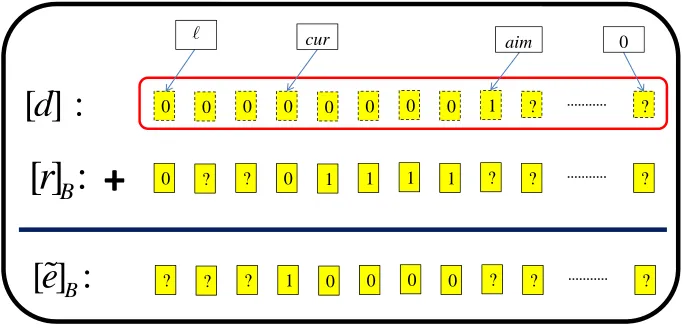
The addition process (over the integers) ˜e=d+rcan be seen in Figure 7. For this addition process, we will useci to denote the carry-bit generated in bit-positioni, i.e.ci = 1 means the (i+ 1)’th bit-position will get a “1” from the i’th bit-position. After computing [˜e]B, we perform [e0]B ←[˜e]B⊕[r]B and set [E]B ←πpre-c ∨([e0]B).
Then, obviously,E must be of form
E= 000· · ·000111· · ·111
We use cur (which is a shorthand for “current”) to denote the index of the left-most “1” inE. Obviously, we can get the encryption ofcureasily from [E]B (by adding up the bits of [E]B). Additionally, we useaim to denote theindex of the left-most “1” in d. Obviously, aim is essentially the desired index, as `d=aim+ 1. Moreover, we havecur≥aim.
5 In this section, as in the text, we assume thatdis of bounded bit-length`. In fact, for
dof unbounded size (or we can say “whendcan be any value inZM”), the discussions
0 0 0 0 0 0 0 0 1 ? ··· ?
0 ? ? 0 1 1 1 1 ? ? ··· ?
aim cur
0
+
? ? ? 1 0 0 0 0 ? ? ··· ?
[ ] :
r
B
[ ] :
d
[ ] :
e
B
Fig. 7.The Addition Process in the Base-2 Case
Below we define some necessary notations.
– Denote byxi↔jfori > jthe sub-string of bit-vectorx= (xl, xl−1, ..., x1, x0)
fromitoj, i.e.
xi↔j = (xi, xi−1, ..., xj+1, xj) .
– For any bitwise encrypted variable [x]B, we defined an operation “shift”. Specifically, when we say “right-shift [x]B1 bit”, we mean “moving every bit of [x]B to the right by 1 bit-position; dropping the right-most bit; setting the left-most bit to be 0”. Although all the bits ofxare encrypted, this “shift” operation can be carried out. We use [
1 −→
x]B to denote the obtained value by “right-shifting [x]B1 bit”. Other “shift” operations can be denoted similarly; for example, we can use [
3 − →
x]B and [ 2 ←−
x]B to denote the obtained values by “right-shifting [x]B 3 bits” and “left-shifting [x]B 2 bits”, respectively. The following computation then determines`d.
I. First decide whether cur = aim, i.e. determine [cur=? aim]. This is done based on the following observation:
– Ifcur=aim, thenccur−1=caim−1= 0. This follows from the fact that cur=aimimpliescaim= 0, and then by the fact thatdaim = 1, we can seeraim=caim−1= 0.
– Otherwise (i.e.cur > aim), we haveccur−1 = 1. In this case,caim = 1, and therefore all the bits inccur−1↔aim+1 are “1”.
That is to say, “cur=aim”⇔“ccur−1= 0”. Hence, we need only compute [ccur−1], which can be done by comparing the bit-decomposedrcur−1↔0and ˜
(padded with “0”s on the left such that they are `+ 1 bits long) can be obtained easily using a componentwise logical AND (multiplication) with the vector [
1 − → E]B.
After determining [cur=? aim], we can compute `d in both the two cases (cur=aimandcur > aim) and then select the correct one (using [cur=?aim]). II. Below we will discuss the two cases in detail.
(a) cur=aim
In this case, we havecaim = 0.
This case is very simple. We need only to sum up all the bits of [E]B to get`d.
(b) cur > aim
In this case, we havecaim = 1.
This case is somewhat involved. We need to compute the gap between curand aim(i.e. the number of the bits between bit-positionscur and aim). We proceed as follows
i. First we denote by t an (`+ 1)-bit long, bit-decomposed integer satisfying “ti = 1” ⇔ “ri = 1 and ˜ei = 0” for i ∈ 0,1,· · ·, l. This can be obtained by setting ti =ri−ri·e˜i. It is easy to see that all the bits in tcur−1↔aim+1 are “1” and that the bits of t`↔cur are “0”.
ii. For this integert, we set all the bits int`↔cur to “1” by adding the all-1 vector and entrywise subtracting [
1 − →
E]B. The resulting vector will be denotedt0.
iii. We computeT = Prefix-∧(t0) (using a protocol analogous toπc pre-∨
[DFK+06]). We have the following two facts: A. All the bits inT` ↔ aim+1 are “1”.
This is obvious because all the bits int0`↔aim+1 are “1”. B. All the bits inTaim−1 ↔0 are “0”.
This can be proven based on two cases:
– Ift0
aim= 0, then this is obvious.
– If t0aim = 1, then taim = 1 and this means raim = 1 and ˜
eaim= 0. Recall thatdaim= 1, so we can see thatcaim−1= 0. Then we can say that “raim−1 = 1” and “˜eaim−1 = 0” can
not hold at the same time (because if this happens, we have caim−1= 1). So, we havet0aim−1= 0 and the claim is proved. iv. Then we need to decide the value of the bit Taim. We use a
com-parison to do this. We denote theindex of theleft-most “0” of [T]B (or we can say “the first ‘0’ of [T]B”) asf ir0. Then obviously,f ir0 can beaim(whenTaim= 0) oraim−1 (whenTaim= 1). It is easy to see that, no matter what f ir0 is, rf ir0↔0 and ˜ef ir0↔0 can be obtained with the help of [T]B. Below we discuss what will happen whenTaim is 0 or 1.
– WhenTaim= 0
the case wherecur > aimwhich meanscaim = 1. Fromcaim= 1, we can get
˜
ef ir0↔0= ˜eaim↔0< raim ↔0=rf ir0↔0
– WhenTaim= 1
In this case,f ir0 =aim−1. Obviously,Taim= 1 meanst0aim = 1 (becauseT = Prefix-And(t0)). Recall that
taim0 = 1⇒raim = 1 ∧ e˜aim= 0⇒caim−1= 0 So we can see that
˜
ef ir0↔0= ˜eaim−1↔0≥raim−1↔0=rf ir0↔0 Concluding the above two cases, we can say
“Taim= 0”⇔“˜ef ir0↔0< rf ir0↔0”
i.e. we have Taim = 1−(˜ef ir0↔0 ?
< rf ir0↔0). That is to say, to
compute [Taim] we need only to determine vectors, ˜ef ir0↔0 and rf ir0↔0, (using a logical AND with [T]B) and compare these. v. Finally, we have
[`d] = (`+ 1)− X
[T]B−[Taim]
in which (`+ 1) is the total length of d and P
[T]B represents the encryption of the sum of all the bits of T.
Below are some further discussions.
1. In the above discussion, we introduce a protocol for computing [`d] given encryption [d]; we believe it a basic protocol and it will be useful for con-structing complex protocols. However, in the text of this paper, we do not need [`d] but only need [2`d] (See theπcBLprotocol in Section 5.1). If we first get [`d] and then compute [2`d] by using a private exponentiation protocol, then it will be much too complex. To solve this problem, we can first get the (bitwise-encrypted) prefix-or of d (denoted as [D]B hereafter) and then we have [2`d] = [D]
B+ 1. For getting [D]B, we can modify the length protocol as follows:
(a) In the case wherecur=aim, obviously, we have [D]B= [E]B.
(b) In the case where cur > aim, after getting [T]B, we left shift it 1 bit to get [
1 ←−
T]B, then we perform the following selection to get [ ¯D]B:
[ ¯D]B←−[Taim] ? [ 1 ←−
T]B : [T]B
Then, similar to the original length protocol, after getting both of the two possible values of [D]B in the two case (cur=aim andcur > aim), we can select the correct value for [D]B using [cur
? =aim].
2. A surprising point is that, even in the case where cur=aim, by performing the steps designed for the cur > aim case (i.e. all the steps in Part IIb), we can also get the correct result! That is to say, Part I and IIa are both unnecessary at all. Similar conclusion can also be arrived at when we are computing [D]B in Part 1; that is to say, Part 1a is also unnecessary. We can simply ignore whether cur > aim holds and perform the computations designed for the case where it holds, and this will give us the correct result (both the length ofd,`d, and the prefix-or ofd, [D]B). However, despite this, we still separate the two cases in the protocol for readability and clarity. 3. All the discussions in this section can be carried over to the linear secret
sharing setting in which all the operations take place over a prime field, e.g.
Zp. All we need are some minor modifications and, in this setting, we can get a constant-rounds, linear Bit-Length protocol with perfect security.
A.2 Generalizing to base-m and hybrid-base case
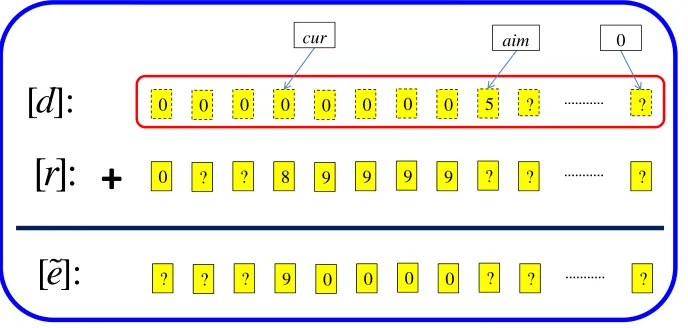
The above Bit-Length protocol can be generalized to the Digit-Length protocols, which can handle the base-mcase and the hybrid-base case. As for the base-m case, we usem= 10 as an example (see Figure 8 ); as for the hybrid-base case, we refer the readers to [NX11] to see some examples.
0 0 0 0 0 0 0 0 5 ? ··· ?
0 ? ? 8 9 9 9 9 ? ? ··· ?
aim
cur 0
+
? ? ? 9 0 0 0 0 ? ? ··· ?
[ ]:
r
[ ]:
d
[ ]:
e
Fig. 8.The Addition Process in the Base-10 Case
1. To decide cur, we need to perform a ⊕on every digit, i.e. computing a bit which identifying whether the two digits are different (this bit equals to 1 if and only if the two digits are different). This can be easily carried out since we know the sharing of the bits of every digit (similar to the case in [NX10]). 2. It can be checked that deciding whethercur=aimin Step I becomes a must in the base-mcase wherem≥3, and more importantly, the method for doing this in Step I does not work any more! The solution for this problem is to compute thecur’th digit ofd(i.e. [dcur] or [dcur]B) and then decide whether it’s 0; both of these two operations can be carried out in linear complexity [NO07].
![Fig. 1. The full division protocol, πdiv([n] , [d �→]) [⌊n/d⌋]](https://thumb-us.123doks.com/thumbv2/123dok_us/7892268.1309812/9.612.133.480.324.528/fig-division-protocol-pdiv-n-d-n-d.webp)
![Fig. 4. Constant-rounds truncation protocol,� πctrunc([ˆq] , k �→)⌊q/ˆ2k⌋ + c�](https://thumb-us.123doks.com/thumbv2/123dok_us/7892268.1309812/12.612.136.481.352.481/fig-constant-rounds-truncation-protocol-pctrunc-q.webp)