Open problems on computable sets
X ⊆
N
, which require that a
known integer
n
satisfies card(X)
=
ω
⇔ X ∩
(
n
,
∞)
,
∅, and
which cannot be stated formally as they refer to current
knowledge about
X
Apoloniusz Tyszka
Abstract
Letβ=(((24!)!)!)!, and letPn2+1denote the set of all primes of the formn2+1. LetMdenote the set of all positive multiples of elements of the setPn2+1∩(β,∞). The setX={0, . . . , β} ∪ Msatisfies the following conditions: (1)card(X) is greater than a huge positive integer and it is conjectured thatXis infinite,(2)we do not know any algorithm deciding the finiteness ofX,(3)a known and short algorithm for every n∈Ndecides whether or not n∈ X,(4)a known and short algorithm returns an integernsuch thatXis infinite if and only ifXcontains an element greater thann. The following problem is open:simply define a setX ⊆Nsuch thatXsatisfies conditions(1)-(4), and we do not know any representation of X as a finite union of sets whose definitions are simpler than the definition ofX (5). Let f(1)=2, f(2)=4, and let f(n+1)= f(n)! for every integer
n>2. For a positive integer n, let Ψn denote the following statement: if a system of equations
S ⊆nxi!=xk:i,k∈ {1, . . . ,n} o
∪nxi·xj =xk:i,j,k∈ {1, . . . ,n} o
has only finitely many solutions in positive integers x1, . . . ,xn, then each such solution (x1, . . . ,xn)satisfies x1, . . . ,xn 6f(n). We prove that for every statementΨn the bound f(n) cannot be decreased. The author’s guess is that the statements Ψ1, . . . ,Ψ9 are true. We prove that the statement Ψ9 implies that the setX of all non-negative integerskwhose number of digits belongs toPn2+1satisfies conditions(1)-(5).
Key words and phrases: Alexander Zenkin’s super-induction method, arithmetical operations on huge integers cannot be performed by any physical process, computable setX ⊆Nwhose finiteness remains conjectured, computable setX ⊆Nwhose infiniteness remains conjectured.
2010 Mathematics Subject Classification:03D20.
1
Basic definitions and lemmas
Definition 1. Letβ=(((24!)!)!)!.
Lemma 1. β≈10101010
25.16114896940657 .
Proof. We ask Wolfram Alpha athttp://wolframalpha.com.
Lemma 2. ((7!)!)!≈101016477.87280582041
Proof. We ask Wolfram Alpha about 0.0+((7!)!)!.
Definition 2. We say that an integer m>−1is a threshold number of a setX ⊆N, ifXis infinite if and
only ifXcontains an element greater than m, cf. [10] and [11].
If a set X ⊆N is empty or infinite, then any integer m>−1 is a threshold number of X.
If a set X ⊆N is non-empty and finite, then the all threshold numbers of X form the set
{max(X),max(X)+1,max(X)+2, . . .}.
Definition 3. We say that a non-negative integer m is a weak threshold number of a setX ⊆N, ifXis infinite if and only ifcard(X)>m.
Theorem 1. For everyX ⊆N, if an integer m>−1is a threshold number ofX, then m+1is a weak
threshold number ofX.
Proof. For everyX ⊆N, ifm∈[−1,∞)∩Zand card(X)>m+1, thenX ∩[m+1,∞),∅.
We do not know any weak threshold number of the set of all primes of the formn2+1. The same is
true for the sets
n∈N: 22n+1 is composite
and
{n∈N:n!+1 is a square}
Lemma 3. For every positive integers x and y, x!·y=y!if and only if
(x+1=y)∨(x=y=1)
Lemma 4. (Wilson’s theorem, [1, p. 89]). For every integer x>2, x is prime if and only if x divides (x−1)!+1.
2
Open Problems 1 and 2
The following two open problems cannot be stated formally as they refer to current knowledge aboutX
and intuitive concept of simplicity.
Open Problem 1. Simply define a setX ⊆Nthat satisfies the following conditions:
(1)card(X)is greater than a huge positive integer and it is conjectured thatXis infinite,
(2)we do not know any algorithm deciding the finiteness ofX,
(3)a known and short algorithm for every n∈Ndecides whether or not n∈ X,
(4•)a known and short algorithm returns an integer n such thatXis infinite if and only ifcard(X)>n,
(5)we do not know any representation ofXas a finite union of sets whose definitions are simpler than
the definition ofX.
Open Problem 2. Simply define a set X ⊆N such that X satisfies conditions (1)-(3), (5),
and a known and short algorithm returns an integer n such thatXis infinite if and only ifXcontains an
element greater than n(4).
Theorem 2. Open Problem 2 claims more than Open Problem 1.
Proof. By Theorem 1, condition(4)implies condition(4•).
3
Two partial solutions to Open Problem 2
Edmund Landau’s conjecture states that the set Pn2+1 of all primes of the formn2+1 is infinite, see
[4, pp. 37–38] and [7]. LetMdenote the set of all positive multiples of elements of the setPn2+1∩(β,∞).
Theorem 3. The setX={0, . . . , β} ∪ Msatisfies conditions(1)-(4).
Proof. Condition (1) holds as card(X)> β and the set Pn2+1 is conjecturally infinite. By Lemma 1,
due to known physics we are not able to confirm by a direct computation that some element ofPn2+1is
greater thanβ. Thus condition(2)holds. Condition(3)holds trivially. Since the setMis empty or
infinite, the integerβis a threshold number ofX. Thus condition(4)holds.
Lemma 5. For every non-negative integer n,
3n−3β+3
3n−3β+2
equals0 or1. The first case holds when
n6β−1. The second case holds when n>β.
Lemma 6. The function
N∩[β,∞)3n−→θ β+n−
h√
ni2 ∈N∩[β,∞)
takes every integer value k>βinfinitely many times. Proof. Lett=k−β. The equalityθ(n)=kholds for every
n∈n(t+0)2+t, (t+1)2+t, (t+2)2+t, . . .)o∩[β,∞)
Theorem 4. The set
X=
(
n∈N: 2+
"
3n−3β+3 3n−3β+2
#
·
β+n−h√ni2
2
−1
!
is prime
)
satisfies conditions(1)(4).
Proof. Condition(3)holds trivially. By Lemma 5,X={0, . . . , β−1} ∪ H, where
H =
(
n∈N∩[β,∞) :
β+n−h√ni2
2
+1 is prime
)
By Lemma 6, the setH is empty or infinite. The second case holds when
∃k∈N∩[β,∞) k2+1 is prime (6)
The equalityX={0, . . . , β−1} ∪ H and the last two sentences imply thatβ−1 is a threshold number ofXand conditions(1)and(4)hold. Condition(2)holds as due to known physics we are not able to
confirm statement (6) by a direct computation.
4
The statements
Ψ
nwhich seem to be true for every
n
∈ {
1
, . . . ,
9
}
Let f(1)=2, f(2)=4, and let f(n+1)= f(n)! for every integern>2. LetU1 denote the system of equations which consists of the equation x1!=x1. For an integer n>2, letUn denote the following
system of equations:
x1! = x1
x1·x1 = x2
∀i∈ {2, . . . ,n−1} xi! = xi+1 The diagram in Figure 1 illustrates the construction of the systemUn.
!
x1 squaring x2 ! x3
. . .
xn−1 ! xnFig. 1 Construction of the systemUn
Lemma 7. For every positive integer n, the system Un has exactly two solutions in positive integers,
Let
Bn=
n
xi!= xk : i,k∈ {1, . . . ,n}
o
∪nxi·xj = xk : i,j,k∈ {1, . . . ,n}
o
For a positive integer n, let Ψn denote the following statement: if a system of equations S ⊆Bn has
only finitely many solutions in positive integers x1, . . . ,xn, then each such solution(x1, . . . ,xn)satisfies
x1, . . . ,xn 6 f(n).The statementΨnsays that for subsystems ofBnwith a finite number of solutions, the
largest known solution is indeed the largest possible. The author’s guess is that the statementsΨ1, . . . ,Ψ9 are true.
Theorem 5. Every statementΨnis true with an unknown integer bound that depends on n.
Proof. For every positive integern, the systemBnhas a finite number of subsystems.
Theorem 6. For every statementΨn, the bound f(n)cannot be decreased.
Proof. It follows from Lemma 7 becauseUn⊆ Bn.
5
The statement
Ψ
9solves Open Problem 2
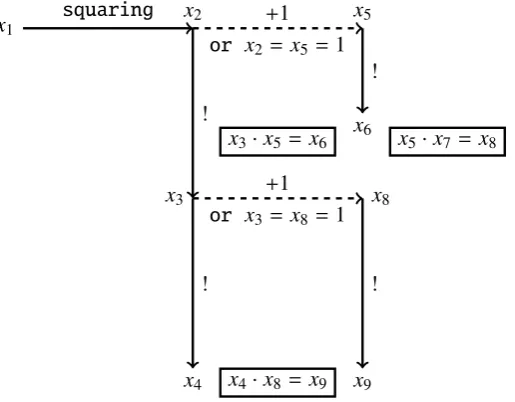
LetAdenote the following system of equations:
x2! = x3
x3! = x4
x5! = x6
x8! = x9
x1·x1 = x2 x3·x5 = x6 x4·x8 = x9 x5·x7 = x8
Lemma 3 and the diagram in Figure 2 explain the construction of the systemA.
x1
squaring x2 +1
or x2= x5=1
x5 ! x6 ! x3 ! x4 +1
or x3= x8=1
x8
!
x9
x5·x7= x8 x3·x5 =x6
x4·x8 =x9
Lemma 8. For every integer x1>2, the systemAis solvable in positive integers x2, . . . ,x9if and only if x21+1is prime. In this case, the integers x2, . . . ,x9are uniquely determined by the following equalities:
x2 = x21
x3 = (x21)! x4 = ((x21)!)! x5 = x21+1 x6 = (x21+1)!
x7 =
(x21)!+1 x21+1 x8 = (x21)!+1 x9 = ((x21)!+1)!
Proof. By Lemma 3, for every integerx1>2, the systemAis solvable in positive integersx2, . . . ,x9if
and only ifx21+1 divides (x21)!+1. Hence, the claim of Lemma 8 follows from Lemma 4.
Lemma 9. There are only finitely many tuples(x1, . . . ,x9)∈(N\ {0})9 which solve the systemA and satisfy x1 =1.
Proof. If a tuple (x1, . . . ,x9)∈(N\ {0})9 solves the systemAand x1=1, then x1, . . . ,x962. Indeed, x1 =1 implies thatx2 =x21=1. Hence, for example,x3 =x2!=1. Therefore,x8= x3+1=2 orx8=1.
Consequently,x9= x8!62.
Theorem 7. The statement Ψ9 proves the following implication: if there exists an integer x1 >2such that x21+1is prime and greater than f(7), then the setPn2+1is infinite.
Proof. Suppose that the antecedent holds. By Lemma 8, there exists a unique tuple (x2, . . . ,x9) ∈
(N\ {0})8 such that the tuple (x1,x2, . . . ,x9) solves the systemA. Since x21+1> f(7), we obtain that x21 > f(7). Hence, (x21)!> f(7)!= f(8). Consequently,
x9=((x21)!+1)!>(f(8)+1)!> f(8)!= f(9)
SinceA ⊆B9, the statementΨ9and the inequalityx9 > f(9) imply that the systemAhas infinitely many solutions (x1, . . . ,x9)∈(N\ {0})9. According to Lemmas 8 and 9 the setPn2+1is infinite.
LetF denote the set of all non-negative integerskwhose number of digits belongs toPn2+1.
Lemma 10. card(F)>9·109·4747.
Proof. The followingPARI/GP([6]) command
isprime(1+9*4^747,{flag=2})
returns %1=1. This command performs theAPRCLprimality test, the best deterministic primality test algorithm ([9, p. 226]). It rigorously shows that the number3·27472+1 is prime. Since 9·109·4747
non-negative integers have 1+9·4747digits, the desired inequality holds.
Theorem 8. The statementΨ9implies thatX=F satisfies conditions(1)-(5).
Proof. Suppose that the antecedent holds. Since the setPn2+1is conjecturally infinite, Lemma 10 implies
condition(1). Conditions(3)and(5)hold trivially. By Theorem 7, 9. . .9
|{z}
f(7) digits
is a threshold number
ofX. Thus condition(4)holds. By Lemma 1, due to known physics we are not able to confirm by a
direct computation that some element ofPn2+1is greater than f(7)=(((24!)!)!)!=β. Thus condition(2)
6
Open Problems 3 and 4
Definition 4. Let(1)denote the following condition: card(X)is greater than a huge positive integer
and it is conjectured thatX=N.
Definition 5. Let (2) denote the following condition: we do not know any algorithm deciding the
equalityX=N.
The following two open problems cannot be stated formally as they refer to current knowledge aboutX
and intuitive concept of simplicity.
Open Problem 3. Simply define a set X ⊆N that satisfies conditions (1)-(2), (2)-(3), (4•),
and(5).
Open Problem 3 claims more than Open Problem 1 as condition(1)implies condition(1).
Open Problem 4. Simply define a setX ⊆Nthat satisfies conditions(1)-(2)and(2)-(5).
Open Problem 4 claims more than Open Problem 2 as condition(1)implies condition(1).
Theorem 9. Open Problem 4 claims more than Open Problem 3.
Proof. By Theorem 1, condition(4)implies condition(4•).
7
A partial solution to Open Problem 4
LetVdenote the set of all positive multiples of elements of the set
{n∈ {β+1, β+2, β+3, . . .}: 22n+1 is composite}
Theorem 10. The setX={0, . . . , β} ∪ Vsatisfies conditions(1)-(2)and(2)-(4).
Proof. The inequality card(X)> βholds trivially. Most mathematicians believe that 22n+1 is composite
for every integern>5, see [2, p. 23]. These two facts imply conditions(1)and(2). Condition(3)
holds trivially. Since the set V is empty or infinite, the integerβ is a threshold number ofX. Thus condition(4)holds. The question of finiteness of the set{n∈N: 22n+1 is composite}remains open, see [3, p. 159]. By this and Lemma 1, the question of emptiness of the set
{n∈ {β+1, β+2, β+3, . . .}: 22n+1 is composite}
remains open. Therefore, the question of finiteness of the set V remains open. Consequently, the
question of finiteness of the setXremains open and condition(2)holds.
8
Open Problems 5 and 6
Definition 6. Let(1*)denote the following condition: card(X)is greater than a huge positive integer and it is conjectured thatXis finite.
The following two open problems cannot be stated formally as they refer to current knowledge aboutX
and intuitive concept of simplicity.
Open Problem 5. Simply define a setX ⊆Nthat satisfies conditions(1*),(2)-(3),(4•), and(5).
Open Problem 6. Simply define a setX ⊆Nthat satisfies conditions(1*)and(2)-(5).
Theorem 11. Open Problem 6 claims more than Open Problem 5.
9
A partial solution to Open Problem 6
A weak form of Szpiro’s conjecture implies that there are only finitely many solutions to the equation x!+1=y2, see [5].
Lemma 11. ([8, p. 297]). It is conjectured that x!+1is a square only for x∈ {4,5,7}.
LetWdenote the set of all integersxgreater thanβsuch thatx!+1 is a square.
Theorem 12. The set
X={0, . . . , β} ∪ {k·x: (k ∈N\ {0})∧(x∈ W)}
satisfies conditions(1*)and(2)-(4).
Proof. Condition (1*) holds as card(X)> β and the set W is conjecturally empty by Lemma 11.
Condition (3) holds trivially. We do not know any algorithm that decides the emptiness of W and
the set
Y={k·x: (k ∈N\ {0})∧(x∈ W)}
is empty or infinite. Thus condition (2)holds. Since the setY is empty or infinite, the integerβis a
threshold number ofX. Thus condition(4)holds.
10
The statement
Ψ
6solves Open Problem 6
LetCdenote the following system of equations:
x1! = x2
x2! = x3
x5! = x6
x4·x4 = x5 x3·x5 = x6
Lemma 3 and the diagram in Figure 3 explain the construction of the systemC.
x1 !
x2
x4
squaring
x5
+1
or x2= x5 =1
!
x3
!
x6 x3·x5= x6
Fig. 3 Construction of the systemC
Lemma 12. For every x1,x4 ∈N\ {0,1}, the system C is solvable in positive integers x2,x3,x5,x6 if and only if x1!+1= x24. In this case, the integers x2,x3,x5,x6are uniquely determined by the following equalities:
x2 = x1!
x3 = (x1!)!
x5 = x1!+1
x6 = (x1!+1)!
Theorem 13. If the equation x1!+1= x24has only finitely many solutions in positive integers, then the statementΨ6guarantees that each such solution(x1,x4)satisfies x1<24!.
Proof. Suppose that the antecedent holds. Let positive integers x1 and x4 satisfy x1!+1=x24. Then,
x1,x4∈N\ {0,1}. By Lemma 12, the system C is solvable in positive integers x2,x3,x5,x6. Since
C ⊆B6, the statementΨ6 implies that x6=(x1!+1)!6 f(6)= f(5)!. Hence, x1!+16 f(5)= f(4)!.
Consequently,x1< f(4)=24!.
Theorem 14. LetX denote the set of all non-negative integers n which have ((k!)!)! digits for some k∈ {m∈N:m!+1 is a square}. We claim that the statementΨ6implies thatXsatisfies conditions(1*)
and(2)-(5).
Proof. Letd=((7!)!)!. Since 7!+1=712, we obtain that{10d−1, . . . ,9. . .9
|{z}
ddigits
} ⊆ X. Hence, card(X)>9·
10d−1. By this and Lemmas 2 and 11, condition(1*)holds. Conditions(2)-(3)and(5)hold trivially. By Theorem 13, the statementΨ6 implies that 9. . .9
|{z}
βdigits
is a threshold number ofX. Thus condition(4)
holds.
References
[1] M. Erickson, A. Vazzana, D. Garth, Introduction to number theory, 2nd ed., CRC Press, Boca
Raton, FL, 2016.
[2] J.-M. De Koninck and F. Luca, Analytic number theory: Exploring the anatomy of integers,
American Mathematical Society, Providence, RI, 2012.
[3] M. Kˇrížek, F. Luca, L. Somer, 17 lectures on Fermat numbers: from number theory to geometry, Springer, New York, 2001.
[4] W. Narkiewicz, Rational number theory in the 20th century: From PNT to FLT,Springer, London, 2012.
[5] M. Overholt, The Diophantine equation n!+1=m2, Bull. London Math. Soc. 25 (1993), no. 2, 104.
[6] PARI/GP online documentation, http://pari.math.u-bordeaux.fr/dochtml/html/
Arithmetic_functions.html.
[7] N. J. A. Sloane, The On-Line Encyclopedia of Integer Sequences, A002496, Primes of the form
n2+1,http://oeis.org/A002496.
[8] E. W. Weisstein, CRC Concise Encyclopedia of Mathematics, 2nd ed., Chapman & Hall/CRC,
Boca Raton, FL, 2002.
[9] S. Y. Yan, Number theory for computing,2nd ed., Springer, Berlin, 2002.
[10] A. A. Zenkin, Super-induction method: logical acupuncture of mathematical infinity, Twentieth
World Congress of Philosophy, Boston, MA, August 10–15, 1998, http://www.bu.edu/wcp/
Papers/Logi/LogiZenk.htm.
Apoloniusz Tyszka Technical Faculty Hugo Kołł ˛ataj University
Balicka 116B, 30-149 Kraków, Poland