Bing Sun1,a, Xin Hai1,b, Wenyu Zhang2,c, Lei Cheng1, Zhichao Yang1
1 College of Science, National University of Defense Technology,
Changsha, Hunan, 410073, P. R. China
2 State Key Laboratory of Cryptology, P.O. Box 5159, Beijing, 100878, P.R. China
3 Shandong University of Finance and Economics,
Jinan, Shandong, 250012, P. R. China
a
happy [email protected], [email protected], [email protected]
Abstract. Feistel structure is among the most popular choices for de-signing ciphers. Recently, 3-round/5-round integral distinguishers for Feistel structures with non-bijective/bijective round functions are pre-sented. At EUROCRYPT 2015, Todo proposed the Division Property
to effectively construct integral distinguishers for both Feistel and SPN structures. In this paper, firstly, it is proved that if X ⊆ Fn
2 has the division propertyDn
k, the number of elements inX is at least 2 k, based
on which we can conclude that if a multi-setX has the division prop-ertyDn
n, it is in some sense equivalent to either Fn2 or ∅. Secondly, let dbe the algebraic degree of the round functionF :Fn
2 →Fn2 of a Feis-tel structure. Ifd≤n−1, the corresponding integral distinguishers are improved as follows: there exists a 3-round integral distinguisher with at most 2n chosen plaintexts and a 4-round integral distinguisher with
at most 22n−2 chosen plaintexts. These results can give new insights to both the division property and Feistel structures.
Keywords: Feistel structure, Integral cryptanalysis, Division property
1
Introduction
Integral cryptanalysis[1], which was first proposed by Knudsen and Wagner, is among the most important cryptanalytic techniques. With some special inputs, we check whether the sum of the corresponding ciphertexts is 0 or not. Usually, we do not need to investigate the details of the boxes and only view the S-boxes as bijective transformations over finite fields/vector spaces. In some other literatures, integral cryptanalysis is also known as square attack[2], saturation attack[3], multi-set attack[4], higher-order differential attack[5, 6] and so on. The following 4 integral properties of a multi-setX are the most used ones:
⋆
- ALL(A): Every value inFn2 appears the same times inX.
- BALANCE(B): The Xor of all values inX is 0.
- CONSTANT(C): The value is fixed to a constant for all texts inX.
- UNKNOWN(U):X is indistinguishable from random sets.
With these notations, we can determine that, after applying a bijective trans-formation, property A is reserved; the sum of two multi-sets with property A has propertyB. However, assume a multi-set has propertyB, it is hard to deter-mine, after applying a nonlinear transformation, whether the output multi-set has property B or not. And if we could determine the property of the output multi-set, the integral distinguishers could be improved.
As the notations introduced above can only apply to word-oriented ciphers, in [7], Z’aba introduced thebit-patternto evaluate the sum of some outputs. And this method is quite useful in constructing integral distinguishers for bit-oriented ciphers such as PRESENT and SERPENT. In [8–10], by using polynomials over finite fields, the authors proposed some algebraic techniques to construct integral distinguishers for block ciphers, such asPURE and ARIA.
In EUROCRYPT 2015, Todo proposed theDivision Propertyto evaluate the sum of the outputs of a nonlinear function[11]. A multi-set X has the division property Dn
k if and only if for all Boolean functions f : Fn2 → F2, degf < k, the sum off onX is always 0. It has been pointed that the division property Dn
2 is equivalent to the propertyB. However, there is a gap betweenDnn andA. Let X andY be the input and output sets of an S-box, respectively, andd be the algebraic degree of the S-box. The newly proposed methods of constructing integrals for both Feistel and SPN structures are based on the following fact: If X has the division propertyDn
k,Y has the division propertyDn⌈k/d⌉. The result
shows that for a given Feistel structure, we can always construct a 3-round and a 5-round integral distinguisher in case the round function is non-bijective and bijective, respectively.
In CRYPTO 2015[12], Sun et al. proved that a zero correlation linear hull always implies the existence of an integral distinguisher. Therefore, we can con-struct integrals of a block cipher by finding zero correlation linear hulls. For example, based on the known zero correlation linear hulls of 3-round/5-round Feistel structures with non-bijective/bijective round functions, they theoretically proved that there always exist 3-round/5-round integral distinguishers for Feistel structures with non-bijective/bijective round functions.
In [11], Todo constructed a special subset with the division property Dk n. Since the number of elements in this subset is 2k, we wonder whether we could construct some other subset with the division property Dk
n, however with less elements than 2k, to reduce the data complexity of the integral distinguishers of Feistel structures.
(1) We prove that ifX⊆Fn2 has the division propertyDnk, #X ≥2k;
(2) Although Dn
n and A are different, we prove that if a multi-set X has the division propertyDn
n, X is in some sense equivalent to either Fn2 or ∅ (we define this equivalence relation in Section 3);
Furthermore, when the algebraic degree of the round functiondis no more than n−1, the 3-round integral distinguishers for Feistel structures could be improved in the following two directions:
(3) The data complexity of the known 3-round integral distinguishers is reduced from 2n+1 to 2n;
(4) We prove that there always exists a 4-round integral distinguisher with 22n−2 chosen plaintexts.
The rest of this paper is organized as follows: Sec. 2 gives the definitions of Feistel structure and the division property; Sec. 3 studies the properties of Dn
k; Sec. 4 improves the known 3-round integral for Feistel structure and Sec. 5 concludes the paper.
2
Preliminary
We will briefly introduce the Feistel structure and the division property that will be used throughout this paper.
2.1 Feistel Structure
Many block ciphers are designed based on the Feistel structure, such as DES[13] and Camellia[14]. A Feistel structure consists ofrrounds, each of which is defined as follows (See Fig.1). Denote by (Li−1, Ri−1) the 2n-bit input to thei-th round, and (Li, Ri) the output of thei-th round. Then
(
Li= Fi(Li−1)⊕Ri−1, Ri= Li−1,
where Fi is the round function. In the following we use (n, d)-Feistel structure to denote a Feistel structure, where nis the number of input bits of the round function anddis the algebraic degree of the round function.
2.2 Division Property
F
i1 i
L
1 i
R
i
L
i
R
Fig. 1.Feistel Structure
Definition 1 (Bit Product Function).[11] Letu= (u0, . . . , un−1)∈Fn2 and x= (x0, . . . , xn−1)∈Fn2. The Bit Product Functionπu is defined as
πu(x) = Y ui=1
xi.
Let U = (u(0), . . . , u(m−1))∈ (Fn
2)m and X = (x(0), . . . , x(m−1))∈ (Fn2)m. The Bit Product FunctionπU is defined as
πU(X) = m−1
Y
i=0 πu(i)
x(i).
In the definition above, forx∈Fn2, we always letπ0(x) = 1.
Definition 2 (Hamming Weight). Let x= (x0, . . . , xn−1)∈Fn2. The Ham-ming Weightof xis defined as
w(x) = #{i|xi 6= 0, i= 0,1, . . . , n−1}.
Let X = (x(0), . . . , x(m−1)) ∈(Fn
2)m. The Extended Hamming Weight of X is defined as
W(X) =w(x(0)), . . . , w(x(m−1))∈Zm.
Let x= (x0, x1, . . . , xm−1), y = (y0, y1, . . . , ym−1)∈Zm. We define xy if for every i,0≤i≤m−1,xi ≥yi, otherwise,x6y.
Definition 3 (Division Property). [11] LetX be a multi-set whose elements take a value of Fn2, andk takes a value between0 andn. When the multi-setX has the division propertyDn
k, it fulfils the following conditions: P
x∈Xπu(x) = 0 if w(u)< k. Moreover,P
x∈Xπu(x) becomes unknown ifw(u)≥k.
Definition 4 (Vectorial Division Property). [11] Let X be the multi-set whose elements take a value of (Fn2)m, and k = (k0, . . . , km−1) ∈ Zm where 0 ≤ ki ≤ n. When the multi-set X has the division property Dn,mk , the multi-set fulfils the following conditions: P
x∈XπU(x) = 0 if W(U) 6k. Moreover, P
Definition 5 (Collective Division Property). [11] Let X be the multi-set whose elements take a value of (Fn2)m, and k(0), . . . , k(t−1) ∈ Zm. When the multi-set X has the division property Dkn,m(0),...,k(t−1), the multi-set fulfils the fol-lowing conditions: P
x∈XπU(x) = 0 if
U ∈ {V ∈(Fn2)m|W(V)6k(0), . . . , W(V)6k(t−1)}.
Moreover, P
x∈XπU(x) becomes unknown if there exists an i0, 0 ≤i0 ≤t−1 such that W(U)k(i0).
Example 1. Let X be a k-dimension sub-space of Fn2, and Bk = {f : Fn2 →
F2|degf < k} be the set of all the Boolean functions on Fn2 with algebraic degree no more thank−1. Then for anyf ∈Bk, we always have[5]
X
x∈X
f(x) = 0.
Meanwhile, we can construct a function g : Fn2 → F2 such that degg =k and P
x∈Xg(x) = 1. Therefore ak-dimension sub-space ofFn2 always has the division propertyDn
k.
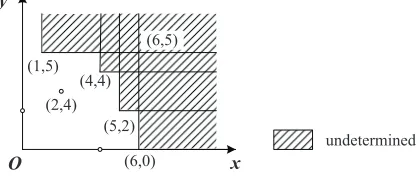
Example 2. LetX have the division propertyDn,(12,5),(4,4),(5,2),(6,0),(6,5). See Fig.2, if (u0, u1) is in the gray part, for example (u0, u1) = (7,1), we cannot deter-mineP
x∈Xπ(u0,u1)(x). Otherwise, for example (u0, u1) = (2,4), we always have P
x∈Xπ(u0,u1)(x) = 0. According to the definition of collective division proper-ty, Dn,(12,5),(4,4),(5,2),(6,0),(6,5)is the same as Dn,(12,5),(4,4),(5,2),(6,0)since from Fig. 2, we can see that these two division properties have the same (u0, u1) such that P
x∈Xπ(u0,u1)(x) is either 0 or undetermined.
(5,2) (4,4) (1,5)
(6,0)
O x
y
(2,4)
(6,5)
undetermined
Fig. 2.Division PropertyDn,(1,25),(4,4),(5,2),(6,0)
Property 1. [11] Let X be the multi-set whose elements take a value of (Fn2)m, s0, . . . , sm−1bem n×nS-boxes and deg(s0) =· · ·= deg(sm−1) =d. The multi-setY is computed asY ={(s0(x0), . . . , sm−1(xm−1))|(x0, . . . , xm−1)∈X}. IfX has the collective division property Dkn,m(0),...,k(t−1), Y has the collective division propertyDn,m⌈k(0)/d⌉,...,⌈k(t−1)/d⌉.
Property 2 (Propagation for Feistel Structure). [11] Let X be the input of a 1-round Feistel structure F which has division property Dn,(k2
1,k2). Assume the algebraic degree of the round function isd. Then the output ofFhas the division propertyDn,(k22+⌈0/d⌉,k1),...,(k2+⌈i/d⌉,k1−i),...,(k2+⌈k1/d⌉,0).
3
Properties of
D
nk
and
D
n,m
(k0,...,km−1)
In this section, we will give some bounds on the number of elements in a set which has special division property. Notice that whenX is a multi-set, an element ofFn2 may appear several times inX, however, whenX is a subset ofFn2, an element ofFn2 appears at most 1 time in X.
Lemma 1. Let X be a non-empty subset of Fn2 with the division property Dnk, k≥1. Then #X ≡0 (mod 2).
Proof. According to the definition of the division property, fork= 1, we always have
X
x∈X
π0(x) = X x∈X
1 = #X ≡0 (mod 2).
Theorem 1. LetX be a non-empty subset ofFn2 with the division propertyDnk. Then #X ≥2k.
Proof. Firstly, according to Lemma 1, we can check that if k = 1, #X ≥ 2. Assume fork=k0< n, A6=∅ is a subset ofFn2 and has the division property Dn
k0, we have #A≥2 k0.
Now, assume B ⊆Fn2 has the division propertyDnk0+1 and B 6=∅. SinceB has at least 2 different elements, there exists at least one position t such that the t-th elements ofB are not equal to a constant. Without loss of generality, lett= 0 and
B0={(x0, x1, . . . , xn−1)∈B|x0= 0} 6=∅, B1={(x0, x1, . . . , xn−1)∈B|x0= 1} 6=∅.
Therefore,B0∩B1=∅andB0∪B1=B. SinceB has the division propertyDn
k0+1,
X
x∈B
thus
X
x∈B
x0πu(x) = X x∈B,x0=1
πu(x) = X x∈B1
πu(x) = 0,
wherew(u)< k0, which impliesB1 has the division propertyDn k0. On the other hand, forw(u)< k0,
X
x∈B
πu(x) = X x∈B0
πu(x) + X x∈B1
πu(x) = 0.
Since
X
x∈B0
πu(x) =X x∈B
πu(x)− X x∈B1
πu(x) = 0, w(u)< k0,
we can conclude thatB0has the division propertyDn
k0. Therefore,
#B= #B0+ #B1≥2k0+ 2k0 = 2k0+1.
By using the same technique, we can prove the following Theorem for the vec-torial division property:
Theorem 2. LetX6=∅be a subset of(Fn2)mwith the vectorial division property Dn,m(k0,...,km
−1)
. Then #X≥2k0+···+km−1.
From these results, we could find that the data complexity of the integral con-structed by Todo cannot be reduced.
Corollary 1. LetX 6=∅be a subset of Fn2 with the division propertyDnn. Then X =Fn2.
This could be deduced directly from Theorem 1. However, we could give an independent proof as follows:
Proof. AssumeA6=Fn2, thereforeB=Fn2−Ais non-empty.
Since bothFn2 andAhave the division propertyDnn,B also has the division propertyDn
n.
Letx0∈Asuch that for anyx∈A,w(x0)≥w(x), and lety0∈B such that for anyy∈B, w(y0)≥w(y). Then we have
πx0(x) = (
1 x=x0,
0 x6=x0. πy0(y) = (
1 y=y0, 0 y6=y0.
Therefore,
X
x∈A
πx0(x) = 1,
X
y∈B
πy0(y) = 1.
Since both A and B have the division property Dn
Based on these results, we could give the following Corollary:
Corollary 2. Let Fn2 ={a0, . . . , a2n−1}, X be a multi-set whose elements take a value ofFn2, andtx,X be the times thatxappears in X. If X has the division property Dnn, we have
ta0,X ≡ · · · ≡ta2n
−1,X (mod 2).
Assume a multi-set X has the division propertyDn
k, and let the multi-setY = X ∪ {a, a}. Then Y also has the division property Dn
k. This fact leads to the following definition:
Definition 6. Let X and Y be multi-sets whose elements take a value of Fn2. Then X is equivalent withY, denoted byX ∼Y, if and only if for anya∈Fn2, ta,X≡ta,Y (mod 2).
Therefore, ifX∼Y,X andY always have the same division property.
Theorem 3. Let X be a multi-set whose elements take a value ofFn2. IfX has the division propertyDn
n, we have either X ∼Fn2 orX ∼ ∅.
4
Improved Integral Distinguishers for Feistel Structures
With the condition d ≤ n−1, we will improve the known 3-round integral distinguishers for Feistel structures in two directions: The first one is to reduce the data complexity from 2n+1 to 2n; the second one is to increase the rounds of integral distinguisher from 3 to 4.
Lemma 2. Letr(n, d)be the rounds of the integral distinguisher of(n, d)-Feistel structure which could be found by Algorithm 1 in [11]. If d1 ≤ d2, we have r(n, d1)≥r(n, d2).
This could be shown from the fact that for k ∈Zm, ifd1 ≤ d2, we always have⌈k/d1⌉ ⌈k/d2⌉.
Theorem 4. Let F :Fn2 →Fn2 be the round function of a Feistel structure and d= degF ≤n−1 be the algebraic degree ofF. For such a Feistel structure:
(1) There always exists a3-round integral distinguisher with2nchosen plaintexts and the Xor sum of the right half of the ciphertexts is0.
(2) There always exists a 4-integral distinguisher with 22n−2 chosen plaintexts and the Xor sum of the right half of the ciphertexts is0.
Proof. Since the technique are the same, we only give a detailed proof for the 4-round distinguisher.
O
Input 1st Round L
R O
L
R O
2nd Round L
R
(2,0)
O
3rd Round L
R
(1,1)
Undetermined
(n,n2)
(n )
(1,0)
O
4th Round L
R
(0,2) (n2,n)
(n ) (n n)
(0,n)
Fig. 3.Propagation of 4-round (n, n−1)-Feistel structure
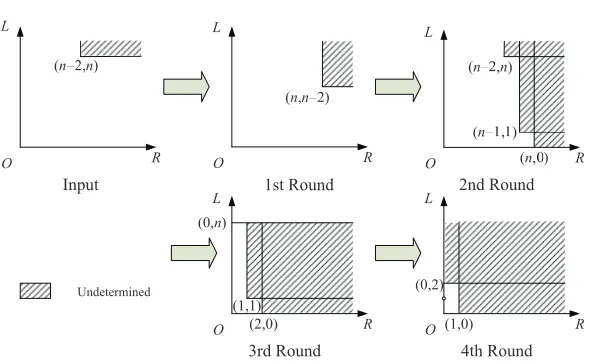
Since the input set has the division property D(n,n2−2,n). According to the propagation of the Feistel structure, the output set of the first round has the division propertyDn,(n2+⌈0/d⌉,n−2),...,((n+⌈(n−2)/d⌉,0))=D(n,n,n2−2).
Then, the output set of the second round has the division property
Dn,(n2−2+⌈0/d⌉,n),···,(n−2+⌈i/d⌉,n−i),···,(n−2+⌈n/d⌉,0).
which is equal to D(n,n2−2,n),(n−1,1),(n,0).
Similarly, we can get that the output of the third round has the division propertyDn,(02,n)(1,1),(2,0)and the output of the forth round has the division prop-ertyDn,(02,2),(1,0), which means for anyu,w(u) = 1, letCLandCRbe the left and right halves of the output of the forth round, respectively. We always have
X
x0,...,xn
π0(CL)πu(CR) = 0,
which indicatesP
x0,...,xnCR= 0.
Moreover, we can only determine that the output of the fifth round has the division property Dn,(0,21),(1,0), which means we cannot determine whether the output is balanced or not.
With the results of [11] and [12], we have
5
Conclusion
In this paper, firstly, we showed some property of a setX ⊆Fn2 which has the division propertyDn
k. We proved that the number of different elements inX is at least 2k. If a non-empty subset X ofFn
2 has the division propertyDnn, X is equal to Fn2, from which we can conclude that if a multi-setX is not equivalent to the empty set, there is no essential difference between Fn2 and a multi-setX which has the division propertyDn
n.
Table 1.Integral Distinguishers for (n, d)-Feistel Structures
d Rounds Input Data Round Function
n 3 Dn,2
(1,n) 2
n+1 non-bijective
≤n−1 3 Dn,(0,n2) 2n
≤n−1 4 Dn,2
(n−2,n) 2
2n−2
≤n−1 5 Dn,2
(n−1,n) 2
2n−1 bijective
∗For all these distinguishers, the right halves of the outputs are balanced.
Secondly, we presented some new features of Feistel structures with respect to the integral attack. Ifd≤n−1, the known integral distinguishers for 3-round Feistel structure could be improved. These results are shown in Table.1.
Acknowledgement
The authors wish to thank Vincent Rijmen, Yosuke Todo and Xuan Shen for their helpful discussions.
References
1. L.R. Knudsen, D. Wagner. Integral Cryptanalysis. Fast Software Encryption 2002, LNCS 2365, pp. 112–127, Springer–Verlag, 2002.
2. J. Daemen, L. R. Knudsen, V. Rijmen. The Block Cipher Square. Fast Software Encryption 1997, LNCS 1267, pp. 149–165, Springer–Verlag, 1997.
3. S. Lucks. The Saturation Attack — A Bait for Twofish. Fast Software Encryption 2001, LNCS 2355, pp. 1–15, Springer–Verlag, 2002.
4. A. Biryukov, A. Shamir. Structural Cryptanalysis of SASAS. EUROCRYPT 2001, LNCS 2045, pp. 394–405, Springer–Verlag, 2001.
5. X. Lai. Higher Order Derivatives and Differential Cryptanalysis. Communications and Cryptography: Two Sides of One Tapestry, 227 (1994)
6. L.R. Knudsen. Truncated and Higher Order Differentials. Fast Software Encryption 1994, LNCS 1008, pp. 196–211. Springer, Heidelberg (1995)
7. M. Z’aba, H. Raddum, M. Henricksen, E. Dawson. Bit-Pattern Based Integral Attack. FSE 2008, LNCS 5086, pp. 363–381, Springer-Verlag, 2008.
9. B. Sun, R. Li, L. Qu, C. Li. SQUARE Attack on Block Ciphers with Low Algebraic Degree. Science China Information Sciences 53(10), pp. 1988–1995, 2010.
10. P. Li, B. Sun, C. Li. Integral Cryptanalysis of ARIA. Inscrypt 2009, LNCS 6151, pp. 1–14, Springer-Verlag, 2010.
11. Y. Todo. Structural Evaluation by Generalized Integral Property. To appear in EUROCRYPT 2015.
http://eprint.iacr.org/2015/090
12. B. Sun, Z. Liu, V. Rijmen, R. Li, L. Cheng, Q. Wang, H. Alkhzaimi, C. Li. Links among Impossible Differential, Integral and Zero Correlation Linear Cryptanalysis. To appear in CRYPTO 2015.
http://eprint.iacr.org/2015/181
13. FIPS 46–3. Data Encryption Standard. In National Institute of Standards and technology, 1977.
14. K. Aoki, T. Ichikawa, M. Kanda, M. Matsui, S. Moriai, J. Nakajima, T. Toki-ta. Camellia: A 128-bit block cipher suitable for multiple platforms. Availale at http://info.isl.ntt.co.jp/crypt/camellia/dl/support.pdf.